2019 International Conference on Artificial Intelligence and Computing Science (ICAICS 2019) ISBN: 978-1-60595-615-2
Quantitative Evaluation Method of Turbine Virtual Maintenance
Based on Improved AHP
Ya-ting GUO, Ze DONG
*, Chang-qing LI and Hui YAO
Hebei Technology Innovation Center of Simulation & Optimized Control for Power Generation, North China Electric Power University, Baoding 071003, China
Keywords: Improved AHP, Virtual maintenance, Steam turbine, Quantitative evaluation.
Abstract. In order toevaluate the training process of steam turbine virtual maintenance for personnel training more reasonably, a quantitative evaluation method of turbine virtual maintenance based on improved analytic hierarchy process (AHP) is proposed in this paper. This paper establishes a set of evaluation index system and gives the quantitative algorithm of the corresponding index according to the characteristics of virtual maintenance of steam turbine equipment. The traditional AHP is also improved without consistency checking, which avoids the blindness of artificial adjustment of the judgment matrix and makes it easier and faster to get the weight value of the index. Under the balanced consideration of all evaluation factors, the evaluation of operators is completed, and the results of the comprehensive evaluation are more objective and credible. This method has been applied to a virtual maintenance training and assessment platform of steam turbine in thermal power plant, and the validity of the method has been verified.
Introduction
At present, there are still some key technical difficulties in virtual maintenance, analysis and evaluation of steam turbine equipment in thermal power plants, which limit its development and application in the design and use of steam turbine equipment. Therefore, in order to test the training effect, improve the training efficiency and improve the training quality, it is urgent to study the evaluation technology effectively applied to the maintainability design of steam turbine equipment [1]. Nowadays, there are many evaluation methods proposed at home and abroad. Among them, AHP method can express and deal with expert knowledge and subjective experience in quantitative form, so as to minimize the drawbacks caused by subjective assumptions. By using improved AHP to determine the weights of indicators at all levels and introducing quasi-optimal transfer matrix, it avoids blindly adjusting the judgment matrix after the consistency test is not satisfied, and greatly reduces the amount of calculation [2,3].
Based on this, this paper will establish a virtual maintenance evaluation system for turbines, analyze the quantitative methods of each evaluation index, and propose a quantitative evaluation method for virtual maintenance of turbines based on improved AHP. Finally, the application of the developed virtual maintenance training and assessment platform for steam turbines shows that the evaluation results are consistent with the actual situation, which effectively solves the evaluation problem of maintenance training in virtual maintenance system.
Evaluation Index System and Corresponding Quantitative Method
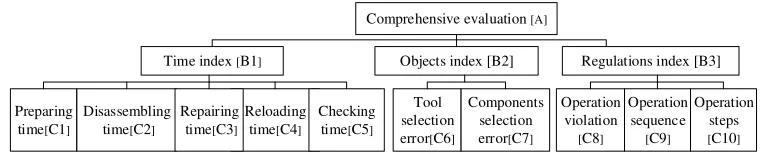
Evaluation Index System
Time index [B1] Objects index [B2]
Preparing time[C1]
Disassembling time[C2]
Reloading time[C4]
Checking time[C5]
Tool selection error[C6]
Components selection error[C7]
Regulations index [B3]
Operation violation
[C8]
Operation sequence
[C9]
Operation steps
[C10]
Comprehensive evaluation [A]
[image:2.612.122.502.67.144.2]Repairing time[C3]
Figure 1. Evaluation index system.
Classification and Quantification Method of Index
Time Index. The time index evaluates the maintenance process from the aspect of time factor. Five indicators are determined according to the general process of turbine maintenance: preparing time C1, disassembling time C2, repairing time C3, reloading time C4 and checking time C5. The sum of the five indexes is the total maintenance time. The system records the operation time of each step and divides the operation into five categories according to the content of each step. For the i indicator of the time index, the quantification algorithm is as follows:
≤ > =
) s ( , 1
) s ( , s
i i
i i i
i
ai
a a a
q (1)
Among them, si is the reference standard value, ai is the actual value of operation, and qai is the
actual value of quantization.
Objects Index. During the virtual maintenance of steam turbine, the operator maintains the equipment according to the standard maintenance regulations. Therefore, the number of maintenance steps in the whole operation process and the tools used in each step and the parts to be operated are determined. Set the operation step of the whole maintenance process as ns1, the number of tools used
as ns2, and the number of parts operated in the maintenance process as ns3. In step i, the number of
wrong tools selected is set to ki, and the number of wrong parts selected is set to pi. Then the
quantization algorithm of object index is:
= ≠ −
=
) 0 ( , 1
) 0 ( , 1
6 6 2
6 6
a a n
a
qa s
= =1
1 6
a s
n
i i
k s6 =ns2 (2)
= ≠ −
=
) 0 ( , 1
) 0 ( , 1
7 7 2
7 7
a a n
a
qa s
= =1
1
7 p
a s
n
i
i s7=ns3 (3)
Regulations Index. Regulations index is used to evaluate whether the maintenance process conforms to the maintenance rules and procedures, and it includes three indicators: operation violation C8, operation sequence C9 and operation steps C10. Actually, safety is the vital factor in the operation of steam turbine equipment in thermal power plants, and the operation violation usually leads to severe casualty and property loss. Therefore, as long as the irregularities appear, the punishment should be significant. The quantitative algorithm for adjusting the operation violation C8 is as follows:
= ≠ =
) 0 ( , 1
) 0 ( , 0
8 8 8
a a
qa (4)
standard value is zero and preventing the extreme phenomena in quantization, the quantization algorithm of operation sequence C9 is as follows:
= ≠ −
=
) 0 ( , 1
) 0 ( , 1
9 9 1
9 9
a a n
a
qa s (5)
The operation is completed step by step in the virtual maintenance learning and assessment platform of steam turbine, consequently, the actual operation steps of operators will not be higher than the standard value. The quantization algorithm of operation step C10 is as follows:
≤ > =
) n
( , 1
) n
( , n
10 1
10 1 1
10 10
a a a
q
s s s
a (6)
Improved Analytic Hierarchy Process
The Principle of Improved Analytic Hierarchy Process
Analytic Hierarchy Process (AHP) is a systematic analysis method which combines qualitative analysis with quantitative analysis[5-7]. In conventional nine-scale analytic hierarchy process, eigenvector method and consistency ratio are used to determine weight and consistency test criteria respectively[8]. When the consistency test fails, the judgement matrix needs to be adjusted artificially and then calculated until it passes, which is not only blindness and inaccuracy, but also a large amount of calculation. In this paper, quasi-optimal transfer matrix is introduced to improve the nine-scale AHP, So that it can meet the consistency at the beginning stage and the weight value can be calculated directly, which simplifies the calculation steps and reduces the calculation amount.
(
)
− =
=
n
p ip jp
a a n ij
b
1lg lg 1
10
(7)Among them, bij is the element of row i and column j of matrix B, matrix B is called quasi-optimal
transfer matrix of A.
Steps of Improved Analytic Hierarchy Process
The steps of the improved Analytic Hierarchy Process are as follows: (1) Constructing hierarchy structure model.
(2) Constructing a pairwise judgment matrix A by using the nine-decimal scale:
( )
ij n nA
=
a
× ,i, j=1,2,⋯,n,a
ii=
1
,a
ij=
1
a
ji(3) Converting to transfer matrix C1:c1ij =lgaij
(4) Constructing the Optimal Transfer Matrix C:
=
(
−
)
=
n
p ip jp
ij
c
c
n
c
1
1
1
1
(5) Construction of quasi-optimal transfer matrix B:
b
ij ijc
10
=
(6) Determining relative weights of indexes: n n
j ij
i b
w
∏
= =
1
n , , 2 , 1 i= ⋯
(7) Normalizing the relative weight of indexes:
=
=
n
i i i
i w w
w
Application of Virtual Maintenance Training and Assessment Platform for Steam Turbine
Taking the maintenance task of low pressure cylinder in steam turbine equipment as an example, the evaluation method is applied to verify the evaluation effect. The assessment interface and the operation information record of the operator x1are as follows:
[image:4.612.141.486.140.236.2]
Figure 2. The assessment interface and the operation information.
Maintenance Data and Corresponding Quantified Values
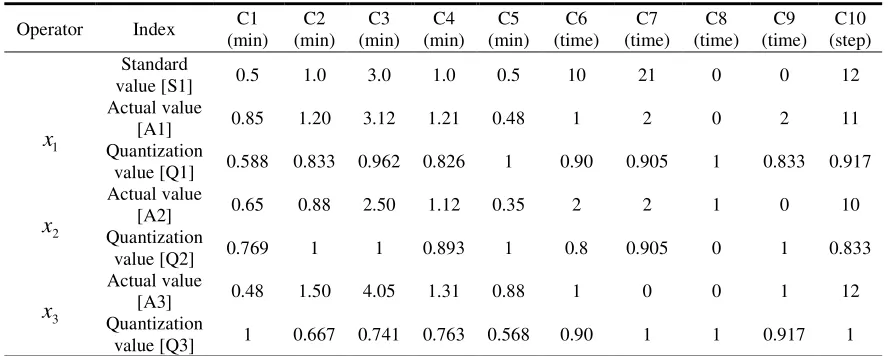
[image:4.612.84.529.329.507.2]By retrieving the information of the expert database and the parts database, referring to the evaluation index system in chapter 2 and the corresponding quantitative methods, we selected the operation information of operators x1, x2, x3, and the data is recorded as shown in Table 1.
Table 1. Recording of operating information.
Operator Index C1
(min) C2 (min)
C3 (min)
C4 (min)
C5 (min)
C6 (time)
C7 (time)
C8 (time)
C9 (time)
C10 (step) Standard
value [S1] 0.5 1.0 3.0 1.0 0.5 10 21 0 0 12
1
x
Actual value
[A1] 0.85 1.20 3.12 1.21 0.48 1 2 0 2 11
Quantization
value [Q1] 0.588 0.833 0.962 0.826 1 0.90 0.905 1 0.833 0.917
2
x
Actual value
[A2] 0.65 0.88 2.50 1.12 0.35 2 2 1 0 10
Quantization
value [Q2] 0.769 1 1 0.893 1 0.8 0.905 0 1 0.833
3
x
Actual value
[A3] 0.48 1.50 4.05 1.31 0.88 1 0 0 1 12
Quantization
value [Q3] 1 0.667 0.741 0.763 0.568 0.90 1 1 0.917 1
Weight Value of Each Evaluation Index
Referring to the evaluation index system of Fig.1 and using 1~9 ratio calibration method, expert are invited to score and form the judgment matrix and then calculate the weight vector matrix according to the improved AHP. The resulting judgment matrix consists of target layer A, criterion layer A1, A2
and A3 respectively.
=
1 2 3
2 1 1 2
3 1 2 1 1
A
=
1 2 1 6 2 3
2 1 7 3 5
6 1 7 1 1 5 1 3
1 2
1 3 1 5 1 2
3 1 5 1 3 2 1 1
1
A
=
1 5
5 1 1
2
A
=
1 3 2
3 1 1 2
1 2
1 2 1
3
A
= 000 . 1 817 . 1 302 . 3 550 . 0 000 . 1 550 . 0 303 . 0 817 . 1 000 . 1 B = 000 . 1 612 . 0 470 . 6 610 . 1 825 . 2 636 . 1 000 . 1 576 . 10 631 . 2 618 . 4 155 . 0 095 . 0 000 . 1 249 . 0 437 . 0 621 . 0 380 . 0 020 . 4 000 . 1 756 . 1 354 . 0 217 . 0 290 . 2 431 . 1 000 . 1 1 B = 000 . 1 000 . 5 200 . 0 000 . 1 2
B
= 000 . 1 302 . 3 817 . 1 301 . 0 000 . 1 550 . 0 550 . 0 817 . 1 000 . 1 3 B
The corresponding normalized weights are w,w1,w2,w3 respectively:
[
]
Tw= 0.2030 0.2477 0.5493
[
]
Tw1= 0.110 0.162 0.041 0.426 0.261
[
]
Tw2= 0.1667 0.8333 w3=
[
0.2966 0.1645 0.5390]
T The final index weight is:[
]
T2961 . 0 0904 . 0 1629 . 0 2064 . 0 0413 . 0 0530 . 0 08648 . 0 0083 . 0 0329 . 0 0223 . 0 W=
The comprehensive results of operators x1, x2and x3 were as follows:
T
W Q
score= * (8)
According to the expression (8): Score1=0.907 , Score2=0.745 , Score3=0.932.
On the basis of the calculation results above, the comprehensive score of operator x1 is 0.907,
operator x2 is 0.745 and operator x3 is 0.932 under the scale of 0~1 respectively.
Conclusion
In this paper, a set of steam turbine virtual maintenance evaluation index system is established. According to the characteristics of steam turbine equipment and actual maintenance conditions, complex virtual maintenance evaluation problems are organized and hierarchical, and the identification and quantification methods of indicators are analyzed. An improved analytic hierarchy process (AHP) is also proposed and applied to the evaluation index system, which avoids the blind adjustment of the judgment matrix caused by the failure of consistency test, and makes full use of the expert information, making the evaluation result more precise and reasonable. Finally, this method is applied to the steam turbine virtual maintenance training and assessment platform developed by JA DE Engineering Training Center, and the evaluation results can effectively reflect the real level of operators.
References
[1] Zhang Shuang, Wang Jie, Xu Qi-yun, Lv Shuang. Evaluation of Virtual Maintenance Training Based on AHP and Entropy Weight [J]. Modular Machine Tool & Automatic Manufacturing Technique 2014(06): 149-153.
[2] Zhang Fa-ming, Liu Zhi-ping .Combined evaluation methods: A literature review [J]. Journal of Systems Engineering, 2017, 32(04): 557-569.
[3] Yang Yong. Research on Intelligent Comprehensive Evaluation Theory and Method [D]. Zhejiang Gongshang University, 2014.
[4] Gang Xue, Risk Assessment and Analysis of Small Hydropower Project Construction based on Improved Analytic Hierarchy Process [J]. Heilongjiang Science and Technology of Water Conservancy, 2018, 46(11): 124-127+131.
[5] Kang Xing-ru. Research on Maintenance Simulation of steam turbine equipment in power plant based on Virtual Reality Technology [D]. Shenyang Ligong University, 2013.
[7] Mao Ren-jie, You Jian-xin, Duan Chun-yan. An Improved Sustainable Supplier Evaluation Model Based on Stochastic Analytical Hierarchy Process Method and Fuzzy Set Theory [J]. Journal of Tongji University(Natural Science), 2018, 46(8).