Using NLP Techniques to Enhance Content
Discoverability and Reusability for Adaptive
Systems
A thesis submitted to the
University of Dublin, Trinity College
in fulfilment of the requirements of the degree of
Doctor of Philosophy
Mostafa Bayomi
Knowledge and Data Engineering Group (KDEG)
School of Computer Science and Statistics
Trinity College, Dublin
Ireland
Supervised by Prof. Séamus Lawless
ii
Declaration
I declare that this thesis has not been submitted as an exercise for a degree at this or any
other university and it is entirely my own work.
I agree to deposit this thesis in the University’s open access institutional repository or
allow the library to do so on my behalf, subject to Irish Copyright Legislation and
Trin-ity College Library conditions of use and acknowledgement.
Signature ___________________________ Date ___________________
iii
Permission to lend or copy
I, the undersigned, agree that the Trinity College Library may lend or copy this thesis
upon request.
Signature ___________________________ Date ___________________
iv
Dedication
v
Acknowledgements
First and foremost, all thanks and praise are due to God, who has granted me this great
success in my PhD, and has bestowed upon me all the necessary strength, health, wits,
patience, and perseverance to complete it.
I would like to express my gratitude to numerous people who have helped me to complete
my work over the last number of years. I would like to express my utmost gratitude to
my supervisor Prof. Séamus Lawless for all his guidance, patience, feedback,
encourage-ment, and for his great support personally and professionally throughout my PhD journey.
I could not have done it without him.
I would like to thank all my colleagues in KDEG and ADAPT who have directly and
indirectly supported me both personally and academically during the years of the PhD.
My utmost gratefulness and sincerest thanks to my father (Mohamed Bayomi), my
broth-ers (Ahmed and Amr) and my sister (Rasha) who have always believed in me and for all
their care, support and encouragement. To my lovely wife Alaa, for all her love, devotion,
never-ending support and encouragement. To my kids, Hamza and Omar who are the joy
of my life.
I would like to thank all my Egyptian friends in Dublin who have been a major part of
this journey. And a special thanks to two very special people, Ramy Shosha and Rami
Ghorab. Words of gratitude and thanks can never do them their rights.
And I’ve saved the best for last: My utmost gratefulness and sincerest thanks to my
mother (Boushra Shams), whom I wish that she is with me in this moment. She has been
and will always be the greatest supportive person in my life, especially in my PhD
jour-ney. You have left this world, but you will always be with me. Thanks mum for
vi
Abstract
The volume of digital content resources written as text documents is growing every day,
at an unprecedented rate. Because this content is generally not structured as
easy-to-han-dle units, it can be very difficult for users to find information they are interested in, or to
help them accomplish their tasks. This in turn has increased the need for producing
tai-lored content that can be adapted to the needs of individual users. A key challenge for
producing such tailored content lies in the ability to understand how this content is
struc-tured. Hence, the efficient analysis and understanding of unstructured text content has
become increasingly important. This has led to the increasing use of Natural Language
Processing (NLP) techniques to help with processing unstructured text documents.
Amongst the different NLP techniques, Text Segmentation is specifically used to
under-stand the structure of textual documents. However, current approaches to text
segmenta-tion are typically based upon using lexical and/or syntactic representasegmenta-tion to build a
struc-ture from the unstrucstruc-tured text documents. However, the relationship between segments
may be semantic, rather than lexical or syntactic.
Furthermore, text segmentation research has primarily focused on techniques that can be
used to process text documents but not on how these techniques can be utilised to produce
tailored content that can be adapted to the needs of individual users. In contrast, the field
of Adaptive Systems has inherently focused on the challenges associated with
dynami-cally adapting and delivering content to individual users. However, adaptive systems have
primarily focused upon the techniques of adapting content, not on how to understand and
structure this content. Even systems that have focused on structuring content are limited
in that they rely upon the original structure of the content resource, which reflects the
perspective of its author. Therefore, these systems are limited in that they do not deeply
“understand” the structure of the content, which in turn, limits their capability to discover
and supply appropriate content for use in defined contexts, and limits the content’s
ame-nability for reuse within various independent adaptive systems.
In order to utilise the strength of NLP techniques to overcome the challenges of
under-standing unstructured text content, this thesis investigates how NLP techniques can be
utilised in order to enhance the supply of content to adaptive systems. Specifically, the
contribution of this thesis is concerned with addressing the challenges associated with
hierarchical text segmentation techniques, and with content discoverability and
vii
Firstly, this research proposes a novel hierarchical text segmentation approach, named
C-HTS, that builds a structure from text documents based on the semantic representation of
text. Semantic representation is a method that replaces keyword-based text representation
with concept-based features, where the meaning of a piece of text is represented as a
vector of knowledge concepts automatically extracted from massive human knowledge
repositories such as Wikipedia. Using this approach, C-HTS represents the content of a
document as a tree-like hierarchy. This way of structuring the document can be regarded
as a hierarchically coherent tree that is useful for supporting a variety of search methods
as it provides different levels of granularity for the underlying content. Secondly, this
research proposes a novel content-supply service named CROCC. The aim of CROCC is
to utilise the produced structure of C-HTS in order to overcome the limitations of the
state of the art content-supply approaches. Finally, this research conducts an evaluation
of the extent to which the CROCC service enhances content discoverability and
viii
Table of Contents
Abstract ... vi
1. Introduction ... 1
1.1 Motivation ... 1
1.2 Research Question ... 5
1.2.1 Research Objectives ... 5
1.3 Research Contributions ... 6
1.4 Research Methodology ... 8
1.5 Thesis Overview ... 10
2. State of the Art ... 13
2.1 Introduction ... 13
2.2 Natural Language Processing ... 13
2.2.1 Overview ... 13
2.2.2 Low-level NLP Tasks ... 14
2.2.3 High-level NLP Tasks ... 16
2.2.4 Summary ... 18
2.3 Text Segmentation ... 18
2.3.1 Overview ... 18
2.3.2 Content-based and Discourse-based ... 19
2.3.3 Supervised and Unsupervised ... 20
2.3.4 Borderline sentences detection methods ... 20
2.3.5 Linear and Hierarchical ... 21
2.3.6 Hierarchical Text Segmentation Techniques ... 23
2.3.7 Summary ... 25
2.4 Adaptive Systems ... 26
2.4.1 Overview ... 26
2.4.2 Anatomy of Adaptive Systems ... 27
2.4.3 Models of Adaptive Systems ... 30
2.4.4 Content Models ... 32
2.4.5 Summary ... 38
2.5 Content Discoverability Techniques ... 39
2.5.1 External Content Discoverability Techniques ... 39
2.5.2 Content Indexing ... 41
2.5.3 Internal Content Discoverability Techniques ... 45
2.6 Content Reusability Techniques ... 47
2.6.1 Content Encapsulation ... 48
2.6.2 Shared publishing ... 50
2.6.3 Content Modification ... 51
2.7 Natural Language Processing in Adaptive Systems ... 52
ix
3. OntoSeg: A Novel Approach to Text Segmentation using Ontological Similarity 57
3.1 Introduction ... 57
3.2 OntoSeg Architecture ... 58
3.2.1 Semantic annotation ... 58
3.2.2 Similarity Computation ... 60
3.2.3 Hierarchical Agglomerative Clustering (HAC) ... 64
3.3 From Hierarchical into Linear Representation ... 66
3.4 Evaluation ... 67
3.4.1 Experimental Setup ... 67
3.4.2 Elementary Units for OntoSeg ... 69
3.4.3 Evaluation Metrics ... 70
3.4.4 Results ... 71
3.4.4.1 OntoSeg Performance Against Other Approaches... 72
3.5 Chapter Summary ... 73
4. C-HTS: A Concept-based Hierarchical Text Segmentation approach ... 75
4.1 State of the Art Influences ... 76
4.2 Intuition behind C-HTS ... 78
4.3 Semantic Relatedness ... 79
4.3.1 How does Explicit Semantic Analysis work? ... 80
4.4 C-HTS Architecture ... 83
4.4.1 Morphological Analysis ... 83
4.4.2 Semantic Representation and Relatedness Measuring ... 84
4.4.3 Hierarchical Agglomerative Clustering ... 84
4.4.4 Word Sense Disambiguation ... 85
4.5 Evaluation ... 87
4.5.1 Datasets ... 87
4.5.2 Baselines ... 88
4.5.3 Results ... 89
4.6 Discussion ... 90
4.6.1 Elementary Units for C-HTS ... 90
4.6.2 Text Granularity ... 91
4.6.3 Multilingual C-HTS ... 92
4.7 C-HTS Validation ... 92
4.7.1 Semantic Similarity using WordNet ... 93
4.7.2 Lexical Representation ... 95
4.8 The Impact of Knowledge Breadth ... 96
4.8.1 Experiment and Results ... 97
4.9 Chapter Summary ... 98
5. CROCC: Customised Reuse of Open- and Closed-corpus Content ... 100
5.1 State of the Art Influences ... 100
5.1.1 Content Incorporation Techniques ... 101
5.1.2 Content Right-Fitting ... 101
5.1.3 Content Structuring ... 102
x
5.1.5 Content Indexing ... 103
5.1.6 Content Discoverability ... 104
5.1.7 Content Reusability ... 105
5.1.8 Summary ... 107
5.2 CROCC Architecture ... 107
5.2.1 Content Harvester ... 108
5.2.2 Content Pruner ... 109
5.2.3 Structure Builder ... 110
5.2.4 Slice Indexer ... 112
5.2.5 Content Repository ... 113
5.2.6 Slice Selector ... 117
5.3 Adhering to the Key Principles ... 120
5.4 CROCC Implementation ... 122
5.4.1 RESTful Web Service ... 122
5.4.2 Content Harvester ... 123
5.4.3 Content Pruner ... 124
5.4.4 Structure Builder ... 125
5.4.5 Slice Indexer ... 126
5.4.6 Content Repository ... 126
5.4.7 Slice Selector ... 126
5.4.8 Request Coordinator ... 126
5.5 Chapter Summary ... 127
6. Evaluation of the CROCC Service ... 128
6.1 Evaluation Methodology ... 128
6.2 Data and Content Sourcing ... 131
6.2.1 Closed Corpus Content Resources ... 131
6.2.2 Open Corpus Content Resources ... 132
6.3 Baseline System ... 133
6.3.1 Document Indexing ... 134
6.3.2 Slice Generation ... 134
6.4 Experimental Setup ... 135
6.4.1 Concept Vector Cut-off Parameter ... 135
6.4.2 Datasets Indexing and Slices Generation ... 136
6.4.3 Evaluation System ... 138
6.5 Results ... 140
6.5.1 General Performance ... 141
6.5.2 The Query Element of the Request ... 142
6.5.3 Number of Sentences Element of the Request ... 143
6.5.4 Discussion ... 144
6.6 Chapter Summary ... 145
7. Conclusion and future work ... 146
7.1 Research Question, Objectives and Achievements ... 146
7.1.1 Research Objective 1 ... 146
7.1.2 Research Objective 2 ... 147
7.1.3 Research Objective 3 ... 149
xi
7.2 Contributions ... 152
7.3 Further Work ... 154
7.3.1 Multilingual Content-Supply ... 154
7.3.2 Domain-Specific Concept Space ... 155
7.3.3 Integrate Different Content Annotation Tools ... 155
7.4 Final Remarks ... 156
xii
List of Figures
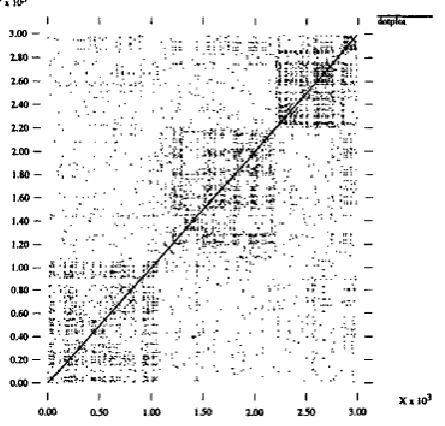
Figure 2.1 A dotplot of four concatenated Wall Street Journal (Reynar, 1994) ... 21
Figure 2.2 Paragraph dendrogram of the Stargazers article (Yaari, 1997) ... 24
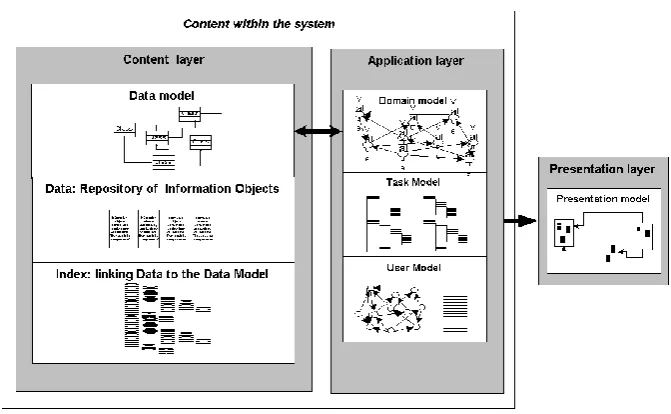
Figure 2.3 Layers of the Dexter model (Halasz & Schwartz 1990) ... 28
Figure 2.4 A depiction of the three layers of the Dexter model as embedded in an actual adaptive system. ... 29
Figure 2.5 AHAM model (De Bra et al., 1999) ... 30
Figure 2.6 An Adaptive System with a closed corpus content model (Aroyo et al., 2004) ... 35
Figure 2.7 The ArtEquAKT system ... 43
Figure 2.8 Slicepedia Architecture Pipeline ... 44
Figure 3.1 Example of three sentences annotated by DBpedia Spotlight ... 59
Figure 3.2 A vector representation of the three sentences after mapping entities to their classes from DBpedia ontology ... 59
Figure 3.3 Example of ontology extract (Slimani et al.,2006) ... 62
Figure 3.4 OntoSeg Algorithm ... 65
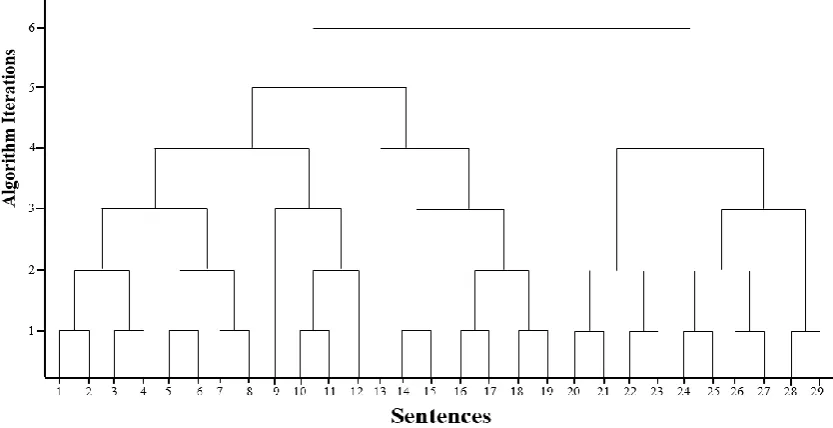
Figure 3.5 Sentences dendrogram of a sample text ... 66
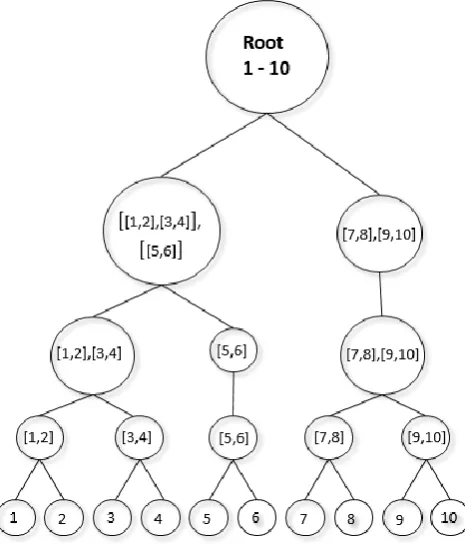
Figure 3.6 A tree representation for a text from 10 sentences ... 67
Figure 4.1 The process of generating an ESA model from Wikipedia articles (Egozi et al., 2011). ... 81
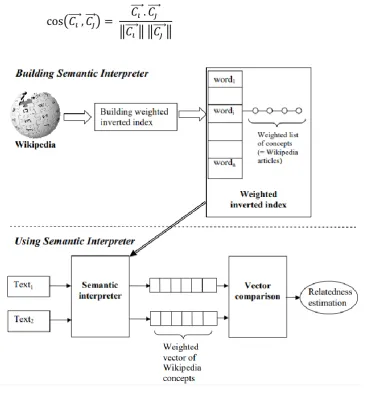
Figure 4.2 Semantic interpretation of two text units using ESA (Gabrilovich and Markovitch, 2007) ... 82
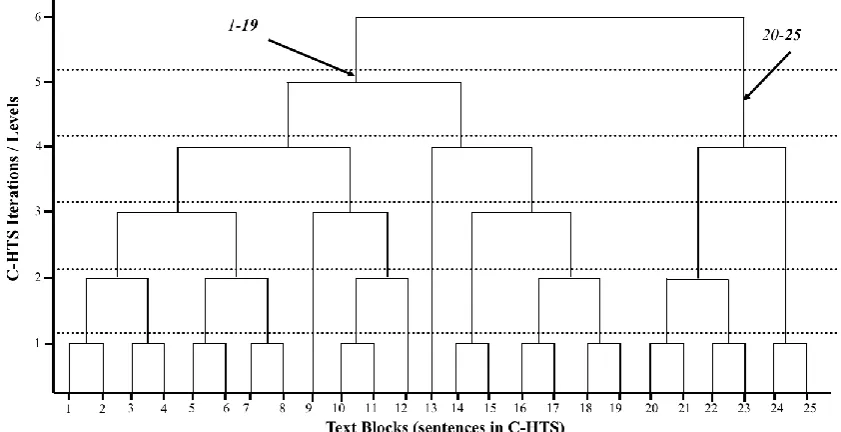
Figure 4.3 C-HTS output as a dendrogram of a sample text ... 85
Figure 5.1 The CROCC service architecture ... 108
Figure 5.2 Removing the unnecessary content fragments by the Content Pruner ... 110
Figure 5.3 A sample of the output of one iteration of the C-HTS algorithm in the Structure Builder module ... 112
Figure 5.4 Illustration of how the Slice Indexer maps a concept to slice objects associated with it ... 113
Figure 5.5 An example of the concept index in the Content Repository ... 115
Figure 5.6 Document sentences stored in the Text Index after the morphological analysis phase in C-HTS ... 116
Figure 5.7 A sample of a document indexed in the Text Index ... 117
Figure 5.8 Illustration of how the Slice Selector module works ... 117
Figure 5.9 A sample of the centroid vector of three concepts with their relevance scores to the query ... 118
Figure 5.10 Example of the returned lists of slices associated with the three concepts in Figure 5.9 ... 119
Figure 6.1 A sample of the XML structure produced by the PDFX system ... 132
Figure 6.2 An illustration of how a document is indexed in Lucene ... 134
Figure 6.3 A flowchart of the slice generation process by the baseline system ... 135
Figure 6.4 Slices distribution over closed and open corpora ... 138
Figure 6.5 Evaluation System ... 140
xiii
List of Tables
Table 3.1 Choi’s dataset statistics ... 68
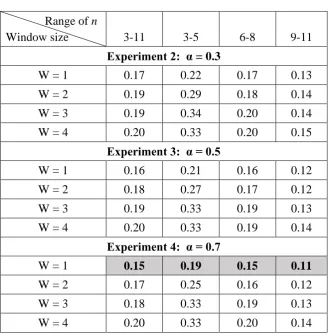
Table 3.2 Ontological similarity error rates (WD) for different window sizes ... 71
Table 3.3 Hybrid approach error rates for different window sizes ... 72
Table 3.4 Pk values for various algorithms in the literature with provided segment number ... 73
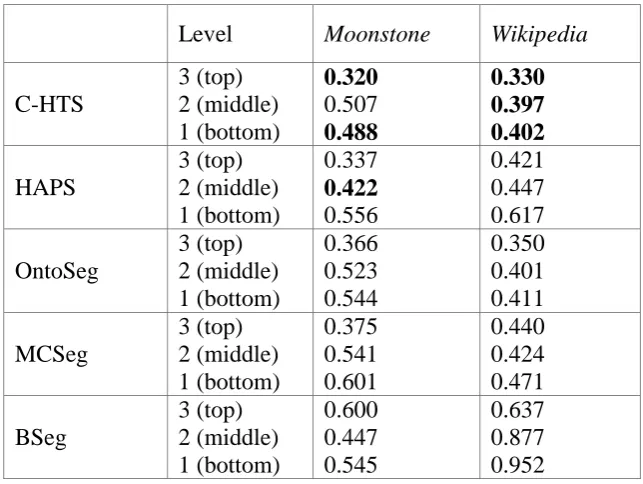
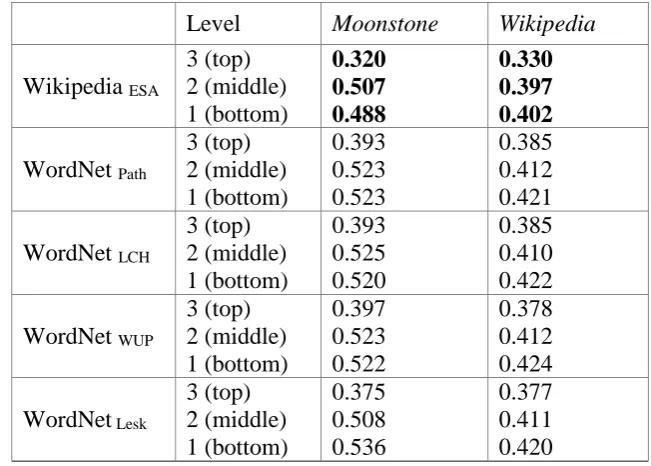
Table 4.1 Evaluation of C-HTS, HAPS, OntoSeg and iterative versions of MCSeg and BSeg using windowDiff per level ... 90
Table 4.2 Comparison between different similarity measures using WordNet in C-HTS ... 94
Table 4.3 Comparison between different coherency measures used with C-HTS... 96
Table 4.4 Comparison of the three Wikipedia snapshots ... 97
Table 4.5 Comparison of the three Wikipedia snapshots ... 97
Table 6.1 A sample of slices generated by both systems ... 138
Table 6.2 Slice sizes for each topic in each group ... 139
Table 6.3 Mean scores of user evaluations for all slices produced by each system ... 141
Table 6.4 Mean scores of user evaluations for slices produced for each query by each system ... 143
xiv
Acronyms
AHS Adaptive Hypermedia System
APeLS Adaptive Personalized eLearning Service
AR Anaphora Resolution
DOM Document Object Model
ESA Explicit Semantic Analysis
HAPS Hierarchical Affinity Propagation for Segmentation
IR Information Retrieval
JSON JavaScript Object Notation
LO Learning Objects
LOM Learning Object Metadata
LSA Latent Semantic Analysis
MHTSS Multi-granularity Hierarchical Topic-Based Segmentation System
NER Named Entity Recognition
NLP Natural Language Processing
PMCC Personal Multilingual Customer Care
RDF Resource Description Framework
SCORM Sharable Content Object Reference Model
SME Subject-Matter Expert
TFIDF Term Frequencies - Inverse Document Frequency
UML Unified Modelling Language
WSD Word Sense Disambiguation
1
1.
Introduction
1.1
Motivation
A large proportion of digital content resources are written as text documents in the form
of web pages, product manuals, news articles, research papers, etc. The volume of this
content is growing at an unprecedented rate, making it very difficult for users to find
information they are interested in or to help them accomplish their tasks (Uchyigit, 2009).
The reason is that these resources are generally not properly structured into easy to handle
units. Hence, efficient analysis and understanding of unstructured text content is
becom-ing increasbecom-ingly important (Alani et al., 2003). This has led to the increasbecom-ing use of
Nat-ural Language Processing (NLP1) techniques to help with processing unstructured text
documents (Beck et al., 2014; Sathiyamurthy and Geetha, 2011). The fundamental
objec-tive of NLP research is to convert a piece of text into a data structure that unambiguously
and completely describes the meaning of the natural language text (Collobert et al., 2011).
In the real world, natural language text usually appears as sequential patterns without
explicitly defined boundaries to identify how the text is structured. Amongst the various
NLP techniques that have been developed, Text Segmentation is used to identify
bound-aries in natural language text, and hence understand the structure of textual documents
(Badjatiya et al., 2018; Wang et al., 2017; Eisenstein, 2009; Hearst, 1997). Current
ap-proaches to text segmentation are based upon using lexical and/or syntactic representation
to identify the coherent segments of text (Azzopardi et al., 2017; Kazantseva and
Szpakowicz, 2014). However, the relationship between segments may be semantic, rather
than lexical or syntactic. Furthermore, text segmentation research has mainly focused on
techniques that can be used to process text documents but not on how these techniques
can be utilised to produce tailored content that can be adapted to the needs of individual
users.
The field of content adaptation has aimed to assist users with the problem of information
overload, and focused on the challenges associated with the growing body of digital
con-tent and methods to dynamically adapt and deliver it to individual users (Janati et al.,
2018; Bunt et al., 2007). One area of content adaptation is Adaptive Systems2. One of the
2
main services that adaptive systems offer to their users is the provision of content3 that is
tailored to individual users’ needs. In order to provide such content, adaptive systems
utilise different techniques to incorporate content that meets the requirements of their
users.
Early adaptive systems primarily focused on content adaptation techniques rather than
the processing and production of the content itself (Dieberger & Guzdial, 2003; Conlan
& Wade, 2004; De Bra et al., 2003; Brusilovsky, 2004). Such systems have traditionally
relied upon the manual processing and production of content (Dieberger & Guzdial,
2003). This manual processing makes the resources available in these systems highly
cu-rated, and easily discovered and adapted to the user’s preferences. However, the result,
typically, is the production of relatively low volumes of content at high cost which makes
these systems only able to satisfy a narrow range of content requests (Levacher, 2014).
Furthermore, the labour-intensive requirements imposed upon the manual processing of
content resources results in a limited capability of content reusability within different
systems.
As a result, various adaptive systems have been proposed to address these challenges by
employing automatic techniques to incorporate and process content. They have mainly
focused on leveraging and utilising open corpus resources available on the World Wide
Web (Heufemann et al., 2013; Sosnovsky et al., 2012; Lawless, 2009; Weal et al., 2007).
This in turn allowed these systems to incorporate a wider range of open corpus content
resources that cover a more diverse range of information needs (Smith & Blandford,
2003). However, since these approaches have prioritised the development of automatic
techniques to support the use of open corpus content, these techniques typically used the
content resources in the form they were created, as static one-size-fits-all content objects,
with limited control over content granularity. As pointed by (Bunt et al., 2007), presenting
the incorporated content resources in their native form allows more content to be “visible
to the user. However, the more content is shown, the higher the chance of generating information overload and reducing attention to the most relevant information, defeating one of the very reasons for having adaptive systems in the first place”.
Additionally, when content reuse has been achieved in these systems, it is traditionally
performed manually (Henze and Nejdl, 2001) or at best using automated approaches that
3
treat such resources as document level packages only. As pointed out by (Lawless, 2009),
“there is an inverse relationship between the potential reusability of [...] content and its
granularity”. The reuse of open web resources in their native form could be improved if
reused in different sizes.
As a result, other systems tried to overcome these problems and focused on performing
adaptation at a finer level of granularity (Levacher et al., 2012b). In these approaches, the
harvested resources are processed and structured into coherent fragments. ArtEquAKT
(Millard et al., 2003; Weal et al., 2007) for example, utilised information extraction and
knowledge management techniques to automatically extract parts of content resources
(paragraphs) to create dynamic biographies of artists from content available on the web.
Another example is the PMCC4 system (Steichen, 2012) that delivers personalised
con-tent to individual users using open corpus concon-tent as fragments of text. The harvested
content is fragmented based on its HTML structure using a wrapper-based content
frag-mentation approach (Bunt et al., 2007) to identify regions of pages in order to produce
individual fragments of content. Slicepedia (Levacher, 2014) was introduced as a web
service to process open corpus resources and extract content for reuse by right-fitting it
to the specific content requirements of individual content consuming applications.
Slicepedia fragments the harvested open corpus content into segments based on their
HTML structure.
Although these systems have demonstrated their ability to automatically process textual
content and hence enhance its discoverability and reusability, they are limited in that they
rely only upon the original structure of the content resource that reflects the needs and
perspective of its author. While each adaptive system has its own content requirements
(based on its users), relying upon such structure does not reflect these requirements.
Fur-thermore, content resources that do not possess any layout structure (e.g. plain text) or do
not make use of orthographic information (e.g. content is not structured as paragraphs),
cannot be effectively processed and reasoned about by these systems. Additionally, these
systems are limited in that they do not deeply “understand” the structure of the content,
which, in turn, limits their capability to supply appropriate content for use in defined
contexts. Understanding the structure of content requires a deep understanding of the
meaning of that content.
4
In order to utilise the strength of NLP techniques and to overcome the challenges of
un-derstanding unstructured text content, this thesis investigates how NLP techniques can be
utilised in order to enhance the supply of content to adaptive systems. Specifically, this
thesis focuses on the use of text segmentation, as a technique for structuring textual
doc-uments, to enhance content discoverability and reusability for adaptive systems.
In this thesis, two novel hierarchical text segmentation approaches are presented. The two
approaches are: OntoSeg (Bayomi et al., 2015) and C-HTS (Bayomi & Lawless, 2018).
Both approaches use the semantic representation of textual content in order to segment it
and produce a tree-like hierarchical structure. This way of building the document
struc-ture can be regarded as a hierarchically coherent tree that is useful to support a variety of
search methods as it provides different levels of granularity for the underlying content.
This tree is then traversed to obtain different levels of content granularity that facilitate
content discoverability and reusability. Each approach was evaluated independently to
explore its efficiency in performing its task. Additionally, a novel content-supply service
called CROCC (Customised Reuse of Open- and Closed-corpus Content) is presented.
The aim of CROCC is to utilise the produced structure of the segmentation algorithm
(C-HTS5) in order to overcome the limitations of the state of the art content-supply
ap-proaches. Furthermore, an evaluation of the extent to which the CROCC service enhances
content discoverability and reusability for adaptive systems is presented.
In this thesis, CROCC (using C-HTS) is designed and evaluated with reference to the
supply of content to adaptive systems. However, the work presented in this thesis can
potentially be used by a range of different applications that rely on structuring and
under-standing content such as Recommender Systems (Karimi et al., 2018) and Passage
Re-trieval systems (Cohen and Croft, 2018).
Adaptive systems rely on different models to produce adaptive content compositions
ac-cording to their users’ needs. It is not within the scope of this research to design and build
an adaptive system. Rather, the aim of this thesis is to propose novel approaches for
struc-turing textual content based on its semantic representation and to utilise the produced
structure in a content-supply service to enhance the discovery and reuse of content for
adaptive systems.
5
1.2
Research Question
The question that this research seeks to answer is:
To what extent can the semantic representation of unstructured textual content be ex-ploited by novel text segmentation approaches to build a document structure?
To assess whether the structure produced by the proposed approaches is of benefit to
content adaptation, a further question will be addressed:
Can the produced structure be used to enhance the discoverability and reusability of con-tent for adaptive systems?
In light of these research questions, and the research objectives outlined in section 1.2.1
below, this research aims to propose novel approaches for producing a structure out of
textual content in order to improve content discoverability and reusability for adaptive
systems.
1.2.1
Research Objectives
In order to address the research questions outlined above, the following research
objec-tives were identified for this thesis:
RO 1: Perform a state of the art survey on NLP techniques, specifically text segmen-tation as a technique for structuring textual content. The aim of this survey is to
in-vestigate how text segmentation is used to analyse and understand text to produce a
structure from unstructured textual documents. Additionally, perform a state of the
art survey on adaptive systems as content adaptation applications, to investigate how
they process content and the different techniques they utilise in order to facilitate the
discovery and reuse of this content. The survey should also review how state of the
art adaptive systems utilise NLP techniques in order to provide adaptive content.
RO 2: Examine the different methods and techniques that can be used to enhance the performance of text segmentation using the semantic representation of text, and
de-velop a new text segmentation approach to enhance the understanding of unstructured
textual documents. This also involves the evaluation of the effectiveness of the
pro-posed approach in processing and structuring content.
6
the structure of that content. The proposed hierarchical text segmentation approach
makes it possible to build a structure out of content resources based on the semantic
representation of text. In this context, a new content-supply service that utilises the
structure produced by the proposed segmentation approach needs to be built. The
de-sign of this service should be focused on exploiting the produced structure in order to
overcome the limitations of the state of the art content-supply approaches.
RO 4: Evaluate the extent to which the proposed content-supply service can enhance the discovery and reuse of content for adaptive systems.
1.3
Research Contributions
This work makes notable contributions to the state of the art of unstructured textual
con-tent analysis and understanding, along with concon-tent adaptation. These contributions are
illustrated throughout this thesis. The majorcontribution of this research is the use of NLP techniques, specifically text segmentation, to analyse and build a structure from text
documents based on the semantic representation of text. This structure is utilised by a
novel content-supply service in order to enhance content discoverability and reusability
for adaptive systems. To build a structure from text documents, this research proposes
two novel hierarchical text segmentation algorithms based on the semantic representation
of text, OntoSeg (Chapter 3) and C-HTS (Chapter 4).
OntoSeg (Ontological Segmentation) (Bayomi et al., 2015) is a novel approach to text segmentation that uses the semantic similarity between text blocks based on an ontology, and uses a Hierarchical Agglomerative Clustering (HAC) algorithm to represent the text
as a tree-like hierarchy that is semantically structured.
Evidence from experiments conducted as part of this research indicates that although
On-toSeg is able to produce a hierarchical structure out of text based on its semantic
repre-sentation, it did not perform well against the state of the art approaches and thus, its
per-formance needs to be enhanced through improved understandability of text by exploring
the semantic relatedness between text blocks rather than just using the semantic
7
As a result, another algorithm called C-HTS (Concept-based Hierarchical Text S egmen-tation) (Bayomi and Lawless, 2018) is presented. C-HTS is a hierarchical text
segmenta-tion approach that uses the explicit semantic representasegmenta-tion of text to measure the seman-tic relatedness between text blocks. The semantic representation of text is a method that replaces keyword-based text representation with concept-based features, automatically
extracted from massive human knowledge repositories such as Wikipedia. C-HTS
repre-sents the meaning of a piece of text as a weighted vector of knowledge concepts, in order to reason about text. Similar to OntoSeg, C-HTS produces the content of a single
docu-ment as a tree-like hierarchy. This way of structuring the docudocu-ment can be regarded as a
hierarchically coherent tree that is useful to support a variety of search methods as it
provides different levels of granularity for the underlying content.
This thesis also proposes a novel content-supply service named CROCC (Customised
Reuse of Open- and Closed-corpus Content) that utilises the structure produced by C-HTS in order to overcome the limitations of the state of the art content-supply approaches.
CROCC is a service which harvests content resources from open and closed corpus in
their native form and builds a structure out of each content resource without the reliance
upon its original structure. The service builds the structure of a content resource based on
its semantic representation (using C-HTS) and delivers content slices6 according to the
needs and requirements of individual adaptive systems. The thesis also presents a
task-based experiment to evaluate the extent to which the CROCC service can enhance the
discovery and reuse of content for adaptive systems.
A minor contribution of this research is a concept space that was built from a Wikipedia snapshot (April 2017) to be used for the explicit semantic analysis of text within C-HTS.
This concept space is publicly available7. Another minor contribution is the implemen-tations of the two hierarchical text segmentation algorithms proposed in this thesis,
On-toSeg and C-HTS. Implementations of both algorithms have been open-sourced and made
publicly available8,9.
To date, three research papers directly related to this research have been published:
6 A slice is a piece of content (one or more sentences) that originates from pre-existing content resource 7 https://goo.gl/JZhEvm
8
1. Bayomi, M., Levacher K., Ghorab, M.R., and Lawless, S. "OntoSeg: A Novel Ap-proach to Text Segmentation using Ontological Similarity”. In the proceedings of
the 5th ICDM Workshop on Sentiment Elicitation from Natural Text for
Infor-mation Retrieval and Extraction, ICDM SENTIRE. Held in conjunction with the
IEEE International Conference on Data Mining, ICDM 2015. Nov 14th, 2015.
At-lantic City, NJ, USA.
This publication describes the OntoSeg algorithm that uses the semantic similarity
be-tween text blocks. The publication also describes the experiments that have been carried
out in order to evaluate the performance of OntoSeg in comparison with state of the art
text segmentation approaches.
2. Bayomi, M. & Lawless, S. “C-HTS: A Concept-based Hierarchical Text Segmen-tation approach”. In the Proceedings of the Eleventh International Conference on
Language Resources and Evaluation (LREC 2018). Miyazaki, Japan: European
Language Resources Association (ELRA).
This publication describes the C-HTS algorithm that uses the semantic relatedness
be-tween text blocks. The publication describes the approach used by C-HTS to apply
hier-archical text segmentation and the concept space that has been built from Wikipedia in
order to measure the semantic relatedness between text blocks. The publication also
de-scribes the experiments that have been carried out in order to evaluate the performance
of C-HTSagainst the state of the art hierarchical text segmentation approaches.
3. Bayomi, M. "A Framework to Provide Customized Reuse of Open Corpus Content for Adaptive Systems." In the Proceedings of the 26th ACM Conference on Hyper-text & Social Media. HT ’15. Northern Cyprus, pp 315–318. ACM, 2015.
This publication describes a preliminary version of the CROCC framework that has been
built to facilitate the use of text segmentation in a content adaptation scenario.
Another publication describing the CROCC service and its evaluation (detailed in
Chap-ter 5 and ChapChap-ter 6) is underway and will target the ACM Hypertext conference10.
1.4
Research Methodology
This research addressed the abovementioned research questions and objectives by
fol-lowing a number of iterative steps that involved theoretical investigation, experimental
9
design, technical implementation, and quantitative and qualitative evaluation. This
sec-tion provides an overview of the research methodology followed.
Initially, a state of the art survey on NLP techniques in general and a focused review on
text segmentation was undertaken. The review investigated the different text
segmenta-tion approaches used for analysing and structuring textual documents and identified
points of strength and weakness in these approaches and how they could be enhanced.
The survey then included a review of adaptive systems, their anatomy, models and the
different content models that adaptive systems rely on. The survey also investigated the
different approaches for content discoverability and reusability used within adaptive
sys-tems. The survey then investigated the different NLP techniques used in adaptive systems
in order to structure textual content (RO 1).
Based on the influences derived from this survey, two new text segmentation algorithms
that use the semantic representation of content were proposed. The two algorithms,
namely OntoSeg (Chapter 3) and C-HTS (Chapter 4), use the semantic representation of
content to reason about it. Both algorithms were proposed to enhance text
understanda-bility and hence build a semantic structure to change the static and inflexible nature of
textual content. Both algorithms were evaluated independently, using a set of
experi-ments, to assess their performance in text segmentation tasks (RO 2).
As discussed in section 1.1, text segmentation research has mainly focused on techniques
that can be used to process text documents but not on how these techniques can be utilised
to produce tailored content that can be adapted to the needs of individual users. Thus, in
order to utilise the C-HTS algorithm in content adaptation, a content-supply service
named CROCC was developed (Chapter 5). CROCC was offered as an intelligent
con-tent-supply framework designed based on the influences derived from the state of the art
review on adaptive systems. The fundamental objective of CROCC is to utilise the
struc-ture produced by C-HTS to enhance content discoverability and reusability for adaptive
systems (RO 3).
To evaluate the extent to which the CROCC service enhances the discovery and reuse of
content for adaptive systems, a task-based experiment was carried out (RO 4). Since
de-signing and building an adaptive system is not within the scope of this thesis, this
exper-iment did not focus on evaluating the process of content use within an actual adaptive
10
CROCC and the quality of the slices produced by the service, according to the specific
requirements of a set of content requests that could be sent by an adaptive system.
1.5
Thesis Overview
The remainder of this thesis is organised as follows:
Chapter 1 presents a state of the art survey of NLP and adaptive systems. The survey begins with a comprehensive review of a number of different NLP techniques. The field
of text segmentation is reviewed, through an overview of the categories of text
segmen-tation proposed so far in the literature, along with different techniques for segmensegmen-tation
and their strengths and limitations. The survey then focuses on hierarchical text
segmen-tation and investigates how hierarchical text segmensegmen-tation is used to analyse text to
pro-duce a structure from unstructured textual documents. The chapter then provides an
over-view of adaptive systems and describes their anatomy. Their strengths and limitations are
also presented. Types of content such as closed and open corpus content are then outlined.
Following this is a review of how state of the art adaptive systems utilise the different
techniques in order to discover content that is suitable for their users’ needs. Reusability
techniques applied by adaptive systems are then reviewed. The chapter also comprises a
review of a range of NLP techniques utilised by adaptive systems in order to structure
textual content.
The following chapters outline the design of the various elements of research presented
in this thesis. They build on the influences from the state of the art survey and outline the
design of the theoretical approaches proposed to meet the research questions and
objec-tives of this thesis.
Chapter 3 presents the design of OntoSeg, a new algorithm for text segmentation that hierarchically represents the conceptual structure of content based on the semantic
repre-sentation of text. The chapter also describes a set of experiments that have been carried
out in order to evaluate the performance of OntoSeg using well-known evaluation
met-rics. The OntoSeg evaluation comprises a set of experiments where each experiment
eval-uates OntoSeg from a different perspective. The performance of OntoSeg is also
com-pared against a set of state of the art approaches using a dataset widely used in the
litera-ture.
11
related to building a concept space from Wikipedia are presented. Wikipedia was selected
in this research as it is considered the largest and fastest growing knowledge base in
ex-istence as it is a collaborative effort that combines the knowledge of hundreds of
thou-sands of people. The chapter also describes a set of experiments that have been carried
out in order to evaluate the performance of C-HTS using two different datasets in the
hierarchical text segmentation literature. Also, to assess the efficiency of C-HTS, its
per-formance is compared against state of the art hierarchical text segmentation approaches.
The chapter then describes two sets of experiments that have been carried out in order to:
(1) validate the efficacy of using Wikipedia as the underlying knowledge base for the
semantic representation of text in C-HTS, and (2) validate the efficacy of using the
se-mantic representation of text rather than its lexical representation.
Since C-HTS uses Wikipedia as the underlying knowledge base to reason about text, and
since the amount of knowledge in Wikipedia is expanding, such expansion, and the
growth of information available in the knowledge base should impact the accuracy of the
segmentation process. Hence, this chapter presents an evaluation of how this knowledge
expansion impacts upon the segmentation accuracy of C-HTS.
Chapter 5 presents the CROCC service and describes the different modules in the ser-vice. The chapter starts by presenting the influences derived from the state of the art
re-view and the key principles that impacted the core properties of the CROCC service. The
chapter then presents the design aspects of CROCC service along with an explanation of
how each component in the service influences the content provision process. After that,
the chapter discusses how the design of the service adheres to the key principals derived
from the state of the art influences. Details of a prototype implementation of the service
are then presented.
Chapter 6 describes the experiment that has been carried out in order to evaluate the extent to which the CROCC service can enhance the discovery and reuse of content for
adaptive systems. The chapter starts by describing the methodology applied in this
exper-iment. After that, the chapter outlines how content resources from closed and open corpus
were acquired for the purpose of the experiment. A baseline system is then introduced,
which has been developed to compare its performance against the CROCC service. The
12
then described. The chapter concludes by presenting the analyses carried out, along with
the findings derived from this analysis.
Chapter 7 concludes the thesis with a summary of the key contributions of this research, a discussion of how well the objectives were met and how the research questions were
13
2.
State of the Art
2.1
Introduction
This chapter presents a state of the art survey of NLP techniques, specifically text
seg-mentation, and presents a review of adaptive systems. The aim is to provide the reader
with an overall context of the research area, so as to extract relevant limitations and
in-fluences from the state of the art. The aim is also to contribute to the first objective of this
thesis (RO 1) by reviewing the field of text segmentation to investigate how text
segmen-tation is used to analyse and understand unstructured textual documents. The survey
re-views a number of different approaches to text segmentation along with their limitations.
The survey also reviews adaptive systems, as content adaptation applications, to get an
insight into how they process content to adapt it to their users’ needs. Additionally, the
survey reviews content discovery and reuse techniques within adaptive systems. These
techniques and systems are reviewed in terms of their strengths and their limitations. The
survey also reviews a range of different NLP techniques utilised by adaptive systems.
2.2
Natural Language Processing
2.2.1 Overview
Natural Language Processing (NLP) is a phrase used to describe a range of computational
techniques, based upon linguistic theory, for the automatic analysis and representation of
natural language (Cambria & White, 2014). The fundamental objective sought by NLP
research is to convert a piece of text into a data structure that unambiguously and
com-pletely describes the meaning of the natural language text (Collobert et al., 2011). During
the last decades, scientific efforts and the increasing availability of computational
re-sources have made it possible to come closer to the goal of understanding textual content
(Riedl 2016). Existing NLP techniques have been applied successfully in a wide range of
areas such as Machine Translation (McCann et al., 2017), Information Extraction
(Stanovsky et al., 2018; Fader et al., 2011), and Information Retrieval (Masumura et al.,
2017; Mitra and Craswell, 2017) among others.
In 1950, Alan Turing presented the Turing Test (Turing, 1950). The test consists of a text
conversation between two participants. One participant is a human and the other is a
14
as a game, in which a computer’s use of language would form the basis for determining
if the machine could think. Turing defined a machine as intelligent if the evaluator cannot
distinguish the machine from the human. Following that, in 1954, John Hutchins
pro-posed the Georgetown-IBM system that involved the translation of Russian sentences
into English (Hutchins, 2005). Similar to Turing system, (Weizenbaum, 1966) proposed
ELIZA program 1966. ELIZA was an early natural language processing system capable
of carrying on a limited form of conversation with a user by using pattern matching to
process the input and translate it into suitable outputs.
Over time, a vast amount of NLP approaches have been drawn from these systems
(Jurafsky, 2000). NLP systems usually split practical problems into a series of
consecu-tive tasks. Each of these tasks represent a research field of its own and attempts to solve
a particular problem in processing natural language. These tasks are usually subdivided
into two broad classes based upon whether they consist of low-level or high-level
pro-cessing tasks (Levacher, 2014).
2.2.2 Low-level NLP Tasks
Low-level NLP tasks are usually used as a pre-processing step for other NLP tasks. An
example of a low-level task is Tokenisation, which is also referred as word segmentation
(Mullen et al., 2018; Goldwater et al., 2006). This task aims at handling word structure
by separating a stream of text into a consecutive set of tokens which roughly correspond
to "words" (Chang & Manning, 2014). Tokenisation mainly depends on word boundaries,
such as space, to identify the different tokens in the given piece of text. Each token can
roughly be defined as a sequence of characters positioned between two white spaces,
while punctuation can easily distinguish between two separate sentences. However, Asian
languages such as Chinese and Japanese have no explicit word boundaries, which make
tokenisation a challenging task (Zhang et al., 2010). Even in western languages, valid
words are often not identical to space-separated tokens. For example, proper nouns such
as “United Kingdom” or idiomatic phrases such as “with respect to” actually function as
a single word (Mochihashi et al., 2009). Nevertheless, different approaches have been
proposed to tackle these problems (Manning et al., 2014).
On the other hand, the task of sentence splitting is concerned with segmenting text into
sentences (Xu et al., 2017; Mikheev, 2000). While tokenisation relies on the delimiters
between tokens, sentence splitting depends on the boundaries between sentences in raw
15
summarise text each sentence needs to be identified in order to measure how important
this sentence is to be included in the final summary (Bayomi et al., 2016; Mihalcea &
Tarau, 2004). In a text segmentation task, to identify coherent segments in the given text,
there is a need to split it into sentences and then measure how these sentences are similar
(or related) to each other (Bayomi & Lawless, 2018; Bayomi et al., 2015; Choi, 2000).
Both tokenisation and sentence splitting tasks are generally used as the first processing
tasks applied to a raw natural language text, which directly influence the results of the
subsequent tasks.
While some NLP tasks might only require text to be tokenised or segmented into
sen-tences, some other tasks require various tokens to be grouped together based upon their
common root in the language. For example, in a search engine (Information Retrieval
task), we want to find relevant results not only for the exact word we typed in the search
bar, but also for the other possible forms of the words we used. If the typed word is
“skirts”, for example, it is very likely we will want to see results containing the word “skirt”. Hence, grounding words into their root is an essential task. This task is usually
referred to Lemmatisation (Chakrabarty et al., 2017; Joel et al., 2004) or Stemming
(Hajeer et al., 2017; Willett, 2006). Both tasks aim to reduce the inflectional forms of
each word into a common base or root. For example, words such as, play, plays, played,
playing all possess the same root of “play”. However, both tasks are different in the way
they work and therefore so is the result that each of them returns. Essentially, stemming
algorithms cut off the end or the beginning of the word based on a list of common prefixes
and suffixes that can be found in a word. This makes such algorithms limited in some
cases. For example, for the two words “Studies” and “Studying”, although their root form is “Study”, a stemming algorithm would reduce the two words, based on their suffixes, into “Studi” and “Study” respectively. On the other hand, lemmatisation algorithms
usu-ally use a vocabulary and morphological analysis of words to remove inflectional endings
only and to return the base or dictionary form of a word, which is known as the lemma. For the previous example, a lemmatisation algorithm can use a detailed dictionary to look
through and link the two words back to their lemma, “Study”.
Another task that is typically used as a pre-processing task is the Part-Of-Speech (POS)
tagging (Farrah et al., 2018; Stratos et al., 2016). POS tagging explains how a word is
used in a sentence by labelling each token with a unique tag that indicates its syntactic
function, such as, noun, pronoun, verb, adverb, etc. (Santos & Zadrozny 2014). In a given
16
example, “Play” can be verb (I play football every week) or can be a noun (I watched the
play and it was wonderful). Different taggers have been proposed for the English
lan-guage. (Shen et al., 2007) for example, propose a sequence classification approach for the
English language that obtained an error rate of 2.67% on standard benchmarks. On the
other hand, different taggers have been proposed for other languages (Habash & Rambow
2005). (Stratos et al., 2016) proposed an unsupervised part-of-speech (POS) tagger by
learning Hidden Markov Models (HMMs), which they call anchor HMMs, where they
extend the non-negative matrix factorization framework proposed by (Arora et al., 2013).
Various POS taggers have been proposed for languages other than English. (Farrah et al.,
2018), for example, proposed a rule-based hybrid tagger for Arabic language that uses an
artificial neural network classifier to determine the appropriate tags of an Arabic text. The
first step in their approach is to use the affixes in text to understand the nature of the word
and its tags according to grammatical rules. The second step then is to apply a
translit-erated mechanism on text to convert it into Roman letters. This translittranslit-erated text is then
used as an input of the classifier based on the neural networks. After that, the output of
the two steps is used to identify the tag of each word.
2.2.3 High-level NLP Tasks
This category of tasks usually rely on the output from the pre-processing tasks presented
in the previous section. One of these tasks is Information Extraction (IE) that is
con-cerned with extracting semantic information from text (Li et al., 2018; Chang et al., 2006).
The aim of IE algorithms is to extract structured information from unstructured
docu-ments. As stated by (Cowie & Lehnert, 1996): “Information Extraction (IE) is the name given to any process which selectively structures and combines data which is found, ex-plicitly stated or implied, in one or more texts. The final output of the extraction process varies; in every case, however, it can be transformed so as to populate some type of da-tabase.” Hence, the field of Information Extraction essentially comprises different (sub)
tasks, among them, which are of particular relevance for this thesis, is Named Entity
Recognition (NER) (Gabbard et al., 2018).
Named Entity Recognition (NER) algorithms aim to detect entities within text and assign
a type for each found entity, such as person, location, organization, etc. NER is essential
to recognise information units like names, including person, organization and location
names, and numeric expressions including time, date, money and percent expressions
17
entities which carry key information in a sentence and serve as important targets for most
language processing systems (Mohit, 2014). Early NER approaches relied upon
handcrafted rule-based algorithms and lexicons (Nadeau and Sekine, 2007). As the task
evolved into a statistical learning problem, modern approaches have moved towards the
use of machine learning techniques (Yadav and Bethard, 2018). (Agerri and Rigau, 2016)
for example, proposed a multilingual NER approach (called ixa-pipe-nerc1) which learns supervised models via the Perceptron algorithm (Collins, 2002). (Habibi et al., 2017)
presented a NER approach for biomedical text using long short-term memory
network-conditional random field (LSTM-CRF). Their approach combines deep learning and
word embeddings techniques and evaluation results showed that their approach
outperformed other NER tools that do not use deep learning or use deep learning methods
Another high-level task in the NLP field consists of the Word Sense Disambiguation
(WSD). WSD is the task of identifying the meaning of a term, when the term has multiple
meanings, based upon the context of where it appears (Raganato et al., 2017; Agirre et
al., 2014). For example, “light” can mean “not heavy” or “illumination”, what identifies
its meaning is the context of where “light” is used. While most of the time humans do not
even think about the ambiguities of language, machines need to process unstructured
tex-tual content to understand it and reason about it. WSD algorithms mainly rely on external
knowledge resources to associate the most appropriate senses with words in context
(Agirre & Stevenson 2006). Examples of these knowledge resources are: Thesauri (Cañas
et al., 2003), Machine Readable Dictionaries (Basile et al., 2014; Lesk, 1986) and
Ontol-ogies (Philpot et al., 2005). For example, (Banerjee & Pedersen 2002) proposed an
adap-tation of the Lesk algorithm (Lesk 1986) for word sense disambiguation. While the Lesk
algorithm relies upon a standard dictionary in order to find overlaps between
neighbour-ing words, they extended the algorithm and used the lexical database WordNet (Miller
1995) as the source of glosses for their approach.
Another NLP task is Automatic Text Summarisation. Text summarisation is the process
of abstracting key content from information sources. The goal of automatic
summarisa-tion is to process the source text to produce a shorter version of the informasummarisa-tion contained
in it then present this version in a way that suits the needs of a particular user or
applica-tion (Bayomi et al., 2016). Various techniques have been proposed in the literature for
18
the automatic summarisation of text, some of which are supervised, while others are
un-supervised. Supervised techniques involve the need for an existing dataset of example
summaries (Cruz et al., 2006). In contrast, unsupervised techniques do not rely upon any
external knowledge sources, models or on linguistic processing and interpretation to
sum-marise text (Mihalcea & Tarau 2004). There are two primary approaches to automatic
summarisation. Extractive methods work by selecting a subset of existing words, phrases, or sentences from the original text to form the summary (Vodolazova et al., 2013). In
contrast, Abstractive methods build an internal semantic representation and then use nat-ural language generation techniques to create a summary that is closer to what a human
might generate (Fiszman & Rindflesch 2003). Such a summary may contain words that
are not included in the original text.
2.2.4 Summary
This section presented a general overview of NLP algorithms including the most common
low-level and high-level tasks typically involved in this area. However, NLP field has
many other tasks, each of these tasks represent a research field of its own and attempts to
solve a particular problem in processing natural language. Example of other NLP tasks,
among others, are: Machine Translation (Moussallem et al., 2018), Sentiment Analysis
(Verma and Thakur, 2018; Medhat et al., 2014), Relationship Extraction (Zeng et al.,
2015) and Speech recognition (Zhang et al., 2017; Povey et al., 2011).
It is worth mentioning that NLP tasks are not mutually exclusive. For example, for a
Relationship Extraction (RE) task, an NER system should be used to extract entities for
which the RE algorithm can identify the relationships among them (e.g. who is married
to whom). Additionally, these tasks are very closely intertwined.
2.3
Text Segmentation
2.3.1 Overview
A large proportion of digital content resources are written as text documents in the form
of web pages, product manuals, papers, etc. The volume of this content is growing at an
unprecedented rate, making it very difficult for users to find interesting information or
information which helps the user complete their task (Uchyigit, 2009). Several research
fields have emerged which focus on the challenges associated with this growing body of
19
unstructured text documents. One of these research fields is Text Segmentation (Pak and
Teh, 2018; Tsunoo et al., 2017; Glavaš et al., 2016; Choi, 2000; Hearst, 1997).
Text segmentation is the process of placing boundaries within text to create segments
according to some task-dependent criterion. It aims to divide text into coherent segments
which reflect the sub-topic structure of the text. Text segmentation algorithms are widely
used as an essential step for Information Retrieval (Prince and Labadié, 2007; Llopis et
al., 2002) and several NLP tasks such as text summarisation (Bokaei et al., 2016;
Boguraev and Neff, 2000), Question Answering (Riahi et al., 2012) and automatic
gen-eration of eLearning Courses (Beck et al., 2014). In Information Retrieval, a document is
segmented into distinct topics and only the topical segments relevant to the user’s needs
are retrieved. Segmentation not only provides more accurate information to the user, but
also reduces the burden on the user of having to read the whole document. In document
summarisation, a document is segmented into topics and then each topic is summarized
independently. This process guarantees that the final summary covers all the key topics
in the document.
Various synonyms in the literature are used to refer to text segmentation such as: Linear
Text Segmentation (Badjatiya et al., 2018), Hierarchical Text Segmentation (Tsunoo et
al., 2017), Topic Segmentation (Wang et al., 2017), Text Boundaries or Boundary
Deter-mination (Jamil et al., 2015; Labadié and Prince, 2008), and Topic Boundaries (Kim and
Cho, 2014). Furthermore, text segmentation has been categorised from a number of
dif-ferent points of view. The following subsections present a number of these categorisations.
2.3.2 Content-based and Discourse-based
Content-based approaches focus on the story content and resolve the segmentation
prob-lem by relying on some measure of the difference in word usage on the two sides of a
potential boundary: the larger the difference, the more indicative of a boundary. A
well-known content-based approach is TextTiling, proposed by Hearst (Hearst, 1994). Text-Tiling is a content-based text segmentation algorithm that uses a sliding window approach
to segment a text. The calculation is accomplished by two vectors containing the number
of occurring terms of each block. The similarities between adjacent blocks within the text
are computed to detect topic changes. The computed similarities are smoothed and used
20
On the other hand, discourse-based techniques focus on story structure or discourse.
These approaches make use of lexical features such as the presence of certain cue phrases
that tend to appear near the segment boundaries. An example of discourse-based
ap-proaches is the Hidden Markov Model (HMM) segmentation method (Allan et al., 1998)
that models “marker words”, or words which predict a topic change.
2.3.3 Supervised and Unsupervised
A supervised text segmentation approach called divSeg was introduced by (Song et al., 2011), where they apply an iterative approach that splits text at its weakest point in terms
of the lexical connectivity strength between two adjacent parts. After they found the
weak-est point in the text, their approach produces a deep and narrow binary tree. The tree is
then flattened into a broad and shallow hierarchy through supervised learning of a
docu-ment set or explicit input of how a text should be segdocu-mented. (Hsueh et al., 2006) described
a supervised hierarchical topic segmentation approach that trains separate classifiers for
topic and sub-topic segmentation.
On the other hand, (Eisenstein and Barzilay, 2008) proposed a Bayesian approach to un-supervised topic segmentation. They showed that lexical cohesion between text segments can be placed in a Bayesian context by modelling the words in each topic segment.
(Malmasi et al., 2017) extended this model and segmented text based on the stylistically
expressed characteristics of text such as change of authorship or native language. Text-Tiling (Hearst, 1994) and C99 (Choi, 2000) are also considered unsupervised linear topic segmentation algorithms.
2.3.4 Borderline sentences detection methods
There are three main approaches to detect borderline sentences within text (i.e. sentences
that identify the end or the beginning of a segment) (Labadié and Prince, 2008):
1- Similarity based methods: Represent text blocks as vectors and then measure the
prox-imity by using (typically) the cosine of the angle between these vectors. The C99
algo-rithm (Choi, 2000) for example uses a similarity matrix to generate a local classification
of sentences and isolate topical segments.
2- Graphical methods: Represent terms frequencies and use these representations to
iden-tify topical segments (which are dense dot clouds on the graphic). (Reynar, 1994)
21
and a graphical technique called DotPlotting (Church, 1993). The approach is based on
enumerating the lexical items in text and plotting points which correspond to word
rep-etitions. Figure 2.1 depicts a sample dotplot of four articles. Since the repetition of
lex-ical items occurs more frequently within regions of a text which are about the same
topic or group of topics, the visually apparent squares along the main diagonal of the
plot correspond to regions of the text.
Figure 2.1 A dotplot of four concatenated Wall Street Journal (Reynar, 1994)
3- Lexical chains based methods: The central idea of approaches based on lexical chains is that if the text continues to use similar words, then it is probably still talking about
the same topic (Manning, 1998). The notion of lexical chains was first proposed by
(Morris & Hirst, 1991) to chain semantically related words together via a thesaurus. A
chain links multiple occurrences of a term in the document and is considered broken
when there are too many sentences between two occurrences of a term. (Wang et al.,
2017) proposed a multi-granularity hierarchical topic-based segmentation system
(MHTSS) that divides a digital library document into a document segmentation tree based on the structure of the document (built by its author) and the lexical cohesion
between its paragraphs.
2.3.5 Linear and Hierarchical
If we look at the text segmentation from a text representation perspective, we can divide
it into linear and hierarchical approaches. Linear text segmentation deals with the
sequen-tial analysis of topical changes where segments are non-overlapping and sequensequen-tial. Linear
[image:35.595.216.439.192.405.2]