Munich Personal RePEc Archive
Which Institutions are more relevant
than others in inequality mitigation?
Mamoon, Dawood
Institute of Social Studies
1 September 2005
Online at
https://mpra.ub.uni-muenchen.de/82018/
Which Institutions are more relevant than others in inequality
mitigation?
Dawood Mamoon
Institute of Social Studies (ISS)
PO Box 29776, 2502 LT
The Hague, the Netherlands
[email protected]
+ 31 70 4260 683
ABSTRACT
The paper estimates the respective contributions of legal, economic, political and social institutions on inequalities within countries across the globe, while using various measures of openness and trade policy as our control group. The results suggest that institutions have significant effects on inequality. Among legal institutions, rule of law and control for corruption have a stronger impact on inequality than voice and accountability. Though we find that countries which practice democracy are less prone to unequal outcomes, we also find that autocratic setups may not necessarily lead to greater inequalities. Both frameworks may carry redistributive effects, as both are found to be positively associated with the incomes of the poorest and negatively associated with the incomes of the richest. Secondly, whether a country is politically stable is rather a more decisive institutional factor apropos inequality than whether a country has an autocratic or a democratic orientation. Economic institutions also seem to play an important role in alleviating inequalities within countries. Whether the government is functioning effectively and whether it has a robust fiscal and monetary policy seems to have stronger impact on inequality than regulatory quality. Education for all, a proxy for social institutions, has a strong redistributive power. Overall, legal institutions trump any other institutional categories in reducing inequalities in a country. On the other hand, middle income group is most likely to benefit from good functioning institutions than any other income group.
JEL Codes: O1, N40
1. Introduction:
During the 1950s, 1960s and most of the 1970s inequality followed declining trends
in the most developed and developing countries. However, the inequality trends have
been reversed in most countries since the early 1980s. First, inequality started rising
in the mid- to late- 1970s in the United States, United Kingdom, Australia and the
New Zealand, which were the first among the OECD countries to adopt a neoliberal
policy approach. In United Kingdom the increase in inequality was quite pronounced
as the Gini coefficient of the distribution of net disposable income rose more than 30
percent between 1978 and 1991, which was twice as fast as that recorded in United
States for the same period. The Scandinavian countries and the Netherlands were next
to follow where inequality followed a U shaped pattern. From 1970 to 80, Finland and
France also experienced a halt in declining trends in inequality. In Italy inequality
rose by 4 points between 1992 and 1995. In 1993 the Gini coefficient for Japan stood
at 0.44, which is approximately the same as United States and far higher than the likes
of Sweden and Denmark. Most of this increase in income inequality in these
industrialised countries is explained by a rise in earnings inequality (Cornia et al,
2004). Since 1989, inequality in the transition countries of Central Europe has also
witnessed increasing trends but they remain modest when compared to former USSR
and Southeastern Europe where the Gini coefficients rose on average by 10-20 points
which is 304 times faster than the Gini in Central Europe. The rise in inequality in this
region has been attributed to rise in returns to education following liberalisation
(Rutkowski, 1999).
Partly due to the recession in the 1980s, which hit the poor harder than the rich,
Costa Rica) witness sharp rise. Gini coefficients in Latin America have been ranged
between 0.45 and 0.60 since early 1950s, which are among the highest in the world.
The acute polarisation of income has been rooted in a highly unequal distribution of
land and educational opportunities (Cornia et al, 2004).
In China income concentration has been rising rapidly since 1985 so that the Gini
coefficient reached 0.43 by 1995 and remained more or less at the same level until
recently. The rise in income disparity can be attributed to a rise in urban-rural divide
arising from a faster expansion of urban activities amid active participation of China
in international markets. Among South East Asian economies, the Gini coefficient for
Indonesia increased to 0.38 by 1997 from 0.32 in 1987-90.In South Asia, the
inequality also followed a U-shaped pattern, though it was less pronounced. In India,
the experience of 1990s points to a moderate rise in both urban and rural inequality
and a larger rise in overall inequality due to widening gap between urban and rural
areas. In 1990s the urban inequality rose to 0.36. The Gini coefficient in Pakistan rose
from 0.39 in 1960s to 0.41 in 1990s. Much like India, the rise in overall inequality is
attributed to a sharp rise in rural inequalities. Inequality in Sub Saharan Africa has
been among the highest in world. There is some evidence of falling urban-rural gap
but there is rising intra urban and at times intra rural inequalities. For example, in
Tnazania the Gini coefficient for rural inequality rose from 0.53 in early 1980s to 0.76
in early 1990s. Similarly for Kenya, the rural inequalities increased by 9 points from
1980 to 1992 and stand at 0.49 (Ibid, 2004).
In the retrospect, the problem of poverty can not be separated from the way in which
relates to inequality. The aim of this paper is to analyse the impact of one of the key
determinant of growth on inequality. Recent literature suggests that strong
institutions1 are the key determinant of growth ( i.e, see Dollar and Kraay, 2003;
Rodrik et al, 2004; Glaeser et al, 2004a, Mamoon and Murshed, 2005). It is important
to look at the different institutional setups; countries may have while working along
with the surge of globalisation. For example, India is a thriving democracy but China,
South Korea and Taiwan have been growing under one-party dictatorships, the last
two eventually turning to democracy. Recently, Pakistan has become one of the
fastest growing economies of the region, even out passing India, under rule of General
Pervez Musharraf. Among the transition economies, rapid economic growth was
achieved by Kazakhstan under Nazarbaev. Here one may conveniently assume that
these countries have performed well under market friendly policies (i.e., trade
liberalisation) and thus successfully achieved robust economic performance. However
the analogy is not that simple. Market friendly policies may not work in the absence
of good institutions. The failure of Russian economy and its reform process can be
attributed to the lack of a supportive legal, regulatory and political apparatus. In Latin
America little attention has been paid to the mechanisms of social insurance and to the
safety nets which has resulted in the dissatisfaction with market oriented reforms. It
may also be the case that some institutions may be more important than others. For
example, even pro-market dictators can secure property rights as a matter of policy
choice (Glaeser, 2004a). Similarly, stronger social institutions lead to improved
government functioning: “Education is needed for courts to operate and to empower
citizens to engage with government institutions (Ibid, 2004: 3)”.
1 In this paper we have assumed education, which would otherwise be considered as a proxy for human
This paper tries to analyse different institutional settings, and their relationship with
various definitions of inequality to shed light on the effects of pro growth policies on
poverty.
[image:6.595.78.521.276.557.2]2. Different Types of Institutions, Inequality and the Endogenising Factors:
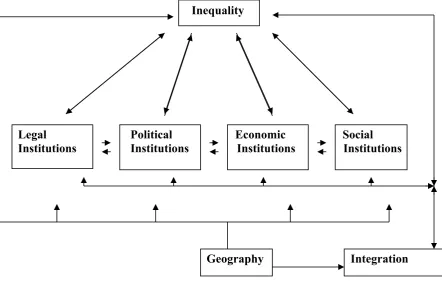
Figure 1: Endogeniety between Institutions, Integration and Inequality
Inequality
Legal Political Economic Social Institutions Institutions Institutions Institutions
Geography Integration
There are issues of two way causality between inequality and institutions (i.e., see
Keefer and Knack, 2002; Chong and Gradstein, 2004), between different types of
institutions as shown by figure 1 and discussed below. Many recent studies ( i.e., see
Chen and Ravallion , 2003; Cockburn, 2001; Friedman, 2000; Lofgren, 1999) show
that international trade is significantly related with inequality while institutions and
integration are also endogenous (i.e., Rodrik et al, 2004). Any empirical analysis
inequality may lead to miss-specification bias. Here on the line of Ridrik et al (2004),
we assume geography is a pure exogenous concept.
Chong and Gradstein (2004) find strong evidence of bi-directional causality between
institutions and inequality. Inequality may affect the quality of institutions. For
example, high inequality will prevent the poor from investing in education or the
ruling class may not invest in education so that the poor majority will not be
politically active thus undermining the development of necessary social and political
institutions. Easterly (2001) and Keefer and Knack (2002) suggests that social
polarisation negatively affects institutional quality.
The countries with poor institutions are also likely to have high inequality. For
example in Russia in the 1990s, a small group of entrepreneurs exploited their
political power to promote their own interests, subverting the emergence of
institutions committed to the protection of smaller share holders and businesses.
According to the Corruption Perceptions Index published by Transparency
International, among the transition economies, Estonia is placed 28, and Hungary 31;
whereas Russia is placed 79, and Ukraine 83. In these transition economies, weak
performance of public institutions, infringement of property rights in favour of
influential parties, lower willingness to use courts to resolve business disputes, lower
level of tax compliance and higher levels of bribery all have been strongly correlated
with inequality (Hellman and Kaufman, 2002). Similarly, in several Latin American
countries, the ruling elites, the military and large businesses impeded smaller business
interests giving rise to significant informal sector. Chong and Gradstein (2004) show
institutional quality may reinforce each other, indicating endogeniety between the
two.
There may also be inter-linkages between various institutions. For example, nearly all
developed countries are democracies and most developing countries are either run
under one party system, dictatorships or military regimes. The countries with lower
levels of economic and human development tend to have lower levels of education,
limited political rights, weak or non existent political competition, lower level of
economic freedom and openness, ethno linguistic factionalism, the lack of judicial
independence and a free press and high levels of permissiveness towards corruption.
Before discussing the interdependence of different institutions we would first like to
differentiate between them. We identify four types of institutions: 1) Legal, 2)
Political, 3) Economic and 4) Social. Legal institutions capture the transparency and
fairness of legal system, political rights of the citizens, State legitimacy, freedom of
speech, independence of judiciary, enforceability of contracts, police effectiveness,
access to independent and impartial courts, confidence in judicial system in insuring
property rights, prevention of improper practices in public sphere, control of
corruption etc. Political institutions represent political stability, democracy, autocracy
or dictatorship. Economic institutions include state effectiveness at collecting taxes or
other forms of government revenue, states ability to create, deliver and maintain vital
national infrastructure, states ability to respond effectively to domestic economic
problems, independence of government economic policies from pressure from special
interest groups, trade and foreign exchange system, competition policy, privatisation,
financial institutions etc. Social Institutions capture socio economic conditions such
as health, education and nutrition etc.
The Legal, political, economic and social institutions are strong in developed
countries and for developing countries there are mixed experiences. For example,
intellectual property rights are protected vigorously in the US and most advanced
societies, but not in many developing countries (Rodrik, 1999). Similarly, most rich
countries in the world circa 1960 were democracies with well-educated populations.
Over the subsequent 40 years, these countries grew rapidly, on average and the
dispersion of their growth rates was relatively small. Most poor countries in the world
circa 1960 were dictatorships with badly educated populations. These countries did
not grow as rapidly as the democracies on average, but perhaps more strikingly, the
dispersion of growth rates across these countries has been huge (Glaeser et al,
2004b:3). Engerman and Sokoloff (2002) link the development of public education as
a social institution to the democratization as a political process in US. According to
them, while starting at about the similar level of development in the 18nth century,
US led the way in setting up a system of common schools and promoting literacy,
where as in countries in South America and the Caribbean these processes were much
delayed. Today specifically for the Carribean’s, the economic development problems
are associated with region’s lack of diverse and open economies, government
ownership of inefficient state enterprises, continued restrictive tariff barriers, failure
to institute free trade measures and the lack of governance measures (Collier, 2002).
Gupta et al (1998) finds that if government officials use their authority for private
gain and indulge in corruption that affects the effectiveness of social spending and the
and unequal access to education. Corruption also affects the government effectiveness
as it weakens tax administration and can lead to tax evasion and improper tax evasion
and improper tax exemptions. Higher corruption is associated with increases in
inequalities in education, land distribution and health spending. Wealthy urban elites
can lobby the government to bias social expenditure toward higher education and
tertiary health, which tend to benefit high income groups (Ibid, 1998).
3. Data and Methodology:
Much recently Kaufman et al (2002) formulated aggregate governance indicators for
six dimensions of governance covering 175 countries. They relied on 194 different
measures of governance drawn from 17 different sources of subjective governance
data constructed by 15 different sources including international organizations,
political and business risk rating agencies, think tanks and non governmental
organizations. The governance indicators have been oriented so that higher values
correspond to better outcomes on a scale from -2.5 to 2.5. They are categorized as rule
of law (Rl), political stability (Ps), regulatory quality (Rq), government effectiveness
(Ge), voice and accountability (Va) and control of corruption (Ctc). We divide them
into four classification based on their definitions. We consider Rl, Va and Ctc as legal
institutions. Ge and Rq are dubbed as economic institutions whereas Ps is taken as a
proxy for Political institutions. We add two more political indicators namely
democracy (Demo) and autocracy (Auto) to our analysis from Polity dataset whereas,
both ranging from 0 to 10. We have also included social institutions in our analysis.
Average Schooling Years in the total population at 25 (Sch) and Adult literacy rate
As we mention above, international trade is also a significant determinant of
inequalities in countries across the globe, integration enters our regression model to
enhance its explanatory power. We incorporate not 1 but 8 various concepts of
openness and trade policy in our regression model in order to carry out a robustness
check for our results on institutions. We have carefully chosen three specific measures
of openness. The ratio of nominal imports plus exports to GDP (lcopen) is the
conventional openness indicator (see Frankel and Romer, 1999; Alcala and Ciccone,
2002; Rose, 2002; Dollar and Kraay, 2003; Rodrik et al, 2004). Two other measures
of openness are overall trade penetration (tarshov) derived from World Bank’s TARS
system and overall import penetration (Impnov) respectively (see Rose, 2002). Neither
of these measures are direct indicators of trade policy of a country, pointing only
towards the level of its participation in international trade. There are indicators of
trade restrictiveness acting as measures of trade policy (Edwards, 1998; Greenaway et
al, 2001, Rose 2002). Import tariffs as percentage of imports (Tariffs), tariffs on
intermediate inputs and capital goods (Owti), trade taxes as a ratio of overall trade
(Txtrg) and total import charges (Totimpov) can all be considered as good proxies for
trade restrictiveness and have also been employed in our study. Other measures which
capture restrictions in overall trade are non-tariff barriers. We use overall non-tariff
coverage (Ntarfov) and non-tariff barriers on intermediate inputs and capital goods
(Owqi) as two proxies for non-tariff barriers (see Rose, 2002). Moreover there is also
a trend in the trade literature to use composite measures of trade policy. Edwards
(1998) advocates the Sachs and Warner (1995) openness index (Open80) as a proxy
To capture inequality we not only take GINI income inequality index (Gini) from
UNU/WIDER World Income Inequality Database (WIID) but also we employ
UTIP-UNIDO Theil measure (Theil) calculated by University of Texas Inequality Project
(UTIP) which captures wage inequality between skilled and unskilled labour. This is
motivated by several considerations. First, comparable and consistent measures of
income inequality, whether on a household level or per head basis are difficult, almost
implausible and generally fails to provide adequate or accurate longitudinal and
cross-country coverage. On the other hand, inequality of manufacturing pay, based on
UNIDO Industrial Statistics provides indicators of inequality that are more stable,
more reliable and more comparable across countries because UNIDO measures are
based on a two or three digit code of International Standard Industrial Classification
(ISIC) a single systematic accounting framework. Furthermore, manufacturing pay
has been measured with reasonable accuracy as a matter of official routine in most
countries around the world for nearly forty years (Galbraith and Kum, 2002). Further
more we take income deciles and percentiles from UNU/WIDER World Income
Inequality Database (WIID) as other proxies of inequality. Institutions or Integration
will be guilty of inequality if it has the negative impact on the incomes of bottom 10
percent (low10) and positive impact on the income of the top 10 percent (high 10).
We also take income groups divided into quintiles where the effect of Institutions is
anticipated to be negative for the ratio between top 20 percent and bottom 20 percent
(high20/low20) and positive for the middle income groups (Middle20). The exercise
on income deciles and percentiles will further shed light on how institutions and
integration are related with income distribution. Especially, we are interested to know
how quality of institutions are related with the incomes of the middle class or the ones
measures is taken for the latest year for which data is available and in most cases
represent inequality in mid 1990s.
Our basic inequality and income share equations would look like:
Inequality = f (Institutions, Integration, Geography) …………... (1)
and Income Share= f (Institutions, Integration, Geography)………(2)
Corresponding to equation 1, our inequality model based on Theil index has 8
equations, whereas each equation corresponds to a different institutional or integration
classification The model specifications for Gini, High20/Low20, Midlle20, Low10 and
High10 contain same 8 equations each with same variable specifications.
………3
i i i
i LI Open
Theil1 11 1 1
…………..4
i i i
i PI Open
Theil2 2 2 2 2
…………...5
i i i
i EI Open
Theil3 3 3 3 3
………6
i i i
i SI Open
Theil4 4 4 4 4
………7
i i i
i LI TP
Theil5 5 5 5 5
………8
i i i
i PI TP
Theil6 6 6 6 6
………9
i i i
i EI TP
Theil7 7 7 7 7
……….10
i i i
i SI TP
Theil8 8 8 8 8
The variable Theiliis Theil Index in a country i,LIi, PIi,EIi, and SIiare respectively
measures for legal, political, economic and social institutions, whereas Openi
measures general openness in the economy and TPi is a measure for trade policy and
is the random error term. Please refer to appendix 1 for information on equations
i
based on Gini, High20/Low20, Middle20, Low20 and High10.
As we have discussed, there are potential endogenity problems between institutions
and integration and between institutions and inequality itself. To this effect we have
instruments. Frankel and Romer (1999) suggests that we can instrument for openness
by using trade/GDP shares constructed on the basis of a gravity equation for bilateral
trade flows. The FR approach consists of first regressing bilateral trade flows (as a
share of country’s GDP) on measures of country mass, distance between the trade
partners, and a few other geographical variables, and then constructing a predicted
aggregate trade share for each country on the basis of coefficients estimated. Hall and
Jones (1999) employed distance from the equator and the extent to which the primary
languages of Western Europe are spoken as first languages today as instruments for
institutions. Hall and Jones made an argument that the instruments are not correlated
with the error term. Acemolgu, Johnson and Robinson (2001) identify the mortality
of European settlers as a potential instrument. Using two ex post assessments of
institutional quality- risk of expropriation by the government and constraints on the
executive- as measures of institutions, they showed that settler mortality is a strong
predictor of institutions. However there are two drawbacks for AJR instrument. First,
the data is only available for 64 countries. Though Rodrik et al (2004) have extended
it to 80 countries; it still covers a relatively low number when compared to ‘the extent
to which the primary languages of Western Europe are spoken as first languages
today’ which covers as many as 140 countries. Secondly, according to Glaeser et al
(2004b), AJR instrument of settler mortality fails to be orthogonal to the error term.
‘Settler mortality is strongly correlated not just with ancient, but also with the
modern, decease environment, suggesting that it might be the decease environment,
rather than history, that matters for economic development. Secondly settler mortality
is strongly correlated with human capital accumulation, suggesting that it cannot be
used as an instrument for institutions (Glasear et al, 2004b:8).’ Thus following Dollar
speaking English (Engfrac) and Western European languages as the first language
(Eurfrac)’ as an instrument for legal, economic and political institutions. Since we are
using years of schooling and adult literacy rate as a proxy for social institutions we
looked for instruments which can capture the qualitative and quantitative properties in
education sector. Total public spending on education (as a percentage of GDP) and
primary public-teacher ratio are the two instruments proposed by Mamoon and
Murshed (2005). The former instrument captures the quality of education and the later
instrument captures the quantity of education. As in Rodrik et al (2004), we employ
‘distance from the equator’ as another instrument (proxy for geography) also
employed by Hall and Jones (1999).
………..11
i i
i i
i Eng Eur FR Disteq
LI 11 1 1 1 1
………12
i i
i i
i Eng Eur FR Disteq
PI 2 2 2 2 2 2
……….13
i i
i i
i Eng Eur FR Disteq
EI 3 3 3 3 3 3
………...14
i i
i i
i Eng Eur FR Disteq
Open1 4 4 4 4 4 4
………....15
i i
i i
i Eng Eur FR Disteq
TP1 5 5 5 5 5 5
………..16
i i
i i
i Tlex Ptr FR Disteq
SI 6 6 6 6 6 6
………17
i i
i i
i Tlex Ptr FR Disteq
Open2 7 7 7 7 7 7
………..18
i i
i i
i Tlex Ptr FR Disteq
TP2 8 8 8 8 8 8
Where Engi and Euriare our instruments for legal, economic and political
institutions referring to fractions of population speaking English and European
languages respectively. Tlex is total public spending on education as a percentage of
GDP and Ptr is primary pupil-teacher ratio and both are instruments for average years
of schooling and adult literacy rate. FRiis instrument for openness and trade policy.
is proxy for geography showing distance from the equator. At the second
i
Disteq
stage the predicted values of respective institutional, openness and trade policy
4. Results:
4.1. Legal Institutions:
Barreto (1996) finds that corruption is positively and significantly correlated with
inequality, implying that increased income inequality is associated with greater
corruption. Tanzi (1995) argues that the benefits from corruption are likely to accrue
to the better connected individuals in society, who mostly belong to high-income
groups. It has been further contended that corruption creates incentives for higher
investment in capital intensive projects and lower investment in labor intensive
projects (UNDP, 1997), thus increasing the wage inequality. Gupta et al (1998) show
that a worsening of corruption index of a country by one standard deviation (2.52
points on a scale of 0 to 10) is associated with an increase in the GINI coefficient of
about 4.4 points.
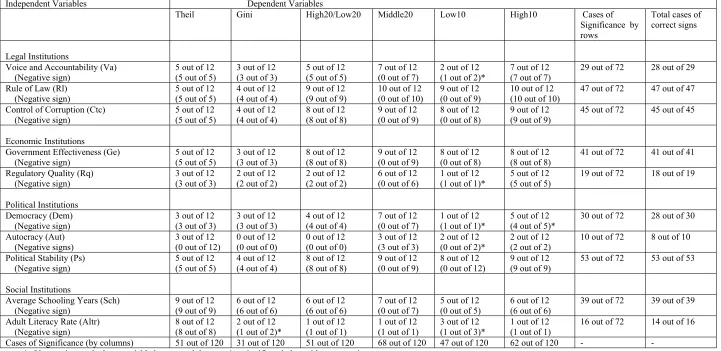
The results (Table 1; appendix 1) suggest that wage inequality (Theil) is more
sensitive to legal institutions than overall income distribution (Gini). Results based on
the ratio of income percentiles (High20/Low20) and income deciles show that voice
and accountability, rule of law and control for corruption has a strong redistributive
power. The relationship between legal institutions and income of the middle income
groups (Middle20) as well as low income groups especially for Rl and Ctc is positive
and significant. This means that good quality legal institutions not only to reach out to
the middle income groups but they are also altruistic to the poorest of the poor. The
evidence quite robustly suggests that redistribution of income takes place from the
institutions are negatively and significantly related with the incomes of the richest 10
percent or 20 percent in most of the cases.
4.2. Economic Institutions:
Every government must maintain a sustainable fiscal policy, which includes a deficit
that is manageable in the short term, and the associated public debt it creates being
serviceable. More concentration of resources on social sector is always pro-poor. The
value added tax has received exaggerated appreciation and has not faced its due
criticism. In the world when poverty reduction strategies are implemented and
inequalities are growing, value added tax needs to give way to more pro poor tax
system (Roy and Weeks, 2003). Inflation in many developing countries is an outcome
of political decision when government has a lax monetary policy and is unable or
unwilling to increase taxes. High inflation has a negative distribution effects. In
developed countries sometimes monetary policy outcomes are related with increased
inequalities. Khalifa (2005), shows that a positive shock to Federal Reserve fund
rates in US induce a larger and more persistent increase in the unemployment ratio of
the low skilled relative to that of high skilled, indicating that low skilled bear the
brunt of the increase in unemployment after a contractionary policy.
Result summary in table 1 (appendix I) indicates that government effectiveness is
negatively and significantly related with wage inequality between skilled and
unskilled. However, the relationship is weak at best with Gini. Though it doesn’t
mean that effectiveness of government policies don’t carry redistributive effects. Our
results show that if the governments which work in the interest of public; they have a
they are negatively and significantly related with the incomes of the elite. The results
in Table 1 indicate that though regulatory quality has weak relationship with the
traditional measures of inequality but it has positive and relatively significant effects
on the income share of middle income groups.
4.3. Political Institutions:
The results in table 1 indicate that political stability is one of the key factors to a more
equal society and it is especially favourable to the wages of the unskilled population.
Furthermore, politically stable societies not only redistribute incomes to the middle
income groups but they also benefit the lowest segments of the society equally.
However, in comparison to political stability index, democracy has a weak
relationship with inequality. It doesn’t seem to matter much whether a country works
under a democratised framework or an autocracy, the average effects on inequality
have generally been insignificant. This is inline with the existing evidence which
doesn’t find any robust relationship between democracy and inequality in a cross
country regression. ‘Indeed a casual inspection of recent events in East Europe as well
as in East Asia casts doubts that any such simple relationship may exist. It has been
argued that, in the East European countries, democratization of the 90’s actually
resulted in an increase income inequality. Similarly, some of the East Asian countries
such as South Korea, Taiwan, Singapore have had among the most egalitarian income
distributions in the world, yet their political record is far from democratic. (Gradstein
et al, 2001: 1)’. According to Glaeser et al (2004b), it is good leadership that matters
and not whether a country has democratic setup or ruled under a dictatorship.
Nevertheless, our results do show that democracy seem to favour middle class more
with greater inequality of factor income tend to redistribute more to the less affluent
(Milanovic, 2000). This result may also seem much in line with current political set
up initiated by the government of General Pervez Musharraf, whereby Pakistan may
score low in democracy but has seen significant political stability, so much so that it
seems that it would be the first time in the history of Pakistan a government will be
able to complete its 5 year period. This political stability has been combined with a
accelerated economic performance with increasing incomes of especially middle
class.
4.4. Social Institutions:
Education enhances the earnings potential of the poor, both in competing for jobs and
earnings and as a source of growth and employment. The distribution of physical and
human capital emerges from the theoretical and empirical literature as the key to
distributional consequences of growth, and a determinant of growth itself (Kanbur,
1998:20). The results (table 1; appendix I) show that average years of schooling (Sch)
is negatively related with the Gini, and the relationship is significant in most cases
suggesting countries which have a more educated population are also the ones where
distribution of income is relatively less unequal. For example, in US the percapita
income of the richest decile exceeds that of second richest decile by 60 percent only,
where as in Latin America where Gini is also one of the highest among developing
countries, the richest decile exceeds that of the second richest decile by 160 percent.
In comparison to Latin America, US has highly educated population with average
years of schooling at little more than 12 years and 99 percent of the adult population
Increased educational attainment also leads to less wage inequality. Along with the
processes of globalisation the comparative advantage of developed nation lies in high
skill intensive goods as lower skill intensive goods and services are being outsourced
to developing nations. As the skill demand is increasing at greater pace than its
supply, so is the wage of more skilled and educated labor thus increasing wage
inequalities in developed nations. Harrigan and Balaban (1999) show that relative
factor supply is an important factor in determining the growing return to skill in US
during 1963-91. Given the current situation of increasing inequality in most
developed societies, of which globalisation is a much-cited culprit, policy makers
have been very keen to demand further public funding for schooling (Pereira and
Martin, 2000: 2). Similarly education inequalities have led to wage inequality in
developing countries specifically Latin America. Coincidently, Latin America has a
Gini coefficient (about 0.50 for the region as a whole) which is approximately 15
points above the average for the rest of the world (Mamoon, 2005). Londoño and
Székely (1997) estimate that the low level of education of Latin American workers
and the enormous inequality in educational assets account for the largest portion of
the region's excessive inequality, larger than other contributing factors -- lower
physical capital accumulation, the relative abundance of natural resources, and a high
concentration of land resources. In Latin America, only a relatively small proportion
of the total population has completed secondary or higher education. These relatively
few skilled workers earn a substantial wage premium due to their limited supply. Thus
a poor distribution of education contributes to differentials in the returns to different
Our results show that average years of schooling and adult literacy rate are
significantly and negatively related with wage inequality, confirming that countries
where education is more equally distributed or levels of average schooling are higher;
wage inequality would be less severe. Though Altr is quite weakly related with the
our inequality measures, results for Sch do imply that education has a strong
redistributive power from richer segments of the society to the less affluent. A
comparison of coefficients of Middle20 and Low10 suggests that education benefits
middle class more than the poor.
Conclusions:
This paper is an attempt to gauge the effects of different institutions on inequality.
Though the literature is limited on the subject, the existing one suggests that there is
two way causality between institutions and inequality. To this effect we solve the
problem of endogeniety by utilising a set of instruments already in use for institutions.
We used a rich set of openness and trade policy variables as controls in our multiple
regression equations. This was done to also check the robustness of our results for
institutions while increasing the explanatory power of our model.
Our results have reconfirmed that good quality institutions lead to decrease in
inequality. It also appears that it is political stability that is more important than
democracy. In line to previous studies, we find that it may not matter much whether a
country is working under a democracy or autocracy, but it is good policies of the
leaders which eventually determine the welfare enhancing effects through
preservation of property rights etc. Good leadership which not only follow more
policy choice is a key to economic development. On the basis of our relative
significance, social and legal institutions are by far the most significant institutions
apropos inequality suggesting their relative importance over other institutions. Rule of
law is the best performing institution viz-a-viz inequality mitigation. If education is
more equally distributed among the population, relative wages of skilled and unskilled
labour will have least amount of distortions especially when the country opens up to
international trade. Among economic institutions, regulation is less important when
compared to government’s independent fiscal and monetary policy and its effective
capacity to decentralise and its pro business orientation. The results in table 1 also
suggest that Middle class comes out to be the main beneficiary of good quality
institutions than any other income group as Middle20 equations give most significant
results.
References:
Acemoglu, Daron, Simon Johnson and James A. Robinson, “The Colonial Origins of Comparative
Development: An Empirical Investigation,” American Economic Review, 91, No. 5, 2001, pp.
1369-1401, http://emlab.berkeley.edu/users/chad/e236c_f04/ajr2001.pdf
Alcala, Francisco and Antonio Ciccone, ‘Trade and Productivity,’ CEPR Discussion Paper No. 3095, 2001
Barreto, Raul A., “Endogenous Corruption, Inequality and Growth: Econometric Evidence,” Mimeo, University of Colorado, September 1996.
Chong, Alberto and Mark Gradstein, “Inequality and Institutions,” Inter-American Development Bank, Working Paper No. 506, April 2004.
Cockburn, John, “Trade Liberalization and Poverty in Nepal: A Computable General Equilibrium Micro Simulation Analysis,” The Centre for the Study of African Economies Working Paper Series. Working Paper 170, 2002
http://www.bepress.com/csae/paper170
Collier, Michael W., “The Effects of Political Corruption on Caribbean Development,” Caribbean Studies Association Annual Conference, June 2002.
and Poverty in an Era of Liberalisation and Globalization”, Oxford Press for UNU_WIDER and UNDP, 2004
Dollar, David and Aart Kraay, “Trade, Growth, and Poverty,” Economic Journal, Vol. 114, 2004 pp.
F22-F49.
Dollar, David and Aart Kraay, “Institutions, Trade and Growth,” Journal of Monetary Economics, 50
(1), 2003, pp. 133-162.
Easterly, W., “The Middle Class Consensus and Economic Development,” Journal of Economic
Growth, Vol. 6, No. 4, 2004 pp. 317-336.
Edwards, Sebastian, “Openness, Productivity and Growth: What Do We Really Know?” Economic
Journal, Vol. 108, 1998, pp. 383-398.
Engerman, S. L. and K. L. Sokoloff, “Factor Endowments, Inequality, and Paths of Development among New World Economies,” NBER Working Paper No. 9259, 2002.
Frankel, Jeffery, and David Romer, “Does Trade Cause Growth?” American Economic Review, Vol.
89, No. 3, 1999, pp. 379-399.
Friedman, Jed, “Differential Impacts of Trade Liberalisation on Indonesia’s Poor and Non-Poor,” Conference on International Trade and poverty, Stockholm, October 20, 2000.
Ga;braith, Jame K. and Hyunsub Kum, “Inequality and Economic Growth: Data Comparisons and Econometric Tests,” UTIP Working paper No. 21, The University of Texas at Austin, 2002
Glaeser, Edward, L., Raphael La Porta,, Florencio Lopez-de-Silanes, and Andrei Shleifer, “Do
Institutions cause Growth,” Journal of Economic Growth, Vol. 9, No. 3, 2004a, pp. 271-303
Glaeser, Edward, L., Raphael La Porta,, Florencio Lopez-de-Silanes, and Andrei Shleifer, “Explaining Growth: Institutions, Human Capital, and Leaders,” (PD: Preliminary Draft) 2004b
http://www.brook.edu/es/commentary/journals/bpea_macro/papers/20040325_glaeser.pdf
Gradstein, Mark, Branko Milanovic and Yvonne Ying, “Democracy and Income Inequality: An Empirical Analysis,” (Unpublished) December 2001
Greenaway David, Wyn Morgan, and Peter Wright, “Trade Liberalisation and Growth in Developing
Countries,” Journal of Development Economics, Vol. 67, 2001, pp. 229-224.
Gupta, Sanjeev, Hamid Davoodi and Rosa Alonso-Terme, “Does Corruption Affect Income Inequality and Poverty?” IMF Working Paper, WP/98/76, May 1998
Hall, Robert E., and Charles Jones, “Why do Some Countries Produce So Much More Output per
Worker than Others?” Quaterly Journal of Economics, Vol. 114, 1999, pp. 83-116
Harrigan, James and Rita Balaban, “U.S. Wages in General Equilibrium: The Effects of Prices, Technology, and Factor Supplies, 1963-1991,”NBER Working Paper No. 6981, 1999
Hellman, J., and Daniel Kaufmann, “The Inequality of Influence,” Washington DC, US, World Bank, 2002
Justino, Patricia, “Redistribution, Inequality and Political Conflict,” Poverty Research Unit, Sussex, PRUS Working Paper No. 18, 2004.
Kaufman, Daniel, Aaart Kraay and Zoido-Lobaton, “Governance Matters II: Updated Indicators for
2000/01,” Policy Research Working Paper 2772, The World Bank, 2002
Keefer, P., “Polarisation, Politics, and Property Rights: Links between Inequality and Growth,” Public Choice, Vol. 111, No. 1-2, 2002, pp. 127-54
Khalifa, Sherif, “Monetary Policy, the Skill Premium, and Unemployment Across Skills,” Working Paper, December 2005
http://www.econ.jhu.edu/jobmarket/2005/khalifa/Chapter2Khalifa.pdf
Lofgren, Hans, “Trade Reform and the poor in morocco: A Rural-Urban General Equilibrium Analysis of Reduced Protection,” TMD Discussion paper, IFPRI, Washington DC, No. 38, 1999
Londono, J.L. and M. Szekely, "Distributional Surprises After a Decade of Reforms: Latin America in
the Nineties." In R. Hausman and E. Lora (eds.), Latin America After a Decade of Reforms: What
Comes Next? (Washington, DC: Inter-American Development Bank), 1997.
Mamoon, Dawood ‘Education for all is central to Higher Education Reforms in Developing
Countries’in Boeren, Ad and Gerrit Holtland (eds) ‘A Changing Landscape - making support to higher education and research in developing countries more effective’, NUFFIC, the Netherlands, 2005
http://www.nuffic.net/common.asp?id=1704
Mamoon, Dawood, “What Matters Most Apropos Neo Classical Free Market Paradigm: ‘Poverty or
Inequality’?” Conference paper, 2nd Development Dialogue on ‘Globalization, Poverty and Inequality’,
Institute of Social Studies, The Hague, the Netherlands, May 2004.
Mamoon, Dawood and S. Mansoob Murshed, “Are Institutions more important than Integration?” Institute of Social Studies, Working Paper Series No. 416, November 2005
Milanovic, Branko, “The Median-Voter Hypothesis, Income Inequality, and Income redistribution: An Empirical Test with the required Data,” European Journal of Political Economy, Vol. 16, 2000, pp. 367-410
Murshed, Mansoob S. and Scot Gates, “Spatial-Horizontal Inequality and the Maoist Insurgency in Nepal,” DFID, Februray 2003
Norris, Pippa, “Giving Voice to the Voiceless,” John F. Kennedy School of Government, Harvard University (Darft Version), 2001
Pereira, Pedro, Telhado and Silva Pedro Martins, “Does Education Reduce Wage Inequality? Quantile regressions Evidence from Fifteen European Countries” Unpublished, February 2000
http://portal.fe.unl.pt/FEUNL/bibliotecas/BAN/WPFEUNL/WP2000/wp379.pdf
Rodrik, Dani, “Institutions for High Quality Growth: What They are and How to Acquire Them,” IMF Conference on Second Generation Reforms, October, 1999
Rodrik, Dani, Arvind Subramanian and Francesco Trebbi , “Institutions Rule: The Primacy of
Institutions Over Geography and Integration in Economic Development,” Journal of Economic
Growth, Vol. 9, No. 2, 2004, pp. 131-165
Rose, Andrew, “Do WTO Members Have a More Liberal Trade Policy?” NBER Working Paper 9347, 2002
Roy, Rathin and John Weeks, “Making Fiscal Policy Work for the Poor,” Mimeo, UNDP, 2003
Rutkowski, J. “Wage Inequality in Transition Economies of Central Europe: Trends and Pattern in the Late 1990s,” Mimeo, August, 1999
Segura-Cayuela, Ruben, “Inefficient Policies, Inefficient Institutions and Trade,” Job Market Paper, MIT, November 2005
Slaughetr, M.J., “What are the results of product-price studies and what can we learn from their differences?” in R.C. Feenstra (ed.) The Impact of International Trade on Wages, Chicago, University of Chicago Press, 2000, pp. 129-165.
Smeeding, M. Timothy, “Globalisation, Inequality and the Rich Countries of the G-20: Evidence From the Luxembourg Income Study (LIS),” Social Policy Research Centre (SPRC) Discussion Paper No. 122, December 2002.
Tanzi, Vito, “Corruption: Arms Length Relationships and Markets,” in Gianluca Fiorentini and Sam Peltzman (eds) The Economics of Organised Crome,’ Cambridge University Press, Cambridge, England, 1995.
UNDP, Human Development Report, 1997
Appendix I:
Table: Significance Count of Institutions under Augmented Regression Analysis for Inequalities
Independent Variables Dependent Variables
Theil Gini High20/Low20 Middle20 Low10 High10 Cases of Significance by rows
Total cases of correct signs
Legal Institutions
Voice and Accountability (Va) (Negative sign)
5 out of 12 (5 out of 5)
3 out of 12 (3 out of 3)
5 out of 12 (5 out of 5)
7 out of 12 (0 out of 7)
2 out of 12 (1 out of 2)*
7 out of 12 (7 out of 7)
29 out of 72 28 out of 29
Rule of Law (Rl) (Negative sign)
5 out of 12 (5 out of 5)
4 out of 12 (4 out of 4)
9 out of 12 (9 out of 9)
10 out of 12 (0 out of 10)
9 out of 12 (0 out of 9)
10 out of 12 (10 out of 10)
47 out of 72 47 out of 47
Control of Corruption (Ctc) (Negative sign)
5 out of 12 (5 out of 5)
4 out of 12 (4 out of 4)
8 out of 12 (8 out of 8)
9 out of 12 (0 out of 9)
8 out of 12 (0 out of 8)
9 out of 12 (9 out of 9)
45 out of 72 45 out of 45
Economic Institutions
Government Effectiveness (Ge) (Negative sign)
5 out of 12 (5 out of 5)
3 out of 12 (3 out of 3)
8 out of 12 (8 out of 8)
9 out of 12 (0 out of 9)
8 out of 12 (0 out of 8)
8 out of 12 (8 out of 8)
41 out of 72 41 out of 41
Regulatory Quality (Rq) (Negative sign)
3 out of 12 (3 out of 3)
2 out of 12 (2 out of 2)
2 out of 12 (2 out of 2)
6 out of 12 (0 out of 6)
1 out of 12 (1 out of 1)*
5 out of 12 (5 out of 5)
19 out of 72 18 out of 19
Political Institutions Democracy (Dem) (Negative sign)
3 out of 12 (3 out of 3)
3 out of 12 (3 out of 3)
4 out of 12 (4 out of 4)
7 out of 12 (0 out of 7)
1 out of 12 (1 out of 1)*
5 out of 12 (4 out of 5)*
30 out of 72 28 out of 30
Autocracy (Aut) (Negative signs)
3 out of 12 (0 out of 12)
0 out of 12 (0 out of 0)
0 out of 12 (0 out of 0)
3 out of 12 (3 out of 3)
2 out of 12 (0 out of 2)*
2 out of 12 (2 out of 2)
10 out of 72 8 out of 10
Political Stability (Ps) (Negative sign)
5 out of 12 (5 out of 5)
4 out of 12 (4 out of 4)
8 out of 12 (8 out of 8)
9 out of 12 (0 out of 9)
8 out of 12 (0 out of 12)
9 out of 12 (9 out of 9)
53 out of 72 53 out of 53
Social Institutions
Average Schooling Years (Sch) (Negative sign)
9 out of 12 (9 out of 9)
6 out of 12 (6 out of 6)
6 out of 12 (6 out of 6)
7 out of 12 (0 out of 7)
5 out of 12 (0 out of 5)
6 out of 12 (6 out of 6)
39 out of 72 39 out of 39
Adult Literacy Rate (Altr) (Negative sign)
8 out of 12 (8 out of 8)
2 out of 12 (1 out of 2)*
1 out of 12 (1 out of 1)
1 out of 12 (1 out of 1)
3 out of 12 (1 out of 3)*
1 out of 12 (1 out of 1)
16 out of 72 14 out of 16
Cases of Significance (by columns) 51 out of 120 31 out of 120 51 out of 120 68 out of 120 47 out of 120 62 out of 120 - -- * Observation made that a variable has entered the equation significantly but with a wrong sign
DATA AND SOURCES:
Altr: Adult Literacy Rate, Year: 1999, Source: WDI (2002)
Auto: Autocracy, Year: 1999, Source: Polity IV dataset
Ctc: Control for Corruption, Year: 1997/98. Source: Kaufman et al (2002)
Demo: Democracy, (numeric) Range = 0-10 (0 = low; 10 = high), Democracy Score: general openness of political institutions. The 11-point Democracy scale is constructed additively. Year: 1999, Source: Polity IV dataset
Disteq: Distance from Equator of capital city measured as abs (Latitude)/90. Source: Rodrik, Subramanian & Trebbi (2002)
Engfrac: Fraction of the population speaking English. Source: Rodrik, Subramanian &
Trebbi (2002)
Eurfrac: Fraction of the population speaking one of the major languages of Western Europe:
English, French, German, Portuguese, or Spanish. Source: Rodrik, Subramanian & Trebbi (2002)
Ge: Government Effectiveness, Year: 1997/98. Source: Kaufman et al (2002)
Gini: Coefficient in Percentage Points as calculated by WIDER. Year: 1995, Source: UNU/WIDER
World Income Inequality Database (WIID) http://www.wider.unu.edu/wiid/wiid.htm
High10: Highest Income Decile, Year: 1995, Source: UNU/WIDER World Income Inequality
Database (WIID) http://www.wider.unu.edu/wiid/wiid.htm
High20: Fifth Income Percentile, Year: 1995, Source: UNU/WIDER World Income Inequality
Database (WIID) http://www.wider.unu.edu/wiid/wiid.htm
Sch: Average Schooling Years in the total population at 25,Year: 1999. Source: Barro R & J. W. Lee
data set, http://post.economics.harvard.edu/faculty/barro/data.html
Impnov85: Import Penetration: overall, 1985. Source: Rose (2002).
Impnov82: Import Penetration: overall, 1982. Source: Rose (2002).
Lcopen: Natural logarithm of openness. Openness is given by the ratio of (nomnal) imports plus exports to GDP (in nominal US dollars), Year: 1985. Source: Penn World Tables, Mark 6.
Logfrankrom (FR) : Natural logarithm of predicted trade shares computed following Frankel and Romer (1999) from a bilateral trade equation with ‘pure geography’ variables. Source: Frankel and Romer (1999).
Low 10:Lowest Income Decile, Year: 1995, Source: UNU/WIDER World Income Inequality Database
(WIID) http://www.wider.unu.edu/wiid/wiid.htm
Low20: First Income Percentile, Year: 1995, Source: UNU/WIDER World Income Inequality Database
(WIID) http://www.wider.unu.edu/wiid/wiid.htm
Nontarfov: Non- Taiff Barriers Coverage: Overall, 1987. Source: Rose (2002).
Owqi: Non Trade Barriers Frequency on intermediate inputs, Capital goods, 1985. Source: Rose (2002).
Owti: Tariffs on Intermediate and Capital Goods, 1985. Source: Rose (2002)
Ps: Political Stability, Year: 1997/98. Source: Kaufman et al (2002)
Ptr: Pupil Teacher Ratio, Primary, Year: 1999, Source: WDI (2002)
Rl: Rule of Law, Year: 1997/98. Source: Kaufman et al (2002)
Rq : Regulatory Quality, Year: 1997/98. Source: Kaufman et al (2002)
Tarshov85: TARS Trade Penetration: overall, 1985. Source: Rose (2002).
Tarshov82: TARS Trade Penetration: overall, 1982. Source: Rose (2002).
Tariffs: Import Duties as %age imports, Year:1985. Source: World Development Indicators (WDI), 2002.
Theil: UTIP-UNIDO Wage Inequality THEIL Measure - calculated based on UNIDO2001 by UTIP,
Year: 1997. Source: University of Texas Inequality Project (UTIP) http://utip.gov.utexas.edu.
Tlex: Public Spending on Education, Total (as a percentage of GDP), Year: 1999, Source: WDI (2002)
Thrd20: Third Income Percentile, Year: 1995, Source: UNU/WIDER World Income Inequality
Database (WIID) http://www.wider.unu.edu/wiid/wiid.htm
Totimpov: Weighted Average of Total Import Charges: overall, 1985. Source: Rose (2002)
Txtrg: Trade taxes / trade, 1982. Source: rose (2002)