An Ontological Approach to Support Personalized
E-Learning System
Kalla Madhu Sudhana
Ph.D Scholar, Dept of C.S.ESt. Peter’s University Chennai, India
V. Cyril Raj
Head, Dept of Computer Science Dr M.G.R University
Chennai, India
K.T. Sikamani
Head, Dept of Computer Science St, Peter's University
Chennai, India
ABSTRACT
Learners who use educational applications need to get suitable learning material in their concerned domain. However, their level of knowledge, preferences and interests are different. The e-learning system should be able to deliver suitable learning materials based on learner’s preferences and knowledge. The solution is knowledge based personalized model-driven approach. The learner-model and domain-model plays an important role for delivering personalized learning material to learner. In this paper we proposed an ontological representation of learner-model with domain and educative support preferences along with this we described various categories of information that needs to be considered while developing the domain ontology for managing e-learning material. Finally the concerned architectural overview of ontology based e-learning system is proposed.
General Terms
Learner-model, Domain-ontology, Domain-specific preferences, Educative support preferences
Keywords
Ontology, educational, e-learning, Personalization
1.
INTRODUCTION
This paper employs Semantic Web technology in order to able the reuse existing educational materials and an ontological approach that is responsible for personalization. Ontologies support formal specification of knowledge and are being utilized by many researchers to represent user-profiles and domain models.
The personalized delivery of learning materials is the mechanism that is used to select appropriate learning materials based on the personal characteristics and educational objectives of e-learner.
The main contribution of this paper is to propose learner ontology for personalized delivery of learning materials and categories of metadata information that helps in developing domain ontologies for learning material.
The learner ontology consists of Domain preferences and Educative support preferences aimed for improving the overall effectiveness of the personalization process through the integration of the content and the structure.
The Learning Material Description Schema in “Section-5”
consists of different categories of metadata information that is compatible and tailored for personalized learning environment.
The paper is structured as follows: after discussing application of ontologies in educational domain, the learner
ontological-Schema” we discuss about different types of metadata information that is to be considered while developing domain ontologies for e-learning environments. Finally, concluded with architectural overview of proposed system and analysis.
2.
RELATED RESEARCH
Here, the related research review presents on ontology-based personalized systems in e-learning domain used for selecting appropriate learning resources.
[1] User interests are the main feature of the user’s profile, it indicates background information of user like topics of interest, familiarity with the query topic, preferences etc. This can be represented in the form of semantic structures enhanced with the use of ontologies.
[2] The way users perceive quality (Perception) defines their satisfaction level. Personalization ontology-model defines user perception, the concepts in ontology represent user’s application specific purposes (Goal) and properties in ontology establish relationships between these concepts.
[3] An ontology-based representation is richer, more precise and less ambiguous than a keyword-based model. It provides an adequate grounding for the representation of learning course-material to fine-grained user interests.
[4] The semantic based personalization in e-learning environment is considered based on learner’s prior knowledge, learning style and performance aspects of the e-learner.
[5] Proposed ontology based dialog system called OWL-OLM, for acquisition of user knowledge and to analyze the current state of the user’s knowledge according to the needs for a particular course task.
[6] Proposed personalized e-learning system based on Item Response Theory (PELIRT) to provide adaptive learning. It consist s of two parts, the front-end part is for managing communication with learner and recording learner behavior. The back-end part is to analyze learner ability and select suitable learning materials for learner based on estimated learner ability
3.
ONTOLOGY APPLICATIONS IN
EDUCATION DOMAIN
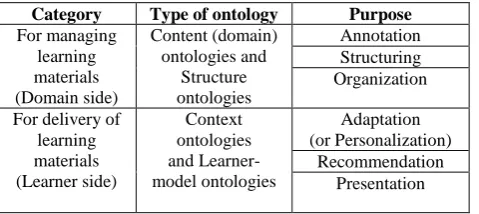
Ontologies have proven their success in many application domains like Bio-informatics and E-commerce. In recent research trend the ontologies are being used in educational domain for semantic annotation of learning objects, personalization, adaptation and recommendation of learning material.
Table 1. Applications of ontology in educational domain
Category Type of ontology Purpose
For managing learning materials (Domain side)
Content (domain) ontologies and
Structure ontologies
Annotation Structuring Organization
For delivery of learning materials (Learner side)
Context ontologies and Learner-model ontologies
Adaptation (or Personalization)
Recommendation Presentation
The reason for using ontological approach in personalization is: it consists of powerful mechanism to support for keyword based search and advanced personalized search options. Ontology has been a basis for the construction of a user model [7] in several personalized systems ranging from information delivery systems to Intelligent Tutoring Systems [8].
Ontology is a machine-processable representation of concepts so that the ontology based e-learning model can be formally represented with well known semantic supportive standard languages like Resource Description Framework (RDF) model and Web Ontology Language (OWL). The semantic supportiveness of ontology representation languages is as shown in “Figure.1”.
Fig 1: Languages for formal representation of ontology
4.
LEARNER ONTOLOGY
The e-learning materials are authored by different people with different goals, for various purposes and with different domain expertise. These learning materials are accessed by learners which differ in a wide range of characteristics, requirements and preferences.
In e-learning systems the learner preferences from the perspective of learning domain and educative support information, plays an important role to implement successful educational applications.
We are interested here, to achieve an ontological orientation to represent learner preferences so that it will be very important, that such ontology is going to capture all the details related to learners learning scenario.
The most common preferences or requirements of learner during accessing learning material consists of mainly two strategies like; the learning material must be related to his learning domain and related to his learning style.
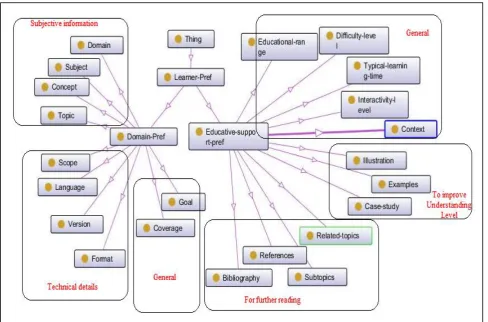
The learner ontology as shown in “Figure.2” is created in order to facilitate the extraction of the learner’s personal educative preferences and interests under the context of particular domain.
4.1
Domain specific preferences
Domain preferences of e-learner consist of content specific needs of learner in learning area. We believe that learner preferences are mainly concerned to subjective and technical supportive along with general preferences of concerned domain.
4.2
Educative support preferences
The Preferences that support to enrich the knowledge or understanding level of learner can be considered as Educative support preferences. As shown in “Figure.2” Educative support preferences mainly consist of preferences that improve understanding level of learner and for further reading.
The ontological representation of these preferences in personalized e-learning system provides the support to deliver the educational material as per the preferred modality of learner.
Educative-support Information is an important requirement to be incorporated in educational metadata standards that helps learner to understand well about the topic or concept through referring different supportive materials such as examples, references and application scenarios [9].
[image:2.595.55.284.383.548.2]Fig 2: Learner preferences ontology for personalized e-learning system
5.
LEARNING MATERIAL
DESCRIPTION SCHEMA
Learning materials are meant to be reusable in different contexts by different users. These learning materials must be associated with suitable descriptions, so that they can be easily searchable and manageable.
The learning material repositories allow the learner to search and retrieve learning materials from the repository. The search engine returns the learning material based on given input keywords.
The learner may need to search specific learning materials according to his personal requirements and preferences, which needs the learning repositories to allow advanced search options.
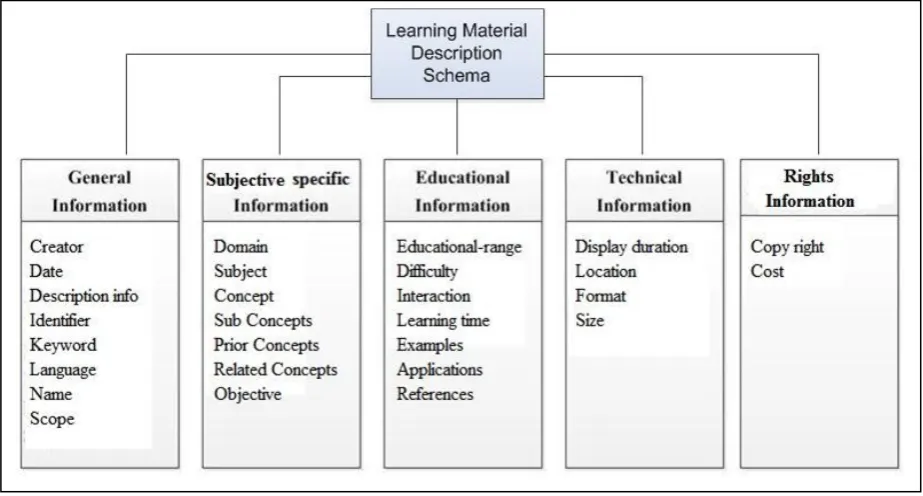
Here, five categories of learning material description information are proposed as shown in “Figure.3”. These metadata information needs to be considered while developing the domain ontology for e-learning materials as well as it is also useful for specific management needs of learning material to support advanced search.
The learning material repository must allow the users for browsing through the learning material as well as it must support simple keyword based search and advanced search to meet the specific needs and preferences of e-learner.
5.1
General information
It gives primary details of learning material and to support keyword based search approach.
5.2
Subjective specific information
Incorporating the subjective specific details in domain ontology make the search engine to find more suitable and related topics to given query.
5.3
Educational information
This information is for searching the supportive learning material of search topic such as examples, applications and concerned references of topic.
5.4
Technical information
Learner can get learning material with preferred technical details such as location, size and format. For example, the learner can search for his learning style formats like video, audio, animation, text etc.
5.5
Rights information
Fig 3: Categories of learning material description information
Fig 4: An ontological representation for Technical information
The “Figure.4”shows the partial ontological representation for Technical information from the proposed five categories of learning material description schema. The ontology shows various classes (concepts) and concerned relations along with the data type properties of concepts.
Fig 5: Partial OWL representation of Technical information
The “Figure.5”shows partial Web Ontology Language (OWL) representation of Technical information concerned to five categories of description schema.
<rdf:RDF
xmlns:owl ="http://www.w3.org/2002/07/owl#"
xmlns:rdf ="http://www.w3.org/1999/02/22-rdf-syntax-ns#" xmlns:rdfs="http://www.w3.org/2000/01/rdf-schema#" xmlns:xsd ="http://www.w3.org/2001/XLMSchema#">
<owl:Ontology rdf:about="Technical information"> <rdfs:comment>Domain Ontology</rdfs:comment> </owl:Ontology>
<owl:Class rdf:ID="Location">
<rdfs:subClassOf rdf:resource="#Technical"/> </owl:Class>
<owl:ObjectProperty rdf:ID=" isLocationIn"> <rdfs:domain rdf:resource="#Technical"/> <rdfs:range rdf:resource="#Location"/>
<rdfs:Datatype rdf:about="http://www.w3.org/1999/02/22-rdf-syntax-ns#XMLLiteral">
</owl:ObjectProperty> ---
6.
PROPOSED SYSTEM
ARCHITECTURE
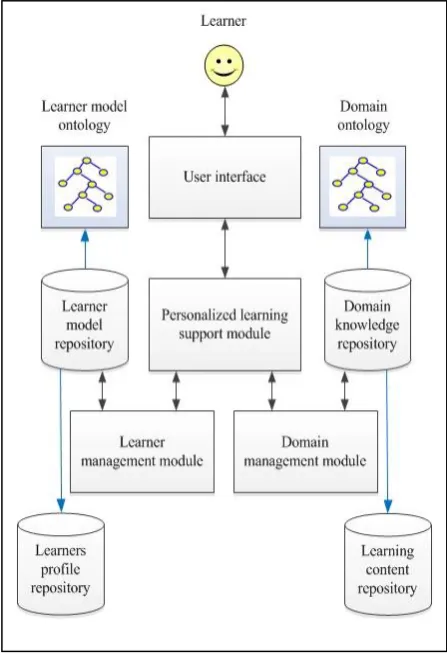
The success of any e-learning system depends on the organization of learning material with specific metadata and the retrieval of relevant learning material. We are proposing an adaptive e-learning system architectural overview, which tries to provide learning materials according to the learner’s preferences as shown in “Figure.6”.
The proposed architectural model consists of Ontology-driven learning repository and learner-model. The intuitive interface supports efficient navigation and search capability for accessing the preferred learning materials. It is assumed that the domain-model and learner-model of the system is being formally represented with ontology.
The functionality of various components in the proposed architectural model is:
6.1
Content (Domain) management
module
It provides an environment for updating, maintains extension of the contents in repositories, sequences access to the educational material and it also acts as an interface between repository and personalized learner module.
6.2
Learner management module
It performs managing the registration process of e-learner, monitoring of learning process, recording of user’s activities and generation reports.
6.3
Domain Ontology
When learning materials are stored in a database, without external domain knowledge other than the database itself, it can be difficult to decide what a learning material is supposed to mean and for what requirements or preferences of learner it can be delivered. So the learning material must be accompanied with concerned domain ontology.
6.4
User model ontology
The ontology based learner model, for personalized learning environment have explicit representation of semantics using ontologies. The ontologies can be reasoned by the available logic inference engines. This ontology classes contains a wide categorization details provided by learner through user interface, from learner profile and from external learning environment detection service.
6.5
Personalized learning support
module
[image:5.595.316.540.72.400.2]The personalized learning support module takes the metadata annotated learning material and the domain knowledge as the input from domain-management module. It checks whether the documents are relevant to the user’s preferences and to the input query.
Fig 6: Architectural overview of proposed system
7.
EXPERIMENTAL EVALUATION
To evaluate the proposed prototype approach, we have implemented a web-based prototype in research center of computer science department in Dr M G R University, Chennai.
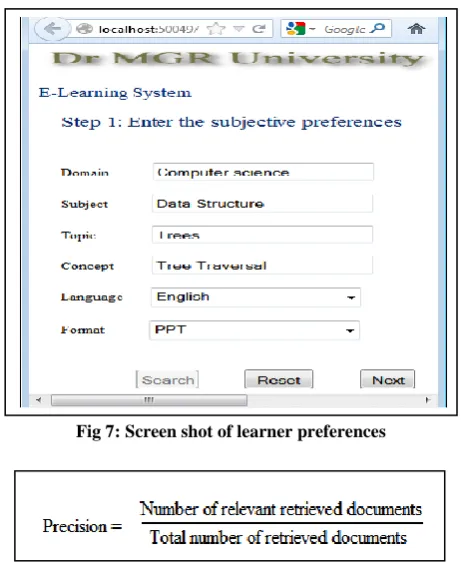
The screen-shot of implemented system for entering learner preferences is as shown in “Figure.7”.
The study of evaluation approach was organized on different subjects of the same branch, to retrieve concerned learning materials. The retrieved contents are ranked based on their similarities to the given query and concerned subject.
The proposed system is analyzed through the calculation of information retrieval metric “precision” to measure its performance. Experiment is performed through Intranet and using local university database as Data-set for learning materials.
Fig 7: Screen shot of learner preferences
The analytical graph of the measured precision for the proposed system is as in “Figure.8”, it shows only for six subjects of computer science department. In each subject the average precision is calculated for ten different topics that have been searched.
The graph shows that there is considerable improvement in precision with the use of proposed system to compare with direct search approach.
Fig 8: Comparison of precision for various subjects
8.
CONCLUSION
In this paper we proposed the learner-model, categories of metadata information for e-learning domain ontologies and architecture of ontology-based personalized e-learning system.
The proposed ontology based learner-model is aimed to simulate learner Domain specific preferences and Educative support preferences for Personalized accessing of learning materials in e-learning domain.
primary details for developing an ontological representation of e-learning materials.
Finally, the architecture model is proposed under the assumptions and scope of ontology based approach. It consists of domain ontology for organizing learning materials and learner-model ontology to manage the personalized delivery of learning material.
9.
REFERENCES
[1] Sieg, A., Mobasher, B., and Burke, R. (2007). Learning ontology-based user profiles: A semantic approach to personalized. IEEE Intelligent Informatics Bulletin, 8(1):7–17.
[2] Ribeiro, C. M. F. A., Rosa, N. S., Cunha, P. R. F., An Ontological Approach for Personalized Services., in: Proceedings of the 20th International Conference on Advanced information Networking and Applications (AINA'06), v. 2, pp. 729-733
[3] D. Vallet, I. Cantador, M. Fernandez, and P. Castells. “A Multi- Purpose Ontology-Based Approach for Personalized Content Filtering and Retrieval,” Proceedings of the First International Workshop on Semantic Media Adaptation and Personalization (SMAP '06). IEEE Computer Society, Washington, DC, USA, pp. 19-24.
[4] M. A. Ramadhanie, S. Aminah, A. N. Hidayanto and A. A. Krisnadhi, Design and Implementation of Learning Object Ontology for e-Learning Personalization, International Conference on Advanced Computer Science and Information System, pp. 428-433, 2009.
[5] Aroyo, L., Denaux, R., Dimitrova, V., Pye, M. (2006). Interactive Ontology-Based User Knowledge Acquisition: A Case Study. European Semantic Web Conference, 560–574.
[6] Chih-Ming Chen, Hahn-Ming Lee, and Ya Hui Chen. Personalized e-learning system using item response theory. Computers & Education, 44(3):237{255, April 2005.
[7] Middleton, S. E., Alani, H., Shadbolt, N. R., and Roure, D. C. D. (2002). Exploiting synergy between ontologies and recommender systems. Proceedings of Semantic Web Workshop 2002 At the Eleventh International World Wide Web Conference, 41–50.
[8] Dicheva D., Aroyo, L. (2000). An approach to intelligent information handling in webbased learning environments. Proceedings of International Conference on Artificial Intelligence, CSREA Press, 1327–1333.
[image:6.595.52.281.462.648.2]