Face Recognition System with various Expression
and Occlusion based on a Novel Block Matching
Algorithm and PCA
Shermina.J
Department of Information Technology Kalasalingam University
India
V.Vasudevan
HoD, Department of Information Technology Kalasalingam University
India
ABSTRACT
Face recognition has acquired abundant attention in market and research communities, but still remained very accosting in real time applications. It is one of the various techniques used for identifying an individual. The major factors affecting the face recognition system are pose, illumination, identity, occlusion and expression. The image variations due to the change in face identity are less than the variations among the images of the same face under different illumination, expression, occlusion and viewing angle. Among the several factors that influence face recognition, illumination and pose are the two major challenges. Next to pose and illumination, the major factors that affect the performance of face recognition are occlusion and expression. So in order to overcome these issues, we proposed an efficient face recognition system based on partial occlusion and expression. The similar blocks in the face image are identified. Then the occlusion can be recovered using the block matching technique. Expression detected by extracting the EMD feature and ANN is combined with the proposed method to provide an effective recognition technique. Finally, the face can be recognized by using the PCA. From the implementation result, it is proved that the proposed method recognizes the face images effectively.
General Terms
Occlusion Detection, Expression, Hybridization, Block matching Algorithm, Principal Component Analysis
Keywords
Face recognition, Occlusion Detection, Expression, Block matching Algorithm, Principal Component Analysis (PCA).
1.
INTRODUCTION
Biometric technologies have been evolved as an enchanting solution to perform secure identification and personal verification.It replaces the traditional authentication methods that are easily stolen, forgotten or duplicated. The commonly used biometric features are face, iris, fingerprints and voiceprints. Among all the recent biometric techniques, face recognition systems have received the most attention due to the non intrusion nature of the person involved in recognition. It is more convinient to users when compared to other individual identification methods of biometric features. It involves pattern recognition, image processing, intelligent learning and so on [1]. Face recognition technologies have been improved significantly during the past few decades, and thus become an effective tool for automatic access control and video surveillance.
Face recognition, a kind of biometric identification, researched in several fields such as computer vision, image processing, and pattern recognition is a natural and direct biometric method [2]. Automated methods that use facial features as essential elements of distinction to determine identity are involved in the process of facial recognition. The recognition performance thoroughly degrades with pose and lighting variations [3]. Face recognition involves categorization of extremely confusing multi dimensional input signals, and matching them with the known „signals‟ and it is an extremely complicated type of pattern recognition. A prohibitively large numbers of training samples are required for classifying a pattern with high dimensions. Humans commonly identify individuals by their face, and automatic face recognition is now possible because of the developments made in the computing capability over the past few decades. Information security, law enforcement and surveillance, smart cards, access controls are some of the areas of applications for face recognition [4], [5], [6]. Face images of a single person is subjected to have considerable differences with faces of different persons, in which face recognition have ambitious challenges. The facts that integrate facial expressions, illumination conditions, pose presence or absence of eyeglasses and facial hair causes such disparities [7], [8]. Throughput, ease, and non-invasiveness are the main advantages of face recognition.
A live face image is captured and compared with the stored images by the face recognition system. A face is basically a 3D object amidst random background objects lighted by diverse lighting sources from several directions. Because of this, when a face is projected against a 2D image its appearance varies remarkably [9]. Major changes in 2D appearance are also caused by diverse pose angles. Capability of figuring out identity in spite of such changes in appearance that a face can have in a setting is needed for robust face recognition. At the same time problems like noise, camera distortion or image resolution should not affect the working of the system.The variation caused by factors such as occlusion, illumination, expression, pose, accessories and aging produces a performance drop in all the face recognition algorithms [10].
practical face recognition [12]. Sources of occlusion include eyeglasses, hats, scarves and objects like cell phones placed to cover part of the face. Different expressions like happy, sad, angry or surprise can affect the performance of face recognition. Robustness to occlusion is therefore essential in real time face recognition. The rest of the thesis is structured as follows: section 2 describes the literature survey and face recognition approaches. Section 3 described about an efficient face recognition system based on occlusion and expression condition. Experimental results and discussion are given in Section 4 and finally, the conclusion is provided in Section 5.
2.
RELATED WORKS
Illumination, Occlusion, Expression and pose are the main confronts to face recognition out of the diverse factors that affect face recognition. In that, occlusion and expression variation considerably reduces the performance of recognition. So to tackle this problem, the face with different occlusions and expression is recognized under by our proposed system. Few expression based and occluded face recognition approaches have been proposed earlier.
Xiaoyang Tan et al.[13] deals with the uncooperative persons who deliberately change the appearance of the face through variant expressions or by partial occlusions with the concept of similarity matching. Perception-inspired nonmetric partial similarity measure is used in dealing with the concerned problems because it can help capture the prominent partial similarities that are dominant in human perception.
De Marsico et al.[14] proposed a face recognition for occlusions and expression variations. It is based on the concept of partitioned iterated function systems(PIFS) which compute a map of self-similarities within the whole input face image and search for the relation among small square regions. Algorithms of this kind suffer from local distortions such as occlusions. To overcome this, information extracted by PIFS is made local by working independently on each face component like eyes, nose, and mouth. Distortions are further reduced by means of an ad hoc distance measure.
Tarrés et al [15] have presented a face recognition method that could be able to manage with partial occlusion or variations in face expression. Their method solves the face recognition problem from a near holistic perspective. The concept behind this approach was to eliminate the few features that cause reduction in recognition accuracy under variations in occlusion or expression.
Aleix M. MartõÂnez [16] has described a probabilistic approach that was able to compensate for imprecisely localized, partially occluded, and expression-variant faces even at one single training sample per class was available to the system. For solving the localization problem, they found the subspace (within the feature space, e.g., eigenspace) that represents their error for each of the training images. To determine the occlusion problem, each face was divided into k local regions which are analyzed in isolation. In contrast with other approaches where a simple voting space is used, they presented a probabilistic method that analyzes how good a local match was.
Dibeklioglu et al. [17] have proposed that automatic localization of 3D facial features was important for face recognition, tracking, modeling and expression analysis. approaches developed for 2D images were shown to have problems working across databases acquired with different illumination conditions. Expression variations and occlusions
also hinder the accurate detection of landmarks. Their algorithm could be employed to model any facial landmark, provided that the facial poses present in the training and test conditions were similar. They have tested their algorithm on the recently acquired Bosphorus 3D face database, and also inspected cross-database performance by using the FRGC database. Then, a curvature-based method for localizing the nose tip was introduced and found to perform well under severe conditions.
Kepenekci et al [18] have proposed an approach to feature based frontal face recognition using Gabor wavelets. The features were automatically extracted using the local characteristics of each individual face in order to decrease the effect of occluded features. There were no training as in neural network approaches, thus single frontal face for each individual was enough as reference.
Tae Young Kim et al. [19] have proposed a method that uses 2D PCA for occlusion invariant face recognition. It projects a 2D image directly into the 2D PCA subspace. Each row of the resulting feature matrix exhibits the distribution of corresponding row of the image. So by allocating each row of the feature matrix independently, they could easily identify the locally occluded parts in a face image. Occlusion detection and partial matching are involved in occlusion invariant face recognition algorithm. To identify the occluded regions, the combined k-NN and 1-NN classifier is applied to each row of the feature matrix of the test face. In partial matching, after removing the rows identified as the occluded parts, the similarity between the feature matrices was evaluated.
Dahua Lin and Xiaoou Tang [20] have proposed a method to detect and recover the occluded facial region automatically. It frees the user from marking the occlusion area by incorporating an automatic occlusion detector, that learns a face quality model as a criterion to guide the whole procedure and it couples the detection and occlusion stages to achieve accurate occlusion detection and high quality recovery simultaneously.
Kazuhiro Hotta [21] has presented the use of Support Vector Machine (SVM) with local Gaussian summation kernel for robust face recognition under partial occlusion. Because conventional methods apply one kernel to global features and global features were influenced easily by noise or occlusion, the conventional methods are not robust to occlusion. The recognition method based on local features, was robust to occlusion because partial occlusion affects only specific local features. In order to utilize their property of local features in SVM, local kernels were applied to local features. The effectiveness and robustness of their method are shown by comparison with global kernel based SVM.
3.
RECOGNITION METHOD BASED
ON OCCLUSION AND EXPRESSION
Let D be a database containing N number of images,
I1,I2,...
,IN
and let I be a database image of sizeRS.D
, After inputting an image from the databaseD
, the user must specify the type of the image i.e., whether it is occluded, expression invariant or both occluded and expression invariant. Depending on the image category specified by the user, one of the following three processes is executed by the system.If the image category is occlusion, then we must perform the occlusion recovery first and then recognize the image using PCA. If the image category is expression invariant, then we must perform the expression invariant process first and then recognized by using the PCA. If the image contains both occlusion and expression, then the occlusion can be recovered first and then the expression invariant process is performed.
3.1
Occlusion detection using block
matching process
Let I be the image in the database, the occlusion can be
recovered by employing the block similarity measure scheme. For block matching process the image can be divided into number of NN non overlapping blocks. This can be represented as
Ib
Ib
Ib
Nb
I
1,
2,
,
(1)
where
Nb
represents the total number of blocks in the image.Similar block identification
The common type of region matching method is called as block-based motion estimation which uses rectangular blocks for motion estimation. Motion estimation is nothing but the process of obtaining the displacement of the block of pixels between the two images. This displacement is obtained by searching for the matching block which is done by Block Matching Algorithm (BMA). Moreover, Block Distortion Measure (BDM) gives the level of correlation between the blocks. All the pixels within a block are assumed to have identical motion activity by BMAs. In our proposed work, a novel block matching algorithm is described for discovering occlusion.
When we divide the image into block by block, some of the blocks are similar. To identify these similar blocks, we are using block matching algorithm. These block matching algorithms are normally used in video compression scheme to estimate the motions between the frames. Here the block matching algorithm is used to detect the occlusion in the face image. The Euclidean distance measure is used to calculate the similarity between the images.
For block matching process, we must compare each and every block of the query image and the images in the database. Let
q
be the query image then we must divide the query image into block by block as described below.
qb
qb
qb
Nb
q
1,
2,
,
(2)
Then compare each block of the query image and the image in the database by employing Euclidean distance measure. This can be described as follows.
2
a aa
Ib
qb
Ed
(3)
Here
a
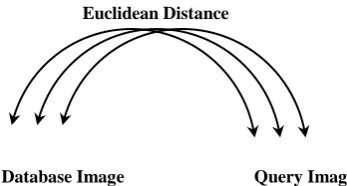
is the total number of blocks in the image. This block matching process can be described in the following figureEuclidean Distance
[image:3.595.333.507.132.225.2]Database Image Query Image
Fig.1: Block matching process
After calculating Euclidean distance between each block of two images, we perform soft thresholding technique to remove the occlusion. The pseudo code for soft thresholding is given as follows:
If Edi thresh then Replace Ibiwithqbi
End if
This soft thresholding will recover the occlusion in the image. If
0
i Ed
, both the blocks are similar. Otherwise there is a occlusion in the query image. So the occluded block is replaced by the original block in the database image. After identifying the occlusion we must extract certain features in an image.
3.2
Expression identification using EMD
If the input image is the expression image, then we must normalize the expression to get the original expression free image. Then only it is easy for recognition process. For that we must calculate the EMD for each block of the image with expression.Frequency Feature
After identifying the occlusion using similar blocks in the face image, we can normalize the facial expression by extracting the feature from each block and stored it in a separate array. Here we extract the Frequency feature from each block i.e., we can calculate EMD for each block. By employing Empirical Mode Decomposition (EMD) the frequency feature can be extracted [23]. N. Huang [24] recently introduced a technique that decomposes a signal into a sum of components, each with slowly varying amplitude and phase. Once one has a signal represented in such a form, using the Hilbert Transform one may analyze the properties of each component. Every component of the EMD is called an Intrinsic Mode Function (IMF). The two criteria will satisfy the IMFs, as modes, so that they will resemble a generalized Fourier decomposition.
The number of extrema and zero-crossings in the dataset must be either equal or differ at the most by one. The mean value of envelope defined by the local maxima and the envelope defined by the local minima is zero.
More specifically, a real valued input signal is represented byX(k), and then the application of EMD generates a set of
M IMFs
M j j k IMF 1 ) (
, such that
M
j
j res k
IMF k X 0 ) ( ) ( (4)
Where the residual res(k) is a monotonic function and it represents the trend within the original signal. The following algorithm gives the method that is used for the extraction of
IMF from the signal
x
'
(
k
)
.The set of IMFs is initially defined as
M
(empty set).Find the locations of all extrema of
x
'
(
k
)
.a)
x
'
(
k
)
X
iIIMF
i b) Computek
th IMF (sifting).i) Interpolate between all the minima using cubic spline interpolation to obtain the signal envelope passing
through the minima
e
min(
k
)
(resp.e
max(
k
)
).ii) Compute the local mean of these
envelopes
m
(
k
)
e
min(
k
)
e
max(
k
)
/
2
.iii) Subtract x'(k) from the mean m(k) to obtain the oscillating signal
s
(
k
)
x
'
(
k
)
m
(
k
)
.iv) If the resulting signal
s
(
k
)
obeys the stopping criterion, IMF(k)s(k) becomes IMF.v) Otherwise set
x
'
(
k
)
s
(
k
)
and repeat the process from steps i to v.c) x'(k) is added to set
M
.The stoppage criterion used in the final step can be, for instance, the normalized squared difference between two
successive sifting iterates
s
pre(
t
)
ands
cur(
t
)
, that is
T t pre cur pre t s t s t s SD 0 2 ) ( ) ( ) ( (5)Where T represents the total number of samples in the
original series, and the empirical value of SD is using a set within the range (0.2-0.3). Upon obtaining an IMF, the same procedure is applied to the residual
signal
res
(
k
)
x
'
(
k
)
IMF
(
k
)
to extract the next IMF. The process is continued until all the IMFs are extracted and no other oscillations are carried in the remaining signal, illustrated by an insufficient number of extrema. From theelement with high frequency the IMFs are successively obtained. Hence, the residual signal
res
(
k
)
has the lowest frequency. Then, for evaluating the imaginary part Hilbert Transform is employed. The Hilbert Transform is used to obtain Y(t) from X(t) as follows
t
d
X
p
t
Y
(
)
1
(
)
(6)
where
P
indicates the Cauchy principal values. Then the analytical signal Z(t) is) (
)
(
)
(
)
(
)
(
t
X
t
iY
t
t
e
i tZ
(7)where
(t) is the amplitude of Z(t) and
(
t
)
is its phase given as follows2 1 2 2
(
)
(
)]
[
)
(
t
X
t
Y
t
(8) ) ( ) ( arctan ) ( t X t Y t
(9)The instantaneous frequency
(t) is derived from(t).dt t d
()
(10) In Hilbert transform, the signal ought to comprise a single frequency or a narrow band of frequencies. The IMF is a narrow band signal. With the Hilbert spectrum already
defined, the marginal spectrum
h
(
)
can also be defined as follows
Tdt
t
H
h
0)
,
(
)
(
(11) A Spectrum that is calculated using the IMF is called a Hilbert Huang spectrum and it is defined by the following equation. otherwise 0 (t) ) ( ) ,
(t
t
H(12)
Here we can generate a Hilbert spectrum contour plotH(t,
), which displays the amplitude (z- axis) as the function of time and frequency. The spectrum H is qualitative, but certain integral quantities provide statistics. After calculating the EMD for each block, stored it in a separate array. Then based on these EMD value we can restore the original image from the database. This can be done by using the Euclidean distance measure.3.3
Normalization of images with both
occlusion and expression
stored in a separate array. Here the size of the array is huge. So for recognition process we must reduce the dimensionality. For that we use PCA based recognition.
3.4
Recognition using Principal
Component Analysis
By using the Principal Component Analysis (PCA), the normalized images can be recognized. Numerous possibly correlated variables are transformed into a smaller number of uncorrelated variables by a mathematical method known as principal components by PCA [25]. Compute the eigen-faces from the training set by obtaining an initial set of
R
normalized images (the training set) andR
'
Eigen faces that correspond to the highest Eigen value are preserved. The average face for a given training set of imagesR
1,
2,
,
can be defined as,
Rn n
R
11
(13) The vector by which each face differs from average is
ii
(14)
Covariance matrix is obtained as,
R
n
T T
n
n A A
R CV
1
1
(15)
where the matrix
A
[
1,
2,
,
R]
. A set ofR
orthonormal vectorsu
1,
u
2,
,
u
R is searched by principal component analysis from this set of large vectors. The face image is converted into its eigen-face components projected onto the face space by an easy process to achieve a weight vector
of contributions of distinct eigen-faces to a facialimage
,
(
)
T k
k
u
(16)For
k
1
,
2
,
,
R
'
where R'R is the number of Eigen-faces utilized for recognition. Treating the Eigen-Eigen-faces as a basis set for face images, the weights from vector]
,
,
,
[
1
2
R
that illustrates the involvement ofeach Eigen-face in representing the face image
. Findingthe image
k
that minimizes the Euclidean distance
kis the easiest technique for identifying the face that provides the best description of an unknown input facial image.
2k
k
(17)
where kis a weight vector that depicts the kth face from
the training set. If
k is less than certain selected threshold
then the face is categorized as that of the personk
otherwise it is categorized as an unknown face. Thus theproposed method will effectively recognize the face images with both occlusion and expression.
4.
RESULTS AND DISCUSSIONS
The proposed novel face recognition approach is implemented in Matlab (7.10) and face recognition was performed using the set of Yale Database and JAFFE database under various expression and occlusion conditions. The results show that our approach has an encouraging performance.
4.1
Databases
The Japanese Female Facial Expression (JAFFE) Database
The database contains 213 images of 7 facial expressions posed by 10 Japanese female models. Each image has been rated on 6 emotion adjectives by 60 Japanese subjects.
Yale Database
[image:5.595.323.532.299.378.2]The database contains 165 GIF images of 15 subjects. There are 11 images per subject, one for each of the following facial expressions or configurations: center-light, w/glasses, happy, left-light, w/no glasses, normal, right-light, sad, sleepy, surprised, and wink.
Fig.2 : Block division process in Yale Database images
[image:5.595.320.537.475.568.2]In our proposed method, we used 2 types of databases which contain the face images with various pose, illumination, occlusion and expression. Fig.3 and Fig.4 represents the images in the both Yale and Jaffe databases. Initially, we must divide the face image into block by block which is represented in the figure.
Fig. 3: Block division process in JAFFE Database images
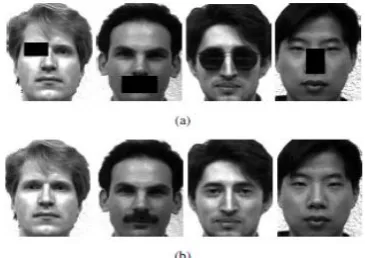
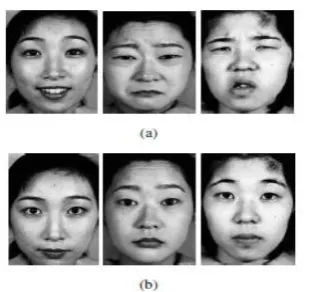
[image:5.595.337.520.597.726.2]If the user input is an occlusion image means then the occlusion recovery process is performed first by employing the block matching algorithm. The occlusion recovered images are shown in fig.5. Like wise the expression can be normalized in fig.6 by using EMD.
Fig. 5: Occlusion recovery process in JAFFE Database a) Occluded images b) Occlusion recovered images
Fig. 6: Expression Normalization process in Yale Database a) Images with various expression b) Expression
Normalized images
[image:6.595.78.255.131.278.2]
Fig.7 : Expression Normalization process in JAFFE Database a) Images with various expression b) Expression
Normalized images
[image:6.595.86.271.324.478.2]The frequency feature is used to normalize the expression in the face image. After the block division process, the EMD feature can be extracted from each block of the image. Fig. 7 represents the feature extraction process.
Fig.8 : EMD Feature extracation process in Yale Database images
4.2
Comparative analysis
The recognition accuracy of the proposed approach is compared with some existing approaches. Computing the false acceptance rate (FAR) and false rejection rate (FRR) is the common way to measure the biometric recognition accuracy. FAR is the percentage of incorrect acceptances i.e., percentage of distance measures of different people‟s images that fall below the threshold. FRR is the percentage of incorrect rejections - i.e., percentage of distance measures of same people‟s images that exceed the threshold. The following equation is used to calculate the accuracy measurement of the overall approach,
2
)
(
100
FAR
FRR
Accuracy
(18) Genuine acceptance rate (GAR) is an overall accuracy measurement of the approach. The following table gives the percentage of the recognition rates and the accuracy rates.
Table I: Comparison results of our proposed hybridized technique with other existing methods.
Methods
Database
Yale Database Jaffe Database
FRR (%)
FAR (%)
Accuracy (%)
FRR (%)
FAR (%)
Accuracy (%)
Face recognition based on
Occlusion 4.18 5.48 96.3
4.75 5.92 95.8
Face recognition based on
Expression 5.37 6.72 95.4 6.02 7.1 94.3
Proposed
[image:6.595.297.549.487.730.2] [image:6.595.89.244.529.675.2]In this table, we calculate the measures for both Jaffe and Yale database. The result shows that our proposed method has a lower value of FAR and FRR error rate in both the databases. Moreover, the proposed system has a higher accuracy compared the other two methods. Yale database gives the better result when compared with the Jaffe database, because it is a small database when compared to the Jaffe database and also the Jaffe database contains more expression images than Yale. Normally expression image is more difficult to recognize than occluded image. So Yale database gives better accuracy in face recognition system. It is evident that the proposed face recognition system efficiently recognizes the face under various expression and occlusion.
5.
CONCLUSION
In this paper, a face recognition system based on occlusion and expression condition was proposed efficiently. The efficiency of the proposed system is mainly due to the application of hybrid process for face recognition i.e, recognition of the face images which has both occlusion and expression. The occlusion recovery is done by employing an efficient block matching algorithm and the expression can be detected by extracting the EMD feature and ANN. The implementation results showed that the face recognition of the hybridization of partial occlusion and expression method was more effective than the existing method that are either occlusion based or expression based. The results demonstrated the effectiveness of the proposed approach with improved recognition accuracy.
6.
ACKNOWLEDGMENTS
I express my sincere thanks to Dr.V.Vasudevan for providing the guidance in the approach used in the concept of hybridization of Expression and Occlusion.
7.
REFERENCES
[1] Hongzhou Zhang, Yongping Li, Lin Wang and Chengbo Wang, "Pose insensitive Face Recognition Using Feature Transformation", IJCSNS International Journal of Computer Science and Network Security, VOL.7 No.2, February 2007.
[2] Anil K. Jain, Arun Ross, and Salil Prabhakar, “An Introduction To Biometric Recognition”, IEEE Transactions On Circuits And Systems For Video Technology, Vol. 14, No. 1, Jan. 2004.
[3] Zhiwei Zhu and Qiang Ji, "Robust Pose Invariant Facial Feature Detection and Tracking in Real-Time", In proc. of the 18th International Conference on Pattern Recognition, pp.1092-1095, 2006.
[4] Shang-Hung Lin, "An Introduction to Face Recognition Technology", Informing Science Special Issue on Multimedia Informing Technologies, Vol.3, No. 1, 2000. [5] Gregory Shakhnarovich and Baback Moghaddam, "Face
Recognition in Subspaces", Springer, Heidelberg, May 2004.
[6] Zhao, W. Chellappa, R., Phillips, P. J. and Rosenfeld, A., “Face Recognition: A Literature Survey”, ACM Computing Survey, pp. 399-458, Dec 2003.
[7] Florent Perronnin, Jean-Luc Dugelay and Kenneth Rose, "A Probabilistic Model of Face Mapping with Local Transformations and Its Application to Person Recognition", IEEE Transactions on Pattern Analysis and Machine Intelligence, Vol. 27, No. 7, July 2005.
[8] R. Chellappa, C. Wilson, and S. Sirohey, “Human and Machine Recognition of Faces: A Survey,” In Proc. of the IEEE conference, vol. 83, No. 5, pp. 705-740, May 1995.
[9] N.V.S.L. Swarupa and D.Supriya, "Face Recognition System" ,International Journal of Computer Applications, Vol. 1,No. 29,pp.36-41,2010.
[10] Hazim Kemal Ekenel and Bulent Sankur, "Multiresolution face recognition", Image and Vision Computing, Vol.23, pp.469-477, 2005.
[11] Hongjun Jia and Aleix M. Martinez, “Support Vector Machines in Face Recognition with Occlusions”, Computer Vision and Pattern Recognition - CVPR , pp. 136-141, 2009
[12] Zihan Zhou, Andrew Wagner, Hossein Mobahi, John Wright and Yi Ma, “Face RecognitionWith Contiguous Occlusion Using Markov Random Fields”, In Proceedings of ICCV'2009, pp.1050-1057 , 2009. [13] Xiaoyang Tan, Songcan Chen, Zhi-Hua Zhou and
Jun Liu, “Face Recognition Under Occlusions and Variant Expressions With Partial Similarity”, Information Forensics and Security, IEEE Transactions, Vol. 4, Issue 2, pp.217-230,2009
[14] De Marsico, M. Nappi, M. Riccio, D., “Face Recognition Against Occlusions and Expression Variations”Systems, Man and Cybernetics, IEEE Transactions, Vol.40, Issue 1, pp. 121-132, 2010 [15] F. Tarrés, A. Rama, L. Torres, "A Novel Method for
Face Recognition under Partial Occlusion or Facial Expression Variations", In proc. of the 47th International Symposium (ELMAR-2005) on Multimedia Systems and Applications, Zadar, Croatia, June 2005.
[16] Aleix M. MartõÂnez, "Recognizing Imprecisely Localized, Partially Occluded, and Expression Variant Faces from a Single Sample per Class", IEEE Transaction on Pattern Analysis and Machine Intelligence, Vol.24, No.6, pp.748-763, 2002.
[17] Dibeklioglu, H., Salah, A.A. and Akarun, L.,"3D Facial Landmarking under Expression, Pose, and Occlusion Variations", In proc. of the IEEE International Conference on Biometrics Theroy, Applications and Systems, Arlington, pp.1-6, 2008.
[18] B. Kepenekci, F. B. Tek, and G. B. Akar, "Occluded face recognition by using gabor features", In proc. of the 3rd COST 276 Workshop on Information and Knowledge Management for Integrated Media Communication, Budapest, pp. 1-6,Oct. 2002.
[19] Tae Young Kim, Kyoung Mu Lee, Sang Uk Lee, and Chung-Hyuk Yim, "Occlusion Invariant Face Recognition Using Two-Dimensional PCA", Advances In Computer Graphics and Computer Vision, Vol.4,No.8,pp.305-315,2007.
[20] Dahua Lin and Xiaoou Tang, "Quality-Driven Face Occlusion Detection and Recovery", In Proc. of the IEEE Conference on Computer Vision and Pattern Recognition, pp.1-7, 2007.
Gaussian summation kernel", Image and Vision Computing, Vol.26, No. 11, pp.1490–1498, 2008. [22] Hyun Jun Oh, Kyoung Mu Lee and Sang Uk Lee,
"Occlusion invariant face recognition using selective local non-negative matrix factorization basis images", Computer Vision, Vol.3851,pp.120-129,2009.
[23] Naveed ur Rehman and Danilo P. Mandic, "Empirical Mode Decomposition for Trivariate Signals", IEEE Transactions On Signal Processing, Vol. 58, No. 3, pp.1059-1068, March 2010.
[24] N. E. Huang, Z. Shen, S. R. Long, M. C. Wu, H. H. Shih, Q. Zheng, N. C. Yen, C. C. Tung and H. H. Liu, "The empirical mode decomposition and the Hilbert spectrum for nonlinear and non-stationary time series analysis", In Proc. of the Royal Society of London. Series A: Mathematical, Physical and Engineering Sciences, Vol. 454, No. 1971, pp. 903-995, 1998.