An Analysis on LEACH-Mobile Protocol for Mobile
Wireless Sensor Networks
Renugadevi G.
PG Student, Department of ECE Bannari Amman Institute of TechnologyTamilNadu
Sumithra M.G.
Professor of ECE Department Bannari Amman Institute of TechnologyTamilNadu
ABSTRACT
LEACH and centralized LEACH has demonstrated the possibility of achieving good efficient routing path for wireless sensor network. By taking into consideration the mixed sensory fields with fixed and mobile nodes in a sensor field LEACH and LEACH-C are not appropriate to support mobile sensor nodes. The enclosure of mobility as a new criterion for the cluster creation and maintenance adds new challenges for these clustering schemes. The Mobile LEACH protocol is suitable for mobile wireless sensor networks, which provides a highly adaptive routing scheme to deal with clusterhead selection and frequent topology changes. In this paper the performance of LEACH- Mobile protocol is evaluated and compared with the LEACH protocol based on metrics such as energy consumed, number of alive nodes, packet delivery ratio and packet loss.
General Terms
Protocol, Clustering, Mobility, Mobile wireless sensor network, Stability.
Keywords
Energy consumption, Lifetime, LEACH, TDMA, Residual energy, Homogeneous.
1.
INTRODUCTION
The rapid evolution of wireless technologies and the significant growth of wireless network services have made wireless communications a ubiquitous means for transporting information across many different domains. Within the framework of Wireless Sensor Networks (WSNs), there are many potential possibilities where a WSN can be deployed to support numerous applications [1, 2, 3]. They are mainly used in applications like surveillance, machine failure diagnosis,
nuclear research areas, military environment and
chemical/biological detection. Considering the resource constrained nature of sensor nodes which depend on un-replenished battery source, the energy should be managed properly to ensure maximum lifetime. In order to guarantee low energy consumption and uniform load distribution over the network, sensor nodes are organized into clusters [4, 5]. Many routing protocols were developed to ensure the low energy consumption and prolonged lifetime of the network based on the clustering concept. Most of current research assumes wireless sensor networks to be stationary, however, in some scenarios; wireless sensor networks must be mobile. For instance, in wildlife applications, sensors are cast in the field as well as equipped on animals to be monitored. The self-organized wireless sensor network is mobile as animals are moving around [6]. In telemedicine applications, sensors attached to patients also constitute a mobile wireless sensor network. As expected, the mobile wireless sensor network is more difficult to deal with than its stationary counterpart. The mobility in sensor nodes possesses challenges like available battery power, minimal lifetime, packet loss and energy
consumption [7, 8]. The mobile wireless communication consumes a considerable amount of power, so mobile sensor nodes should spend little energy for receiving and transmitting the data. When there is a quick mobility change in sensor nodes, the network topology has to be reconstructed. For every reconstruction certain amount of energy is consumed. So the protocols used should be energy efficient.
In the paper Heinzelman et al. [4, 5] proposed a solution called Low-Energy Adaptive Clustering Hierarchy to self organizing and limited power problems. Here small numbers of clusters are created in self organized method. The clusterheads are rotated among the sensor nodes by the randomization method. This protocol provided better results when compared to a direct approach. But LEACH protocol is not suitable to support mobile sensor nodes. After the setup phase of each round, the mobility of the node is not considered in this protocol [6]. Due to this reason the network suffers serious data loss.
To overcome this problem Kim et al. [6] projected a new protocol applicable to Wireless mobile sensor networks called LEACH Mobile. The vital concept in LEACH-Mobile protocol is to confirm whether a mobile node is capable of communicating with specific clusterhead within the time slot allotted in TDMA schedule. The node that does not receive a request from its clusterhead during two successive TDMA schedule, can identify that it is out of the cluster. Now moved sensor node can join the new cluster by broadcasting a cluster joint request message for which it will receive cluster joint ack message from the new clusterhead. This can avoid more packet losses in the network.
In this paper we will review the working of the LEACH Mobile protocol and their effect on network performance. The paper is organized as: in section II LEACH Mobile protocol is presented, in section III describes about the simulation environment and simulation results and Section IV is the conclusion.
2.
LEACH MOBILE PROTOCOL
First order radio model [4, 5] is used for LEACH Mobile protocol implementation. The equations to determine the transmission costs and the receiving costs for L-bit message and distance d are,
represented as Pr-thresh. When the received power is lower than the threshold, the packet is discarded since it cannot be detected and received successfully. If the received power is higher than the threshold, the packet detection and reception will be successful.
For the LEACH Mobile protocols following assumption are made:
The sensor network is considered to be
homogenous. The initial energy of the sensors is same.
Every sensor knows its velocity and location.
The base station is stationary and all sensors are time synchronized.
Each sensor node should be able to estimate the time it takes to transmit a packet.
2.1 Working principle
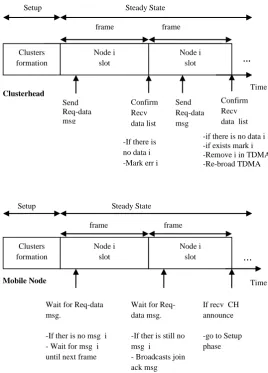
The LEACH-Mobile operation is broken up into rounds. Each round is divided into two phases, namely setup phase and steady state phase. In setup phase clusters are organized and in steady state phase data are transferred to the base station. The vital concept in LEACH-Mobile protocol is to confirm whether a mobile node is capable of communicating with specific clusterhead within the time slot allotted in TDMA schedule. In LEACH algorithm, the clusterhead waits to gather the sensed data from non clusterhead nodes according to TDMA scheduling during the steady state phase. There is a slight modification in steady the state phase of the LEACH protocol to support mobility of nodes. The clusterhead in LEACH mobile first sends the req. message for data transmission to non clusterhead node for gathering the sensed data at each time slot. When the data sensed are sent by non clusterhead nodes, the clusterhead will make the time slot list of nodes from which the data is received according to the TDMA time slot at all the time when a frame ends. It also makes note of the nodes from which the data are not received in the time slot at the end of each frame. If the data is not received again from same node when the next frame ends, then it is considered to be removed from the cluster. The time slot of removed node is assigned to a newly arrived node. The sensor node which is removed is considered as node gone out of cluster region due to mobility. Then the TDMA is rescheduled and transmitted to all cluster members by the clusterhead. The node which moved away from cluster region or the node which didn’t get the req. message for data transmission from the clusterhead for two successive frames should join the new clusterhead. That node will broadcast cluster joint req. message. The clusterhead which receives cluster joint req. message transmits clusterhead advertisement message to that node as a reply. Depending on the signal strength of received clusterhead advertisement message, the node will decide to join the new cluster. After deciding which cluster to join, the node will inform the corresponding clusterhead. The new clusterhead will revise the cluster membership list and TDMA schedule, and then broadcast the new TDMA schedule to its cluster members. The newly joined member works according to the new schedule. Figure 1 shows the time line for a round of the LEACH Mobile Protocol [6]. LEACH Mobile Protocol could be used in mobility centric wireless sensor network as it organizes the
Setup Steady State
frame frame
…
Setup Steady State
[image:2.595.314.583.69.443.2]frame frame
Fig 1: Time line of allocated TDMA time slot for a node
3.
SIMULATION ENVIRONMENT
NS-2 simulator version 2.32 from [14] has been used to analyse the LEACH Mobile protocol. It is a discrete event simulator and one of the popular simulation tools being used for networking research recently. The performance of the LEACH Mobile protocol with is compared with the low energy adaptive clustering hierarchy routing protocol. The metrics considered in evaluating the performance of LEACH Mobile are Average energy consumed, Number of alive nodes, Packet loss and Packet delivery ratio.
Table 1. Simulation Environment Specifications
Parameters Values
Network area 100*100m2
No. of nodes 25, 50,75,100 and125
Base station One (not mobile)
Location of Base station (50,50)
Clusters formation
Node i slot
Node i slot
Time
Send Req-data msg
Confirm Recv data list
Send Req-data msg
Confirm Recv data list
…
Clusterhead
-If there is no data i -Mark err i
-if there is no data i -if exists mark i -Remove i in TDMA -Re-broad TDMA
Clusters formation
Node i slot
Node i
slot
;;;
Mobile Node
Wait for Req-data msg.
-If ther is no msg i - Wait for msg i until next frame
Wait for Req-data msg.
-If ther is still no msg i - Broadcasts join ack msg
If recv CH announce
-go to Setup phase
Time
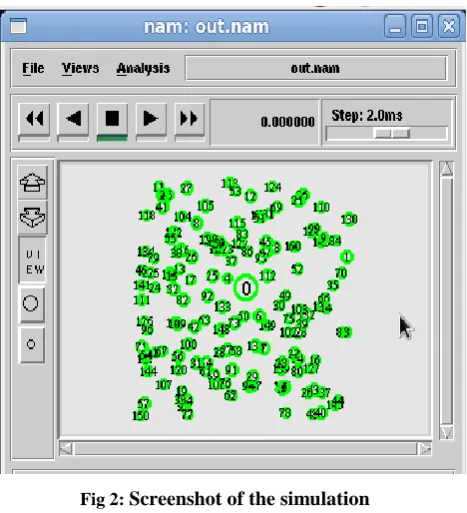
[image:2.595.315.543.631.744.2]The LEACH Mobile and LEACH protocols are simulated for different number of nodes with random topology and 100m*100m network region. In LEACH Mobile except base station all other nodes are mobile and in LEACH scenarios all nodes are considered to be motionless. The initial energy of every node is considered to be 1J and base station has no energy constrain problems. For data fusion energy consumed is 5nJ/bit. Table 1 shows the shows the Simulation Environment Specifications. Figure 2 is the snapshot of the LEACH Mobile simulation.
Fig 2: Screenshot of the simulation
3.1
Simulation result and discussion
The performance of the LEACH Mobile protocol is analysed using parameters such as average energy consumed, alive nodes, packet loss and packet delivery ratio. Figure 3 shows the average energy consumed by sensor nodes in each round in the WSN. Cluster member node wakes up to send the data packet according to TDMA schedule otherwise they are in sleep mode. This can reduce the energy consumption. For LEACH Mobile protocol energy consumed is more when compared to LEACH protocol for each round. This is due to the fact that more control request packets are used in the LEACH Mobile protocol to maintain the network communication. For transmitting these packets extra energy is consumed in the LEACH Mobile protocol than the other one.
0 0.2 0.4 0.6 0.8 1 1.2
0
250 500 750 1000 1250 1500 1750 2000
A
v
g
.
en
erg
y
c
o
n
su
m
ed
i
n
J
No. of rounds
LEACH LEACH-M
Fig 3: Average energy consumed
[image:3.595.54.288.183.440.2]
Figure 4 represents the number of alive nodes at each round of the network. Since energy consumed by the LEACH Mobile is high compared to basic LEACH protocol, the life of nodes reduces quickly in the former for each round.
0 20 40 60 80 100 120
0
250 500 750 1000 1250 1500 1750 2000
N
o
.
o
f
a
li
v
e
n
o
d
es
No.of rounds
LEACH LEACH-M
Fig 4: Number of alive nodes
[image:3.595.318.529.366.528.2]0 20 40 60 80 100
25 50 75 100 125
P
ac
ke
t d
el
ive
ry
ra
ti
o
in
%
No. of nodes
LEACH(m=1) LEACH(m=2)
[image:4.595.56.288.70.274.2]LEACH-M(m=2) LEACH-M(m=1)
Fig 5: Packet delivery ratio
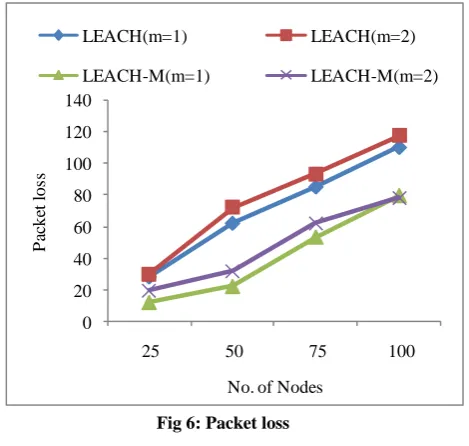
From figure 6 it can be figured out that packet loss is higher for LEACH than LEACH Mobile protocol. In the network of mobile nodes, LEACH protocol leads to more packet loss. For both the protocols, packet loss increases with the increase of mobility and number of nodes.
0 20 40 60 80 100 120 140
25 50 75 100
P
ac
ke
t l
os
s
No. of Nodes
LEACH(m=1) LEACH(m=2)
LEACH-M(m=1) LEACH-M(m=2)
Fig 6: Packet loss
4.
CONCLUSION
As wireless sensor network is used widely nowadays, the energy conservation of WSN is very important. One of the crucial challenges in the organization of the WSNs is energy efficiency and stability because battery capacities of sensor nodes are limited and replacing them is impractical. In some environment, mobility of the sensor nodes is very important. To maintain the lifetime of the network and proper packet transmission, routing protocol should be aware of packet loss
extra control packets. Future works may concentrate on reducing the energy consumption for each round in the LEACH Mobile protocol.
5.
REFERENCES
[1] Akylidiz F., Su W., Sankarasubramanyam Y. and Cayirci E., (2002), “Wireless Sensor Network: a survey”, Computer Networks, vol. 38, Pages 393-422.
[2] K. Akkaya, and M. Younis, “A survey on Routing Protocols for Wireless Sensor Networks,” Elsevier Ad Hoc Network Journal, 3, pp.325-349, 2005.
[3] Sachinpal, Pritika and Amritpal, (2012), “Analyzing the Effect of Clusterhead in Low Energy Adaptive Clustering Hierarchical in Wireless Sensor Network”, International Journal of Computer Applications, Pages 26-29.
[4] Heinzelman W.B., Chandrakasan A.P. and Balakrishnan
H, (2002), “An Application-Specific Protocol
Architecture for Wireless Microsensor Networks”, IEEE Transactions on Wireless Communications, Pages 660-671.
[5] Heinzelman W.B., Chandrakasan A.P. and Balakrishnan
H, (2000), “Energyefficient routing protocols for wireless microsensor networks,” Proc. 33rd Hawaii Int. Conf. System Sciences.
[6] Do-Seong Kim and Yeong-Jee Chung, (2006), “Self-Organization Routing Protocol Supporting Mobile Nodes for Wireless Sensor Network”, Proc. of the First International Multi-Symposiums on Computer and Computational Sciences.
[7] Ekici E., Yaoyao Gu, and Bozdag D., (2006), “Mobility-based communication in wireless sensor networks”, IEEE Communications Magazine, vol. 44, no. 7, Pages 56-62.
[8] Bhagyashri Bansode and Rajesh Ingle, (2012), “Routing Protocol for Mobile Nodes in Wireless Sensor Network”, International Journal of Computer Applications, vol.52, Pages 13-16.
[9] Lindsey S., Raghavendra C., and Sivalingam K., (2002), “Data Gathering Algorithms in Sensor Networks Using Energy Metrics”, IEEE Trans. on Parallel and Distributed Systems, vol.13, Pages 924-935.
[10]Sudhanshu Tyagi and NeerajKumar, (2013), “A
systematic review on clustering and routing techniques based upon LEACH protocol for wireless sensor networks”, Journal of Network and Computer Applications, Pages 623–645.
[11]Yang Y., Blum R. S., and Sadler B. M., (2009), “Energy-efficient routing for signal detection in wireless sensor networks”, IEEE Transactions on Signal Processing, Volume 57, Pages 2050-2063.
[image:4.595.55.290.368.591.2][13]Chang R. and Kuo C., (2006), “An energy Efficient Routing Mechanism for Wireless Sensor Networks”, In Proc. Int. Conf. Advanced Information Networking and Applications, Vol.2.
[14]The Network Simulator (ns-2), Available online: http://www.internetworkflow.com/downloads/
ns2leach/ns-allinone-2.32.tar.gz