The Energy Efficient Cooperative MIMO Technique for
Hierarchical Clustering Protocol
Kaushlendra Kumar
Pandey
M-Tech, Wireless Communication and Computing
Indian Institute of Information Technology
Allahabad, India
Ankit Jain
Assistant Professor Lovely Professional University
India
Rahul Dekar
M-Tech, Wireless Communication and Computing
Indian Institute of Information Technology
Allahabad, India
ABSTRACT
Recent development in microelectronics and signal processing enable more efficient use of wireless sensor network. Wireless sensor network finds its applicability in different area where the access of human being is so constrained. The sense data is being sent to the far situated user with the help of sensors. The different challenges of a wireless channel are bit error rate, signal attenuation and fading that occur in a wireless channel due to its unpredictable nature. Apart from this, using sensors for data transmission lots of energy is being consumed due to various mentioned constrained of wireless channel. A sensor mote is battery operated and fixed available power leads to network which posses a fixed life time. Thus lots of researches have been done at various layer of communication to reduce the energy consumption of a sensor during the communicating the sense data. In this paper a scheme has been proposed to implement MIMO system in hierarchical clustering protocol and the results shows that above a certain distance a cooperative MIMO technique is more energy efficient than the conventional hierarchical clustering protocol.
Keywords
Cooperative Communication, Virtual MIMO, Wireless Sensor Network, Energy Efficiency
Abbreviations
-MIMO: Multiple inputs multiple outputs; SISO: Single Input single output; STBC: Space time block code; BER: Bit Error Rate; WSN: Wireless Sensor Network; SNR: Signal to Noise Ratio1.
INTRODUCTION
Now the days WSN has come out to be the most promising technology for addressing the various challenges in the field of habitat monitoring, agriculture, object tracking, military systems, industrial, home automation etc. sensor networks find their application where the manual deployment of nodes are difficult. The sensor nodes are operated by battery which has the limited energy. Recent development in wireless sensor network have increased the requirement of high data rate and increased quality of service but it is difficult to fulfill these requirements in resource constrained network such as WSN [1]. Limited life time of WSN deter the complete exploitation of WSN. Various researches have been done to enhance the life time of WSN. Clustering is the method which is adopted in the network to reduce the energy consumption of each individual node deployed in the network. LEACH [2] is an important clustering protocol that used to conserve the life time of sensor network. With the advent of MIMO technique
it has been proved that it has been proved that by using multiple antennas at the transmitter and receiver side will assist to produce less distortion in the message signal this MIMO has been successfully implemented in the cellular network. MIMO technique can efficiently reduce the energy consumption in the transmission of data in a wireless fading channel this effect has been shown in [3], [4].
However it is difficult to implement this technique directly in a sensor network because a sensor node is so small that it cannot have multiple antennas possessing multiple antennas is also a very energy draining for a sensor mote. Thus cooperative technique is used among the sensor node in which multiple antenna share their antennas for the data transfer [5] and results shows that this could be an energy efficient method for conserving the energy.
Sharing antennas by the cooperative node leads to achieve spatial diversity technique at the transmitter side [5].
Implementation of cooperative communication leads to situation where the synchronization among the node become necessary, the effect of losing the synchronization among the cooperative nodes have been studied in [6], the effect of co channel interferences in MIMO based WSN and their performance is shown in [7].
Space time block codes are being used in MIMO implemented WSN this has been studied in [3], [8], and [9]. a clustered sensor network can efficiently find the cooperative node for the data transmission. A Cooperative communication in clustered WSN is being used in [6], [9], [10] and [2].
The proposed technique implements the MIMO system in hierarchical clustering protocol. This is achieved by enabling MIMO between the cluster head and a sensor node. The results depicts that proposed scheme is more energy efficient than the hierarchical clustering protocol above a certain distance.
2. PROPOSED TECHNIQUE
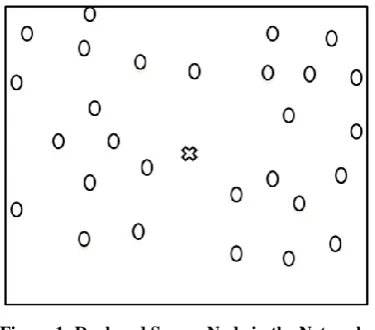
The proposed scheme implemented a MIMO system in conventional hierarchical clustering protocol in order to enhance the life time of sensor network. The system model is shown in the following figure in which it is assumed that the clustered network in which node have joined their respective cluster head and now the cluster will transmits its data to the base station. It also being assumed that clustering has been take place in the network by any suitable hierarchical clustering protocol such as LEACH [2].
deployed sensor node and the cross at the middle of the network represents the sink node.
Figure 1: Deployed Sensor Node in the Network
[image:2.595.335.522.178.341.2]In the conventional clustering protocol the next step is the formation of clusters and then data transmission to the base station these two steps are depicted in the next two figures:
Figure 2: Nodes Joining Their Respective Cluster Heads
Figure 3: Cluster Head Sending Sense data to Base Station
In the above two figure the circle which are yellow colored are the cluster head black arrow are representing the node which are associated with the particular cluster head and the
arrow which is in blue color represents the finial data transmission to the base station.
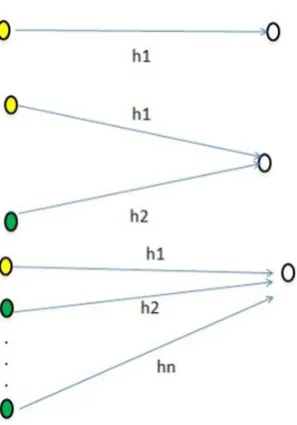
[image:2.595.56.260.317.477.2]In the proposed scheme when all the node send their sense data to their respective cluster head the cluster head will select one node as a cooperative node which will simultaneously send the data with the cluster head. This node along with the the cluster head send the data. This data transmission is done by enabling the STBC. In the given figure green nodes are representing the cooperative node.
Figure 4: Cluster Head Selecting Cooperative Node
The selection of cooperative node is based on the signal strength. The nearest node will send the highest strength signal based on this calculation the cluster head will declare the cooperative node apart from this any optimal scheme will be suitable for the selection of cooperative node. It is totally depends on the designer choice that what kind of rule is selected for deciding the cooperative node.
Figure 5: Final data Transmission to the Base station
[image:2.595.327.531.447.627.2] [image:2.595.57.258.499.680.2]Figure 6: Scenarios When Cluster and When Cluster head and Cooperative Node transmitting data
In the above figure the first part shows when there is conventional hierarchical clustering protocol when there is one sender that is cluster head and the one receiver which is sink. In the second part it is shown that when there is one cluster head with one cooperative node the third parts have generalized our approach in which there is (n-1) cooperative node which are transmitting data to the sink. The h represents the gain of wireless channel for a particular wireless channel.
The modeling of above problem is being done in simple MIMO transmission and reception problem with the conventional SISO problem under the same BER and throughput condition. The analysis of per node energy consumption over a long range of communication is also being done. It is assumed that the Alomouity diversity code for the data transmission in the MIMO system. Binary phase shift keying (BPSK) has been consider to model the energy consumption in the network.
In the results it has been shown that for the short range communication conventional MIMO system is not as much energy efficient but as the communication range will increase this will be more energy efficient.
3. ENERGY CONSUMPTION
CALCULATION
Cconsidering the general communication model [11] in which the wireless communication link betweenen the two nodes has been shown. In the proposed system the transmitting node are two or more and there is only one receiving node which is sink. In other there are three possibility whether the SISO(single input single output) or MISO( multiple input single input). To calculate the per node energy consumption it is required to involve all the circuit and signal processing block involving in the wireless communication link. Some blocks which involve in the communication are avoided in this calculation such as source coding pulse shaping and digital modulation blocks this can be the extension for the future work. It has been also assumed that the wireless system is encoded thus no error correction block has been considered while calculation the energy consumption. During the calculation of per bit energy consumption during the
transmission from the cluster head and the cooperative node to the base station. The energy consumption in clustering and local communication that is the communication within a cluster is neglected because energy consumption in the long haul communication that is the communication from cluster head to the base station is quiet large then the local communication and clustering.
[image:3.595.316.553.185.332.2]The resulting signal transmitter blocks and receiver blocks has been shown in the given figure [7]:
[image:3.595.317.553.363.520.2]Figure 7: Circuit Block involved during the transmission of Signal
Figure 8: Circuit Block involved during the Reception of Signal
In the above figure Mt is the number of transmitting antenna
and Mr is the number of receiving antenna. In the proposed
solution Mr=1 while the number of transmitting antenna Mr is
varying from one to certain fixed value.
Similar to the SISO mentioned in [12]-[13] the energy consumption in the SISO can be divided into the two important section the energy consumption in the power amplifier PPA and the energy consumption in the other circuit
blocks Pc. The energy consumption in the power amplifier is
depend upon the transmit power and the transmit power is calculated with the help of link budget relationship [14]. Considering the square law path loss model which can be given by:
= × × (1)
Where Eb represents the per bit energy at the receiver for
given BER, Rb is the bit rate, d represents the transmission
distance Gt representing the transmitting antenna gain and Gr
margin which compensates the hardware process variation noise and interference and Nf is equal to noise level of
receiver circuitry
= (2)
Nr Represents power spectral density of total noise at the receiver and N0 is single sided power spectral density of
thermal noise. The value of N0=-171 dbm⁄Hz at 27 ℃ (Room
Temperature).
The power consumption in the power amplifier can be approximated [12]
= (1+α) (3)
In the above equation α = (ζ/η)-1 where ζ is magnitude of peak to average ratio which mainly depend upon the modulation scheme related to the constellation size [13] η specified the draining efficiency of power amplifier.
The other part Pc which is the circuit block consumption can be approximated by the given equation:
≈ ( + + )+2 + ( + + +
+ ) (4)
In the above equation , ,
, , are representing the power in the digital to analog converter, the mixer, low noise amplifier(LNA), the intermediate frequency amplifier (IFA), the active filters at the transmitter side, the active filters at the receiver side, the ADC, and the frequency synthesizer, respectively. In order to calculate all these value the model in [13] is adopted.
Thus the per bit energy consumption for given fixed rate is:
= (5)
It is assumed that Alamouity diversity code have been used for the MIMO system. The Alamouity code for Mt=2 has been
shown in [15]. From the results in [16] has been shown that in Rayleigh fading channel MIMO system have lower probability of error for than conventional SISO system due to transmit diversity gain. In other words for a given throughput number of transmission in MIMO is lessor than the SISO system.
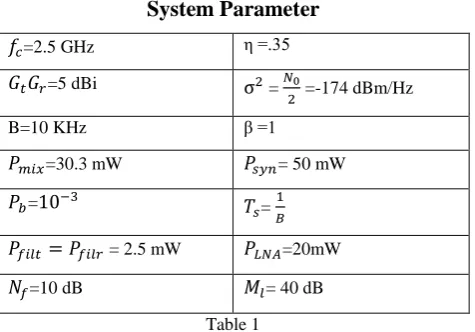
The system parameter has been considered from [11]
System Parameter
=2.5 GHz η =.35
=5 dBi = =-174 dBm/Hz
B=10 KHz β =1
=30.3 mW = 50 mW
= =
= 2.5 mW =20mW
=10 dB = 40 dB
Table 1
It is assumed that the channel gain between the transmitter and receiver is scalar or in other words there is exist a
Rayleigh fading channel between the transmitters. Apart from the square law path loss model the signal is further attenuated by the fading matrix H in which each entry is a zero-mean circulant symmetric complex Gaussian (ZMCSCG) random variable with unit variance [17]. It is assumed that that the fading occur in the channel is fixed when the transmission of code word takes place.
Now considering the Alamouity 2×1 scheme that is number of transmitting node in the cluster are two and number of receiving node is one.
H= [ ] (6)
The SISO case is the special case of MIMO in which H= [ ]. The instantaneous SNR can be given [17].
= =1,2 (7)
The average value of bit error rate is given by [17]
= {Q } (8)
Applying the chern off bound [17]
≤ (9)
Taking the upper bound
≤
(10) By taking the bound as equality the total per bit energy consumption is formulated for the proposed MISO and conventional SISO system as:
= (1+α)
×
+ (11)
4. RESULTS AND DISCUSSION
The value of Eb can also be calculated with the help of
numerical computation. The Eb can be calculated by randomly
[image:4.595.50.288.576.742.2]generating the 10000 channel samples according to (8) at each communication range after inverting the desired value is obtained. This solution and Chern off bound is shown in the following figure.
The graph depicts that the upper bound taken is quiet loose. Thus it can said that numerical method will be the more suitable method for the calculation of Eb thus substituting the
value of Eb in (1) and further (5) and (6), the value of Ebit over
[image:5.595.327.532.76.282.2]a transmission distance d in meter can be obtained. This graph has been shown in the in the following figure:
Figure 10: Long haul Per Bit Energy Consumption in Joule Numerical Method
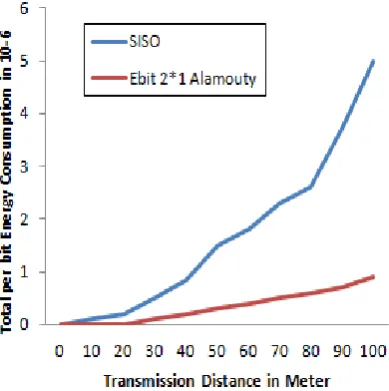
[image:5.595.66.266.145.339.2]From the above graph it can be observed that over a long haul distance d=60m the SISO system is more energy efficient than the proposed MIMO system but as the distance further increases from 60 m MIMO system outperforms the SISO system and emerges as a more energy efficient system. But when considering the total transmission energy consumption the following results shows that proposed two transmitting antenna system will far better the conventional SISO system and this is because transmit diversity gain.
[image:5.595.62.257.492.688.2]Figure 11 Total per bit Energy Consumption in Joule in Numerical Method
Figure 12: Total per bit energy consumption in Joule using bound approximation
In the above depicts that if calculating the energy consumption using the bound approximation the cross over point changes than the numerical solution method because of looseness of bound.
5. CONCLUSIONS AND FUTURE WORK
The results show that MIMO technique is more energy efficient than a SISO technique in a Rayleigh fading channel but this could be contradictory if considering the circuit energy consumption. The results also shows that the for the short range communication the SISO is more energy efficient than MIMO but as the communication range increases MIMO system will become energy efficient. Thus for a long range communication, proposed technique will be more energy efficient than a SISO technique.
The dependence of energy consumption over constellation size is not being considered, this could be a extension of this work an optimal constellation size will help to further reduce the energy consumption of the network.
6. REFERENCES
[1] F. Baccelli and S. Zuyev, Poisson Voronoi spanning trees with applications to the optimization of communication networks, Operations Res., 47(4), 619–631, 1999.
[2] W. B. Heinzelman, A. P. Chandrakasan, and HariBalakrishnan, ―An Application-Specific Protocol Architecture for Wireless Microsensor Networks,” IEEE Trans. Wireless Commun., vol. 1, no. 4, Oct. 2002.
[3] V. Tarokh, H. Jafarkhani and A.Calderbank, “Space-Time Block codes from orthogonal design,” IEEE trans.Inform.Theory,vol.45,no.5,pp.1456-1466,1999.
[4] J. Li, Y. Gu, W. Zhang and B. H. Zhao, “MIMO Techniques in Cluster-Based Wireless Sensor Networks” , APWeb 2006.
[6] X. Li, M. Chen and W. Liu, “Cooperative transmissions in wireless sensor networks with imperfect synchronization,” IEEE signal process. Lett. , 2004, 11(12), 948-951.
[7] Y. B .Zhang and H. Y. Dai., “Selecting optimal transmission strategies for cooperative sensor networks,” Proceedings of Conference on information and systems2005, John Hopkins University, 335-441.
[8] X. Li, M. Chen, and W. Liu, “Application of STBC-encoded cooperative transmissions in wireless sensor networks,” IEEE Signal Processing. Lett., 2005, 12(2):134-137.
[9] L. S. Pillutla, W. Krishnamurthy, “Joint rate and cluster optimization cooperative MIMO sensor networks,” Proceedings of Signal Processing of SPAWC 2005,pp: 265-269
[10]Shuguang Cui, Student Member, IEEE, Andrea J. Goldsmith, Senior Member, IEEE, and Ahmad Bahai, Member, IEEE, Energy-Efficiency of MIMO and Cooperative MIMO Techniques in Sensor Networks,” IEEE JOURNAL ON SELECTED AREAS IN COMMUNICATIONS, VOL. 22, NO. 6, AUGUST 2004
[11]S. Cui, A. J. Goldsmith, and A. Bahai, “Modulation optimization under energy constraints,” in Proc. ICC’03,
AK, May 2003, pp. 2805–2811. [Online]. Available: http://wsl.stanford.edu/Publications.html.
[12] “Energy-constrained modulation optimization,” IEEE Trans. Wireless Commun., 2004. [Online]. Available: http://wsl.stanford.edu/Publications.html, submitted for publication
[13]J. G. Proakis, Digital Communications, 4th ed. New York: McGraw- Hill, 2000.
[14]S. Alamouti, “A simple transmit diversity technique for wireless communications,” IEEE J. Select. Areas Commun., vol. 16, pp. 1451–1458,Oct. 1998.
[15]A. Paulraj, R. Nabar, and D. Gore, Introduction to Space-Time Wireless Communications, Cambridge, U.K.: Cambridge Univ. Press, 2003. preprint.
[16]“Energy-constrained modulation optimization for coded systems,” in Proc. GLOBECOM’03, San Francisco, CA, Dec. 2003, pp. 372–376. [Online].Available: http://wsl.stanford.edu/Publications.html.