Performance Comparison of Gradient Mask Texture
based Image Retrieval Techniques using Global and
Local Hybrid Wavelet Transforms with Ternary Image
Maps
H. B. Kekre
Senior Professor Computer Engineering
Department SVKM`s NMIMS
(Deemed-to-be University) Mumbai, India
Sudeep D. Thepade
Professor Computer Engineering
Department Pimpri Chinchwad College of Engineering
(Pune University) Pune, India
Varun K. Banura
Computer Engineering Department SVKM`s NMIMS
(Deemed-to-be University) Mumbai, India
Sanchit Khandelwal
Computer Engineering Department SVKM`s NMIMS
(Deemed-to-be University) Mumbai, India
ABSTRACT
The theme of the work presented here is performance comparison of gradient mask texture based image retrieval techniques using global and local hybrid wavelet transforms generated from the combination of Walsh, Haar and Kekre transforms. Ternary image maps of Prewitt/Robert/Sobel filtered images are compared with „64-pattern‟ texture set generated using local and global hybrid wavelet transforms for matching number of ones, minus ones & zeros per texture pattern. The proposed content based image retrieval (CBIR) techniques are tested on a generic image database having 1000 images spread across 11 categories. For each proposed CBIR technique 55 queries (randomly selected 5 per image category) are fired on the image database. To compare the performance of image retrieval techniques average precision and recall of all the queries per image retrieval technique are computed. In the discussed image retrieval methods, the „64-pattern‟ shape texture generated using Haar-Walsh (HW) global hybrid wavelet transform matrix with Sobel as gradient operator gives the highest crossover point of precision and recall indicating better performance.
Keywords
CBIR, Walsh, Haar, Kekre, Hybrid Wavelet Transforms, Texture Patterns, Shape, Ternary Image Maps
1.
INTRODUCTION
Today the information technology experts are facing technical challenges to store/transmit and index/manage image data effectively to make easy access to the image collections of tremendous size being generated due to large numbers of images generated from a variety of sources (digital camera, digital video, scanner, the internet etc.). The storage and transmission is taken care of by image compression [10,13,14]. The image indexing is studied in the perspective of image database [11,15,16,19,20] as one of the promising and important research area for researchers from disciplines like computer vision, image
forecast [14,31], medical imaging [14,27], trademark databases [30,32], criminal investigations [33,34], image search on the Internet [18,28,29].
1.1
Content Based Image Retrieval
For the first time Kato et all [13] described the experiments of automatic retrieval of images from a database by colour and shape feature using the terminology content based image retrieval (CBIR). The typical CBIR system performs two major tasks [25,26] as feature extraction (FE), where a set of features called feature vector is generated to accurately represent the content of each image in the database and similarity measurement (SM), where a distance between the query image and each image in the database using their feature vectors is used to retrieve the top “closest” images [25,26,35].
2.
EGDE
DETECTION
MASKS
Edge detection is a very important in image analysis. As the edges give idea about the shapes of objects present in the image so they are useful for segmentation, registration, and identification of objects in a scene. An edge is a jump in intensity. An ideal edge is a discontinuity (i.e., a ramp with an infinite slope). The first derivative assumes a local maximum at an edge. The various gradient operators [19] used for edge extraction are Prewitt, Roberts and Sobel. Sobel Operator is a discrete differentiation operator, computing an approximation of the gradient of the image intensity function. The Sobel operator is based on convolving the image with a small, separable, and integer valued filter in horizontal and vertical direction and is therefore relatively inexpensive in terms of computations. The Sobel mask can be depicted as shown in equation 2 and 3.
(2)
(3)
Prewitt edge detector is an appropriate way to estimate the magnitude and orientation of an edge. The Prewitt mask can be defined as given in equations 4 and 5.
(4)
(5)
Equations 6 and 7 show the Roberts gradient operators. It is used to detect edges applying a horizontal and vertical filter in sequence.
(6)
(7)
3.
SLOPE
MAGNITUDE
METHOD
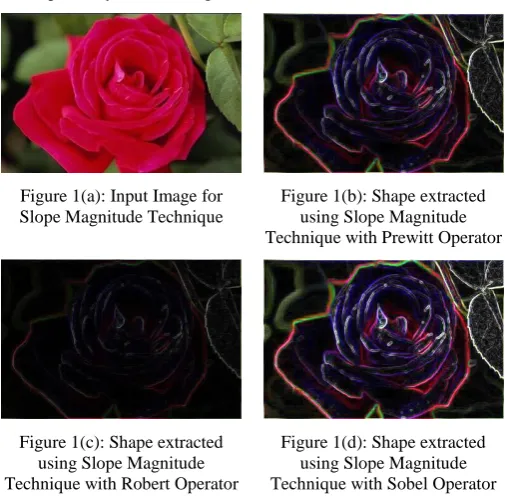
The problem with edge extraction using gradient operators is detection of edges in only either horizontal or vertical directions. Shape feature extraction in image retrieval requires the extracted edges to be connected in order to reflect the boundaries of objects present in the image. Slope magnitude method is used along with the gradient operators (Prewitt, Robert & Sobel) to extract the shape features [6] in form of connected boundaries. The process of applying the slope magnitude method is given as follows. First one needs to convolve the original image with the Gx mask to get the x gradient and Gy mask to get the y gradient of the image. Then the individual squares of both are taken. Finally the two squared terms are added and square root of this sum is taken as given in equation 8.
(8)
For the sample image shown in Figure 1(a), the shape features extracted using the gradient operators Prewitt, Robert and Sobel are respectively shown in Figures 1(b), 1(c) and 1(d).
Figure 1(a): Input Image for Slope Magnitude Technique
Figure 1(b): Shape extracted using Slope Magnitude Technique with Prewitt Operator
Figure 1(c): Shape extracted using Slope Magnitude Technique with Robert Operator
Figure 1(d): Shape extracted using Slope Magnitude Technique with Sobel Operator
Figure 1: Slope Magnitude Method
4.
GENERATION
OF
HYBRID
WAVELET
TRANSFORM
The hybrid wavelet transform [42] matrix of size NxN (say „TAB‟) can be generated from two orthogonal transform matrices
[38,42] (say A and B respectively with sizes pxp and qxq, where N=p*q=pq) as given by Figures 2 and 3. Here first „q‟ number of rows of the hybrid wavelet transform matrix are calculated as the product of each element of first row of the orthogonal transform A with each of the columns of the orthogonal transform B. For next „q‟ number of rows of hybrid wavelet transform matrix the second row of the orthogonal transform matrix A is shift rotated after being appended with zeros as shown in Figure 3. Similarly the other rows of hybrid wavelet transform matrix are generated (as set of q rows each time for each of the „p-1‟ rows of orthogonal transform matrix A starting from second row up to last row).
pp p
p
p p
a
a
a
a
a
a
a
a
a
A
2 1
2 22
21
1 12
11
qq q
q
q q
b
b
b
b
b
b
b
b
b
B
2 1
2 22
21
1 12
[image:2.595.306.559.152.400.2]11
[image:2.595.118.267.236.309.2] [image:2.595.114.216.349.434.2] [image:2.595.313.564.609.679.2]Figure 3: Generation of Hybrid Wavelet Transform
4.1
Generation of Global Hybrid Wavelet
Transform
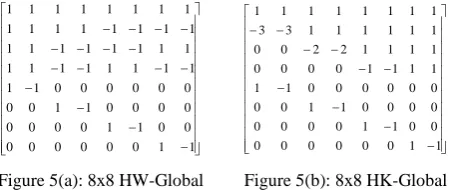
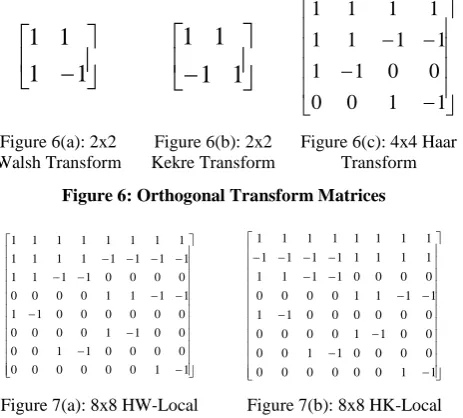
To generate „64-pattern‟ texture set, 8x8 hybrid wavelet transform is required. To generate a global hybrid wavelet transform of size 8x8, two orthogonal transform matrices A of size 2x2 and B of size 4x4 are required i.e. p=2, q=4 thus N=p*q=8. In this paper we have considered the combinations of Walsh, Haar and Kekre transform [1,37] matrices to generate 9 global hybrid transforms as Haar, Kekre, Haar-Walsh, Kekre-Haar, Kekre-Kekre and so on. However, since the 2x2 matrix is same for Haar and Walsh is same, the global hybrid wavelet transforms Haar & Walsh-Haar, Haar-Kekre & Walsh-Haar-Kekre and Haar-Walsh & Walsh-Walsh turn out to be same. Thus we consider only six global hybrid wavelet transforms as Haar-Haar (HH-Global), Haar-Kekre (HK-Global), Haar-Walsh (HW-(HK-Global), Kekre-Haar (KH-(HK-Global), Kekre-Kekre (KK-Global) and Kekre-Walsh (KW-Global). Figures 4(a), 4(b) and 4(c) show 2x2 Haar transform, 4x4 Walsh transform and 4x4 Kekre transform respectively. HW-Global and HK-Global hybrid wavelet transforms are shown in Figures 5(a) and 5(b) respectively.
1
1
1
1
1 1 1 1 1 1 1 1 1 1 1 1 1 1 1 1 1 1 0 0 1 1 2 0 1 1 1 3 1 1 1 1Figure 4(a): 2x2 Haar Transform
Figure 4(b): 4x4 Walsh Transform
Figure 4(c): 4x4 Kekre Transform
Figure 4: Orthogonal Transform Matrices
1 1 0 0 0 0 0 0 0 0 1 1 0 0 0 0 0 0 0 0 1 1 0 0 0 0 0 0 0 0 1 1 1 1 1 1 1 1 1 1 1 1 1 1 1 1 1 1 1 1 1 1 1 1 1 1 1 1 1 1 1 1 1 1 1 1 0 0 0 0 0 0 0 0 1 1 0 0 0 0 0 0 0 0 1 1 0 0 0 0 0 0 0 0 1 1 1 1 1 1 0 0 0 0 1 1 1 1 2 2 0 0 1 1 1 1 1 1 3 3 1 1 1 1 1 1 1 1
Figure 5(a): 8x8 HW-Global Figure 5(b): 8x8 HK-Global
Figure 5: Global Hybrid Wavelet Transforms
4.2
Generation of Local Hybrid Wavelet
Transform
[image:3.595.312.540.368.463.2] [image:3.595.60.288.610.690.2]
1
1
1
1
1
1
1
1
1
1
0
0
0
0
1
1
1
1
1
1
1
1
1
1
Figure 6(a): 2x2 Walsh Transform
Figure 6(b): 2x2 Kekre Transform
Figure 6(c): 4x4 Haar Transform
Figure 6: Orthogonal Transform Matrices
1 1 0 0 0 0 0 0 0 0 0 0 1 1 0 0 0 0 1 1 0 0 0 0 0 0 0 0 0 0 1 1 1 1 1 1 0 0 0 0 0 0 0 0 1 1 1 1 1 1 1 1 1 1 1 1 1 1 1 1 1 1 1 1 1 1 0 0 0 0 0 0 0 0 0 0 1 1 0 0 0 0 1 1 0 0 0 0 0 0 0 0 0 0 1 1 1 1 1 1 0 0 0 0 0 0 0 0 1 1 1 1 1 1 1 1 1 1 1 1 1 1 1 1 1 1 1 1
Figure 7(a): 8x8 HW-Local Figure 7(b): 8x8 HK-Local
Figure 7: Local Hybrid Wavelet Transforms
5.
TEXTURE
PATTERN
GENERATION
To generate N2 texture patterns [1-6,37,39] (N2-pattern), NxN hybrid wavelet transform matrix is considered and the element wise multiplication of each row of the transform matrix is taken with all possible rows of the same matrix (consideration of one row at a time gives one pattern). If a pixel value of a texture pattern is greater than zero then corresponding pixel value of the texture pattern is considered equal to „one‟, the values that are less than zero are considered equal to „minus one‟ and the remaining values are considered equal to „zero‟. The texture patterns obtained are orthogonal in nature. The first sixteen texture patterns of the „64-pattern‟ texture set generated using global and local hybrid wavelet transforms above are shown in Figures 8 and 9 respectively. Here black represents „1‟, gray represents „0‟ and white represents „-1‟.
Figure 8(a): HH-Global
Figure 8(b): HK-Global
Figure 8(c): HW-Global
Figure 8(d): KH-Global
Figure 8(e): KK-Global
Figure 8(f): KW-Global
Figure 8: First sixteen texture patterns (out of total 64) generated using 8x8 Global Hybrid Wavelet Transforms
Figure 9(a): HK-Local
Figure 9(a): HW-Local
Figure 9(a): KK-Local
Figure 9(a): KW-Local
Figure 9(a): WK-Local
Figure 9(a): WW-Local
Figure 9: First sixteen texture patterns (out of total 64) generated using 8x8 Local Hybrid Wavelet Transforms
6.
GENERATION
OF
TERNARY
IMAGE
MAPS
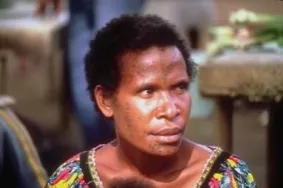
Image maps [1,2,3,4,6] of color image are generated using three independent red (R), green (G) and blue (B) components of Prewitt/Robert/Sobel filtered image obtained using slope magnitude method. Let X={R(i,j),G(i,j),B(i,j)} where i=1,2,….m and j=1,2,….,n; be an m×n slope magnitude gradient of color image in RGB space. Here for each color plane ternary image maps [1,3] are computed (TMr, TMg and TMb) which are given by the equations 9, 10 and 11. If a pixel value of respective color component is greater than 170, the corresponding pixel position of the image map gets a value „one‟; else if the pixel value is less than 85, the corresponding pixel position of the image map gets a value of „minus one‟; otherwise it gets a value „zero‟.
85
)
,
(
.
,
1
170
)
,
(
85
.
,
0
170
)
,
(
..
,
1
)
,
(
j
i
R
if
j
i
R
if
j
i
R
if
j
i
TMr
(9)
85
)
,
(
.
,
1
170
)
,
(
85
.
,
0
170
)
,
(
.
,
1
)
,
(
j
i
G
if
j
i
G
if
j
i
G
if
j
i
TMg
(10)
85
)
,
(
.
,
1
170
)
,
(
85
.
,
0
170
)
,
(
.
,
1
)
,
(
j
i
B
if
j
i
B
if
j
i
B
if
j
i
TMb
(11) [image:4.595.303.562.72.290.2] [image:4.595.59.291.75.284.2]Figure 10: Sample Input Image from the database for generating Ternary Image Maps
Figure 11(a): Ternary Image Map of
R-Plane
Figure 11(b): Ternary Image Map of
G-Plane
Figure 11(c): Ternary Image Map of
B-Plane
Figure 11: Ternary Image Map of Prewitt filtered Image
Figure 12(a): Ternary Image Map of
R-Plane
Figure 12(b): Ternary Image Map of
G-Plane
Figure 12(c): Ternary Image Map of
B-Plane
Figure 12: Ternary Image Map of Robert filtered Image
Figure 13(a): Ternary Image Map of
R-Plane
Figure 13(b): Ternary Image Map of
G-Plane
Figure 13(c): Ternary Image Map of
B-Plane
Figure 13: Ternary Image Map of Sobel filtered Image
7.
PROPOSED
CBIR
METHODS
In the proposed gradient shape texture based CBIR methods, the shape feature of the image is extracted using the three gradient mask operators Prewitt, Robert and Sobel. Then the ternary image map of the shape feature is generated using the modified BTC technique as described above. The ternary image map thus obtained is compared with the „64-pattern‟ texture set generated using global and local hybrid wavelet transforms to produce the feature vector as the matching number of ones, minus ones and zeros per texture pattern. The size of the feature vector (FV) of the image is given by equation 12.
FV size = s*p*(no. of considered texture-pattern)
pattern‟ texture set. The main advantage of proposed CBIR methods is that the feature vector size is independent of image size unlike the color averaging [7,8,9,40] and vector quantization [41] based CBIR. Moreover the time complexity for query execution in the proposed CBIR methods is reduced due to reduction in size of feature vector resulting into faster image retrieval with better performance.
8.
IMPLEMENATATION
[image:5.595.27.280.213.305.2]The implementation of the discussed CBIR techniques is done in MATLAB 7.0 using a computer with Intel Core 2 Duo Processor T8100 (2.1GHz) and 2 GB RAM. The CBIR techniques are tested on the Wang image database [24] of 1000 variable size images spread across 11 categories of human being, animals, natural scenery and manmade things, etc. The categories and distribution of the images is shown in Table 1.
Table 1: Image Database Category-wise Distribution Category Tribes Buses Beaches
Number of Images 85 99 99
Category Horses Mountains Airplanes
Number of Images 99 61 100
Category Dinosaurs Elephants Roses
Number of Images 99 99 99
Category Monuments Sunrise
Number of Images 99 61
To assess the retrieval effectiveness, we have used the precision and recall as statistical comparison parameters [10,11] for the proposed CBIR techniques. The standard definitions for these two measures are given by the equations 13 and 14.
retrieved images
of number Total
retrieved images
relevant of
Number ecision
_ _
_ _
_ _
_ _
Pr
(13)
database in
images relevent of
number Total
retrieved images
relevant of
Number call
_ _ _ _ _ _
_ _ _
_
Re (14)
9.
RESULTS
AND
DISCUSSION
[image:5.595.297.551.259.390.2] [image:5.595.25.285.451.544.2]Figure 14: Performance comparison of proposed CBIR methods with different gradient operators for global hybrid
[image:6.595.55.282.431.601.2]wavelet transforms
Figure 14 shows the performance comparison of proposed CBIR methods with different gradient operators for global hybrid wavelet transforms. Here in case of global hybrid wavelets, it is observed from the graph that the gradient operator Sobel outperforms the gradient operators Prewitt and Robert in all the proposed CBIR methods. However gradient operator Robert gives the worst performance. In all the three gradient operators, it is observed from the precision-recall crossover points that HW-Global hybrid wavelet transform performs the best followed by KW-Global hybrid wavelet transform. Moreover it is observed that in the combination of global hybrid wavelet transform if the second transform matrix is Walsh then the performance is ameliorated and the performance is deteriorated if the second transform matrix is Haar.
Figure 15: Performance comparison of proposed CBIR methods with different gradient operators for local hybrid
wavelet transforms
Figure 15 shows the performance comparison of proposed CBIR methods with different gradient operators for local hybrid wavelet transforms. It can be observed from the graph that in local hybrid wavelet transform also gradient operator Sobel gives the best performance followed by Prewitt and Robert. In Robert and Sobel gradient operators WK-Local hybrid wavelet transform performs the best followed by WW-Local hybrid wavelet transform as indicated by precision-recall crossover point value. However in case of Prewitt operator, WW-Local outperforms
combination of local hybrid wavelet transforms if the first transform matrix is Walsh then the performance is best.
In all the discussed CBIR methods the „64-pattern‟ texture set generated using HW-Global hybrid wavelet transform with Sobel as gradient operator gives the best performance as indicated by higher precision-recall crossover point value.
10.
PERFORMANCE
COMPARISON
OF
VARIANTS
IN
GRADIENT
MASK
TEXTURE
BASED
CBIR
METHODS
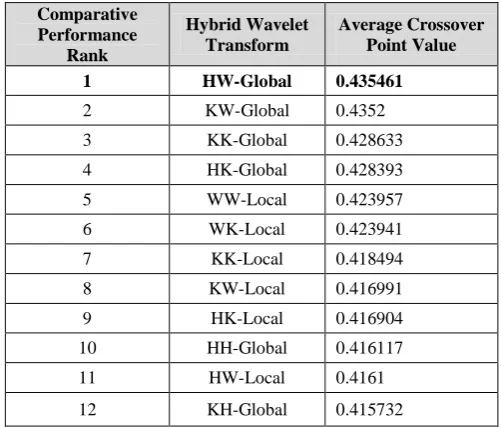
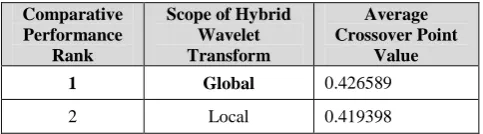
[image:6.595.298.549.515.729.2]The novel image retrieval methods using gradient mask texture patterns are presented in this section. Here in all 36 variations of the proposed image retrieval methods with gradient mask texture patterns are proposed using six global (HH-Global, HK-Global, HW-Global, KH-Global, KK-Global & KW-Global) & six local (HK-Local, KK-Local, WK-Local, HW-Local, KW-Local & WW-Local) hybrid wavelet transform and three gradient operators (Prewitt, Robert and Sobel). The average of precision-recall crossover point values for respective variation is considered for the performance ranking of these variations. Twelve hybrid wavelet transforms (6 global and 6 local) are considered to generate shape texture patterns. From the results after experimentation it is found that the HW-Global hybrid wavelet transform is showing the best performance and KH-Global hybrid wavelet transform is showing the worst performance in proposed CBIR methods as indicated by average precision-recall crossover point values of shape texture based CBIR variants using respective hybrid wavelet transform given in Table 2. The „64-pattern‟ texture set has given better performance with global hybrid wavelet transforms than local hybrid wavelet transforms as per the average precision-recall crossover point values of shape texture based CBIR variants using respective scope of hybrid wavelet transforms given in Table 3. Among the three gradient operators used for generating the filtered image maps, Sobel gives the best performance followed by Prewitt and Robert as per the average precision-recall crossover point values of shape texture based CBIR variants using respective gradient operators given in Table 4.
Table 2: Performance Comparison ofHybrid Wavelet Transforms used in Shape-texture based Image Retrieval
Comparative Performance
Rank
Hybrid Wavelet Transform
Average Crossover Point Value 1 HW-Global 0.435461
2 KW-Global 0.4352
3 KK-Global 0.428633
4 HK-Global 0.428393
5 WW-Local 0.423957
6 WK-Local 0.423941
7 KK-Local 0.418494
8 KW-Local 0.416991
9 HK-Local 0.416904
10 HH-Global 0.416117
11 HW-Local 0.4161
Table 3: Performance Comparison of Scope of Hybrid Wavelet Transforms used in Shape-texture based Image
Retrieval Comparative
Performance Rank
Scope of Hybrid Wavelet Transform
Average Crossover Point
Value
1 Global 0.426589
[image:7.595.51.293.108.175.2]2 Local 0.419398
Table 4: Performance Comparison of Gradient Operators used in Shape-texture based Image Retrieval Comparative
Performance
Thresholding Method
Average Crossover Point
Value
1 Sobel 0.444803
2 Prewitt 0.431059
3 Robert 0.39312
11.
REFERENCES
[1] Dr. H. B. Kekre, Sudeep D. Thepade, Varun K. Banura, “Performance Comparison of Texture Pattern Based Image Retrieval Methods using Walsh, Haar and Kekre Transforms with Assorted Thresholding Methods”, International Journal of Computer Science and Information Security (IJCSIS), Volume 9, Number 3, 2011 (ISSN:
1947-5500), Available online at
http://sites.google.com/site/ijcsis
[2] Dr. H. B. Kekre, Sudeep D. Thepade, Varun K. Banura, “Amelioration of Walsh-Hadamard Texture Patterns based Image Retrieval using HSV Color Space”, International Journal of Computer Science and Information Security (IJCSIS), Volume 9, Number 3, 2011 (ISSN: 1947-5500), Available online at http://sites.google.com/site/ijcsis
[3] Dr. H. B. Kekre, Sudeep D. Thepade, Varun K. Banura, “Performance Comparison of Texture Pattern based Image Retrieval using Haar Transform with Binary and Ternary Image Maps”, International Journal of Computer Applications (IJCA), Proceedings on International Conference and workshop on Emerging Trends in Technology (ICWET 2011), Number 3, Artilcle 5, 2011.pp.23-28 (ISBN: 978-93-80747-67-2), Available online at http://www.ijcaonline.org
[4] Dr. H. B. Kekre, Sudeep D. Thepade, Varun K. Banura, “Image Retrieval using Texture Patterns generated from Walsh-Hadamard Transform Matrix and Image Bitmaps”, Springer International Conference on Technology Systems and Management (ICTSM 2011), MPSTME and DJSCOE, Mumbai, 25-27 Feb 2011. Available online at Springerlink.
[5] Dr. H. B. Kekre, Sudeep D. Thepade, Varun K. Banura, “Query by Image Texture Pattern content using Haar Transform Matrix and Image Bitmaps”, Invited at ACM International Conference and Workshop on Emerging Trends in Technology (ICWET 2011), TCET, Mumbai, 25-26 Feb 2011. The paper will be uploaded online on
Bitmaps”, International Journal of Computer Science and Information Security (IJCSIS), Volume 8, Number 9, 2010.pp.76-82 (ISSN: 1947-5500), Available online at http://sites.google.com/site/ijcsis
[7] Dr. H.B.Kekre, Sudeep D. Thepade, Varun K. Banura, “Augmentation of Colour Averaging Based Image Retrieval Techniques using Even part of Images and Amalgamation of feature vectors”, International Journal of Engineering Science and Technology (IJEST), Volume 2, Issue 10, (ISSN: 0975-5462) Available online at http://www.ijest.info
[8] Dr. H.B.Kekre, Sudeep D. Thepade, Varun K. Banura, “Amelioration of Colour Averaging Based Image Retrieval Techniques using Even and Odd parts of Images”, International Journal of Engineering Science and Technology (IJEST), Volume 2, Issue 9, (ISSN: 0975-5462) Available online at http://www.ijest.info.
[9] Dr. H.B.Kekre, Sudeep D. Thepade, Akshay Maloo, “Query by Image Content Using Colour Averaging Techniques”, International Journal of Engineering Science and Technology (IJEST), Volume 2, Issue 6,
2010.pp.1612-1622 (ISSN: 0975-5462) Available online at
http://www.ijest.info.
[10] Dr. H.B.Kekre, Sudeep D. Thepade, “Boosting Block Truncation Coding using Kekre‟s LUV Color Space for Image Retrieval”, WASET International Journal of Electrical, Computer and System Engineering (IJECSE), Volume 2, Number 3, pp. 172-180, Summer 2008. Available online at http://www.waset.org/ijecse/v2/v2-3-23.pdf
[11] Dr. H.B.Kekre, Sudeep D. Thepade, “Image Retrieval using Augmented Block Truncation Coding Techniques”, ACM International Conference on Advances in Computing, Communication and Control (ICAC3-2009), pp. 384-390, 23-24 Jan 2009, Fr. Conceicao Rodrigous College of Engg., Mumbai. Is uploaded on online ACM portal.
[12] Dr. H.B.Kekre, Sudeep D. Thepade, “Scaling Invariant Fusion of Image Pieces in Panorama Making and Novel Image Blending Technique”, International Journal on Imaging (IJI), www.ceser.res.in/iji.html, Volume 1, No. A08, pp. 31-46, Autumn 2008.
[13] Hirata K. and Kato T. “Query by visual example – content-based image retrieval”, In Proc. of Third International Conference on Extending Database Technology, EDBT‟92, 1992, pp 56-71
[14] Dr. H.B.Kekre, Sudeep D. Thepade, “Rendering Futuristic Image Retrieval System”, National Conference on
Enhancements in Computer, Communication and
Information Technology, EC2IT-2009, 20-21 Mar 2009, K.J.Somaiya College of Engineering, Vidyavihar, Mumbai-77.
2004, pp.193-233.
[17] Dr. H.B.Kekre, Sudeep D. Thepade, “Creating the Color Panoramic View using Medley of Grayscale and Color Partial Images ”, WASET International Journal of Electrical, Computer and System Engineering (IJECSE), Volume 2, No. 3, Summer 2008. Available online at www.waset.org/ijecse/v2/v2-3-26.pdf.
[18] Stian Edvardsen, “Classification of Images using color, CBIR Distance Measures and Genetic Programming”, Ph.D. Thesis, Master of science in Informatics, Norwegian university of science and Technology, Department of computer and Information science, June 2006.
[19] R.C. Gonsalez, R.E. Woods “Digital Image Processing”, Second Edition, Pearson Publication
[20] Zhibin Pan, Kotani K., Ohmi T., “Enhanced fast encoding method for vector quantization by finding an optimally-ordered Walsh transform kernel”, ICIP 2005, IEEE International Conference, Volume 1, pp I - 573-6, Sept. 2005.
[21] Dr. H.B.Kekre, Sudeep D. Thepade, “Improving „Color to Gray and Back‟ using Kekre‟s LUV Color Space”, IEEE International Advanced Computing Conference 2009 (IACC‟09), Thapar University, Patiala, INDIA, 6-7 March 2009. Is uploaded at online at IEEE Xplore.
[22] Dr. H.B.Kekre, Sudeep D. Thepade, “Image Blending in Vista Creation using Kekre's LUV Color Space”, SPIT-IEEE Colloquium and International Conference, Sardar Patel Institute of Technology, Andheri, Mumbai, 04-05 Feb 2008.
[23] Dr. H.B.Kekre, Sudeep D. Thepade, “Color Traits Transfer to Grayscale Images”, In Proc.of IEEE First International Conference on Emerging Trends in Engg. & Technology, (ICETET-08), G.H.Raisoni COE, Nagpur, INDIA. Uploaded on online IEEE Xplore.
[24] http://wang.ist.psu.edu/docs/related/Image.orig (Last referred on 23 Sept 2008)
[25] Dr. H.B.Kekre, Sudeep D. Thepade, “Using YUV Color Space to Hoist the Performance of Block Truncation Coding for Image Retrieval”, IEEE International Advanced Computing Conference 2009 (IACC‟09), Thapar University, Patiala, INDIA, 6-7 March 2009.
[26] Dr. H.B.Kekre, Sudeep D. Thepade, Archana Athawale, Anant Shah, Prathmesh Verlekar, Suraj Shirke,“Energy Compaction and Image Splitting for Image Retrieval using Kekre Transform over Row and Column Feature Vectors”, International Journal of Computer Science and Network Security (IJCSNS),Volume:10, Number 1, January 2010, (ISSN: 1738-7906) Available at www.IJCSNS.org.
[27] Dr. H.B.Kekre, Sudeep D. Thepade, Archana Athawale, Anant Shah, Prathmesh Verlekar, Suraj Shirke, “Walsh Transform over Row Mean and Column Mean using Image Fragmentation and Energy Compaction for Image Retrieval”, International Journal on Computer Science and Engineering (IJCSE), Volume 2, Issue 1, January 2010,
(ISSN: 0975–3397). Available online at
www.enggjournals.com/ijcse.
[28] Dr. H.B.Kekre, Sudeep D. Thepade, “Image Retrieval
Feb.2010, pp.9-18, Available online
www.icgst.com/gvip/Volume10/Issue1/P1150938876.html
[29] Dr. H.B.Kekre, Sudeep D. Thepade, “Color Based Image Retrieval using Amendment Block Truncation Coding with YCbCr Color Space”, International Journal on Imaging (IJI), Volume 2, Number A09, Autumn 2009, pp. 2-14. Available online at www.ceser.res.in/iji.html.
[30] Dr. H.B.Kekre, Tanuja Sarode, Sudeep D. Thepade, “Color-Texture Feature based Image Retrieval using DCT applied on Kekre‟s Median Codebook”, International Journal on Imaging (IJI), Volume 2, Number A09, Autumn
2009,pp. 55-65. Available online at
www.ceser.res.in/iji.html (ISSN: 0974-0627).
[31] Dr. H.B.Kekre, Sudeep D. Thepade, Akshay Maloo “Performance Comparison for Face Recognition using PCA, DCT &WalshTransform of Row Mean and Column Mean”, ICGST International Journal on Graphics, Vision and Image Processing (GVIP), Volume 10, Issue II, Jun.2010,
pp.9-18, Available online
http://209.61.248.177/gvip/Volume10/Issue2/P1181012028 .pdf..
[32] Dr. H.B.Kekre, Sudeep D. Thepade, “Improving the Performance of Image Retrieval using Partial Coefficients of Transformed Image”, International Journal of Information Retrieval, Serials Publications, Volume 2, Issue 1, 2009, pp. 72-79 (ISSN: 0974-6285)
[33] Dr. H.B.Kekre, Sudeep D. Thepade, Archana Athawale, Anant Shah, Prathmesh Verlekar, Suraj Shirke, “Performance Evaluation of Image Retrieval using Energy Compaction and Image Tiling over DCT Row Mean and DCT Column Mean”, Springer-International Conference on Contours of Computing Technology (Thinkquest-2010), Babasaheb Gawde Institute of Technology, Mumbai, 13-14 March 2010, The paper will be uploaded on online Springerlink.
[34] Dr. H.B.Kekre, Tanuja K. Sarode, Sudeep D. Thepade, Vaishali Suryavanshi,“Improved Texture Feature Based Image Retrieval using Kekre‟s Fast Codebook Generation Algorithm”, Springer-International Conference on Contours of Computing Technology (Thinkquest-2010), Babasaheb Gawde Institute of Technology, Mumbai, 13-14 March 2010, The paper will be uploaded on online Springerlink.
[35] Dr. H.B.Kekre, Tanuja K. Sarode, Sudeep D. Thepade, “Image Retrieval by Kekre‟s Transform Applied on Each Row of Walsh Transformed VQ Codebook”, (Invited), ACM-International Conference and Workshop on Emerging Trends in Technology (ICWET 2010),Thakur College of Engg. And Tech., Mumbai, 26-27 Feb 2010, The paper is invited at ICWET 2010. Also will be uploaded on online ACM Portal.
[36] Dr. H.B.Kekre, Sudeep D. Thepade, Shobhit W., P. Mukharjee, S. Singh, Miti K., “Image Retrieval with Shape Features Extracted using Gradient Operators and Slope Magnitude Technique with BTC”, International Journal of Computer Applications (IJCA), Volume 6, Number 8, pp.28-23, September 2010. Available online at http://www.ijcaonline.org/volume6/number8/pxc3871430.p df
Computer Applications (IJCA), Proceedings on International Conference on Technology Systems and Management (ICTSM 2011), Number 3, Artilcle 8, 2011.pp.1-8 (ISBN: 978-93-80746-62-5), Available online at http://www.ijcaonline.org
[38] Dr. H. B. Kekre, Dr. Sudeep D. Thepade, Varun K. Banura, Aanchal Bhatia, “Image Retrieval using Fractional Coefficients of Orthogonal Wavelet Transformed Images with Seven Image Transforms”, International Journal of Computer Applications (IJCA),Volume 30 , Number 1, Article 3, 2011.pp.14-20 (ISBN: 978-93-80864-84-7), Available online at http://www.ijcaonline.org
[39] Dr. H. B. Kekre, Dr. Sudeep D. Thepade, Varun K. Banura, Ankit Khandelwal “Introducing Global and Local Walsh Wavelet Transform for Texture Pattern Based Image Retrieval”, International Journal of Computer Science and Network Security (IJCSNS), Volume 11, Number 9, 2011.pp.65-72, Available online at http://ijcsns.org
[40] Dr. H. B. Kekre, Dr. Sudeep D. Thepade, Dr. Tanuja K. Sarode, Varun K. Banura, “Reduction in Feature Vector Size of Colour Averaging Based Image Retrieval Techniques using Walsh Wavelet Pyramid Levels”, International Journal of Computer Applications (IJCA), Volume 32, Number 3, Article 5, 2011.pp.28-35 (ISBN:
978-93-80865-16-7), Available online at
http://www.ijcaonline.org
[41] Dr. H. B. Kekre, Dr. Sudeep D. Thepade, Dr. Tanuja K. Sarode, Varun K. Banura, “Performance Comparison of Image Retrieval Using KFCG with Assorted Pixel Window Sizes in RGB and LUV Color Spaces”, International Journal of Electronics and Communication Technologies (IJECT), Volume 3, Issue 1, 2012.pp.177-182, Available online at http://iject.org
[42] Dr. H. B. Kekre, Dr. Sudeep D. Thepade, Varun K. Banura, Ankit Khandelwal, “Augmentation of Image Retrieval using Fractional Coefficients of Hybrid Wavelet Transformed Images with Seven Image Transforms”, International Journal of Computer Science and Technology (IJCST), Volume 3, Issue 1, 2012.pp.557-563, Available online at http://ijcst.com
12.AUTHORS PROFILE
Dr. H. B. Kekre has received B.E. (Hons.) in Telecomm. Engineering. from Jabalpur University in 1958, M.Tech (Industrial Electronics) from IIT Bombay in 1960, M.S.Engg. (Electrical Engg.) from University of Ottawa in 1965 and Ph.D. (System Identification) from IIT Bombay in 1970 He has worked as Faculty of Electrical Engg. and then HOD Computer Science and Engg. at IIT Bombay. For 13 years he was working as a professor and head in the Department of Computer Engg. at
Thadomal Shahani Engineering. College, Mumbai. Now he is Senior Professor at MPSTME, SVKM‟s NMIMS University. He has guided 17 Ph.Ds, more than 100 M.E./M.Tech and several B.E./B.Tech projects. His areas of interest are Digital Signal processing, Image Processing and Computer Networking. He has more than 350 papers in National / International Conferences and Journals to his credit. He was Senior Member of IEEE. Presently He is Fellow of IETE and Life Member of ISTE Recently ten students working under his guidance have received best paper awards and two have been conferred Ph.D. degree of SVKM‟s NMIMS University. Currently 10 research scholars are pursuing Ph.D. program under his guidance.
Dr. Sudeep D. Thepade has received Ph.D. from SVKM‟s NMIMS (Deemed to be University) in July 2011, Mumbai, M.E. in Computer Engineering from University of Mumbai in 2008 with Distinction, B.E.(Computer) degree from North Maharashtra University with Distinction in 2003. He has about 09 years of experience in teaching and industry. He was Lecturer in Dept. of Information Technology at Thadomal Shahani Engineering College, Bandra(W), Mumbai and then worked as Associate Professor & H.O.D. in Computer Engineering at Mukesh Patel School of Technology Management and Engineering, SVKM‟s NMIMS (Deemed to be University), Vile Parle(W), Mumbai, INDIA. He is currently working as Professor in Computer Engineering at Pimpri Chinchwad College of Engineering, Pune. He is member of International Advisory Committee for many International Conferences, acting as reviewer for many referred international journals/transactions including IEEE and IET. His areas of interest are Image Processing and Biometric Identification. He has guided five M.Tech. projects and several B.Tech projects. He has more than 135 papers in National/International Conferences/Journals to his credit with a Best Paper Award at International Conference SSPCCIN-2008, Second Best Paper Award at ThinkQuest-2009, Second Best Research Project Award at Manshodhan 2010, Best Paper Award for paper published in June 2011 issue of International Journal IJCSIS (USA), Editor‟s Choice Awards for papers published in International Journal IJCA (USA) in 2010 and 2011.
Varun K. Banura is currently pursuing B.Tech. (CE) from MPSTME, SVKM`s NMIMS (Deemed-to-be University), Mumbai. His areas of interest are Image Processing and Computer Networks. He has 15 research papers in International Conferences/Journals to his credit. He has received one editor`s choice paper award in IJCA (U.S. based Journal) April 2011 and has one invited paper published at ACM portal.
1.Sanchit Khandelwal is currently pursuing B.Tech. (CE) from MPSTME, SVKM`s NMIMS (Deemed-to-be University), Mumbai. His areas of interest are Image Processing. He has two
research papers in International Journal to