2016 International Conference on Computer, Mechatronics and Electronic Engineering (CMEE 2016) ISBN: 978-1-60595-406-6
Research and Application of a Mobile Device Assisted
Nuclear Power Plant On-Site Inspection Method
Yan-zhao ZHANG, Xiao-tian LIU, Da-jian SUN and Wen-xin TI
Suzhou Nuclear Power Research Institute, Suzhou 215004, China
Keywords: Nuclear power plant; On-site inspection; Mobile device.
Abstract. On-site inspection of nuclear power plants is an important operation and maintenance
means to ensure the safety, reliability and economic of the operation of the units. Due to the complexity of the scene, generally, staff required to execute the inspection directly and cannot rely on automated equipment. The nuclear site exist a variety of risk factors, like other industrial sites, and also some other adverse environmental factors like radiation and other unavoidable ones, the overall personnel risk is proportional to the residence time and the complexity of the work. The use of mobile device combined with specially designed functions to assist the on-site inspections of nuclear power has been proposed in this paper which can greatly optimize the long time-consuming process such as positioning the inspection point, so as to reduce personnel risk and radiation dose. The mobile equipment can also assist the results of on-site multimedia recording, quick analysis, and help to carry out the preliminary issue cause determination. The on-site inspection assistance system developed based on this method has been successfully applied in many nuclear power plants and played an important role.
Backgrounds
In the management of nuclear power plant equipment, on-site inspection is important in the timely detection of equipment problems, disposal and related issues and the investigation of nearby issues [1]. At the same time the record can also provide important first-hand information to help determine the cause of the problem and find common cause problems [2][3].
Repeatedly measurement in the same location is needed to get the comparable measures or to track the development of the defect but it is often difficult to describe and re-locate inspection points in complex field situations, especially in hazardous environments or high-risk environments. In some case, the proper working conditions are no longer met even before the formal work initiate, such as personnel or team cumulative dose reached the limit, the lack of residual oxygen or high-temperature environment, resulting in operating personnel physical overdraft and so on[4].
Nuclear on-site inspection equipment is generally customized ones which only concerned about the measured indicators related information with an off-line analysis or historical results comparison function. It is also not a convenient tool when a field personnel need to use the multimedia means to record relevant information as much as possible detailed or carry out a preliminary issue judgment.
Function Design
The method uses the GPS positioning and the gyroscope information to check the location on the target inspection point, and records/compares the inspection result based on the photo and audio track, can also display the information related to the field work.
1)Assisted positioning
When using the device for positioning the first time, the device will determine the approximate position and orientation by GPS (global satellite positioning, outdoor use) or room number OCR (optical identification, indoor use) with the electronic compass, and the personnel can also take a picture with the gesture information provided by the gyroscope at this time.
other reference information can be marked on the photo by touching the device screen. With this method, the user can quickly and completely record the position information of the inspection point. Compared with the traditional means which relies on environment description and drawing, the method can greatly improve the work efficiency and accuracy.
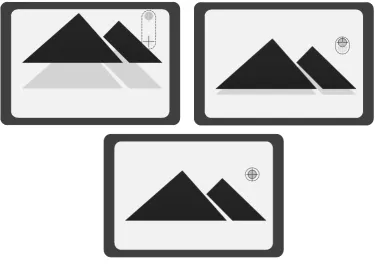
[image:2.595.110.486.263.529.2]When carrying out the measurement repeatedly, the personnel can first determine the approximate position and orientation of the device by GPS or room number OCR, and the device will guide the user to approximately the same position as the previous inspection. Then, the device gesture can be determined by real-time gyro information comparison. User can compare the last photograph taken for the location reference with the image on the device viewfinder in an easy way, as so called “Visual-Assist Positioning” shown in Figure 1, for further positioning and posture determination to reproduce the exact location of the last inspection. In the tradition means, this step is often the most time-consuming risky procedure. If a quick and accurately positioning cannot be achieved, the follow-up measurement could be greatly affected.
Figure 1. Visual-Assist Positioning.
2)Inspection Record and Compare
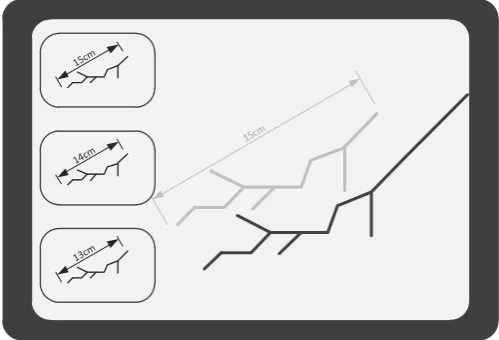
When using the device for inspection the first time, user can mark the key information, such as annotate distance and angle, on the image. The personnel can simultaneously add voice or video instructions or descriptions which can greatly reducing the difficulty of operation. In the traditional method of this step, a steel ruler is needed as reference when one personnel holding it as the other one taking the photograph, the additional information can be only recorded on paper. The two-men-at-least work will result in a higher overall radiation dose and potential risk. In some cases, the inspection result can be recorded only in test due to the ruler or other reference tools cannot be placed or fixed which will significantly reduce the efficiency and accuracy of the inspection.
inspection window may be lost due to the repetition of this step or the problem that could be dealt will be further developed, leading to serious consequences.
15cm
15cm
14cm
[image:3.595.172.422.114.284.2]13cm
Figure 2. Inspection Result Comparison.
3)On-Site Inspection Reference information
On the basis of the site-assisted positioning, the mobile terminal can display the location-relevant information in combination with the positioning information and image recognition results. E.g.:
Field Risk: Dose rate, temperature and humidity, oxygen content, drop and other issues; Historical issues in same region: Prompted the issues, causes and solutions ever happened;
On-Site task information and the current task information: According to the location information, prompts the current task information, steps, key points and risks, also provides personnel information to facilitate the work of the temporary allocation of tasks on site or disposal of unexpected situations.
This method utilizes the mature mobile application in the hardware, and the design and function realization is based on the open software environment, the method is of low development, use and maintenance cost, which is convenient for the promotion and application of the method.
On-Site Applications
A mobile application client on Apple iPad has been designed to implement on-site. On this platform, a data cache and delay synchronization feature was needed to adapt the on-site network environment which is not convenient for data exchange. The staff could initiate data synchronization between the mobile terminal and server before the start of work through the wireless network set up in office or wired connection. The same procedure executes automatically after the on-site work to transfer the data acquired on the mobile terminal to the server once a wireless network connection is established or a cable is connected to the terminal. In order to support multi-user operation, the system has a conflict handling mechanism. The system overall design is showed in fig.3.
Figure 3. Mobile Application System.
This method can significantly improve working efficiency and reduce personnel risk in On-Site inspection by assisting positioning inspection point under complicated field conditions.
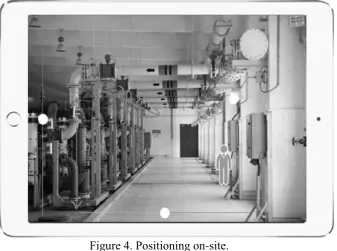
When carrying out the inspection of the crack width on containment, the field staff uses the mobile terminal to assist the positioning as shown in Fig. 4. The time span of the positioning is greatly reduced and the accuracy of positioning can also be guaranteed when the tradition locating process which relies on field markers and multiple reference objects is usually very time-consuming and inaccurate.
Figure 4. Positioning on-site.
It is convenient and comprehensive to record and compare the inspection results, which is of high importance for finding and preliminary judging the issues.
After recording the crack width, the mobile terminal displays the development trend graph based on the previous measurement results in real time, and gives the inspection suggestion. If the change rate is higher than before, a repeat measurement will be suggested.
[image:4.595.138.476.379.630.2]maintenance work is found necessary, the photographs, voice memos and short videos which could represent the circumference around the defect would be very helpful to develop a maintenance program.
The method is of a very high practical value in general on-site inspection work and has been implemented in multiply nuclear power plant domestic.
Conclusions
This method can significantly improve working efficiency and reduce personnel risk in On-Site inspection by assisting positioning inspection point under complicated field conditions. Record and compare inspection result in a convenient and efficient way and help to find and quick judgement for the issue. Notice the key point of inspection, work risk and historical to the field personnel based on current position.
This method is applied in multiple nuclear power plant for its good applicability and effectiveness.
References
[1] Cheng Fang Fang, Eechien Chang. Securing interactive sessions using mobile device through visual channel and visual inspection. Annual Computer Security Applications Conference[C], 2010.
[2] Anoop Sattineni, Taylor Schmidt. Implementation of Mobile Devices on Jobsites in the Construction Industry. Procedia Engineering[J], 2015(123), 488-495.
[3] Sarun Sumriddetchkajorn Mobile device-based optical instruments for agriculture[C], 2013.