2017 2nd International Conference on Computer Science and Technology (CST 2017) ISBN: 978-1-60595-461-5
Analysis of Operational Effectiveness Index of
Army Weapon Equipment System
Qiang QU
1, Xin-hua HE
1and Wei-chao ZHANG
11Department of Information Engineering, Academy of Armored Force Engineering,
Beijing 100072, China
Keywords: Army weapons and equipment system; Operational effectiveness index; OEI
Abstract. Army weapon system OEI (operational effectiveness index) is operational
capability index of army weapon equipment. By improving the proportion of combat capability of the army's weapons and equipment, we stress the importance of loss probability; this paper presents a new OEI of army weapon equipment system. It is used to optimize the probability that the army will lose its combat capability and in this paper the effectiveness of this parameter is verified by a specific operation.
Introduction
Operational effectiveness evaluation of army weapon equipment system is the basis of equipment development and optimization of structure and force structure. OEI is a common method to measure the combat effectiveness of weapons, and the numerical value of the weapon system directly reflects the level of the pros and cons. Taking into account the full consideration of the factors about the index based on the index system is difficult, and the index selection and weight setting are subjective [1].
In order to solve these problems this paper presents a new type of OEI. At first, the paper will introduce two types of operational index of weapon system and these pros and cons. In the second part, it will define a new type of OEI, called IRL, and give its calculation method. Finally, it will introduce a real case of operational evaluation and simulation of OEI.
Weapon Equipment Evaluation and Analysis Weapons and Equipment System
Weapons and equipment system is the goal of building an information army and winning information war, For the best overall combat effectiveness, a variety of weapons and equipment systems are functionally interrelated, complementary to each other and integrated in a certain structure, it is a higher level of armed equipment system. Its most typical characteristic is integrity and antagonism. The core and the key point of the research on the weapon system in the information war article should be the relationship between the internal systems.
Evaluation Method of Operational Effectiveness of Weapon Equipment
The evaluators use their own accreditation criteria and they use a certain evaluation technique, methods and processes to assess the target attributes of the quantitative or qualitative assessment [2]. Evaluation method is the core of evaluation. Evaluation method of operational effectiveness of weapon equipment mainly includes the index method, practical test method, such as modeling and simulation method.
the evaluation method of the object itself is OEI. For a single weapon, using the practical test method can obtain very intuitive results, but the weapon system composed of a large number of equipment is almost impossible to use the weapon system test and evaluation. Therefore, the researchers used physical or mathematical model to replace the physical model. Researchers have proposed modeling and simulation methods.
Modeling simulation method is to establish a model of weapons and equipment, and it Include physical model, semi-physical model or mathematical model, and the model in the actual or simulation environment to run, then it can access to OEI. The advantage of modeling simulation method is that it has less equipment to transfer and low cost of manpower and material resources. It is the potential method in weapon system evaluation. Its disadvantage is that the model needs to be repeatedly verified and amended in order to achieve a satisfactory degree of confidence.
OEI
OEI is a comprehensive indicator of the size of Operational effectiveness simulation. It can be a probability, a physical or an abstract and normalized value. OEI is divided into two categories; one is based on the comprehensive index system; the other is based on the effect of operation. The OEI based on the index system is mainly used in the comprehensive evaluation of indicators, and the focus is to establish a reasonable index system, and then synthesized into a normalized value. The OEI based on effectiveness is obtained by simulating the effect or effectiveness of the combat mission execution to obtain the OEI, and it includes the equipment war loss ratio, propulsion speed [3], equipment loss exchange ratio, personnel loss exchange ratio, equipment loss fraction exchange ratio. Personnel loss fraction exchange ratio, comprehensive performance measurement, simulation against time [4]. It is often used in the real test method and the modeling simulation evaluation method.
OEI Based on Index System
The combat index which basing on the index system is mainly used in combination with the comprehensive evaluation of indicators, the key is to establish a comprehensive and reasonable index system. Operational effectiveness is a dynamic confrontation effect, which is determined by the combat capability, operational efficiency and operational environmental factors of both sides.
The OEI system of the Army weapon equipment system is mainly composed of six categories of indicators, including technical and tactical indexes of equipment capability, personnel quality indicators, technical and tactical indexes of enemy equipment capability, enemy personnel quality indicators, environmental conditions indicators and operational use indicators. Operational effectiveness indicators are selected based on the degree of adaptation of the operational system. However, the OEI also has shortcomings, mainly because there is a nonlinear relationship between indicators. It is difficult to ensure independence, personnel quality and environmental conditions and other factors have a very complex impact on performance, and it is difficult to achieve a comprehensive and objective quantification. Finally, the index selection and weight setting are subjective.
OEI Based on Effect of Operation
to the different requirements of combat capability will have different operational effects. Some mode of operations stressed the speed of combat, some stressed the completion of the task of the battlefield, and some stressed the proportion of equipment and personnel losses.
With the emphasis on the proportion of equipment and personnel loss of combat as an example, Equipment loss swap ratio is defined as the ratio of enemy equipment loss to the number of equipment damage. It is equivalent to the enemy equipment loss of the effectiveness of the completion of the task, one's own equipment equivalent to the cost of the completion of the task. There are also some improved models for equipment loss exchange. For example, the equipment combat capability to consider, rather than assuming that all the equipment capacity is the same equipment, combat capability loss exchange ratio.
(OC ) (OC)
LossOf e
LossOf ′
′ = (1)
LossOf (OC) represents the value of one's own combat capability loss. LossOf (OC‘) represents the loss of enemy combat capability. The loss of combat capability represents loss of quantity and loss of performance. Based on the effectiveness of the OEI in personnel, environment, operational using is transparent, It avoids the study of these complex and dynamic factors, and Its physical meaning is clear and easy to understand. But the combat capability only contains the weapons and equipment of the individual measurement, if the equipment into the system background, there is the importance of the network level is not reflected.
Constructing Operational Effectiveness Model of Weapon Equipment System Define a New OEI
The new OEI needs to be measured both globally and on a macro scale, and it is necessary to fully analyze the equipment system combat capability in the allegation network and information network system-level role. In addition, the equipment loss data in the loss exchange ratio is difficult to obtain prior to the occurrence of the war, so it cannot be used as a predictor of a priori performance evaluation.
Therefore, by emphasizing the importance and loss probability to improve the exchange loss ratio of operational capability, a new OEIis proposed, that is, the importance loss probability ratio. Supposing that at some point t in the process, the Red Army's weaponry system consists of Nweapons
{
A A1, , ,2 AN}
and the Blue Army contains Mweapons{
B B1, 2, , BM}
. The importance of the Red Army equipment{
I I1, , ,2 IN}
and the probability of loss{
L L1, , ,2 LN}
, respectively, and the importance of the Red Army equipment{
I I1′ ′, , ,2 IM′}
and the probability of loss{
L L1′ ′, , ,2 LM′}
, so the Red Army weapons and equipment system Importance Loss Probability Ratio(ILR) defined as1
1
M j j j
N i i i
I L ILR
I L
=
=
′ ′⋅ =
⋅
(2)Probability Ratio defined as 1 1 1 N i i i M j j j I L ILR ILR I L = = ⋅ ′ = = ′ ′⋅
(3)We can get the following two conclusions through the above two formulas:
(1)The importance of the probability of loss can be seen as one side of the loss of weapons and equipment, and it can be seen as the other side of the attack efficiency. This conclusion seems to indicate that ILR is only determined by the ability of weapons and equipment attack, in fact, reconnaissance, mobility, security capabilities will affect the attack efficiency, and thus indirectly determine the size of Importance Loss Probability Ratio
(2)The ILR of each side of the battle are reciprocal. Combat is a shift in the activities of an operational effectiveness; the other is bound to reduce the proportion, which is in line with objective laws.
Calculation of ILR
The Importance of Target Selection. We all want to attack the most important
and valuable goals. Therefore, the importance of the target is defined as the role of the target in the enemy system or system. Its state value is mainly determined by the ability of the target equipment and the degree of network contribution and the fit of the guiding objectives of our task. Assuming that the attack capacity index Ai of the target equipment Ai is ci, the network contribution is ηi, and the target fit degree is βi, the target importance can be expressed asIi =F c
(
i, ,η β
i i)
.In this paper, the average of the wrecking efficiency is used as the attack capability index as1
, ,
1
M M
i i i j i j j
c w p
ϕ
=
=
,Whichwi means that the average rate of equipment Ai,pi j,ϕ
i j,stands for average single-hit probability and average hit probability of Bj. In this paper, the degree of network equipment used to calculate the degree of contribution to describe the rate at which the target equipment plays a role in the functioning of the weapon system. Assuming the Red Army weaponry system information network, the corresponding degree of each equipment node
{
A A1, , ,2 AN}
is{
λ λ
1, , ,2 λ
N}
, then the network contribution of Ai is{
1 2}
max i i N
λ
η
λ λ
λ
=
, , (4)
In this paper, the product form, the importance of the target equipment can be written as
, ,
1
M i i
i i i i i i j i j j
I c w p
M
η β
η β
ϕ
=
= =
(5)Combat Loss Ratio. The attack probability is mainly affected by the number of
bombs, single-shot hit probability and hit probability. The Blue Army equipment Bj on the Red Army equipment Ai attack probability of destruction as
(
, , ,)
j,i j,i j i j i
single-shot hit probability and hit-and-miss probability of the equipment Bjfor Ai,The attack probability is usually expressed as a function of time and its maximum value is 1.The probability of attack is expressed as
( )
( ) ( ) ( )
, ,( ) ( ) ( )
( ) ( ) ( )
, ,, ,
1
1 1
j,i j i j i j,i j i j i j,i
j,i j i j i
t p t t t p t t
K t
t p t t
α ϕ α ϕ
α ϕ
′ ′ ′ ′ ′ ′ <
′ = ′ ′ ′ ≥
(6) Supposing the Red Army equipments Aiare attacked by the Red Army’sQ (Q M≤ ) equipments, Q equipments on the Red Army equipments Ai single bomb attacks can be seen as independent events. In probability theory, there is at least one probability of occurrence of independent events is
(
)
1 2
1
(A A A ) 1 1 (A )
Q
Q i
i
P P
= = −
∏
− (7)
Therefore, when the Q equipments to attack the equipment Ai, the probability of Ai’s Destruction rate is
( )
1(
1( )
)
Q
i j,i
j J
L t K t
∈
′
= −
∏
− ,Where setJQ⊆{
1 2,, , M}
.Themost important parameters of the probability of loss are single-shot hit probability and hit probability. When the probability of loss is 1, not to say that the equipment must be destroyed, but by probability is likely to be destroyed. In the system warfare, when the number of equipment samples is large enough, we can equate the probability of loss equal to 1 equates to the equipment destroyed or lost.
Case Analysis Case Description
Table 1. the average single-shot hit rate, hit the average hit rate.
Type of
equipment B1 light armored vehicles B2 heavy armored vehicles
B1 light armored vehicles
B2 heavy armored
vehicles 15%, 33.3%
Simulation
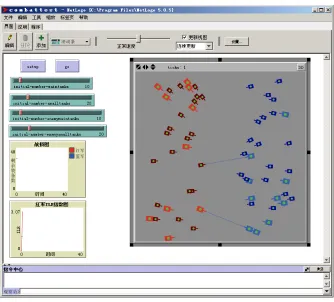
These operations were modeled in the NetLogo environment. Supposing the Blues use the "nearest target within attack range" strategy, Red Army "priority attack range within the heavy armored vehicles" strategy, the simulation running process shown in Figure 1.
Figure 1. Example Net logo simulation process diagram.
The importance probability loss ratio between the red and blue sides is calculated, and the network contribution ηi and the target fit degree βi of all the equipments are
20%, 100%
15%, 50% 20%, 50%
15%, 100% 20%, 25%
[image:6.612.140.474.375.677.2]set to 1. The simulation program detects equipment damage and the importance of probability of loss than the indexin real-time, as shown in Table 2.
Table 2. Simulation Experiment Data Sheet.
T 1 3 5 7 9 11 13 15 17 19 21 23 25 27
NR 30 30 29 24 17 14 14 13 10 9 6 6 5 4
NB 30 30 29 25 20 15 13 11 9 6 4 1 1 0
I 0 1.31 1 0.95 1.17 2.64 2.96 4.19 0 3.6 0 2.75 7.03 0
Among them, the T represents the simulation time, the NR represents the Number of Red Army equipment, the NB represents the Number of Blue Army equipment, the Irepresents the Loss probability ratio.
According to Table 2, we can analyze that the fighting in the Red Army's index is greater than 1, that the Red Army tactical operational effectiveness better than the blue strategy, which is consistent with the actual combat results.
Summary
In this paper, we design a new type of OEI, that is, the importance of probability of loss ratio. Compared with the traditional OEI, it has a more objective and more comprehensive measurement of the characteristics of the results. In addition, it can be used for operational effectiveness prediction. However, it also has some shortcomings: First, we need to further study and demonstrate the importance and feasibility of the parameters of the calculation method; Second, it is the premise of the assumption that the operation to annihilate the enemy as the goal. It does not apply not to annihilate the main objective of the situation,
References
[1] C. Z. Yang, K. Y. Teng, Y. B. Cheng. Weight Determination of Indexes for Evaluating Operational Effectiveness. Computer Simulation, 2008 (10).
[2] K. Cheng, et al. Review of Combat Effectiveness and Its Evaluation Methods. System Science Journal, 2014 (01): 88-92.
[3] Z. R. Ni. Modeling and Simulation of Weapon Equipment System Confrontation. Military Operations Research and Systems Engineering, 2004 (01): 2-6.
[4] Q. S. Guo, Z. J. Tang, X. M. Luo, et al. Equipment combat simulation. Beijing: National Defense Industry Press, 2013.