University of Huddersfield Repository
Alabed, Asmaa
Knowledge Management for Grinding Technology
Original Citation
Alabed, Asmaa (2011) Knowledge Management for Grinding Technology. Doctoral thesis, University of Huddersfield.
This version is available at http://eprints.hud.ac.uk/id/eprint/14575/
The University Repository is a digital collection of the research output of the University, available on Open Access. Copyright and Moral Rights for the items on this site are retained by the individual author and/or other copyright owners. Users may access full items free of charge; copies of full text items generally can be reproduced, displayed or performed and given to third parties in any format or medium for personal research or study, educational or notforprofit purposes without prior permission or charge, provided:
• The authors, title and full bibliographic details is credited in any copy; • A hyperlink and/or URL is included for the original metadata page; and • The content is not changed in any way.
For more information, including our policy and submission procedure, please contact the Repository Team at: [email protected].
Knowledge Management for Grinding
Technology
Asmaa Alabed
A thesis submiutted to the University of Huddersfield in partial
fulfilment of the requirements for the degree of Doctor of
Philosophy
The University of Huddersfield
[2]
Abstract
This thesis describes an investigation concerned with development of a grinding knowledge warehouse system (GKWS). Based on a study of previous work on knowledge management and technique for a selection of grinding conditions, the thesis proposes a novel methodology to deal with missing data in surface and cylindrical grinding using Genetic Programming.
The GKWS provides a guided tool for users to support the decision-making process to provide suggestions for selecting grinding conditions using rule-based reasoning (RBR) and case-based reasoning (CBR) and it can learn from new and previous grinding cases to improve and expand the CBR cases.
The GKWS developed a new methodology to deal with missing data in grinding operations. The new methodology is built on If-Then rules, mathematical equations and modelling using genetic programming (GP). Dealing with missing data improves the performance of knowledge discovery in the GKWS and the results of the CBR.
The GP is developed for modelling surface roughness in cylindrical and surface grinding. The developed GP model for surface grinding shows the ability to predict the surface roughness parameter especially when the GP terminals vary and the same material and wheel are used.
[3]
Acknowledgments
I would like to acknowledge the contribution of all those who assisted towards the completion of this thesis. First, I would like to thank my supervisor Dr Xun Chen, for his patience, support, help, encouragement and valuable guidance throughout my PhD study.
Thanks are expressed to company A for their contribution and suggestions in the first stage of this thesis.
Further thanks go to all members of computing and engineering department for their help and support.
Finally, I wish to thank my family and friends especially, my parents, my husband Saher, my friend Nadia, and my kids Hala, Omar and Jodie, for their support, encouragement and patience through my study without them this work would be impossible.
[4]
List Symbols of Acronyms
a Depth of cut for cylindrical grinding and down feed for surface roughness
d
a Dressing depth of cut
AI Artificial Intelligence
s
b Wheel width
CBR Case-based Reasoning CoP Community of Practice
g
d Grain size
w
d Work diameter
wo
d Workpiece diameter in exciting case
wn
d Work piece diameter in the problem
eq
D Equivalent diameter
DM Data Mining
ENoPs Electronic Networks of Practices
d
f Feed rate
do
f Feed rate in an exciting case
dn
f Feed rate in the solution FTDE Free Text Data Entry GA Genetic Algorithm
GKWS Grinding Knowledge Warehouse System
GP Genetic Programming
eq
h Equivalent grinding thickness
HTML Hyper Text Markup Language IS Information System
[5]
KDD Knowledge Discovery in Database MBR Model Based Reasoning
n Sample size
ODBC Open Database Connectivity PHP Hypertext Pre-processor
Q′ Material removal rate
a
R Surface roughness
a
R Surface roughness sample mean
aGP
R GP value for surface roughness
ao
R Workpiece surface roughness in an exciting case
an
R Workpiece surface roughness in the problem
RBR Rule-based Reasoning
s Standard deviation
d
s Dressing lead
t
s Cross feed
SDE Structured Data Entry SQL Structured Query Language
av
T Average chip removal thickness
f
v Feed rate
0
f
v Feed rate in an existing case
fn
v Feed rate in the solution
w
v Work speed
wo
v Work speed in an existing case
wn
v Work speed in the solution
s
v Wheel speed
so
v Wheel speed in an existing case
sn
v Wheel speed in the solution
'
w
V Specific work material removal
w
[6]
Table of Contents
Abstract ... 1
Acknowledgments ... 3
List Symbols of Acronyms ... 4
Table of Contents ... 6
List of Figures ... 10
List of Tables ... 14
CHAPTER 1 INTRODUCTION ... 16
1.1 Research Motivations and Aim ... 16
1.1.1 Overview of Knowledge Management (KM) ... 16
1.1.2 Overview of Grinding Technology ... 20
1.1.3 Research Aim ... 23
1.2 Research Objectives ... 24
1.3 Research Methodology ... 24
1.4 Contributions ... 26
1.5 Thesis Outline ... 26
CHAPTER 2 LITERATURE REVIEW ... 30
2.1 Knowledge and Knowledge Management ... 30
[7]
2.1.2Knowledge Creation ... 34
2.1.2 Knowledge Management ... 36
2.2 Knowledge Discovery in Databases ... 59
2.2.1 Data and Knowledge Mining ... 60
2.2.2 Missing Data and Data Mining ... 63
2.3 Grinding Technology ... 65
2.3.1 Modelling and Knowledge Management System in Grinding ... 65
2.4 Research Gap ... 71
CHAPTER 3 GKWS ANALYSIS AND SYSTEM DESIGN ... 76
3.1 Procedures of GKWS Development ... 76
3.1.1 Investigation of user demands ... 78
3.1.2 Comparison Between the Performance of CoP in Two Manufacturing Operations ... 78
3.2 System Function Analysis ... 83
3.2.1 Sequence Diagram ... 84
3.2.2 Use Case Diagram ... 86
3.2.3 Activity Diagram ... 88
3.3 General Description of the GKWS ... 90
3.3.1 Decision Support Sub-system ... 93
3.3.2 Managing Grinding Records Sub-system ... 93
3.3.3 CoP Collaborative Sub-system ... 93
3.4 The Methodology of the GKWS ... 94
3.4.1 Technical Tools for GKWS ... 101
3.5 Summary ... 103
[8]
4.1 Data Collection Module ... 104
4.1.1 Data Required for Selecting Grinding Conditions ... 108
4.1.2 Surface Roughness ... 111
4.2 Database Module ... 114
4.2.1 Design Philosophy ... 114
4.2.2 Data Preparation ... 120
4.3 Knowledge Storage ... 123
4.4 Application Example ... 125
4.5 Summary ... 126
CHAPTER 5 KNOWLEDGE ACQUISITION AND PROBLEM SOLVING MODULE ... 128
5.1 Knowledge Acquisition Module ... 128
5.2 Problem Solving Module ... 132
5.2.1 Inference Engine ... 139
5.2.2 Application Example ... 140
5.3 Summary ... 142
CHAPTER 6 LEARNING KNOWLEDGE DISCOVERY ... 146
6.1 Knowledge Learning and Discovery Module ... 146
6.1.1 Rule-based Learning in the CoP Forum ... 147
6.1.2 Data Mining in GKWS ... 154
6.1.3 Methodology of Dealing with Missing Data ... 160
6.1.4 Mathematical Equations ... 163
6.1.5 Genetic Programming Model ... 165
6.2 Screenshot of the Main Functions of GKWS ... 177
[9]
CHAPTER 7 SYSTEM EVALUATION AND DISCUSION ... 186
7.1 Evaluation of GKWS ... 186
7.2 Evaluation of User Interaction ... 187
7.3 Measure of GP Model Adequacy ... 187
7.3.1 Absolute Value for Relative Error ... 188
7.3.2 Test for Significance of a GP Model ... 190
7.3.3 Confidence Interval ... 192
7.3.4 Applying GP Model on Experimental Data ... 193
7.4 Summary ... 201
CHAPTER 8 CONCLUSIONS AND FUTURE WORK ... 202
8.1 Conclusions ... 202
8.2 Future Work ... 205
References ... 207
Appendix A ... 222
AppendixB ... 222
[10]
List of Figures
Figure 1.1 Web-based illustrative designs for GKWS ... 25
Figure 1.2 Schematic of thesis structure ... 29
Figure 2.1 Interaction between explicit and tacit knowledge ... 35
Figure 2.3 KM activities ... 43
Figure 3.1 Procedure of GKWS development ... 77
Figure 3.2 Percentage for Group A ... 80
Figure 3.4 Sequence diagram for GKWS ... 85
Figure 3.5 Use case diagram for GKWS ... 87
Figure 3.6 Activity diagram ... 889
Figure 3.7 Top level of architect of design system ... 92
Figure 3.8 The GKWS architect…………..……….99
Figure 3.9 Knowledge management activities in GKWS ... 100
Figure 3.10 Technical system structures ... 102
Figure 4.1 The framework for data collection and database module ... 107
Figure 4.2 Grinding variables ... 111
Figure 4.3 Relationship between grinding tables ... 117
Figure 4.4 Structure of CoP Forum ... 119
[11]
Figure 4.6 Knowledge storage in GKWS ... 124
Figure 4.7 Home page screen ... 125
Figure 4.8 Form interface for collecting grinding variables ... 126
Figure 4.9 Free text data entry ... 126
Figure 5.1 CBR and RBR flow chart ... 138
Figure 5.2 Old part key in screen ... 140
Figure 5.3 Retrieved grinding conditions for previous machined part ... 140
Figure 5.4 User Input Screen ... 141
Figure 5.5 Grinding conditions using CBR ... 141
Figure 5.6 Input user interfaces for Cast Iron material ... 142
Figure 5.7 Recommended case using RBR ... 142
Figure 5.8 Flow chart for CBR and RBR in GKWS where the wheel is selected system ... 144
Figure 5.9 Flow chart for CBR and RBR in GKWS where the user selects the wheel ... 145
Figure 6.1 Posting a new topic in the conference and event forum ... 147
Figure 6.2 Categorised CoP forums ... 148
Figure 6.3 Searching CoP topics ... 149
Figure 6.4 Searching results for “grinding wheel” ... 150
Figure 6.5 Detailed results for “grinding wheel trial at Nottingham uni” ... 150
Figure 6.6 Problems and remedies main page ... 151
Figure 6.7 Problems and remedies search engine ... 152
Figure 6.8 The results for symptoms search ... 152
Figure 6.9 The uploading file user interface ... 153
[12]
Figure 6.11 The files that contain grinding ... 153
Figure 6.12 Methodology for filling missing data ... 162
Figure 6.13 Comparison between Ra experimental value and using GP model for cylindrical exp. dataset (1) ... 173
Figure 6.14 Comparison between Ra value and using GP model for cylindrical cal. dataset (2) ... 174
Figure 6.15 Comparison between Ra value and using GP model for surface exp. dataset (3) ... 175
Figure 6.16 Comparison between Ra value and using GP model for surface cal. dataset (4) ... 175
Figure 6.18 GKWS main screen ... 178
Figure 6.19 CoP screen ... 179
Figure 6.20 the Input form for grinding case ... 180
Figure 6.21 User is notified that depth of cut is calculated ... 181
Figure 6.22 User typed in the depth of cut ... 181
Figure 6.23 The case is added ... 181
Figure 6.24 The calculated feed rate and surface roughness value ... 182
Figure 6.25 Warning message for missing data ... 183
Figure 6.26 Security Screen ... 183
Figure 7.1 Absolute relative error between experimental and calculated surface roughness using GP for cylindrical exp. dataset (1) ... 188
Figure 7.2 Absolute relative error between experimental and calculated surface roughness using GP for cylindrical cal. dataset (2) ... 189
[13] Figure 7.4 The tree output for Ra modelling using GP ... 194 Figure 7.5 Graphical output for Ra modelling using GP ... 195 Figure 7.6 Comparison between Ra experimental value, Ra using GP and Lee, Choi and Shin’s (2003) model ... 195 Figure 7.7 Absolute relative error between Ra experimental and Ra using GP ... 196 Figure 7.8 Comparison between Ra experimental value and Ra using GP and Lee, Choi and Shin’s (2003) model ... 197 Figure 7.9 Absolute relative error between Ra calculated using Lee, Choi and Shin’s (2003) model and Ra using GP ... 198 Figure 7.10. The tree output for Ra modelling using GP... 199 Figure 7.11 Comparison between Ra value and using a GP model for surface
[14]
List of Tables
Table 1.1 A brief list of some selectable grinding processing variables ... 23
Table 2.1 Activities for knowledge exchange ... 36
Table 2.2 Summary of KM Activities ... 38
Table 2.3 Comparison between KM suites (November 2004) ... 56
Table 2.4 Summary of KM suites (September 2008) ... 57
Table 3.1 Number of emails for group A from March 2005-November 2006 ... 80
Table 3.2 Number of emails for group B from March 2005-November 2006 ... 80
Table 3.3 Percentages for groups A and B ... 81
Table 3.4 Analyses for the answered questions ... 82
Table 4.1 Grinding parameters at a glance ... 105
Table 4.2 Database table fields for grinding ... 115
Table 4.3 CoP tables ... 120
Table 6.1 Cylindrical and surface grinding datasets ... 157
Table 6.2 Mathematical equations ... 163
Table 6.3 Surface roughness models for cylindrical grinding ... 168
Table 6.4 Surface roughness models for surface grinding ... 169
Table 6.5 GP terminals for surface grinding ... 170
Table 6.6 GP terminals for cylindrical grinding ... 170
[15]
Table 7.1 Test for significance where α=0.05 ... 191
Table 7.2 Test for significance where α=0.1 ... 192
[16]
CHAPTER 1 INTRODUCTION
This chapter presents the philosophy, motivation and aim behind the research undertaken, and it introduces the themes of knowledge management (KM) and grinding technology. The research methodology is identified and original contributions made by this thesis are summarised. Finally, a brief outline of the thesis structure is given.
1.1 Research Motivations and Aim
1.1.1 Overview of Knowledge Management
(KM)
[17] industry, maintain a well-trained workforce, and develop new innovative approaches and methods (Kuivanen 2008).
In recent years, organisations have tended to improve their efficiency, to automate their manual labour and to reduce redundancy, which has caused a decrease in informal employee communications and a reduction in tacit knowledge sharing (Sánchez and Palacios 2008). In Europe, the industry will lose a large amount of silent knowledge in a short period of time because a large number of employees will be retiring (Kuivanen 2008). The reduction in personnel will have a great impact on the operations that depend on the skills and experience of people, such as grinding technology. As people leave, organisations realise that they take valuable knowledge with them that had been kept in their minds (Connolly and Begg 1998; Hildreth, Wright and Kimble 1999; Kuivanen 2008; Sánchez and Palacios 2008).
The main objective of knowledge management is to manage knowledge processes (collect, store, retrieve and share), maintain current knowledge, and create new knowledge. Such new knowledge could be created by combining existing knowledge pieces or by a generation of novel concepts through knowledge sharing. An interesting characteristic of knowledge is that its value grows when shared (Bhirud, Rodrigues and Desai 2005; Tiago et al. 2007; Chawla and Joshi 2010). Further work observed that there are two additional key enablers that can create effective knowledge management systems – competency and infrastructure (Baveja, Shankar and Acharia 2009).
[18] stored, retrieved, shared and accessed at the convenience of employees and is well suited even for busy employees (Hildreth and Kimble 2002; Gillingham and Roberts 2006).
The tacit knowledge is found in people’s heads or experience and it develops from direct experience of action. It could be shared through highly interactive conversion, storytelling, e-learning and sharing experiences (Wenger 1998; Hildreth, Wright and Kimble 1999; Hildreth and Kimble 2002; Bhirud, Rodrigues and Desai 2005; Coff, Coff and Eastvold 2006; Taminiau, Smit and De Lange 2009; Harris 2009).
The most challenging part of any KM programme is managing tacit knowledge (Denning 1998; Gurteen 1999; Hildreth, Wright and Kimble 1999; KPMG 2000; Kimble, Hildreth and Wright 2001; Du Plessis 2007; Taminiau, Smit and De Lange 2009). The challenge inherent with tacit knowledge is figuring out how to recognise, generate, share and manage it.
[19] 2005), in general, the researcher will investigate the advantages and disadvantages to these methods and then apply the selected method to input the missing data.
Information Technology (IT) in the form of e-mail, groupware, instant messaging, electronic database, video and audio recording, multimedia presentations, and related technologies can help facilitate the dissemination of tacit knowledge (Wiig 1997; Parlby and Taylor 2000; Santosus and Surmacz 2001; He and Li 2010; Choi, Lee and Yoo 2010). Hildreth and Kimble (2002) argued that another role of IT in KM is to make the tacit visible.
Knowledge sharing is a critical issue in any KM programme. Knowledge sharing is a key issue in order to enhance the innovation capability of firms and organisations (Sáenz, Aramburu and Rivera 2009). Taminiau, Smit and De Lange (2009) claim that the most important route to innovation is informal knowledge sharing.
[20] they do not have the time to learn or/and search deeply about the subject (Baek et al. 1999; Sena and Shani 1999; Teigland 2003; Teigland and Wasko 2004).
1.1.2 Overview of Grinding Technology
Aiming at high quality parts at low costs and high-performance products in respect of part precision, surface integrity, machining efficiency and batch stability, manufacturing companies look for more accurate, reliable and efficient process planning with the support of computer aided manufacturing, computer aided process planning and flexible manufacturing systems (King and Hahn 1986; Oliveira et al. 2009).
Grinding is a material removal process using a grinding wheel, which is made up of random size, shape and orientation of abrasive grains. In other words, grinding is basically a chip-removal process in which the cutting tool is an individual abrasive grain (Kalpakjian 1991). Grinding is commonly selected for finishing operation because grinding has high accuracy and surface finish with a relatively high material removal rate. Existing techniques for the selection of grinding variables are data retrieval methods, empirical methods, and artificial intelligence (AI). Different approaches have been implemented to select grinding conditions using Case-based Reasoning (CBR), Rule-based Reasoning (RBR), and a hybrid approach (Rowe et al. 1994; Watson 1995; Rowe et al. 1988; Li et al. 1999; Li, Rowe and Mills 1999; Morgan et al. 2007;Malkin and Guo 2008).
[21] have been examined and investigated in the literature (Kegg 1983; King and Hahn 1986; Rowe, Bell and Brough 1987; Malkin 1989; Kalpakjian 1991; Tonshoff et al. 1992; Rowe et al. 1994; Vishnupad and Shin 1998; Chen 2002a; Chen 2002b; Zhou and Xi 2002; Hou and Komanduri 2003; Agarwal and Rao 2004; Brinksmeier et al. 2006; Kwak, Sim and Jeong 2006; Morgan et al. 2007; Choi and Shin 2007; Mukherjee and Ray 2008; Stepien 2009; Oliveira et al. 2009; Aurich et al. 2009; Hou, Li and Zhou 2010).
Firstly, the demand for a highly optimised and, at the same time, a more flexible grinding process results in high challenges concerning its stability (Oliveira et al. 2009). Grinding process planning and control tries to ensure high process stability by early identification of desirable grinding output. Numerous researches and approaches have been developed and investigated to improve the possibilities of process control in grinding (Midha, Zhu and Trmal 1991; Sakakura and Inasaki 1993; Gupta, Shishodia and Sekhon 2001; Choi and Shin 2007; Gallego 2007; Morgan et al. 2007; Malkin and Guo 2008). The stochastic nature of the grinding process affects the processes stability (Zhou and Xi 2002; Hou and Komandure 2003). The stochastic nature of the grinding process means that, during a material removal process, the wheel geometry varies with time when the grits participate in the process and removal of material from a workpiece. Because grinding is performed by a number of abrasives particles, which are randomly oriented in a grinding wheel, it is not possible to maintain the same surface finish and dimensional accuracy even though the input parameters of wheel, dressing and materials are the same.
[22] Morgan et al. 2007; Mukherjee and Ray 2008; Shin, Subrahmanya and Choi 2008; Oliveira et al. 2009; Aurich et al. 2009). Some of these variables are displayed in table 1.1.
Thirdly, there is a complex relationship between the process of grinding variables and machine variables and work results (Morgan et al. 2007; Choi and Shin 2007; Shin, Subrahmanya and Choi 2008; Aurich et al. 2009; Oliveira et al. 2009; Hou, Li and Zhou 2010). Although the understanding and modelling of grinding processes is advanced, most models developed to date are seldom utilised in industrial or practical applications and the process planning is done in industry by trial and error on the machine (Morgan et al. 2007; Shin, Subrahmanya and Choi 2008; Oliveira et al. 2009; Hou, Li and Zhou 2010).
[23] Alabed and Chen (2009) proposed a methodology for knowledge warehouse systems in grinding to facilitate explicit and tacit knowledge sharing and retrieving and supporting the decision-making process for grinding process planning.
Oliveira et al. (2009) suggested integrating different methods of process analysis and a knowledge management for improving the possibilities of process control in grinding. Effective data management could reduce lead times considerably, but a generic solution is difficult since grinding is a complex process (Brinksmeier et al. 2006; Oliveira et al. 2009).
1.1.3 Research Aim
The aim of the research is to establish a reliable and flexible grinding knowledge warehouse system (GKWS) in order to facilitate a knowledge management process in grinding technology and improve the decision-making process for selecting grinding conditions, taking into account missing or incomplete data.
Table 1.1 A brief list of some selectable grinding processing variables
Variable Definition
Wheel specification Topography of a grinding wheel that includes important factors such as wheel width, wheel hardness, abrasive type, grain size, and bond type. Wheel dressing The dressing lead and depth are two important factors.
Material properties Material properties include density, compounds, tensile strength, and hardness.
[24]
1.2 Research Objectives
In summary, the main objectives are:
• To investigate the challenges in managing the knowledge of modelling grinding technology.
• To develop KM system that can retrieve appropriate grinding parameters efficiently and accurately.
• To develop a decision-making support method for selecting an initial grinding condition with limited available data and incomplete data.
1.3 Research Methodology
The RBR and CBR are used to provide the engineers and experts with the guidance to select the required parameters for a given grinding operation, taking into account limited grinding cases data and incomplete data. The GKWS provides users with an intelligent data acquisition form that will fill the missing key parameters using mathematical equations, empirical models, or Genetic Programming (GP) models. The core methodology of this research is using GP as the learning knowledge discovery for GKWS that takes advantage of the ability of GP to produce general solutions for modelling grinding surface roughness parameters.
[25] allows users to exchange their knowledge through storytelling, passing documents, or asking questions.
The grinding cases and grinding knowledge are kept in a knowledge warehouse (MySQL database). The users will be able to access and retrieve this knowledge by browsing the intranet and the GKWS is connected with a database server by using Open Database Connectivity (ODBC). The database server and web server will respond to any user query using PHP that is responsible for data manipulation. The data can be transferred to the intranet or Internet and users from different locations can access it by browsing the website constructed in a framework as shown in Figure 1.1.
Clients (users)
Knowledge Warehouse Web Server
ODBC
Database (KDBS) Universal
SQL Original
SQL User SQL
query HTTP
Protocol
[26]
1.4 Contributions
The results of this thesis contribute to the grinding technology by:
• Development of a GKWS to facilitate the knowledge management process in grinding technology and support the decision-making process for selecting grinding parameters.
• Establishment of a novel GP method in dealing with missing data. In the case study, the GP method was used to model a surface roughness parameter and the results are compared with different surface roughness models.
• The CBR is extended and adapted for selecting grinding conditions by increasing the number of saved grinding cases as the missing parameters are filled.
• The development of a categorised discussion forum to encourage knowledge sharing and retrieving of the communication between CoP that would encourage and facilitate an exchange of ideas and expertise.
• The contribution to the academic society by producing several publications.
1.5 Thesis Outline
[27] knowledge warehouse system. Knowledge creation and sharing are discussed and explored. Chapter 2 explores the current related knowledge management software. Grinding modelling and its challenges are summarised. Finally, the research gap is identified.
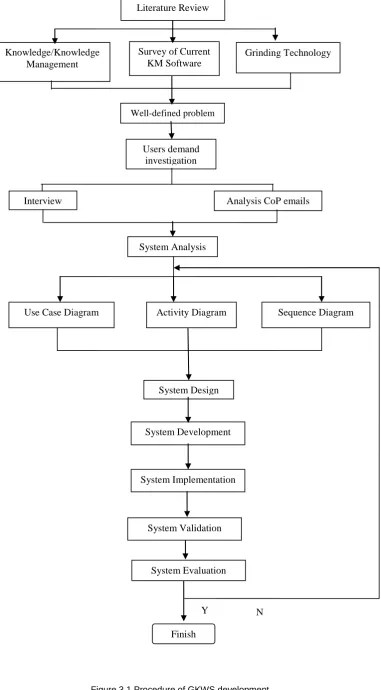
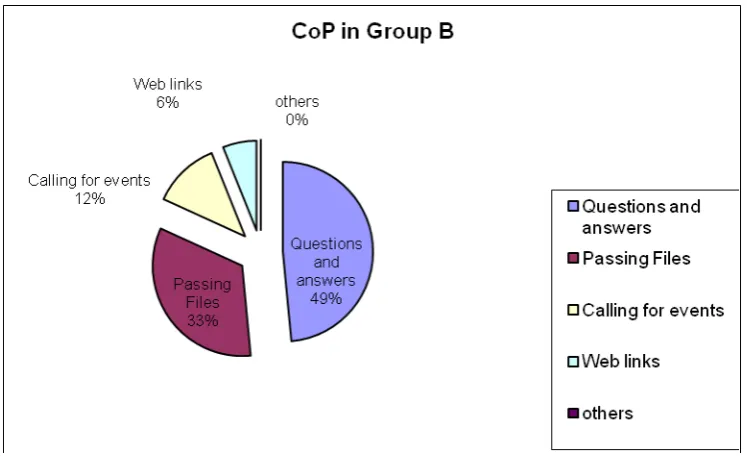
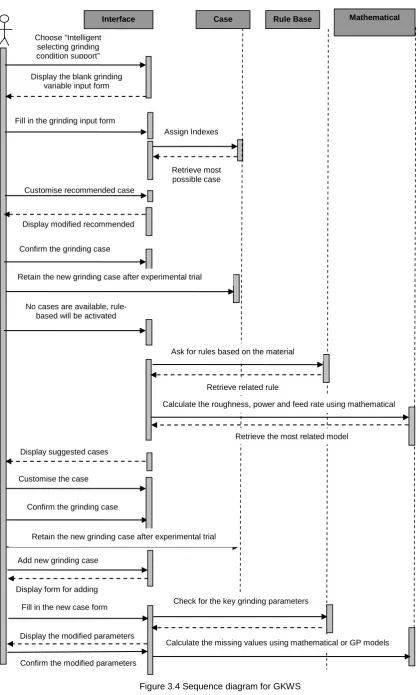
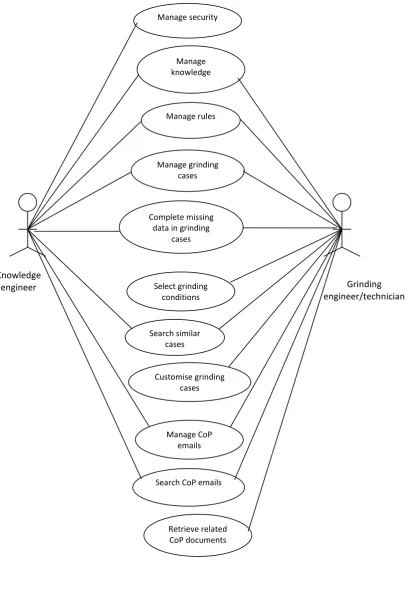
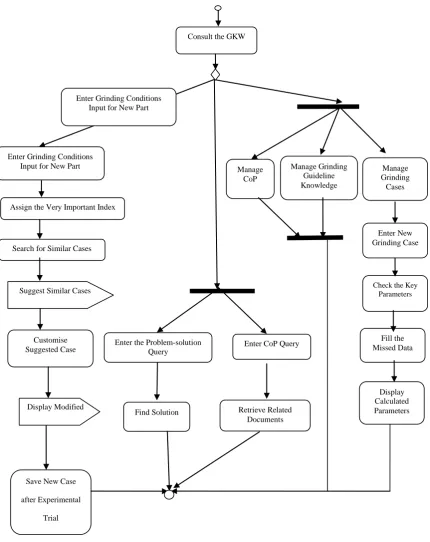
Chapter 3 explains the steps for the development of the grinding knowledge warehouse system (GKWS), including investigation of user demand, system function analysis and general description of the GKWS. Two CoP communities are investigated and the results are presented and discussed. It introduces the methodology, main functions and capabilities of GKWS. The system function analysis is illustrated using a sequence diagram, a use case diagram and an activity diagram. General description of GKWS including the main sub-systems is introduced. The methodology of developing GKWS is discussed.
Chapter 4 presents the data presentation methodology for collecting and managing data. This stage is a very important stage for developing a knowledge warehouse. Although the number of grinding variables that are required to describe the grinding process is very large, the GKWS is recording the key parameters that are needed for selecting a grinding condition without losing any key knowledge that may have a generic application sense. The database module is designed and developed using free source MySQL. The data preparation function is established to ensure that useful knowledge is derived from the input data in knowledge discovery module.
[28] core of this module is Case-based Reasoning (CBR), Rule-based Reasoning (RBR), and Model-based Reasoning (MBR). Data transformation, knowledge inference engine and knowledge representation are explained and discussed in this chapter.
The learning knowledge discovery is discussed in Chapter 6. The main function of this module is to extract implicit, previously unknown and potentially useful models and patterns, and to modify and update the existing models and patterns. The methodology for dealing with missing data issue is identified. The novelty of using Genetic Programming (GP) as a technique to deal with missing data is explained. The GP model for the surface roughness variable is generated and the results are displayed and discussed.
[29]
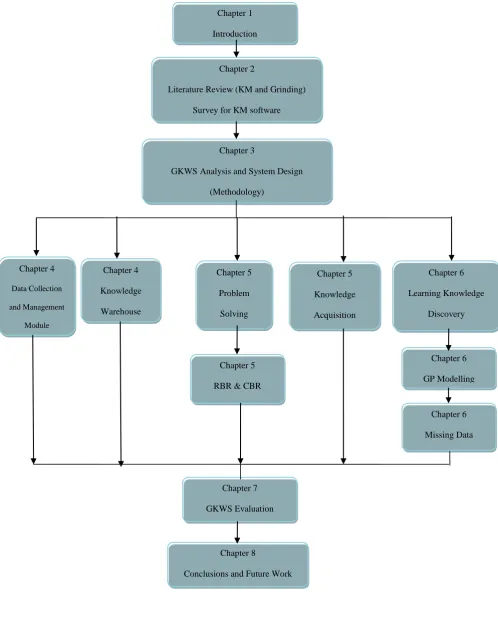
Figure 1.2 Schematic of thesis structure Chapter 1
Introduction
Chapter 2
Literature Review (KM and Grinding)
Survey for KM software
Chapter 3
GKWS Analysis and System Design
(Methodology)
Chapter 4
Data Collection
and Management
Module
Chapter 5
Knowledge
Acquisition Chapter 5
Problem
Solving
Chapter 5
RBR & CBR Chapter 4
Knowledge
Warehouse
Chapter 6
Missing Data Chapter 6
GP Modelling
Chapter 7
GKWS Evaluation
Chapter 6
Learning Knowledge
Discovery
Chapter 8
[30]
CHAPTER 2 LITERATURE REVIEW
This chapter is divided into two main parts: knowledge management and grinding technology. The first part represents different definitions of knowledge and knowledge management in literature. The benefits and challenges of knowledge management are presented and knowledge creation is explained and managing explicit and tacit knowledge is discussed. Knowledge discovery in databases is briefly introduced including data and knowledge mining. The second part discusses grinding technology. The grinding process and its challenges are represented and identified in the literature. The investigation of the modelling grinding process is explained in the literature including knowledge management systems in the grinding process. Finally, the research gaps are identified.
2.1 Knowledge and Knowledge Management
2.1.1 Knowledge Definition
[31] knowledge (Davenport and Prusak 1998; Gurteen 1999; Grover and Davenport 2001), although these terms are often commonly used in day-to-day activities.
Gurteen (1999) differentiates between data, information and knowledge in a simple cake recipe example. Beckman (1997) proposed a five level hierarchy starting from data, information, knowledge, expertise and capability. Data is considered as raw material or facts or texts or numbers, while information is more structured and organised data. Knowledge is about reasoning and using data and information for an instance or a future guide. Knowledge depends on individual understanding and perspectives from information. The author believes that knowledge is a competitive resource that consists of experience, perspectives, concepts, and believes that it is indeed important for both individuals and organisations for problem-solving, decision-making, learning, creating and re-inventing what individuals know.
[32] knowledge is found in documents and computers, which can be readily accessible, as well as documented into formal knowledge sources (Beckman 1999). Polanyi (1966) first defined tacit knowledge as knowledge that cannot be articulated or verbalised; it is a knowledge that resides in an intuitive realm.
Leonard and Sensiper (1998) describe knowledge as a continuum. Explicit and tacit knowledge are two extremes. The completely tacit knowledge that is semiconscious and unconscious is held in people’s heads and bodies. On the other hand, completely explicit knowledge is codified, structured and accessible to people other than the individuals originating. Most knowledge of course exists between the extremes (Leonard and Sensiper 1998).
Regarding knowledge duality theory for Hildreth and Kimble (2002), hard knowledge is the part of what people know that can be articulated, captured, and stored and soft knowledge is the part of what people know that can’t be articulated. According to the view of knowledge as duality, by implication, all knowledge is to some extent both hard and soft: it is simply the balance between the two variables (Hildreth and Kimble 2002). Wenger (1998) defines duality of knowledge that can fit into Hildreth and Kimble’s (2002) definition of soft and hard knowledge. The first form (hard knowledge) is socially constructed knowledge. In anthropology, socio-psychological and sociological work knowledge tends to seen as a product of social activity. The second form of soft knowledge might be termed as internalised domain knowledge, for example, skills, experience, and expertise (Hildreth and Kimble 2002).
[33] forming and utilising are manifested by inspiration, skill, habit and belief, and so on (He and Li 2010).
Several views of knowledge have been explored in KM, most of them in the form of opposites, for example, formal/informal (Conklin 1996), know-what/know-how (Brown and Duguid, 1998), explicit/tacit (Nonaka 1991), and hard/soft (Hildreth and Kimble 2002). Nonaka (1991) differentiates between explicit and tacit knowledge. Tacit and explicit knowledge are not totally separated but mutually complementary entities. They can interact and exchange into each other in the creative minds of human beings. On the other hand, Leonard and Sensiper (1998) prefer to view knowledge as a continuum rather than a pair of opposites. They regard the two extremes as being tacit and explicit. They observe that most knowledge will reside somewhere between the extremes.
[34]
2.1.2Knowledge Creation
Knowledge creation according to Nonaka and Takeuchi (1995) is a continuous and spiral conversion between explicit and tacit knowledge via four patterns of knowledge patterns of interactions, socialization, combination, internalisation and externalisation.
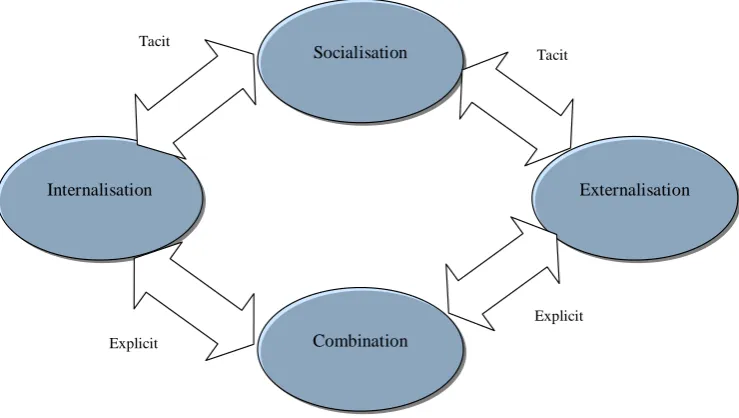
Nonaka and Takeuchi (1995) developed a model to describe how explicit and tacit knowledge interact and interchange into each other in the creative activities of human beings (see Figure 2.1).
Socialization involves the interaction between individuals through mechanisms such as observation, imitation or apprenticeships. Combination represents the mechanism of combining explicit knowledge through meeting and conversation or using information systems such as database, Internet and reports. Internalisation converts explicit knowledge into tacit knowledge through working groups and seminars. Externalisation converts tacit knowledge into explicit knowledge.
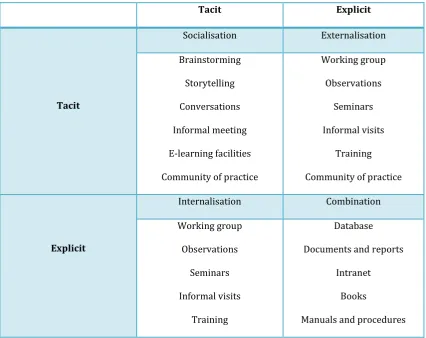
[35] Table 2.1 shows the activities that may facilitate and encourage knowledge interaction and exchange between explicit and tacit knowledge, taking into account Nonaka and Takeuchi’s (1995) model. It can be concluded from table 2.1 that the same activity could encourage knowledge exchange tacit to tacit or tacit to explicit. For example in a brainstorming, part of the tacit knowledge could be transferred to explicit knowledge and the other part to tacit knowledge will be transferred to tacit knowledge depending on the knowledge taker’s perspective from the brainstorming and their beliefs and their to share their expertise and tacit knowledge (Kreitner and Kinicki 1992; Szuianski 1996; Beckman 1997; Choi, Lee and Yoo 2010; He and Li 2010).
Figure 2.1 Interaction between explicit and tacit knowledge Combination
Externalisation Internalisation
Socialisation Tacit
Tacit
Explicit
[36]
2.1.2 Knowledge Management
2.1.2.1 Knowledge Management Definition
[image:37.595.86.513.119.457.2]Nowadays, Knowledge Management (KM) is widely known and practised in many large organisations; it will be useful to look back and try to give some perspective on how this old but new subject developed. Prusak (2001), one of the leading KM experts and one of a small group of practitioners who began to talk and write about knowledge management of the last few years, believed that the beginning of the
Table 2.1 Activities for knowledge exchange
Tacit Explicit
Tacit
Socialisation Externalisation
Brainstorming
Storytelling
Conversations
Informal meeting
E-learning facilities
Community of practice
Working group
Observations
Seminars
Informal visits
Training
Community of practice
Explicit
Internalisation Combination
Working group
Observations
Seminars
Informal visits
Training
Database
Documents and reports
Intranet
Books
[37] knowledge management timeline was a conference held in Boston in early 1993 that several colleagues and Prusak organised—the first conference specifically devoted to knowledge management (Prusak 2001; Davenport, Prusak and Wilson 2003).
Unfortunately, there is no universal definition of KM. Davenport and Prusak (1998) define knowledge management as a fluid mix of framed experience, values, contextual information and expert insight that provides a framework for evaluating and incorporating new experiences and information. However, Petrash (1996) expresses the need for learning organisations to create, develop and share knowledge. Beckman (1997) defines knowledge management as being access to knowledge and expertise to create capabilities and superior performance, encourage innovation and enhance customer value. According to Alavi and Leidner (2001) and Chow et al. (2005), KM is the interdependent and distinctive processes or activities of knowledge creation, knowledge storage and retrieval, knowledge transfer, and knowledge application. Knowledge management activities are comprehensively discussed in the literature, which are summarised in Table 2.1.
All of these definitions agree on three important points. First, knowledge itself cannot be managed; what can be managed are knowledge processes of creation, storage, retrieval and sharing (Alavi and Leidner 2001; Chow et al. 2005; Park, Kim and Lee 2006).
[38] Lee and Choi 2003; Bhirud, Rodrigues and Desai 2005; Coff, Coff and Eastvold 2006; Wang, Klein and Jiang 2007). Lee and Choi (2003) confirmed the positive impact of IT on knowledge management. In the manufacturing industry, Wang, Klein and Jiang (2007) argue that information technology (IT) support for KM can directly enhance an organisation’s knowledge-based activities.
The author believes that knowledge management is the creation, acquisition, analysis, storage, sharing, and manipulation of knowledge and expertise in a learning environment that encourages and rewards knowledge sharing where IT could support and facilitate these activities.
Author and Publication Knowledge Management Activities
Wiig (1993) Creation Compilation Dissemination
Application O’Dell and Grayson (1998) Identify
Collect Adapt Organise
Apply Share Create Beckman (1997) Identify
Capture Select
Store Share Apply Create Sell Ruggles (1997) Generation
Codification Transfer
Meso and Smith (2000) Marwick (2001)
Use Search Creation Packaging Alavi and Leidner (2001) Creation
Storage and retrieval Transfer Application
[39]
Chow et al. (2005) Creation Storage Distribution Application Park (2006) Acquisition Organisation
Utilisation Disposition
Sharing SHRM (2009) Creating
Acquiring Sharing Managing
2.1.2.2 Benefits from Knowledge Management
The benefits of investing in KM are deeply discussed and documented in the literature (Carrillo and Gaimon 2000; Gold, Malhotra and Segars 2001; Lee and Choi 2003; Jones 2003; Ferrada and Serpell 2009; Wang, Klein and Jiang 2007; Tiago et al. 2007; Chawla and Joshi 2010; Ovaska et al. 2010). To get the most value from a company’s knowledge assets, knowledge management practitioners maintain that knowledge must be shared and served as the foundation for collaboration. The main benefits can be summarised as follows:
• improve competitive advantage and create new knowledge (KPMG 2000; Tiago et al. 2007; Chawla and Joshi 2010).
• improve customer service (KPMG 2000; Tiago et al. 2007).
• improve revenue growth and profit growth (KPMG 2000; Carrillo and Gaimon 2000).
[40] responsiveness to market changes, and reduced redundancy of information/knowledge (KPMG 2000; Gold, Malhotra and Segars 2001; Taminiau, Smit and De Lange 2009).
• foster effective tools for increasing productivity and performance in the manufacturing industry (Carrillo and Gaimon 2000; Gold, Malhotra and Segars 2001; Da Silva Garza et al. 2007; Ferrada and Serpell 2009).
2.1.2.3 Challenges of Knowledge Management
Culture, trust, creating a learning environment, IT support, and managing tacit knowledge are the main challenges facing the implementation of effective KM programmes.
• Culture and trust
[41] organisation’s new management practices, senior management commitment and technology support (Havens and Knapp 1999; O’Dell and Grayson 1999; Chau 2005; Tiago et al. 2007). Trust is another critical challenge to any KM programme. Trust can be defined as maintaining reciprocal faith in each other in terms of intentioned behaviours (Kreitner and Kinicki 1992). According to Szuianski’s study (1996), the lack of trust among employees is one of the key barriers against knowledge exchange. Trust may facilitate and encourage knowledge exchange and creation. Lee and Choi (2003) confirmed the impact of trust on knowledge creation. Trust, relationships and dialogue are the foundation for building organisational knowledge sharing (SHRM 2009).
• Creating a learning environment
In an environment where an individual’s knowledge is valued and rewarded, establishing a culture that recognise tacit knowledge and encourages employees to share it is critical. Organisations should motivate and reward employees to get the best from any KM programme (Petrash 1996; Gurteen 1999; Davenport, Prusak and Wilson 2003; Chinowsky 2007; Harris 2009; Choi, Lee, and Yoo 2010). Davenport, Prusak and Wilson (2003) argued that incentives and rewards create and support positive behaviours required for KM. Chinowsky (2007) addressed the challenge on how to transform an organisation from a focus on knowledge management to a focus on developing a learning culture.
[42] While information technology could support and facilitate KM as discussed in the literature (Sena and Shani 1999; Hargadon and Sutton 2000; Meso and Smith 2000; Marwick 2001; Bhirud, Rodrigues and Desai 2005; Coff, Coff and Eastvold 2006; Du Plessis 2007; Wang, Klein and Jiang 2007; Choi, Lee, and Yoo 2010), KM is not a technology-based concept and IT is not the starting point of any KM programme.
• Managing tacit knowledge
The difficulty of managing tacit knowledge is one of the most important challenges for KM (Hildreth, Wright and Kimble 1999; KPMG 2000; Santosus and Surmacz 2001; Kimble, Hildreth and Wright 2001; Du Plessis 2007; Harris 2009; He and Li 2010). While IT in the form of databases, e-mail, groupware, instant messaging, electronic databases, video and audio recordings, multimedia presentations and related technologies can help facilitate the dissemination of tacit knowledge, identifying tacit knowledge in the first place is a major hurdle for most organisations (Gurteen 1999).
[43] Wong and Radcliffe (2000) argued that explicit knowledge requires an understanding process in order to collaborate with the tacit domain to perform needed tasks. He and Li (2010) claimed that tacit knowledge explicating activity is a distributed cognitive activity, whose success depends on interaction the following factors: individuals, artefacts, environment and sharing culture. These factors depend on each other and affect each other so none of the factors should be neglected. The challenge inherent with tacit knowledge is figuring out how to recognise, generate, and share it whereby it could then be easily managed.
2.1.2.4 Managing Explicit and Tacit Knowledge
As discussed earlier, the KM process is a continuous process that starts with knowledge creating and gathering, organising and refining, storing and retrieval and utilising (Hildreth, Wright and Kimble 1999; Alavi and Leidner 2001; Kimble, Hildreth and Wright 2001; Bhirud, Rodrigues and Desai 2005; Chow et al. 2005; Gillingham and Roberts 2006; SHRM 2009), as shown in Figure 2.3.
Knowledge Codifying and
Storing
Knowledge retrieving Knowledge
creating and generating
Knowledge sharing and manipulation
[44] The first step is knowledge acquired and captured from internal and external sources. The external sources are customers and suppliers’ records, researching, net browsing and reading books. The internal resources are employee knowledge (tacit knowledge), database, procedures, reports, documents etc.
The second step is knowledge storage. Organisational memory is found in employees, organisational culture, processes and procedures, the physical workplace, and archives. Knowledge needs to be organised and codified so it will be easy to be retrieved and accessed. Technology plays an important role in retrieving knowledge; organisations must make sure that there is an efficient way of managing the content and making such that search engines and intranet browsers can retrieve the knowledge in an effective way.
Knowledge sharing is highly critical, which will be discussed deeply in the next section. Sharing knowledge has been facilitated by Internet technology, email, groupware etc.
Explicit knowledge can be written down, processed by information systems, codified or recorded, archived and protected by organisations (Hildreth, Wright and Kimble 1999; Kimble, Hildreth and Wright 2001; Gillingham and Roberts 2006). Many researchers argued that explicit knowledge can fit into this cycle but there is some knowledge that cannot be captured, codified and stored (Hildreth and Kimble 2002; Gillingham and Roberts 2006).
[45] Hildreth and Wright 2001; Santosus and Surmacz 2001; Gillingham and Roberts 2006; Harris 2009; He and Li 2010).KM is concerned with making knowledge visible and therefore developing knowledge processes. Knowledge creation is a continuous and dynamic interaction between explicit and tacit knowledge. Both types of knowledge should be found in any organisation. The most crucial part is how to recognise and transfer tacit knowledge to explicit knowledge(Nonaka and Takeuchi, 1995; Hildreth, Wright and Kimble 1999; Kimble, Hildreth and Wright 2001; Prusak 2001; Teigland 2003; Gillingham and Roberts 2006).
According to Hildreth, Wright and Kimble (1999), the first step to manage tacit knowledge is to understand the social processes that govern its constructions and its sustenance in an organisation. Community of Practice (CoP) has been identified as being a group where tacit knowledge is natured and sustained (Hildreth, Wright and Kimble 1999; Kimble, Hildreth and Wright 2001; Wenger 1998).
[46] Tacit knowledge could be shared through innovation days, organisation’s internal conferences, storytelling, technology shows, best practice, sharing of artefacts via telephone conferencing and net meeting and internal training (Hildreth, Wright and Kimble 1999; Kimble, Hildreth and Wright 2001). Harris (2009) endorses the need for a focused approach to e-learning that facilitates social interaction and learning in order to harness the value of shared tacit knowledge.
He and Li (2010) discussed that tacit knowledge explicating activity is a distributed cognitive activity, whose success depends on interaction the following factors: individuals, artefacts, environment and sharing culture. These factors depend on each other and affect each other so none of the factors should be neglected. Further studies are needed to explore how to design these factors in the system so that the explication of tacit knowledge can be accomplished successfully (He and Li 2010).
[48] Reward
Encourage learning Knowledge creating and generating
Explicit Tacit
Data entry Informal
Discussion
Phone calls
Online conversion, emails,
Observation, brainstorming, training, CoP
Knowledge storage
Explicit Tacit
Database People’s heads
Reports People’s perception
Procedures and records
Data/knowledge warehouse
Intranet
Emails
Knowledge retrieving and sharing
Explicit Tacit Database brainstorming
Storytelling
Informal meetings
Best practice
Data/knowledge warehouse
Intranet
Groupware
Reward Encourage
Encourage Reward
[49]
2.1.2.5 Knowledge Sharing
Knowledge sharing is a critical issue in any KM programme. Workers tend to form networks of expertise spontaneously: to facilitate individual learning and collaboration and to discuss work related problems together. Sometimes these networks transform into a Community of Practice (CoP) (Leave and Wenger 1991) and more recently virtual communities as Electronic Networks of Practices (ENoP) (Teigland and Wasko 2004).
In a CoP, employees who share a common interest for the field they work in come together on a regular basis to help each other, solve problems and to share and create knowledge collaboratively (Wenger 1998). Knowledge creating and sharing are two of the core activities of CoP. The CoPs provide the social structure in organisations for an interactive approach to KM.
Leave and Wenger (1991) first introduced the concept of CoP in 1991. They saw the acquisition of knowledge as a social process where people can participate in communal learning at different levels depending on their level of authority in the group.
[50] CoP creates value by improving the performance of their members when they apply their knowledge in the performance of their job. Because practitioners belong at once to their CoP and their work teams, they are the direct “carriers” of knowledge. Involving practitioners in KM is also important for returning knowledge from the field (Wenger 2004). CoPs have been identified as effective tools for the variation and sharing of knowledge (Hildreth, Wright and Kimble 1999; Sharratt and Usoro, 2003; Wenger 2004).
Brown and Duguid (1998) developed the concept of networks of practice. This concept refers to the overall set of various types of informal, emergent social networks that facilitate learning and knowledge sharing between individuals conducting practice-related tasks.
Thus, in an effort to replicate traditional CoPs electronically, management in numerous organisations have invested in computer-mediated communication technologies to facilitate knowledge sharing regardless of time and space constraints. These emergences are defined as virtual communities of electronic networks of practices (ENoP) (Teigland and Wasko 2004).
[51] Yang and Wei (2010) proposed a model that can numerically measure the performance of communities of practice and quantify the knowledge level of the knowledge workers. The model takes into account the tutor’s willingness to share knowledge, the learner’s motivation to learn knowledge, the learning by teaching effect, the learning by discussion effect, the effect of the reward system, and the ability of teaching and understanding.
Sáenz, Aramburu and Rivera (2009) claimed that knowledge sharing is a key issue in order to enhance the innovation capability of firms. Another research stressed the importance of informal knowledge sharing to enhance innovation in organisations (Taminiau, Smit and De Lange 2009).
2.1.2.6 Knowledge Sharing Technology
[52] provides tools to solve “collaboration oriented” problems. Much groupware software is available in the market such as Lotus Notes, MS Exchange, Tetranet Software etc.
Groupware can be used to send messages, files, data or documents between people and to facilitate the knowledge sharing that includes chatting, telephone, and video conferencing and management of group activities such as electronic calendars, project management, workflow etc (Allee 1997; Kimble, Hildreth and Wright 2001; Santosus and Surmacz 2001).
Many organisations are migrating from e-mail to electronic collaborative culture that will cause a huge increase of the generation of knowledge. This increase of knowledge generation will require corporate culture to evolve to the next step of managing this knowledge (Coleman 1999).
Many companies have used file servers, email and groupware as a collaborative tool (Baek et al. 1999). However, none of these tools are fundamentally designed for knowledge sharing. File servers are designed to provide teams with shared access to files and applications. They can provide a fast and reliable method to share files between a team, but not to find the knowledge in that file. E-mail is designed to send messages to one or more people. It is not intended to enable group communications. Groupware allows users to share knowledge and have fast and reliable access to files and applications, but it requires them to have the same groupware system in order to share knowledge (Coleman 1999).
[53] knowledge is still very difficult. This is because, in these search engines, they assume that the user has used the right keywords, which is not always the case. And even if the user used the right keywords, that word might have more than one meaning in a different context (Baek et al. 1999). Providing access to any data alone assumes that the users can read, understand and utilise the knowledge from that database or knowledge repository. These assumptions are not frequently valid because of the complexity of the decision-making, as no one can be trained in all areas, and there are time limitations. Most of the time, people need simply answers for their questions and they don’t have the time to learn deeply about the subject.
In the manufacturing industry, Wang, Klein and Jiang (2007) argued that IT support for KM can directly enhance an organisation’s knowledge-based activities and, thus, a firm’s performance. Choi, Lee and Yoo (2010) found that IT has a positive impact on knowledge sharing. Also, it showed that sharing knowledge is not enough, since organisations must ensure that shared knowledge is applied and utilised in order to improve CoP performance.
2.1.3 Review of Current KM Software
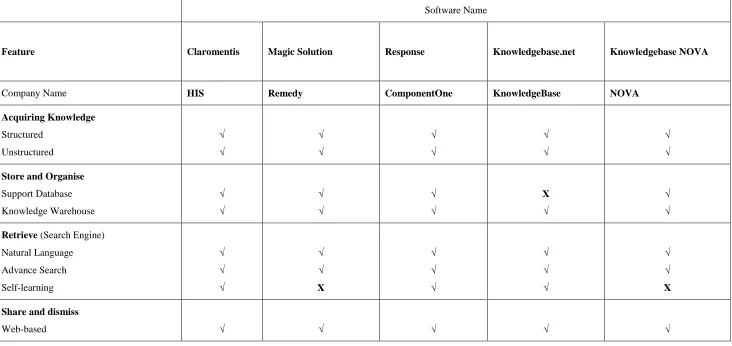
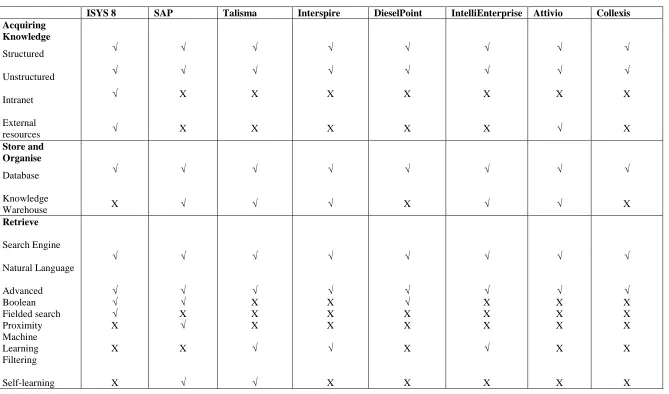
[54] Internet has revealed many KM suites available online where some of the most related software suites are explained. Searching the Internet for current knowledge warehouse software and solutions using different combinations of key words (such as knowledge warehouse software, knowledge base warehouse software, collaborative tool, knowledge sharing) revealed that different packages of knowledge warehouse software are available from a number of vendors, including NOVA, ISYS, and SAP. The first search was carried out in November 2004; the related KM suites were compared in Table 2.2. Another search was carried out in September 2008 in order to investigate the most recent KM warehouse and collaborative suites. An overview of their features and comparison is shown in Table 2.3.
Different knowledge management software are designed and developed to optimise knowledge sharing and to take advantage of IT. The comparison is based on the KM activities: acquire knowledge, store and organise, retrieve and share. From the comparison between Table 2.2 and 2.3 for different KM suits, all of the software is designed to capture, store, retrieve and share structured (such as database and articles) and unstructured (such as online discussions and emails) data. The search engine for all of the suites can use natural language search and/or more advanced search such as Boolean and fielded search (Response, NOVA, Talisma, SAP, and Interspire) or by combining advanced full-text and linguistic techniques in Dieselpoint suite. Intelligent methods are used to discover sets of related documents such as fingerprints in Colleix suite and state-of-the-art algorithm in SAP.
[55] on search and documentation management. That means knowledge management processes (gathering, storing, retrieving and sharing) are all covered. It can be noticed that the search engine is becoming more and more advanced in recently used knowledge discovery and self-learning methods.
[56]
Software Name
Feature Claromentis Magic Solution Response Knowledgebase.net Knowledgebase NOVA
Company Name HIS Remedy ComponentOne KnowledgeBase NOVA Acquiring Knowledge
Structured Unstructured
√ √
√ √
√ √
√ √
√ √
Store and Organise
Support Database Knowledge Warehouse
√ √
√ √
√ √
X √
√ √
Retrieve (Search Engine) Natural Language Advance Search Self-learning
√ √ √
√ √ X
√ √ √
√ √ √
√ √ X
Share and dismiss
[image:57.842.71.803.142.488.2]Web-based √ √ √ √ √
[57]
ISYS 8 SAP Talisma Interspire DieselPoint IntelliEnterprise Attivio Collexis
[image:58.842.70.739.116.510.2]Acquiring Knowledge Structured Unstructured Intranet External resources √ √ √ √ √ √ X X √ √ X X √ √ X X √ √ X X √ √ X X √ √ X √ √ √ X X Store and Organise Database Knowledge Warehouse √ X √ √ √ √ √ √ √ X √ √ √ √ √ X Retrieve Search Engine Natural Language Advanced Boolean Fielded search Proximity Machine Learning Filtering Self-learning √ √ √ √ X X X √ √ √ X √ X √ √ √ X X X √ √ √ √ X X X √ X √ √ √ X X X X √ √ X X X √ X √ √ X X X X X √ √ X X X X X
[58]
Knowledge Discovery
X X X X √ X X X
Share and dismissing Web Intranet Encourage Collaboration √ √ X √ X X √ X √ √ √ X √ X X √ √ √ √ X X √ X X Extra features Automatic
classifications and text mining Custom fields for search engine feedback Suggestion system Linguistic techniques Suggestion engine Search by attributes Fingerprints Suitable for education and search organisation Most Powerful feature
Search engine Search engine Text mining classifications Documentation and sharing knowledge Publishing, sharing, and collaboration Search and navigation Manage and update structure and unstructured data Search for biomedical
Price From $1,000 + $24,000
[59]
2.2 Knowledge Discovery in Databases
Knowledgediscovery in databases (KDD) is the process of extracting models and patterns from large databases. The term Data Mining (DM) is often used as a synonym for the KDD process although strictly speaking it is just a step within KDD (Sarker, Abbass and Newton 2002). In other words, DM is the application of specific algorithms to extract patterns and models from the data. The basic problem addressed by the KDD process is one of mapping low-level data into other forms that might be more compact, more abstract, or more useful (Fayyad, Piatetsky-Shapiro and Smyth 1996a)
.
KDD steps have been discussed in the literature. Fayyad, Piatetsky-Shapiro and Smyth (1996b) suggested nine steps: application domain understanding, creating a target data set, data cleaning and processing, data reduction and projection, choosing the mining task, choosing the mining algorithm, mining the data, interpreting the mined patterns, and consolidating the discovered knowledge.
Sarker, Abbass and Newton (2002) proposed thirteen steps: problem definition and determining the mining task, data description and selection, data conversion, data cleaning, data transformation, data reduction and projection, domain-specific data pre-processing, feature selection, choosing the mining algorithm, algorithm-specific data pre-processing, applying the mining algorithm, analysing and refining the results and knowledge consolidation (Sarker, Abbass and Newton 2002).
[60] previous work on KDD that KDD focused on step of DM in all previous researches. The literatures studies on the KDD steps reveal that most of the studies have the same structure of the KDD process. The KDD is adopted in this research and its six steps can be summarised as follows: identify the domain, data selection, data cleaning, data transformation, data mining, and results evaluation.
2.2.1 Data and Knowledge Mining
Simoudis (1996), among others, discussed definitions of DM in the literature review. He related that DM is the process of extracting valid, previously unknown, comprehensible, and actionable information from a large database and using it to make crucial business decisions.
A different view is proposed by Fayyad, Piatetsky-Shapiro and Smyth (1966a), who stated that DM is a step in the KDD process that consists of applying data analysis and discovery algorithms that produce a particular enumeration of patterns (or models) over the data.
In DM, there are three primary components: model representation, model evaluation and search. Model representation is the language used to describe discoverable patterns. It is crucial that a data analyst fully understands the representational assumptions that may be inherent in a particular method.
[61] The search method includes two components: parameter search and model search. In parameter search, the algorithm searches for the set of parameters that optimise the model evaluation criteria, given the observed data where the model is fixed. Model search acts as a loop over the parameters where the model representation is changing so that the family of models is considered.
The basic functions of the DM process consist of feature selection, summarisation, association, clustering, prediction, and classification.
• Feature selection is concerned with the identification of a subset of features that significantly contribute to the discrimination or prediction problem (Bradley, Mangasarian and Street 1998).
• Summarisation involves methods for finding a compact description for a subset of data. This is useful for understanding the importance of certain attributes when compared against each other (Hui and Jha 2000).
• Dependency modelling determines how to find a model that is related the various attributes.
• Clustering identifies a finite set of categories or clusters to describe the data (Jain and Dubes 1988). The categories may be mutually exclusive and exhaustive, or consist of a richer representation such as hierarchical or overlapping categories (Fayyad et al. 1996).
[62]
• Classification is designed to predict the most likely state of a categorical variable given the values of the other variables.
Different listed techniques are available for data mining; this list should not be considered complete, but rather a sample of the techniques for data mining.
• Genetic Programming (GP) is considered as induction for classification and generalised rules (Goldberg 1989; Koza 1992). Freitas (1997) proposed a GP framework for two data mining tasks; classification and generalised rule induction based on relational algebraic operations, expressed by an SQL query. Wong (2001) presented a flexible knowledge discovery system called generic genetic programming, which combines genetic programming and inductive logic programming to induce production rules from knowledge represented in various knowledge formats. Elkaffas and Toony (2006) developed a framework for using genetic programming to induce classification rules from a database.
• Artificial Neural Networks (ANNs) are one of the most commonly used for
DM. As a rule of thumb, ANNs are more accurate than many DM techniques and the choice of decision of the appropriate DM tool is usually a cost benefit analysis when it comes to real life applications.
[63] Michalski (2003) defines knowledge mining as concerned with developing and integrating a wide range of data analysis methods that are able to derive directly or incrementally new knowledge from large (or small) volumes of data using relevant prior knowledge. Knowledge mining process of deriving new knowledge can be characterised by the criteria inputted to the system, algorithms for generating new knowledge, and creating new knowledge from prior knowledge (Michalski 1983).
Raamesh and Uma (2009) applied attribute selection and clustering techniques to mine the knowledge in their test case system. Riel and Boonyasopon (2009) presented an application of knowledge mining to extract new explicit and implicit knowledge hidden in a large collection of electronic text documents. Vladislavleva et al. (2010) presented an approach for knowledge mining from a sparse and repeated dataset and variable selection and sensitivity analysis using genetic programming model ensembles, although Gilbert et al. (1998) and Keijzer (2004) have investigated the variable selection via genetic programming.
2.2.2 Missing Data and Data Mining
The missing data issue has been discussed in the literature (Little 1992; Affifi and Elashoff 1966; Pigott 2001; Raghunathan 2004; Ibrahim et al. 2005; Horton and Kleinman 2007). Missing data might be missing completely at random or missing at random.
[64] can introduce bias in the evaluated model and lead to inaccurate DM results (Brown and Kros 2003).
Different methods have been applied for dealing with missing data, such as regression imputation that predicts the missing value based on the relationships between the variables. Horton and Kleinman (2007) briefly reviewed the methods for incomplete missing observation in regression models as follows:
• The complete case only method is the simplest and easiest way to deal with missing data where the case with missing data is deleted. This method could be useful when there is a large amount of data collected and the amount of missing data is small (Pigott 2001; Horton and Kleinman 2007).
• Maximum likelihood is an alternative approach, which also assumes that missing data is missing at random. For each observation with missing data, multiple entries are created in an augmented dataset for each possible value of the missing covariates, and a probability of observing that value is estimated given the observed data and current parameter estimates (E-step) (Pigott 2001; Horton and Kleinman 2007). The augmented complete data dataset can then be used to fit the regression model, accounting for these weights. One of the complications of this method is the need to model the nuisance distribution of the covariates. In some settings with only a few categorical variables a saturated multinomial distribution can fit. Another complication for maximum likelihood relates to the calculation of the standard errors of estimates.
[65] missing fits, and the inverse of these probabilities are used as weights for the complete cases (Horton and Kleinman 2007). This approach is mainly for a single missing predictor but becomes considerably less tractable with multiple missing variables.
• Bayesian approaches have been applied more generally. Ibrahim et al. (2005) described estimation with a prior distribution on the covariates, and there is a close relationship between the Bayesian approach, maximum likelihood and multiple imputation methods (Horton and Kleinman 2007).
• Multiple imputation is a combination of a number of imputation methods into a signal method. First, generating several possible values for missing observations are created that result in the creation of a number of “completed” datasets. Second, each of these completed datasets is analysed using a standard analysis procedure. Finally, the results are combined to obtain the multi-impute estimates.
2.3 Grinding Technology
2.3.1 Modelling and Knowledge Management System in
Grinding
[66] Gupta, Shishodia and Sekhon 2001; Zhou and Xi 2002; Hecker and Liang 2003; Agarwal and Roa 2005; Kwak, Sim and Jeong 2006; Choi and Shin 2007; Choi et al. 2008; Stepien 2009). Tonshoff et al. (1992)