2017 2nd International Conference on Communications, Information Management and Network Security (CIMNS 2017) ISBN: 978-1-60595-498-1
Vulnerability Scanning System Used in the Internet
of Things for Intelligent Devices
Yu-rui SU
1,*, Xiao-feng LI
2, Song-fei WANG
3, Jing YI
1and Hui-ru HE
11
School of Science and Technology, Shandong Jianzhu University, Jinan 250101, Shandong, China
2
School of Science and Technology, Shandong Jianzhu University, Institute of Digital Family and Cloud Computing, Jinan 250101, Shandong, China
3
School of Information Science and Engineering, University of Jinan Jinan 250022, Shandong, China
*Corresponding author
Keywords: Internet of things, Vulnerability scanning, Information security.
Abstract. This paper presents and implements an integrated set of the system and method called vulnerability scanning for the Internet of things, including the scanning scheme of the background application service and the front desk vulnerability. The scheme not only has the advantages of passive scanning and active scanning, but can scan the security holes in the internet-connected intelligent devices commonly used in Wi-Fi, Bluetooth LE, ZigBee and RFID communications. By the vulnerability scanning system to the network layer and application layer traffic analysis, it can accurately scan some specific vulnerabilities existing in smart devices, as well as be a real-time online vulnerability analysis system given suggestion.
Introduction
The main communication technology protocols currently used in the Internet of things (IoT) are wireless transmission, including Wi-Fi, Bluetooth technology, Low-Power Bluetooth technology, ZigBee, Z-Wave and RFID. Compared with Ethernet using optical fiber and cable channel for communication, IoT communication data directly exposed to the air, so it is more vulnerable to intruders. At the same time, the Internet of things node was restricted by energy, computing power and storage capacity, therefore the Internet of things has been vulnerable for these indirect result.
In the architecture of the IoT, the perception layer of smart devices is at the bottom level, so information security at this level is most vulnerable. In the process of collecting information, the perception layer mainly applies Wireless Sensor Network (WSN) and Radio Frequency Identification (RFID) technology. Because the wireless communication technology is not transparent for end users (users is not familiar with wireless communication mechanism and realization process), the wireless communication technology and the IoT terminal node configuration are easy to slip. So IoT vulnerability scanning system comes to detect loopholes existing in itself environment, and reasonable suggestions are put forward based on vulnerability helping users or enterprise to improve the security of IoT environment.
This method in my paper made up for the deficiency of traditional Internet vulnerability scanner (usually only scanning through the Ethernet protocol cable channel), as well as the security research field of IoT. At present, there is not an effective system that can scan the IoT environment vulnerability comprehensively and thoroughly, so this scheme is innovative.
Scanning Method of Wireless Sensor Network Vulnerability
There are three kinds of scanning methods for wireless sensor network vulnerability [1]:
its strong analytical capability, which takes a lot of time and maybe a slow and inefficient offline analysis.
Simulated attack method: By directly attacking on wireless network (such as the flood attacks and denial of service attack, etc.), we can determine where the loopholes are. But this method cannot be fully found that all the holes in the wireless sensor network; it will affect the wireless network and the quality of the target network transmission. Neither it is sure of the protocol itself leaving loopholes nor targeted.
Black box testing method: Sending a lot of errors or abnormal data packets to the target network, we can observe: whether the target network data packets can handle it, whether these normal or network will collapse, and then determine whether there are vulnerabilities in the target network. Similarly, this method is less targeted and inefficient.
The Internet of Things Vulnerability Scanning Method
The steps of the Internet of things vulnerability scanning method are as follows:
Step 1, the Web visualization terminal receives the user's vulnerability scan request, and then sends the request to the vulnerability scan server;
Step 2, vulnerability scanning server analyzes the request, and extracts the object of the request analysis. According to the ways of vulnerability scanning from the requester, the system will send the needed vulnerability scanning mode;
Step 3, based on the vulnerability scanning sent by the vulnerability scanning server, the scanner sends the sniffer instructions to the traffic sniffer;
Step 4, by sniffing flux under the Internet of things environment, traffic sniffer will capture the data through the scanner that feedbacks to vulnerability scanning server, and finally show the result of the scanning in the Web visualization terminal.
Content of Project
In order to solve the problem above, we put forward a new scheme that using an Internet of things vulnerability scanning system and scanning method to make up the shortage existing Internet vulnerability scanner; this scheme is suitable for a large-scale commercial IoT environment. It can not only carry on the real-time online vulnerability analysis but also make proposals.
In order to achieve the above goals, we adopted the following technical schemes:
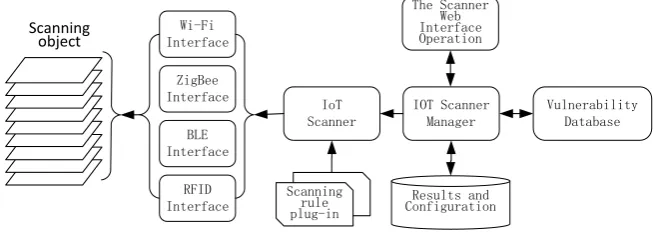
The Internet of things vulnerability scanning system includes the traffic sniffer, scanner, Internet of things vulnerability scanning server and Web visualization terminal. These four modules are connected with one another sequentially in turn. The schematic diagram of this system is shown in figure 1.
IoT Scanner
Scanning object
ZigBee Interface
BLE Interface
RFID
Interface Scanning plug-inrule
IOT Scanner Manager The Scanner
Web Interface Operation
Vulnerability Database
Results and Configuration Wi-Fi
[image:2.595.133.460.590.706.2]Interface
Figure 1. Schematic diagram of system architecture.
Traffic Sniffer
layer flux in the actual IoT environment, and uncovers the transmission to the link layer, the network layer, etc. [3].
Scanner
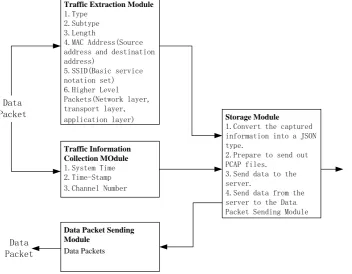
The scanner is used to handle the traffic data captured by the traffic sniffer. It is also used to construct the packets and send them to the target IoT environment through the traffic sniffer. The scanner includes traffic extraction module, traffic information collection module, data packet sending module and storage processing module. The internal function module of the scanner is shown in figure 2.
Traffic extraction module includes several different protocol traffic scanning module, and each traffic scanning modules are used to send traffic detection packet capturing network data packets. Based on sending the data packet to capture the returned data or sending the module to the IoT vulnerability scanning server through the data packets, this system can accurately analyze.
Each traffic scanning submodule is used to scan the target device, which is divided into active scanning and passive scanning. Active scanning sends data packets and affects the target network environment; passive scanning, which captures the radio that is already in the air, will not have any impact on the target network.
Traffic information collection module is used to record the useful information such as the position of traffic sniffer which capturing flux, flux of data frame size and the data frame of time stamps.
The data packet sending module is used to send the data packets generated by the server to the target network environment, receive the returned information, and receive the flux from the traffic extraction module.
The storage processing module is used to collect and store the data of traffic extraction module and traffic information collection module.
Data Packet
Traffic Extraction Module 1.Type
2.Subtype 3.Length
4.MAC Address(Source address and destination address)
5.SSID(Basic service notation set) 6.Higher Level Packets(Network layer, transport layer, application layer)
Traffic Information Collection MOdule 1.System Time 2.Time-Stamp 3.Channel Number
Data Packet Sending Module
Data Packets
Storage Module
1.Convert the captured information into a JSON type.
2.Prepare to send out PCAP files.
3.Send data to the server.
4.Send data from the server to the Data Packet Sending Module
[image:3.595.127.480.399.673.2]Data Packet
Figure 2. Internal function module of scanner.
Internet of Things Vulnerability Scanning Server
database. If the vulnerability is found, the scan result will display to the user through the Web visual terminal and the PDF document will be generated in the document database [4]. In real time, the flux is shown through the bar chart including: the sending and receiving flux of each device, controlling flux, managing traffic and data flow.
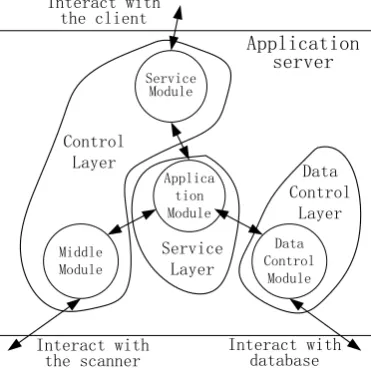
The Internet of things vulnerability scan server includes the application server and the database server, and the server layered schematic diagram is shown in figure 3.
As the core processing module—application server provides the interface used to connect the scanner, IoT vulnerability database and Web visualization terminals. Not only undertake a variety of data transmission and task scheduling but is used in all kinds of traffic data processing analysis to make various modules coordinated operation.
The database server is used to store captured traffic and analyze results for Web visualization terminal queries and analysis.
Applica tion Module Service
Module
Middle Module
Data Control
Module
Control Layer
Service Layer
Data Control
Layer Application
server Interact with
the client
Interact with
[image:4.595.205.391.248.435.2]the scanner Interact with database
Figure 3. Server layered architecture diagram.
Web Visualization Terminal
Through a RESTful API interface connected with IoT vulnerabilities server [5], Web visualization terminals provide interactions with IoT vulnerabilities server page, and a real-time link between equipment and devices under the Internet of things environment monitoring. What’s more, it shows users the IoT environment topology, node information, link details as well as a variety of scanning report.
Node information includes ID number, manufacturer, MAC address, number of frames, signal number, SSID.
The link details include source address, destination address, frame total, total data size.
Scanning reports include vulnerability name, vulnerability level, vulnerability profile, vulnerability announcement, discovery time, vulnerability type.
The Vulnerability Scanning Implementation Based on Wi-Fi
The vulnerability scanner is mainly divided into the following five scanning module: default login account password scanning module for the intelligent devices, vulnerability scanning module based on the AP, DVR, scanning module based on home wireless router connection weak password, telnet scan module and vulnerable port detection module of IoT devices. This paper only introduces default login account password scanning module for the intelligent devices.
This module mainly uses the HTTP/HTTPS service to detect and identify. By coding with Perl language and using AnyEvent module, programmers can scan a large number of IoT devices at the same, so the module improves the scanning efficiency. Furthermore, this module sets with JSON format configuration files which used widely in intelligent devices, and then exists in the database with the form of document. Thus it is convenient for users and developers to extend the new devices configuration file so as to scan more equipment.
The implementation principles of module are as follows:
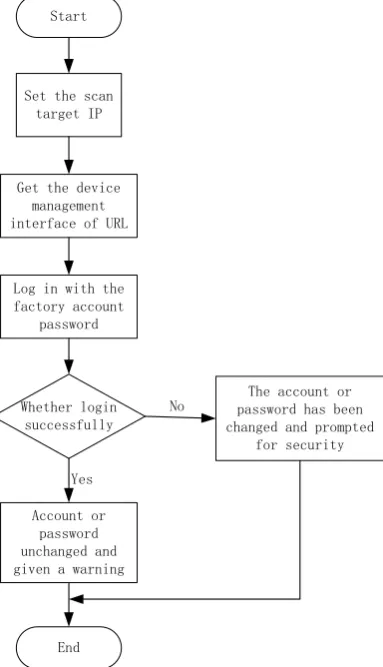
Firstly, client inputs the IP address of the intelligent device or an IP address range for scanning, and then the module accesses the IP address and tests whether the default user name and password in the configuration file successful login. Login successfully suggests that the device does not change the initial password, and the flow chart is shown in figure 4.
Start
Set the scan target IP
Get the device management interface of URL
Log in with the factory account
password
Whether login successfully
The account or password has been changed and prompted
for security
Account or password unchanged and given a warning
End
No
[image:5.595.203.395.230.564.2]Yes
Figure 4. Flow chart of intelligent devices management interface with default password scanning.
The Scanning Test and Analysis of Intelligent Device with Default Login Account Password
Scanning name: Scanning the factory setting of intelligent devices.
Testing target: Mercury MW153R wireless router, firmware version of 1.1. Target IP: 192.168.1.1.
Testing preparation: Set the password of the router management interface for default factory setting that is login name: admin, password: admin.
Testing process Adjust the network card to normal mode for testing.
Scanning the factory setting of intelligent devices
High risk; Management account password is vulnerable.
Vulnerability profile
The equipment user without password to make changes to its factory settings, the remote attacker can take advantage of the loopholes successful invasion of network environment, get the user's network
environment sensitive information, do any operation on the router, and pose a threat to the user's network environment.
Vulnerability announcement
Please change the password of the default login account and restart the router.
Discovery time
March 10, 2017
Loophole type
[image:6.595.193.402.82.339.2]Configuration error.
Figure 5. The scan results of intelligent equipment factory setting.
Summary
The focus of this paper is to research a kind of general scanning system scheme for automatic scanning intelligent equipment loopholes that existing in the process of scanning, and users don't need to make analysis of the target network environment in advance or gains control of someone node. To effect that users needn’t obtain target network environment of actual equipment, network structure, communication encryption, key, communication channel, the types of equipment, the number of equipment and other related information by relevant technical means in advance, so the vulnerability scanning system has a certain universality and operability.
Acknowledgement
This research was financially supported by the Shandong Province Higher Education Science and Technology Program (No.J15LN22).
References
[1] Kumar Maurya R. Network Vulnerability Testing Through OpenVAS[J]. PC Quest, 2014.
[2] Benmoshe B, Berliner E, Dvir A, et al. A joint framework of passive monitoring system for complex wireless networks[C]. Consumer Communications and Networking Conference. IEEE, 2011:55-59.
[3] Spragins J. Computer networks, Third edition [Books][J]. IEEE Network, 1996, 10(4):5.
[4] Lv J, Xu S, Li Y. Application Research of Embedded Database SQLite[C]// International Forum on Information Technology and Applications. IEEE Xplore, 2009:539-543.