2017 2nd International Conference on Information Technology and Management Engineering (ITME 2017) ISBN: 978-1-60595-415-8
Research on the Effect of Information Sharing on Command
Decision-Making in Network-Centric Warfare
Ying SHAO
1,*, Qing-xin TANG
2, Hao-guang CHEN
1and Kang-ming ZHANG
11
Equipment Academy, Beijing 101416 China
2
Control Science and Engineering College of Shandong University, China
*Corresponding author
Keywords: Command decision-making, Network—centric warfare, Information sharing.
Abstract. In network centric warfare, battlefield information sharing can provide more accurate and timely battlefield situation for combat decision making. This paper analyzes the influence of different levels of battlefield information sharing on combat decision making. Bayesian criterion is used to quantify the state change of decision-making conditions on battlefield situation information, and the results are expressed in the form of information entropy. This method can be used to evaluate the influence of battlefield information sharing on combat decision making conditions.
Introduction
Decision science is widely used in military, sociology and economics as a method of quantitative analysis.Command decision-making as an important application of decision-making in the military is the military commander and commanding agency in the command of their troops to carry out combat operations and other military operations in a certain objective conditions in order to achieve a certain objective, to determine the force's operational objectives and methods of action for the implementation of a series of planning, optimization and decision-making activities. Command decision-making depends mainly on decision-making body, decision-making information and commanders and battlefield intelligence. Decision information is the battlefield environment information collected by the sensor, which is used to eliminate the uncertainties of decision-making body on the battlefield environment.
The accuracy of decision-making information is a prerequisite for high quality command decision-making. Accurate and complete information plays an important role in improving decision-making quality. Battlefield information sharing is the activity of many information users sharing the same information resource through the network or other media. It can provide more accurate, effective and complete battlefield environment information for the command decision-making body, and reduce the objective uncertainty in command decision-making conditions to increase the accuracy of command decision-making program. This paper analyzes the battlefield environment information capability acquired by battlefield sensors, and evaluates the influence of different information sharing conditions on command decision-making.
The Concept of Network-Centric Warfare Information Sharing
mainly on the battlefield of the enemy and other operational-related intelligence, including the enemy situation, trends, important objectives, as well as combat environment, combat effectiveness[3].
Combat information sharing can shorten the command response time, ensure the precise coordination of troops, and realize the command control of fast, efficient and accurate combat, so as to meet the needs of fast-paced information warfare and precision strike.
The Concept of Decision-Making in Management Science
Decision-making is the core problem in modern management science. All decision-making applications in the field should aim at pursuing and optimizing the benefits of the system, collecting as much as possible accurate and complete information about the decision [4], and developing a set of alternatives that are feasible.
Analysis of Decision-Making Process
Decision analysis is to solve the problem in decision-making, to complete the choice of the link is the key to the entire command decision [5]. Decision analysis Using effective evaluation criteria and models, using mathematics or optimization methods in the decision-making objectives and conditions have been set under the action plan, solve the decision problem. The process of solving the problem is to compare the difference between the actual problem and the expected state, and adopt various methods to eliminate the difference process. For different issues, the time invested and the way to solve the problem is different.
In the 1960s, H. A. Simon, the founder of Western decision theory, adopted the psychological view and proposed a well-known three-stage model of decision-making theory[6], in which intelligence activities, design activities and selection activities are required to generate decisions. According to their views, decision-making can be divided into the four links. In this paper, decision-making is divided into four steps: intelligence collection, decision-making program design, Decision-making Analysis and decision-making result implementation. Decision-making Analysis is the most important step, is the process of selecting battle plan.
Decision-Making Analysis Concepts
Decision-making analysis consists of decision-making body, decision-making options, decision-making conditions and decision-making results. The decision-making body is the individual or collection that makes the decision. The decision alternatives representative contains a set of scenarios that may be selected, which may be denoted as set A. The decision condition is a description of the natural state of the battlefield, which can be denoted as S. The decision result is the value obtained by decision analysis. The process of decision analysis can be normalized to a binary function: A × S → R, where each alternative matches the natural state, producing a unique result R, with which the only scheme can be determined.
In the command decision-making, the command authority or commander is the subject of decision-making, and the decision-making conditions are generated by the command organ on the acquired battle sensor and information processing unit battlefield intelligence analysis, decision-making subject cognition determines the mapping relationship between the decision-making program and decision-making conditions.
Command Decision Utility Theory Concepts
In this paper, the command decision-making analysis model set by the use of utility function selection decision-making program. The utility function is derived from the concept of economics, and the utility function applied in different fields has different definitions. Under normal conditions, the utility function can be defined as:
satisfies reflexivity, transitivity, completeness. At this time, the univariate function is set as the decision utility function, which can be defined as (1):
(1)
When the set A is adopted, the expected utility value of each scheme can be calculated according to the following formula (2):
(2) is the decision condition state utility function, and is the probability that the utility function appears at this time. If the utility expectation value of the scheme is larger than the utility expectation value of , the scheme is not inferior to the . From the quantitative
point of view, we can see that the decision-making body will choose scheme , which is the scheme with the highest utility expectation. At this point the decision process can be expressed as follows (3):
(3) At this time, according to the expected value of utility, the selected action is the optimal action plan identified by the maximum utility expectation criterion.
Assess the Impact of Battlefield Information Sharing on Combat Decision Conditions
Battlefield intelligence is the basis of combat decision-making conditions. Combat information sharing can change the relationship between the sensor and the decision-making body, so that the decision-making body can get more information collected by the sensor unit. In this paper, information entropy is used to quantify the state distribution of command decision conditions, and the Bayesian method is used to quantify the change of decision condition distribution of new intelligence information. The decision conditions are generated by the operational environment information. After obtaining the new battlefield information, the probability distribution of the original target states in the decision conditions will be modified to reduce the uncertainties.
Battlefield Entropy Concepts
Information is difficult to be quantitative, information theory founder Shannon in 1948 put forward the concept of information entropy to quantify the information[7]. Information entropy describes the uncertainty of states in a space by means of probability distributions, which can be obtained by calculating the probability of occurrence of events in the state space. The uncertainty of the event distribution in the state space of the battlefield decision-making condition makes it possible to describe quantitatively by entropy. According to the concept of information entropy, the entropy of a discrete random variable can be defined as (4):
(4) When the state space of the state distribution is determined, there will be a unique fixed entropy in the space.
Introduction to Bayesian Method
probability. After many years of development, the Bayesian method has become a systematic theory and method of statistical inference, which can make use of the acquired new knowledge and change the occurrence probability of the original acquisition decision-making condition[8]. In this paper, the Bayesian method is used to measure the change of the state distribution in the command decision-making condition.
Bayesian method to the event space is called the sample space S, in this method,
represents the conditional state of all possible events, are the prior probabilities of these conditional states, in this paper we can set the prior probability state as the original decision condition. At this point as a possible decision by the state of the priori probability of the event to amend the event H, that is, the new combat information. According to the Bayes theorem, we can set the probability that the event H happens simultaneously when the state si occurs in the decision condition is . According to the Bayesian theorem, we can deduce that the conditional probability of the event is (5):
(5) The conditional probability of occurrence of event at event H is the a posterior probability, and the total probability of event H can be defined as (6):
(6) In summary, the Bayesian theorem can be used to modify the probability distribution of the original decision conditions through new information.
Analysis of Battlefield Intelligence Information on Decision State Condition Distribution
Entropy difference can be used to assess the impact of operational information sharing on combat command decision. By quantifying the change of the entropy value of the probability distribution of the decision space before and after acquiring a certain battlefield information, the entropy value carried by the information can be described quantitatively. The calculation process can be described as follows (7):
(7) By calculating the different information sharing conditions,entropy difference of probability information entropy in new decision, can quantitatively assess the change of uncertainty in decision-making conditions when the situational awareness sharing bar and independent information assurance.
Combat Information Sharing the Impact of Command Decision-Making Algorithm
Bayesian methods are used to quantify the relationship between operational information sharing and command decision-making. The steps are:
Step 1: Make the battle command decision-making problem, clear combat command decision-making objectives.
Step 2: Establish the operational command decision-making model, clear decision-making body, decision-making conditions for the program set and conditional concentration of the program assignment.
Step 3: Calculate the utility function of the decision-making to evaluate the expected value of each scheme's utility, set the probability distribution probability of each scheme, etc. At this time, the decision-making state distribution function and the program state utility value have been obtained to complete the command decision-making selection without new information.
Step 5: Calculate the entropy difference under the original decision condition and the new decision condition, and calculate the entropy difference in the two distributions. The entropy difference is defined as the change value of the new information to the decision condition distribution.
Step 6: Determine whether there is new information, when there is new information to go to Step 4, when no information at this time to calculate the currently obtained entropy difference.
Battlefield information sharing capacity and combat decision-making subject to obtain the amount of intelligence information is closely related.
When the connectivity among combat units is enhanced, it can be concluded that the increase of connectivity between combat units can make the decision-making body acquire more information provided by sensors in the same time. In summary, the battlefield information sharing ability and combat command decision-making to obtain the amount of intelligence there is a positive linear relationship. The same decision-making body in the battlefield in the decision-making can continue to obtain new battlefield intelligence information, making battlefield command and decision conditions are constantly updated. Through this algorithm, the change of the command decision state distribution can be evaluated when the new information is obtained.
The Results of Analysis
[image:5.612.149.466.376.432.2]In order to simplify the analysis process, this paper sets the command decision conditions for each scenario set contains only two options, each program includes only two states, including the program for more state and state processing, according to the Method. At this point the decision condition table can be expressed as:
Table 1. Decision table under original condition.
Condition
Program s1 s2
a1 x11 x12
a2 x21 x22
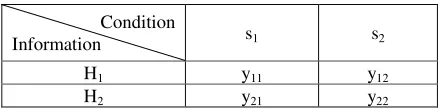
At this point, we can compute the expected utility function of each scheme without information and make the scheme selection. When the new information condition H is added, the description of the information condition versus decision inclusion state can be shown in Table 2. below.
Table 2. New Information State Distribution Table.
Condition
Information s1 s2
H1 y11 y12
H2 y21 y22
The original state table can be modified by Bayesian method and the entropy of new information is obtained. By assuming the original data values, it can be seen that the information entropy can be obtained by calculating the state space probability distribution in the decision condition under the condition that the new information is continuously input. By comparing with the original value, the influence of battlefield intelligence on command decision conditions can be evaluated.
Conclusion
[image:5.612.196.416.493.548.2]information sharing can provide powerful help for making accurate combat decision-making. This paper lays a good foundation for further study of command decision-making.
References
[1]David S Alberts. Network centric warfare: Developing and Leveraging Information Superiority (2nd Edition), www.nap.edu. 2000.
[2]Garstka John. Network Centric Operation Conceptual Framework V1.0.2003.
[3]David S Alberts, James Moffat. Network centric warfare and Complexity Theory. Publishing house of electronics industry, Beijing, 2004.
[4]David R. Anderson, Dennis J Sweeney, Thomas A Williams. Quantitative Approaches to Decision Making (13th Edition). China Machine Press. Beijing, 2012.
[5]Simon French, John Maule, Nadia Papamichail. Decision Behavior, Analysis and Support, Cambridge University Press, Cambridge. 2012.
[6]Simon, H.A.The New Science of Management Decision, Harper and Row, New York.1960.
[7]Thomas M, Cover. Joy A.Thomas. Elements of information theory. (2nd Edition). China Machine Press. Beijing, 2014.