2017 International Conference on Mathematics, Modelling and Simulation Technologies and Applications (MMSTA 2017) ISBN: 978-1-60595-530-8
New Method of Improving the Quality of Single Images
in a Video Sequence
Maksim KHISAMUTDINOV, Anatoly KALYAEV and Iakov KOROVIN
*Southern Federal University, 347900, Chekhov Str., 2, Taganrog, Russia *Corresponding author
Keywords: Image processing, software, White Gaussian noise, Addition of images, The image alignment, Peak signal to noise ratio (PSNR).
Abstract. In this paper, authors propose a new method of processing a video sequence to produce better quality single images from video frames. We propose new image alignment algorithm based on the approach of searching corresponding point and increasing of resolution. In addition, we develop new algorithm based on adding a plurality of images to obtain a single noiseless image. As the conclusion, we present results of experimental research of the proposed method.
Introduction
The problem of improving the quality of images in actual in many spheres of human activity: cartography, photogrammetry, medicine, astronomy, and others. And there always is a problem of increasing of quality of images and minimizing of artificial noises on it. As example, digital noise - the defect image made by electronics. Digital noise represents randomly arranged raster elements having dimensions close to the size of the pixel. raster elements representing digital noise, different from the image brightness grayscale - such noise is called luminance noise. There is also a chroma noise - raster elements differ in color from the neighboring elements [2]. Consider the main causes of the digital noise. On index ratio signal / noise affecting the analog LC components: amplifiers, analog-to-digital converter (ADC) and the main source of noise - the photosensor [3] (- CCD matrix, a CMOS - matrix vidicon). The noise in the photosensor occur for the following reasons:
- defective impurity on photosensor - dust particles disposed in the matrix. These defects are statically arranged in raster elements and visible as small dark spots on a light background, the size of one to several pixels. The above defect is eliminated by wet cleaning matrix;
- defective pixels - are the black dots arranged in the image size of one pixel. This defect can not be removed from the matrix, are used to suppress the interpolation methods; a defective pixel is replaced by averaging adjacent pixels workers;
- noise stochastic nature of the photon interaction with atoms of the material of the sensor photodiode. To suppress this effect may use noise reduction algorithms;
- dark current - occurs in the sensor when applying potential to an electrode is the result of the tunnel effect and thermionic emission. It appears in the image as bright dots on a dark background. His manifestation noticeably stronger with long exposures and high temperature photosensor.
Known filtering algorithms specialize in the removal of a certain kind of noise. Universal algorithm that "struggling" with all kinds of noise, there is no [4, 5]. Many noises fairly well approximated by white Gaussian noise model [6], so most existing algorithms aimed at addressing precisely this kind of noise. To assess the quality of noise cancellation algorithms noiseless image superimposed white Gaussian noise, the selected filter algorithm is used and compared with the original image obtained by evaluating the PSNR (peak signal-to-noise ratio peak signal / noise ratio) [7]. Since TC TASP records video information as a series of halftone images (thermal channel) digital image processing techniques are considered hereinafter with regard to the halftone images.
10
2
255 20 log
1
Im_ Im_
i N
i i
i o PSNR
new orig
N
(1)
Where N - the number of pixels in the image; Im_new - the image obtained after application of noise reduction algorithm to artificially noisy image; Im_orig - noiseless original image.
The closer the image processed by the noise reduction algorithm to the original noiseless, the higher PSNR measure and, consequently, better quality of noise reduction algorithm. Consider the most well-known image filtering algorithms, which include: linear averaging pixel median filtering, Gaussian blurring [6]. The simplest way to deal with digital noise is the algorithm of linear averaging pixels. Its idea is to average the pixel values in the spatial surroundings. The simplest embodiment, when as a new pixel value the average value is taken of its neighboring pixels. Another method of removing a digital impulse noise is median filtering. The luminance values of pixels within the filter window is sorted in ascending order, the value in the middle of the list is applied to the output of the filter. The window moves in the filtered image and the calculation repeated. The third method of combating noise is a Gaussian blur. idea of the method is to use an image convolution function:
2
2
( ) x
G x Mexp
(2)
Where M - normalization factor;
- the degree of blur.
The results of studies [6, 11] have shown that the methods and algorithms aimed at processing single images, slightly increase the PSNR measure, at the same time filters, using a series of images, a high value of this indicator.
Algorithm of Image Superposition
Within the research we have revealed that for a variety of practical tasks developed methods aimed at their solution; universal image superposition method does not exist [12].
Consider the main existing image registration techniques. The method, based on the areas of [13].
A method based on the selected path [14]..
A method based on finding point correspondences [15]. This method consists of two stages. At the first stage the search for point features in the images [16]. At the second stage search pairs of point correspondences. The main drawback of this method is the complexity of the search point correspondences between pairs of images [15], [16].
The method of variable resolution [16].
The problem of image enhancement involves processing unit or a series of images to obtain a noiseless single image. Results of studies [6, 11] have shown that the methods and algorithms, designed to process single images, insignificant increase PSNR value (for evaluating the performance of noise reduction algorithms noiseless image superimposed white Gaussian noise is used selected filter algorithm and comparing the resulting image with the original with by evaluating the PSNR (peak signal-to-noise ratio - a peak signal / noise ratio) [7]), at the same time filters using a series of images reach high values of the indicator. Therefore, in developing a method of improving image quality by analyzing a series of images obtained from one angle of the photodetector, it makes sense to use the method of addition of a plurality of images. However, it is necessary to take into account the specifics of obtaining a series of images - some image series may be offset relative to each other. Therefore, the proposed method of obtaining noiseless single image based on image processing, the series consists of two phases:
The Algorithm is Combining a Series of Images Based on the Search Approaches Point Correspondences and Increasing Resolution
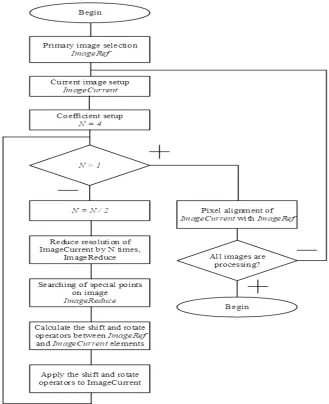
[image:3.612.141.470.294.698.2]Literature analysis undertaken proved [that approaches based on finding point correspondences have high precision alignment [15] and software implementations of methods based on increasing the resolution - high speeds [15]. We propose a combined image registration algorithm based on point correspondences search methods and increasing resolution. The proposed algorithm reaches pixel-precision image registration by using an approach based on finding the point correspondences in the images as well as high speed through the use of an approach based on iteratively improving image resolution. Fig. 1 is a diagram of a combined image registration algorithm. Consider the operation of this algorithm in more detail. Let two monochrome image ImageRef and ImageCurrent given. Each image is represented by a matrix HxW elements. It is necessary to find a transformation matrix ImageCurrent ImageRef, wherein the difference of brightness of images will be minimal. The essence of the algorithm is sequential processing a series of images with a view to align images with the reference image ImageRef. Reference is selected the first image. Each image ImageCurrent passes iterative processing. At each iteration, the image processing resolution coarsens and searched point correspondences [16]. Further, the found point correspondences are computed transformation matrices operators.
As matrix transformation operators considered shift operators and rotation. Conversion of rotation, as well as in the analysis of planar geometry allows the original image is rotated by a predetermined angle.
Rotation is carried out around the center of the image. There are two possible rotation options: - image area, coming to its boundaries by turning cut off and blank portion of the pixels are filled with zero brightness;
- calculated the size of the new image based on the steering angle so that the Rotated entire image fits into the new size. Unfilled part of the image as the pixels are filled with zero brightness.
In any case, the following formula can be used to calculate conversion of rotation [16]:
[ ][ ], [0, 1] [0, 1] [ ][ ]
, [0, 1] [0, 1]
old old old
new
old old
C a b a H b W
C i j
C a H b W
(3)
where
cos( ) ; 2 new W
b j i0,Hold1; j0,Wold1;
C - the brightness of the pixel that fills the empty areas of the image;
- angle of rotation clockwise in radians.
The above formula rounds transformed coordinates. However it is possible to use bilinear interpolation and when the pixel luminance is computed as a weighted sum of the luminances of four neighboring pixels. After that, the image aligning operation ImageCurr c ImageRef pixel by pixel. For per-pixel image alignment ImageRef is compared to the 9 th embodiments ImageCurr image (original ImageCurr shifted up / down to 1 pixel shifted left / right by one pixel shifted diagonally 1 pixel), analyzing kor correlation coefficient by the formula [16]:
2 2
( ( , ) ) ( ( , ) )
( ( , ) ) ( (
Im Im
Im , ) Im )
m
c r m
m m
c r c r
ImageRef ImageRef ageCurr ageCurr
ImageRef ImageRef a
c r c r
kor
c r geCurr c r ageCurr
(4)Where
in ImageRefm - average value ImageRef; ImageCurrm - average value ImageCurr.Selects one of
9-shifted images embodiment ImageCurr kor with the highest value of correlation coefficient as a
superimposed image pixel by pixel with ImageRef.
Conclusions
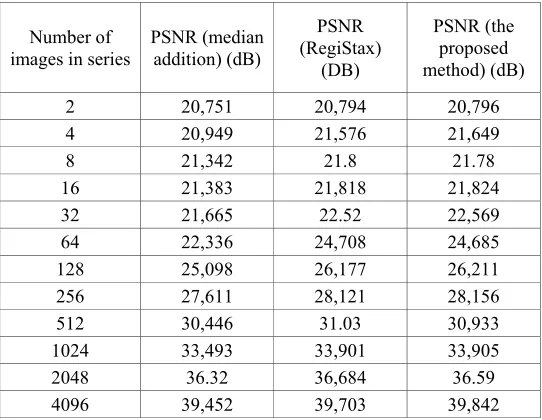
Table 1. Comparison of methods of image enhancement, the resolution of 256x256 pixel video sequences (original image 5.1.09 - Moon surface).
Number of images in series
PSNR (median addition) (dB)
PSNR (RegiStax)
(DB)
PSNR (the proposed method) (dB)
2 20,751 20,794 20,796
4 20,949 21,576 21,649
8 21,342 21.8 21.78
16 21,383 21,818 21,824
32 21,665 22.52 22,569
64 22,336 24,708 24,685
128 25,098 26,177 26,211
256 27,611 28,121 28,156
512 30,446 31.03 30,933
1024 33,493 33,901 33,905
2048 36.32 36,684 36.59
4096 39,452 39,703 39,842
Table 2. Comparison of methods of image enhancement, the resolution of the video sequence 512x512 pixels (original image 7.1.03 - Tank)
Number of
images in series PSNR (median addition) (dB)
PSNR (RegiStax)
(DB)
PSNR (the proposed method) (dB)
2 26,577 26,595 26,591
4 27,492 27.79 27,881
8 27,541 29,903 29.75
16 28,007 31,243 31.46
32 31,964 33,994 34,199
64 36,003 36,615 36,822
128 38,989 39,384 39,413
256 41,999 42,296 42,189
512 45,068 45,269 45.18
1024 48,212 48,217 48.21
2048 51,239 51,352 51,298
4096 53,993 54,497 54,523
As seen from the table, the proposed method is superior to the method of addition of the median of the set of images, and compare with the method of addition of a series of images implemented in RegiStax program, and when a certain number of images in the series exceeds it in PSNR metric.
Acknowledgement
The paper is published within the research, supported by the Grant of the President of Russian Federation for young PhDs, project № МК-5463.2016.9
References
[image:5.612.174.442.335.544.2][2] Gruzman I.S. Digital image processing in information systems [Text] / I.S. Gruzman, V.S. Kirichuk, V.P. Oblique // Novosibirsk: Publishing House of Novosibirsk State Technical University, -2000. 168.
[3] Tayurskii V.A. Statistics interference image obtained using the CCD-elements [Text] / V.A. Tayurskii // Scientific and Technical Gazette Information Technologies, Mechanics and Optics, - 2008. - №4. - S. 202-209.
[4] Angel E. interactive computer graphics. An introductory course on the basis of OpenGL [Text] / E. Engel / M .: Williams - 2001, pp 592.
[5] Zhuravel I.M. matlab.exponenta.ru. [Electronic resource] / Information on http://matlab.exponenta.ru/imageprocess/book2/10.php (reference date: 02.09.2015).
[6] Pratt W.K. Digital Image Processing [electronic resource] / Information on http://www.twirpx.com/file/206447/ (reference date: 10/02/2015)
[7] Shelukhin O.I. Evaluation of the quality streaming video via networks telekommunikatsionngh firmware [Text] / O.I. Shelukhin, Y. Ivanov // Electrical and information systems and systems, - 2009. - №4. - S. 48-56.
[8] Nikitin O.R. Development of criteria for assessing the quality of the systems of digital television [Text] / O.R. Nikitin, E.A. Arkhipov, V.S. Shanazarov // Methods and apparatus transmitting and processing information, - 2007. - №8. - S. 139-142.
[9] Black and white television cameras [electronic resource] / Information on http://daily.sec.ru/publication.cfm?pid=23981 (reference date: 04.13.2015).
[10] Nevsky M.Y. Observation of astronomical objects in the telescope [Text] / M.J. Nevsky / Rostov-on-Don - 2008.
[11] Gonzalez R.S. Digital Image Processing [Text] / R.S. Gonzalez, R.E. Woods / New JercyPrentice Hall, - 2002.
[12] Computer Graphics [electronic resource]: Tomsk Polytechnic University, 2005. –
[13] Korovin I.S. Method for determination of fuel assemblies in raznovysotnyh problem TV control fuel assemblies VVER [Text] / I.S. Korovin, M.V. Hisamutdinov // Journal of Computer and Information Technology, - 2012. - №12. - P. 3-7.
[14] Iakov S. Korovin, Maxim V. Khisamutdinov. Method of noise-free image production based on video sequence handling. 2ND AASRI Conference on Computational Intelligence and Bioinformatics. Book Series: AASRI Procedia, Volume: 6 Pages: 73-81. DOI:
10.1016/j.aasri.2014.05.011. Published: 2014:
http://www.sciencedirect.com/science/article/pii/S2212671614000122.
[15] Korovin Y.S., M.V. Khisamutdinov. Method of obtaining unnoise image on the basis of video sequence handling/ Journal "Computer Optics ", ISSN 0134-2452, Russia, Samara / / Volume 38 N1, January - March 2014, p. 112-118 .