2017 2nd International Conference on Information Technology and Management Engineering (ITME 2017) ISBN: 978-1-60595-415-8
What Affects China’s ODI to the Arab States? An Empirical
Study of Panel Data Analysis
Zhan-wen MU
*School of Economics and Management, Nanjing University of Science and Technology, Nanjing, Jiangsu, China
*Corresponding author
Keywords: China, Arab states, ODI, Gravity model, Panel data.
Abstract. The China-proposed “Belt and Road” initiative will bring new opportunities for Chinese enterprises’ ODI to Arab states. What affects China’s ODI to the Arab states? Based on the latest investment panel data of China in Arab countries (2004-2014), this study examines the influencing factors of China's ODI to Arab countries by reconstructing the investment gravity model. The empirical study in this paper presented China’s ODI is positively linked to economic scale of the Arab states, the scale of Chinese economy, the tax level of host country, the trade volume between the two states, and the host country natural resources endowment. Meanwhile, it is negatively associated with the host country's infrastructure level, wage level, exchange rate, and the distance between the two states. On the basis of empirical research results, this study finally gives conclusions.
Introduction
Since 2013, the Chinese government has been actively promoting the "Belt and Road" initiative, international cooperation in production capacity and equipment manufacturing, "going global" and accelerating the integration of enterprises into economic globalization. The foreign investment and cooperation show a rapid development momentum. China's outward FDI stock and flows in 2014 reached US $ 882.64 billion and US $ 123.12 billion, respectively, and the two-way direct investment was close to equilibrium for the first time. China's direct investment in the Arab countries (the Arab League countries) is also increasing, in 2014, the statistics of the Ministry of Commerce shows that China's direct investment stock and flows in the Arab countries reached US $ 10.68 billion and US $2.22 billion , compared to the previous year to achieve growth. The "Belt and Road" initiative will bring new opportunities for Chinese enterprises’ ODI to Arab countries, which will also become an important investment destination for China. What affects China’s ODI to the Arab states? Therefore, the current study of the effecting factors of China's direct investment in the Arab countries, it has some innovation and practical value.
Throughout the domestic and foreign investment environment facing Arab countries, China-Arab investment cooperation is in an important period of strategic opportunities, vigorously carry out investment cooperation with the Arab countries will have a bright future. The China-proposed "Belt and Road" initiative in line with common development needs of China and the countries (regions) along the "Belt and Road", to meet the interests of the development, also brings historic new opportunities for Chinese enterprises to Arab investment cooperation. Therefore, taking into account the background of the "Belt and Road", it is particularly urgent and important to quantitatively study the influencing factors of China's ODI in Arab countries which can not only contribute to the development of China's "Belt and Road" initiative theory, but also to provide investment cooperation advice for more enterprises "going global" to the Arab countries.
Brief Literature Review
The traditional view is that FDI occurs between the developed and the developing countries, while the developed countries are the exporting countries, while the developing countries are the other side of the capital input. Therefore, some of the investment theories are based on the transnational corporations of developed and developed countries, and the theoretical conclusions that describe transnational corporations' behaviors, and interpretations and predictions of transnational behavior are extended to all countries and transnational corporations. However, according to the World Investment Report, many developing countries have becoming capital-exporting countries. Many international economists, from the perspective of the reasons, purpose, competitive advantage and characteristics of developing countries' foreign investment, have also come up with a theory to explain the investment behavior of developing, including long-term strategy theory, small-scale technology theory, technology localization theory, competitive advantage development theory, and other theories. Although the theoretical conclusions above describe and explain the investment behavior of developing countries from different perspectives, they are not in the leading position of international investment theory research. To sum up, even if the academic research on international investment has not given a more systematic and comprehensive general theory, but the research results are increasingly rich, the impact on the behavior of multinational corporations is also more and more important.
James E. Anderson (1979) uses the gravity model to explain the problems of international investment flows, thus creating a precedent for applying the gravity model to the study of international investment. Because gravity model provides a tool for quantitative analysis of international direct investment, more and more scholars at home and abroad use gravity model to study the influencing factors of location choice on FDI. Moreover, most of the research results are of practical significance to the study of international direct investment, and to make a better explanation and prediction. S Bellos, T Subasat (2003), M Frenkel, K Funke, G Stadtmann (2004), B Agnes, C Maylis, M Thierry (2005), Klimis Vogiatzoglou (2007), P. Chintrakarn (2010), S. Sudsawasd 2012), T Subasat, S Bellos (2013) and D Haberly, D Wojcik (2015) and other scholars use the panel data gravity model to study, the results show that the distance between the two countries, market size, home and host country characteristics, the host country's degree of risk and economic growth, the source of government governance, market competition and other factors create important influence to FDI flows.
Methodology and Data
International direct investment theory holds that economic factors and institutional factors have an impact on the inflow of international direct investment (Minghong Lu, 1999). In order to study the influencing factors of China’s ODI to Arab countries, this study, taking into account the natural, economic and socio-cultural environment of the host country, including the institutional and non-institutional factors. With the reference to the existing research results, the economic scale of the host country, wage level, exchange rate, bilateral trade scale, institutional environment, the level of infrastructure construction, geographical distance between the two countries, natural resources and other variables are introduced into the model, and the investment gravity model is taken as a quantitative analysis tool. At the same time, we use the panel data to measure and test the model to analyze the correlation between the distribution of ODI and these variables, and then analyze the factors that affect China's ODI in Arab countries.
Investment Gravity Model
The gravity model of investment suggests that the scale of investment between the two countries is proportional to the size of the economies of the two countries and inversely proportional to the distance. In order to quantitatively analyze the impact of China's ODI in Arab countries, this paper assumes that there are no policy measures, organizational systems and other factors that are difficult to quantify in each country to have an impact on attracting foreign capital inflows. The initial investment gravity model can be simplified to be given in the following form:
lnFDI = α + βlnGDP + βlnGDP + βlnDIS + ε (1)
where:
is the volume of direct investment from country i to country j; is the economic size
of country i; is the economic size of country j; ! is the relative distance between country i and country j; " is the system error term; = 1, ⋯ , &; = 1, ⋯ , − 1, + 1, ⋯ , & + 1. In this study, the logarithmic linear model is used to convert the nonlinear relationship between the explanatory variable and the explanatory variable into a linear relation. At the same time, this method can also reduce the abnormal points, the non-normal distribution of residuals and heteroskedasticity. Taking into account the particularity of the object and the availability of data and other factors, also refer to L. Matyas (1997) gravity model equation, The following investment gravity model is constructed as the research model:
lnODI) =
β*lnTRADE) + β/lnTAX) + β1lnINC) + β4lnNRE) + β5lnDIST) + μ) (2) where:
i is the investment home country; j is the host country; t is the time; 7 is an individual characteristic that is unpredictable and does not change over time; 8 9 is a random disturbance term with time and individual change; = 1, ⋯ , &; = 1, ⋯ , − 1, + 1, ⋯ , & + 1; : = 1, ⋯ , ;;
< 9 is the stock of investment from investing country to country j at time t; 9 is the real
GDP of host country j at time t; = 9 is the real GDP of the investing country i and the host country j at time t; >?@ 9 is the wage level of host country j at time t; @A= 9 is the exchange rate of host country j at time t; ;B?@ 9 is the trade volume between the investing country i and the host country j at time t; ;?A 9 is the tax level of host country j at time t; &= 9 is the infrastructure level of the host country j at time t; &B@ 9 is the natural resource endowments of the host country j at time t; !; 9 is the relative distance between investing country i and host country j at time t.
This study estimates the model using panel data for the 18 members of the League of Arab States, including Algeria, Oman, Egypt, Bahrain, Qatar, Comoros, Kuwait, Lebanon, Libya, Mauritania, Morocco, Saudi Arabia, Tunisia, Syria, Yemen, Iraq, Jordan and the United Arab Emirates.
For the dependent variable ODI uses the direct investment stock of China for the host country over the years, stock data better measures the size of a country's foreign assets (Dunning, 2001) and can also explain the relationship between investment activity and economic indicators (He, 2009).At the same time, taking into account the availability of data. For each independent variable, using real gross domestic product to measure the market size of the host country (GDP), using the actual gross domestic product of China and the host country to measure the size of the two economies and market size (CGDP); The wage level (labor cost) adopts nominal per capita gross national product (WAGE); The exchange rate level using IMF statistics host currency exchange rate against the US dollar (EXC); The trade scale using China's total exports volume of goods to the host country to measure (TRADE); The tax level (TAX) is measured by the total tax rate in the host country (The total tax rate measures the ratio of taxable and mandatory contributions to business profits after deductible and deductible allowances, the World Bank database); The infrastructure level (INC) of the host country is measured by the number of people accessing the Internet per 100 people; The natural resource endowment (NRE) is measured by the proportion of exports of fuels and ores to total exports of commodities; The relative distance (DIST) is determined by the product of the average distance between the capital of the Chinese capital and the capital of the host country and the proportion of the population of the host country to the world population, refer to Soloaga and Wintersb (2001) for the calculation method.
Results
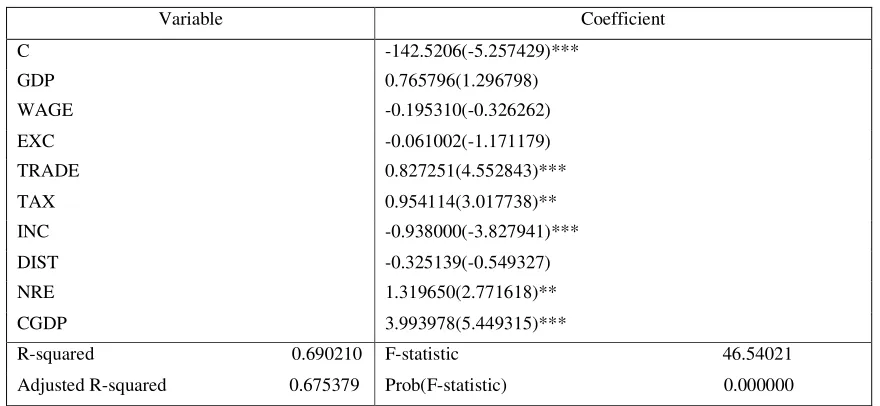
[image:4.612.86.526.484.687.2]Based on the established investment gravity model, this study uses the panel data analysis method to carry on the measurement regression, estimates the coefficient of each explanatory variable and examines the correlation. Since, there is no individual characteristic of the variable at any point in time between China and the specific host country, that is, the model has no individual influence in the cross section and no structural change, conforming to the invariant intercept, constant coefficient model. Thus, this paper uses mixed regression model estimation, and chooses mixed least square method, presents the results:
Table 1. Estimation results of model (2).
Variable Coefficient
C -142.5206(-5.257429)***
GDP 0.765796(1.296798)
WAGE -0.195310(-0.326262)
EXC -0.061002(-1.171179)
TRADE 0.827251(4.552843)***
TAX 0.954114(3.017738)**
INC -0.938000(-3.827941)***
DIST -0.325139(-0.549327)
NRE 1.319650(2.771618)**
CGDP 3.993978(5.449315)***
R-squared 0.690210 F-statistic 46.54021
Adjusted R-squared 0.675379 Prob(F-statistic) 0.000000
Note: *Indicates significance at the 10% level.**Indicates significance at the 5% level.***Indicates significance
at the 1% level.
development level and market size, with the market seeking motivation, which is in line with the expectations of this article.
The coefficient of WAGE is negative, which indicates that labor costs in Arab countries will have a negative impact on investment in China. The host country's labor price is negatively correlated with the amount of investment in China. That is, the higher the wage level of the host country, the less access to the investment of Chinese enterprises. The direct investment of Chinese enterprises to Arab states will be limited by the wage level of the host country.
The negative coefficient of EXC indicates that the change of exchange rate has a negative impact on direct investment. The instability of the US dollar exchange rate will bring the risk to Chinese enterprises, which will limit the investment of Chinese enterprises in Arab countries cooperation.
The coefficient of TRADE is significantly positive at the 1% level, indicating that China's direct investment in the Arab countries positively correlated to trade. The long-term trade relations between China and the Arab countries have directly contributed to China's investment in the host country.
The TAX coefficient is significantly positive at the 5% level, indicating that there is a positive correlation between China's direct investment in the Arab countries and the host country's tax level. The tax system of the host country has a significant positive impact on attracting investment from Chinese enterprises. It also shows that Chinese enterprises choose to invest in tax-preferential Arab countries with relatively clear tax avoidance purposes.
The coefficient of the variable INC is significantly negative at the 1% level, indicating that China's investment in the Arab countries is significantly negatively related to the host country's infrastructure level. The better the infrastructure level of the host country, the smaller the scale of China's investment in the Arab countries that is different from the results of some scholars' research on China’s ODI in other countries (Chen et al., 2015).
The coefficient of DIST is negative, indicating that China's investment in Arab countries is negatively correlated with distance. China's direct investment in Arab countries will be limited by geographical distance.
The NRE coefficient is significantly positive at the 5% level, showing that China has a resource-seeking motive for direct investment in Arab countries. The natural resource endowment of the host country has a significant positive impact on attracting direct investment from Chinese enterprises.
The coefficient of CGDP is also positive and is significant at the level of 1%. This highly significant correlation indicates that the size of China's direct investment in Arab countries is positively related to the size of the country's economy. China's economic development directly and significantly promoted the development of foreign direct investment, which is consistent with the expectations of this article.
Conclusions
negative effect on China's investment, China's direct investment in Arab countries will be limited by geographical distance, which is the same as the previous research, but the significance level is relatively low. Because of the cultural similarities between China and the Arab countries, it is easy to produce psychological identity, and also beneficial to the investment management work, so that some negative effects of distance can be offset. China's ODI in Arab countries is affected by the negative impact of the exchange rate, the volatility of the dollar exchange rate create investment risks to the Chinese multinational enterprises, make Chinese enterprises to invest in Arab countries will be subject to a certain degree of exchange rate restrictions. The tax rate of Arab countries is positively related to Chinese investment, that is, the tax system of the host country is significantly influencing Chinese investment, and the good taxation system of Arab countries has greatly promoted the investment cooperation of Chinese enterprises.
In addition, the research and analysis of this study, there are still varying degrees of shortcomings to be further improved. Future research in this regard could consider the micro-level, or the industry level to explore the influencing factors of China's direct investment in Arab states.
References
[1]James E. Anderson, A Theoretical Foundation for the Gravity Equation, The American Economic Review, Vol. 69, No. 1 (1979) 106-116.
[2]Xintao Yuan, An Analysis of the National Strategy of “Belt and Road”, Theory Monthly, No. 11 (2014) 5-9.
[3]Benfang He, and Xiang Zhang, A Study on the Location Choice Model of Chinese Enterprises' ODI, Finance & Trade Economics, No. 2 (2009) 96-101.
[4]Yingwu Zhang, The Relation between Foreign Direct Investment and Trade: Complementarity or Substitutability, Journal of International Trade, No. 6 (2007) 87-93.
[5]Yongqin Wang, Julan Du, and Kai Wang, The Determinants of Location Choices of China's ODI: Institutions, Taxations and Resources, Economic Research Journal, No. 12 (2014) 126-142.
[6]En Chen, and Bo Chen, Location choice and influencing factors of China’s FDI in developing countries, Journal of International Economic Cooperation, No. 8 (2015) 14-20.
[7]Helian Xu, and Lihua Li, An Analysis of the Influence of Cultural Difference on the Location Choice of China's ODI, Statistics & Decision, No. 17 (2011) 154-156.
[8]Minghong Lu, Institutional Factors and Location Distribution of International Direct Investment: An Empirical Study, Economic Research Journal, No. 7 (1999) 57-66.
[9]L Matyas, Proper Econometric Specification of the Gravity Model, World Economy, Vol. 20, No. 3 (1997) 363-368.
[10]John H. Dunning, Explaining the international direct investment position of countries: Towards a dynamic or developmental approach, Review of World Economics, Vol. 117, No. 1 (1981) 30-64.
[11]FD Mauro, The Impact of Economic Integration on FDI and Exports: A Gravity Approach, CEPS Working Document, No. 156, November (2000)
[12]John H. Dunning, The Eclectic (OLI) Paradigm of International Production: Past, Present and Future, International Journal of the Economics of Business, Vol. 8, No. 2 (2001) 173-190.
[13]Soloaga and LA Wintersb, Regionalism in the nineties: what effect on trade? North American Journal of Economics & Finance, Vol. 12, No. 1 (2001) 1-29.
[15]Information on http://fec.mofcom.gov.cn/article/tjsj/tjgb/
[16]Information on https://comtrade.un.org/
[17]Information on http://data.worldbank.org.cn/
[18]Information on https://www.wto.org/english/res_e/statis_e/statis_e.htm