2017 2nd International Conference on Software, Multimedia and Communication Engineering (SMCE 2017) ISBN: 978-1-60595-458-5
An Efficient Metaheuristic Algorithm for Optimal Capacitor Allocation in
Electric Distribution Networks
Bogdan Constantin NEAGU and Gheorghe GRIGORAȘ
*Gheorghe Asachi Technical University of Iasi, Romania
*Corresponding author
Keywords: Capacitor allocation, Distribution network, Metaheuristic.
Abstract. The capacitors are generally used to provide the compensation of reactive power in the
electric distribution systems. This paper investigates a particular approach that highlights the influences which the connection of shunt capacitors may have over the solutions for voltage control in the medium voltage distribution networks. The problem of optimal capacitor allocation for minimization of bus voltage deviation index was solved by using the Bat algorithm in order to find the near-optimal solutions for the capacitor allocation problem in electric distribution systems. To demonstrate the feasibility of algorithm, a real distribution network was used and the results were compared with those obtained using genetic algorithm.
Introduction
The electric distribution networks operated with traditional methods can have high power losses and poor voltage regulation. The optimization problem of voltage in nodes represents an indispensable task for system operators, both for ensuring operational security and increasing the transfer capacity. The basic duties of a reasonable electric distribution network (EDN) are allowable voltage profile, the accessibility of power on demand and reliability. Taking into account some advantages and disadvantages, the EDN efficiency can be developed by choosing one, two or more of the next knowing single or hybrid methods [1]: optimal network configuration, capacitors allocation, voltage regulation, and distributed generation implementation.
The capacitors are usually used in order to provide the compensation of reactive power in EDN. Shunt capacitors placement is a strong method used in EDN for power losses reduction, voltage profile improvement, the maximization power capacity of the distribution elements and the power factor correction [2]. On the other hand, the capacitor allocation in EDN requires appropriate location and sizing, playing an important role in losses minimization achieved by using optimization methods. The capacitors are oftentimes used in the EDN for maintain the node voltage in allowable limits, and also for power loss reduction or line capacity upgrade. The capacitors are efficient in overall current minimization through withering the reactive current supplied by the transformer. In literature, for solve the optimal capacitors allocation problem in distribution networks, a lot of metaheuristic techniques were used, such as: modified cultural algorithm, [1]; ant colony optimization algorithm, [3]; shark smell optimization algorithm [4]; bee colony optimization algorithm, [5]; plant growth simulation algorithm, [6]; monkey search optimization algorithm [7]; particle swarm optimization algorithm, [8]; flower pollination algorithm, [9]; mine blast algorithm, [10]; gravitational search algorithm, [11]; cuckoo search algorithm, [12]; self-adaptive harmony search algorithm, [13]; bacterial foraging optimization algorithm [14], etc.
The proposed approach admit a lot of operating restrictions: the maximum allowed limits for current; the voltages level in the accepted operating limits; the reactive power added by the capacitors need to not flow towards the supply source, and the maximum compensation is limited to the total reactive power demand.
Proposed Algorithm
Metaheuristic algorithms use a compromise between local search and randomization that permit a solid strategy to advance from the local to global search. The Bat Algorithm was proposed in [15]. Accordingly, it can be used when the input parameters of the examined problem can be arranged in a string of characters. The proposed algorithm is based on the echolocation comportment of micro bats. The bats can emit a precisely loud and short sound pulse, and the reflected echo from the surrounding is received by their greater auricle. The approximated rules are the following: i) the bats know the difference between prey and barriers and use echolocation for distance perception. ii) the bats randomly fly taking into account the velocity vi at a location xi and a fixed frequency fmin, having
wavelength λ and loudness A0 to inspect for prey. Automatically, the bats can adjust the wavelength or
frequency of both emitted pulses and pulse emission rate (r) that depend on the target proximity. r can have values between [0,1], where 0 are no pulses and 1 the maximum pulse emission rate. iii) Loudness can vary from a large positive A0 to a minimum constant value, noted as Amin.
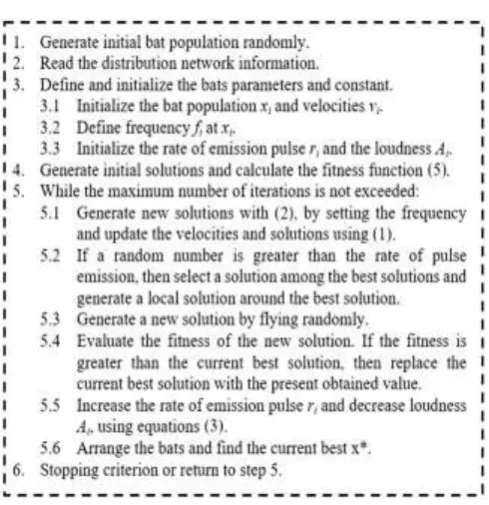
An initial population of 10-40 bats is randomly generated [15]. After initial fitness adopting for the population for the given fitness function, the values are updated only used the loudness, location and pulse rate. The rules for updating the frequency fi, the velocities vi and locations xi, of bats are
computed using the following relations:
it i it i it i i it i it i it i i v x x f x x v v f f f f 1 1 min max min * (1)where χ is a random vector with values between 0 and 1. Also, x* represents the global best solution in the current iteration, and fminand fmaxrepresent the minimum and maximum frequency.
When the solution is generated among the current best solutions, a new solution is generated for each bat through local search using random stroll, with:
t o
n x A
x (2)
where xn is the new solution, xo is old solution, and δ ε [-1, 1] represent a random value.
Through the iterative process, both loudness (Ai) and rate of pulse emission (ri) are accordingly
updated. Furthermore, if the bat closes on its prey, the loudness decreases and rate of pulse emission increases, and the equations for convergence are:
it i it
i A
A 1 and r riit
it
it
i
exp 1
1
(3) Because α (cooling factor) and γ are constants, for each 0 < α < 1 and γ > 0, if it tends to ∞, then:
0
it i
A and 0 i it i r
Figure 1. The pseudocode of bat algorithm for capacitor allocation.
Problem Formulation
The capacitor allocation problem approached in this paper aims to determine a combination for the capacitors location and size in an EDN so that the goal function (voltage deviation) is minimized. Considering a maximum available number of capacitors, the Bat Algorithm solves two aspects:
• Finding the optimal buses for capacitors placement. • Finding the required compensation level.
The fitness function considers the minimization of bus voltage deviations with regard to their nominal values:
NN
bus
bus n
bus U
U abs dU
1
, )
(
min (5)
with to the following operating constraints:
• Branch current flows must not exceed the maximum allowed limits:
NB branch
I
Ibranch max,branch, 1.. (6) • Bus voltages must not exceed the allowed range:
NN bus
U U
Umin,bus bus max,bus, 1.. (7) • The maximum compensation is limited to the total reactive power demand:
NN bus
N Q N
QC,bus c,bus d,bus l,bus, 1.. (8) • The capacitor power must not flow towards the supply source, in any operating state:
minQC,bus
q0Ni,iNN (9) where NN – the number of buses in the system, NB – the number of branches in the system, Ubus - theactual value of the bus voltage, Un,bus– the nominal bus voltage, Ibranch – the actual value of the branch
current, Imax,branch– the maximum branch current limit, Umin,bus– the minimum bus voltage limit, Umax,bus– the maximum bus voltage limit, q0 – the reactive power of a capacitor, Qc,bus– reactive
total number of capacitors placed at bus i. In the proposed algorithm, voltages were considered in kilovolts (kV), and currents in amperes (A).
Since the standard Bat algorithm maximizes its fitness function, 1/dU was used.
Case Study
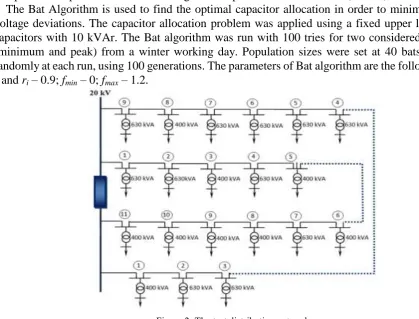
The proposed approach for optimal capacitor allocation is tested on a real EDN with 20 substations of 20/0.4 kV which supplies urban residential consumers, given in Figure 2. The substations have distribution transformers, with 400 or 630 kVA.
In particularly cases, an EDN operate at medium (MV) or low voltage (LV) and the reactive power compensation optimization is done using shunt capacitors on the LV side (0.4 kV) of transformers.
[image:4.595.63.483.222.541.2]The Bat Algorithm is used to find the optimal capacitor allocation in order to minimize the bus voltage deviations. The capacitor allocation problem was applied using a fixed upper limit of 100 capacitors with 10 kVAr. The Bat algorithm was run with 100 tries for two considered load cases (minimum and peak) from a winter working day. Population sizes were set at 40 bats, generated randomly at each run, using 100 generations. The parameters of Bat algorithm are the following: Ai, α, γ and ri – 0.9; fmin – 0; fmax – 1.2.
Figure 2. The test distribution network.
[image:4.595.142.441.314.534.2]For the real operating configuration and load data without compensation, the voltages range are between 0.975 to 0.994 p.u., and the fitness function is 3.56 at minimum load, and between 0.963 to 0.991 p.u. of a fitness function by 1.81 at peak load. The obtained results for each combination of population size, number of generations and both bat and genetic algorithm parameters value is given in Table 1. Each cell value represents the maximum fitness function obtained in the 100 tries attempted with a specific combination of parameters.
Table 1. Description of bat algorithm parameters.
Algorithm and state
Bat Algorithm Genetic Algorithm Minimu
m load
Peak load
Minimum load
Peak load Fitness function 2.1565 5.0780 2.1489 5.0675
Table 2. The bus voltage deviation and power losses for minimum and peak load with the two algorithms.
Algorithm and state
Uncompensated state Bat Algorithm Genetic Algorithm dU
[V]
dP [kW]
dU [V]
dP [kW]
dU [V]
dP [kW] Mimimum load 280.89 15.64 196.92 12.01 198.68 12.26 Peak load 552.48 64.98 463.71 57.64 468.49 58.21
Conclusions
The paper proposes an approach for optimal capacitor allocation problem in real distribution systems using an efficient metaheuristic algorithm. To confirm the Bat algorithm performances, a real distribution network was tested, and the optimization of shunt capacitor placement for bus voltage deviation index minimization was solved. The main advantage of Bat algorithm is that it does not require spending more effort in tuning the control parameters, as in case of Genetic algorithm, or other Evolutionary algorithms. The simulated results obtained using the Bat algorithm are compared with genetic algorithm, and the results show that the performance of the proposed method is found to be better than the other existing methods. The proposed method can be easily applied to any large-scale particle radial distribution system.
References
[1] V. Haldar, N. Chakraborty, Power loss minimization by optimal capacitor placement in radial distribution system using modified cultural algorithm, Inter Trans Electr Energy Syst, 25 (1), 54-71, 2015.
[2] B. C. Neagu, G. Georgescu, The Optimization of Reactive Power Sources Placement in Public Repartition and Distribution Systems for Power Quality Improvement. In Int. Conf. on Optim. Of Electr. a. Electron. Equip., OPTIM 2012, 200-207, 2012.
[3] C. F. Chang, Reconfiguration and capacitor placement for loss reduction of distribution systems by ant colony search algorithm. IEEE Trans. on Power Syst., 16 (4), 1747-1755, 2001.
[4] N. Gnanasekarana, S. Chandramohanb, P. Sathish Kumarc, A. Mohamed Imran, Optimal placement of capacitors in radial distribution system using shark smell optimization algorithm, Ain Shams Eng. J., no. 7, 907-916, 2016.
[5] A. Baghipour, S. Fallahian, Multi-objective placement of capacitor banks in distribution system using bee colony optimization algorithm, J. of Adv. in Comp. Res., 6 (2), 117-127, 2015.
[6] R.S. Rao, S. Narasimham, M. Ramalingaraju, Optimal capacitor placement in radial distribution systems using plant growth simulation algorithm, Int. J. Electr. Power Energy Syst., 33, 1133-1139, 2011.
[7] F. G. Duque, L. W. Oliveira, E. J. Oliveira, A. L. M. Marcato, I. C., Jr. Silva, Allocation of capacitor banks in distribution systems through a modified monkey search optimization technique. Int. J. of Electr. Power & Energy Syst., 73, 420-432, 2015.
[8] H.S. Ramadana, A.F. Bendaryc, S. Nagyd, Particle swarm optimization algorithm for capacitor allocation problem in distribution systems with wind turbine generators, Int. J. of Elect. Power and Energy Syst., no. 84, 143-152, Istanbul, 2017.
[9] A.Y. Abd-Elaziz, E.S. Ali, S.M. Abd-Elazim, Flower pollination algorithm and loss sensitivity factors for optimal sizing and placement of capacitors in radial distribution systems. Int. J. Electr. Power Energy Syst., 78, 207-214, 2016.
[11] Y. Mohamed Shuaib, M. Surya Kalavathi, C. Christober Asir Rajan, Optimal capacitor placement in radial distribution system using Gravitational Search Algorithm, Int. J. Electr. Power Energy Syst., 64, 384-397, 2015.
[12] Y.A. Baysal, I. H. Altas, Cuckoo search algorithm for power loss minimization by optimal capacitor allocation in radial power systems, in IEEE/IAS Int. Conf. on Industry App., 1-6, 2012.
[13] D. Rani, N. Subrahmanyam, M. Sydulu. Self-adaptive harmony search algorithm for optimal capacitor placement on radial distribution systems, in Int. Conf. on Energy Effic. Techn. for Sustain. (ICEETS), 1330-1335, 2013.
[14] K. R. Devabalaji, K. Ravi, D.P. Kothari, Optimal location and sizing of capacitor placement in radial distribution system using bacterial foraging optimization algorithm, Int. J. Electr. Power Energy Syst. 71, 383-390, 2015.