Page 1 of 312
The London School of Economics and Political Science
Watching the Cops: a case study of production processes on
television police drama “The Bill”
Marianne Colbran
A thesis submitted to the Department of Sociology of the London
School of Economics for the degree of Doctor of Philosophy,
Page 2 of 312
Declaration
I certify that the thesis I have presented for examination for the PhD degree of the London School of Economics and Political Science is solely my own work other than where I have clearly indicated that it is the work of others (in which case the extent of any work carried out jointly by me and any other person is clearly identified in it).
The copyright of this thesis rests with the author. Quotation from it is
permitted, provided that full acknowledgement is made. This thesis may not be reproduced without my prior written consent.
I warrant that this authorisation does not, to the best of my belief, infringe the rights of any third party.
Page 3 of 312
Abstract
This thesis examines the process of storytelling on television police drama,
The Bill. It explores how factors such as commercial imperatives, working processes and artistic constraints affected representation of the police. The study argues that, in the early days of the show, stories originated with the freelance writers and were based on research and observation of police work. Representation of the police was favourable, partly due to the
ideological views of the makers and partly due to the format: stories had to be resolved within a half-hour timeslot, which militated against writers being able to tell stories about issues such as racism, sexism and corruption.
However, due to changing market forces in the television industry, the show reinvented itself as a serial in 2001. The exigencies of the new schedule meant less time for research. There was also pressure on the makers to attract a younger audience demographic. Stories were now originated by an in-house team and based on other media sources, setting up “media loops” (Manning 2003) and a recycling of ideas current in media culture about policing and law and order politics. Story-lines became inaccurate and controversial. Findings from focus groups with officers from the Metropolitan Police Service and the Greater Manchester Police also showed that, on occasion, story-lines concerning the handling of witnesses on the show and interview procedures had hampered officers when carrying out
investigations.
The study concludes that, to echo Silverstone (1985), there is an
Page 5 of 312
Acknowledgements
Firstly, I would like to express my gratitude to all those staff and writers from
The Bill, from throughout its history, who gave up so much of their time to talk to me and answer my questions. I would also like to thank all those from other shows, who also helped me with my fieldwork and were equally
generous with their time.
Secondly, I would like to express huge thanks to my wonderful supervisors at the London School of Economics and Political Science, Professor Paul Rock, Professor Robert Reiner and Dr. Janet Foster. They were, throughout the process, and particularly in the last few months when I bombarded them with endless rewritten chapters, a source of huge support and wisdom and gave me the confidence to think that I could attempt a career change. I really can‟t thank them enough for all their kindness, help and endless patience.
I would also like to say thank you to my good friends and fellow students, Peter Dunn and Roxana Bratu, for their encouragement throughout the process – and making me laugh along the way – and indeed to all my other non-criminologist friends, especially Helen, Ruth, Martin, Ali and Cathy who‟ve also kept me going and were so kind when my husband, Phil, had a serious accident halfway through finishing my thesis. An especial thanks also has to go to my dear friend, Gareth, for opening doors and making a number of interviews possible for me.
Page 7 of 312
Table of contents
List of diagrams and figures 10
Outline of chapters 11
Outline of chapters 11
Chapter One: Introduction 15
1. Background to the study 15
1.1 Research questions 18
2. The importance of mass media images of policing in society 19 3. Reasons for choosing The Bill as a case study 21
4. Literature review 21
4.1 Representation of the police, crime and criminals 22 4.2 The development of the police procedural 25
4.3 Production research 37
5. Theoretical framework for the thesis 51
6. The “circuit of culture” 52
7. Conclusion 57
Chapter Two: Research methods 59
1. Introduction 59
2. Research design 59
3. Reasons for choosing ethnography and other methodologies as a research approach 60
3.1 The practice of ethnography: strengths and weaknesses as a research approach 61 3.2 Reasons for choosing mixed methods approach 62
4. Gaining access: advantages and disadvantages of being an “insider” 65 5. The experience of being in “the field” 70
6. Interviews 73
6.1 Selecting informants 74
6.2 Interviews with creative personnel on The Bill: February – July 2007 75 6.3 Interviews with former production staff on The Bill: July 2007 – March 2008 77 6.4 Interviews with personnel on other police shows: July 2007 – June 2008 79
6.5 Focus groups 81
7. Analysis 82
8. Ethics 86
9. Conclusion 88
Chapter Three: Inside the world of The Bill 89
1. Introduction 89
Page 8 of 312
3. Inside the studio: The process of creating and developing stories 91
3.1 Major decision makers on the show 1983 – 2001 92 3.2 Changes in the story production team 2001 – 2010 97 3.3 In the studio: the working culture of The Bill 101 3.4 The world of the cultural bureaucracy 103 3.5 The world of the commercial bureaucracy 114
4. Conclusion 124
Chapter Four: The origins of story ideas 126
1. Introduction 126
2. Finding Stories on The Bill 1983 – 2001 129
2.1 Internal sources 129
2.2 Source origins 134
2.3 Media origins 140
2.4 Why working practices changed 142
3. Finding stories on The Bill 2001 – 2010 144
3.1 Media origins 144
3.2 Internal sources 152
3.3 Source origins 154
4. Conclusion 157
Chapter Five: Influences on the story-line 160
1. Introduction 160
2. Commercial imperatives and how these affected the storytelling process 162
2.1 Phase 1 1983 – 1998 162
2.2 Phase 2 1998 – 2005 173
2.3 Phase 3 2005 – 2010 181
3. Working processes on The Bill 185
3.1 Phase 1 1983 – 2001 185
3.2 Phase 2 2001 – 2010 187
4. Artistic considerations 191
4.1 Phase 1 1983 – 2001 191
4.2 Phase 2 2001 – 2010 195
5. Conclusion 198
Chapter Six: Creating the story 200
1. Introduction 200
2. Overview of the story creation process 201
3. Creating the story-line 205
4. The origins of the idea 206
5. Stage one: Brainstorming 209
5.1 Preparation 209
Page 9 of 312
6. Stage two: The planning meeting 219
6.1 Developments prior to the planning meeting 220
6.2 The planning meeting 225
7. Stage three: The commissioning meeting 230
8. Stage four: The final scripts 233
9. Conclusion 234
Chapter Seven: The ‘old Bill’ on The Bill 238
1. Introduction 238
2. The research 239
3. Do police officers perceive that mass media images of policing have an impact on police work
and interaction with the public? 241
4. How do police officers perceive representations of policing might affect public perceptions and
expectations of policing? 250
5. How might police officers wish to see themselves portrayed in television drama? 256
6. Conclusion 265
Chapter Eight: The function and importance of the television police show in shaping public
understanding 267
1. Introduction 267
2. Being an insider: fielding familiarity 268
2.1 Representation of the police on The Bill 1983 – 2001: “the small change of policing” 270 2.2 Representation of the police on The Bill 2001 – 2010: “a cast of murderers, psychopaths, child molesters and arsonists, all of them in police uniform” 275
3. The lifecycle of the police drama 281 4. The function of the police procedural 287 5. The haphazard nature of television production and the ramifications for audiences 293
Bibliography 300
Page 10 of 312
List of diagrams and figures
Diagram 1.1 Johnson’s (1986) “circuit of culture” 54 Diagram 1.2 Du Gay et al.’s (1997) “circuit of culture” 55
Figure 2.1 Timetable of research 74
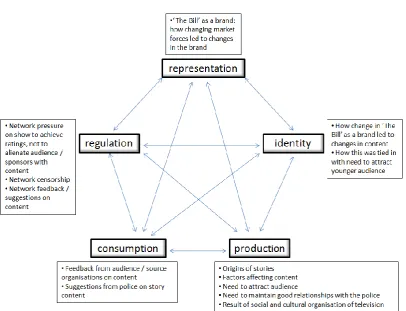
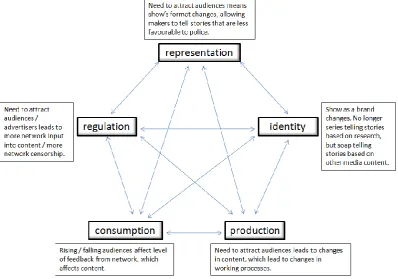
Figure 3.1 Roles in the story development process 92 Figure 3.2 Chain of command in the story production team 98 Figure 4.1 Theoretical framework for my thesis, based on Du Gay et al.’s (1997) interpretation of
the “circuit of culture” 127
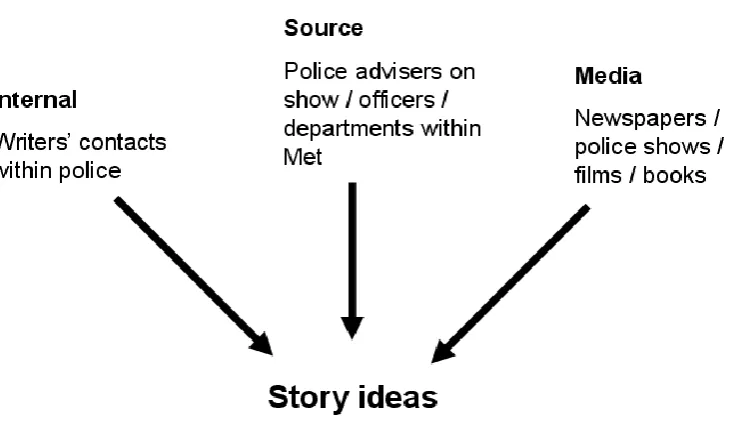
Figure 4.2 Origins of stories for the show 129
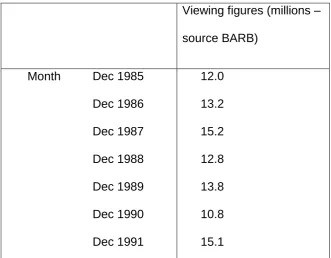
Figure 4.3 Viewing figures 142
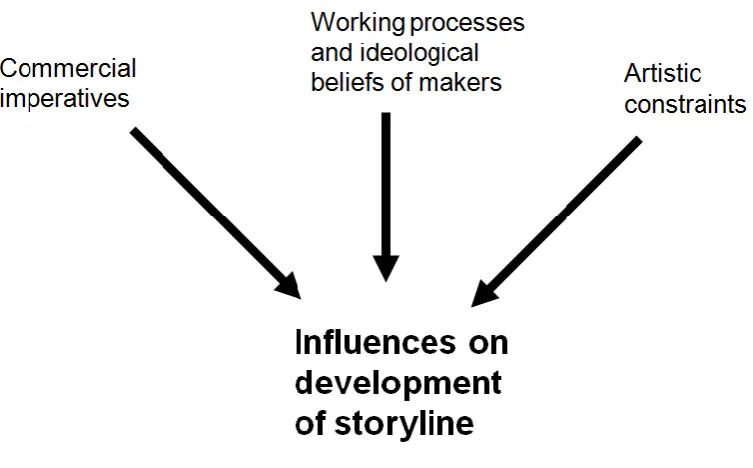
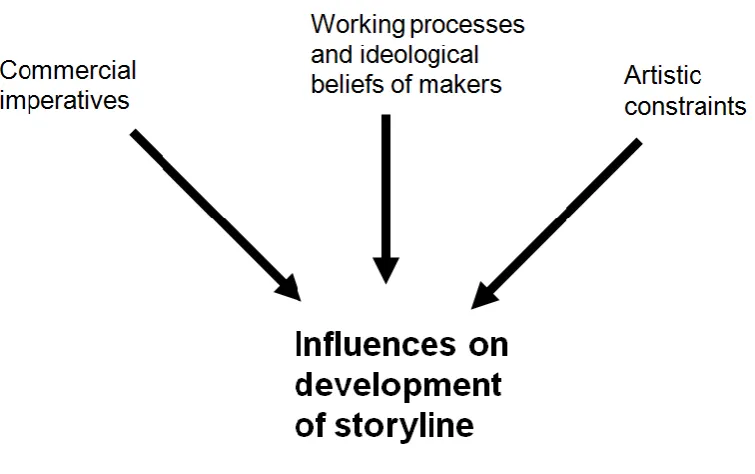
Figure 5.1 Sets of factors affecting the development of story-lines on The Bill 161 Figure 5.2 The development of story-lines on The Bill based on Du Gay et al.’s (1997)
Page 11 of 312
Outline of chapters
In Chapter One, I outline my research and reasons for choosing to study production processes on a popular television drama. I examine the importance of mass media images of policing in society and describe my reasons for choosing The Bill as a case study. I review the existing literature on the representation of the police, crime and criminals in media narratives as well as research on production processes in news and television and conclude by identifying how my research might extend the existing literature in this field. Finally, I discuss the work of Hall (1980) and Johnson (1986) and how I will draw on Johnson‟s concept of the “circuit of culture” to analyse my findings.
In Chapter Two, I discuss the methods employed in my study and my reasons for choosing a “mixed methods” approach, combining the exploratory nature of ethnography with interviews and focus groups. I describe my experience of gaining access to the field and my fieldwork. I conclude by discussing the ethical implications of my research and the
difficulties of ensuring anonymity, when researching a world in which many of the participants are easily identifiable.
Page 12 of 312 dwindling audiences and how these, in turn, also changed working
processes in terms of the creation and development of stories. Finally, I discuss how these changes had a huge impact on the culture of those involved in that process.
In Chapter Four, I analyse the origins of story ideas for scripts on The Bill. I note that, in the early years of the show, writers derived story material from contacts they had made in other forces, conversations they had with officers, contacts they made through the show‟s police advisers, going out on patrol with officers, spending time shadowing police work in specialist units and from magazine articles or news reports. I note that, in the last ten years of the show‟s history, stories were instead generated by an in-house production team of four or five story editors, with stories being based on other media sources, particularly other police shows. I argue that this resulted in the creation of “media loops”, recycling ideas and themes from other shows, and in an increasingly distorted, inaccurate and controversial depiction of policing on the show.
In Chapter Five, I discuss the process of developing storylines on The Bill
and, in particular, how various contingent, complex and interlocking factors – namely commercial imperatives, working processes and ideological beliefs of those involved in the creative process, and artistic constraints – all played a part in determining how and what kind of stories about the police could be told on the show.
Page 13 of 312 major story-line or narrative from the initial idea to final script. I describe how this story-line was created and, in particular, I look more closely at how commercial imperatives, working processes and ideological beliefs of those involved in the creative process, and the constraints of the format influenced the decision-making process on a daily basis in the creation of story-lines. In Chapter Seven, I discuss officers‟ perceptions of how fictional
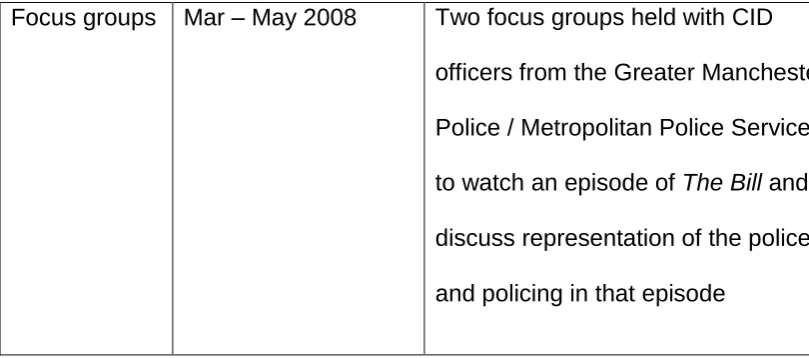
representations of police work may shape public understanding and knowledge of policing, based on findings from two focus groups held with officers from the Greater Manchester Police and the Metropolitan Police Service. I look firstly at police perceptions of mass media images of policing and how these affect police work and the public‟s treatment of the police. Secondly, I examine whether police officers from these focus groups perceive mass media images of policing to have an impact on public expectations of the police. Finally, I explore how police officers from the focus groups might wish the police to be represented in crime drama in ways in which, in their opinion, might increase public support.
Page 15 of 312
Chapter One: Introduction
1. Background to the study
The first time I ever had a conversation with a police officer was when I became a scriptwriter for The Bill in 1990. It was standard practice for new writers to spend time at London police stations shadowing police officers, as the executive producer and script editors of the show claimed it was
extremely important for writers to have a good knowledge of the world they would be writing about.
I was told to report for an early shift at Bethnal Green in the East End of London. My guide for the day was a young Asian female officer who showed me round the station and then took me out in one of the patrol cars with another colleague so that I could start to get a sense of the scope of police officers‟ activities during an average shift.
What was so striking about my first day with the police was how familiar and yet unfamiliar the sights and sounds of this new world were. The offices, the cells, the dispatch room, the endless corridors, the banter, the sense of hierarchy, the camaraderie, the black humour … all these seemed as though I had seen them a million times before – which, of course, I had, in television crime series and police films throughout my adolescence and my early
twenties. But what was unfamiliar were the things I had rarely seen in films or drama series – the tedium of driving round and round the streets of Bethnal Green waiting for a call, the lack of dramatic car chases or grappling
Page 16 of 312 the police were called upon to do: dealing with a confused old lady who had locked herself out, a young man discharged on a Friday afternoon into the community after months on a psychiatric ward, finding himself without gas or electricity and causing a disturbance in order to get help. I observed at first-hand how, contrary to the images I was so familiar with from television
drama, the police operate primarily not as crime-fighters or law-enforcers but as providers of a twenty-four hour emergency service available to respond to those in need (Cumming et al. 1965; Bittner 1967; Bayley 1994; Reiner 2000b).
Page 17 of 312 but there have been no studies to date of the production processes of
television police dramas.
This thesis is, I believe, the first criminological study to investigate the
production of police fiction, following other studies of news-making. My study is a detailed ethnography of production processes on the long running
television drama, The Bill.
As Becker (2007) argues, any representation about society, whether a film, a novel or a police series, makes most sense:
“… when you see them in an organizational context, as activities, as ways some people tell what they know to other people who want to know it, as organized activities shaped by the joint efforts of everyone concerned” (Becker 2007, p. 15)
Although many production studies are framed in a “tripartite” structure or an integrated theoretical framework, which seeks to understand the complex relationships between media production, media texts and audience reception (Henderson 2007), the aim of my thesis is to explore the process of
storytelling on The Bill in an organisational context. In particular, I wish to explore how commercial imperatives, the ideological frames of the creative personnel, working processes and the constraints of the format affected the construction of stories on The Bill and the changing representation of the police on the show. I follow Greer (2010) who points out:
“The study of media content can provide important insights into the role of expressive cultural forms in interpreting our social world and constructing particular versions of reality. But this research is at its richest, and surely has the greatest explanatory potential, when the
Page 18 of 312 For that reason, my thesis will be focused solely on the production process and on the creation of stories on the show.
1.1 Research questions
In order to understand how representations of the police, policing and crime were constructed on The Bill, and how such depictions were affected by the organisational dynamics, ideology and professional imperatives of the personnel and institutions, I decided to ask four main research questions:
1. How was the production process organised in terms of creation of stories? Who was involved in this process? What were their roles? Did these change over time? If so, what impact did these changes have on working processes, working culture and content?
2. How did factors such as organisational pressures, commercial
imperatives, constraints of the medium and ideological values of those involved in the story creation process affect stories about the police, crime and criminals being told on The Bill? Were some factors more important than others and, if so, why? Was this a constant or did this also change over time?
3. How were stories created? What knowledge did the show‟s makers draw on in order to create stories? What made a “good” story? Why were some stories rejected? Why could some stories about the police never be told?
4. How did The Bill‟s makers work with police sources, both serving
officers and the (retired) police advisers who work for the show? What were the benefits for the police in co-operating with the show? How were police advisers recruited? What was their role? Did this changed over time and, if so, why? What influence and sanctions did the police advisers have over stories? How important was authenticity? What steps did the makers of the show take to ensure authenticity? In order to provide some context for this exploratory study, I briefly discuss why mass media images of policing are important in society and my reasons for choosing The Bill as a case study. I then review, firstly, the existing
Page 19 of 312 from the “official” picture painted by statistics and self-report or victimisation studies found in British and American research. Secondly, I discuss the extensive literature on the changing representation of the police in television drama. In both cases, I suggest how my research into production processes extends our understanding of what Reiner (2007) terms the “causes” of media representations. I then review the existing literature on production processes in news and fiction, both empirical and theoretical. I discuss the work of Hall (1980), Johnson (1986) and Du Gay et al. (1997), including the “circuit of culture” (Johnson 1986) in which it is argued that each moment in the circuit of production, circulation and consumption of cultural objects “depends on the others and is indispensable to the whole” (Johnson 1986, p. 284). I then explore how this concept influenced the theoretical framework adopted by Ericson et al. (1987; 1989; 1991) in their study of crime news-making. Finally, I discuss the similarities between the aims of the research undertaken by Ericson et al. (1987; 1989; 1991) and those of my own research, and how I intend to use a similar theoretical framework based on the “circuit of culture” to analyse my findings.
2. The importance of mass media images of policing in
society
Page 20 of 312 police contact is more frequent, police activity is largely restricted to young males. It is rare for middle or upper class people to have any adversarial contact with the police other than for traffic offences (Reiner 1994; 2000b; 2003) yet, as Reiner (2010) points out, “the most crucial sectors for
determining police prestige, power and resources are the majority higher up the social scale” (Reiner 2010, p. 177). For these groups, Reiner (2010) argues that the mass media are the main source of perceptions of and preferences about policing.
There is considerable evidence to bear this out. In the Policing for London
survey, 80% of respondents said that the news media were their principal source of information about the police while 29% of respondents got their information from “media fiction” (Fitzgerald et al. 2002). In the British Crime Survey (2006–7), 59% of people said they got their information from
television and radio news, with 10% citing media fiction. Indeed, as Reiner (2010) suggests, Sir Ian Blair, the former Commissioner of the Metropolitan Police Service, was not entirely joking in his 2005 Dimbleby Lecture on BBC TV when he observed that “lots of people in this country are actually
undertaking a permanent NVQ on policing – it‟s called The Bill”.
Reiner (2010) also suggests that, on occasion, “the media representation of policing feeds back into policing practice” (Reiner 2010, p. 178). As an example, he cites how in 2005, Sir Stephen Lander, the then newly
Page 21 of 312 Agency Will Use the Press to Set Agenda‟ The Independent 10 January 2005).
Thus, mass media images of policing are of considerable importance in terms of shaping people‟s perceptions and knowledge of policing and, on occasion, helping to shape policy and practice. However, the
media-constructed image of policing “does not float free of the actualities of policing, but it is not a mirror image of them either” (Reiner 2010, p. 178). The aim of this thesis is to understand how working processes, organisational dynamics and the ideological frames of the show‟s makers not only conspire to
produce a “refraction of the reality of policing” (Reiner 2010, p. 178) but also determine what aspects of the police role and of police work are omitted from television drama.
3. Reasons for choosing
The Bill
as a case study
I chose The Bill for three reasons. Firstly, the show always placed particular emphasis on procedural accuracy and, for that reason, may have been seen to be particularly influential on audiences in terms of making claims for authenticity (Leishman and Mason 2003). Secondly, because of its frequency, it was possible to portray a much more diverse and broadly representative array of different kinds of police officers and police work than most series or one-off films. Lastly, as I mentioned earlier, I was myself a scriptwriter on The Bill and this gave me unique access to, as well as direct participant experience of, the social world of its production.
Page 22 of 312 Although no studies of the production processes of police drama exist, there is nevertheless a considerable body of literature on the content of police shows. This can be divided into two key areas: firstly, content analyses of patterns of representation of the police, crime and criminals in police dramas and crime films and, secondly, the development of the police procedural (or drama which deals with the everyday work of the police in investigating crime, both by uniformed and non-uniformed officers) as well as the changing presentation of the police over the last fifty years.
4.1 Representation of the police, crime and criminals
A considerable body of work has emerged on the content of images of crime and policing in the entertainment media, both film and television, mostly in the United States. In this country, there has been a major historical analysis of changing representations of crime and criminal justice between 1945 and 1991 in newspapers and film, and between 1955 and 1991 in television (Allen et al. 1998). The authors found that the depiction of the police in all media was represented most positively between 1945 and 1963 but during the middle years of the survey, 1964 to 1979, the image is more negative. These were the years in which a number of major corruption scandals came to light: revelations published by The Times in 1969 on widespread
corruption among CID officers in the Metropolitan Police Service, the Maxwell Confait1 case of 1972, followed by two other corruption scandals involving the Drugs Squad and the Obscene Publications Squad. However,
1
Page 23 of 312 in the last years of the survey, 1980 to 1991, there has been “some recovery in the overall representation of police ethics and efficiency” (Reiner 2000a, p. 60), despite revelations of further abuse of police powers and miscarriages of justice in the late 1980s and early 1990s. Reiner (2000a) concludes that underlying these shifts in representation is a “demystification of authority and law, a change in the conceptualisation of policing and criminal justice from sacred to secular” (Reiner 2000a, p. 62).
In terms of representations of crime, criminals and victims, Reiner (2010) argues that there are significant differences between the characteristics of crime and criminals reported or portrayed by the media and the picture conveyed by official statistics, victimisation or self-report studies (Allen et al.
1998; Reiner et al. 2000; 2001; 2003; Reiner 2007a) – although Reiner adds
the caveat that criminal statistics used to compare with media
representations are, in turn, problematic measures of “truth” (Reiner 2007a).
Three main divergences between the characteristics of crime and criminals reported by the media and the “official” picture painted by statistics and self-report or victimisation studies are found in British and American research.
Page 24 of 312 1990, Mason (1992) found that traffic offences, followed by breach of the peace, were the two most commonly featured crimes on the show.
Secondly, offenders in both American and British television police dramas are depicted as primarily higher-status, white, middle-aged men (Mason 1992; Lichter et al. 1994; Reiner et al. 2000; 2001), unlike their counterparts in official statistics who are predominantly young, from the most marginal socio-economic groups and disproportionately black.2
Finally, another important feature of fictional crime is the high clear-up rate. In Allen et al.’s (1998) sample of crime films since 1945, there were no films before 1952 in which criminals escaped capture and hardly any up to the 1970s in which this was the case. However, thereafter, offenders got away with crimes in an increasing number of films, albeit still a minority. In
American television, Lichter et al. (1994) report a similar pattern – crimes are
generally cleared up by the police but, in a small but significant number of stories, the police do not always “get their man”. In Mason‟s (1992) study of
The Bill, the clear-up rate was 90%.
Reiner (2007b, p. 142) points out that, since the 1970s, there has been an increasing portrayal of police deviance, including a tendency in both film and, more recently, in television on both sides of the Atlantic to show narratives that increasingly justify vigilante-style methods (Reiner 2007b).
2
Page 25 of 312 In the next section, I trace the history of the police procedural – dramas which depict the activities of police officers as they investigate crime – and discuss in more detail some of the social, economic, cultural and
organisational reasons for the changing depictions of the police and policing in television fiction over the last fifty years.
4.2 The development of the police procedural
4.2.1 Representation of the police (1955 – 1970): carers or controllers?
Reiner (1994) argues that, while it is widely assumed that the major function of the police is law enforcement and order maintenance, a central aspect of “the legitimating myth of the British police has been that they are carers rather than controllers” (Reiner 1994, p. 13).
In his 1994 study, The Dialectics of Dixon: the Changing Image of the TV Cop, Reiner suggests that the development of the police series, starting with
Dixon of Dock Green (1955 – 1976), the first major police procedural to be screened in this country, was characterised by a shifting balance between images of the police as carers and controllers. Reiner argues that each shift corresponded to the changing politics of police legitimation and changes in the evolution of the television police series, while Clarke (1986, p. 224) suggests that each shift also reflected changes in public knowledge about policing and changes in public attitudes to the police. As Rafter (2006)
Page 26 of 312 Although Rafter (2006) is talking specifically about American crime films, the same appears applicable to British police dramas. In creating a police drama, media workers are drawing on current knowledge of, and on widespread attitudes to, law, punishment and crime, and then refracting those postures through the generic conventions of television, which in turn are subject to change. Thus, each shift in the British police drama is a development in the genre in terms of storytelling, but also gives an insight into changing attitudes towards policing and law and order.
According to Reiner (1994), Dixon of Dock Green depicted the police above all as “carers” and created a symbolic representation of the “British Bobby” that remains a reference point to this day (Mawby 2003). The show featured working-class police officers who were an integral part of the East-End working class community they patrolled, while the series also presented a much wider conception of the police role than had previously been shown in other fictional depictions of policing, as officers dealt with a whole range of problems experienced by the local public. Dixon‟s image and that of policing were also, as Mawby (2003, p. 220) points out, presented as being at one with the post-war consensus that existed at a time when policing was not perceived as a controversial national issue.
Reiner (1994) argues that the image of the police as carers rather than controllers persisted in Z Cars (1962 – 1978), the next significant police
Page 27 of 312 (1994) cites as being so shocking that the Chief Constable of Lancashire immediately drove straight to London to register a complaint! Although Z Cars caused controversy with senior police officers for its “warts and all
portrayal of the police as adults with personal weaknesses and defects” (Reiner 1994, p. 23), Reiner argues that the police were still seen as working closely with the community, albeit a fragmented one, and that crime was still presented as a result of social problems.
4.2.2 Representation of the police (1970 – 1980): thief-takers and
rule-breakers
In the late 1960s and 1970s, Reiner argues that the image of the police shifted from “carers” to “controllers” (1994, p. 23), with the emergence of shows such as Special Branch (1969 – 1974), The Sweeney (1975 – 1978), The Professionals (1977 – 1983) and Target (1977 – 1978). While Dixon of Dock Green and Z Cars focused on the work of a group of uniformed officers, The Sweeney concentrated on two detectives, Detective Inspector Jack Regan and Detective Sergeant George Carter, who worked for “The Sweeney”, being cockney rhyming slang [Sweeney Todd] for the Flying Squad, a specialist unit operating within the Metropolitan Police Service to prevent armed robberies and investigate serious and organised crime. Reiner (1994) suggests that “the depiction of the police in The Sweeney was the Dixon image on its head” (Reiner 1994, p. 24). The Sweeney was
Page 28 of 312 police series in the 1970s were increasingly situated in a society that was far more critical of the police, following the revelations in the early and mid-1970s of widespread corruption in several specialist squads in the
Metropolitan Police Service, and of police malpractice and abuse of police powers. Both Clarke (1986) and Reiner (1994) argue that changes in representation of the police in The Sweeney were also due to two other sources. These were, firstly, changes in the American crime film genre and the American police series, which in turn influenced British television
professionals and, secondly, changes in the political climate – in particular the advent of law and order politics.
Clarke (1986) argues that the new image of the police officer as rule-breaker, bending the law within certain parameters to bring criminals to justice, had its roots in the Dirty Harry trilogy of films starring Clint Eastwood. The character of Dirty Harry was a San Francisco Police Inspector who had little time for the rules of police conduct, dismissing them as “red tape” and who avenged victims of crime by whatever means necessary, often extra-legal (Rafter 2006). While The Sweeney‟s methods were not as violent as those of Dirty Harry, the image of the police as vigilantes, “breaking the rules of law to
achieve true justice” (Reiner 1994, p. 25), was central to The Sweeney.
Page 29 of 312 crime rates were rising and in which crime increasingly came to be perceived as “the product of evil, not social problems” (Reiner 1994).3
4.2.3 Representation of the police (1980 – 1990): carers and controllers
In 1984, a new police drama, The Bill (1984 – 2010) was screened for the
first time, following the success of a pilot episode, Woodentop, the year before and featuring some of the same characters. Although Reiner (1994, p. 26) describes The Bill in the early days of its history as a “soap opera of the
community and community policing”, he also argues that the depiction of the CID in the show incorporates some of the tough culture of The Sweeney and argues that the police are portrayed as both “carers” and “controllers”.
Leishman and Mason (2003, p. 64) develop this argument and suggest that the images of “care” and “control” are embodied in two of The Bill‟s
characters in the show, Sergeant Cryer, whom they describe as an updated Dixon, with the same concern for the public and his fellow officers and a similarly well-developed moral code, and Detective Inspector Frank Burnside, described as an “anachronism straight out of The Sweeney”
(Leishman and Mason 2003, p. 65). In one of the more memorable episodes in the early 1990s, Burnside flushes a recalcitrant suspect‟s head down the lavatory in order to extract a confession.
Reiner (1994, p. 27) situates the development of the police genre in both changes in law and order politics and changes in the representation of the police in television series. According to Reiner (1994, p. 28), in the
3
By comparison, it is worth noting that, although there had been some changes to police patrol work in terms of the introduction of radios and the patrol car in the 1960s,
Page 30 of 312 1980s, the Conservative government turned away from its reliance on a law and order approach because, despite significant investment in the police, recorded crime continued to rise. Crime prevention in which the public worked as partners with criminal justice professionals became central to policy. In terms of development of the police procedural, Reiner (1994) argues that shows such as Juliet Bravo (1980 – 1985) and The Gentle Touch
(1980 – 1984), both with female officers as their leads, created a new feminine perspective in crime drama and a return to the image of the police as carers (Leishman and Mason 2003).
Although Reiner (1994) argues that the synthesis of the police as carers and controllers is an uneasy one, the presentation of the police during the first fourteen years of The Bill‟s history (1984 – 1998) is by and large favourable,
with the emphasis on the “caring” image of the police (Mason 1992). Any police illegality is either minor and confined to a single character or confined to characters at other neighbouring stations (Mason 1992) and the police are shown as carrying out a necessary social function with integrity and
effectiveness.
4.2.4 Representation of the police (1990 – 1998): carers, controllers or
endemically corrupt?
In the 1990s, Leishman and Mason (2003) argue that the fictional
representation of the police became more political and critical. Ironically, during the 1980s and 1990s, police powers and accountability were
Page 31 of 312 establish a balance between police powers – of stop and search, arrest, detention and interrogation – and suspects‟ rights (Newburn 2009). However, there is inevitably a time-lag between commissioning of scripts and their appearance on screen – in the case of drama series, that time lag may be as great as five or even ten years – so it is inevitable that television depiction of policing may often lag behind “real-life policing”.
A number of dramas emerged during this period that portrayed the police in a more critical light than had previous fictional series. Leishman and Mason (2003) suggest that Prime Suspect (1991 – 2006) was the first key drama to
do this. While previous dramas had looked at the role of the police – carers or controllers, force or service – Prime Suspect and the dramas that followed it in the 1990s were what Eaton (1995, p. 181) describes as “explorations of the underpinnings of the police force”. The first Prime Suspect series (1991) was about a female CID officer, Jane Tennison4, recently promoted to the traditionally male role of Senior Investigating Officer in charge of a murder inquiry team, having not only to prove herself in terms of solving the case but having to overcome the hostility and resentment of her almost exclusively male team (Leishman and Mason 2003, p. 95). Eaton (1995, p. 182) argues that while earlier police series in the 1970s, such as The Sweeney, had raised the need for rule-breaking to get results, Prime Suspect was the first drama to question wholesale “the values that permeate the organisation”.
Prime Suspect dramatised and criticised the “hegemonic masculinity” of
“canteen culture” (Waddington 1999a), characterised by moral conservatism,
4
Page 32 of 312 isolation and action-based machismo (Westley 1970; Cain 1973; Reiner 1978; Chan 1997; Waddington 1999a; Reiner 2000b). The series also dramatised the sexism of “canteen culture” and how women officers were routinely excluded, both from the male officers‟ socialising and from interesting work assignments (Heidensohn 1992; 2003; Brown and Heidensohn 2000).
Between The Lines (1992 – 1994) featured the work of the Metropolitan
Police Service‟s anti-corruption squad, the Complaints Investigation Bureau (CIB), and was the next seminal police drama to emerge in the 1990s. While earlier treatments of police corruption were primarily about the “one bad apple in the barrel” (Mawby 2003), Between The Lines presented what Leishman and Mason (2003) memorably describe as the “apple crumble effect”. The show dealt with the politics of policing in a way not hitherto shown on British television and showed “flexible morality at all levels of the hierarchy from the street cops, through the management cops, to their political overseers” (Leishman 1995, pp. 148–9). Between The Lines
portrayed policing at its most morally ambiguous and constantly raised the question of “whether effective policing can be achieved without a necessary blurring of boundaries between policing and criminality” (Brunsdon 2000, p. 208).
Both Leishman and Mason (2003) and Brunsdon (2000) argue that the next significant sub-genre to emerge in the mid-to-late 1990s was what they term “the medico-detective series” – shows such as Dangerfield (1995 – 1999), Silent Witness (1996 – present) and McCallum (1995 – 1998). These were
Page 33 of 312 working closely with the police and drawing on the terrain of Between The Lines, often at odds with the police and finding that evidence is routinely “doctored”. The emergence of such shows clearly reflected the growth of forensic science in the 1990s and the desire on the part of television programme makers to reflect these changes in police work. But more than that, as Reiner (2010) argues, the fact that detective work is carried out using state-of-the-art technology is a way of “resolving tensions about policing” (Reiner 2010, pp. 193–4). Series such as Between The Lines and Prime Suspect may have raised questions about the police‟s integrity and
trustworthiness, but solving crime through technology and forensic methods resolves these tensions, according to Reiner (2010), by “unequivocally establish[ing] guilt through objective techniques without anything but minimal reactive force” (Reiner 2010, p. 194).
While the 1990s were notable for the new crop of critical and “medico-detective” police drama series, also popular during this period were “nostalgia” series such as Heartbeat (1992 – 2009)set in Yorkshire in the 1960s. Although there was a crime story each week, the emphasis in the storytelling was very much on “the human rather than the organisational or technological resources of the police” (Reiner 2010, p. 199).
Page 34 of 312 featured, while other regular characters began to acquire character flaws and major failings such as drink and drugs addiction (see section 2.2 in Chapter Five for further discussion).
4.2.5 Representation of the police (1998 – present day): fighting a losing
battle and the return of the vigilante cop
McLaughlin (2007) argues there have been three separate directions for the police series genre over the last decade: tales of police officers corrupted by “the job” and fighting a losing battle – The Cops (1998 – 2000), Without Motive (2000); “investigative techno-chic” – Messiah (2001 – present), Wire in The Blood (2002 – present); and “nostalgia” policing – New Tricks (2003 –
present), The Last Detective (2003 – 2007) and Life On Mars (2006 – 2007).
McLaughlin (2007) describes the promotional advertisements for The Cops
as looking like “trailers for a real documentary about the depressing reality of contemporary urban policing” (McLaughlin 2007, p. 107). Focused on a fictional northern town, The Cops shows:
“policing as a remorseless and thankless labour in which officers are continually challenged and compromised, not only by the situations they are placed in and the people they deal with, but also by
management, by colleagues and the circumstances of their personal lives.” (Mawby 2003, p. 224)
As both Mawby (2003) and McLaughlin (2007) comment, the world of The Cops is one of little hope, where social deprivation is the norm and the police, often despised, are helpless.
Page 35 of 312 the “critical” or “alternative” tradition (Rafter 2006, p. 131). Rafter (2006) argues that films in this genre (State of Grace 1990; Bad Lieutenant 1992) depict their police officer protagonists as being profoundly corrupted by the job that they do, “lost souls doomed to wander forever in a maze of cynicism” (Rafter 2006, p. 131). Without Motive (2000), a show devised by one of the co-creators of Between The Lines, explores similar terrain. The premise of the story is simple: a long and tortuous murder investigation of a serial killer over several years and the pressure on the murder investigation team to get a result – any result. However, where Without Motive differs so powerfully from other police “corruption” dramas of this era is that rule-breaking is not seen as a means to justify an end. Instead, the outside pressure exerted on the officers by the public, the media and their bosses to get a result after six years‟ fruitless investigation forces the team to bring charges against a suspect, despite the knowledge that they have insufficient evidence and the series concludes bleakly by showing the personal damage suffered by the officers involved in the case as a result of their rule-breaking.
McLaughlin (2007) also identifies two other major developments in the police genre in the 2000s. Firstly, he argues that dramas such as Messiah and Wire in The Blood continue in the “forensic, psychological, „investigative
techno-chic‟” vein (McLaughlin 2007, p. 112) pioneered by earlier dramas such as
Page 36 of 312 disturbed and ultimately corrupted by the unbearable nature of the crimes they are investigating and the society they are dealing with. At the end of such shows, there is rarely a sense of any moral or social order being restored (Sparks 1992).
McLaughlin (2007) argues that the only escape for viewers during the 2000s was nostalgia and cites the Inspector Morse series. He argues (2007, p. 110) that “nostalgia for policing as craftwork and more comprehensible crime-free times” becomes more apparent in every successive series and Morse is seen to be increasingly distant and more at odds with the rise of bureaucracy within the police force. Other shows that played with the notion of whether past or present policing was preferable include New Tricks (2003 – present)
and Life on Mars (2006 – 2007). Life on Mars is the story of Sam Tyler, a present-day CID officer from the Greater Manchester Police, who is hit by a car while hunting a serial killer and wakes up in 1973. Tyler has to adjust to a world without technology, intelligence-led detective work and any semblance of an ethical approach to policing. The contrast is, as Reiner (2010) puts it, between “the supposedly politically correct PACE rule-bound, scientifically equipped police of today and the corner-cutting, sexist, loud-mouthed but more human Sweeney-model, with the latter ultimately prevailing” (Reiner
2010).
Page 37 of 312 factors have had any impact on a) why the characteristics of crime and
criminals reported by the media differ from the “official” picture painted by statistics and self-report or victimisation studies found in British and American research and b) why representations of the police and policing vary over time.
4.3 Production research
4.3.1 Literature on the production of crime news
Very little literature exists on the production of crime news and, as mentioned earlier, there have been no studies of the production processes involved in creating television police dramas. Indeed, as Greer argues, there seems to be have been a “death of ethnography” in media criminology (Greer 2010, p. 3). There has been some work on the construction of crime news and
relationships between the police and reporters in other countries, including Canada (Ericson et al. 1987; 1989; 1991) and the United States (Motschall and Cao 2002; Lovall 2003; Chermak and Weiss 2005). However, as this is a study about the production of images about the British police, and they differ in important respects from the police in the United States and Canada, I shall review the existing literature in this country in this section, with the exception of Ericson et al.’s study as this is one of the very few ethnographic studies of the process of news-making based on both interviews and observation of journalistic work.
In terms of studies of media production generally – and not just the production of crime news – Devereux (2003) argues that three main
Page 38 of 312 pluralist. The political economy approach (Hesmondhalgh 2005; 2006;
Murdock and Golding 2005) emphasised the importance of economic pressures, such as media ownership, advertising and the structure of the market as influences that shape the content of media texts. The critical theory or neo-Marxist approach examines the extent to which media professionals, knowingly or unknowingly (Elliott 1972; Devereux 2003), engage in the reproduction of dominant ideologies or ideas and values favourable to the politically and economically powerful in society – transmitting a conservative, conformist view of the world and portraying capitalist society in a favourable light (Marsh and Melville 2009). By contrast, the liberal pluralist approach stresses the autonomy of media professionals and that, as a result, media content conveys a vast array of messages, some of which are favourable to the status quo and some of which are not
(Devereux 2003).
One of the earliest studies of the production of crime news in the United Kingdom was Policing The Crisis (Hall et al. 1978), a study of the so-called mugging panic in the early 1970s. Taking a critical or neo-Marxist approach, Hall et al. (1978) argue that time pressures and the need for media
statements wherever possible to be grounded in “„objective‟ and
Page 39 of 312 interpretation of events or subjects that sets the terms of reference for
subsequent debates and discussions.
Hall et al. (1978) also argue that “since the media are institutionally distinct
from other agencies of the state, they do not automatically take their lead from the state” (Hall et al. 1978, p. 65) and add that the media frequently attempt to find out things that primary definers would rather keep quiet.
However, they conclude that the “prevailing tendency of the media is towards the reproduction, amidst all theircontradictions, of the definitions of the
powerful” but a tendency which is “inscribed in the structures and processes of news-making itself” (Hall et al. 1978, pp. 65–6).
However, Hall et al.’s (1978) analysis is not based on empirical work but on readings of media texts and assumptions about media processes of
production. Other studies based on either interviews with media
professionals or observation of production processes take a rather more nuanced approach, drawing on ideas from the political economy and liberal pluralist schools of thought and stressing the importance of economic factors and working relationships between reporters and sources (Ericson et al.
Page 40 of 312 1977, p. 4). However, he also argues that this is not just a result of
journalists‟ dependence on a limited number of sources but that news output is, in fact, the result of a number of complex and contingent factors, which leads, in turn, to the reproduction of ideas and values favourable to the economically and socially powerful:
“The economic contexts within which production takes place, the restricted time period within which the newspaper must be
reproduced, the conventional wisdoms of professional journalism, the largely shared and complementary expectations of editors, sources, colleagues and readers all work towards the creation of the same type of product, which, in turn, recreates the conditions for its reproduction. Today‟s news is processed according to the expectations moulded by yesterday‟s news … the constant recreation and reinforcement of the taken-for-granted frameworks of knowledge production.” (Chibnall 1977, p. 233)
In another interview-based study, Schlesinger and Tumber (1994) examine both the practice of specialist crime reporters and what they term as the media strategies of the sources crime reporters work with in constructing crime news. They also suggest that Hall et al.’s (1978) approach is problematic and that it omits one crucial point – that even among the
privileged elite, there are inequalities of access to the media and competition for space and time in the media by official sources:
“The essentially structuralist approach of Hall et al., … is profoundly
incurious about the processes whereby sources may engage in ideological conflict prior to or contemporaneous with the appearance of „definitions‟ in the media. It therefore tends to ignore questions about how contestations over the presentation of information takes place within institutions and organisations reported by the media, as well as overlooking the concrete strategies pursued as they contend for space and time.” (Schlesinger and Tumber 1994, p. 20)
Similarly, Schlesinger and Tumber (1994) argue that Hall et al.‟s (1978)
Page 41 of 312 the initiative in the definitional process by challenging the so-called primary definers” (Schlesinger and Tumber 1994, p. 19) and cite examples of this, such as scandals inside organisations such as the police, in the world of business or leaks by dissident figures which in turn force what Schlesinger and Tumber term “undesired and unintended official responses” (Schlesinger and Tumber 1994, p. 19).
In the same vein, Mawby (1999) also suggests that the concept of the police as “primary definers” needs re-examination. Using a number of case studies from 1998, he argues against the idea that the police and other authoritative sources always set the news agenda. Innes‟ (1999) study of the ways in which the police seek to use the media as an investigative resource also concludes that “the media is not necessarily a functionary of the police institution, it is a diverse industry with its own set of guiding principles and objectives” (Innes 1999, p. 273).
Page 42 of 312 Finally, Ericson et al.‟s (1987; 1989; 1991) three volume Canadian study
remains one of the few to focus on the news-making process. It draws on both in-depth interviews and ethnographic observation of working processes. Clearly, there are differences between news and fiction – the Oxford English Dictionary defines the former as “newly received or noteworthy information
about events” and the latter as “prose literature describing imaginary events or people” – but there are also many similarities. Like fiction, news is a construction; like the crime writer, journalists “tell stories, as opposed to simply reflecting reality or gathering facts” (Ericson et al. 1987, p. 9). Indeed, as Ericson et al. (1987) argue, “the news process does not entail the
reporting of a self-evident reality”; like the work of the fiction writer, it also “involves using organizational resources and occupational routines of the craft” (Ericson et al. 1987, p. 19) to construct accounts. An understanding of the processes of news-making will also inform an understanding of the processes of constructing fiction and, for that reason, I review this study below, despite the fact that it is not set in a British context.
Ericson et al. (1987) emphasise how commercial imperatives, working processes and constraints of the medium have an impact on how crime stories are chosen, developed or rejected. They argue that the process of news-making constantly narrows what they term the “news aperture” (Ericson et al. 1987, p. 9):
Page 43 of 312 has been edited substantially by the sources and journalists involved previously.” (Ericson et al. 1987, p. 297)
Ericson et al. (1987) suggest that the process of news-making is “fluid and
equivocal” (Ericson et al. 1987, p. 178), that journalists do possess some autonomy and that newsrooms are not characterised by a consensus of norms and values but rather by “ongoing disagreement, tension and conflict between assignment editors and reporters” (Ericson et al. 1987, p. 211). They argue that, while what is broadcast or printed usually is decided by what they term as the dominant ideology of those in power in a particular news setting, journalists are often able to find ways of refusing or avoiding assignments they do not wish to undertake, usually for ideological reasons (Ericson et al. 1987, p. 217). Echoing the findings of British studies, Ericson
et al. (1987) conclude that routine working processes and organisational constraints also in turn lead to journalists reproducing ideas favourable to powerful sections of society:
“The journalist is partial to going where the power is. He goes to the person who is best placed in an organization to give an authoritative version of what appears to be the case. This person may be the least well placed to know about the matter he is asked to address, but that does not matter for the purposes of news and political discourse. What matters is that the chosen source has been authorized politically and bureaucratically to give an account.” (Ericson et al. 1987, p. 360) The result, according to Ericson et al. (1987), is a news output that enacts “a
view of the world that is partial to particular sources and their versions of reality” (Ericson et al. 1987, p. 9).
Having reviewed the existing literature on the production of crime news in this country (and also Ericson et al.‟s work), I now discuss the literature on
Page 44 of 312
4.3.2 Research on the production of television programmes
There is very little information on the processes of production of television fiction, or indeed of television programmes in general, particularly in the British context. There have been studies of particular occupational groups (Tunstall 2002) and studies of an entire organisation (Burns 1977; Born 2005) but very few studies of the production of individual programmes (Elliott 1972; Hobson 1982; Intintoli 1984; Silverstone 1985; Tulloch and Moran 1986; Devereux 1998; Henderson 2007) either in the United Kingdom or in other countries. As Murdock and Halloran (1979) point out, “paradoxically, then, we know the least about the production of the very programmes that are the most popular with the viewers” (Murdock and Halloran 1979, p. 274). Thirty years on, we still know very little about the processes and practices that shape the content of those shows. As there is so little literature, I will review studies not just from this country but also from the United States, Eire and Australia. It should be added that, drawing on my own experience as a soap opera writer in this country5, it seems from the literature that the
process of storytelling on soap operas is fairly consistent in its methods from country to country and over time so, for this reason as well, I include these studies.
Two of the earliest and most in-depth studies of the production process in the United Kingdom focused on documentaries (Elliott 1972; Silverstone 1985). Both studies were based on interviews and in-depth participant observation of working processes over a period of several months, exploring how
commercial imperatives, working processes and constraints of the format
5
Page 45 of 312 helped to shape the final form of documentaries. Both Elliott (1972) and Silverstone (1985) stress that, as a result of these factors, the process of television production is haphazard. As Silverstone (1985) comments:
“There is a certain arbitrariness – a serendipity – at the heart of
documentary practice. Things happen in shot that are not controlled or controllable, contributors perform less well or better than expected, the world out there imposes all kinds of constraints, sets up all kinds of practical political obstacles so that the final film is always a frail compromise, as ephemeral in its statements and judgements as its appearance on the screen.” (Silverstone 1985, p. 165)
He argues that the arbitrariness of television production means that what actually ends up on screen is as often determined “by the availability of a shot as by a clear commitment by the producer to a given line or set of observations” (Silverstone 1985, p. 16).
Elliott‟s (1972) study of the making of a documentary series, The Nature of Prejudice, also stresses the arbitrary quality of the television production process. Looking at the generation of ideas for each of the six programmes in the series, he suggests that the processes by which researchers found people to appear on the programme and source material came from people they already knew or by drawing on what he terms “their experience of a general media culture” (Elliott 1972, p. 146). According to Elliott, this limits “the views of the world” (Elliott 1972, p. 59) transmitted in such programmes. As he puts it:
“Through these various mechanisms a new production draws on the culture of the media, thus ensuring similarity and continuity in the view of the world presented.” (Elliott 1972, p. 146)
Page 46 of 312 invariably maintains consensus and the status quo, is overly simplistic. In his view, those “working in the media are not able to exercise sufficient control over its output to engage in such direct manipulation” (Elliott 1972, p. 165). He goes on to argue:
“This does not mean, however, that nothing is said, that no effect is produced, that no manipulation takes place. What is said is the unplanned product of following accepted production routines within established organisational systems. As a result it must be expected that what is said will in the main be fundamentally supportive of the socio-economic structure of the society in which those organisations are set.” (Elliott 1972, pp. 165–6)
In other words, Elliott (1972) is suggesting that dominant ideologies are being reproduced not as a result simply of media workers‟ dependence on “authoritative sources”, but rather as a result of drawing on limited contacts within the media culture which in turn leads to a recycling of ideas within that culture. This is an idea to which I shall return in my thesis (see Chapters Six and Eight).
In addition to Elliott‟s (1972) and Silverstone‟s (1985) work, there have also been a limited number of studies of production processes in soap operas in Britain, in Australia and in the United States. Soap operas began in the 1930s in America as radio serials, which were sponsored by the giant soap powder manufacturers such as Proctor and Gamble. Those who made them wanted to create programmes that would attract female listeners and allow them at the same time to advertise their products – hence the title (Hobson 1982).
Page 47 of 312 in a motel in the Midlands. Although part of her study looks at the roles of those involved in the production of the show, the main emphasis of Hobson‟s work is on audience reception of story-lines and, in particular, how audiences “add their own interpretation and understanding to the programme” (Hobson 1982, p. 170). Similarly, Tulloch and Moran‟s 1986 study of the Australian soap, A Country Practice, also concentrates on how different audiences – in
this case, housewives and schoolchildren – bring their own experiences to bear in watching a programme and interpret programmes differently as a result of those experiences.
An American study by Intintoli (1984) of the soap opera, Guiding Light, does look in depth at production processes on the show and takes a political economy approach to analysing findings. The study is based on interviews and limited observation of the filming process but not of story development. He argues that the “ultimate consideration in creating and selecting stories is that they garner and keep a sufficiently large and demographically
appropriate audience” (Intintoli 1984) – “appropriate”, in this context, meaning attractive to prospective advertisers and sponsors of the show. However, as Intintoli (1984) observes, a basic characteristic of production for large mass markets is uncertainty as to whether shows will actually be
Page 48 of 312 Intintoli argues that another way in which makers of soap operas attempt to attract or indeed retain audiences is to avoid potentially controversial
subjects – which, at the time he was writing, included “child beating, wife beating, incest and homosexuality” (Intintoli 1984, p. 233). He suggests that the soap opera genre is characterised by stories about community and
relationships between families and friends and, for that reason, subjects such as domestic violence or incest might be seen “to tear at the fabric of
community itself” (Intintoli 1984, p. 233). However, he argues that as a result of these practices and factors, the world as presented in soap operas
“provides a restricted and repetitive frame for experience and a very narrow view of social life” (Intintoli 1984).
A study by Devereux (1998) on how poverty and unemployment are represented in Radio Telefis Eireann (RTE)‟s factual and fictional
programmes also argues that soap operas present “a very narrow view of social life”. Devereux‟s (1998) study draws on a critical/neo-Marxist approach to analyse his findings and, like Intintoli‟s (1984) work, is based on interviews and limited observation of production practices. His starting point is to
Page 49 of 312 involved in making the show and, in particular, the personal ideology of the executive producer who possessed a final veto on the show‟s content.
By contrast, Henderson‟s (2007) study examines the ways in which three controversial social issues – the topics of breast cancer, child abuse and mental health – were represented on three British soap operas, Emmerdale, Coronation Street and Brookside. Taking a political economy approach, her study is not based on observation but on interviews. She argues that
commercial imperatives were the driving force in all cases behind the decision on these shows to feature these issues for the first time in British soap opera. By contrast to Devereux‟s (1998) findings that potentially
controversial story-lines were generally avoided on Glenroe for fear of losing viewers, Henderson discusses how the decision to run a sexual abuse story on Emmerdale was part of a deliberate strategy to attract a new audience. As one of her interviewees stated:
“The programme had an imperative over the last few years to change its audience profile which was fairly old … with a strong base in Yorkshire. The result was to try to change that audience. To get a younger audience … and a greater following in London and the south-east which is where the money is. Advertisers are not interested in advertising to 65-year-olds … who live in Yorkshire. It‟s simply not of interest to them, and that‟s a fact of life” (quoted in Henderson 2007, p. 62).
Page 50 of 312 Mandy, her two daughters, Beth and Rachel and their abusive father, Trevor – that culminated in Trevor‟s murder was also introduced as a way to
“kickstart waning audience interest” (Henderson 2007, p. 64). However, although she emphasises the importance of commercial imperatives in creating and developing story ideas in soap opera, unlike Intintoli‟s (1984) and Devereux‟s (1998) studies, Henderson (2007) also explores “how the availability of actors, the restrictions of sets and other bureaucratic or technical limitations” (Henderson 2007, p. 73) act as constraints on the storytelling process. As an example, Henderson (2007) cites how the sudden sacking of the actress who played the abused teenager, Beth Jordache, had a huge effect on the story-line and, indeed, triggered a furore among
women‟s groups when the news was announced. After her mother‟s murder of her father, Beth helped Mandy to bury Trevor Jordache under the patio in their garden and when the police subsequently discovered the body, both Mandy and Beth Jordache were sent to prison. However, the announcement that the actress who played Beth was to be sacked resulted in speculation in the press that Beth would commit suicide in prison as an “exit” story. This in turn resulted in demonstrations outside the offices of Channel 4, the
broadcasters of Brookside, by members of incest survivors‟ groups. In an
interview with Henderson, one of the demonstrators expressed her concern: “Beth had portrayed this really strong survivor … And then all of a sudden, somebody, somewhere, and I feel very insensitively, decided she would hang herself in prison so they‟re saying to us as survivors, „You‟re always the victim, you never survive‟.” (quoted in Henderson 2007, p. 72)
Page 51 of 312 shape the development of a social issue story-line, issues such as the
availability or otherwise of actors may result in such a story-line being abandoned prematurely.
Although these later studies of production processes have mainly been interview-based, my research draws both on interviews with those involved in the process of story creation and on an observation of working processes. My aims in this thesis will be, firstly, to add to the limited body of knowledge that exists on the production of television drama but, secondly, also to address the question: how much control do media workers in television drama have over the content of these shows?
5. Theoretical framework for the thesis
Greer (2010) argues that, despite a number of groundbreaking
interdisciplinary studies in the 1960s and 1970s, media criminology has come to be characterised by a lack of attention to the methods and theory used by key cultural theorists, to the extent that “serious theoretical and methodological engagement with the rapidly changing media side of the crime-media relationship has become increasingly rare” (Greer 2010, p. 2). He suggests that this has led to most media criminology being founded on a partial theorisation of the crime-me