LONDON SCHOOL OF ECONOMICS AND POLITICAL SCIENCE
Discursive intersections
of newspapers and policy
elites:
A
CASE STUDY OF GENETICALLY MODIFIED FOOD
IN BRITAIN
,
1996-2000
ANITA HOWARTH 5/1/2012
1
Declaration
I certify that the thesis I have presented for examination for the MPhil/PhD degree of the London School of Economics and Political Science is solely my own work other than where I have clearly indicated that it is the work of others (in which case the extent of any work carried out jointly by me and any other person is clearly identified in it).
The copyright of this thesis rests with the author. Quotation from it is permitted, provided that full acknowledgement is made. This thesis may not be reproduced without the prior written consent of the author.
I warrant that this authorization does not, to the best of my belief, infringe the rights of any third party.
2
Acknowledgements
This PhD is dedicated to my parents who taught me to love knowledge for its own sake; the virtues of hard work and persistence; and to make the most of educational opportunities that I have had but they and millions of others have not.
I also owe much to various supervisors who have helped me translate the vision of this project into a reality. Here I owe a particular debt of gratitude to Lilie Chouliaraki who taught me to love theory, to overcome my fears of discourse analysis and to enjoy the richness of understanding that it elicits. She also showed me what constitutes excellent, professional supervision.
I would like to thank my colleagues at Kingston University, the past and present occupants of the PhD room at LSE, Yasmin Ibrahim and other friends who have struggled and celebrated with me the little and big achievements along the way.
3
Abstract
This thesis explores the under-researched terrain of policy elite-newspaper engagements and in so doing makes a substantive contribution in formulating an original conceptual framework for understanding how the interactional dynamics of the political-media complex work. This framework is then applied to the GM food row in Britain by asking how contestation emerged, was sustained then subsided in the political-media complex. This reconstructs the processes by which the pro-GM government consensus was challenged by newspapers, conflict escalated to fever pitch, threatening policy elite agenda and was finally negotiated through key compromises.
Drawing on a theoretical framework that combines participatory politics, the political-media complex and new risks, the thesis conceptualises interactional dynamics as ‘discursive intersections’. These are shifts in claims and counter-claims that emerge during engagement at the interface of different sets of knowledge, cultures and agenda in the political-media complex. However there is an element of unpredictability in discursive intersections that arises from the paradoxical interdependence-independence of the relationship in the political-media complex; the elective and episodic nature of engagement on particular issues; and the variable form this may take with potential for conflict, negotiation or consensus. Historical and wider argumentative contexts are crucial to how and what form engagement takes place but do not define it. Thus, the trajectory of discursive intersections needs to be explored empirically rather than predetermined theoretically. This is done using a hybrid methodology that draws attention to the dialogical, persuasive nature of discursive intersections. The substantive contribution of the research is the formulating of this alternative framework for the analysis of interactional dynamics and its application to the GM food row in Britain.
It does this by exploring how – that is the process in which - engagement emerged, escalated into contestation, was negotiated and then subsided. What emerged were the following findings.
(1) Parallel, sustained and conflictual systems of argumentation about risk were developed between media and political elites despite elite consensus, abstract debates and short news cycles.
4
(3) Elite responses to this were shaped by New Labour-style, neo-liberal hegemonies within a new repertoire of entrepreneurial managerialism. This was manifest in the recognition of the importance of limited consumer agency and new forms of (functional) participatory governance. These sought to depoliticize and decentralize food safety but within mechanisms intended to safeguard strategic technologies such as GM food.
(4) The negotiation and subsiding of conflict over GM food emerged out of a common neo-liberal paradigm, newspaper ambivalence and elite desperation to neutralize the threat to their innovation-based agenda.
5
TABLE OF CONTENTS
CHAPTER 1: INTRODUCTION 12
Criteria and critique of existing literature 15
Theoretical and analytical choices: An alternative location and framework 17
The political–media complex 17
New risks 17
Participatory newspapers and participatory governance 19
Discursive intersections – a unique analytical framework 21
Methodological rationale and research design 23
Parameters, limitations and contributions 27
Thesis structure 30
CHAPTER 2: THE WEAKEST LINK – MEDIA AND GOVERNMENT INTERACTIONS
IN EXISTING STUDIES 31
Introduction 31
Selection and qualification 32
Media-centric frameworks: moral panics and SARF 33
Moral panic frameworks and questions as to their relevance 34 Transmission approaches: Interactions as the missing concept in SARF 37
From moral panics and SARF to new risks 39
Policy-centric frameworks: advocacy versus discourse coalitions 40
Advocacy Coalition Framework (ACF) 41
Discourse-based coalitions 43
A critical, comparative evaluation of advocacy and discourse coalitions 46
Biotechnology/GM specific frameworks: cultivation analysis framework 46
Towards an alternative framework 51
CHAPTER 3: CONCEPTUALIZING MEDIA–ELITE DISCURSIVE INTERSECTIONS 53
Introduction 53
The political-media complex, new risks and participatory politics 53 The political–media complex: an interactionist perspective 54
New risks and definitional struggles 59
Participatory media, participatory governance 61
Summary 63
Discourse, power and change 64
Discourse theory: dialogical and argumentative, dialectical and critical 65
6
Power and discursive change 70
An analytical framework of discursive intersections 72
Engagement 72
Problematization 73
Contestation 74
Behavioural actions 74
Original contributions 75
CHAPTER 4: A METHODOLOGICAL APPROACH TO DISCURSIVE
INTERSECTIONS 77
Introduction 77
Devising a methodological approach to discursive intersections 78
From research location to methodological premises 78
A research strategy for capturing discursive intersections 79 A historical–institutional case study of a risk controversy 80
Why a case study of GM food? 80
Why history? Why institutional contexts? Why argumentative contexts? 83
Which policy and newspaper actors 84
From conceptualization to methodology: operationalizing uncertainty 86
Methodological framework – how the data was collected 87
An alternative qualitative approach of CDA–rhetorical analysis 88
CDA–rhetorical analysis: methodological tools 89
Validity of the overall approach and research strategy 91
From corpus construction to purposive sampling 92
Operationalizing engagement and discursive intersections 95
Data collection: parallel and synchronous processes of data analysis 97
Intersectional analysis: credibility and contributions 98
Methodological contributions 99
CHAPTER 5: POLICY ELITES: FROM PRE-PROBLEMATIZATION TO
PROBLEMATIZATION (1996-1998) 100
Introduction 100
Pre-problematization and emerging policy 103
The argumentative context 103
The formalization of policy: the White Paper (1989) and Food Safety Act (1990) 105 Existing elite hegemonies, systemic hindrances and consumer threats 106 The ‘solution’: ministerial control and formalizing technocratic processes 107
Argumentative strategy: legitimacy and competing agendas 107
The emergence of an elite repertoire and the potential for future conflict 109
Summary 109
New Labour and a discursive shift to entrepreneurial managerialism 110
Argumentative context 110
Britain’s first GM food product: a ‘successful’ launch 111
Escalating controversy over BSE/CjD 112
The general election of 1997 and New Labour’s ‘radical solution’ 113
A critical analysis of key New Labour discourses 113
7
Elite problematization of institutional failure and ‘crisis of public confidence’ 115 The ‘solution’: a proposed shift to new forms of governance 115
A limited acknowledgement of scientific uncertainty 116
A new argumentative strategy 118
Summary 118
Problematization: responding to discursive challenges 119
Argumentative context 119
A critical analysis of crisis discourses 121
The application of the ‘competitiveness’ agenda to biotechnology 122
The problematization of an escalating row over GM food 122
The ‘solution’: a multi-dimensional response 123
Argumentative strategy and potential for contestation 125
Conclusion 125
CHAPTER 6: NEWSPAPER ENGAGEMENT AND PROBLEMATIZATION – 1996 TO
1998 129
Introduction 129
Background: food scares and the launch of GM food 131
The broader argumentative context: elite hegemony and the rise of alternative voices 132 Polarization of labelling debates and increased direct action 134 Initial newspaper engagement with GM food: 1996 to mid-1998 136
Two critical interventions and escalating contestation 137
Contextualizing the interventions of Prince Charles and Professor Pusztai 138 Prince Charles: the voice of moral authority, moderation and lay reason 140
Professor Pusztai: the ‘independent’ expert-consumer 144
Mounting momentum and escalating contestation 147
Conclusion 152
CHAPTER 7: ESCALATING POLICY ELITE CONTESTATION – BLAIR ENTERS
THE FRAY (1999–2000) 155
Introduction 155
Escalating uncertainty and challenges in the argumentative context 156
Sites of contestation: scientific uncertainty 156
Sites of contestation: arguments over public uncertainty 158
Sites of contestation: time for the public intervention of the prime minister 158
Escalating contestation: Blair enters the fray 159
Recasting the minimalist argument as a ‘national interest’ discourse 160 Rejection of a ban, counter-attack on campaigning newspapers 160 A response to the problematization of media ‘scaremongering’: an action discourse 161
In defence of entrepreneurial managerialism 162
The management of expert advice: the case of English Nature 163
Summary 165
Reviews: a new discourse of participatory governance 165
Moving towards accommodation 166
From problematization to principles of a regulatory framework 167
From secrecy to transparency 169
Strategic and participatory governance 169
8
Summary 172
Negotiation: the unresolved issue of uncertain, contested science 173 The argumentative context: towards a moratorium and ‘stakeholder dialogue’ 173
Biotechnology industry moves towards truce talks 174
The new FSA 174
Blair intervenes again: an admission of uncertain, contested science 176
‘The jury is out’: an acknowledgement of uncertainty 177
Conclusion 177
CHAPTER 8: NEWSPAPER CAMPAIGNS (1999-2000) 182
Introduction 182
Argumentative context 184
The process of escalation: entrenching newspaper positions 185 Bolstering maximalist arguments with ‘evidence’ and legitimacy 185
English Nature and the launch of newspaper campaigns 187
Consolidation of resistance in behavioural actions 188
Maximalist campaign objectives 188
The newspaper campaigns: a detailed analysis 190
The campaign imperative and dynamics 191
Discourses of undue access, policy failure and past experience 192
The campaign agenda 195
Newspaper responses to retailer boycotts and a moratorium 196
Labelling and retailer boycotts 196
A ‘voluntary’ moratorium 199
Towards an uneasy truce on scientific uncertainty 201
Postscript 204
Conclusion 204
CHAPTER 9: CONCLUSION 208
Introduction 208
Theorizing engagements in conditions of uncertainty 211
The political–media complex 211
New risks and radical uncertainty 213
Participatory politics: campaigns and participatory governance 214 From theoretical to analytical framework and empirical agenda 216
Discursive intersections: the interactional dynamics of the political–media complex 217
Key findings 218
Parallel systems of argumentation 219
Campaigns and the emergence of an intractable controversy 221
Negotiation, subsiding contestation and assimilation 223
Argumentative context 225
9
Limitations and reflexivity 229
APPENDIX 1: GLOSSARY OF KEY TERMS 229
APPENDIX 2: RESEARCH FRAMEWORK 236
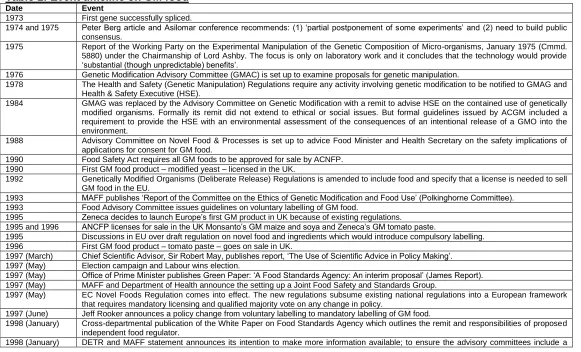
APPENDIX 3: CHRONOLOGY OF EVENTS 238
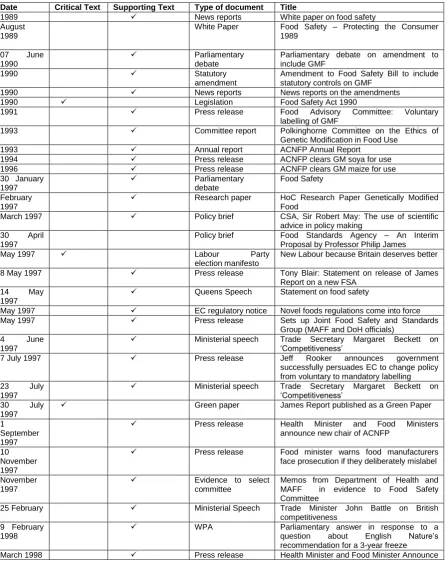
APPENDIX 4: POLICY CORPUS (1989–2000) 241
APPENDIX 5: POLICY EXTRACTS USED IN CHAPTERS 5 AND 7 244
APPENDIX 6: NEWSPAPER EXTRACTS USED IN CHAPTERS 6 AND 8 256
APPENDIX 7: SHIFTS IN THE INTENSITY OF MEDIA COVERAGE 270
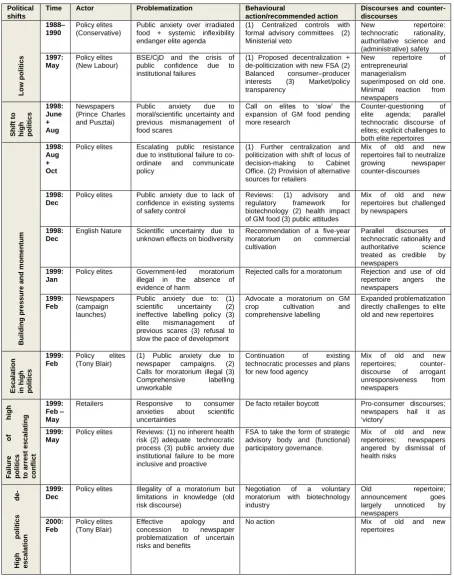
APPENDIX 8: EMPIRICAL FINDINGS 272
12
Chapter 1: Introduction
Studies have explored media coverage of policy but little work has been done on the implications of this for the ‘substance of political decisions’ (Koch-Baumgartner & Voltmer, 2010: 1) or vice versa. The consequence is that 80 years after Lasswell (1927, 1942, 1951a, 1951b) first started writing about communication and policy, little progress has been made on understanding the interactional dynamics between the two. This shortfall is even more surprising today given the prominence of mass media, the pervasiveness of policy over nearly every aspect of everyday life, the nature of mass-mediated politics (see Meyer, 2002; Page, 1996) and the institutionalization of media monitoring by the British government after 1997 (Heffernan 2006).1 The manifestation of this knowledge gap can be seen in studies of risk interactions with their asymmetrical privileging of one at the expense of the other and predilection for out-dated, reductionist assumptions about linear, hierarchical and non-persuasive communication (see Chapter 2). Here, other reviews have noted a lack of engagement between risk studies and media studies of risk whereby ‘reconstructions of public discourse and the media tend to neglect institutional and organization historical changes within the media and … how this impacts or is intertwined with risk reporting’ (Tullock & Zinn 2011 p.2). This thesis sets out to explore this under-researched terrain in policy elite–newspaper engagements over risks. In the process it makes a substantive contribution by formulating a unique conceptual framework – discursive intersections – for understanding how the interactional dynamics of the political–media complex work. Discursive intersections as defined in this research is concerned with institutionally-grounded shifts in claims and counter-claims that take place during engagement in the political–media complex. The conceptualization of discursive intersections is:
(1) Housed in a tripartite theoretical framework comprising the political-media complex (Swanson, 1997), new risks (Beck, 1992) and participatory politics (Teorell, 2006).
Footnotes
1
13
(2) Rooted in a hybrid discourse theory which combines the persuasive dimensions of Billig (1987) with the criticality of Fairclough (1992) to facilitate the empirical2 capture of shifting claims and counter-claims during engagement in the political-media complex.
(3) Concerned to direct attention to the critical question of how a particular form of media-government engagement emerged, was sustained and was then
negotiated.
This framework is then applied to a critical case study of intense policy elite–newspaper contestation: that of GM food in Britain between 1996 and 2000. The rationale for the selection of an extreme case such as GM food is that it would throw into sharp relief elements of engagement that might in less extreme cases be more subtle, and so difficult to discern. What emerged first was an evolving controversy that prepared for the emergence of a ‘grand narrative’ of GM food in which policy elite-newspaper contestation was a crucial driver. Second, what also emerged were critical insights into and a framework for the analysis of the interactional dynamics of the political–media complex in other cases.
The ‘grand narrative’ is of an initially successful launch of Europe’s first genetically modified (GM) food3 product in Britain in 1996, in spite of deep newspaper distrust and a ‘crisis of public confidence’ in elite management of food safety controls but which turned controversial and conflictual. There was a pro-GM consensus amongst the policy elite
2
Here I argue that discourse can be understood as a social phenomenon expressed in text and action. If we take empirical to mean the source of any object of study then the analysis of discourse (texts) becomes a legitimate inquiry irrespective of whether the texts are written (policy or media) documents or oral (interviews or recordings). The turn in the social sciences to discourse or argumentation has been discussed by Fairclough (1992); in policy studies by Fischer (1998, 2003c); and the methodological implications and criteria by which they can be assessed by Bauer and Gaskell (2003).
3
14
and broadly across Westminster; newspaper coverage was sporadic, fragmented and ambivalent towards the novel food; and retailers claimed that consumer sales were good. This changed in mid-1998. Critical interventions by Prince Charles and Professor Arpád Pusztai tapped into submerged doubts about the novel food and opened a parallel system of argumentation in which newspapers were able to challenge the elite consensus. Newspapers re-positioned themselves with the anti-GM ‘camp’, their engagement intensified and its content increasingly diverged and conflicted with that of policy elites. Although sales of GM food collapsed and societal opposition escalated, the elites continued to justify their pro-GM policies with discourses that had already been discredited during the BSE/CjD crisis.
Within six months, four newspaper campaigns had been launched to mobilize readers and influence policy change. Prime Minister Tony Blair counter-attacked the campaigning newspapers, accusing them of misinformation and fictionalized scaremongering. Rather than discredit the newspapers, this only gave added momentum to their campaign: societal resistance expanded and high street names announced a de facto retailer boycott to accompany the consumer one. Elites, fearing that mounting opposition to GM food could undermine their neo-liberal agenda and technocratic hegemonies, sought to negotiate compromises. They empowered retailers to decide how to respond to consumer demands and negotiated a five-year voluntary moratorium with the biotechnology industry, whilst Blair apologetically conceded that the science of GM was uncertain. Newspapers claimed a victory and their campaigns against GM food largely subsided. However, the arrangements for the new de-politicized, decentralized Food Standards Agency highlight the extent to which elites had felt threatened by the newspaper-driven escalation of resistance and their determination to insulate the future development of novel food technologies from similar controversies. These new institutions sought to assimilate future resistance into a wider neo-liberal, capitalist paradigm; however, the measures taken illustrate the traces the GM food controversy left in the institutional processes, practices and discourses that followed.
15
and methodologically problematic for reasons that are explored in Chapter 2. The rest of the present chapter briefly outlines the rationale and choices that underpinned the selection and use of existing potentially relevant literature, the devising of the conceptual framework, methodology and the research parameters.
Criteria and critique of existing literature
The main challenge of this project is that the research is caught between, on the one hand, voluminous bodies of potentially relevant literature on media, public policy and risk and, on the other hand, a paucity of studies that deal with or can potentially deal with the interactional dynamics of all three at a substantive level. Two criteria that support the research focus and case study in this project were used to select the literature for evaluation: that it potentially affords both key roles in risk debates, and that it has the potential to be adapted to support an analysis of interactional dynamics between them. These criteria lead to a focus on five theoretical strands in the literature that are potentially relevant:
(1) Media-centric frameworks: (a) moral panic thesis and (b) social amplification of risk (SARF);
(2) Policy-centric frameworks: (a) advocacy coalitions and (b) discourse coalitions; and
(3) Biotechnology/GM food specific frameworks: social representation-cultivation analysis.
16
(social representation and advocacy coalition), thereby obstructing an understanding of interactions as dynamic.
Most promising for the capture of interactional dynamics were the constructionist approaches: moral panic and discourse advocacy coalition. They point towards a useful conceptualization of interactions as dialectical, dialogical and persuasive, and so capable of capturing the shifting claims and counter-claims that lie at the centre of interactional dynamics. They also offer an alternative to the relatively rigid compare-contrast-converge analyses of positivist-informed quantitative approaches, which are ill-equipped to capture these shifts (see discussion of SARF, advocacy coalitions and social representations in Chapter 2). Despite the advantages of discursive methodologies used in moral panic and discourse advocacy coalition, they have been dismissed for the reasons outlined above. Thus it is clear that a unique theoretical and conceptual framework needs to be devised to support a discursive methodology for the analysis of interactional dynamics.
17
Theoretical and analytical choices: An alternative location and
framework
The theoretical framework emerged out of the need identified in critiques of existing literature of risk interactions for one that is symmetrical in the sense of affording equal attention to both media and government; that draws on a more sophisticated understanding of the institutional dimensions of both and their interactions; and conceptualizes these as discursive. What emerged was a macro-institutional framework comprising the political-media complex (Swanson, 1997), new risks (Beck, 1992) and participatory politics (Teorell, 2006).
The political–media complex
A framework based on the political–media complex addresses the problem of asymmetry and problematic, out-dated understandings of the inter-relationship by giving equal attention to both and locating engagements within a historically located, institutionally-grounded relationship. The relationship is characterized as one of a paradoxical interdependence-independence at the interface of different knowledges, cultures and agendas, from which arises the potential for conflict, consensus or negotiation (Deacon & Golding, 1994; Swanson, 1997; Voltmer, 2006). Thus, the relationship dynamics provide an imperative for engagement but do not prescribe whether, when, how or in what form it may occur, leaving this open to empirical analysis rather than theoretical predetermination. This means that, on the one hand, the framework acknowledges a degree of unpredictability about the emergence, nature and trajectory of discursive intersections in the political-media complex. On the other hand, it recognizes that these are shaped by and shape the institutional particularities of media and government at a given moment in time. It also means that how contestation emerged, was sustained and was then negotiated is a critical empirical question that to date has been largely unexplored in studies of risk interaction.
New risks
18
different from ‘old risks’ in ways that generate radical uncertainty (Beck, 1992, see also Wilkinson, 2000). This uncertainty arises from constructions of new risks as pervasive, proximate and invisible, that present unknown effects and potentially catastrophic, unlimited consequences that cannot be managed (Beck, 1992). The role of the media is to ‘spotlight’ the uncertainties (Beck, 1992; Cottle, 1998); the role of government is to manage new risks while lacking the knowledge to do so (Giddens, 1998) hence their attempts to ‘veil’ these discursively (Beck, 1992). Media–government engagement, therefore, is central to the escalation of controversy over new risks, and it has the potential to take the form of definitional struggles over the problems presented by new risk uncertainties and fundamental disagreements over knowledge, values and how to proceed (Beck, 1992; see also Wilkinson, 2000, 2001; Cottle, 1998). These struggles also have the potential to evolve into intractable controversies in which the old strategies for negotiating conflict fail because disagreements are too fundamental and no point of consensus can be found (Pellizzoni, 2003).
The advantages of applying Beck’s new risk theorization (1992) to an analytical framework for discursive intersections over GM food are that it directs attention to the particularities of debates over ‘technological toxins’ (Garland, 2007); it not only affords both media and government equal attention, but also ascribes them particular roles; and locates their engagement as central in the escalation of controversy. It also directs attention to the institutional–discursive nature of engagements and to how divergent, conflictual constructions of the problem of uncertainties are central to this. However, existing research has highlighted how media do not always engage with risk controversies because the abstract nature of the debates does not readily fit with news values; when they do so it is not always in conflict with government (see Kitzinger, 1999). Other studies have highlighted two other obstacles to the conflictual engagement of newspapers. First, media coverage tends to follow elite dissent: thus, where there is elite consensus oppositional media discourses may not emerge (see Kingdon, 2003; Robinson, 2001). Second, discrepancies between short news cycles and long policy ones mean that elites can usually wait for newspaper paroxysms to subside before resuming policy business as usual thereby undermining media potential to influence policy (see Miller, 2001; Reese, Gandy and Grant, 2001; Stromberg, 2001).
19
news cycles. The empirical findings in this research highlight how the negotiation of these depends on the perception of journalists that the phenomenon is emblematic of a deeper disturbance in society, (relatively) unpredictable interventions by credible alternative sources and the use or adaptation of professional mechanisms to concretize risks and sustain coverage. In the absence of these, policy elites are able to draw on old strategies, including certainty claims about no evidence of harm, which are intended to reassure the public and but time for the media engagement to subside.
Participatory newspapers and participatory governance
The analysis of the ability of parts of the media to negotiate these constraints, the form this took and particularities of elite responses to it required the third dimension of the tripartite theoretical framework: that of participatory approaches. These view enhanced public participation as critical to the revitalization of mature democracies; however, the concept is elusive, arising from different rationales and taking different forms (Newman & Clarke, 2009). This thesis is concerned only with those forms most relevant to the case study here: newspaper campaigns and the participatory governance of food safety controls.
20
The advantage of applying participatory theory to newspaper campaigns is that it avoids the presupposition that these are deficient because they signify a departure from the professional ideals of journalistic impartiality and rationality. Instead, it suggests that campaigns are a legitimate form of newspaper intervention, which, normatively speaking, aims to enhance political participation and, operationally speaking, provides a mechanism by which to sustain engagement beyond relatively the short news cycles that obstruct media influence on the ‘substance of policy’ (see Chapters 3 and 8). It also justifies the focus in this research on newspapers whose campaigning capacities are a crucial factor in their ability to set the medium- to long-term media agenda (see McNair, 2000). The focus in this research on newspapers to the exclusion of broadcast media is further justified in that it was printed campaigns that the elites singled out for counter-attack, suggesting it was these they perceived as posing the greatest threat to their agenda (see Chapter 7).
However, there is a challenge in applying participatory approaches to newspaper campaigns in that, first, these frameworks have previously been applied to new media (see Rheingold, 2007) and to media activism (see, Huesca 1995) or community media (Howley, 2005) but not to mainstream media campaigns. Second, media campaigns have been under-researched and under-theorized (see Birks, 2009; Howarth, 2012a; Milne, 2005). One of the contributions of this research is a theorization of newspaper campaigns within a participatory framework. This supports a conceptualization of them as deliberate, self-labelled interventions that take a particular form of sustained engagement constructed around the stated intention to influence policy and mobilize readers thus ensure greater elite responsiveness to public concerns. However, they differ from media activism in that they are concerned with reforming the existing system rather than destabilizing and revolutionizing it; thus there is an inbuilt limit as how far, and on what issues newspapers are willing to campaign.
21
variety of participatory mechanisms not only in science policy domains such as biotechnology but also in urban regeneration and hospital governance (Newman & Clarke, 2007; Thorpe 2010). What is absent from these discussions, however, is any exploration of the role of the media in the shift to participatory mechanisms – a gap all the more puzzling given the extensive literature on New Labour’s pre-occupation with media management (see Scammell, 2000; Stanyer, 2003). The chronology here means it is implausible to claim that the participatory mechanisms of the new Food Standards Agency were the result of newspaper campaigns on GM food, because the ideology had been under development in the Labour Party since the 1980s (see Thorpe, 2010). It is possible to argue, however, based on empirical analysis in Chapter 7 and 8, that the particular form it took – such as the strategic/proactive dimensions and the measures to neutralize the media – did follow from newspaper campaigns. However, this requires empirical analysis.
The empirical analysis in this research brings together participatory newspapers and participatory governance at a particular moment in time in the evolution of the political– media complex and debates over new risks. What the theoretical framework outlined above provides is a macro-institutional approach to interactional dynamics in the political–media complex and informs the research question as to how contestation over the new risks of GM food emerged, was sustained and was negotiated. It also informed the proposition intended to guide the empirical exploration of the case study: that
escalating uncertainty, increased media engagement, divergent and conflictual
problematizations led to media–elite contestation over GM food. However an additional analytical level – that of discursive intersections – needs to be added in order to capture the discursive, dynamic and persuasive dimensions of shifting claims and counter-claim in the empirical material of the study.
Discursive intersections – a unique analytical framework
22
complex and hence the need to explore how contestation emerged, was negotiated and subsided. However, this framework needs a supporting methodology. The literature review (Chapter 2) argues that positivist-quantitative approaches to risk interactions are ill-equipped to explore the dynamic, dialectical and dialogical dimensions implicit in such a question about the processes of interactional dynamics. At best they offer a relatively rigid and linear, hierarchical or non-persuasive notion of argument or controversy that supports compare-contrast-converge analyses. The turn in this research to discursive intersections in the political–media complex offers an original alternative that is capable of addressing the question of how contestation emerged.
The concept of discursive intersections was derived from post-colonial studies, where it refers to discursive changes that emerge from ‘constant negotiation and conflict’ at the interface of different knowledges, agendas and cultures (Nakata, 2004). Its adaptation here to the political–media complex draws on discursive policy studies (see Chapter 2), definitional struggles over risk (see above) and action theory (see Chapter 3). What emerges is a novel discursive intersectional framework that differs from the post-colonial version in that: (1) it is concerned with struggles in the political–media complex over control of the public agenda, problematization of uncertainty and what solutions – or behavioural actions – are deemed most appropriate, and (2) it emphasizes the element of unpredictability in political-media engagements by conceptualizing these as episodic and elective, with potential for conflict, negotiation and consensus.
These distinctions have been further developed into the following analytical categories (see Chapter 3 and Appendix 1 for more detailed accounts):
(1) Engagement – given the (relative) independence of both media and policy elites and the obstacles to it – cannot be assumed but needs to be empirically examined.
(2) Problematization is the process by which issues are discursively re-defined as problems capable of being addressed (Hajer, 1995; Majone, 1989). How a problem is defined circumscribes what solutions – or behavioural actions – are considered, hence the potential for contestation. With new risks, problematization has the potential to centre on uncertainty.
23
(4) Negotiation: Discursive intersections can become a metaphor for intersecting discourses of negotiation when supported by a methodology capable of capturing shifts in claims and counter-claims. When, how and in what form negotiation takes place needs to be empirically explored.
(5) Behavioural actions are non-routinized, deliberate and discrete forms of agency. Boundaries between behavioural action (action) and discursive action (text) are blurred and a matter of emphasis rather than exclusivity. Nonetheless, the distinction is important in that ‘behavioural action’ or the lack of it can signify important elements and shifts in argumentation.
This analytical framework of discursive intersections (summarized in Chart 1) offers a very different understanding of risk interactions to positivist-informed approaches with their linear view of argument, quantitative methodologies and rigid compare-contrast-converge research designs (see Chapter 2). Instead, argument is seen here as dynamic, dialogical, dialectical and persuasive. However, it needs a methodological framework to support it.
Methodological rationale and research design
The review of existing studies in Chapter 2 draws attention to the frequent use of case studies in discursive approaches to risk interactions. This is because case studies facilitate in-depth analysis of the changing nature of multi-faceted phenomenon (Yin, 1994). However, a key issue is the rationale for the selection of the particular case study. The review also draws attention to the particularities of GM food row in Britain in that policy elites had identified it as a strategic technology linked to British national interest, a greater intensity of newspaper engagement than anywhere else and a cultural resonance with evolutionary genetics (see Bauer, 2005). This research argues that two dimensions need to be added. First, there was climate of deep distrust of elite management of food safety and a questioning of the legitimacy of technocratic governance following a decade of food scares. Second, a realignment of the newspaper industry meant they had
24
Chart 1: Schematic of conceptual, analytical and methodological framework
+ +
Research question:
How contestation emerged, was sustained and negotiated in the political–media complex over risks of GM food
Proposition
Increased uncertainty + intensification of media engagement + Divergent and conflictual constructions
Media–Elite Contestation
Analytical framework:
[1] Engagement [2] Problematization [3] Contestation [4] Behavioural actions [5] Negotiation
Synthesis/final analysis:
Theorization of discursive intersections Empirical chapters
[1] Policy elites: from pre-problematization and problematization (1996-mid 1998) [2] Newspapers: Engagement and problematization (1996-end of 1988)
[3] Elite contestation: Blair enters the fray (mid 1998 to end of 2000) [4] Newspaper contestation: Campaigning (1999-2000)
Political-media complex Independent–interdependent Interface of different knowledges, agenda and
cultures
Potential for conflict, consensus and negotiation
New risks Associated with uncertainty Inadequacy of elites to manage
Definitional struggles Role of media = spotlight uncertainties Role of government = veil uncertainties
Participatory politics
Campaigning newspapers = influence policy and mobilize public
Participatory governance = more inclusive or assimilative processes
25
Theorists have long argued that discourse needs to be contextualized (see Fairclough, 1992) and the review of discourse coalition approaches in Chapter 2 reinforces the idea that interactions need to be placed in their institutional-historical contexts. Where this research goes further is in an empirical exploration of the dialectic between policy elite– newspaper engagement and the argumentative context. It argues that, on the one hand, both sets of actors positioned themselves within wider debates in the argumentative context from where they extracted discourses in constructing their own problematization. On the other hand, escalating policy elite–newspaper contestation altered the discursive balance of the argumentative context as newspaper-backed maximalist (anti-GM) arguments became ascendant and elite-backed minimalist (pro-GM) arguments lost credibility as societal resistance to the novel technology widened and deepened.
Second, studies of media and journalism have tended to focus on the newest developments and neglected the historical dimensions (Carey, 1989; Catterall, Seymour-Ure & Smith, 2000). Conversely, historians and policy analysts have long argued that present features need to be understood within institutional and discursive ‘trajectories’ that originate in the past, highlight the ‘continuities which persist’ (Tosh, 2008: 141) and commit both the speakers and their successors to action (Schmidt, 2008: 309). The application of this in this research supports the argument that an understanding of the historicized and institutionalized contexts in which the GM food row developed is essential to understanding the intensity of contestation, its emotive dimensions and its influence on newspaper and policy elite responses to each other. However, contextualized discourses – including articulations of historical and contemporaneous events, the problematization of other scares and the management of these – informed but did not predetermine how both problematized GM food. The principle of a degree of unpredictability in the political–media complex and risk domains means that engagement is elective – it does not have to take place.
26
including pro-Labour and anti-Labour titles. This thesis does not claim that these were representative of newspapers in general: they were not in that other titles chose not to campaign or were broadly supportive of government policy (see Chapter 4). Their significance lies in the extent to which policy elites perceived the campaigning newspapers as posing a threat and responded first with a counter-attack and then through negotiated compromises (see Chapter 8). Before explaining how particular policy elites were selected it is first necessary to define and justify the term. Policy elites is used as a collective term for policymakers comprising ministers, civil servants and expert advisors/advisory committees (see p. 26). The “policy” collective is a signifier not a fixed category so it allows for the possibility of differences and conflicts between policy elites. The “elite” component is also a signifier of the argumentative strategies used by policymakers to exclude the public from debates on the new technologies, control public debate, co-opt them, limit consumer choice and so exclude their preferences from consideration in decision-making processes (see chapters 5 and 7). Implicit in these strategies are assumptions that policy elites and their experts “know” and conversely a potentially irrational, adverse public reaction could derail this.4
Narrowing the focus to particular policy elites was also challenging because of the large number of departments and committees with direct or indirect responsibility for aspects of biotechnology policy. The focus in this research on GM food directs attention in the first instance to the Ministry of Agriculture, Farming and Food (MAFF); then, as this became discredited and contestation over GM food escalated, the locus of decision-making shifted first to the Cabinet Office and Prime Minister and then, after 2000, to the Food Standards Agency. Thus the object of study – GM food – has itself directed the selection of which policy elite discourses to analyse.
The merging of the analytical framework and these methodological principles was operationalized in a research design comprising chronologically ordered yet alternating empirical chapters:
(1) The analysis of problematization between 1996 and the end of 1998 is tackled in: Chapter 5: Policy elites – from pre-problematization to problematization; and Chapter 6: Newspaper engagement and problematization.
4
27
(2) The analysis of contestation, negotiation and the subsiding of contestation between early 1999 and 2000 is tackled in:
Chapter 7: Escalating policy contestation – Blair enters the fray; and Chapter 8: Newspaper contestation and campaigns.
The analysis of critical texts in these was based on the conceptualization of discursive intersections as dialogical and dynamic, and is supported by a hybrid methodology that seeks to capture these in shifting claims and counter-claims. It draws on Billig’s (1987) theorization of interactions as argument and persuasion as well as on Fairclough’s (1992) understanding of discourse as critical and dialectical. This draws attention to shifting claims and counter-claims in:
(1) The argumentative context; that is, the macro-context of all circulating discourses on a particular issue that are organized during processes of societal argumentation into positions and counter-positions;
(2) Repertoire and counter-repertoire; that is, the total configuration of discourses used by elites that summarize key arguments and the challenges to these by newspapers; and
(3) Order of discourse; that is, shifts during argumentation in the dominant, subordinate and silent discourses used by elites and newspapers. Silent discourses are those that are not drawn on.5
The findings were checked against a timeline compiled prior to the empirical analysis (see Appendix 3) to ensure not inadvertent historical fallacies crept into the conclusions. Furthermore, much of this research is innovative, aimed at deriving new conceptualizations and theorizations about discursive intersections and participatory media-governance. Thus, as findings emerged these were reformulated into new conceptualizations and included in the glossary (see Appendix 1).
Parameters, limitations and contributions
A final methodological consideration needs to be negotiated: the issues of research credibility and significance. Questions of significance are often seen as synonymous with questions of generalizability particularly in quantitative studies, where there are clearly defined criteria for the evaluation of the latter. However, qualitative studies avoid such a conflation by seeking significance in what is emblematic but at the same time struggle with
5
28
questions of generalizability that arise from interpretative methods, researcher subjectivity and the use of critical – or extreme – case studies (see Marston 2004).
Here the thesis draws on Hajer’s (2005a) argument that the generalizability of qualitative research lies in its contribution to social theory and its significance in the extent to which it elucidates the emblematic nature of the phenomenon studied. First, the substantive contribution of this thesis is its exploration of the hitherto under-researched terrain of interactional dynamics in the political–media complex and its unique formulation of a conceptual framework – discursive intersections – for the analysis of it. This research applies this to one particular form of engagement – contestation over new risks of GM food – however, the framework has been designed for application to instances of less intense contestation, consensus and negotiation. Further studies are needed of how these emerge, in what conditions and with what implications for discursive shifts if a richer picture of discursive intersections in the political–media complex is to emerge. This would also support subsequent research on why certain forms of engagement and not others emerge in the political–media complex.
Second, Hajer (2005a) draws attention to how the significance of extreme reactions and controversies lies in their emblematic nature. That is, they signify the eruption of a deep disturbance in a society (see also Garland, 2007) and they leave traces in new discourses, institutional processes and practices when they subside (see also, Schmidt 2008, 2010; Marston 2010). This thesis introduces an added dimension: that is, the emblematic itself is a site of struggle over what past is included and how. For instance, with GM food newspapers increasingly incorporated BSE/CjD in claims about ‘why government could not be trusted’ on GM food while the new Labour Government sought to exclude such associations from their problematizations. There is also a futuristic dimension in the ways in which key actors may attempt to forestall repeats of the past. For instance, the analysis of the arrangements for the new Food Standards Agency highlight how policy elites determined to avoid GM food-style scares threatening future innovations (see Chapter 7); however, subsequent research needs to explore the implications of this for other food safety issues dealt with by the new regulator. Emblematic traces can also be found in the plethora of investigations into Science in Society after 2000, which highlighted a new sensitivity on the part of policy and political elites to the social acceptability of novel technologies and risks (see House of Lords, 2000).
29
subjectivity has delivered previously unidentified insights that question the methodological premises used – and hence findings – in supposedly more reliable quantitative methods (see the critique of social representation approaches in Chapter 2). This is supported by Flick’s argument (2002) that researcher subjectivity is a valuable part of the research process. These findings still need to be subjected to scrutiny if they are to be considered credible. Here the research draws on ‘functionally equivalent criteria’ of transparency, thick description and reflexivity (Bauer & Gaskell, 2000). These have been operationalized in a clear articulation of the rationale for research decisions, the inclusion of key extracts in the appendix and the cross-referencing of these with empirical analysis in Chapters 5 to 8.
Apart from these limitations – or opportunities depending on your epistemological premises – the following research parameters or caveats must also be added:
(1) This research is not concerned with an ontological reality against which media or elite articulations can be assessed for ‘truthfulness’ or distortion. It assumes a constructionist epistemology in which knowledge is formed of and is informed by beliefs, values, ideas, culture, etc., so it is relative, negotiable and contestable.
(2) It is not concerned with linear causality but with exploring shifting and evolving discursive intersections in which each party may revise their own arguments slightly or substantially to accommodate, reject or neutralize opponents’ arguments. That is, it sets out to map the trajectory of discursive struggles while recognizing that these may not lead to a ‘victor-loser’ scenario but often messy compromises.
(3) There are overlaps between genetically modified food and genetically modified crops, not least in their irrevocable intertwining within constructions of the food chain. Some of these linkages will be explored, but agriculture is not the primary focus of the research; it is only relevant in so far as debates about it inform those about GM food and contextualize this within government.
30
Thesis structure
The remainder of the thesis is structured as follows.
Chapter 2 identifies key criteria for the selection of literature to review, then critically evaluates their usefulness for a study of the dynamic interactions between media and government. It argues that the main limitations are an asymmetrical privileging of media or government, reductionist or out-dated understandings of communication, and methodologies that are ill-equipped to capture dynamic interactions.
Chapter 3 justifies an alternative location from which a theoretical framework comprising the political–media complex (Swanson, 1997), new risks (Beck, 1992) and participatory politics (Teorell, 2006). This not only addresses the asymmetry of other studies but also supports the conceptualization of discursive intersections in the political–media complex. This is seen as arising out of a paradoxical relationship of interdependence– independence at an interface of different cultures, agendas and knowledges with potential for conflict, negotiation and consensus.
Chapter 4 outlines a constructionist, qualitative methodology that offers an alternative to those critiqued in Chapter 2 and supports the operationalization of discursive intersections as shifting claims and counter-claims during processes of argumentation. This methodology draws on a hybrid discourse theory that merges Fairclough’s (1992) critical discourse analysis and Billig’s (1987)/Bakhtin’s (1982) emphasis on position and counter-position, argument and counter-argument. It also justifies the methodological selection of the case study and the focus on newspapers and elites in MAFF, the Cabinet Office and the prime minister.
Chapters 5 and 6 empirically locate emerging problematization by policy elites and newspapers in their particular institutional interfaces, which informed which claims they drew on and how they constructed their particular arguments. It also traces how problematizations increasingly diverged and conflicted.
Chapters 7 and 8 trace the escalation of contestation with the launch of four newspaper campaigns, the counter-attack by Blair and the emergence of a retailer boycott. It also explores how elites sought negotiated compromises, the subsiding of the newspaper campaigns against GM food and the assimilation of resistance into new discourses and structures.
31
Chapter 2: The Weakest Link – Media
And Government Interactions in
Existing Studies
Introduction
This chapter sets out to evaluate critically the existing literature for what can be used or adapted to inform the current research agenda; that is, interactional dynamics between newspapers and policy elites over GM food risks. This presents two challenges. First, there are substantial bodies of literature on the increasingly central role played in politics by the media, and political responses to this. However, most studies have centred either on representations or on policy processes but few have examined both (see Koch-Baumgartner & Voltmer, 2011). One of the most commonly used frameworks – the CNN effect – is limited to television (see Robinson, 2001) and has not been applied to risk or to other media platforms.6 Agenda-setting has been, but this is only concerned with one type of effect so has limited applicability to interactional dynamics. Second, there is considerable literature on risk and media; risk and policy; as well as of media and of biotechnology or GM food policy but little on media-policy engagements and only one on these in the particular risk domain studied here. The following criteria were therefore used to ensure the selection of literature for evaluation was manageable and focused:
That it conceptually – explicitly or implicitly - affords both media and government roles in risk debates.
That it has the potential to be adapted to support policy elite–newspaper interactions over risk.
Five frameworks met these criteria but were then rejected because of: (1) media/policy centrism, which creates an asymmetry that undermines the analysis of media-government interactions; (2) a limited understanding of the nature and role of media or policy elites; and (3) methodological frameworks that were ill-equipped to capture interactional dynamics. The review of the literature identified an additional problem: the term interactions means different things in different approaches. Hence the preference here for an alternative terminology of discursive intersections to refer to shifting claims and
6
32
counter-claims that emerge during sustained engagement. This chapter concludes by arguing that despite the rejection of these frameworks they do include elements that can inform the original conceptualization of discursive intersections here developed.
Selection and qualification
Five frameworks were derived from the criteria outlined above and grouped as follows: Media-centric frameworks: (1) Moral panic (2) Social amplification of risk (SARF). Policy-centric frameworks: (1) Advocacy coalitions (2) Discourse coalitions.
Biotechnology/GM specific frameworks: Social representation and cultivation analysis.
This chapter evaluates each of these in terms of:
The context in which it emerged and the influences on it;
An outline of the framework, its predominant epistemology and understanding of its applicability to the research agenda here; and
A critical evaluation of the contribution and limitations of the framework when applied to an analysis of media-government interactions over GM food.
Before reviewing this literature a qualification and an explanation need to be added. First, any chronological sequencing of the literature does not signify a linear or cumulative progression of knowledge of interactional dynamics over risk. There are temporal overlaps between the frameworks, and sequencing broadly follows shifts in the focus in risk debates from moral panic to ‘technological toxins’ over time. However, there has been little systematic engagement between frameworks – with the exception of the two coalition-based approaches – so little sense of cumulative knowledge building from one to the next. Cross-fertilization of knowledge has been further hampered by considerable differences in the focus, aims, objectives and disciplinary influences of the different approaches. This research, for the first time, brings together these disparate literatures into a critical review of our understanding of the interactional dynamics of risk in the political-media complex.
33
therefore relies on the application of broadly standardized research procedures, quantitative methods and scientifically rooted criteria of validity, reliability and generalizability. On the other hand, constructionist7 epistemologies and interpretative methodologies contend that risks exist only in knowledge as social constructs that emerge out of interpretations, which are in turn interpreted by the researcher. Such constructs emerge through ‘the collective generation of meaning as shaped by the conventions of language and other social processes’ (Schwandt, 1994: 127). Thus social constructionism ‘emphasizes the hold our culture has on us: it shapes the way in which we see things ... and gives us a quite definite view of the world’ (Crotty, 1998: 58). So what matters are not media distortions but how social practices construct risks and the subjectivities involved in this. This directs research attention to qualitative research methods such as discourse analysis. This chapter argues that the latter is better equipped to analyse interactional dynamics because of its focus on discourse as dialogical and dialectical.
The following sections explore the five frameworks identified and argue that to varying degrees they offer useful insights into interactions but their limitations are such that a new framework needs to be designed to meet the research aim here – that is, an exploration of the interactional dynamics of policy elite-newspaper engagements over new risks of GM food.
Media-centric frameworks: moral panics and SARF
Both moral panic and SARF emerged out of growing public awareness and proliferation of risk discourses between the 1960s and 1990s, are media-centric in their focus on media ‘amplification’ of risk, and in focusing on exaggeration infer a researcher bias against this. However, they differ quite fundamentally in the type of risks they analyse and the theoretical influences on their understanding of interactions, and hence their applicability to case studies of media-elite discursive intersections over GM food. The outcome of the critical evaluation of these concludes that moral panic, for all its sophisticated appreciation of interactions and discursive methodologies, is too narrowly focused on moral threats posed to the dominant culture by marginalized cultures to be readily applicable to technological risks that potentially impact populations. Conversely, SARF has been specifically applied to technological risks, so in principle should be well suited to an analysis of GM food, but its reliance on transmission precepts supports a linear
7
34
understanding of communication that undermines an understanding of the dynamic and dialogical nature of interactions.
Moral panic frameworks and questions as to their relevance
Moral panic thesis, which initially emerged out of attempts to use social reaction theory, labelling theory and interactionist studies (Erikson, 1966; Lemert, 1967)8 to explain the social upheaval of the 1960s, is concerned with moral threats to the dominant culture. The radical interactionism at its roots informed a critique of exaggerated media coverage, public over-reaction and government attempts to increase social control of stigmatized, marginal groups who were perceived to threaten the core values of a society (Cohen, 1972; Young, 1971). This critique was further expanded with the introduction of Gramscian-influenced theorization of interactions as the manufacturing of a media-government consensus through the stereotyping of black youths as ‘folk devils’ intent on street robberies (Hall, Crichter, Jefferson, Clarke & Roberts, 1978). This emphasis on exaggeration and stereotyping informed constructionist approaches and qualitative methodologies.
By the 1990s a rich body of studies had emerged, the findings of which were distilled by Goode and Ben Yehuda (1994) into a five-part framework of moral panics:
An event which generates concern or anxiety;
Hostility towards folk devils as a result of media coverage;
The building of consensus around the need for government action; The reaction that follows is disproportionate to the actual risk; and
Media engagement is volatile in that it can emerge and subside suddenly.
Garland adds two other critical features: the moral elements and the construction of deviance as symptomatic of a wider malaise (2008: 11). These ‘point to the true nature of the underlying disturbance that gives rise to extreme reactions, namely the anxious concern on the part of certain social actors’ that an ‘established value system’ or way of life is under threat (Garland, 2008: 11). ‘Successful moral panics’, further argues Cohen, ‘owe their appeal to their ability to find points of resonance with wider anxieties’ (2004: 13).
8 The three main tenets of ‘classic’ symbolic interactionism as posited by Blumler (1972) are that
35
Thus the rich theoretical and analytical framework provided by the moral panic thesis meets three key criteria identified earlier in this chapter: an emphasis on interactions, the ability to explore media-government engagements in a risk domain and recognition of the potential for conflict and consensus in these (see Garland, 2008). Furthermore, it points to an exploration of the significance of panics not only in their particular nature but also to underlying anxieties, threats and resonances. Its emphasis on changing discourses of folk devils suggests that there is potential for the analysis of discursive intersections where phenomena are stigmatized. However, a closer examination of moral panic thesis also highlights why it is inadequate for this research.
The first obstacle is whether a moral framework can be applied to technological risks such as GM food. Researchers have applied it to nuclear power scares where the ‘exaggerated fear’ of contamination, sensationalist discourses and discrepancies between public perception and expert accounts of risk have obstructed the building of new power stations in the US (see Ericson, 1990). Similar arguments have justified the application of moral panic thesis to the analysis of food scares (see Beardsworth, 1990)9 and to GM food in particular, where the sophistication of the moral panic framework is seen as preferable to SARF’s ‘out-dated’ linear understanding of communication (Murdock, Petts & Horlick-Jones, 2003).10 Critics are unconvinced. Miller and Reilly argue that ‘food scares just don’t fit the model in that ‘folk devils’, in Cohen’s analysis, are marginalized sections of a society labelled as ‘deviant’ by the control culture (1995: 329). However, recent studies note that Cohen’s original definition of ‘folk devils’ is not limited to people so does include conditions and issues (see Crichter, 2003; Ungar, 2001). Thus, food or technology per se
is not excluded from moral panic analysis.
The question, then, is whether moral frameworks can adequately address ‘technological toxins’ (Goode & Ben Yehuda, 1994) – such as radiation, pesticides, and GM food and crops. The latter are constructed as qualitatively different in ways that extend beyond the pre-eminence of the moral dimensions stressed by Garland (2007). Attempts to apply moral panic thesis to technological toxins were based on the claim that the consequences
9
A distinction is made here between the use of the theoretically and analytically robust framework of moral panic thesis outlined here and the use of the term moral panic as ‘an essential argumentative device ... [a] way of saying “no” to the forces of hyperbole and hysteria’ (Garland, 2008: 9). (For examples of this in academic texts, see Bauer, Kohring, Allansdottir & Gutteling, 2001: 35.)
10
36
were wide ranging, serving to ‘contaminate rather than merely damage; they pollute, befoul and taint rather than just create wreckage’ (Erikson, 1990: 120, 125) and that the exaggerated anxiety associated with them stemmed from ‘deep, primordial feelings that may be impervious to machinations’ (Goode & Ben Yehuda, 1994: 163). At the same time, researchers were uneasy about the fit between technological toxins and moral panic acknowledging that constructions of the former were more extensive and included the ‘involuntary, delayed, unknown, unfamiliar, catastrophic, dreaded and fatal’ (Perrow, 1984: 325). This understanding of the construction of ‘technological toxins’ and the primordial reactions associated with them anticipated the subsequent the translation into English of Beck’s Risk Society (1986 (1992)). This thesis argues the latter provides a more fruitful location for this research (see Chapter 3).
A much bigger question, however, arises in the moral panic literature and that is whether extreme reactions, such as those that emerged during the social upheaval of the 1960s, are still relevant at the turn of the century. McRobbie & Thornton (1995) argue not because the growing fragmentation of society, media and politics has disrupted the potential for major social reactions and a broadly collective media. Moral panic theorists acknowledge that society has changed but add that there are still occasions of ‘a genuine moral panic’ – for instance, over child abuse – but ‘this is much less common than moral crusades, symbolic politics and culture wars’ (Garland, 2007: 17).11
Furthermore when ‘genuine’ moral panics do occur, the nature, intensity and trajectory of their interactions tend to differ from those identified in the early research. For instance, the familiarity of moral panics has encouraged a more self-conscious, deliberate and adept handling of the media by governments. Furthermore, participants align themselves accordingly and the media ‘ironicize its own sensationalism, pointing out its alarmism at the same moment that it sounds the alarm’ (Garland, 2007: 18; Thompson, 1998). The consequence is that the power dynamics of moral panics are less asymmetrical and the extreme reactions lack the ‘mobilizing power’ they had in the past (Garland, 2007).
This section has argued that although moral panic thesis has been applied to technological toxins other frameworks that evolved subsequently – such as Risk Society – may be better suited to the research agenda here. However, the theoretical and empirical richness of moral panic thesis support two reflections that can inform the exploration in this thesis of GM food: the need to view extreme social reactions as symptomatic of
11Culture wars are ‘where specific social groups engage in moral politics in order to redistribute
37
deeper disruptions in society; and, if socio-political fragmentation has undermined the mobilizing of extreme reactions, how was broad-based contestation over GM food possible.
Transmission approaches: Interactions as the missing concept in SARF
SARF, unlike moral panic, is less narrowly focused so in principle better able to explore media–government interactions over technological risks and their environmental and health implications for populations. However the framework, despite claims to the contrary by its proponents, is too flawed to facilitate the analysis of interactional dynamics. Later attempts by its proponents to detach the framework