2016 International Conference on Wireless Communication and Network Engineering (WCNE 2016) ISBN: 978-1-60595-403-5
Targeted Attack of Interdependent Networks
Based on Asymmetric Dependency
An-wei SHEN
*, Ji-lian GUO and Zhuo-jian WANG
Air Force Engineering University, Xi’an 710038 China *Corresponding author
Keywords: Interdependent network, Cascading failure, Robustness, Complex system.
Abstract. We expand the research to interdependent coupling networks based on asymmetric
dependency. And then we focus on the robustness problem of interdependent networks under targeted attacks based on four different network combinations. The influences brought by tolerance coefficient of network nodes, coupling manner of interdependent networks and network removal proportion to network robustness are also analyzed. Research results show that under targeted attacks, network robustness depends on the size of attack scope. BA-BA interdependent networks perform better under large-scope attacks, and WS-WS interdependent networks perform better under small-scope attacks; based on a relatively small tolerance coefficient, the robustness of BA-BA interdependent networks tend to increase and then decrease with the increase of removal proportion.
Introduction
In recent years, theories and methods about complex networks have gradually become a more and more important research field in statistical physics science. In 2010, Buldyrev [1] et al. firstly proposed a theoretical research framework for a cascading failure problem of interdependent networks under random-attack node failures, opening up a new direction for researching the cascading failure problem of interdependent networks. Parshani et al. [2] propose a set of classic theoretical methods in order to research influences brought by coupling probability to interdependent networks. Cheng et al. [3] research the cascading failure problem of interdependent networks coupled by different types of networks. Ji et al. [4] increase the quantity of connection edges to research the method for improving robustness of interdependent networks. Peng et al. [5] research cascading failures in interdependent networks under loads, and analyze influences brought by externality degree and internality degree to load contribution rate, coupling factors and layer internality degree correlation to cascading failures of interdependent networks. More theses about cascading failures of interdependent networks can be found in References [6][7].
there are rare researches about cascading failures of interdependent networks with asymmetric dependency. Hence, the paper mainly analyzes the robustness of networks under such situation.
This paper has the following chapters: In the second part, a new measurement method is defined for cascading failures of interdependent networks. In the third part, the robustness problems of four different interdependent networks under targeted attacks are analyzed based on the above model; influences brought by tolerance coefficient of network nodes, coupling manners of interdependent networks and network removal proportion to network robustness are researched. The fourth part makes a conclusion of the paper.
Measure of Interdependent Networks Robustness
In order to trigger cascading failures, the paper removes nodes of a certain proportion (0q q 1) from network A through certain attack strategies (random or targeted) so as to transmit failures to network B via the interdependent edges. It is assumed that quantities of remained nodes in network A and network B are respectively SA and SB, so the remaining proportion of the whole interdependent network after occurrence of the cascading failure is as follows:
A B
A B
S S P
N N
(1)
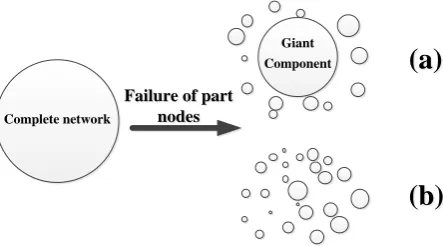
In general, after occurrence of cascading failures of the researched networks, the effective nodes under consideration are the maximum giant component remained after occurrence of the cascading failures, while nodes which do not belong to the giant component are deemed as failure nodes, as shown in Figure 1(a).
Complete network
Giant
Component
(a)
(a)
(b)
(b)
Failure of part nodes Failure of part
[image:2.595.185.407.406.529.2]nodes
Figure 1. Two manners for possible network failures.
Nevertheless, in the reality, nodes which do not belong to the giant component and their connection edges do not always fail. These nodes may also keep on running according to original functions, as shown in Figure 1(b). For example, in a military system confrontation network, due to attacks from hostile forces, our military system network may be broken. However, according to common war-related sense, any node will give play to its energy and functions if it finds that some teammates are still fighting together with it. Hence, the paper assumes that these noses which do not belong to the giant component are normal nodes if their loads do not exceed the capacity and at least one connection edge exists.
In order to eliminate influences causes by accidental factors, above steps are repeated for K times. The average value of K values of P obtained through K times of simulation calculation is calculated, namely:
1 2 K
P P P
P
K
network cascading failures under different conditions and find weak links of interdependent networks.
Targeted Attack Simulation
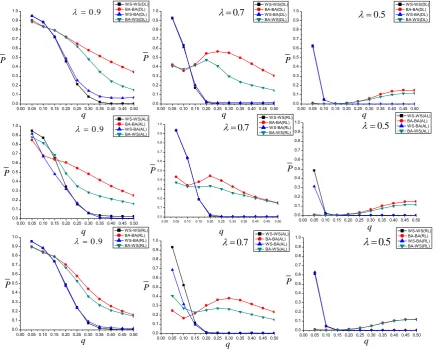
In the other research, nodes are removed from network according to a random node removal proportion (0q q 1). Such manner represents random attacks in the networks. Next, we will research the cascading failure problem of interdependent networks under other attack strategies. Except for random attacks, targeted attack is the commonest attack manner. Through removal of a proportion of nodes with the largest loads from the network, simulating analysis is carried out to generation of cascading failures. the average quantity P of remained nodes result of different removal proportion qis shown in Figure 2.
0.00 0.05 0.10 0.15 0.20 0.25 0.30 0.35 0.40 0.45 0.50 0.0 0.1 0.2 0.3 0.4 0.5 0.6 0.7 0.8 0.9 1.0
0.00 0.05 0.10 0.15 0.20 0.25 0.30 0.35 0.40 0.45 0.50 0.0 0.1 0.2 0.3 0.4 0.5 0.6 0.7 0.8 0.9 1.0
0.00 0.05 0.10 0.15 0.20 0.25 0.30 0.35 0.40 0.45 0.50 0.0 0.1 0.2 0.3 0.4 0.5 0.6 0.7 0.8 0.9 1.0
0.00 0.05 0.10 0.15 0.20 0.25 0.30 0.35 0.40 0.45 0.50 0.0 0.1 0.2 0.3 0.4 0.5 0.6 0.7 0.8 0.9 1.0
0.00 0.05 0.10 0.15 0.20 0.25 0.30 0.35 0.40 0.45 0.50 0.0 0.1 0.2 0.3 0.4 0.5 0.6 0.7 0.8 0.9 1.0
0.00 0.05 0.10 0.15 0.20 0.25 0.30 0.35 0.40 0.45 0.50 0.0 0.1 0.2 0.3 0.4 0.5 0.6 0.7 0.8 0.9 1.0
0.00 0.05 0.10 0.15 0.20 0.25 0.30 0.35 0.40 0.45 0.50 0.0 0.1 0.2 0.3 0.4 0.5 0.6 0.7 0.8 0.9 1.0
0.00 0.05 0.10 0.15 0.20 0.25 0.30 0.35 0.40 0.45 0.50 0.0 0.1 0.2 0.3 0.4 0.5 0.6 0.7 0.8 0.9 1.0
0.00 0.05 0.10 0.15 0.20 0.25 0.30 0.35 0.40 0.45 0.50 0.0 0.1 0.2 0.3 0.4 0.5 0.6 0.7 0.8 0.9 1.0 0 .9 P q WS-WS(DL) BA-BA(DL) WS-BA(DL)
BA-WS(DL) 0.7
P
q
WS-WS(DL) BA-BA(DL) WS-BA(DL)
BA-WS(DL) 0.5
[image:3.595.82.520.249.602.2]P q WS-WS(DL) BA-BA(DL) WS-BA(DL) BA-WS(DL) 0 .9 P q WS-WS(AL) BA-BA(AL) WS-BA(AL) BA-WS(AL) 0.5 P q WS-WS(AL) BA-BA(AL) WS-BA(AL) BA-WS(AL) 0.7 P q WS-WS(RL) BA-BA(RL) WS-BA(RL) BA-WS(RL) 0.5 P q WS-WS(RL) BA-BA(RL) WS-BA(RL) BA-WS(RL) 0.7 P q WS-WS(AL) BA-BA(AL) WS-BA(AL) BA-WS(AL) 0 .9 P q WS-WS(RL) BA-BA(RL) WS-BA(RL) BA-WS(RL)
Figure 2. Robustness Analysis of Different Combined Networks under Targeted Attacks.
From the perspective of tolerance coefficient, Figure 2 is discussed at first based on three situations:
that of WS-WS interdependent network. As for a mixed interdependent network (BA-WS or WS-BA network), the relevant properties fall in between.
(2) Under the tolerance coefficient of 0.7, the average remained node quantities of WS-WS interdependent network and the WS-BA interdependent network decrease with the increase of the removal proportion q , while the results of BA-BA interdependent network and BA-WS interdependent network tend to increase firstly and then decrease. This result indicates that with the increase of removal proportion, robustness of interdependent networks is better. This phenomenon violates general theories. Hence, the paper will detailedly analyze this problem below.
(3) Under the tolerance coefficient of 0.5, the average remained node quantities of WS-WS interdependent network and WS-BA interdependent network tend to be 0 when the removal proportion satisfies q0.1; results of BA-BA interdependent network and BA-WS interdependent network also tend to increase firstly and then decrease.
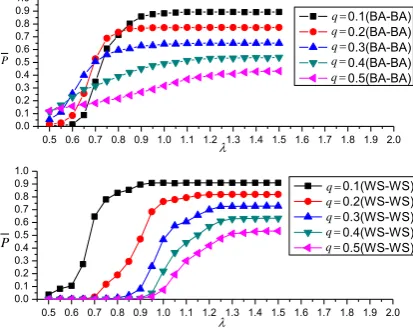
Under above three situations, interdependent networks with different tolerance coefficients generate completely different network robustness. A lot of conclusions inconsistent with previous research results are also found. Hence, the paper will then analyze network robustness of the BA-BA network under the tolerance coefficient which varies from 0.5 to 1.5. Specific analysis results are shown in the Figure 3.Under three manners including DL, AL and RL and the tolerance coefficient of respective 0.9, 0.7 and 0.5, the relations about variations of the average remained node quantity P
along with the node removal proportion q under four different network combinations.
0.5 0.6 0.7 0.8 0.9 1.0 1.1 1.2 1.3 1.4 1.5 1.6 1.7 1.8 1.9 2.0 0.0
0.1 0.2 0.3 0.4 0.5 0.6 0.7 0.8 0.9 1.0
0.5 0.6 0.7 0.8 0.9 1.0 1.1 1.2 1.3 1.4 1.5 1.6 1.7 1.8 1.9 2.0 0.0
0.1 0.2 0.3 0.4 0.5 0.6 0.7 0.8 0.9 1.0
0.1(BA-BA) 0.2(BA-BA) 0.3(BA-BA) 0.4(BA-BA) 0.5(BA-BA)q
q q
P
q q
P
0.1(WS-WS) 0.2(WS-WS) 0.3(WS-WS) 0.4(WS-WS) 0.5(WS-WS)q
[image:4.595.194.401.358.523.2]q q q q
Figure 3. Relations about variations of average remained node quantity of interdependent network along with tolerance coefficient changing.
It is shown in the Figure 3 that with the continuous increase of network tolerance coefficient, the average network remained node quantities increase continuously under various removal proportions, wherein these quantities approach a constant when the tolerance coefficient satisfies1. For example, when the removal proportion satisfiesq0.2, 1.5 , the proportion P of average remained nodes approaches 0.8. If we assume that the tolerance coefficient is infinite for nodes in the network, namely other nodes will not cause cascading failures due to the excessive loads, the theoretical value of average remained node proportion will be
100 0.2 100 0.2 0.8
1 0.82
100 100
P
(3)
increase of tolerance coefficient , wherein the average remained node quantity exceeds that under a large removal proportion. Hence, when the average removal proportion increases, robustness of the BA-BA interdependent network still increases, as shown in Figure 2.
Under a large tolerance coefficient, the large removal proportion will lead to a small average remained node quantity, which is a normal situation; however, we wonder why the mall removal proportion still leads to a small average remained node quantity under a small tolerance coefficient. The root cause of occurrence of this situation is related to measures of interdependent network cascading failures, which are proposed in this paper. The asymmetric interdependent network cascading failure model established in this paper considers the remained nodes of which all the loads do not exceed the capacity after occurrence of the cascading faults in the network, but previous discussions are based on a giant component.
Hence, with regard to the BA-BA interdependent network, removal of the largest nodes may divide the interdependent network into many small segments, wherein at least two or more than two nodes of which the loads are maintained in a normal scope exist in each segment. This situation will not take place in the WS-WS interdependent network. Degree distribution of this network is uniform, and fault transmission of its cascading failure can take place easily, wherein a large-scale collapse failure happens, or loads of nearly no node are excessive due to failures of neighbor nodes.
Conclusion
The paper establishes an interdependent network cascading failure model based on asymmetric dependency, puts forward a load-capacity model in networks and defines a new measurement method for interdependent network cascading failures. Based on the network model, the paper researches network robustness under different attack manners and based on different network combinations, different coupling manners in networks, different network tolerance coefficients and different removal proportions. Research results show that under targeted attacks, network robustness is inconsistent with previous research results. The result depends on size of attack scope, wherein robustness of BA-BA interdependent network is better under large-scope attacks and robustness of WS-WS interdependent network is better under small-scope attacks; under a small tolerance coefficient, robustness of the BA-BA interdependent network increases firstly and then decreases with the increase of removal proportion. Research results obtained by the paper can provide reference for establishment of an asymmetric interdependent network with high reliability.
Acknowledgement
The work described in this paper is supported by the National Natural Science Foundation of China (71501185).
References
[1]J. Shao, S. V. Buldyrev, S. Havlin and H. E. Stanley, “Cascade of failures in coupled network systems with multiple support dependence relations,” Physical Review E, vol. 83, no. 3, Article ID 036116, 9 pages, 2011.
[2]R. Parshani, S. V. Buldyrev, and S. Havlin, “Interdependent networks: reducing the coupling strength leads to a change from a first to second order percolation transition,” Physical Review Letters, vol. 105, Article ID 048701, 4 pages, 2010.
[3]Z. Cheng and J. Cao, “Cascade of failures in interdependent networks coupled by different type networks,” Physica A , vol. 430, pp. 193-200, 2015.
[5]X. Z. Peng, Y. Hong, D. Jun, Z. Wang and D. Chao, “Load-induced cascading failure in interdependent network ”, ACTA PHYSICA SINICA, vol. 64 Article ID 048901, 2015.
[6]S. D. Li, L. Li, Y. Jia, X. Liu, and Y. Yang, “Identifying vulnerable nodes of complex networks in cascading failures induced by node-based attacks,” Mathematical Problems in Engineering, vol. 2013, Article ID 938398, 10 pages, 2013.