LEABHARLANN CHOLAISTE NA TRIONOIDE, BAILE ATHA CLIATH TRINITY COLLEGE LIBRARY DUBLIN OUscoil Atha Cliath The University of Dublin
Terms and Conditions of Use of Digitised Theses from Trinity College Library Dublin
Copyright statement
All material supplied by Trinity College Library is protected by copyright (under the Copyright and Related Rights Act, 2000 as amended) and other relevant Intellectual Property Rights. By accessing and using a Digitised Thesis from Trinity College Library you acknowledge that all Intellectual Property Rights in any Works supplied are the sole and exclusive property of the copyright and/or other I PR holder. Specific copyright holders may not be explicitly identified. Use of materials from other sources within a thesis should not be construed as a claim over them.
A non-exclusive, non-transferable licence is hereby granted to those using or reproducing, in whole or in part, the material for valid purposes, providing the copyright owners are acknowledged using the normal conventions. Where specific permission to use material is required, this is identified and such permission must be sought from the copyright holder or agency cited.
Liability statement
By using a Digitised Thesis, I accept that Trinity College Dublin bears no legal responsibility for the accuracy, legality or comprehensiveness of materials contained within the thesis, and that Trinity College Dublin accepts no liability for indirect, consequential, or incidental, damages or losses arising from use of the thesis for whatever reason. Information located in a thesis may be subject to specific use constraints, details of which may not be explicitly described. It is the responsibility of potential and actual users to be aware of such constraints and to abide by them. By making use of material from a digitised thesis, you accept these copyright and disclaimer provisions. Where it is brought to the attention of Trinity College Library that there may be a breach of copyright or other restraint, it is the policy to withdraw or take down access to a thesis while the issue is being resolved.
Access Agreement
By using a Digitised Thesis from Trinity College Library you are bound by the following Terms & Conditions. Please read them carefully.
Static-Light-Light Baryons
A Spectroscopic Study Using Distillation
F in nia n Me Elroy
B.A. (Mod.)
A Thesis subm itted to
T he University of DubHn
for the degree of
Doctor of Philosophy
School of M athem atics
University of Dublin
Trinity College
by
D eclaration
This thesis has not been subm itted as an exercise for a degree a t any other University.
Except where otherwise stated, the work described herein has been carried out by
the author alone. This thesis may be borrowed or copied upon request with the
permission of the Librarian, University of Dubhn, Trinity College. The copyright
belongs jointly to the University of Dublin and Finnian Me Elroy.
-^ T R IN IT Y C O L L E G E ^
2
I,
MAY 2013
^ L I B R A R Y DUBLIN ^
Signature of A uthor ..
...
Static-L ight-L ight B aryons
A Spectroscopic S tu dy U sin g D istilla tio n
F in n ia n M e E lr o y B . A . ( M o d . )
Sum m ary
Acknowledgements
C ontents
1 In tro d u ctio n
9
2 L a ttice B a sics
12
2.1
Q C D ...
12
2.2
Gauge I n v a r ia n c e ...
13
2.3
Group In te g ra tio n ...
15
2.4
Naive F e r n iio n s ...
16
2.5
Wilson Term
...
17
3 S im u la tio n T ech n iq u es
19
3.1
Lattice A c t i o n s ...
19
3.1.1 Gauge A c t i o n ...
20
3.1.2 Light-Quark A c tio n ...
21
3.1.3 Sheikholeslanii-Wohlert T e r m ...
24
3.1.4 Static-Q uark Action ...
26
3.1.5 Sommer S e a l e ...
27
3.2
Tadpole Im provem ent...
28
3.3 T u n in g ...
29
3.3.1 Gauge A n isotropy ...
29
3.3.2 Renormalization C o n d itio n s ...
30
3.4
Heavy Quark Effective T h e o r y ...
31
3.5
Spectroscopy M e t h o d s ...
34
3.5.1 Correlators ...
34
4
G roup T h eo ry
38
4.1 Octahedral G ro u p ...
38
4.1.1 Projections into Irreducible R e p re se n ta tio n s...
39
4.1.2 Subduced R epresentation...
42
4.2 Pauli Exclusion P rin cip le...
43
4.2.1 Flavour ...
44
4.2.2 D isp la c e m e n t...
44
4.2.3 S p i n ...
45
4.2.4 Spin Irrcduciblc R ep rese n tatio n ...
46
4.3 P a r i t y ...
47
4.4 Tensor Product of Spin and Spatial Irreducible Representations . . .
48
5
R e su lts
50
5.1 R esu lts...
50
5.2 Eigenvector T e s t s ...
52
5.3 Non-Local O p e ra to rs ...
54
5.4 Quark M o d e l ...
57
5.5 Effective Mass F it tin g s ...
58
5.5.1
Ai R e su lts...
58
5.5.2 Spin-1 R esu lts...
64
5.5.3
E
R e s u l t s ...
68
5.5.4 Fitting M e th o d ...
72
5.6 Mass S p littin g s ...
73
5.7 Comparison with E x p e r im e n t...
75
5.8 Contemporary R e s u l t s ...
76
5.9 Systematic E r r o r s ...
81
6
C on clu d in g R em ark s
83
A p p en d ic es
86
List of Figures
3-1
Spatial and tem poral plaqucttes in the gauge action...
21
3-2
Spatial and tem poral rectangular plaquettes in the gauge action. . . .
21
3-3
Anticlockwise and clockwisc clover term s...
22
3-4
Anticlockwise and clockwise contributions to
P^u{x)
...
26
4-1
Si^atially extended diquark...
40
5-1
Eigenvector test for an (L = 1, 5 = 0, ./ = 1, / = 0,
P =
—) state
with a 7\ operator...
52
5-2
Eigenvector test for an (L = 0, 5 = 0, J = 0, / = 1, P = —) state
with an
A\
operator...
53
5-3
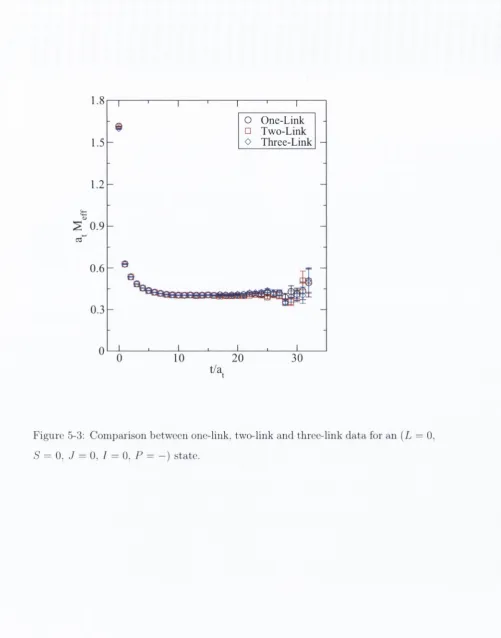
Comparison between one-link, two-link and three-link d ata for an (L =
0, 5 = 0, J = 0, / = 0, P = - ) sta te ...
55
5-4
Sample of different (.4i, / = 0,
P = —)
operator results...
56
5-5
Variational analysis results for a 4 x 4 correlation m atrix optimized
on timeslices (/.q
= 0 ,/i = 1,2) for one-link, two-hnk and three-hnk
isospin-1 operators in the
A\u
irreducible representation of
Oh
...
57
5-6 Irrep y4i; L = 0, 5 = 0, J = 0, / = 0, F =
- I -...
59
5-7 Irrep
Ai: L = 0, S = 0, J = 0, 1 = 0, P = +
...
60
5-8 I rr e p /Ij: L = 0, .9 = 0, J = 0, / = 0, r = - ...
61
5-9 Irrep yli: L = 0, 5 = 0, J = 0, / = 1, P = -f-...
62
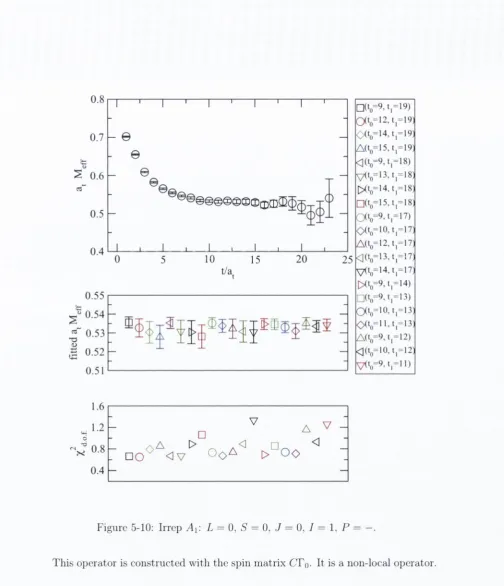
5-10 Irrep
L = 0, 5 = 0, J = 0, / = 1, P = —...
63
5-11 Irrep Ti: L = 0, 5 = 1, J = 1, / = 0, P =
- I -...
64
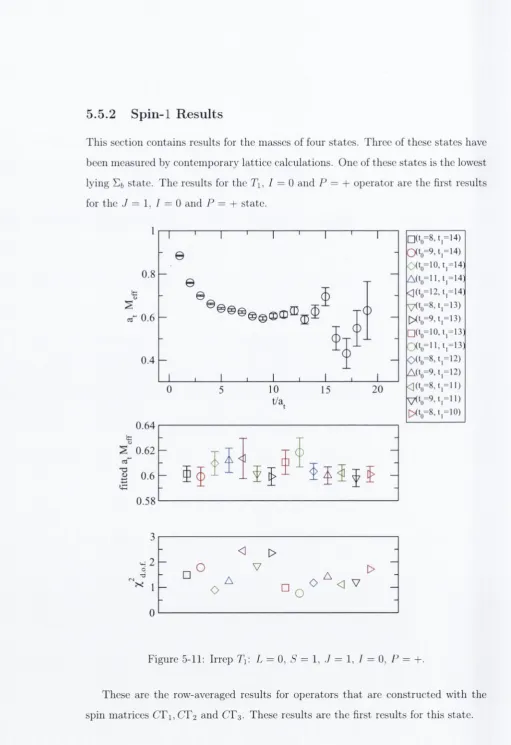
5-13 Irrep Ti\ L = 0, 5 = 1, J = 1, / = 1, P = + ... 66
5-14 Irrcp Ti\ L = 0, 5 = 1, J = 1, / = 1, F = —... 67
5-15 Irrcp S': L = 2, 5 = 0, J = 2, / = 0, P = -t-... 68
5-16 Irrcp E: L = 2, S = 0, J = 2, I = 0, P = - ... 69
5-17 Irrep E: L ^ 2, S = 0, .1 = 2, [ = 1, P = +... 70
5-18 Irrep E: L = 2, S = 0, J = 2, I = I, P = - ... 71
A-1 C onjugacy classes of 0 ... 89
A-2 Irrcp Ti row 1 : L = 0, 5 = l , J = l , / = 0, P = -|-... 98
A-3 Irrep Ti row 2: L = 0, S' = 1, J = 1, / = 0, P = -I-... 99
A-4 Irrcp Ti row 3: L = 0, 5” = 1, J = 1, / = 0, P = + ... 100
A-5 Irrcp Ti row 1: L = 0, S' = 1, J = 1, / = 0, P = —... 101
A-6 Irrcp T\ row 2: L = 0, S ' = l , J = l , / = 0, P = —... 102
A -7 Irrcp T\ row 3: L = 0, 5 = 1, J = 1, / = 0, P = —... 103
A-8 Irrep T\ row 1; L = 0, 5 = 1, J = 1, / = 1, P = -I-... 104
A -9 Irrcp T\ row 2: L = 0, S = 1, ./ = 1, / = 1, P = -|-... 105
A -10 Irrcp 7 \ row 3: L = 0, S = 1, J = 1, / = 1, P = -t-... 106
A-11 Irrcp Ti row 1: L = 0, S' = 1, J = 1, / = 1, P = —... 107
A -12 Irrcp T\ row 2: L = 0, S' = 1, J = 1, / = 1, P = —... 108
A -13 Irrep Ti row 3: L = 0, S' = 1, J = 1, / = 1, P = —... 109
List of Tables
1.1
Experimentally determined masses for bottom baryons...
10
4.1
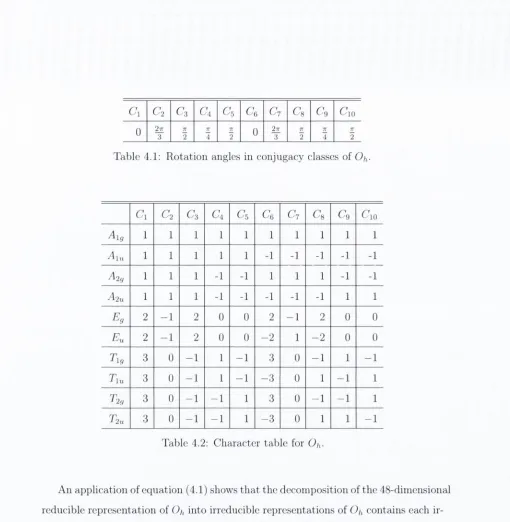
Rotation angles in conjugacy classes of O/,...
41
4.2
Character table for
...
41
4.3
The subduction of S(){3) x {1,7^} to the irreducible representation A
of Oh for integer L ...
42
4.4
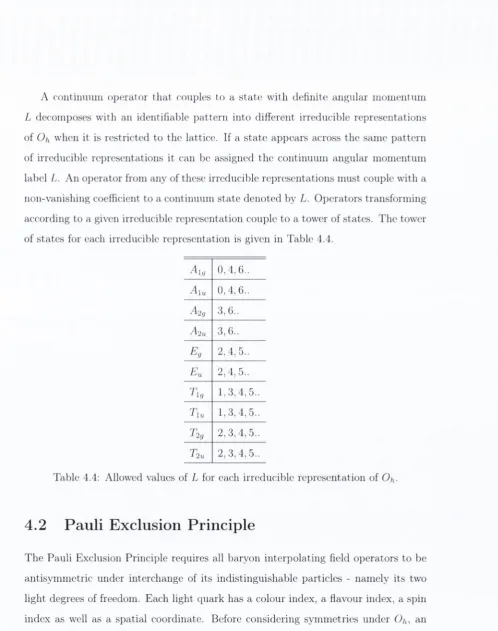
Allowed values of
L for each irreducible representation of
Of,...
43
4.5
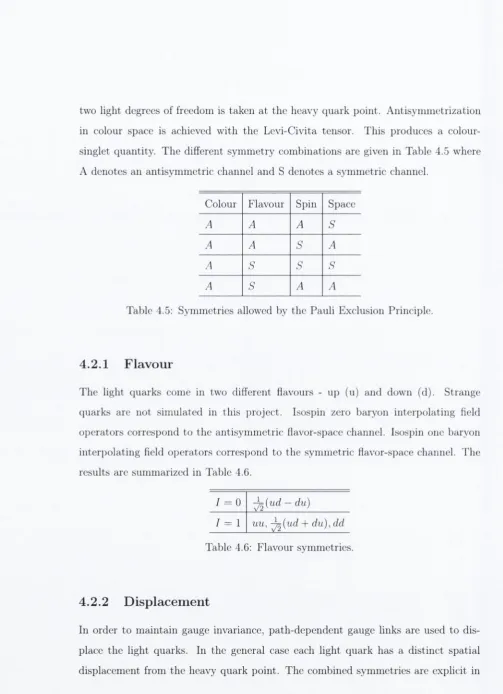
Symmetries allowed by the Pauli Exclusion Principle...
44
4.6
Flavour sym m etries...
44
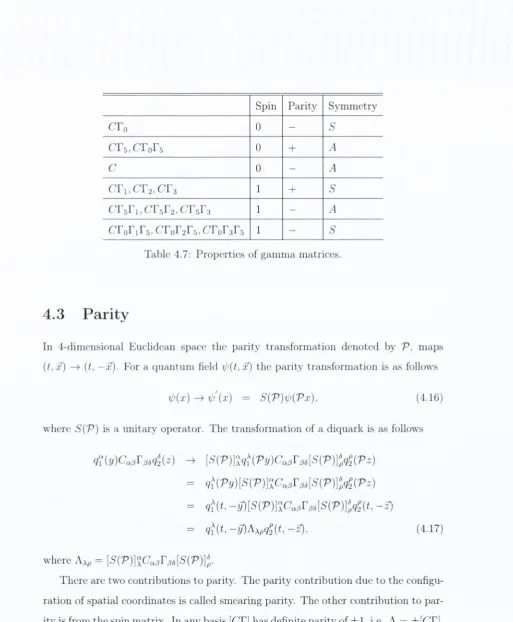
4.7
Properties of gam ma m atrices...
47
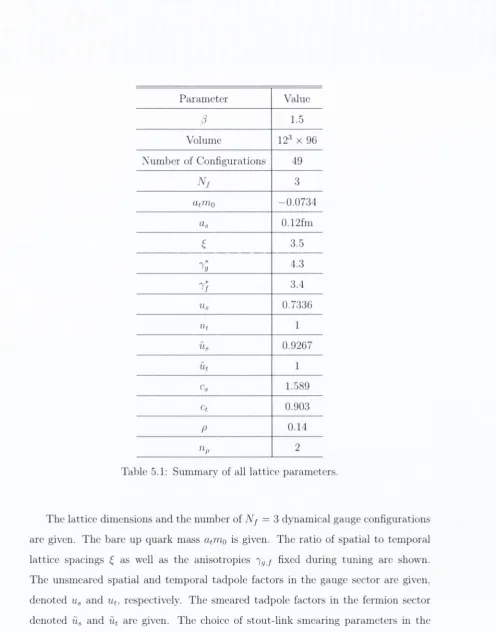
5.1
Summary of all lattice param eters...
51
5.2
List of displacement operators...
56
5.3 Ground state fitting details for all states including
Xdof
fitting
range (<o./i)...
72
5.4
Mass splittings between states with the same parity
P and total an
gular momentum
J
but different isospin
1
73
5.5
Mass splittings between states with the same isospin
I
and total an
gular momentum
J
but different parity
P
74
5.6
Mass splittings between irreducible representations of 0 ...
74
5.7
Experimentally determined bottom baryon masses...
75
5.8
Various quark model mass splittings...
78
5.9
Comparison between Trinlat and ETMC d a ta ...
79
5.11 Triiilat mass splittings...
80
5.12 Comparison of different S;,—
latticc mass splitting calculations. . .
80
A-1 List of spin-0 operators...
96
A-2 List of spin-1 operators...
97
C hap ter 1
Introduction
According to the Standard Model of particle physics, quarks emerge as a basic build
ing block of matter. Quarks interact via the strong interaction. The theory describing
the strong force is Quantum Chromodynamics. The strong force l)ctween quarks in
creases with increasing distance. For this reason, quarks are not seen in isolation but
are confined into bound states know’n as hadrons. There are six varieties of cjuark:
up (u), down (d), charm (c), strange (s), top (t) and bottom (b). The u, d and s
quarks are light in comparison to the c, t, and b quarks. The u, d and s cjuarks lie
below the QCD scale
Aq c d=
200MeV.
Quark Models |1| predict eight baryons containing one bottom quark. Their
properties are given in Table 1.1. They can be described by total spin J, parity
P, isospin I and the total spin of the light quark pair ,s/. The up or down quarks
are denoted q, s denotes the strange quark and b denotes the bottom quark. For
isodoublets and isotriplets the lower and lowest observed masses are quoted.
B aryon
Q uark C ontent
r
I
Si
E xperim ental M ass (Mev)
A6
qqb
2
1 +0
0
5,620.2(1.6)
qqb
2
1 +1
1
5,807.8(2.7)
qqb
3 +2
1
1
5,829.0(3.4)
i \
ssb
2
1 +0
1
6,071(40)
n i
ssb
3 +2
0
1
N ot M easured
“ b
qsb
2
1 +2
10
5,790.5(2.7)
“ 6
qsb
2
1 +2
11
N ot M easured
“ b
qsb
3 +
2
2
11
N ot M easured
Table 1.1: E xperim entally determ ined m asses for b o tto m baryons.
cu rrently very rich w ith th e PANDA experim ent, th e LH Cb, ATLAS an d CMS likely
to produce d a ta relevant for m apping th e b-hadron spectrum .
L attice QCD provides an a ltern ativ e a re n a for stu dying th e had ro n sp ectrum .
Ab
in itio
calculations of th e m ass sp ectru m arc possible on th e lattice. Spectroscopy
results from lattic e QCD are as num erous as those from experim ent. B oth th e charm
and b o tto m m eson sectors are rich research areas. A lgorithm ic im provem ents over th e
last few years have led to highly excited s ta te m ass determ in atio n s for heavy q uark
mesons. Over th e last decade h adron spectroscopy in lattice Q C D has g ra d u a te d from
calculating single rows of th e quark pro p ag atio n m atrix to calculating all elem ents
of th e q uark p ro p ag atio n m atrix - th e so-called all-to-all pro p ag ato r. O n a sp atially
sym m etric anisotropic lattic e of sp a tia l ex ten t
Nx and tem p o ral ex te n t
N t th e q uark
propagation m a trix has ran k 4 x 3 x
x
N t, w here 4 represents th e num ber of
com ponents in a D irac field and 3 represents th e num ber of colours. C alculating all
elem ents of th is m atrix requires 144 x
x
N'^ m a trix inversions - a form idable task.
T h e relatively new m eth o d of d istillation enables access to all elem ents of th e q uark
pro p ag atio n m atrix a t a m uch m ore affordable cost. T his p ro ject includes th e use of
distillation for th e first tim e in static-light-light baryon spectroscopy on anisotropic
lattices. T h e aim of th is project is to determ ine th e m ass sp e ctru m of singly-bottom
baryons. M ass sp littings for previously unm easured s ta te s are calculated. In addition,
C h ap ter 2
Lattice Basics
2.1
QCD
In continuum Q C D , a q u a n tu m field
t) has an infinite num ber of degrees of
freedom, labelled by th e space-tim e co ordinate
as well as discrete indices for
colour and spin. Space-tim e can be discretizcd by in troducing a hypercubic lattic e of
discrete points. T h e lattic e sites are described by a four-vector
x w ith com ponents
where
is an integer,
is th e lattic e spacing in th e
direction and
L = Nf^a^ is
th e lattic e ex ten t in th e
direction. M om enta occur in discrete units
27T7T-w here
= - N ^ / 2 + I , - N ^ / 2 + 2
, N^ / 2.
(2.2)
T he lattice introduces a m om entum cut-off. T h e largest allowed m om entum is 7r/a
and th e lattice provides an u ltra-violet regulator for Q CD . T he sh o rtest w avelength in
th e
direction is 2a^. W avelengths less th a n twice th e lattic e spacing are elim inated
from th e theory.
Integrals in th e p ath -in te g ra l rep resen tatio n of Q C D becom e finite-dim ensional
w hen a lattic e is introduced. T h e vacuum ex p e cta tio n value of an op erato r
(/’,
is given by
j[dxp][d^][dU]0{^p3-U)e~^
,2
3
)
J[d^p][d'4)][dU]e~^
where
S
is th e action,
.S'= y C{'tp{x),'iJ){x)JJ{x))d'^x,
(2.4)
and
C{'i
Ij{x
) ,
iI){x) , U {
x)] is th e L agrangian density. T he fields
ij^{x) and
U{x)
which
describe quark and gluons respectively, will be introduced la te r in th is chapter. A
W ick ro ta tio n from M inkowski space to E uchdean spacc has been perform ed. In
Minkowski space, there is an oscillating phase factor
In E uclidean space, th e
factor
e~^ can be in te rp re te d as a real weight allowing im p o rtan ce sam pling to be
used to estim ate this integral.
2.2
G auge Invariance
T he continuum QCD L agrangian possesses an
SU{3) gauge invariance. Q uarks and
an tiq u ark s ]:>ossess colour charge. T here are th ree different colours - red, green and
blue. T he three different colour fields can be w ritte n as a three-com ponent colunm
vector as follows
i>2
\
)
These fields transform locally as follows
(2.5)
G{x)'i/j{x),
^ ) { x ) G ~ \ x ) ,
(2.6a)
(2.6b)
where
G{x) = exp [ia “ (x )i“(x)].
(2.6c)
C{x)
is an elem ent in th e fundam ental representation of SU{3) , a°'{x) is an arb itra ry
function of
x and
t"{x) are herm itian generators of
SU{3).
T h e derivative
d^ip{x) of a field
’>p{x) is defined as follows
df,ip{x) ^ hm - [ 4 ’{x + ea^) -
This derivative transfonns differently to 0(x) under the local transform ations as
shown below
d^xp{x)
->■ lim -[G (x +
ea^)ip{x + ea^) - G{x)'ip{x)]
7^
G{x)d^ip{x).
(2.8)
e->0 eThe covariant derivative D^"^(x) of a field
ip{x)
is defined as follows
D^'4){x)
=
^^^^p{x) - igA^{x)4){x),
(2.9)
where the vector field
An{x)
hes in the Lie algebra of
SU{3).
The vector field
An(x)
can be w ritten as follows
= (
2.10)
6 = 1
where
A^{x)
are real-valued functions and the
are the 3x3 Gell-Mann m atrices
given in the Appendix. The Gell-Mann m atrices act as generators for the non-Abelian
group
Sll{3).
The Gell-Mann m atrices obey the com m utation relations
8
[A“,A"] = 2 ^ 5 ^ /„ b ,A ^
(2.11)
C = 1where
fah,-
are antisym m etric stru cture constants.
D^%l;{x)
follows the same transfor
m ation law as
'i!){x).
Under the local transform ation of equations (2.6)
Dfj_ip{x)
G{x)Df,ip{x).
(2-12)
The lattice covariant derivative applied to a quark field is
V^'0(a:') =
-^\U^,{x)'lp{x + fi) -
t/^(x -
fi)'>p{x -
/}.)]•
(2.13)
The link variables are parallel tran spo rters between neighbouring latticc sites. They
are the path-ordered product of the exponential of the vector field
Af^{x)
defined as
follows
rx + ii
[/^(x) = 7^exp[i /
gQA^{y)dy],
(2.14)
J X
where
go
is the
bare coupling constant and path-ordering denoted
by
V
involves
ordering the matrices with .4,,(x) to the right of and
Af,{x
-t-
fi)
to th e left of the
product. T h e links arc elem ents of th e fundam ental rep resen tatio n of th e gauge
group. T hey transform under a gauge tran sfo rm atio n as follows
U^{x) ^ G{x
)U^{x
) G \
x+
G{x
)
eSU{3) .
(2.15)
T he path -o rd ered p ro d u ct of links along a p a th P connecting site x and site y is called
a W ilson line and is denoted M p (x , y). U nder gauge tran sfo rm atio n s th e W ilson line
transform s as follows
W p { x , y )
G i x ) W p { x . y ) G \ y ) .
(2.16)
T h e trace of a W ilson line over a closed p a th is called a W'ilson loop. T h e W ilson
looj) is gauge invariant as shown below using th e cyclic j>roperty of traces
Tr \ Wp [ x , x ) \
—> Tr[(7(3’)iyp(3'. a")C7^(x)]
= Tr[M^p(a:,3-)(:7^(T)G(x)]
= Tr[M /p(x,T)].
(2.17)
2.3
Group Integration
T h e links J7^(x) can be w ritten as follows
(/^(x) =
(2.18)
w here
4>^{x) is an elem ent of th e Lie-algebra of
SU{2>). (p^{x) is w ritte n in term s of
th e generators T “ = ^ of th e group in th e fundam ental rep resen tatio n as follows
8
c
I>,{x
) = J 2 K {
x)T^-
(2.19)
a — IT h e generators T “ satisfy
[ T \ T ^ ] = i J 2 f a b c T ^ , (2.2 0) r
w ith th e sam e s tru c tu re co n stan ts
fabc as in equation (2.11). T h e in teg ratio n m easure
(Ill
guarantees th a t gauge invariance is respected. T he H aar nieaaure
dlJ
on a com pact
group
G
has th e two defining pro p erties of invariance and no rm ah zatio n . Invariance
can be s ta te d m ath em atically as follows
/
f { U ) d U =
f
f { W U ) d U =
f
f { U W ) d U
for all IV £
G.
(2.21)
J g
J g
JgN orm alization is given by
f
dU = 1.
(2.22)
Jg
In this stu d y th e com pact group
G
is
SU{3).
2.4
N aive Ferm ions
T he naive Euclidean lattic e ferm ion action for a single flavour is
Sf
=
(2.23)
where
=
+
(2.24)
a
is th e lattic e spacing,
is defined in equation (2.13) w ith
U^{x)
= 1 for free
ferm ions and th e sum over colour and D irac indices is im plicit. T h e tw o-point function
is defined as follows
, , r - r ss
/ ^ ? ^ ^ ' 0 a ( x ) ? ^ ( y ) e - ^ ^
=
r
,— 5--- >
(2-25)
J
D'4)D'4)e-^F
where th e integration m easure
DipDyj
is given by
D'lIjD'ip
=n
d ^ a i u )
n
dip^{v).
(2.26)
a , u (i.v
T h e tw o-point function m om entum space rep resen tatio n is
i-TT/a (27
t)^
77)2-h ^ ^ s m (ap^J/n^
/
w/a(2.27)
■7t / u
(2^)
where
Im
— i y^„
7
„ sin (a» u )/al
5(P) =
2,
w V -(2-28)
N ear
= 0 or ± 7 r/a for /i G { 0 .1 ,2 ,3 } , sin(ap^) can be ap p ro x n n atcd by
to
0{a)'^.
T h e p ro p agator is th en given by
S{p)
=
+ 0{a^) .
(2.29)
T h e p ro p ag a to r has a pole at
= 0. T hese poles exist a t sixteen regions in
th e B rillonin zone —tt/q
< p^ < irla.
One is near
po — P\ = P
2— Pi = ^
which
describes th e D irac particle. T he other fifteen poles correspond to high m om entum
ex citations near
= 0 or ± 7 r/a for // G { 0 ,1 ,2 .3 } . T hese fifteen excitations are
known as doublers. T hey are lattic e artefacts.
T h e naive Euclidean lattice ferm ion action is invariant under th e tran sfo rm atio n
V'(.t) —>■
e^^iplx),
(2.30)
ip{x)
—> ■i/’(a:)e“ *^.
(2.31)
W hen th e m ass
rti
= 0, this action has a chiral synm ietry
^ { x )
e‘®^^V’(^),
(2.32)
il>{x)
—>•
.
(2.33)
2.5
W ilson Term
O ne solution to th e doubling problem is to add a W ilson term to th e naive ferm ion
action. At finite lattice spacing, th e W ilson term raises th e m ass of th e doublers to
th e order of th e inverse lattic e spacing. This rem oves th e effects of doubling. T he
W'ilson action is given below
5 ^ '
= S
f-
^
^ ^ ( x ) A ^ V ^ ( x ) ,
(2.34)
X . ( I
where
and
r
is the Wilson param eter. For non-zero values of
r,
the doublers mass is in
creased. This action can be expressed as follows
Sp
{x,y)tp{y),
(2.36)
where
M^ { x , y) = (aSn +
- y
Y^ii^ ~
+
(r +
(2-37)
This gives the same two-point function as in equation (2.27) when the mass
rn
is
replaced with
m{p)
as follows
2r
.
m(p) —> m H--- E sin^(p^a/2).
(2.38)
The argum ent of the sine function has half the periodicity of the other sine functions
in the propagator. Near
= 7r/a, m(p)
A s a - > 0
m{p)
diverges.
This divergence lifts the masses of the fifteen doublers for fixed nonzero
r
to
0 { l / a ) .
At finite lattice spacing the doublers have a non-zero mass even for
m —
0. The
Wilson term breaks chiral sym m etry [16]. This induccs an additive renormalization
to the quark mass. The quark mass is also multiplicatively renormalized. A fine-
tuning of the bare quark mass to its critical value is necessary in order to obtain a
vanishing renormalized quark mass. The additive mass renormalization can lead to
a negative value for the bare quark mass. The quark mass in this project is negative.
The Nielson-Ninomiya no-go theorem [17] precludes the possibility of constructing a
fcrmion action which respects locality, hermiticity, translational invariance, chirality
and remains undoubled.
C h ap ter 3
Sim ulation Techniques
3.1
L attice A ctions
In this study wc perform sinmlatious on an
N f = 3
dynamical, anisotropic lattice. In
hadron spectroscopy, fine resolution is required when fitting to the effective masses
of two-point correlation functions of a creation operator
O.
Correlation functions
can be expanded as a series of exponential terms - an exponential term for each
state to which the operator
O
couples . The exponential associated with the ground
state decays slowest. Exponential term s associated with excited states decay faster.
Therefore on later timeslices the ground state has a greater relative contribution to
the value of the correlation function. This means th a t ground state masses must
be extracted at later timeslices. Correlation functions also become noisier on later
timeslices with signal-to-noise ratios typically degrading exponentially with tim e [19],
This perm its only a narrow tim e window in which ground state mass extraction can
be well-accomplished. Anisotropic lattices with a finer lattice spacing in the temporal
direction provide a means of maximizing the amount of inform ation obtainable from
correlation functions by allowing fitting over a greater number of timeslices. This is
especially im portant for a treatm ent of the static quark since the signal for the static
quark degrades into noise faster than for light quarks [20]. Errors of
0{at mQ)
in the
tem poral direction relating to the heavy quark can be reduced by simulating on the
spectroscopy [21], Dccrcasiiig the lattice spacing in only the tem poral direction is
com putationally less expensive th an decreasing it in all four directions. Hypercubic
symmetry is broken by the anisotropic lattice. The anisotropic lattice introduces two
new param eters; the fermion and gluon anisotropies denoted
and
respectively.
These param eters are non-perturbatively tim ed so th a t in the continuum limit full
Lorentz sym m etry is restored.
3.1.1
G au ge A ctio n
The gauge action is a Symanzik-improved action with tree-level tadpole-improved
coefhcients |
2 2|:
where
j3 = 2Nc/ g^,
g is the QCD coupling,
N c
= 3 is the number of colours,
7^ is
the bare gauge anisotropy,
Ug
and
Ut
are the spatial and tem poral tadpole factors,
Q.C =
X ]c(V 3 )R c T r(l —
Wc),
where
W c
denotes th e path-ordered product of link
lattice action involves system atically including additional term s to the action in order
to accelerate the rate of convergence to the continuum limit [23]. Here improvement
is achieved by summing linear combinations of different plaquettes weighted w ith the
The action is designed for lattices with large anisotropies where
<C a^. It was first
used in glueball simulations [24]. The procedure for evaluating the tadpole factors is
discussed in a later section on tadpole improvement.
The various sums over plaquettes and rectangular loops are given below
12u\u^
(3.1)
variables along a closed contour C. The Symanzik improvement program applied to a
correct coefhcients. The action has a leading discretization error of 0 (« ^ ,
9^
0^).
X i > j X i > i
^^dTx[l-Ut{x)U^{x+i)Uj{x+2i)Ul{x+i+j)Ul{x+j)U'^^{x)\,
(3.3)
IX
= EE
^RcTr[l-Ut{x)U^{x+i)U^{x+i)U^{x)],
(3.4)
X i
^ s t r
(^') = EE
^ R c T r[l-
U^(x)U,{x+i)Ut
(x+22)
U j [ x + i + l
)
Uj{x+L )Ul{x)],
(3.5)
O X i
where
x
is the lattice coordinate,
i , j
are spatial indices,
i
and j are unit vectors in
the spatial directions, ^ is a unit vector in the time direction and
U^{x)
is the parallel
transporter from site
x
to
x
+ /7„
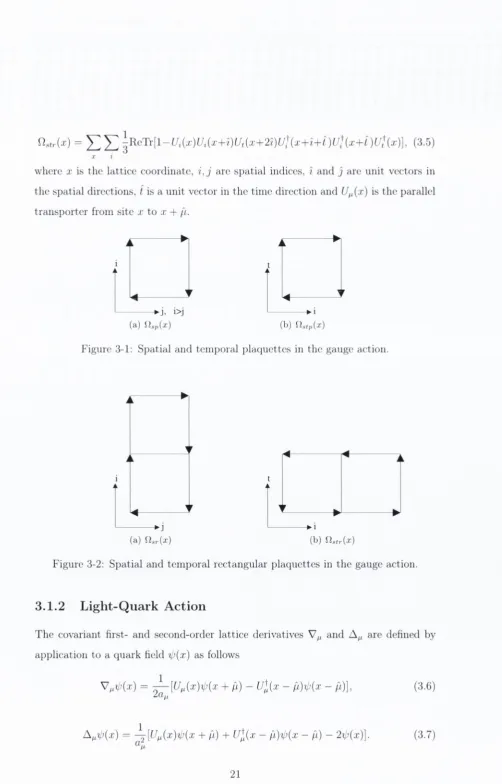
- ► J , i > J
-► 1
(a) ilsp(x) (b)
Figure 3-1: Si)atial and tem poral jilaquettes in the gauge action.
-► 1
(r) ( ^ )
Figure 3-2: Spatial and tem poral rectangular plaquettes in the gauge action.
3.1.2
L ight-Q uark A ction
The covariant first- and second-order lattice derivatives
and
are defined by
application to a quark field
follows
=
^ [U^{x)'i p{x
-F A) -
Ulix - fi)i>{x -
/})],
(3.6)
[image:26.529.16.519.1.786.2]In this n o tatio n ,
lJf,{x)
is th e parallel tra n s p o rte r from
x
to
x + fi
and
Uj^{x - fi)
is
th e parallel tra n s p o rte r from
x t o x — fi.
T he field ten so r
is defined by
where
Qf,.u{x)
is defined as follows
=^[ U^{x)U^{x + f i ) Ul {x + C')Ul{x)
+ U ^ [ x ) U l { x - ji + C')Ul{x - p.)U^{x - /})
+
U l { x - i ^ ) Ul { x - jjL - i ' ) u, , { x - [l-
v ) U ^ { x - u ) + u l { x - C')U„{x - u ) U^ { x + fi - C')Ul{x)].(3.8)
(3.9)
(a) Q^^(x) (b)
Ql^(x)
F igure 3-3; A nticlockw ise and clockwise clover term s.
In th e light quark sector an anisotropic clover ferm ion action is used [25]. It is
given by
Sl.[U,tp,ip] = alat'Y^'ip{x)Qip{x),
(3.10)
where
Q =
[mo+
t ' f V V f - I -
UsWg
- y ( c , c r ^ , F ^ ‘ + ^ ) ] ,(3.11)
S < S
= (1 /2 )[7 /o 7i/] th e r = 1 W ils o n o p e ra to r is given by
U '';. = V , - (3.12)
T he fo llo w in g q u a n titie s w ith a h a t arc a ll dim cnsionless; 0 = a.? V"; = O (^o , =
a ,,V ,,.A ,, = and H-',,. = V ,, - T h e a c tio n can be
re w ritte n as follow s
S l \ U , ’i l j . ^] = ' Y^' i l ) ( yx) Q^, (3.13)
X
where
Q =
— { “ ^^0 + H .S'at Co ^
- + (3.14)
® .s < .s
T he ra tio o f th e bare fe rn iio n a n iso tro p y to the bare gauge a n is o tro p y is denoted ly.
T u n in g o f b o th ciuantities and i/, is n o t necessary. A rescaling o f th e fields recjuires
o n ly one such q u a n tity to be tu n e d to ensure th e a n is o tro p ic la ttic e obeys re la tiv ity .
S e ttin g = 1 and tu n in g Vt is called z^t'tuning. Here, we em ploy i/j- tu n in g where we
set t't = 1. T h e clover coefficients are set to th e ir tree-level ta d p o le -im p ro v e d values
1 / I x 1
.
X
( ' I =
7T
+ 7
^ ;
0^-15
where Ug and Ut are th e ta d p o le factors fo r th e smeared fe rm io n fields. T h e ta d p o le
factors are explaine d fu rth e r in equations (3.29) and (3.30). T h e a n is o tro p y ^ = a «/af
is set to equal 3.5. For a s p a tia l la ttic e spacing o f o rder 0.1 fm an a n is o tro p y o f ^ = 3.5
gives a te m p o ra l la ttic e spacing w ith th e required fineness fo r h a d ro n spectroscopy.
T h re e -d im e n sio n a l s to u t-lin k smeared gauge fields [24] are used in th e fe rm io n a ction
w ith sm earing w e ig h t p = 0.2 and Up = 10 ite ra tio n s . T h e param eters p and Up
are explaine d in (3.61). T h e gauge a n iso tro p y 7^ and th e fe rm io n a n is o tro p y 7/ are
defined as follow s
T he action can be rcparanicterized in term s of th e bare gauge and ferniion anisotropies
as follows
where
(3.17)
Q =~{utrho
+ IFt + - y" VK
u t 7 / V
-
(
3
.
18
)
2 2 7 / ? I f
,s < s
A t f3 = 1.5, th e tad p ole factors are
Us = 0.7336, Ut = 1, Us = 0.9267, Ut = 1.
Critical values for 7* and 7^ arc found by im posing th e renorm alization condi
tions = { 3 .5 ,3 .5 ,0 } in equations (3.42). Since th e gauge and ferniion
anisotropies show a m ild quark m ass dependence th ey are fixed at their critical val
ues
7; = 4.3, 7; = 3.4. (3.19)
T he critical value of th e input quark m ass is ?ho = —0.0854. Sim ulations are run
w ith an input quark m ass niQ = —0.0743. Further d etails of tu n in g are given in [22].
T he clover term s have th e following values
c, = 1.589, c t = 0.903. (3.20)
A ll la ttice param eters are sum m arized in Table 5.1.
3 .1 .3
Sheik h oleslam i-W oh lert Term
S ym an zik ’s im provem ent program m e applied to 0'*-thcory was successful in ensur
ing all "ofT-shell" G reen’s functions have a faster approach to th e continuum lim it
[23]. Luscher and W cisz proposed an im provem ent schem e for th e case o f pure Yang
M ills T heory th a t dem ands th e im provem ent of all "on-shell" quan tities i.e. low -lying
energy sta te s w ith sm all m om entum relative to th e eutoff |26|. Based on these ap
proaches, Sheikholeslam i and W ohlert designed
0 { a ) -
and 0 (a^ )-im p ro v e d ferm ion
actions. W ith off-shell im provem ent, all p a ra m ete rs in th e im proved action m ust be
fixed order-by-order in p e rtu rb a tio n theory. For on-shell im provem ent, general lo
cal covariant tran sfo rm atio n s known as isospcctral tran sfo rm atio n s th a t preserve the
sp ectru m of low-lying observables arc applied to th e im proved action. U pon apply
ing such a tran sfo rm atio n certain param eters a p p e a r explicitly free. T he rem aining
p a ra m ete rs m ust be fixed order-by-order in p e rtu rb a tio n th eory as in th e off-shcll
case.
A brief description of th e Sheikholeslam i and W ohlert approach is given here [27].
For C9(a)-improvem ent, all op erato rs of at m ost dim ension five th a t are invariant un
der discrete ro tatio n s, p arity tran sfo rm atio n s and charge conjugation tran sfo rm atio n s
are considered. Four such linearly independent ojjerato rs exist, th ey are as follows
Sheikholeslam i and W ohlert applied an isospcctral tran sfo rm atio n to th e action
th e coefficient of th e
O
2 o p erato r is red u n d an t. T his o p erato r w ith its associatedcoefficient
C s w
can be added to th e naive ferm ion action to give C>(a)-improvcmcnt.
A lternatively, th e op erato r O
3wit h its associated coefficient
( \ s w
can be added to
O q(x)
=
-
(hm 3,
O i {x ) =
^
i!
j{
x)
- dim 4,
02{x)
1
_
O-six) = — iij{x)a^^P^„^p{x) -
dim 5,
(3.21)
where
P , w = -F f i ) U l { x + C ' ) U l { x )
- U l { x - i > ) U l { x - /} - 0 ) U i , { x - f i - i > ) U ^ { x - j l )
+ U ^ { x ) U l { x - i i + i ' ) U l { x - f i ) U , , { x - fi)
-
U ^ { x ) U l { x+ f i -
i > ) U l { x-
u ) U ^ { x-
/>)].
(3.22)
the Wilson fcrinion action to give C?(fl)-improvement. More recently, the anisotropic
clovcr-improved W ilson fermion action that is used in this project was obtained via
an isospectral transformation from the naive fermion action. This action is described
in work by Chen [28]. This improvement was carried out at the classical level. A
full quantum treatment gives the same results when renormalization of the gauge
coupling and the bare anisotropy is included.
x»
Ai.> 1^
(a) Anticlockwise plaquettes. (b) Clockwise plaquettes.
Figure 3-4: Anticlockwise and clockwise contributions to
3.1.4
S tatic-Q u ark A ction
The static-quark latticc action used in this work is given by
S s t a t =
o-l' Y^h{x)[h{x) - u l { x - i ) h { x -
f)].
(3.23)
It was first proposed by Eichten and Hill in [29]. It has already been used successfully
in the study of static-light mesons [21], In position space the static-quark propagator
from a space-time point (x. .
tq) to a point (y, vyo) is given by
G ( f , Xo;
y,
yo) = ©(yo - (yo -i, y)----Ut{xo, x) P+,
(3.24)where
P+
=(1 /2 )(1
- I - 7 0 )is a projection operator, © is the Heaviside step function
defined in the Appendix and
tis the unit vector in the tim e direction. The static quark
propagator is relatively straightforward to compute. One significant disadvantage of
the static quark propagator is that the signal degenerates into noise quite early.
3 .1 .5
S o m m e r S ca le
T he Som m er scale |30j Tq defined through th e force
F{r )
betw een a s ta tic q uark and
an ti-q u ark sep arated by a distance r is given by rg F (ro ) = 1.65. T he s ta tic quark
p o ten tia l is used to determ ine th e Som m er p a ra m ete r tq via
, d V ( r )
= 1.65.
(3.25)
O ne m eth o d to e x tra ct th e sta tic p o ten tial
V
(r) betw een an infintely heavy quark
and anti-q u ark , se p arated by a distance r in a sp atial direction, is to m easure th e
average value of th e W ilson loop
( H ( r , / ) ) =
{ T T [ U k { y A m i y + k , 0 ) . . I J U y + r k O )
^ ^ ( / 7 + + ' f ' ' -1 ~ i )
lJl{y + r k , i ) Ul { y +
(r -
l ) k , l.)...Ul{y, I)
U ^ i y J ~l ) U^{ y , l ) . . . l J^ { y A) ) ] )
=
-f (excited sta te s),
(3.26)
w here (..) denotes th e average over space points
y
and sp atial directions
k
and C (r)
is th e overlap w ith the ground s ta te [31|. T he sta tic p o ten tia l
V{r )
is o b tained by
tak in g ratio s of W ilson loops. T his m ethod suffers excited s ta te co n tam ination. A
v ariational analysis of a five-by-five m atrix
Cij{r, t)
com prising o p erato rs w ith a b e tte r
overlap w ith th e ground s ta te was perform ed [25]. For these o p erato rs, th e straig h t
p a th of gauge-links in th e sp atial direction is replaced w ith a sum of sm eared paths.
T hese p a th s arc ro tatio n ally invariant ab o u t th e inter-source axis and pass through
th e m idpoint betw een th e color sources. T hey m ay contain staples. U nsm earcd
stra ig h t p a th s are used for propagation of th e s ta tic source th ro u g h tim e. A range of
space separations
r
spanning tq was used as well as a range of tim e sep arations
t.
T he s ta tic p o ten tial is fit to th e Cornell p o ten tia l [32] given by
V{r ) = V a - - + ar,
(3.27)
r
w here
a
is th e Coulom b coefficient,
a
is th e strin g tension and Vq is th e lattice
self energy. Best-fit p aram eters for th e p aram eters Vo, a and
a
are determ ined to
3.2
T adpole Im provem ent
Tadpole im provem ent [33] consists of rem oving th e tad p o le co n trib u tio n s to gauge
links. T h e lattic e gauge link is defined via an expansion in its continuum analog
A^ { x)
as follows
U^{x) =
=
1+
l a M ^ i x ) +
^
^
^^
2 8)where
is th e lattic e spacing in th e
direction,
g is th e coupling and
A^ { x ) is
th e gauge field. A t first sight, it app ears as th ough th e higher order term s will be
sufficiently suppressed in powers of
ag . However, th e con tractio n of th e ^ ^ ’s pro
duces u ltraviolet divergences. T hese are known as tadpoles. T hese tadpoles are not
sufficiently suppressed by th e rem aining factors
a and
g. In a sm ooth gauge, the
link o p e ra to r can be factored into low m om entum (infrared) m odes and high m om en
tu m (ultraviolet) m odes. S u b stitu tin g
w ith
U ^ / u removes th e UV divergences
contained in th e tad p o le factor w.
Tadpole factors ap p e ar in b o th th e gauge and ferm ion actions. In th e gauge action,
th e gauge links are unsm eared giving th e two tad p o le factors
Ug
and Uf, w here the
su bscripts
s and
t denote space and tim e, respectively. In th e ferm ion action, the
gauge links arc sto u t-sm eared giving th e two tad p o le factors
and
Ui.
For large anisotropy
sm all tem p o ral lattic e spacings th a t suppress th e tadpoles
associated w ith gauge links in th e tim e direction can be reached. In th is case, tad p o le
im provem ent is n ot necessary in th e tim e direction and
Ut can be set equal to unity.
In th is calculation,
= 1 and w* and
Ug are m easured from th e m ean field value
of th e sp atial p la q u e tte as follows
y/, = (^T r(/p(„,)5,
(3.29)
Us = (^ T rt/p /a g )s
(3.30)
w here UpUq is defined by any one of th e four term s in equation (3.9). T h e p e rtu rb a tiv e
where
is th e one-loop p e rtu rb a tiv e value of th e tad p o le factor [34].
T he sm eared and unsm eared tad p o le factors arc p aram eterized as follows
U =
Y
---3.32
S 1 +
w ith
= 6 //i and th e co n strain t
a i — bi —w here
is th e one-loop p e rtu rb a tiv e
value of the tad p o le factor. A n in terpolation over a range of values of
was carried
out. T h e tad p o le factors for th is param eterizatio n at
/3 =1.5 are as follows
u , =
0.7336,
Us= 0.9267.
(3.33)
3.3
T uning
3.3.1
G auge A n isotrop y
O n an anisotropic lattic e th ere are two sta tic -q u ark potentials. T hese are denoted
V t { f)
and Ks('0 and
called th e "regular" and "sideways" p o ten tial, respectively.
In th e sideways p o tential, th e heavy q uark and an ti-q u ark p ro p ag ate in one of th e
sp a tia l directions. In this calculation, th e sideways p o ten tia l is used to determ ine
th e renorm alized gauge anisotropy denoted
T here are two types of sideways
p otentials: one w here th e quarks are sep arated along a sp atial direction and one
w here th e quarks are sep arated along a tim e direction. A com parison betw een these
two p o tentials can be used to determ ine
^g.Solving for
t,th e equation
V s i y a s ) = V s i t a t ) ,
(3.34)
for a given y, gives th e renorm aliscd anisotropy
via / =
In th e asym ptotic
lim it of large x, th e W ilson loop
can be described in term s of th e s ta tic quark
p o ten tia l as follows
W s s { x , y )
~ exp[-xasV ;(ya^)].
(3.35)
T h e p o ten tial
Vgis a lattice p o ten tia l and differs from th e th e continuum static-q u ark
self-energy Vq is independent of x and y and depends only on th e lattice spacing
ttg. R atios o f W ilson loops can be used to extract th e continuum contribution to th e
la ttice p o ten tia l [36].
T he p oten tia ls can be extracted from th e ratios of W ilson loops. T h e ratios below
were m easured
D I \ s s i ^ j y ) / r j
Ws t { x + i , t y ^ ^
^
For large x, Rss{x. y) asym p totically approaches exp [—a5\4(?/as)] and Rst {x, t) asym p
to tica lly approaches exp [—asFs(tof)]. T h ese m eth ods are described in [37]. T h e
anisotropy was determ ined by m inim izing
^
x , y( A B , F + (Afi,)^
V / V /'
where A /?s and A/?( are th e sta tistica l errors of Rss and Rgt.
3.3.2
R en o rm a liza tio n C on d ition s
T h e renorm alized anisotropies and as well as th e partially conserved axial cur
rent (P C A C ) quark m ass Alt arc param eterized in term s of th e bare gauge anisotropy
7g, th e bare fermion anisotropy 7/ and th e bare quark m ass m.Q. A linear param eter
ization is given as follows
7 / , "^o) = «o + + «
27
/ + (3.39)0
(7
s,7
/ , "Jo) = &o + + 62 7 / +hrriQ,
(3.40)^ h h g , l f , m o ) = Co+Ci ^g + C2'Jf +C3mo- (3.41)
T his param eterization w as obtained by sim u lating at fixed /3 and various values o f
7p, 7/ and mo- i\/( and were m easured on 12^ x 32 volum es w hile was m easured
on 12^ X 96 volum es.
C ritical values 7g-7} and
as functions of in p u t q uark m ass
ni.^ are found byim posing th e following renorm alization conditions
=
e,
(3.42a)
=
(3.42b)
Mth;..
=
m q .(3.42c)
3.4
H eavy Quark Effective Theory
Two length scales emerge in th e stu d y of heavy-light-light baryons; a short-distance
scale d eterm ined by th e C om pton w avelength
Xq~
l / i n . Qof th e heavy quark and
a long-distance hadronic scale
Rhad ~ 1/^Q C d associated w ith th e light degrees offreedom. T h e m ass scales for a heavy-light system are as follows
m t < Aq c d
<
w q,
(3.43)
where
mi^
is th e m ass of th e light quarks,
A - q c dis th« QCD scale and
rnq
is the
heavy q u ark m ass 138]. T h e C om pton w avelength of th e heavy quark is nm ch sm aller
th a n th e hadronic scale for a heavy-light system . T h e length scales for heavy-light
system s on a lattice are as follows
ci 1 / Aq c d ^ ( 3 - 4 4 )
It is not practical to co n stru ct lattices w ith
a m q
< 1.T ypical m om entum tran sfer in interactions betw een th e heavy q u ark and th e light
degrees of freedom is of th e order of th e QCD scale. A heavy q u ark bound inside a
had ro n moves w ith th e velocity
of th e had ro n up to corrections of 0 ( A q c 'd /^ q ) -
Since
A q c d /'> t^ q1 tbis allows for a non-relativistic tre a tm e n t of th e heavy quark.
Heavy q u a rk effective th eory (H Q E T) provides such a non-relativistic fram ew ork in
which to tre a t th e heavy quark. H Q E T sep arates th e sh o rt-d istan ce an d long-distance
physics. T h e heavy degrees of freedom associated w ith sh o rt-d istan ce physics are
identified in th e generating functional and in teg rated out [39|. T h e heavy quark
T h e generating functional of th e continuum QCD G reen’s functions is given by
Z{T},rj,X)) =
J
[dQ][dQ][d(f)x]cxp[iS + i S \ + i
J
d‘^x{fjQ + Qrj + (f)xX)],
(3.45)
where
<l)x
denotes b o th th e light quarks
q
and th e gluons
Af,.
5^ is th e QCD action
w ith light quarks and th e heavy quark action is given by
^ ~
J
— 'mQ)Q-
(3.46)
It should be noted th a t th is calculation is perform ed in M inkowski space w ith th e te n
sor
g^“'
given in th e A ppendix. T he "upper" com ponents
(j)
and "lower" com ponents
X
of th e heavy quark
Q
can be pro jected as follows
</ >=^ ( l + '/')Q-
H =
(3.47)
X = ^ ( 1 - / ' ) Q >
f X = - X -
(3.48)
T he transverse p a rt
of th e covariant derivative
is given })y
- v^v„Dpg''P,
(3.49)
w ith
=
0. In teractions w ith th e light degrees of freedom alter th e heavy
q uark velocity on th e scale of
AqcD/ f nQ-
T h e heavy quark is nearly on-shell. H Q E T
is an
api)roxim ation of QCD in th e kinetic regim e w here th e heavy quark field can
be p aram eterized in term s of a solution to th e D irac equation of a free particle w ith
velocity
v.
T he heavy quark com ponents are p aram eterized as follows
(j) =
X =
(3.50)
In term s of th is param eterizatio n , th e heavy q uark actio n is given by
.s; =
J d ^ x [ T i , , i { t >
■
D ) K . -
77„{/:(t- ■
D ) + 2 T „ Q } H r
+ h r i 0 ^ l h , + J I , i 0 ^ h , ] .
(3.51)
T he sm all com ponent fields
Hy
ap p e ar in th e action w ith a m ass term of
2mQ.
A
m ass con trib u tio n of rng arises from differentiating th e field x hi th e reparam terized
action. T h e second m ass co n trib u tio n of m g is th e usual m ass term in th e action.
T he sm all com ponent fields correspond to sh o rt-d istan c e v irtu al processes. These
fields are in teg rated out in th e action. T h e
p ro p ag a to r is expanded in a power
series in 1 /m g . T h e H Q E T action to order 1 / m g is given by
.S, =
[ d ^ x [ K i { v D ) K + + M , + 0 { \ ) ] ,
(3.52)
where
h\. =
- v^,v^)D''h„.
(3.53)
2riiQ
M,. =
(3.54)
i j l l Q
B oth th e "kinetic" term A„ and th e "Pauli" te rm
M „are order
l / n i Qterm s. T he
kinetic term describes th e off-shell m otion of th e heavy quark. T he Pauli term cor
responds to th e chrom o-m agnetic coupling of th e heavy-quark w ith th e gluon field.
In th e infinite majss lim it, th e H Q E T action is given by
=
J
(i:^x[li„i{v ■
(3.55)
In th is lim it, th e term s th a t describe th e corrections to th e heavy quark velocity
vanish and th e heavy cjuark moves w ith th e sam e velocity as th e hadron. In th e rest
fram e of th e had ro n , i.e. where
=
(1, 0, 0 ,0 ) th e heavy quark is static. T his action
has an
SU{2)
spin sym m etry associated w ith heavy quark spin conservation. T he
sta tic action contains no m ass term and so th e action possesses a flavour sym m etry.
For
Nh
heavy quarks w ith th e sam e velocity
v,
th e H Q E T s ta tic action possesses an
SU{2Nh)
spin-flavour sym m etry |40|. T he m ass s p littin g betw een th e lowest lying
J
= 3 /2
s ta te and lowest lying ,7 = 1/2
s ta te , w here
J
denotes to ta l angular
m om entum , is a b o u t ten percent of th e m ass of Sfc. In th e sta tic approxim ation
of H Q E T th e m asses of
and
becom e deg en erate due to spin sym m etry. In
th e lite ra tu re [41] th is is taken as a possible in d icato r to suggest th a t th e 0 ( l / m g )
3.5
Spectroscopy M ethods
3.5.1
C orrelators
The zerom om entum correlation function
C{t)
for a hadron interpolating operator
0 { x , t)
is defined as follows
C{t) =
^ (0 |C > (f,^ )C » t(0 ,0 )|0 ),
(3.56)
X
Inserting a complete set of zero-momentum encrgy-eigenstates {|n)} of the Hamilto
nian gives
n