DEVELOPMENT AND EVALUATION OF E-MODULE
FOR PNEUMATICS TECHNOLOGY
Johnson Lim Soon Chong, Jailani Md Yunos & Ghazally Spahat
Faculty of Technical Education
Kolej Universiti Teknologi Tun Hussein Onn (KUiTTHO) City Campus, 86400, Batu Pahat, Johor.
[email protected], [email protected], [email protected]
ABSTRACT
Pneumatics Technology is the integral part of Industrial Automation. The aim of this study was to produce an electronic module (e-module) prototype with multimedia approach in an attempt to assist students’ understanding of the content. The results of our study revealed that the e-module produced conforms to the requirement by students in terms of contents, teaching strategies, teaching presentation and software application. The e-module was also found to be suitable to serve as an alternative learning material that assisted the learning of Pneumatics in the subject of Industrial Automation.
INTRODUCTION
Electronic learning or also known as e-learning is not new in our current Malaysian educational scenario. Norafida Ithnin and Othman Ibrahim (2000) defined e-learning as the environment which enhances the interaction between the learner and the tutor through the use of computer, software and courseware that utilises information technology and communication. With the advancement in computer technology, computer nowadays can do more than just processing plain text and doing simple spreadsheets. Multimedia, which is defined as the presentation of information using various approaches by combining two or more media forms, has proven its effectiveness and success in teaching and learning, especially in the institution of higher learning (Zaidatun Tasir and Yap Sao Wen, 2000).
Engineering has become one of the most important technical field in our country. With the 2020 vision in mind, the engineering education field had evolved as the main player in catering the needs of technical expertise of our nation. Engineering education becomes crucial in producing graduates that are competent in skills. In the context of Mechanical Engineering, engineering education means a good integration between the theoritical and practical aspects. Mechanical Engineering graduates need to have a sound understanding of technical knowledge. Good learning material that assist students in understanding the content becomes important in this form of education where it blends the theoritical and practical elements together.
BACKGROUND OF PROBLEM
In the field of Mechanical Engineering, Pneumatics Technology is the integral part of Industrial Automation. Industrial Automation is the field related with automation and sequences of industrial machinery to enhance productivity. There were nearly eighty percent of industries worldwide utilise Pneumatics in their manufacturing systems (Schmudlach et.al, 2000). Due to its importance, Industrial Automation is one of the most important components in Mechanical Engineering education. However, Pneumatics system is hardly understood by students when it comes to learning. Based on informal interviews with KUiTTHO students that already taken the Industrial Automation course, it was found that they had difficulties in understanding the working principles of a given Pneumatics system presented in diagrammatic form. They were only able to visualise the operations of a given system only when they did their experiments involving actual pneumatic components. In addition, they also hardly understood the symbols used in the pneumatic diagram during the course of their study. In such conditions, students were unable to construct the actual Pneumatics system after given the pneumatic schematic diagram since they did not possess a strong basics of Pneumatics theory. Since Pneumatics system is widely used in industrial automation system, a good understanding of the pneumatic principles is therefore crucial to enable students to interpret and solve complex industrial automation problem.
STATEMENT OF PROBLEM
-
working principles of Pneumatics system. Since animation is one of the multimedia elements and with the advancement in computer technology, it is possible to present the Pneumatics course module in multimedia format with animation as the main agenda for teaching Pneumatics to the students. The study by Hornecker and Robben (1999) and Brauer (1998) serves as the starting point for this research as the writer would like to see how far a multimedia electronic module (e-module) in Pneumatics Technology can serve as a feasible solutions for our students’ problem.
OBJECTIVE AND SCOPE OF STUDY
This study is aimed at producing an electronic module (e-module) prototype with multimedia approach in an attempt to assist students’ understanding of the content and to evaluate its suitability as alternative learning material for the students. The objectives of this study are as follows:
(a) To develop an electronic module (e-module) with multimedia elements to assist students’ understanding of Pneumatics technology
(b) To evaluate the suitability of the e-module as alternative learning material for the students.
The scope of this study is only focused towards learning problems among the students in the field of Pneumatics. The students are only limited to students pursuing Diploma of Mechanical Engineering at KUiTTHO. Contents presented in this module consist only basic Pneumatics without involving any aspects of hybrid Pneumatics system such as electro-pneumatics.
RESEARCH DESIGN
This research is a product-based quantitative research which includes development of product (e-module) as well as the collection and analysis of quantitative data by means of research instrumentation. Quantitative research is based on strategy implementation where variables are manipulated in experimental situation (Siti Zarida Syed Nordin, 2002). A questionnaire is used as the instrument for data collection in this study. The respondents consist of Diploma students in the field of Mechanical Engineering at KUiTTHO that were attending the Industrial Automation course. Based on survey there were only 32 students registered for the subject during the course of this study. Therefore, the samples taken are 32 students (Krejeie and Morgan, 1970).
RESEARCH INSTRUMENTS
[image:2.612.75.488.567.598.2]The research instrument for data collection in this study is questionnaire. Questionnaires were distributed together with the e-modules for evaluation by our respondents. Questionnaires served as instrument to obtain feedback from our respondents regarding various aspects of the e-module. The questionnaire is divided into seven sections. The first section (Section A) aimed at obtaining demographic profiles of the respondents and the rest of the sections (Section B to G) is related with the design of e-module. Items presented to the respondents were related to contents, presentation of modules, multimedia elements usage, user friendliness, screen design, navigational and help aspects as well as the opinions from the respondents regarding the suitability of implementation. Likert scale on a scale of 5 are used as options for Section B to G as shown in Table 1.
Table 1: Likert scale format
Score Value 1 2 3 4 5
Indicator Strongly Disagree Disagree Neutral Agree Strongly Agree
The design of the questionnaire in this study was adapted from the questionnaires designed by Siti Zarida Syed Nordin (2002), Zaidatun Tasir & Yap Sao Wen (2000), Noor Azlina Hashim (2002) and Woo (2003). Besides the scaled items, respondents were also asked for opinion regarding the e-module in the overall sense by means of open-ended questions at the final section of the questionnaire.
E-MODULE DEVELOPMENT
The e-module developed is aimed at assisting students in understanding of contents. The targeted user group was the diploma students taking Industrial Automation course. The module could also serve as introductory learning material for students prior to taking Industrial Automation course and for those who are interested.
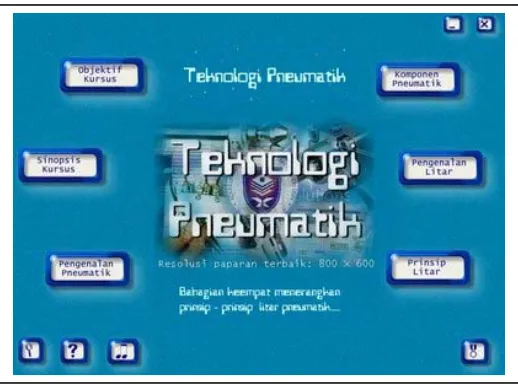
The e-module was in the form of an Compact Disc (CD). User would be given an option of either to run the module directly from CD or to install the module in their personal computer. The module could also be uninstalled from the computer should the user would like to free up some space from their hard drive. The screenshot for the opening menu is shown in Figure 1. The e-module consists of four main sections: The Introduction, Basic Components of Pneumatic Systems, Introduction to Pneumatic Circuits and the Principles of Pneumatic Circuits. Besides, there were also other options such as Navigation Map and Help in case any assistance was required in using the module. The contents of Pneumatics Technology e-module was presented in Malay language to suite the syllabus requirements of the respondents. The screenshot for the main menu of the e-module are as shown in Figure 2.
Figure 1: The opening screen of e-module.
Figure 2: The main menu screen of e-module.
The development of this e-module was based on the ADDIE development model. ADDIE stands for Analysis, Design, Development, Implementation and Evaluation that represents the important phases in developing a good e-module. ADDIE model was used in development of the e-module in this study since it was widely adapted by other courseware designers (Jamalludin Harun et al., 2001). The instructional design of the e-module was following the principles of instructional design written and stated by experts such as Graham (1999), Baharuddin Aris et al., (2002) and Jamalludin Harun et al., (2001). The instructional design was important in ensuring a good design for interface, screen presentation, interactivity and multimedia in the e-module.
[image:3.612.154.413.406.598.2]-
friendliness. Other software packages such as Xara Webstyle 3.1 and Cool MP3 Splitter were used for graphics and sound manipulation. For animation, the writer used Swish 2.0 for creating flash animations for pneumatic circuits animation. All the software mentioned are readily available online. Besides, the software that comes together with the CD Rewritable (CD-RW) Drive called Nero Burning Rom was used for CD Burning.
PROCEDURES OF STUDY
Upon the completion of e-module development, the e-module prototype was verified by content experts in the field of Pneumatics. Comments and suggestions by the experts were taken into account for final amendments of the module. After the module is complete, pilot study was conducted where the e-module together with questionnaire were distributed to ten randomly-picked students to try out and to give their feedback within a week. Then, the questionnaires’ data were entered into a statistical software package called SPSS 10.0 for reliability analysis through the Cronbach score. If the Alpha-Cronbach score is greater than 0.7 then the design of the questionnaire would be considered as good (Gardy, 2002). Otherwise, the questionnaire would have to be updated accordingly until the score exceeds 0.7. After the pilot study was successfully carried out, the actual study will follow with the distribution of verified e-modules and questionnaires set. Data collection process occurred after the respondents had completed the questionnaires set. All the data analysis was done by using SPSS 10.0
statistical packages.
RESULTS OF STUDY
The e-module prototype was sent to content experts prior to actual study. Content experts consist of those who were teaching the Industrial Automation course and experts in related field. The verification of e-module was successfully done where all the experts agree that the e-module prototype was well-designed and well-suited for the learning of students at Diploma level. Besides verification of e-module, results from the pilot study also showed that the questionnaire was reliable since the Alpha-Cronbach score produced was over 0.7 for each sections of questionnaire. Actual study was conducted after the verification of e-module and reliability test for questionnaires were being done successfully. Analysis of data showed that there were 12 female respondents (37.5%) out of all the 32 respondents. The respondents were pursuing Diploma in Mechanical Engineering course at KUiTTHO and all of them does not possess any knowledge about Pneumatics prior to taking the Industrial Automation course.
For Section B to G, the respondents were given numerical options from 1 to 5 on their perception towards the various aspects of the Pneumatics e-module presented to them. They would have to circle a number from 1 to 5 to indicate their preference, with 1 being the “strongly disagree” and 5 being the “strongly agree” option. In the analysis, the number of respondents in each group who had circled 1 and 2 were grouped under the category “disagree” while those who circled 4 and 5 were grouped under the category “agree”. Those who circled 3 were categorized as “neutral”.
The results for Section B on contents revealed that majority of the respondents agreed that the content was comprehensive (87.5%), easy to understand (90.7%), related with the topics they had learned (90.6%) and systematic (96.9%). In terms of examples given in the module, 90.7% of the respondents think that the language used for explanation was simple and understandable, with nearly 85% of them agreed that the contents were free from spelling error. Presentation of module (Section C) includes the presentation of module contents as well as the navigational aspects of the interactive module. All the respondents agreed upon the statement that the learning objectives for the module was clearly written. On overall, 93.8% of respondents perceived that the presentation of contents was good, with systematic arrangement of contents. In terms of navigation, all of them agreed that they had control over the presentation flow of e-module, with the ability to move forward, backward or out of the content. It was discovered that over 90% of respondents felt interesting about the module and 81.3% of respondents felt that the module helped them to do reflections on what they had learnt.
Majority of the respondents also agreed on the suitability of multimedia usage of this module. The items related with multimedia presentation and interactivity were presented in Section D of the module. Of all the respondents, 93.8% of them agreed that the e-module had a good interface design. They also agreed on the suitability of text (90.7%), graphics (87.5%) and colour usage (84.4%) in the e-module. There was a total of 93.7% of respondents agreed that the animation in the e-module did help them to understand the contents. However, only threquarter of them (75%) think that the audio used was suitable in the e-module. On overall, 90.7% of them agreed that there were some degree of interactivity exist between the e-module and the learner.
From the study, respondents also had positive feedback regarding the user friendliness (Section E) of the e-module. There were 93.8% of the respondents think that the e-module was user friendly. They felt that the navigational help in the module was easily understandable (93.8%) and were able to assist them to access the contents they intended (90.7%). On usage manual, the respondents also agreed that usage manual can be easily referred (87.5%) and were helpful for e-module usage (96.9%). In addition, 87.5% respondents also thought that the e-module is stable and not easily “crashed” or “hanged”.
In overall, 85.4% of respondents think that the e-module had assist them in learning. Over 90% of respondents (95%) think that the module is suitable to assist students in learning Pneumatics. Most of them also think that the module can be distributed to students who learn Pneumatics. In the last section of general assessment, respondents were asked about their opinions towards the e-module and whether they would recommend the module in pneumatic education. Feedback showed that most of them were satisfied with e-module presented to them, but improvements still need to be done on the presentation of information in text, graphics and audio used. The results also revealed that most of the respondents would recommend the usage of this e-module as alternative learning material although the e-module still need improvements in various aspects.
DISCUSSIONS AND CONCLUSIONS
The results from the study had been positive. The perception of respondents towards the e-module produced was good in the overall sense. Findings revealed that items related to contents produced good responses. Respondents also had good impressions towards the presentation style, interactivity as well as the blending of multimedia elements into the module, with the exception for audio elements of the module. In terms of user friendliness, respondents were found happy with all the assistance feature of the e-module such as navigational help and user manual embedded inside the e-module.
The results from this study revealed that the e-module produced conforms to the requirement by students in terms of contents, teaching strategies, teaching presentation and software application. Promising results was produced by the study where positive feedback was received regarding the e-module. Based on the feedback, it was believed that the design, contents and presentation of the e-module still have some rooms for improvement. The improvements include adding contents related to Pneumatics such as electro-pneumatics, including more work examples, enhancing interactivity by having interactive quiz or tutorial sections inside the module. Further enhancements in interactivity includes the design of Pneumatics circuit using templates was also feasible. Furthermore, presentation of contents together with English language is also suggested to cope with the translation period of engineering contents from Malay to English language.
On the issue whether the e-module was suitable for the use of students, the e-module was found to be suitable to serve as an alternative learning material that assist the learning of Pneumatics in the subject of Industrial Automation. Respondents had responded that the e-module is suitable in assisting students to learn the subject. However, improvements still need to be done on the e-module to make it better. This includes the presentation of information in text, graphics and audio used. Respondents also commented on the usage of animation, where the animation need to be further enhanced for better presentation. Overall results of the study showed that the study is successful in achieving the objectives stated. The e-module was successfully produced with all the features intended and the evaluation of the e-e-module was carried out successfully.
REFERENCES
Baharuddin Aris, Rio Sumarni Shariffudin & Manimegalai Subramaniam (2002). Rekabentuk Perisian Multimedia. Skudai, Johor Bahru: Publications of Universiti Teknologi Malaysia
Brauer, V. (1998). A collaborative environment for learning pneumatics in real and virtual reality.
http://www.brevie.uni-bremen.de/publications/TAPConcertationJune98/%20ConcertationJune98Paper.html Gardy, G.D. (2002). Assessing the reliability of scales.
http://www.irss.unc.edu/irss/shortcourses/gaddyhandouts/ReliabilityHandouts/reliabilityhandout.pdf Graham, L. (1999). The Principles of Interactive Design. Canada: Delmar Publishing.
Hornecker, E. & Robben, B. (1999). Vocational training with combined real/virtual environments. Paper presented on the 8th International Conference on Human-Computer Interaction, HCI ’99. Vol. 2, 730 – 734.
-
Krejeie, R.V. & Morgan, D.W. (1970). Determining Sample Size for Research. Educational and Psychology Measurement, 30, 607– 610.
Schmudlach, K., Hornecker, E., Ernst, H. & Bruns, F.W. (2000). Bridging reality and virtuality in vocational training. http://www.artec.uni-bremen.de/field1/eugabe/CHI2000.pdf
Noor Azlina Hashim (2002). Kesesuaian Penggunaan Perisian Pendidikan Berbentuk CD-ROM Dalam Proses Pengajaran dan Pembelajaran. Master Thesis. Kolej Universiti Teknologi Tun Hussein Onn.
Norafida Ithnin & Othman Ibrahim (2000). E-pembelajaran secara langsung (live e-learning) dalam pembelajaran maya. Paper Presented at Konvensyen Pendidikan UTM 2000.
Siti Zarida Syed Nordin (2002). Kajian Kesesuaian CD-ROM Interaktif Yang Dibina Bagi Menghasilkan Bahan Pengajaran Teknik dan Vokasional. Master Thesis. Kolej Universiti Teknologi Tun Hussein Onn.
Woo, T.K. (2003). Developing An Engineering Laboratory Work WebCD: Non-Destructive Tests. Master Thesis. Kolej Universiti Teknologi Tun Hussein Onn.
Zaidatun Tasir & Yap Sao Wen (2000). Merekabentuk perisian multimedia berasaskan teori pembelajaran, pendapat tenaga pengajar dan pelajar serta prinsip rekabentuk. Paper Presented at Potensi dan Cabaran Dalam Pembelajaran Maya dan Elektronik.