r . r t h - ! i\i'\ jfti A f s i f i i h t V i - n i » » n r t f i A T A r j v , ' r M . - . V t i . u n ^ b M N L f e i k d u i ^ L A d u R a r u K Y
P E R P U S T A K A A N K U i T T H O
KOLEJ UNIVERSITI TEKNOLOGI TUN HUSSEIN ONN
BORANG PENGESAHAN STATUS TESIS*
JUDUL: DEVELOPING AN ENGINEERING LABORATORY WORK
WEBCD: NON-DESTRUCTIVE TESTS
SESI PENGAJ1AN: 2002/2003
Saya WOO TZE KEONC (780817-08-6137)
(HURUF BESAR)
mengaku membenarkan tesis (PSM/ Saijana/ Doklor Talsafah)* ini disimpan di Perpustakaan dengan syaral-syaral kegunaan seperti berikul:
1. Tesis adalah hakmilik Kolej Universiti Teknologi Tun Hussein Onn 2. Perpustakaan dibenarkan membual salinan unluk tujuan pengajian sahaja
3. Perpustakan dibenarkan membual salina tesis ini sebagai bahan pertukaran antara institusi pengajian tinggi
4. **Sila tandakan (V)
SULIT (Mengandungi maklumal yang berdaijah keselamatan atau kepentingan Malaysia seperti yang termaktub di dalam AK.TA RAHSIA RASMI 1972)
TERHAD (Mengandungi maklumal TERHAD yang telah ditentukan
oleh organisas^adan di mana penyelidikan dijalankan)
(TANDATANGAN PENUL1S)
Alamat Tetap:
NO.38 JALAN PERW1RA 30. TAMAN CICELY MAJU, 36000 TELUKINTAN, PERAK
Tarikh: 28 MARCH 2003
(TANDATANGAN PENYELIA)
Dr. WAHID BIN RAZZALY Nama Penyelia
Tarikh: 28 MARCH 2003
CATATAN: * Potong yang tidak berkenaan.
** Jika tesis ini SULIT atau TERHAD, sila lampirkan sural daripada pihak berkuasa/organisasi berkenaan dengan menyalakan sekali sebab dan tempoh tesis ini perlu dikelaskan sebagai SULIT atau TERHAD.
"Saya akui bahawa saya telah membaca karya ini dan pada pandangan saya karya ini adalah memadai dad segi skop dan kualiti untuk tujuan penganugerahan Ijazah
Saijana Pendidikan Teknik dan Vokasional."
Tan da Tangan
DEVELOPING AN ENGINEERING LABORATORY WORK WEBCD: NON-DESTRUCTIVE TESTS
WOO TZE KEONG
This project has been submitted in partial fulfillment for the award of master of education in technical and vocational
Faculty Of Engineering Technology
Kolej Universiti Tun Hussein Onn
"I hereby testify that this is the work of my own except the quotations and
which each of the sources have been stated out clearly"
Signature
Author's name
DATE
WOO TZE KEONG
iii
EspeciAlty t>ctricAtet> to w w w , &At>, Av»t> a11 At h o m e
I V
ACKNOWLEDGEMENT
The author wishes to take this opportunity to acknowledge Dr. Wahid b. Razzaly, project supervisor, for giving the guidance needed and ensuring the
progress of the project. A big appreciation to him.
Technicians from material testing laboratory KUiTTHO have help in making this project a success. Not forgetting course mates and fellow friends who have been
there to give a word of advice, support and a helping hand. A big thanks to all of
them.
Finally, parents and family members who have been giving a lot of support
and encouragement. Last and not the least, all those who have helped in one way or
V
Abstract
The development of WebCD application has opened a new horizon for
education, especially for an engineering laboratory work where demonstrations of
physical phenomena are require. The use of WebCD in an engineering laboratory
work is beneficial in several ways - providing learners with an economical, safe and simple way to visualize the dynamic behavior and to explore the various aspect of
the actual laboratory work situation. In additional to that, this project is aimed at
identifying the critical success factor for engineering laboratory work. Apart from
that, features needed in a WebCD development are identified so that an engineering laboratory work WebCD can be developed. The engineering laboratory work
WebCD, which was developed based on needs analysis will be evaluated, to examine
the extend to which the product fulfills the needs of students and lecturers.
Questionnaires distribution method is used where questionnaires are designed based
on past researches along with the observations and experiences. 50 students and 10 lecturers from KUiTTHO's engineering department were selected as sample for the
first stage of the project, which is needs analysis. 10 lecturers and 20 students from
KUiTTHO's mechanical engineering departments were selected as samples for the
third stage of the project, which is product evaluation. Through the findings, time management and teaching strategy are the critical success factor for engineering
laboratory work. Non-destructive test is taken as an experimental topic for the
product development, which is based on the needs analysis findings. Through
product evaluation, a conclusion can be arrived at that the product successfully fulfills the needs of students and lecturers in time management and teaching strategy.
However, some recommendations were given by the respondents for further
research. Further research should be done on enhancing the features of the WebCD
such as simulation and chat room. In additional to that, further research on integration of WebCD with an online conferencing should be carried out to further
VI
Abstrak
Pembangunan aplikasi WebCD telah menyumbangkan satu lagi opsyen
dalam pendidikan, terutamanya dalam keija makmal kejuruteraan dimana perlaksanaan secara fizikal diperlukan. Penggunaan WebCD dalam keija makmal
kejuruteraan mempunyai beberapa kebaikan - ia menawarkan kepada pelajar, satu
opsyen untuk mempelajari serta menjelajahi bidang keija makmal kejuruteraan
dengan lebih ekonomi, selamat dan mudah. Usulan daripada itu, objektifprojek ini
adalah untuk mengenalpastikan faktor kejayaan kritikal bagi keija makmal kejuruteraan. Selain daripada itu, ciri-ciri yang diperlukan dalam pembangunan
WebCD dikaji supaya satu WebCD keija makmal kejuruteraan dapat dibangunkan.
Webcd keija makmal kejuruteraan yang telah dibangunkan berdasarkan analisa
keperluan pengguna kemudiannya dinilai untuk mengenalpasti sejauhmanakah product tersebut memenuhi keperluan pelajar serta pensyarah. Kaedah kuantitatif
digunakan dimana borang soal selidik dibangunkan berdasarkan kajian lepasan serta
pemerhatian dan pengalaman. 50 pelajar dan 10 pensyarah daripada jabatan
kejuruteraan KUiTTHO dipilih sebagai sampel kajian pada peringkat pertama iaitu penganalisaan keperluan pengguna. 10 pensyarah serta 20 pelajar daripada jabatan
kejuruteraan makanikal dipilih sebagai sampel untuk peringkat kedua iaitu penilaian
produk. Daripada hasil kajian, didapati pengurusan masa serta strategi pengajaran
merupakan faktor kejayaan kritikal bagi keija makmal kejuruteraan. Ujian tanpa musnah dipilih sebagai topic pembangunan WebCD dimana pembangunan produk
adalah berdasarkan hasil penganalisaan keperluan pengguna. Berdasarkan hasil
penilaian produk, satu kesimpulan dapat dibuat bahawa produk ini telah beijaya
memenuhi keperluan pelajar dan pensyarah dalam keija makmal kejuruteraan. Disamping itu, cadangan telah diutarakan oleh responden bahawa kajian lanjutan
patut dijalankan bagi memumikan lagi ciri-ciri yang terdapat dalam WebCD.
Responden mencadangkan bahawa simulasi dan "chat room" dibangunkan dalam
WebCD untuk meningkatkan lagi ciri-ciri yang ada pada WebCD. Selain daripada itu, kajian lanjutan untuk mengintegrasikan WebCD dengan "online conference"
patut dijalankan supaya proses pembelajaran dan pengajaran dapat dipertingkatkan
VI1
TABLE OF CONTENTS
CHAPTER ITEM PAGE
Dedication iii
Acknowledgement iv
Abstract v
Abstrak vi
Table Of Contents vii
List Of Tables xii
List Of Figures xiv
List Of Appendices xv
I INTRODUCTION 1
1.1 Research Problems 2
1.2 Objective Of The Research 3
1.3 Research Question 3
1.4 Scope Of The Research 4
1.5 Importance Of The Research 5
1.6 Research Constraint 5
1.7 Research Framework 6
1.8 Conceptual And Operational Definitions 7
II LITERATURE REVIEW 8
2.1 Engineering Laboratory Works 8
2.1.1 The Purpose Of Engineering Laboratory
viii
CHAPTER ITEM PAGE
2.1.2 Importance Of Engineering Laboratory
Works 10
2.1.3 Constraint Of Engineering Laboratory
Works 11 2.1.4 Laboratory Work's Management 12
2.2 E-Learning 12
2.2.1 What Is E-Learning 13
2.2.2 Difference Between Conventional
Learning And E-Learning 14
2.2.3 Why E-Learning 14
2.3 Web-Based Learning 15
2.3.1 World Wide Web (WWW) 15
2.4 Multimedia 16 2.4.1 CD-ROM 17
2.5 Webcd 18
2.5.1 Latest Information Access 19
III METHODOLOGY 20
3.1 Introduction 20
3.2 Research Design 20
3.3 Research Samples 22
3.4 Research Instruments 22
3.4.1 Stage One: Needs Analysis 23
3.4.2 Stage Two: Product Development 23
3.4.3 Stage Three: Product Evaluation 24
3.5 Data Collecting Method 24
3.6 Research Procedures 24
3.7 Research Product 25
3.8 Needs Analysis 26
CHAPTER ITEM PAGE
3.8.2 Section B 28
3.8.3 Section C 28
3.8.4 Section D 28
3.9 Product Evaluation 29
3.9.1 Section A 29
3.9.2 Section B 29
3.9.3 Section C 30
3.9.4 Section D 30
3.10 Data Analysis 30
3.10.1 Reliability And Validity 31
3.11 Pilot Test 32
3.12 Research Dimension 32
3.13 Data Analysis Method 32
3.13.1 Percentage 33
3.13.2 Mean Score 33
3.13.3 Negative Statement 34
IV PRODUCT DESIGN AND EVALUATION 35
4.1 Introduction 35
4.2 E-leaming In WebCD 36
4.3 Product Design 37
4.3.1 Needs Analysis Questionnaire Design 38
4.3.1.1 Section A 38
4.3.1.2 Section B 38
4.3.1.3 Section C 39
4.3.1.4 Section D 40
4.3.2 Evaluation Questionnaire Design 41
4.3.2.1 Section A 41
4.3.2.2 Section B 42
4.3.2.3 Section C 43
CHAPTER ITEM PAGE
4.4 Characteristics Of The Product 44 4.4.1 Content In Pre-experiment 45 4.4.2 Content In Experiment 45
4.4.3 Content In Post-Experiment 45
4.5 Developing Instruments 45
4.6 Limitation Of The Product Development 46
V DATA ANALYSIS AND RESEARCH FINDINGS 47
5.1 Introduction 47
5.2 Needs Analysis 48
5.2.1 Section A (Demography) 48
5.2.1.1 Interest In Information Technology 49
5.2.1.2 Personal Computer 50
5.2.1.3 Experiences In Using Interactive
CD-ROM For Teaching And Learning 50
5.2.1.4 Interest In Learning New Things 51
5.2.1.5 Innovations In Learning Process 51
5.2.1.6 Importance Of Computer In Education 52
5.2.2 Section B (Problems Faced By The Students
And Lecturers In Engineering Laboratory
Work Concerning Time Management 53
5.2.3 Section C (Problems Faced By The Students
And Lecturers In Engineering Laboratory
Work Concerning Teaching Strategy 54
5.2.4 Section D (WebCD Content Development) 55
5.3 Evaluation 57
5.3.1 Section A (Content Development) 57
5.3.2 Section B (Teaching Strategy) 58
5.3.3 Section C (Presentation) 60
XI
CHAPTER ITEM PAGE
VI DISCUSSION AND CONCLUSION 62
6.1 Introduction 62 6.2 Discussion 63
6.2.1 Identification Of Critical Success Factor
For Engineering Laboratory Work 63
6.2.1.1 Time Management 63 6.2.1.2 Teaching Strategy 65
6.2.2 Development Of An Engineering Laboratory
Work WebCD 68
6.2.3 Evaluation Of the Engineering Laboratory
Work WebCD 69
6.3 Conclusion 73
6.3.1 Identification Of Critical Success Factor
For Engineering Laboratory Work 73
6.3.2 Development Of An Engineering Laboratory
Work WebCD 74
6.3.3 Evaluation Of the Engineering Laboratory
Work WebCD 74
6.4 Recommendations 75
BIBLIOGRAPHY 76
xii
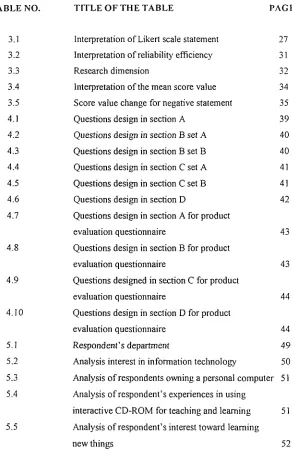
[image:16.601.170.462.235.693.2]LIST OF TABLES
TABLE NO. TITLE OF THE TABLE PAGE
3.1 Interpretation of Likert scale statement 27
3.2 Interpretation of reliability efficiency 31
3.3 Research dimension 32
3.4 Interpretation of the mean score value 34
3.5 Score value change for negative statement 35
4.1 Questions design in section A 39
4.2 Questions design in section B set A 40
4.3 Questions design in section B set B 40
4.4 Questions design in section C set A 41
4.5 Questions design in section C set B 41
4.6 Questions design in section D 42
4.7 Questions design in section A for product
evaluation questionnaire 43
4.8 Questions design in section B for product
evaluation questionnaire 43
4.9 Questions designed in section C for product
evaluation questionnaire 44
4.10 Questions design in section D for product
evaluation questionnaire 44
5.1 Respondent's department 49
5.2 Analysis interest in information technology 50
5.3 Analysis of respondents owning a personal computer 51
5.4 Analysis of respondent's experiences in using
interactive CD-ROM for teaching and learning 51
5.5 Analysis of respondent's interest toward learning
M i l
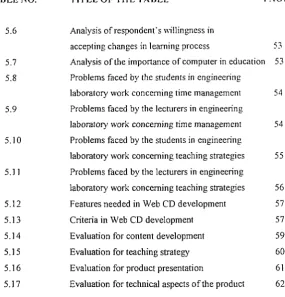
TABLE NO. TITLE OF THE TABLE PAGE
5.6 Analysis of respondent's willingness in
accepting changes in learning process 53
5.7 Analysis of the importance of computer in education 53 5.8 Problems faced by the students in engineering
laboratory work concerning time management 54
5.9 Problems faced by the lecturers in engineering
laboratory work concerning time management 54 5.10 Problems faced by the students in engineering
laboratory work concerning teaching strategies 55
5.11 Problems faced by the lecturers in engineering
laboratory work concerning teaching strategies 56
5.12 Features needed in Web CD development 57 5.13 Criteria in Web CD development 57
5.14 Evaluation for content development 59
5.15 Evaluation for teaching strategy 60
5.16 Evaluation for product presentation 61
X I V
LIST OF FIGURES
FIGURE NO. TITLE OF THE FIGURE PAGE
1.1 Flow chart for conventional engineering
laboratory works 6
X V
LIST OF APPENDICES
APPENDIX NO. TITLE OF THE APPENDIX PAGE
A Questionnaire 79
B SPSS data analysis and findings 85
xii
LIST OF APPENDICES
APPENDIX NO. TITLE O F T H E APPENDIX PAGE
A Questionnaire 79
B SPSS data analysis and findings 85
CHAPTER I
INTRODUCTION
Since the beginning of the globalization era, many fields and sectors
experienced rapid revolution especially in industry and economy sector. These
phenomena indirectly influence Malaysia's technical and vocational educational
system. In the process of development and industrialization. Malaysia needs more
skillful workforces, who are competent not only in on-field knowledge but who also
possess good hands-on skills.
The Ministry Of Education Malaysia took appropriate steps towards the task
of producing quality workforces. As a result, the technical and vocational educational
syllabus was introduced into the secondary school and primary school levels. Besides
that, the teaching and learning system at higher-level education also experienced
changes. Cognitive, psychomotor and affective characteristics were applied to
teaching and learning system of higher-level educational, especially in psychomotor
characteristic. Students were exposed more to hands-on skills through researches and
laboratory work.
However, how has the effectiveness of laboratory work developed the
student's competency? Can conventional teaching and learning of laboratory work
2
Can students that enrolled in distance learning programmes leam from laboratory
experiments effectively?
1.1 Research Problems
Malaysia is marching toward the era of globalization, with the fast development of information and communication technology (1CT). We have to
integrate ICT into our education in order to compete with others. Thus, our students
can benefit more from it. Students can access the best and the latest information
faster and easier without any time and space constraint. With this integration too, the process of teaching and learning will break the conventional barrier that limits the
abilities of accessing and conveying information, knowledge, skills and news.
Integration between ICT and education provides a new platform. At this
point of time, it is still in the early stages in Malaysia whereas other countries have
progressed far beyond. The problem lies in the development of paths and instruments
using appropriate methods. As ICT in education is still a new idea in Malaysia, little
effort is put in to this field with little progress resulting from it.
This research will lead to production of a tool that integrates ICT in
education. A WEB-CD will be produced at the final stage of this research. The
3
1.2 Objective Of The Research
This study aims to identify problems that are faced by engineering students
and lecturers in the process of learning hands-on skills in engineering laboratory work. This study also hopes that a suitable and appropriate solution can be generated. Besides that, a product, in the form of a WEB-CD, a form of e-learning, will be
produced as one of the efforts to overcome the problems stated. To clearly identify the main goal of the research, the main objectives are stated out as below:
i. Identification of critical success factor for engineering laboratory work.
ii. Development of an engineering laboratory work WEB-CD.
iii. Evaluation of the engineering laboratoiy work WEB-CD.
1.3 Research Question
Students are pillars to a country's foundation. They are the ones who will
contribute to the future development of the country. They must be equipped with
competency and experience in order to meet the standards of increasingly
challenging industries. To ensure that our engineering students obtain the adequate
competence, laboratory work has to become a key frame in providing adequate
training on hands-on skills. In order to do so, attention must be paid to the following
questions:
/'. What are the Critical Success Factors for engineering laboratory work?
ii. What are the features and contents needed in the WebCD?
4
These questions must be answered so those engineering students can fully
utilize the knowledge and skill that are obtained in laboratory work. They must not
only have the theoretical knowledge. It is also a priority for them to have the
experience.
Factors that contribute to these problems, whether they result from the
teaching strategy and time management, will be identified in detail so that a method of solution based on the WEB-CD can be used to overcome this problem accurately.
1.4 Scope Of The Research
This research will be conducted in Kolej University Teknologi Tun Hussein
Onn. Lecturers and students from the engineering department in this university
college will be the respondents of this research. The product will consist of several
laboratory works on the Non-Destructive Test.
The research will include feedback on the problems faced by Engineering
Department's lecturers and students. Based on this feedback, a WEB-CD will then
be produced to overcome the problems faced by them. An evaluation process will be