Parameters Affecting the Improvement of Properties
and Stabilities of Immobilized α-amylase on
Chitosan-metal Oxide Composites
V. U. Bindu, A. A. Shanty, P. V. Mohanan*
Department of Applied Chemistry, Cochin University of Science and Technology, India
Copyright©2018 by authors, all rights reserved. Authors agree that this article remains permanently open access under the terms of the Creative Commons Attribution License 4.0 International License
Abstract
Chitosan-metal oxide composites, chitosan- Fe3O4 (CSM) and chitosan-ZnO (CSZ) were synthesizedand intended as suitable supports for immobilization of starch hydrolyzing enzyme, α-amylase. Here α-amylase was chosen as the enzyme to immobilize on these supports due to its wide implementation in industrial applications. The immobilized enzyme, CSZE showed better immobilization yield of 76%, whereas CSME provides high speed and easy separation from the reaction system due to its magnetic property. The quality of the immobilized α-amylases was demonstrated and assessed based on its activity and stability. The immobilized enzymes with higher Ed values provide them more stability towards denaturation compared to free enzyme. At 50°C the thermodynamic parameters such as ∆Hº, ∆Gº and ∆Sº for thermal deactivation of free enzyme were evaluated as 104.29, 12.83 and -0.28 KJ mol-1 respectively and are
found to be higher in case of both immobilized enzymes. The Km values for CSME and CSZE are 0.65 and 0.5mg/mL respectively, which are higher than that of free enzyme (0.45mg/mL). The Vmax of free enzyme is decreased from 34.48μmol mg-1 min-1 to 16.39(CSME) and
23.81 (CSZE) μmol mg-1 min-1 as a result of
immobilization. The immobilized enzymes have exhibited better storage stability over 6 months and retained more than 50% of their initial activities after 10 cycles of reuses.
Keywords
Chitosan-metal Oxide Composite, α-Amylase, Immobilization, Thermal Deactivation, Catalytic Activity, Maltose1. Introduction
Enzymes are biocatalysts having high catalytic activity and excellent selectivity. The use of enzymes in industrial or medical applications has been limited because most
enzymes are relatively unstable and the cost of their isolation and purification is still high. The free enzymes used in solution have inherent susceptibility to protease-catalyzed breakdown [1-2], it is technically very expensive to recover active enzyme from the reaction mixture at the end of a process. Furthermore, in order to purify the product, the enzymes have to be depleted from the reaction solution, whereby they often get inactivated. These drawbacks can be overcome by immobilizing the biocatalysts onto solid supports which enables the easy separation from the reaction system by filtration or centrifugation. In addition, immobilization provide the stability to the enzyme by hindering the opening of the protein molecules and protecting the polypeptide bonds against rupture which leads to the conformational stability in the active sites [3]. The enzyme attained stability due to the formation of numerous hydrogen bonds with amino acid units in its structure [4].
There are several methods for immobilization of enzymes onto various carriers such as adsorption, covalent binding, entrapment or encapsulation. Among this adsorption is the most general, simple to perform and the oldest method. Various materials used as supports for enzyme immobilization have been described in the literatures. Metal oxides such as TiO2 [5], ZnO [6], SnO2 [7]
and Fe3O4 [8] have shown significant attraction towards the
allow the easy separation of the catalyst from the reaction system using an external magnetic field. The magnetic particles possess a high surface area, helps to decrease the diffusion barriers in the transport of the substrate and the reaction products, thereby improving the efficiency of the immobilized enzyme [13].
For the immobilization of the bioactive reagent on to metal oxides, the presence of functional groups on their surface is very important. The surface functionalized materials on immobilization of biomolecules are found to be increased loading capacity and stability. Generally, natural and synthetic polymers are used for the functionalization of the metal oxides [14-16]. In our study we have chosen the biopolymer, chitosan for the surface functionalization of Fe3O4 and ZnO particles. Chitosan is a
naturally occurring polymer which is obtained by the deacetylation of chitin. It is the second most abundant biopolymer after cellulose and consists of 2-amino-2-deoxy-D-glucose units, is joined by β (1→4) linkages. It is one of the most promising immobilization matrices due to several properties such as, hydrophilicity, biocompatibility, biodegradability and antibacterial properties [17-18]. Because of their relatively low production cost and higher adsorption, the preparation of organic-inorganic composites has attracted great interest.
Amylases are the enzymes with attractive industrial applications, which belong to the class of hydrolases. They catalyze the hydrolysis of starch into sugars. In starch processing industries, a large number of commercially available microbial amylases are used for hydrolysis. There have been many reports about the immobilization of amylase and much research has focused on developing polymer based supports [19-24]. α-amylases (1, 4-α-D-glucan-glucanohydrolase) have more importance in the field of biotechnology with applications ranging from food, fermentation, detergent, paper and textile industry [25]. The use of immobilized α-amylase in these industries will reduce the cost of overall enzyme as it can be reused several times, ultimately affect positively their economy. Therefore in this study, we aimed to immobilize α-amylase onto chitosan-metal oxide composites, chitosan-Fe3O4
(CSM) and chitosan-ZnO (CSZ). To the best of our knowledge, this is the first report on α-amylase immobilization on these organic-inorganic composites. We have done the enzyme immobilization studies on these two composites. In case of CSZ composite, as a result of centrifugation, undesirable dilution of the sample and the loss of carrier during washing, complicate its usage. Support with magnetic core, CSM composite is chosen to avoid these problems. It can be used favourably for high speed separation and for the elimination of mechanical damage by centrifugation. Various parameters such as pH, temperature, contact time and amount of enzyme required for immobilization were optimized so as to acquire immobilized enzyme with maximum activity and stability. The kinetics of the hydrolysis reaction was studied at
various substrate concentrations and the kinetic parameters (Km and Vmax) were calculated from the Lineweaver -Burke plot. Performance of thermal deactivation at different temperatures on free and immobilized enzymes has done and thermodynamic parameters were evaluated by determining the deactivation energy and deactivation constant. Thermal stability, reusability and storage stability of the immobilized enzymes were also studied.
2. Materials and Methods
2.1. Materials
Diastase α-amylase (1,4 α-D-glucanglucanohydrolase, EC 3.2.1.1) was acquired from Himedia Laboratories Pvt Ltd, Mumbai. Soluble Starch (potato) was obtained from S.D. Fine-Chem. Ltd, Mumbai. Chitosan (95% degree of deacylation) was purchased from Meron marine chemicals, Cochin. All other chemicals used were in analytical grade.
2.2. Synthesis of Composites
2.2.1. Chitosan-Fe3O4 (CSM) composite
Chitosan-Fe3O4 (CSM) composite was synthesized by
reduction–precipitation process, based on the already reported method with slight modification, in which glutaraldehyde was added as the cross-linking agent instead of epoxy chloropropane [26]. About 70mL FeCl3
solution (0.13 mol L-1 in 0.13 mol L-1 HCl) was added into
50mL of 2% chitosan solution in 1% HCl under continuous stirring for 1h. Then 30mL 0.1M Na2SO3 solution was
added into the colloidal solution and the mixed solution was poured quickly into 40mL of 12% (v/v) ammonia solution under vigorous stirring at room temperature. The black precipitate suspension obtained immediately. After that, 5mL glutaraldehyde (25%) was added to the suspension and stirred for 3hrs in water bath at 60ºC in order to stabilize the particles in acid solution. The black precipitate collected with the aid of a magnet and washed several times with distilled water, ethanol and acetone respectively, then dried in vacuum oven at 60°C.
2.2.2. Chitosan-ZnO (CSZ) composite
added drop by drop until the solution reached pH 10. The solution was placed in a water bath at 80⁰C for about 3hrs. The precipitate obtained were filtered, washed with distilled water several times and then dried in an oven at 50⁰C for 1hr [28].
2.3. Characterization of Composites
The composites were characterized by FT-IR spectrometry using JASCO FT/IR-4100. Bruker AXS D8 Advance is used for XRD analysis. The TEM images of composites were taken by JEM 2100 having 0.24nm resolution with an acceleration voltage of 200kV. Thermograms were obtained Perkin Elmer, Diamond TG/DTA. The surface areas of both the composites were measured using a surface area analyzer (TriStar II 3020 V1.04), plotting nitrogen adsorption isotherms at liquid nitrogen temperature.
2.4. Immobilization of α-amylase
The immobilization of α-amylase was performed by stirring 1g of each of the composites with enzyme in buffer at room temperature. The immobilization parameters like pH, time and the amount of enzyme for immobilization were optimized. The pH of the immobilization medium varied from 5 to 9, the incubation time varied in the interval from 30- 150 minutes and the enzyme concentration from 2 to 20mg enzyme g-1 support. The biocatalyst then filtered
and washed with the same buffer solution. The supernatant and washings were subjected to protein estimation using Folin Ciocaltaue’s reagent by measuring the absorption at 660nm in a Thermo Scientific Evolution 201 UV-Visible spectrophotometer [29]. The prepared immobilized enzymes were kept in a refrigerator at 4°C for further studies. Immobilization yield (IY) was calculated (Eq. (1)) by measuring the difference in protein concentration of the supernatants after and before immobilization.
Immobilization Yield, 1 2 % 100 1 C C IY X C −
= (1)
Where C1 is the concentration of protein introduced for immobilization and C2 is concentration of protein present in the supernatant after immobilization.
The activity yield (Eq. (2)) was determined by measuring the activity of the immobilized enzyme and the activity of the initial enzyme used in the immobilization reaction.
( %) Activity of immobilized enzyme ActivityYield AY
Activity of free enzyme
=
(2) Immobilization efficiency was calculated using Eq. (3).
% AY 100 IE X
IY
= (3)
2.5. Determination of Activity of Free and Immobilized α-amylase
The activity of free and immobilized α-amylase were determined by the detection of released reducing sugars from starch using 3, 5-dinitrosalicyclic acid (DNS). The enzymatic reaction was carried out by adding 1 mL of free α-amylase (0.5 mg/mL) or 0.05g of immobilized enzyme to 1mL of 1% starch solution in desired buffer and the system was incubated in a water bath with constant shaking at 30°C for exactly 15 min. The reaction was stopped by adding 1 mL of 3, 5-dinitrosalicylic acid reagent. Incubation was performed in a boiling water bath for 5 min and cooled the reaction tubes to room temperature. The amount of reduced sugar (maltose) produced was determined spectrophotometrically at 540nm [30]. An enzyme activity unit (EU) was defined as the amount of enzyme liberating 1μmol maltose per minute under the assay conditions.
2.6. Optimization of Immobilization Parameters
The optimum pH for maximum activity of free and immobilized enzymes (CSME and CSZE) was assayed by incubating the enzyme with starch over a pH range 5- 9 at 30°C. The temperature for maximum activity was also assayed by varying the temperature from 30- 60°C. In order to test the thermal stability of free and immobilized enzymes, they were subjected to various temperatures ranging from 30- 70°C for 1hour in a water bath. After 1hour of pre-incubation both free and immobilized enzymes in buffer were cooled to optimum temperature and enzymatic reaction was performed with the addition of definite amount of 1% starch solution to each reaction medium for a definite time interval.
2.7. Thermal Deactivation Study
2.7.1 Kinetic study and estimation of Deactivation energy Study on kinetics was conducted by incubating the free and immobilized enzymes at different temperatures in the absence of starch substrate. After definite time intervals, the enzyme activity assay was done and the residual activity expressed in terms of percent of initial activity. The slope of the logarithmic plot of percent residual activity versus time gives the deactivation constant (kd) and the deactivation energy (Ed) was calculated from the slope of Arrhenius plot drawn between ln kd and reciprocal of temperature, 1/T (K) using Eqn. (4),
Ed Slope
R −
= (4)
2.7.2. Estimation of thermodynamic parameters
H
Ed RT
∆ ° =
−
(5). ln . B kd h G RT k T
∆ ° = − (6)
H G S
T
∆ ° − ∆ °
∆ ° = (7)
Where Ris the universal gas constant, Tis the absolute temperature (K), h is the Planck constant, and kB is the
Boltzman constant.
2.7. Determination of Kinetic Constants
The kinetic parameters were determined by measuring the rates of the reaction at various substrate concentrations ranging from 0.2 to 1.0 mg/mL at optimum temperature and pH. Michaelis constant (Km) and maximum rate (Vmax) were calculated from the Lineweaver - Burk plot. This double-reciprocal plot, 1/V0 as a function of 1/[S0]
gives the y-intercept representing the inverse of Vmax and thex-intercept of the plot as −1/km.
2.8. Reusability and Storage Stability
The reusability of the immobilized enzyme was examined by repeated batch experiments maintaining a couple hours in each cycle. The residual activity of immobilized enzymes at its optimum conditions was measured at fixed time intervals. After each run, the immobilized enzyme was removed, washed with buffer solution and mixed with fresh substrate solution. The reaction was carried out continuously for 10 cycles. The storage stability of immobilized enzymes was studied by calculating their activities after being stored at 4°C in buffer solution for 6 months. The measurement was conducted at regular intervals of time. The activity was compared with initial activity and was represented as percentage relative activity.
3. Results and Discussion
3.1. The Spectral Analysis of Prepared Composites
In the infrared spectrum (supplementary data- Appendix A) of chitosan-magnetite (CSM) composite, the absorption band at 3310 cm−1 was attributed to the combined peaks of
amino (-NH2) and hydroxyl (-OH) groups stretching
vibration and the bands at 1614 cm-1 and 1514 cm-1 were
related to the C=O stretching vibration of amide and the bending vibration of -NH2 groups respectively. The
absorption band at 1056 cm−1 represented the C-O
stretching vibration of primary alcoholic group in chitosan. In case of chitosan-ZnO (CSZ) composite, the above absorption bands are at 3419, 1610, 1515, 1050 cm−1
respectively. These absorption bands are slightly shifted to
lower vibrational frequency when compared to the IR spectrum of chitosan particle in which they are at 3429, 1644, 1540 and 1074 cm−1 respectively. This indicates that
the amino and the hydroxyl groups on chitosan were involved in complexation with the metal oxide. IR spectrum of CSM composite exhibits a strong adsorption band at 576 cm−1 corresponding to the Fe-O bond vibration
of Fe3O4. The electrostatic interaction between positively
protonated chitosan and surface negative charged Fe3O4
also contribute to this IR change. It means that Fe3O4 is
coated by chitosan and no chemical bonding between chitosan and Fe3O4 was formed. The IR spectrum of CSZ
composite shows a new broad absorption band at the range 590- 560 cm-1 was found which is ascribed to the stretching
vibration of N-Zn and O-Zn groups.
The TGA curve (supplementary data- Appendix B) for pure chitosan particles (CS nano) exhibited a weight loss of 5% below 100°C and a rapid and main weight loss at 250– 500°C, referring to the removal of physically adsorbed water and the thermal degradation of the pure chitosan, respectively. No significant weight change was observed above 500°C. However, the TGA curve of CSM composite was very different from that of the pure chitosan. Three stages of weight loss were observed in the TGA curve of CSM composite. The first stage was about 8% weight loss from room temperature to 200°C, as a result of the evaporation of adsorbed water. The other two stages of main weight loss at 200–400°C and 600–730°C were caused by the decomposition of primary chains of biopolymer and cross-linking chitosan with metal oxide respectively. The conformational changes of chitosan and the additional bridging between Fe3O4 and chitosan
enhanced the thermal stability of chitosan in CSM composite [26]. Thus, the final temperature of decomposition for CSM composite was higher than that for the pure chitosan. The similar TGA curves have also been reported [31]. In case of CSZ composite, there are three stages of weight loss observed. The initial stage of weight loss from room temperature to 200°C is due to the evaporation of adsorbed water. The other two stages of weight loss at 250°C – 400°C and 600°C -730°C are due to the decomposition of primary chains of biopolymer and cross-linking of metal oxide with the biopolymer respectively. At the end of the heating it was found that the total weight % of the composite with around 55%. From this it is clear that the thermal stability of the composite is higher than that of pure chitosan. Addition of ZnO paricles into the chitosan matrix increases the thermal stability due to the strong interaction between ZnO and chitosan. Similar observations have been reported [32].
corresponding to (220), (311), (400), (422), (511), and (440) crystal planes of face centred cubic Fe3O4 respectively
(JCPDS File No: 75-0033). These revealed that the crystal structure of Fe3O4 in CSM composite prepared with the
reduction–precipitation method was a cubic spinel structure [33]. Diffraction peaks in XRD pattern of CSZ composite are sharper and stronger at 31.7°, 34.36°, 36.2°, 56.59°, 62.7°, and 67.90° and were assigned to the (1 0 0), (0 0 2), (1 0 1), (1 1 0), (1 03), and (1 1 2) planes of hexagonal zinc oxide can be indexed to the wurtzite ZnO with high crystallinity. All the diffraction peaks are in good agreement with those of hexagonal wurtzite structure of ZnO (JCPDS card 36-1451). The particle sizes can be quantitatively evaluated from the XRD data using the Debye–Scherrer equation which gives a relationship between peak broadening in XRD and particle size:
/ cos
d k
=
λ β
θ
Where d is the particles size, k is the Debye–Scherrer constant (0.89), λ is the X-ray wavelength (0.15406nm) and β is the full width at half maximum, θ is the Bragg angle. According to the Debye-Scherrer equation, the particle size of the chitosan coated Fe3O4 particles is 30nm
and that of the chitosan coated ZnO particles is 25.8nm. The transmission electron microscope photographs of composites were shown in the supplementary material (Appendix D). The images are not agglomerated since polymer is incorporated with the metal oxides. The average size was 20 and 30nm respectively for CSZ and CSM which were close agreement with the values obtained from XRD characterization.
The surface areas of composites were 1.99 and 2.4 m2/g
for CSM and CSZ respectively.
3.2. Immobilization Conditions
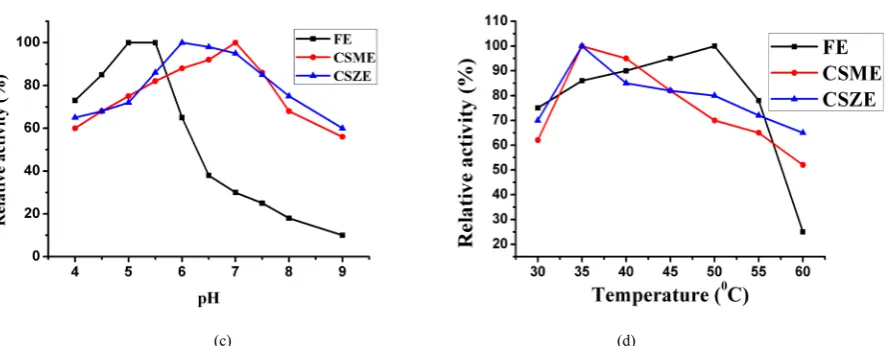
To find out the optimum immobilization condition for the enzyme, we have investigated the effect of pH of the immobilization medium, contact time of support and amount of enzyme taken for immobilization. The retained activity of the immobilized enzymes was recorded and the results were designated in terms of relative activity. The effect of solution pH during immobilization process was given in Figure 1a. Both of the immobilized enzymes, CSME and CSZE have shown maximum activity at pH 6. The isoelectric point of α-amylase is around 4.6 and the amino group in chitosan has a pKa value of about 6.5. At pH 6, the amino groups of chiotsan have net positive charge and these amino groups attract the enzyme molecule which has negative charge. This is due to the significant electrostatic interaction between the supports and the enzyme. When the immobilization is carried out at higher pH, the enzyme activity found to be decreased. This is because at higher pH both the enzyme and the chitosan having net negative charge which results in the electrostatic repulsion.
The effect of contact time on the activity of immobilized enzyme was given in the Figure 1b. The figure illustrates that the activity of the immobilized enzyme increased with contact time of enzyme and support. The highest activity is obtained at 120 and 90 min for CSME and CSZE respectively. The decrease in the immobilized enzyme activity can be due to the formation of a disordered multilayer or formation of multiple bonds which deformed the active site of the enzyme [34].
(c) (d)
[image:6.595.78.515.326.388.2]Figure 1. (a) Effect of pH of immobilization medium on the relative activity of immobilized α-amylases, buffers used are acetate buffer (5-5.5), phosphate buffer (6-8) and glycine buffer (8.5-9) (b) Effect of contact time on immobilized enzymes activity. (c) Effect of reaction pH on the activity of free and immobilized α-amylases. (d) Effect of temperature on activity of free and immobilized enzymes.
Table 1
.
Immobilization yield, activity yield and immobilization efficiency of α-amylase loaded on CSM and CSZ composites. The enzyme was immobilized on different supports at various initial concentrations at optimum experimental conditions.Support protein Initial (mg)
Immobilized protein mg/g
support
IY (%)
Initial activity
(EU)
Immobilized enzyme activity
(EU)
AY
(%) (%) IE
CSM 12.6 7.2 57.14 23.49 10.28 43.76 76.58
CSZ 14.2 10.8 76.05 26.06 13.7 52.57 69.12
The effect of protein loaded on the activity of immobilized enzymes were investigated and shown in the figure (supplementary material-Appendix D1). As the enzyme concentration increases, the amount of enzyme immobilized on the support increased and then reached a saturation point indicating a saturated monolayer formation. Thereafter both the enzyme loading and activity decreases denoting the multilayer adsorption. The decrease in the activity after the saturation point is due to the changes in the conformations of the enzyme or the steric hindrance caused by the support at the active site [35]. The results are depicted in the figure (supplementary material-Appendix D2). The immobilization yield, activity yield and immobilization efficiency were evaluated and the results are given in the table1.
3.3. Activity of Enzymes
3.3.1. Effect of pH and Temperature on the Activity of Free and Immobilized α-amylases
The pH of the immobilization medium will affect the distribution of the ionic groups on the enzyme surface and the net charge on the enzyme, also to the reactivity of the catalytically active groups. The change in pH may cause the denaturation of the protein structure and the loss of activity. We have studied the effect of pH on the activity of free and immobilized enzyme and are shown in the Fig. 1c. The free enzyme showed its maximum activity for starch hydrolysis in the range of pH 5–5.5. From the figure it is
clear that for immobilized enzyme, CSME the maximum activity at pH 7 and for CSZE the optimum activity at pH 6. The optimum pH of the immobilized enzymes shifted to the alkaline region which is due to the unequal partitioning of the H+ and OH− ions between the microenvironment of
the immobilized enzyme and the bulk phase due to the electrostatic interactions with the matrix [36]. The effect of pH on the enzyme activity is expressed on the basis of external solution pH, which in these cases increases, the pH optimum shifts to the alkaline region. The results showed improved stability of the immobilized enzymes at higher pH values than the free enzyme. Similar observations, for immobilization of α-amylase on glutaraldehyde-agarose support have been reported [37].
higher temperature. The decrease in activity of α-amylase at high temperature was reported when immobilized on chitosan–clay composite [38].
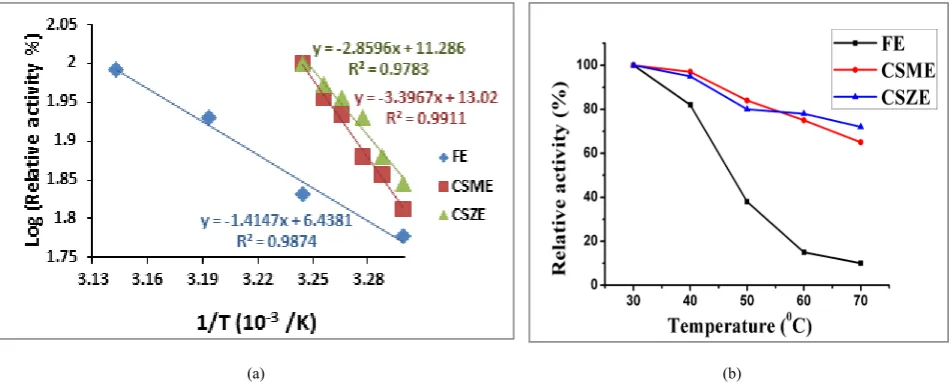
Arrhenius plot was drawn between log relative activity (%) and 1/T in order to estimate activation energy, Ea (figure 2a). The values were found to be 11.75, 28.23 and 23.77 KJmol-1 for free α-amylase, CSME and CSZE
respectively. The decline in the activation energy of enzyme might be due to its reduced conformational flexibility as a result of immobilization. Similar observation was reported when α-amylase immobilized on coconut fiber support [39].
3.4. Thermal Stability
Thermal stability is one of the most important properties of enzymes for different industrial applications. We have studied this property over the range of 30–70⁰C by pre-incubating the free and immobilized enzymes in buffer for 60 min followed by enzyme reaction at optimum temperature. The results are depicted in the figure 2b, which shows that the immobilized enzymes exhibited enhanced heat resistance than free enzyme. This emphasizes the rate of deactivation is lowered as a result of immobilization. The thermal denaturation might be as a result of unfolding of protein structure that is hindered due to immobilization, since the immobilization brings about a restriction in the free movement of enzyme. After 1 hr pre-incubation at 50⁰C, only less than 50% of the free enzyme remained active whereas 80–85% of the immobilized enzymes retained their activity. At 70⁰C the
free enzyme lost almost 90% of its activity, whereas immobilized enzymes lost 25-30%. From the figure it is clear that stability at higher temperature is more for the immobilized enzyme, CSZE. The gentle decline in the enzyme activity of CSME, may be due to the influence of iron core on the biological activity of the enzyme [40].
3.5. Kinetics of Thermal Deactivation and Estimation of Deactivation Energy
The thermal deactivation study of free and immobilized enzymes was performed at various pre-incubation times and the corresponding relative activity was determined. The plot of log relative activity (%) versus time describes the first order thermodynamics[41] and depicted in supplementary material (Appendix E). The deactivation energy (Ed) of free and immobilized enzymes were determined from the slopes of the linear curve plotted between ln(kd) and1/T (figure 3a). The Ed for free α-amylase, CSME and CSZE are found to be 15.52, 18.71 and 23.49 KJ mol-1 respectively. Higher the Ed values for
immobilized enzymes described that more energy was required for thermal deactivation and provide them higher stability towards denaturation compared to free enzyme. Since the thermal stability of the enzyme is the important parameter for industrial applications, the higher Ed values as a result of immobilization made them as a potential candidate [42]. The increased Ed value of α-amylase was observed when modified with bovine serum albumin [43].
[image:7.595.61.537.462.655.2](a) (b)
(a) (b)
Figure 3. (a)Arrhenius plot to calculate deactivation energy (Ed) (b)Lineweaver-Burk plot for evaluation of Km and Vmax for free and immobilized enzymes, where [V0] is rate of the reaction and [S0] is substrate concentration
3.6. Estimation of Thermodynamic Parameters
The enthalpy change (∆Hº) at 50 ºC for free enzyme was found to be 12.83 KJmol-1 and for immobilized enzymes,
CSME and CSZE was 16.02 and 20.81 KJmol-1
respectively (table 2). The high ∆Hº values of immobilized enzymes showed that more energy is required for the thermal denaturation of enzyme as a result of immobilization [44]. It is clear that in both cases the values were decreased with the rise of temperatures indicated that lesser amount of energy is needed to denature the enzyme at high temperatures, but the decrease is more for immobilized enzymes. There is considerable conformational change caused by the enzyme at higher temperatures which leads to the decrease of enthalpy change [45].
The Gibbs free energy change (∆Gº) for thermal deactivation at 50ºC of free enzyme, CSME and CSZE are 104.59, 107.05 and 109.20 KJmol-1 respectively and are
given in the table 2. The high ∆Gº value of immobilized enzymes confirmed that the thermal unfolding at high temperatures is controlled by the immobilization process and resistance towards the thermal denaturation measures the increase of their stability [46]. The ∆Gº values describe the spontaneity of the thermal deactivation processes and the positive values indicate the non-spontaneous nature of the processes.
The entropy of deactivation is related to the thermal unfolding of the enzyme structure. The ∆Sº values for both free and immobilized enzymes were found to be negative indicated the processes of their aggregation and more ordered state (table 2). But the magnitude of the value for immobilized enzyme is found to be lower as compared to the free from and the less negative values indicated their ordered state which might be raised as a result of
immobilization. Due to the improvement in the ordered state, the stability of the enzyme is enhanced as it provides stronger intermolecular forces [47].
Table 2. Thermodynamic parameters for thermal deactivation study of free and immobilized enzymes at different temperatures.
Temperature Enzyme ∆GºKJmol-1 ∆HºKJmol-1 ∆SºKJmol-1
FE 104.59 12.83 -0.2839
50ºC CSME 107.05 16.02 -0.2817
CSZE 109.20 20.81 -0.2735
FE 107.41 12.75 -0.2841
60ºC CSME 109.83 15.94 -0.2818
CSZE 112.11 20.72 -0.2743
FE 110.28 12.67 -0.2844
70ºC CSME 112.69 15.85 -0.2822
CSZE 114.67 20.64 -0.2740
Table 3. Kinetic constants Km and Vmax of free and immobilized α-amylases, calculated from Lineweaver- Burke plots. The enzymatic reaction was carried out at optimum pH and temperature with varying starch concentration from 0.1 to 1 mg/mL
Free enzyme CSM CSZ Km(mg/ml) 0.45± 0.02 0.65± 0.03 0.5±0.04 Vmax (μmol
mg-1 min-1) 34.48±0.05 16.39±0.04 23.81±0.02
3.7. Kinetic Constants
[image:8.595.304.540.393.563.2]of Km and Vmax for free and immobilized enzymes were shown in the figure 3b. Vmax indicates the intrinsic characteristics of the enzyme and Km is a measure of the substrate’s affinity for the enzyme. In our study, the Km values were increased for all immobilized forms compared to the free enzyme. The Km values were calculated for the immobilized enzymes, CSME and CSZE are 0.65 and 0.5mg/mL respectively, which are higher than that of free enzyme (0.45mg/mL). This can be interpreted that increase in Km value is due to the conformational changes of the immobilized enzymes, leads to the lower affinity for substrate compared to the free enzyme. Similar results were reported when α-amylase immobilized onto DEAE-cellulose [48]. The decrease in affinity towards substrate is caused by the structural changes introduced in the enzyme by immobilization procedure and hence resulted in the lower the accessibility of the substrate to the active sites of the immobilized enzyme[49]. On the other hand, Vmax measures the potential of the catalytic activity follows the opposite trend. As seen from the table 3, the Vmax for the free enzyme is calculated as 34.48 μmol mg-1
min-1 and for CSME and CSZE as 16.39 and 23.81μmol
mg-1 min-1 respectively. As a result of immobilization
Vmax decreases, the loss of activity may be due to the conformational changes of the enzyme on immobilization or steric hindrance of the enzyme molecule caused by diffusional limitation of the support [50].
3.8. Reusability and Storage Stability
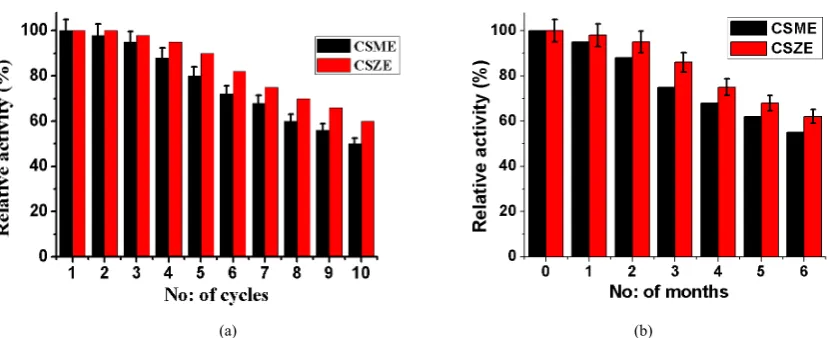
Reusability is the most important advantage of an immobilized enzyme compared to the free enzyme, since it reduce the cost of enzymes for an enzymatic reaction. We investigated the reusability of the two immobilized enzymes maintaining a couple hours in each cycle. The relative activities of the immobilized enzymes for ten cycles of use at optimum conditions were shown in the fig.4a. The figure showed the decreasing tendency of the activity of immobilized enzyme with the reuses. The decreasing activity is caused by the denaturation of the of the immobilized enzyme molecule upon use. The immobilized enzyme, CSZE maintained 90% activity after 5 runs and was about 60% of activity even after 10 cycles of uses and further washing. But CSME retain only 50% of activity after l0 runs. It is very easy to handle the immobilized enzyme, CSME in reuse experiments as it can be recovered by magnetic separation in each cycle because of its magnetic property.
The industrial application for enzymes requires that they could be maintained for long periods. In order to compare the efficiency in storage, the free and immobilized enzymes were stored in buffer at 4⁰C. The free enzyme lost all of its activity within 2 days, while the immobilized enzymes retained activity more than that of free enzyme [9]. The results are depicted in the figure 4b. After storage of 6 months CSZE retained about 60% of its initial activity, while that of CSME was 50%. The loss of activity of the immobilized enzyme, CSME may be caused by the toxic influence of iron ions [40].
[image:9.595.83.498.470.639.2](a) (b)
4. Conclusions
Chitosan-metal oxide composites, CSM and CSZ were synthesized, characterized and subjected to α-amylase immobilization. In our study the enzyme loading ability of CSZ composite found to be more than that of CSM composite. This is attributed to the higher surface area of CSZ compared to the CSM composite. Because of the magnetic property, CSM composite provides us with the best support for high speed and gentle separation. Both of the immobilized enzymes exhibited good thermal stability compared to the free enzyme. The thermal deactivation study followed first order kinetics and the deactivation energy, Ed was found to be higher for immobilized enzymes. Thermodynamic parameters ∆Hº, ∆Gº and ∆Sº were evaluated and revealed that the enhanced stability at high temperatures is due to the immobilization process. The kinetic study showed that the lower substrate affinity of the immobilized enzymes in enzymatic reaction compared to the free enzyme attributed to the conformational change of native enzyme upon immobilization. Reuse assay and studies on pH, temperature and storage stabilities confirmed that the immobilized enzymes are suitable for many industrial applications.
Acknowledgements
The author is thankful to UGC for financial support.
Supplementary Data
Appendix A
FT- IR Spectrum of chitosan, CSM and CSZ
Appendix B
Thermograms of chitosan, CSM and CSZ
Appendix C
1. XRD Spectrum of CSM composite
Appendix D
1. TEM image of CSM composite
2. TEM image of CSZ composite
Appendix E
1. Effect of initial protein amount on protein loading.
2. Effect of initial protein concentration on immobilized enzyme activity.
Appendix F
2. First order of thermal deactivation of CSME
3. First order of thermal deactivation of CSZE
REFERENCES
[1] A. Fishman, I. Levy, U. Cogan, O. Shoseyov, Stabilization of horseradish peroxidase in aqueous-organic media by immobilization onto cellulose using a cellulose-binding-domain, Journal of Molecular Catalysis B: Enzymatic 18(1–3) (2002) 121-131.
[2] N. Lin, L. Gao, Z. Chen, J.H. Zhu, Elevating enzyme activity through the immobilization of horseradish peroxidase onto periodic mesoporous organosilicas, New Journal of Chemistry 35(9) (2011) 1867-1875.
[3] C. Altinkaynak, S. Tavlasoglu, N. Özdemir, I. Ocsoy, A new generation approach in enzyme immobilization: Organic-inorganic hybrid nanoflowers with enhanced catalytic activity and stability, Enzyme and Microbial Technology 93–94 (2016) 105-112.
[4] C. Mateo, J.M. Palomo, G. Fernandez-Lorente, J.M. Guisan, R. Fernandez-Lafuente, Improvement of enzyme activity, stability and selectivity via immobilization techniques,
Enzyme and Microbial Technology 40(6) (2007) 1451-1463.
[5] L. Wu, S. Wu, Z. Xu, Y. Qiu, S. Li, H. Xu, Modified nanoporous titanium dioxide as a novel carrier for enzyme immobilization, Biosensors and Bioelectronics 80 (2016) 59-66.
[6] F. Miao, X. Lu, B. Tao, R. Li, P.K. Chu, Glucose oxidase immobilization platform based on ZnO nanowires supported by silicon nanowires for glucose biosensing, Microelectronic Engineering 149 (2016) 153-158.
[7] M. Guncheva, M. Dimitrov, D. Zhiryakova, Nanosized tin dioxide — Unexplored carrier for lipase immobilization, Catalysis Communications 16(1) (2011) 205-209.
[8] D.-G. Lee, K.M. Ponvel, M. Kim, S. Hwang, I.-S. Ahn, C.-H. Lee, Immobilization of lipase on hydrophobic nano-sized magnetite particles, Journal of Molecular Catalysis B: Enzymatic 57(1–4) (2009) 62-66.
[9] N. Antony, S. Balachandran, P.V. Mohanan,
Immobilization of diastase α-amylase on nano zinc oxide, Food Chemistry 211 (2016) 624-630.
B. Danielsson, Selective determination of urea using urease immobilized on ZnO nanowires, Sensors and Actuators B: Chemical 160(1) (2011) 637-643.
[11] N. Srivastava, J. Singh, P.W. Ramteke, P. Mishra, M. Srivastava, Improved production of reducing sugars from rice straw using crude cellulase activated with Fe 3 O 4/Alginate nanocomposite, Bioresource Technology 183 (2015) 262-266.
[12] L. Yang, Y. Guo, W. Zhan, Y. Guo, Y. Wang, G. Lu, One-pot synthesis of aldehyde-functionalized mesoporous silica-Fe 3 O 4 nanocomposites for immobilization of penicillin G acylase, Microporous and Mesoporous Materials 197 (2014) 1-7.
[13] G. Yucebilgic, N. Gulesci, D. Yildirim, Immobilization and characterization of urease onto different spacer arms attached magnetic nanoparticles, New Biotechnology 33, Supplement (2016) S104.
[14] F.N. Crespilho, R.M. Iost, S.A. Travain, O.N. Oliveira Jr, V. Zucolotto, Enzyme immobilization on Ag nanoparticles/polyaniline nanocomposites, Biosensors and Bioelectronics 24(10) (2009) 3073-3077.
[15] M.A. Rahman, U. Culsum, A. Kumar, H. Gao, N. Hu, Immobilization of a novel cold active esterase onto Fe3O4∼cellulose nano-composite enhances catalytic properties, International Journal of Biological Macromolecules 87 (2016) 488-497.
[16] J. Shan, L. Wang, Z. Ma, Novel metal-organic nanocomposites: Poly(methylene blue)-Au and its application for an ultrasensitive electrochemical immunosensing platform, Sensors and Actuators B: Chemical 237 (2016) 666-671.
[17] H. Susanto, A.M. Samsudin, N. Rokhati, I.N. Widiasa, Immobilization of glucose oxidase on chitosan-based porous composite membranes and their potential use in biosensors, Enzyme and Microbial Technology 52(6–7) (2013) 386-392.
[18] B.R. Facin, B. Moret, D. Baretta, L.A. Belfiore, A.T. Paulino, Immobilization and controlled release of β-galactosidase from chitosan-grafted hydrogels, Food Chemistry 179 (2015) 44-51.
[19] E. Cakmakcı, A. Beyler Cigil, O. Danıs, S. Demir, M. Kahraman, Immobilization of alpha-amylase on aminated polyimide membrane: Preparation, characterization, and properties, Starch - Starke 66 (2014) 3-4.
[20] F. Wang, Z. Gu, Z. Cui, L. Liu, Comparison of covalent immobilization of amylase on polystyrene pellets with pentaethylenehexamine and pentaethylene glycol spacers, Bioresource Technology 102(20) (2011) 9374-9379. [21] A.L. Cordeiro, T. Lenk, C. Werner, Immobilization of
Bacillus licheniformis α-amylase onto reactive polymer films, Journal of Biotechnology 154(4) (2011) 216-221. [22] B. Oktay, S. Demir, N. Kayaman-Apohan, Immobilization
of α-amylase onto poly(glycidyl methacrylate) grafted electrospun fibers by ATRP, Materials Science and Engineering: C 50 (2015) 386-393.
[23] V.U. Bindu, P.V. Mohanan, Enhanced Stability of α-Amylase via Immobilization onto Chitosan-TiO2
Nanocomposite Nanosci Technol. 4(2) (2017) 1-9. [24] Y. Yang, H.A. Chase, Immobilization of α‐amylase on poly
(vinyl alcohol)‐coated perfluoropolymer supports for use in enzyme reactors, Biotechnology and applied biochemistry 28(2) (1998) 145-154.
[25] J. Jiang, Y. Chen, W. Wang, B. Cui, N. Wan, Synthesis of superparamagnetic carboxymethyl chitosan/sodium alginate nanosphere and its application for immobilizing α-amylase, Carbohydrate Polymers 151 (2016) 600-605. [26] C. Cao, L. Xiao, C. Chen, X. Shi, Q. Cao, L. Gao, In situ
preparation of magnetic Fe3O4/chitosan nanoparticles via a novel reduction–precipitation method and their application in adsorption of reactive azo dye, Powder Technology 260 (2014) 90-97.
[27] S. Talam, S.R. Karumuri, N. Gunnam, Synthesis, Characterization, and Spectroscopic Properties of ZnO Nanoparticles, ISRN Nanotechnology 2012 (2012) 6. [28] M.M. AbdElhady, Preparation and Characterization of
Chitosan/Zinc Oxide Nanoparticles for Imparting Antimicrobial and UV Protection to Cotton Fabric, International Journal of Carbohydrate Chemistry 2012 (2012) 6.
[29] O.H. Lowry, N.J. Rosebrough, A.L. Farr, R.J. Randall, Protein measurement with the Folin phenol reagent, J biol Chem 193(1) (1951) 265-275.
[30] N. Jaiswal, O. Prakash, M. Talat, S. Hasan, R.K. Pandey, α-Amylase immobilization on gelatin: Optimization of process variables, Journal of Genetic Engineering and Biotechnology 10(1) (2012) 161-167.
[31] W. Li, L. Xiao, C. Qin, The Characterization and Thermal Investigation of Chitosan-Fe3O4 Nanoparticles Synthesized Via A Novel One-step Modifying Process, Journal of Macromolecular Science, Part A 48(1) (2010) 57-64.
[32] M.M. AbdElhady, Preparation and Characterization of Chitosan/Zinc Oxide Nanoparticles for Imparting Antimicrobial and UV Protection to Cotton Fabric, International Journal of Carbohydrate Chemistry (2012). [33] M. Zhang, D. Lei, X. Yin, L. Chen, Q. Li, Y. Wang, T.
Wang, Magnetite/graphene composites: microwave irradiation synthesis and enhanced cycling and rate performances for lithium ion batteries, Journal of Materials Chemistry 20(26) (2010) 5538-5543.
[34] Z. Konsoula, M. Liakopoulou-Kyriakides, Thermostable α-amylase production by Bacillus subtilis entrapped in calcium alginate gel capsules, Enzyme and Microbial Technology 39(4) (2006) 690-696.
[35] P.C. Ashly, M.J. Joseph, P.V. Mohanan, Activity of diastase α-amylase immobilized on polyanilines (PANIs), Food Chemistry 127(4) (2011) 1808-1813.
[36] V. Singh, K. Rakshit, S. Rathee, S. Angmo, S. Kaushal, P. Garg, J.H. Chung, R. Sandhir, R.S. Sangwan, N. Singhal, Metallic/bimetallic magnetic nanoparticle functionalization for immobilization of α-amylase for enhanced reusability in bio-catalytic processes, Bioresource Technology 214 (2016) 528-533.
Monti, Optimization of the immobilization of sweet potato amylase using glutaraldehyde-agarose support. Characterization of the immobilized enzyme, Process Biochemistry 48(7) (2013) 1054-1058.
[38] M.-Y. Chang, R.-S. Juang, Activities, stabilities, and reaction kinetics of three free and chitosan–clay composite immobilized enzymes, Enzyme and Microbial Technology 36(1) (2005) 75-82.
[39] G. Dey, S. Palit, R. Banerjee, B. Maiti, Purification and characterization of maltooligosaccharide-forming amylase from Bacillus circulans GRS 313, Journal of industrial microbiology & biotechnology 28(4) (2002) 193-200. [40] Z. Bı́lková, M. Slováková, D. Horák, J. Lenfeld, J.
Churáček, Enzymes immobilized on magnetic carriers: efficient and selective system for protein modification, Journal of Chromatography B 770(1–2) (2002) 177-181. [41] F.K. Ajay Pal, Covalent immobilization of xylanase on
glutaraldehyde activated alginate beads using response surface methodology: Characterization of immobilized enzyme, Process Biochemistry 46 (2011) 1315–1322. [42] Z.D. Dorra Driss, Fatma Chaari, and Semia Ellouz
Chaabouni, Immobilization of His-tagged recombinant xylanase from Penicillium occitanis on Nickel-chelate Eupergit C for increasing digestibility of poultry feed, Bioengineered 5(4) (2014) 274–279;.
[43] S.G.K.R. Vijay Kishore, Swati Krishna, Kusha Sharma, Rashmi M., Nishita K. P., Bovine Serum Albumin a Potential Thermostabilizer: a Study on α-Amylase, Journal of Applied & Environmental Microbiology 2 (2014) 37-41.
[44] A.Z. Haq Nawaz Bhatti , Rakhshanda Nawaz, Munir Ahmad Sheikh, Muhammad Hamid Rashid and Ahmad Mukhtar Khalid, Effect of Copper Ions on Thermal Stability of Glucoamylase from Fusarium sp., International Journal of Agriculture & Biology 7 (2005) 585-587.
[45] E. Marin, L. Sanchez, M. Perez, P. Puyol, M. Calvo, Effect of heat treatment on bovine lactoperoxidase activity in skim milk: kinetic and thermodynamic analysis, Journal of Food Science 68(1) (2003) 89-93.
[46] F.K. Ajay Pal, Characterizing and improving the thermostability of purified xylanase from Aspergillus niger DFR-5 grown on solid-state-medium. J Biochem Tech 2(4), 203-209., J Biochem Tech 2(4) (2010) 203-209. [47] S.G. Anema, A.B. McKenna, Reaction kinetics of thermal
denaturation of whey proteins in heated reconstituted whole milk, Journal of Agricultural and Food Chemistry 44(2) (1996) 422-428.
[48] K. Singh, A.M. Kayastha, Optimal immobilization of α-amylase from wheat (Triticum aestivum) onto DEAE-cellulose using response surface methodology and its characterization, Journal of Molecular Catalysis B: Enzymatic 104 (2014) 75-81.
[49] P.C. Ashly, P.V. Mohanan, Preparation and characterization of Rhizopus amyloglucosidase immobilized on poly(o-toluidine), Process Biochemistry 45(8) (2010) 1422-1426.
![Figure 3. (a)Arrhenius plot to calculate deactivation energy (Ed) enzymes, where [V(b) Lineweaver-Burk plot for evaluation of Km and Vmax for free and immobilized 0] is rate of the reaction and [S0] is substrate concentration](https://thumb-us.123doks.com/thumbv2/123dok_us/8795013.911147/8.595.57.539.79.288/arrhenius-calculate-deactivation-lineweaver-evaluation-immobilized-substrate-concentration.webp)