The 4
thInternational Research Symposium on Problem-Based Learning (IRSPBL) 2013
Training of Facilitators in Problem-Based Learning:
A Malaysian Experience
Hussain Othman
a*, Berhannuddin M. Salleh
b, Wahid Razzaly
c,
Abdullah Sulaiman
d, Nor Aziah Abdul Manaf
e, Zuaini Ishak
f,
Sopia Md Yassin
g,
Majid Konting
ha,b,c,dUniversity Tun Hussein Onn Malaysia, 86400 Batu Pahat, Johor, Malaysia e, f
Northern University of Malaysia, Sintok, Kedah, Malaysia gSultan Idris Education University, Tanjung Malim, Perak, Malaysia
hHigher Education Leadership Academy, Ministry of Higher Education Malaysia, Bandar Enstek, Negeri Sembilan, Malaysia
Abstract
Training of facilitators in Problem-Based Learning (PBL) is one of the most challenging tasks facing by higher learning institutions in Malaysia. It was time consuming and demanded high level of commitment from university leaders and training facilitators to prepare and equip the academics with proper skills in PBL. A number of institutions have taken their pro active efforts to train their academics in PBL through organized training sessions internally or externally. Unfortunately, some training sessions were unable to prepare and equip the academics with knowledge and skills to run a proper PBL at their respective institutions. In order to improve this situation, a group of PBL practitioners from three public universities are working together to develop a proper training module to train academics in PBL. The module was initially developed in 2010 and since then was applied in seven training sessions until end of 2012. A questionnaire set was developed in order to identify the effectiveness of this module based on 3C3R Model developed by Hung (2006). Findings show that the module has met six 3C3R standards, i.e. (1) having appropriate content related to PBL, (2) the problems are connected closely to the content and (3) the context of learning. Activities (4) required the participants to research, (5) reason and (6) reflect. The participants highly regarded the module and satisfied with the skills of using PBL and active learning experiences during the workshops.
Keywords: Problem-Based Learning, training of facilitators, Malaysian experience.
1.Introduction
Student-centered outcome-based learning has becoming so crucial for many institutions of higher learning in Europe since the inception of Bologna Process in 1999. As one of the most powerful student-centered outcome-based learning approaches, PBL has becoming a widespread learning method adopted by many institutions worldwide (Kolmos, 2010). Problem-Based Learning (PBL) has proven to be one of the most successful educational strategies adopted to improve the quality of learning among students at all levels and in various discipline areas. For many reasons this approach was used as a strategy for development in the globalized higher education (Kolmos & Graaff, 2007, Du, Graaff & Kolmos, 2009). It was gaining popularity in school curricula in United States (Pecore, 2012), higher learning institutions in Europe (Du, Graaff & Kolmos, 2009) and Asia (O’Grady, 2010). PBL is increasingly accepted as an active and innovative learning approach towards the development of more innovative education systems (Oon Seng, 2003). This approach to learning is an educational strategy where learning is driven by a problem and students work in teams to learn more about the problem and everything related to it, conduct a research, communicate to each other, apply numerous essential or generic skills and enjoy the fruits of active and collaborative learning. The lecturer or the teacher plays the role of a facilitator and motivator guiding students’ learning towards intended learning objectives or outcomes (Savin-Baden & Major, 2004, Savin-Baden, 2003).
2.Statement of Problem
Over the years numerous studies conducted on the quality of graduates produced by public and private universities in Malaysia. Most of the graduates were discovered to be lacked of communication skills, English language proficiencies, problem solving skills, thinking skills and other important and common generic skills (Singh & Singh, 2008). Public universities graduates are seen as passive, old fashioned and unable to perform the challenging jobs. Failures during interview sessions surprisingly increased due to the inability of the graduates to communicate effectively (New Strait Times, September 2 & July 22, 2009). Traditional way of teaching and learning practiced for many decades at Malaysian higher learning
* Hussain Othman. Tel.: +60137792367 / +6074537933 E-mail address: [email protected]
institutions was blamed for this situation. The over utilization of traditional delivery methods in form of lecturer-centered learning approach is seen as the most possible reason why knowledge, skills and values are failed to be delivered satisfactorily to the students. Many parties including the government, private sectors, educationists and society at large had sensed this situation and some steps have been taken to initiate significant changes at higher education level. The Malaysian Ministry of Higher Education (2007) had requested all public universities to take serious actions in tackling the problems of declining quality of graduates. One critical way to improve the quality of graduates is to improve the quality of teaching and learning through the adoption of PBL as one of major teaching and learning approaches at higher learning institutions. PBL is highly demanded because it captures many of the key principles of a constructivist perspective of learning and student-centered learning approaches (Lehman, George, Buchanan & Rush, 2006).
Numerous studies and observations were conducted on the implementation of PBL from many perspectives. Unfortunately, studies conducted on the training of facilitators or tutors are rarely taking forefront news in PBL community. In early 2000, research related to the training of staffs, facilitators or tutors is so limited (Murray and Savin-Baden, 2000). Nine years later the trend seems to be unchanged. For instance, there were only 3 out 77 research papers presented in Second International Problem-based Learning Symposium organized by Republic Polytechnic of Singapore related to the training of PBL facilitators (Proceeding of 2nd International Problem-based Learning Symposium, 2009). As the number of studies conducted on the training of facilitators is so small, the issues addressed were also limited to certain crucial topics. Study conducted by Murray and Savin-Baden (2000) is focusing on the role of staff development for the School of Nursing and Midwifery at the University of Dundee where PBL was introduced and implemented as part of its curriculum change. Dalrymple et al. (2007) as cited by Irene (2010) studied a staff development programme and process that focused on the core skills of PBL facilitators in the restructuring of a dental curriculum. Clancy (2005) as cited by Irene (2010) conducted study on the perceptions of lecturers about PBL and their readiness to implement PBL after attended PBL course and the Masstricht 7-step model. Some studies addressed the importance of identifying the stages of concern on PBL among staffs before introducing them with training session on PBL. Irene (2010) has conducted a study on the stages of concern among academic staffs of a private higher education in Malaysia on PBL.
The crucial issue discussed on the staff development and training in PBL is related to the selection of the most appropriate approach or method for training of facilitators in PBL. As commonly practiced, conventional approach of training is full with lectures, sometimes active and interactive but most of the times the participants were kept in silent mode by the so called “great speaker”. At the end of training session each participant will be asked to evaluate the quality of speaker and the content of his delivery. The data collected might then be analysed in order to identify the effectiveness of the training session in terms of the content and invited speaker. If the analysis shows that the content is not adequate, it will be added some more in the next session. If the content is discovered to be so heavy, it will be reduced. If the speaker is not so good he will be replaced with someone else. If he is good then there will be another session for him.
From the perspective of a student, PBL is an active learning method based on the use of ill-structured problems as a stimulus for learning. It requires students to become responsible for their own learning. The role of a teacher is to facilitate student’s learning. PBL sessions carried out in small, facilitated groups and structured learning process involving continuous discussion, argumentation, problem solving, peer assessment and reflection (Hmelo and Barrows, 2006). Same thing should be applied to the training of facilitators in PBL. Workshops or training sessions conducted among academics in PBL should provide effective professional development among them and address the true culture of students’ learning (Pecore, 2012). As learning process is considered as more critical than learning product, facilitators attended PBL training session should be exposed to the real learning experiences of PBL. They should go through the PBL learning process so that they would be able to identify the crucial steps in handling PBL session and the potential problems and difficulties commonly faced by students. This is the best approach for training facilitators in PBL as Barrows and Lynda (2007) wrote, “There should be no prior lecture or orientation about PBL or the role of the facilitator as there is no better way for participants to understand PBL and the role of the facilitator than to be involved as learners in the process from the outset and experience it for themselves”.
Following the principles outlined in Outcome Based Education (OBE), student-centered learning approaches are becoming the center for the transformation adopted in teaching and learning at higher education in Malaysia. A Centre for Learning and Teaching was established at Higher Education Leadership Academy (AKEPT), Ministry of Higher Education Malaysia to facilitate the transformation of teaching and learning methodologies through various programmes designed to develop and enhance professional knowledge and skills in teaching and learning (AKEPT, 2013). PBL is listed as one of the crucial student-centered learning approaches highly needed to complete the transformation in teaching and learning at Malaysian higher learning institutions. Hence, AKEPT has planned and organized a number of programmes including seminars, workshops and training sessions to develop leaders in PBL. PBL experts were appointed as trainers and facilitators to train academic staffs from public and private universities. Module was developed and tested during the training sessions. It was through these sessions the researchers are able to participate in developing and testing the module.
3.Module Development for Training of Facilitators in PBL
3.1. Module Content
assessment in PBL. Each topic was then provided with a problem trigger designed by the group of facilitators based on the principles of 3C3R Model as proposed by Hung (2006). The problem triggers designed are having the combination of “content”, “context” and “connection” components (3Cs) and activities planned for each problem and topic contained the “researching”, “reasoning” and “reflecting” components (3Rs).
Among the outcomes intended to be achieved from this training session are the ability of the participants to; (1) identify the theoretical foundations of Problem-based Learning, (2) identify the advantages and challenges of implementing Problem-based Learning, (3) apply the principle of active learning through Problem-based Learning, (4) simulate learning activities using Problem-based Learning and (5) appreciate the varieties of learning experiences in Problem-based Learning.
The training session is scheduled for three days. In the first day, participants will explore three topics or units; introduction to Outcome Based Education (OBE), the foundation of PBL and educational process in PBL. Early in the first session participants will have to go through ice breaking activities enable them to get to know facilitators, other participants and get use to the PBL training approach up to the formation of a dynamic PBL learning group. Each participant will also be asked to reflect on their past teaching and learning experience. At this point facilitators will be able to get overview on the background of the participants including their experience in teaching and PBL.
3.2. Rotating Roles
Learning process starts with the presentation of problem by the facilitators. Working in their group participants will have to appoint appropriate person in charge. To make PBL experience is more real, each group is asked to appoint a facilitator, group leader, secretary, scribe and observers. In actual PBL scenario a facilitator is the teacher or lecturer. Other roles are representing students in their actual PBL scenario. These roles need to be rotated among the group members in order to let them experience different roles in each PBL session. Explanation on the role of each person in charge is provided inside the module and the participants can refer to the instruction. The training facilitators will also give details explanation about their roles with some examples from the video presentation. Each session will also be assessed by the observer and group facilitator. In actual PBL scenario, the observer is a student who was selected and given the opportunity to assessed other students through a systematic peer assessment procedure which also briefed by training facilitators at the beginning of the session.
Group’s facilitator should practice facilitating skills and not lecturing skills. They have to focus their attention on questioning participants’ logic and beliefs, providing hints to correct erroneous participants reasoning, providing resources for participants research, and keeping participants on task. In many occasions, facilitator will also have to assess participants learning activities and process, and guide them when they are required to conduct peer assessment process.
The roles of group leader is apply organizational, problem solving and communication skills, stimulate discussion, hone the group members’ ability to analyze and critique the information they bring to group discussions, monitor group process and progress and keep the group members on task.
Group’s secretary might be the one who is doing more jobs than others. He or she should provide personal administrative support to group organizational activities, organize and coordinate meetings and discussions, take, type and distribute minutes of meetings / discussion reports, maintain schedules and time management of the group, arrange and confirm group appointments, organize internal and external planning and projects, handle group’s materials, set up and maintain filing systems and work procedures, collate information and maintain databases, communicate verbally and in writing to answer inquiries and provide information, liaison with internal and external contacts and coordinate the flow of information both internally and externally.
Standing in front of the group or white board is the scribe. His or her jobs is to assist the secretary, listen carefully to the details of the discussion, write gist of discussion on the flip chart in a systematic way and easy to understand, participate in the discussion but focus more on the details of the discussion and not to forget to respond effectively to the group members behaviors that undermine the group process.
The rest of group members are having their own roles and sometimes they will have to be an observer or assessor. They have to observe how other participants take charge of their learning and learn cooperatively with their group members, observe how other participants define the learning issues of a problem, make decisions required by the problem, conduct research beyond their textbooks (perhaps outside class time), and propose solutions to problems and to assess their peers as required by the tasks.
3.3. PBL Learning Process
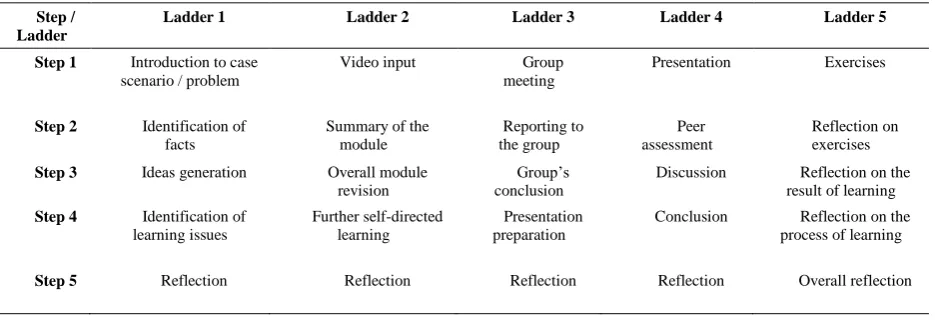
The star of attraction in this module is the newly invented PBL learning process called 5 Ladders of Active Learning. This new inventive PBL learning process was designed by the facilitators and copyrighted in 2012. In 5 Ladders of Active Learning, PBL learning starts at Ladder 1 in which the topic will be introduced to the participants through a presentation of a problem scenario for each unit. The participants then, work in the group to identify the learning issues using 3 Active Thinking Points (Identification of the facts, Ideas generation and Identification of learning issues). To conclude the Ladder 1 learning, the participants will complete the reflection form and soon climb to the Ladder 2.
At Ladder 2, the participants will have to embark on self-directed learning activities including reading the materials, watching the videos, summarizing the topic and to search for additional and supporting learning materials. To conclude the learning activities at Ladder 2, the participants will have to complete the reflection form. At Ladder 3, the participants will have to conduct the meeting and to report the result of their self-directed learning and prepare for the presentation at Ladder 4. To conclude the learning activities at Ladder 3 they will also have to complete the reflection form. At Ladder 4, the participants will have to present their result of learning. The presentation can be in many forms. It could be a parallel presentation or a single presentation or a forum discussion. Again, to conclude the learning activities at Ladder 4, the participants will have to complete the reflection form.
Ladder 5 is the final stage of learning for the topic. At this level the participants will be provided with a number of proper exercises to improve their learning. The exercises can be in many forms. It could be in form of interactive Multi Choice Questions in which the participants will be able to test their understanding and mastery of the topic through interactive approach. Finally, to conclude the learning activities at Ladder 5 and overall learning of the topic, the participants will have to complete the reflection form. There will also be an overall reflection on the course at the end of the session. The participants will have to complete overall reflection of their learning in the specific course and to answer a questionnaire set. The reflection and questionnaire set could be used by the instructors to identify the effectiveness of the overall learning as well as the module. Table 1 below shows overall learning process involved in 5 Ladder of Active Learning.
Table 1. PBL learning process in 5 Ladder of Active Learning
Step / Ladder
Ladder 1 Ladder 2 Ladder 3 Ladder 4 Ladder 5
Step 1 Introduction to case scenario / problem
Video input Group
meeting
Presentation Exercises
Step 2 Identification of facts
Summary of the module
Reporting to the group
Peer assessment
Reflection on exercises
Step 3 Ideas generation Overall module
revision
Group’s conclusion
Discussion Reflection on the result of learning Step 4 Identification of
learning issues
Further self-directed learning
Presentation preparation
Conclusion Reflection on the process of learning
Step 5 Reflection Reflection Reflection Reflection Overall reflection
4.Background of the Study
This study is addressing the importance of having a proper PBL training module developed based on a clear philosophical background, contained a comprehensive content related to PBL and delivered through a proper PBL learning process to achieve the intended training outcomes with truly PBL experiences. A group of researchers from three public universities are working together with Center for Learning and Teaching at Higher Education Leadership Academy (AKEPT), Ministry of Higher Education Malaysia to develop this module. The module was then used in seven training workshops conducted by the facilitators. Four workshops were organized by Center for Learning and Teaching at Higher Education Leadership Academy (AKEPT), Ministry of Higher Education Malaysia and three organized by public and private universities. The first workshop was conducted on December 2010 and the seventh workshop conducted on November 2012. Actual number of participants attended these seven series workshops are 248 participants. A study was planned on the implementation of this module and the data was collected using the instrument developed together with the module from the first workshop.
Main objective of this study is to identify the effectiveness of the module and to propose the best model for training of facilitators in PBL. Specifically, the study is intended to identify the effectiveness of the module based on 3C3R PBL problem design model as proposed by Hung (2006). Initially, 3C3R model is intended to identify the core component and process component of a problem designed for PBL exploration. The core components include the content, context and connection. The process components include researching, reasoning and reflecting. Based on this model, the study is intended to identify;
1. Core components contain in the module.
2. Process components reflect by the activities designed for the module. 3. The effectiveness of the module for training of facilitators in PBL .
[image:4.595.67.535.160.320.2]This study is a descriptive survey research utilizing quantitative and qualitative data. The quantitative data is collected through a set of questionnaire developed by the researchers. The qualitative data is collected from the learning reflection described by the participants at the end of workshop session. The questionnaire set consists of 31 items representing 3C3R model, the six crucial components of a successful PBL exploration i.e. content, context, connection, researching, reasoning and reflecting. Four items represent “content” component (2, 10, 11 and 12), four items represent “context” component (13, 17, 29 and 30), three items represent “connection” component (3, 18 and 25), four items represent “researching” component (4, 7, 15 and 16), four items represent “reasoning” component (8, 9, 23 and 24) and twelve items represent “reflection” component (skills = 19, 20, 21, 22 and 28, values = 14, 26 and 27, overall = 1, 5, 6, and 31). Table 2 below shows the list of items belonging to each component.
Table 2. Items represent six crucial elements of a successful PBL
Component No. of items Items
Content 4 2, 10, 11 and 12
Connection 3 3, 18 and 25
Researching 4 4, 7, 15 and 16
Reasoning 4 8, 9, 23 and 24
Reflecting (Skills) 5 19, 20, 21, 22 and 28
Reflecting (Values) 3 14, 26 and 27
Reflecting (Overall) 4 1, 5, 6, and 31
The questionnaire set is using 5 Likert scales 1=strongly disagree, 2 = Disagree, 3 = Uncertain, 4 = Agree and 5 = Strongly Agree. For the purpose of data analysis and interpretation the scales were then combined (1+2) and (4+5). The sets were distributed to all participants at the end of each workshop. However, only 209 respondents (84.3%) have replied and returned the questionnaire sets. The data was then analysed using SPSS software and reported in form of mean score and percentage.
5.Data Analysis and Findings
5.1. Demographic
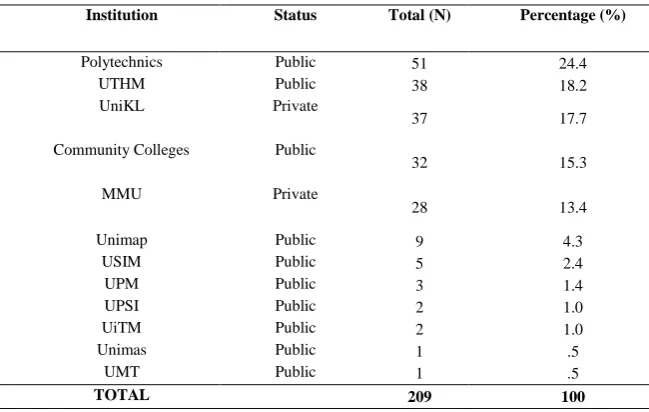
[image:5.595.136.461.392.598.2]Demographic data has recorded that out of 209 respondents, 70.3% (N=147) are from public universities and institutions and 29.7% (N=62) are from private universities and institutions. Respondents from Malaysian Polytechnics recorded the highest number with 24.4% (N=51). Respondents from University Malaysia Sarawak (Unimas) and University Malaysia Terengganu (UMT) are the lowest number with one respondent (0.5%) each. Table 3 below shows the list of institutions and the number of respondents.
Table 3. Respondents and institutions
Institution Status Total (N) Percentage (%)
Polytechnics Public 51 24.4
UTHM Public 38 18.2
UniKL Private
37 17.7
Community Colleges Public
32 15.3
MMU Private
28 13.4
Unimap Public 9 4.3
USIM Public 5 2.4
UPM Public 3 1.4
UPSI Public 2 1.0
UiTM Public 2 1.0
Unimas Public 1 .5
UMT Public 1 .5
TOTAL 209 100
[image:5.595.174.422.671.801.2]Table 4 listed the age range among respondents. The data shows that most of the respondents attended the workshops are between 25 to 35 years old (51.5%, N=108). Majority of the respondents are male (58.4%, N=122) and 41.6% (N=87) are female.
Table 4. Respondents Age
Age Range Total (N) Percentage (%)
Below 25 6 2.9
25-30 years old 54 25.8
31-35 years old 54 25.8
36 - 40 years old 32 15.3
41-45 years old 24 11.5
46-50 years old 18 8.6
51-55 years old 16 7.7
56-60 years old 4 1.9
Over 60 1 .5
TOTAL 209 100
[image:6.595.145.451.126.285.2]Most of the respondents are having 1-5 year experience in teaching. Data in Table 5 recorded 44.5% (N=93) of the respondents are having 1 to 5 years of teaching experience. Few respondents (5.7%, N=12) are having more than 25 years of teaching experience.
Table 5. Teaching Experience
Teaching Experience Total (N) Percentage (%)
1-5 year 93 44.5
6-10 year 42 20.1
11-15 year 30 14.4
16-20 year 21 10.0
21-25 year 11 5.3
More than 25 years
12 5.7
TOTAL 209 100
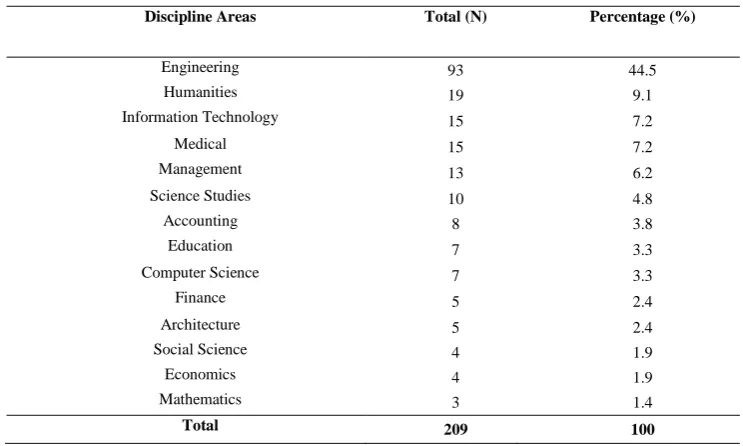
[image:6.595.111.483.382.605.2]As shown in Table 6, respondents attended PBL workshops are coming from various disciplines areas from engineering to medical, humanities and social science. However, based on the data it shows that engineering academics recorded the highest number of respondents attended the workshops with 44.5% (N=93) and followed by humanities studies (9.1%, N=19), information technology (7.2%, N=15), medical (7.2%, N=15), management (6.2%, N=13) and science studies (4.8%, N=10). The rest recorded lower number below than 10 respondents.
Table 6. Discipline Areas
Discipline Areas Total (N) Percentage (%)
Engineering 93 44.5
Humanities 19 9.1
Information Technology 15 7.2
Medical 15 7.2
Management 13 6.2
Science Studies 10 4.8
Accounting 8 3.8
Education 7 3.3
Computer Science 7 3.3
Finance 5 2.4
Architecture 5 2.4
Social Science 4 1.9
Economics 4 1.9
Mathematics 3 1.4
Total 209 100
In terms of academic qualification, most of the respondents are having Master degree. The data in Table 7 recorded 62.2% (N=130) of the respondents are having Master degree as compared to 12.4% (N=26) respondents having Ph.D, 24.4% (N=51) are having Bachelor degree and only 1% (N=2) of them are having Diploma.
Table 7. Highest Academic Qualification
Academic Qualification Total (N) Percentage (%)
Ph.D 26 12.4
Master 130 62.2
Bachelor 51 24.4
Diploma 2 1.0
[image:6.595.148.448.682.783.2]Finally, Table 8 recorded one of the most important demographic data for this study, the data on prior experience of the respondent in PBL. The data shows that majority of the respondents are lack of experience in PBL. A staggering number of them (86.6%, N=181) are not having any experience in PBL and 7.2% (N=15) are having 1-2 year experience in PBL. Only a small number of them (6.2%, N=13) are having experience in PBL more than 3 years.
Table 8. PBL Experience
PBL Experience Total (N) Percentage (%)
None 181 86.6
1-2 years 15 7.2
3-4 years 6 2.9
5-6 years 3 1.4
9-10 years 1 .5
More than 10 years 3 1.4
Total 209 100
5.2. Core Components of the Module
Content, context and connection are the core components of the 3C3R model. These components are primarily concerned with the issues of appropriateness and sufficiency of content knowledge, knowledge contextualization, and knowledge integration (Hung, 2006).
5.2.1. Content Component of the Module
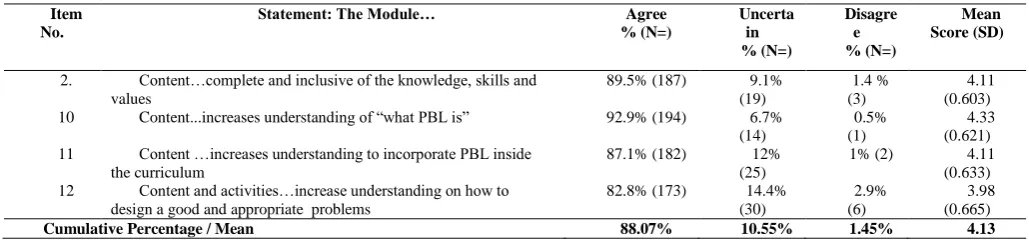
[image:7.595.136.458.113.241.2]Four items related to the content component of the module. Participants were asked to identify whether, (1) the content of the module is complete, inclusive of knowledge, skills and values, (2) enable them to increase their understanding on what is PBL, (3) enable them to incorporate PBL into curriculum and (4) increase their understanding on how to design a good and appropriate problems. Table 9 shows mean score of each item. Mean score of each item exceeded 4.0 except item 12 (3.98, SD0.665) which is slightly lower than 4.0. The cumulative percentage of agreement is 88.07% with high mean score recorded (4.13). This proves that the content of the module is sufficient and appropriate for learning and understanding PBL.
Table 9. Mean Score for Content Component
Item No.
Statement: The Module… Agree
% (N=)
Uncerta in % (N=)
Disagre e % (N=)
Mean Score (SD)
2. Content…complete and inclusive of the knowledge, skills and values
89.5% (187) 9.1% (19)
1.4 % (3)
4.11 (0.603) 10 Content...increases understanding of “what PBL is” 92.9% (194) 6.7%
(14)
0.5% (1)
4.33 (0.621) 11 Content …increases understanding to incorporate PBL inside
the curriculum
87.1% (182) 12%
(25)
1% (2) 4.11
(0.633) 12 Content and activities…increase understanding on how to
design a good and appropriate problems
82.8% (173) 14.4% (30)
2.9% (6)
3.98 (0.665)
Cumulative Percentage / Mean 88.07% 10.55% 1.45% 4.13
5.2.2. Context Component of the Module
The module was designed purposely for the participants to experience PBL onset. Thus, PBL learning process using 5 Ladders of Active Learning was applied all the way with fully active participation from the participants. It was from this context the participants will be able to master PBL content and skills easily and enable them to apply it at their institutions effectively. Four items related to the context component were posted to the respondents. The data in Table 10 shows that all items exceeded mean score 4.0. The module is proven to be highly effective in training skills of implementing PBL with mean score 4.02 (SD 0.567). Participants were also agreed that the module has increased their confidence to start implementing PBL (Mean score 4.02, SD 0.600) and motivation to embark in teaching and learning innovation (Mean score 4.33, SD 0.538). In general, the module is successfully introduced PBL to the participant (Mean score 4.21, SD 0.623). The cumulative percentage and mean score is high (89.72% / 4.15). This shows that the module is having a high level of context component and much better than conventional lecture-based training.
Table 10. Mean Score for Context Component
Item No.
Statement: The Module… Agree
% (N=)
Uncertain % (N=)
Disagree % (N=)
Mean Score (SD)
13 Increases skills to implement PBL at institution 86.1% (180) 13.4% (28) 0.5% (1) 4.02 (0.567)
[image:7.595.40.555.444.565.2]17 Increases confidence to start implementing PBL 85.2% (178) 13.9% (29) 1% (2) 4.02 (0.600) 29 Increases motivation to involve in new teaching and learning
innovation
96.7% (202) 3.3% (7) 0 4.33
(0.538) 30 Successfully introduced PBL to the participants & to
implement PBL at their institution
90.9% (190) 8.1% (17) 1% (2) 4.21
(0.623)
Cumulative Percentage / Mean 89.72% 9.67% 0.62% 4.15
5.2.3. Connection Component of the Module
[image:8.595.58.539.272.360.2]According to Hung (2006), the connection component functions to interweave the concepts and information within the conceptual framework, and content into contexts. It was not so easy to identify the connection parts that highly effective to interweave the concepts and information and within the conceptual framework and content into contexts unless after a proper application of the PBL learning processes in the module. Three items were posted to the respondents in order to identify their perspectives on the connection component exists inside the module. Data in Table 11 shows high mean scores. The module has attracts the participants to take part in learning activities means there is a strong connection between problems presented to the participants with the content and context of learning. High cumulative percentage and mean score (94.4% / 4.28) shows that this module is having a strong connection component.
Table 11. Mean Score for Connection Component
Item No.
Statement: The Module… Agree
% (N=)
Uncertain % (N=)
Disagree % (N=)
Mean Score (SD) 3. Attracts participants to take part in learning activities 93.8% (196) 5.7% (12) 0.5% (1) 4.26
(0.582) 18 Increases learning motivation to learn more about
PBL
97.1% (203) 2.4% (5) 0.5% (1) 4.21
(0.494) 25 Increases ability to manage and execute the given
tasks
92.3% (193) 7.7% (16) 0 4.38
(0.625)
Cumulative Percentage / Mean 94.4% 5.27% 0.3% 4.28
5.3. Process Components of the Module
Process components in 3C3R model were designed to facilitate mindful and meaningful engagement of participants in PBL. Researching, reasoning and reflecting are the three dynamic elements in process components. There are two functions of these dynamic components. First, the main function of the processing components is to serve as an activator to guide the learners to take advantage of the design of the core components. Second, processing components function as a calibration system to guide students’ learning toward the intended learning outcomes, adjust the level of cognitive processing required during the course of PBL in accordance with the cognitive readiness of the learners, and alleviate the issue of students’ initial unfamiliarity or discomfort with PBL. The general purpose of the 3Rs is to facilitate meaningful engagement in scientific inquiry and problem-solving processes and to cultivate effective and efficient learners and problem solvers (Hung, 2006).
5.3.1. Researching Component of the Module
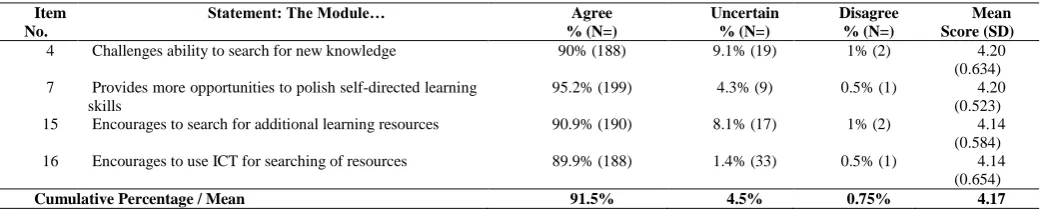
A specific PBL learning process was designed in 5 Ladders of Active Learning to open space for the participants to embark in research activities. It was in Ladder 2 where participants will be able to conduct self-directed learning and research. The main task in this stage is to search for necessary information within the domain as preparation for the next stage of the problem-solving process which is group reporting and discussion at Ladder 3. In order to identify the level of research component in the module four items were posted to the respondents. The result of the survey shows that the module contains high level of research component. The module challenges the participants to search for new knowledge (Mean score 4.20, SD 0.634), providing more opportunities for the participants to polish their self-directed learning skills (Mean score 4.20, SD 0.523), encourages to search for additional learning resources (Mean score 4.14, SD 0.584) and to use ICT for searching the resources (Mean score 4.14, SD 0.654). Cumulative percentage and mean score is high (91.5% / 4.17). Table 12 shows the data related to researching component in the module.
Table 12. Mean Score for Researching Component Item
No.
Statement: The Module… Agree
% (N=)
Uncertain % (N=)
Disagree % (N=)
Mean Score (SD)
4 Challenges ability to search for new knowledge 90% (188) 9.1% (19) 1% (2) 4.20
(0.634) 7 Provides more opportunities to polish self-directed learning
skills
95.2% (199) 4.3% (9) 0.5% (1) 4.20
(0.523) 15 Encourages to search for additional learning resources 90.9% (190) 8.1% (17) 1% (2) 4.14
(0.584)
16 Encourages to use ICT for searching of resources 89.9% (188) 1.4% (33) 0.5% (1) 4.14
(0.654)
Cumulative Percentage / Mean 91.5% 4.5% 0.75% 4.17
[image:8.595.39.560.668.774.2]Reasoning is the processing component that promotes application of knowledge acquired from researching related information and the development of the learners’ problem-solving skills (Hung, 2006). Activities designed in Ladder 1 and Ladder 2 enabled the participants to analyze information, generate and test hypotheses and solutions to the problems. Through this reasoning process they had put their knowledge into practice instead of only memorizing it. During this process, participants as problem solvers engage in the cognitive activities that enable them to solve and learn many things from the problem. In order to identify the level of reasoning embedded in the module, four items were posted to the participants. The data in Table 13 shows that all items recorded high mean scores above 4.20 with the cumulative mean score 4.23. This evidently shows that the module is having high level of reasoning component.
Table 13. Mean Score for Reasoning Component Item
No.
Statement: The Module… Agree
% (N=)
Uncertain % (N=)
Disagree % (N=)
Mean Score (SD) 8 Provides more opportunities to increase group learning skill 95.7% (200) 4.3% (9) 0 4.23
(0.514) 9 Increases level of knowledge through brainstorming and group
sharing
94.7% (198) 4.3% (9) 1% (2) 4.24
(0.574)
23 Increases problem solving skill 93.8% (196) 5.7% (12) 0.5% (1) 4.22
(0.560)
24 Increases the level of thinking skill 95.7% (200) 3.3% (7) 1% (2) 4.22
(0.569)
Cumulative Percentage / Mean 94.97% 4.4% 0.62% 4.23
5.3.3. Reflecting Component of the Module
Reflecting on any event or occasion that happened to us by nature will improve our knowledge retention and skills. Same thing goes to the reflection activities done by the learners in PBL. Through reflecting on the knowledge they have constructed and learning process throughout the PBL learning cycle, learners have an opportunity to organize and integrate their knowledge into a more systematic conceptual framework. Reflecting involves three main metacognitive activities; knowledge abstraction, summary, and self-evaluation. The cognitive activities of abstracting, summarizing and organizing knowledge enhance learners’ conceptual integration and retention of the knowledge. Self-evaluation enables the learners to improve their problem solving skills and learning skills.
[image:9.595.56.543.525.643.2]For the purpose of understanding the level of reflecting component in the module, twelve items were posted to the respondents. Result of the survey from these items will also be able to show the effectiveness of this module. The reflecting component from the items is divided into three groups, 5 items on skills, 3 items on values and 4 overall reflection items. In first group, respondents are required to response on a number of essential PBL skills believed to be mastered at the end of training session. The skills include facilitation skills, team working skills, managing group learning, teaching innovation skills and communication skills. The data recorded high mean scores for all five related items (above 4.10) with high cumulative percentage and mean score (94.16% / 4.29) as shown in Table 14. This proves that the module is highly effective in developing these essential PBL skills.
Table 14. Mean Score for Reflection on Skills Component
Item No.
Statement: The Module… Agree
% (N=)
Uncertain % (N=)
Disagree % (N=)
Mean Score (SD)
19 Increases communication skills 95.2% (199) 4.8% (10) 0 4.44 (0.587)
20 Increases team working skills 95.7% (200) 4.3% (9) 0 4.32 (0.551)
21 Increases facilitation skills 90.9% (190) 8.6% (18) 0.5% (1) 4.17 (0.585)
22 Increases skills of managing group learning
92.8% (194) 7.2% (15) 0
4.22 (0.560)
28 Increases teaching innovation skills 96.2% (201) 3.8% (8) 0 4.28 (0.530)
Cumulative Percentage / Mean 94.16% 5.74% 0.1% 4.29
In second group of reflecting component, respondents are posted with three items related to the mastery of values in teaching and learning. After having a three day training session the module is expected to be able to inculcate and increase noble values, wisdom and creativity. The result of the survey shown in Table 15 recorded high mean scores for all three items related to the mastery of values (above 4.20) with high cumulative percentage and mean score (92.03% / 4.27). This evidently proves that the module is highly effective in inculcating and increasing noble values, wisdom and creativity through PBL exploration.
Table 15. Mean Score for Reflection on Values Component
Item No.
Statement: The Module… Agree
% (N=)
Uncertain % (N=)
Disagree % (N=)
Mean Score (SD)
14 Inculcates better noble values 86.1% (180) 12.4% (26) 1% (2)
4.24 (0.700)
26 Increases ability to act wisely 93.3% (195) 6.2% (13) 0.5% (1)
4.22 (0.571) 27 Increases creativity in teaching and learning 96.7% (202) 2.9% (6) 0.5% (1)
4.28 (0.539)
Cumulative Percentage / Mean 92.03% 7.16% 0.67% 4.27
[image:10.595.33.562.293.435.2]Finally, in third group of reflecting component, the study is intended to identify the overall effectiveness of the module. For this purpose four related items were posted to the respondents. First item (item no. 1), respondents were asked to give their opinion on the structure of the module. Mean score recorded for this item is 3.94 (SD 0.706). Although the score is slightly lower than 4.0, it was within the range of high mean score and it shows that the structure of this module is comparatively easy to follow despite majority of the respondents are lacking of PBL experience as shown in Table 8 previously where 86.6% of participants do not have any PBL experience before attending the course. Second, most of the respondents agreed that the activities and tasks designed in the module are interesting. High mean score (4.36, SD 0.613) is recorded for this item ( item no. 6). Thus, this evidently shows the active parts of the module that enable the participants to learn actively and pleasantly. Third (item number 5), respondents were asked to evaluate the effectiveness of the module. The result of the survey recorded high mean score (4.29, SD 0.600). This clearly shows that the module is highly effective as compared to the traditional lecture approach. Finally, the final item (item number 31) is intended to ask sincere response from the respondents whether they would prefer to use this module in the future. The result clearly shows that most of the respondents are preferred to use this module rather than traditional lecture approach. Mean score recorded is 4.37 (SD 0.645).
Table 16. Mean Score for Overall Reflection Component Item
No.
Statement: The Module… Agree
% (N=)
Uncertain % (N=)
Disagree % (N=)
Mean Score (SD)
1 Structure...easy to follow 78.5% (164) 17.7% (37) 3.3% (7)
3.94 (0.706) 5 More effective compare to the traditional lecture
mode
93.3% (195) 6.2% (13) 0.5% (1)
4.29 (0.600)
6 Activities and tasks... are interesting… 92.9% (194) 7.2% (15) 0
4.36 (0.613) 31 Preferred by the participant compare to the
traditional lecture approach
90.5% (189) 9.1% (19) 0
4.37 (0.645)
Cumulative Percentage / Mean 88.8% 10.05% 0.95% 4.24
Based on the responses and result of the survey on reflecting component, there was a clear indication that this module is having a high level of reflecting component as recorded in high cumulative mean score (4.24). The reflections described by the participants itself are the most valuable sources for them to be used as input in continuous improvement and life-long learning exploration. Facilitators on the other hand could use these reflections for the improvement of the module quality and presentation in the future.
6.Discussion
Within two years of PBL training of trainers programme conducted by the researchers there were more than 200 participants from all over Malaysia undergone the courses. This number is too small to initiate greater changes in teaching and learning at Malaysian higher education. However, it was a very meaningful experience for most of the participants attended the courses since for the first time they have been learning PBL using PBL approach. As the data revealed, majority of the participants (86.6%) having no experience in PBL and it was an interesting experience for them to meet PBL in the first time through PBL approach. Reflections collected from the participants listed in Table 17 clearly show how the module had effectively introduced PBL to these inexperience participants.
Table 17. Overall Reflection on the Module Institu
tion
Discipli ne
Area
Teachi ng Experience
PBL Experi ence
Overall Reflection
Public Engine ering
10 years
none “Overall it is interesting. Increase my understanding because the learning process is conducted through real situation.”
Public Science 10
years
none “I love the content and the information is very valuable. Workshop learning activities are very good and I really understand how to implement PBL.”
Public Engine ering
[image:10.595.35.553.687.789.2]Private Medica l
4 years none “I will apply PBL in my teaching and learning activities” Private Engine
ering
25 years
none “The workshop has been tremendously helpful in not only giving exposure and experience in PBL but proves that PBL is indeed comprehensive and is the most effective student centered learning approach. Thank you very much for the training and invaluable hands-on experience”
Holloway (2003) as cited by Irene (2010) pointed that there are seven stages of concern teachers may experience when a new educational initiative or training programme is introduced; (1) Awareness, (2) informational, (3) personal, (4) management, (5) consequence, (6) collaboration and (7) refocusing. Teachers at awareness level are not interested or concerned with any innovation introduced to them. When reached informational level, they are becoming interested in some information about the change. At personal level, they want to know personal impact of the change. At management level, they are very concerned about how the change will be managed in practice. At consequence level, they are interested in the impact on students or school. At collaboration level, they are interested in working with colleagues to make the change effective and finally at refocusing level they begin to refine the innovation to improve student learning results.
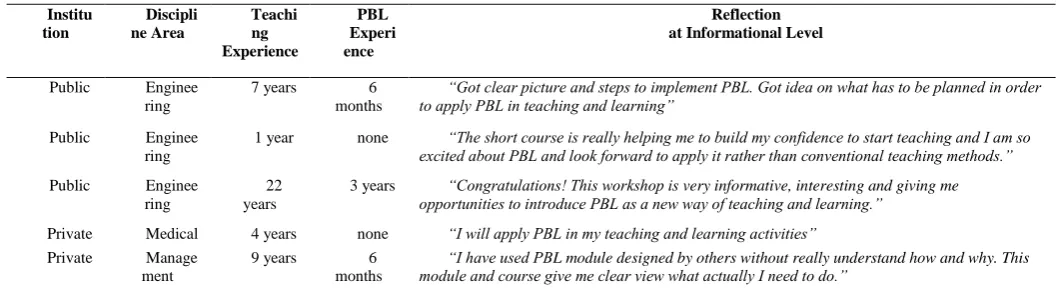
[image:11.595.32.562.323.472.2]As the data revealed that the participants are very satisfied with the module and training sessions they have attended. Definitely this shows that the module has attained the approval from the participants and some improvements might be necessary to be made in the near future through continuous quality improvement (CQI) activities. On the other hand, there is another important issue that needs to get more attention, the possible transformation expected from the participants after they have completed the workshops. This issue is very interesting to be investigated further. Based on preliminary data, the transformation took place among participants has reached second level of Holloway’s seven stages of concern, i.e. informational level. Most of the participants show their interest on PBL and are ready to make the changes to apply PBL. Participants’ reflections in Table 18 clearly show their concern and interest on PBL and their readiness to apply PBL.
Table 18. Interest on PBL at Informational Level
Institu tion
Discipli ne Area
Teachi ng Experience
PBL Experi ence
Reflection at Informational Level
Public Enginee ring
7 years 6
months
“Got clear picture and steps to implement PBL. Got idea on what has to be planned in order to apply PBL in teaching and learning”
Public Enginee ring
1 year none “The short course is really helping me to build my confidence to start teaching and I am so excited about PBL and look forward to apply it rather than conventional teaching methods.” Public Enginee
ring
22 years
3 years “Congratulations! This workshop is very informative, interesting and giving me opportunities to introduce PBL as a new way of teaching and learning.”
Private Medical 4 years none “I will apply PBL in my teaching and learning activities” Private Manage
ment
9 years 6
months
“I have used PBL module designed by others without really understand how and why. This module and course give me clear view what actually I need to do.”
7.Conclusion
The module development and training sessions conducted over two-year period among Malaysian academics to become effective facilitators in PBL have shown the fruitful result. The module is highly regarded as one of the best modules developed to train PBL facilitators in Malaysia. It was also attracted attention from all levels including from the Center for Learning and Teaching at Higher Education Leadership Academy (AKEPT), Ministry of Higher Education Malaysia. Most of the researchers for this module are the module developers themselves and were also contributed to the implementation of this module throughout these two years. Being the persons in charge for this module, they were trusted to contribute further for the development of more challenging module for training of master trainers in PBL at national and international levels. This responsibility was handed over by Center for Learning and Teaching at Higher Education Leadership Academy (AKEPT), Ministry of Higher Education Malaysia to be executed from January to December 2012. Based on prior experiences of developing and implementing the module for training of facilitators, this group of module developers managed to develop a comprehensive module for training of master trainers at national and international levels using the same principles adopted for the previous module for training facilitators. 2013 is the first year of implementation for this module by AKEPT in training of master trainers in PBL. It was expected thousands of Malaysian and foreign academics will benefit from this new module. Definitely, more studies are waiting in the future to be conducted on training of trainers in PBL from various aspects including through the application of PBL models. The application of Hung 3C3R model in this study is still considered as a preliminary attempt. This model could also be applied in future studies with more comprehensive analysis and looking from various perspectives.
Acknowledgements
The researchers would like to express gratitude and appreciation to Center for Learning and Teaching at Higher Education Leadership Academy (AKEPT), Ministry of Higher Education Malaysia for organizing parts of the training workshops, providing the training facilities, fund and technical supports.
This article is based upon research supported in part by the Fundamental Research Grant Scheme (FRGS) 1/2011, under project Vote 0834, University Tun Hussein Onn Malaysia and Ministry of Higher Education, Malaysia. Any opinion, finding, conclusions or recommendations expressed in this article are those of the authors and do not necessarily reflect the views of any of the supporting institutions.
References
AKEPT (2013), Higher Education Leadership Academy, Ministry of Higher Education Malaysia. Available at: http://www.mohe.gov.my/akept/about_9.html
Barrows, Howard S and Lynda, Wee Keng Neo (2007), Principle and practice of aPBL, New Yor: Pearson.
Center for Educational Development (2009), Proceeding of 2nd International Problem-based Learning Symposium, Republic Polytechnic, Singapore, 1-778. Du, Xiangyun, Erik De Graaff, Anette Kolmos (2009). PBL – Diversity In Research Questions And Methodologies, In Research on PBL Practice in
Engineering Education, Sense Publishers, 1–7.
Fewer unemployed graduates expected, New Strait Times report, a Malaysian news paper, 22 July 2009. Glen O’Grady, Glen (2010), PBL in Asia, Reflections on PBL, Issue 9, January, 3.
Graaff, Eric de and Anette Kolmos (2003), Characteristics of Problem Based Learning, International Journal of Engineering Education, Vol. 19, No. 5, 657-662.
Graduates: too choosy about job, New Strait Times report, a Malaysian news paper, 2 September 2009.
Hmelo-Silver, Cindy E. and Howard S. Barrows (2006), Goals and Strategies of a Problem-based Learning Facilitator, The Interdisciplinary Journal of Problem-based Learning, Volume 1(1), 21-39.
Hung, Woei (2006). The 3C3R Model: A Conceptual Framework for Designing Problems in PBL, The Interdisciplinary Journal of Problem-based Learning, Volume 1, no. 1, Spring 2006.
Irene, Tan Ai Lian (2010), Determining the Readiness of Staff for PBL Training and Development, Reflections on PBL, Issue 9, January 2010, 4-9. Kolmos, Anette (2010), Premises for Changing to PBL, International Journal for the Scholarship of Teaching and Learning, Vol. 4, No. 1, 1-7.
Kolmos, Anette, Xiangyun Du, Jette E. Holgaard & Lars Peter Jensen (2008), Facilitation in a PBL Environment, Center for Engineering Education Research and Development, Aalborg University.
Lehman, James D. Melissa George, Peggy Buchanan, Michael Rush (2006), Preparing Teachers to Use Problem-centered, Inquiry-based Science: Lessons from a Four-Year Professional Development Project, The Interdisciplinary Journal of Problem-based Learning, Volume 1(1), 76-99.
Ministry of Higher Education Malaysia, (2007), Humanistic Skills Guidelines, Universiti Putra Malaysia.
Murray, I. & Savin-Baden, M. (2000). Staff development in Problem-based Learning, Teaching in Higher Education, 5(1), 107-126. Onn Seng, Tan (2003). Problem-Based Learning Innovation: Using Problem to Power Learning in the 21st Century. Singapore: Thomson.
Pecore, J. L. (2012). Beyond Beliefs: Teachers Adapting Problem-based Learning to Preexisting Systems of Practice. Interdisciplinary Journal of Problem-based Learning, 7(2), 1-27. Available at: http://dx.doi.org/10.7771/1541-5015.1359
Savin-Baden, Maggi & Claire Howell Major (2004). Foundations of Problem-based Learning. Berkshire: Open University Press. Savin-Baden, Maggi (2003). Facilitating Problem-based Learning: Illuminating Perspectives. Berkshire: Open University Press.