β
-Robust Parallel Machine Scheduling with
Uncertain Durations
Akram Pishevar
*, Reza Tavakkoi-Moghaddam
School of Industrial Engineering, College of Engineering, University of Tehran, 11155-4563, Tehran, Iran *Corresponding Author: [email protected]
Copyright © 2014 Horizon Research Publishing All rights reserved
Abstract
Uncertainty is a main characteristic of manyreal-world scheduling problems, and scheduling solutions should be robust against changes. In this paper, we consider parallel machines that the processing time of each task follows a normal distribution and total completion times as main optimization criterion. We propose a mixed-integer nonlinear programming (MINLP) model to minimize the risk of the completion time exceeding a fixed value. The objective is to find a β-robust schedule. Additionally, we use a proper approximation to convert the MINLP model to an integer programming one. The computational results on a small example are presented to demonstrate the effectiveness of the proposed approach. Furthermore, we compare and analyze the associated results of these models. Finally, the conclusion is provided.
Keywords
Robust Parallel Machines Scheduling, TotalCompletion Time, Uncertain Duration.
1. Introduction
Many scheduling problems consider certainty conditions, in which tasks and their durations are deterministic and fixed. However, due to uncertainty in most real-world scheduling problems (e.g., arriving new jobs), a β-robust schedule is the maximum probability of obtaining a given performance level (e.g., total completion time) less than a fixed value [1]. In particular, we consider parallel machine problems that the processing time of each task is uncertain; however, it can be followed by a normally distributed random variable.
In the recent decade literature on parallel machine scheduling has been improved and included many useful models and algorithms (see, for instance [2–4]). One of the regular criteria in scheduling identical parallel machines is to minimize the makespan (i.e., the maximum completion time of the jobs), in which this problem has been shown to be NP-hard [5]. Some heuristic and exact algorithms are represented to solve this problem [6]. Lee et al., [7] represented parallel machine scheduling as 1-job-on-r-machine (r>1) model and give a review of the
problem.
Another criterion of regular objective in scheduling parallel machines is the total (or mean) weighted completion time [8–12]. However, there is a review of parallel machines scheduling problems minimizing the total completion times. Li and Yang [13] considered a class of non identical parallel machines scheduling problems, in which the objective is to minimize the total (or mean) weighted (or unweighted) completion time. They also collected and classified models and relaxations in their works. Heuristics and exact algorithms are reviewed. Baptiste et al., [14] considered several “min-sum” objective functions including total weighted tardiness, total tardiness, total weighted completion time and total completion time as the parallel machines scheduling problem with releasing dates. They described several lower bounds for these problems that they often were for the first time. They also produced experimental results to compare these lower bounds according to their quality and their computational time requirement. Chen and Powell [15] considered a class of problems of scheduling n jobs on m identical, uniform, or unrelated parallel machines and organize objective of minimizing an additive criterion. They proposed a decomposition approach for solving these problems exactly. This problem is solved by a column generation approach, in which each column represents a schedule on one machine.
Suppose that given a set of n jobs (J1, …, Jn), each of them has to be scheduled on one of m machines, each job is assigned to exactly one machine and a machine can do at most one job at a time. If job j is done on machine i, it will take a processing time. Moreover, for each job, we can consider both weighted and unweighted problems. The objective is to schedule the jobs such that the total weighted completion time of the jobs is minimized. In these problems, the processing time of a job is identical when pij= pjfor all i and j (e.g., the machines have the same speed). The machines are called uniform when pij=pj/si, where sIis the speed of machine i. The machines are called unrelated if pijs are arbitrary. The uniform and the unrelated cases belong to non-identical parallel machines scheduling.
the total completion time (TCT) being less than some level. Then, we will generate a schedule, which maximizes the probability of them for the computational experiment, and then compare results to given a fixed level or a schedule minimizing the level that can be achieved with a fixed probability.
Wu et al., [16] proposed a single-machine scheduling problem with uncertain durations and the flow time is the main solution criterion to find robust schedules that minimizes the risk of the flow time exceeding a fixed value. They represented this problem as a constraint model. The uncertainty and robustness are represented as an input parameters and objectives. Janak et al., [17] studied the problem of scheduling under bounded uncertainty and symmetric uncertainty, in which the uncertain problem parameters can be described by a known probability distribution function. Janak and Floudas [18] proposed a novel robust optimization methodology and produced robust solutions that are immune against uncertainty. The common sources of uncertainty in scheduling problems are processing times of activities, market demands for products, and prices of products and raw materials.
Farias et al., [19] presented the robust single machine problem to minimize the maximum of the total weighted completion time of the jobs. They proposed a large family of inequalities that is valid for the convex hull of the set of feasible schedules. Lu et al., [20] concerned robust single machine scheduling with uncertain processing times. The objective is to obtain robust sequences of jobs families and jobs within each family that minimizes the absolute deviation of the total flow time from the optimal solution. They reformulated this problem as a robust constrained shortest path problem. Leus and Herroelen [21] presented a single-machine scheduling problem with a stability objective and a common deadline. They offered a branch-and-bound algorithm for solving the model that it is exact in specific requirements. Liu et al., [22] proposed a new method considering both robustness and stability for single-machine scheduling with random machine breakdowns and they solved this problem with genetic algorithm. Several approaches use sampling and scenarios in order to generate robust decisions [23], a branch-and-bound algorithm is proposed. At each node, Monte Carlo simulation is used to generate scenarios. Such a technique is only practical for very small problems. For other problems, heuristics are used to transform the probabilistic problem in to a deterministic problem which is used to generate potential solutions which are evaluated using the Monte Carlo simulation.
Kouvelis et al., [24] considered a two-machine flow shop environment that the processing time of jobs are uncertain and the performance measure of the interest in the system is makespan. Anglani [25] studied a robust scheduling problem of parallel machines with sequence dependent setup costs. They used a fuzzy mathematical programming model for formulation uncertainty in processing times. There are several articles in this field. Ranjbar et al., [26] presented the
parallel machines under stochastic processing time of each job to find a robust schedule that the probability of the makespan is not exceeding the due date. Their model is an MINLP and the objective function is a complex and big function.
In this paper, we propose a new model in β-robust parallel machines scheduling, in which the processing times of each task follow the normal distribution, with the total completion times as the main optimization criterion. The goal of the model is to minimize the risk of the completion time, exceeding a fixed value. The rest of this paper is organized as follow. In Section 2, we propose two non-linear and linear integer models for solving the problem. We generate random numbers and use them for the computational experiment. Then, we compare the results for validation of the integer linear model in Section 3. Finally, summarization of the paper, results and the future research are represented in Section 4.
2. Mathematical Model
2.1. Parallel Scheduling Problem with the Total Completion Time
In a parallel machines scheduling problem (PMSP), the total completion time for every machine extracts as follows:
1 1 1
min m n n ij ijk
i j k
kp x
= = =
∑∑∑
(1)
1 1
s.t. m n ijk 1 ; 1,2,....,
i= k= x j n
= ∀ =
∑∑
(2)1
1 ; 1,2,..., ; 1,2,...,
n ijk j
x i m k n
=
≤ ∀ = =
∑
(3){ }
0,1 ; 1,2,..., ; 1,2,...,ijk
x ∈ ∀ =i m k= n (4)
Equation (1) computes the total completion time. Equation (2) assures that each job is assigned to exactly one of the machines and Equation (3) assures that each position is filled up to maximum one job. Equation (4) shows that all the decision variables are binary and xijk is 1 if job j is processed on position k and on machine i ; otherwise, it is 0.
2.2. Robust Parallel Scheduling Problem with the Total Completion Time
For the parallel machines scheduling problem with p and total completion time limit S, the β-robust scheduling problem is to find the sequence, s, which maximize the probability of the total completion time being less than S. It is to find the s that maximizes the probability (i.e., total completion time(s)≤S)[1]. Daniels and Carrillo proved in [1]
We know that for any two independent normal random variables X and Y and two constants a and b, the sum aX+bY has also a normal distribution. In a robust parallel machines scheduling problem (RPMSP), the total completion time for every machine is a normal distribution and it is computed by:
2 2 1 1 1 1 1 1
(m n n ij ijk, m n n ij ijk )
i j k i j k
TCT N k xµ k σ x
= = = = = =
≈
∑∑∑
∑∑∑
(5)So, we can obtain the RPMSP as follows:
max (φTCT S≤ ) (6) It is proved that
φ
( )
z
is an ascending function on [0,+∞) [1]. As a result, we obtain the RPMSP below:max ( )φ z ≈φ(max )z (7) where
z
is:( ) ( ) S TCT z TCT µ σ −
= (8)
Finally, we obtain:
1 1 1 2 2 1 1 1 max
m n n
ij ijk
i j k
m n n
ij ijk
i j k
S k x
Z k x µ σ = = = = = = − =
∑∑∑
∑∑∑
(9)1 1
s.t. m n ijk 1 ; 1,2,....,
i= k= x j n
= ∀ =
∑∑
(10)
1
1 ; 1,2,..., ; 1,2,...,
n ijk j
x i m k n
=
≤ = =
∑
(11)
{ }
0,1 ; 1,2,..., ; 1,2,...,ijk
x ∈ i= m k= n (12)
Constraints (10) to (12) are described in the first model.
2.3. Integer Linear Approximation of the Non-Linear Model
An integer linear approximation of the parallel machines scheduling problem (ILAPMSP), in which the processing time has normally distribution obtained by:
( )
max min( ( )) min( ( )) ( )
S TCT
z TCT or TCT
TCT
µ µ σ
σ −
= ≈ (13)
min ( (µTCT) σ(TCT) )
≈ + (14)
2 1
( ) ) ( )
min( )ij
TCT TCT
h
σ
σ
σ
≤ (15)
[ / ]([ / ] 1) 2
n m n m
h= + m (16)
1 min( )ij l
h
σ
= (17)
2
maxz≈min( (
µ
TCT l)+σ
(TCT) ) (18) In Eq. (18), we want to maximize z, and it is equal to minimize (µ TCT)and minimize (σ TCT)because S is a fixed value. If we ignore the dependence between μ and σ2 we can formulate this model as Constraint (13). If we want to obtain a linear model, we have to eliminate the radical of the formula. For this reason, we useσ
2instead of (σ TCT). We obtain a low limit of
σ
2.
2
minD=
µ
(TCT) l (TCT)+σ
(19)1 1
. . m n ijk 1 1,2,....
i k
s t x j n
= =
= ∀ =
∑∑
(20)
1 1 ; 1,2,..., ; 1,2,...,
n ijk j
x i m k n
=
≤ = =
∑
21)
{ }
0,1 ; 1,2,..., ; 1,2,...,ijk
x ∈ i= m k= n (22)
Finally, we can replace μ and σ with their amount and we obtain:
2 2
1 1 1 1 1 1
min ( m n n ij ijk m n n ij ijk )
i j k i j k
D k x
µ
l kσ
x= = = = = =
=
∑∑∑
+∑∑∑
(23)1 1
s.t. m n ijk 1 ; 1,2,....,
i= k= x j n
= =
∑∑
(24)1
1 ; 1,2,..., ; 1,2,...,
n ijk j
x i m k n
=
≤ = =
∑
(25){ }
0,1 ; 1,2,..., ; 1,2,...,ijk
x ∈ i= m k= n(26)
ILAPMSP model that represent in (23)-(26) is an integer linear programming model solved easier than the last model because last model is a RPMSP model that is an NP-hard problem. ILAPMSP model is solved by exact algorithm simply and in the next section we show that solutions of this approximation are close to solutions of the original model.
3. Computational Results
Suppose that we have 18 jobs and 3 machines. We want to calculate sequence s of jobs on machines that is robust under uncertainty. For this example, we suppose that the mean (µij) of jobs on machines are selected randomly from [5,15] that are given in Table 1. In Table 2, we present
σ
ijthat areTable 1. μ of jobs on machines
Machine Jobs
1 2 3 4 5 6 7 8 9 10 11 12 13 14 15 16 17 18
1 8 6 14 10 8 13 6 10 7 10 13 7 6 5 9 7 10 8
2 9 12 6 12 9 14 8 8 14 15 13 11 7 7 5 6 6 8
[image:4.595.60.546.88.263.2]3 5 8 15 15 10 6 5 6 12 6 11 8 14 5 14 8 15 5
Table 2. σ of jobs on machines
Machine Jobs
1 2 3 4 5 6 7 8 9 10 11 12 13 14 15 16 17 18
1 2.4 2.9 1.7 2.2 1.4 1.4 1.5 1.3 1.6 1.2 2.2 2.2 2.4 2.3 1.3 2.0 1.5 1.9
2 1.5 2.7 1.7 2.6 1.2 1.2 2.3 2.6 1.5 1.8 2.6 3 2.5 1.2 1.5 2.5 1.1 1.9
3 2.5 1.2 2.4 1.7 2.5 2.1 2 1.2 2.1 1.2 1.6 1.9 1.9 2.9 2.6 1.8 2.3 2.2
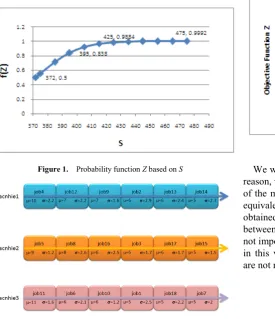
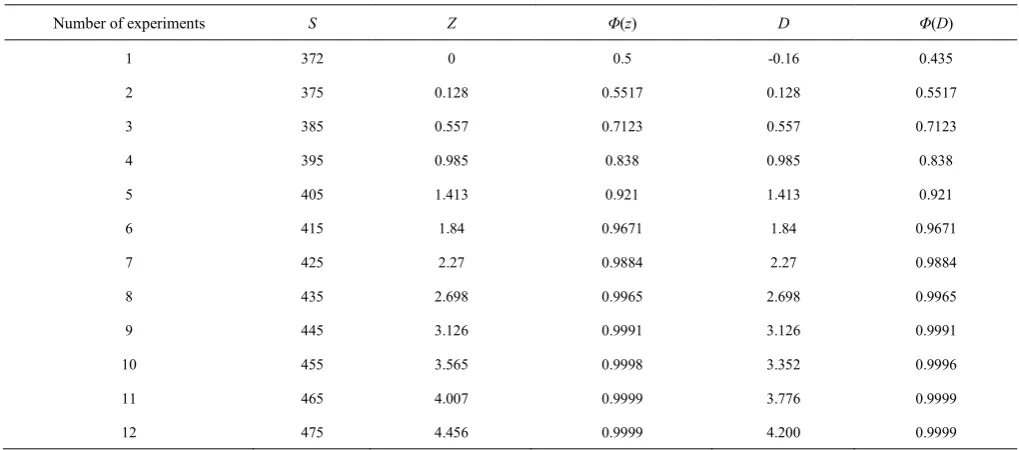
[image:4.595.299.551.397.550.2]We solve Z in (9) and D in (23) with BONMIN and CPLEX in the GAMS software and we found a solution. Different values of S are supposed and we obtain similar results for xijk. Figure 1 shows that optimal sequence s is the solution of D and Z for the most values of the S. if S belongs to [375, 445], the sequence s is solutions of both Z and D. It is shown in Table 3. Sequence s shows the first job that be done on the machine 1 is job 14. Sequence s on Figure 2 is arranged from the right to the left because in the model we suppose that position k is filled from the last.
Figure 1. Probability function Z based on S
Figure 2. Sequence s of the example solution
As expected, z is increased by increasing S. In other words, if we increase S, the total completion time also raise according to Figure 2. At the last experiment where S is 475, Z equal to 4.456. Function ( )φ Z is the standard normal distribution function of Z. In this case, Z is positive, so ( )φ Z is an increasing function and Z is zero, in where S equals 372 as shown in Figure 3. The probability of Z is 99%, in where S equals 425 as shown in Figure 3. So, in the main value of S, solutions of S and D are equal.
Figure 3. Objective function Z based on S
[image:4.595.67.343.402.722.2]Table 3. Results of Experiment under Different Values of S
Number of experiments S Z Φ(z) D Φ(D)
1 372 0 0.5 -0.16 0.435
2 375 0.128 0.5517 0.128 0.5517
3 385 0.557 0.7123 0.557 0.7123
4 395 0.985 0.838 0.985 0.838
5 405 1.413 0.921 1.413 0.921
6 415 1.84 0.9671 1.84 0.9671
7 425 2.27 0.9884 2.27 0.9884
8 435 2.698 0.9965 2.698 0.9965
9 445 3.126 0.9991 3.126 0.9991
10 455 3.565 0.9998 3.352 0.9996
11 465 4.007 0.9999 3.776 0.9999
12 475 4.456 0.9999 4.200 0.9999
4. Conclusion
We have studied the parallel machine scheduling problem with uncertain durations, which finds robust schedules minimizing the probability of the total completion time exceeding a fixed value. First, we have proposed a mixed-integer nonlinear programming (MINLP) model to represent the robust parallel machine scheduling (RPMS) that it was too complex model. Then, we have approximated our non linear model to the ILP model. We showed that this is an NP-hard problem. Additionally, we have solved Z and D with BONMIN and CPLEX in the GAMS software and we found an optimal solution. Solutions have been compared and had similar results. Furthermore, we have attempted to solve the problem by a hybrid algorithm. For future studies, we will investigate better approximation for parallel machines scheduling problems and expand this model to obtain parallel machines scheduling with the makespan criterion. This model can be solved by meta-heuristic or hybrid algorithms.
REFERENCES
[1] R. L. Daniels, J. E. Carrillo, “Beta-robust scheduling for single-machine systems with uncertain processing times”, IIE Transactions, vol. 29 pp. 977-85, 1997.
[2] D. Biskup, J. Herrmann, JND. Gupt, “Scheduling identical parallel machines to minimize total tardiness”, International Journal of Production Economics, vol. 115, pp. 134-142, 2008.
[3] S. O. Shim, Y. D. Kim, “A branch and bound algorithm for an identical parallel machine scheduling problem with a job
splitting property”, Computers & Operations Research, vol. 35, pp. 86-75, 2008.
[4] R. Mellouli, C. Sadfi, C. Chu, I. Kacem, “Identical parallel machine scheduling under availability constraints to minimize the sum of completion times”, European Journal of Operational Research, vol. 197, pp. 1150-65, 2009.
[5] E. L. Lawler, J. K. Lenstra,A. K. Rinnooy, D. Shmoys, “Sequencing and scheduling: algorithms and complexity”, In: S. S. Graves, A. K. Rinnooy, P. Zipkin (Eds.), Handbooks in Operations Research and Management Science, vol. 4, pp. 44-522, 1993.
[6] M. D. Amico, M. Iori, S. Martello, M. Monaci, “Heuristic and exact algorithms for the identical parallel machine scheduling problem”, INFORMS Journal on Computing, vol. 20, pp. 33-44, 2008.
[7] C.Y. Lee, L. Lei, M. Pinedo, “Current trends in deterministic scheduling”, Ann. Oper. Res, Vol. 70, pp. 1-41, 1997. [8] R. McNaughton, “Scheduling with deadlines and loss
functions”, Management Sciences, vol. 6, pp. 1-12, 1959. [9] W. Horn, “Minimizing average flow time with parallel
machines” Oper. Res, vol. 21, pp. 846-847, 1973.
[10] J. L. Bruno, E.G. Coffman, R. Sethi, “Scheduling independent tasks to reduce mean finishing time”, AIIE Trans, vol. 17, pp. 382-387, 1974.
[11] J. Du, J.Y.T. Leung, “Minimizing mean flow time in two-machine open shops and flow shops”, J. Algor, vol. 14, pp. 24-44, 1993.
[12] C. Phillips, C. Stein, J. Wein, “Minimizing average completion time in the presence of release dates”, Math. Program. Soc, vol. 82, pp. 199-223, 1998.
2009.
[14] P. Baptiste, A. Jouglet, D. Savourey, “Lower Bounds for Parallel Machine Scheduling Problems”, Ecole Polytechnique, UMR 7161 CNRS LIX, 91128 Palaiseau, France, January 28, 2011.
[15] Z. L. Chen, W. B. Powell “Solving Parallel Machine Scheduling Problems by Column Generation”, January 1998, [16] C. W. Wu, K. N. Brown, and J. C. Beck, “Scheduling with uncertain durations: Modeling β-robust scheduling with constraints,” Computers & Operations Research, vol. 36, pp. 2348-2356, 2009
[17] S. L. Janak, X. Lin, C. A. Floudas, “A new robust optimization approach for scheduling under uncertainty II. Uncertainty with known probability distribution”, computer & chemical engineering, vol. 31, pp. 171_195, 2007. [18] S. L. Janak, C. A. Floudas, “Advances in robust optimization
approaches for scheduling under uncertainty”, European Symposium on Computer Aided Process Engineering, L. Puigjaner and A. Espufia , vol. 15, pp. 1051_1056, 2005. [19] J. R. Farias, H. Zhao, M. Zhao, “A family of inequalities valid
for the robust single machine scheduling polyhedron”, Computers & Operations Research, vol. 37, pp. 1610-1614, 2010.
[20] C.-C. Lu, S.-W. Lin, K.-C. Ying, “Robust scheduling on a single machine to minimize total flow time”, Computers & Operations Research, vol. 39, pp. 1682-1691, 2012.
[21] R. Leus and W. Herroelen, “Scheduling for stability in single-machine production systems”, Springer Science+Business Media, LLC 11 May 2007, pp. 223-235. [22] L. Liu, H. Gu. Y. Xi, “Robust and stable scheduling of a
single machine with random machine breakdowns”, Int J Adv Manuf Technol, vol. 31, pp. 645-654, 2007.
[23] J. C. Beck, N. Wilson, “Proactive algorithms for job shop scheduling with probabilistic durations”, Journal of Artificial Intelligence Research vol. 28, pp. 183-232, 2007.
[24] P. Kouvelis, R. L. Daniels, G. Vairaktarakis, Robust scheduling of a two-machine flow shop with uncertain processing times, IIE Transactions, vol. 32, pp. 421-432, 2000.
[25] A. Anglani, A. Grieco, E. Guerriero, R. Musmanno, “Robust scheduling of parallel machines with sequence-dependent set-up costs”, European Journal of Operational Research, vol. 161, pp. 70-720, 2005.