BALANCING PROCESS TO THE CIPHERING SYSTEM SEC
1
ZAKARIA KADDOURI, 2FOUZIA OMARY, 3ABDOLLAH ABOUCHOUAR AND 4MOHSSIN DAARI.
1,3,4 PhD.Std., Department of Computer Sciences. Faculty of Sciences, Mohammed V University-Agdal,
Rabat. Morocco.
2Professor, Department of Computer Sciences. Faculty of Sciences, Mohammed V University-Agdal,
Rabat. Morocco.
LRI Laboratory (Ex: Networks and Data Mining Laboratory)
Department of Computer Science, Faculty of Sciences, Mohammed V University-Agdal, Rabat . Morocco. E-mail : 1[email protected], 2[email protected], 3[email protected]
,
ABSTRACT
In this article, we present a new symmetrical encryption system based on symmetric encryption SEC, it formalizes the problem of encryption to a combinatorial optimization problem and uses evolutionary algorithms to solve it. The main objective of this work is to strengthen the resistance of the encryption system “SEC” against cryptanalysis by the characters frequencies study. The Balancing process (BP) is introduced to change the appearance frequencies of characters, and to reach equilibrium. Through the key generated by our algorithm, we illustrate the process of encryption and decryption. Examples of applications will be given at the end of this article, the results show that our new system is robust and resists to any attack by frequency analysis.
Keywords: Symmetric Encryption, Evolutionary Algorithms, Combinatorial Optimization, SEC, Frequency
Analysis.
1. INTRODUCTION
Cryptography allows to take legible, readable data, and to transform it into unreadable data for the purpose of secure transmission. A key is used to transform it back into readable data when it reaches its destination. Only the use of a secret key can convert the cipher text back into a readable clear text.
There are two main types of cryptography: Symmetric encryption which is the oldest cryptographic technique used to transmit or store digital data securely. Data that has been encrypted with symmetric encryption is considered to be confidential, in the sense that only entities (persons or systems) who have the key can understand what the data means.
Asymmetric encryption is also known as public-key cryptography. Asymmetric encryption differs from symmetric encryption primarily in the fact that two keys are used: one for encryption and one for decryption. The most common asymmetric encryption algorithm is RSA.
Compared to symmetric encryption, asymmetric encryption imposes a high computational burden,
and tends to be much slower. Thus, it isn't typically employed to protect payload data. Instead, its major strength is its ability to establish a secure channel over a non secure medium (for example, the Internet).
This is accomplished by the exchange of public keys, which can only be used to encrypt data. The complementary private key, which is never shared, is used to decrypt.
Given that the evolutionary algorithms are stochastic and use random processes, we notice that they are useful in cryptography [6]. The symmetric encryption system SEC is based on Evolutionary algorithm whose main purpose is to establish an exchange of the appearance frequencies that belong to the different characters of the message to be encrypted as well as their own positions [7].
our new system to attack by frequency analysis and exhaustive search.
2. EVOLUTIONARY ALGORITHMS
2.1 Definition
Basically, the metaheuristics consist of creating the evolution of a baseline configuration by replacing it repeatedly by a new configuration chosen in its neighborhood.
The evolutionary algorithm is a kind of the metaheuristics [5]. It is useful for optimization when other techniques such as gradient descent or direct, analytical discovery are not possible. It incorporates aspects of natural selection or survival of the fittest and maintains a population of structures (usually randomly generated initially), that evolves according to rules of selection, recombination, mutation and survival, referred to as genetic operators. A shared "environment" determines the fitness or performance of each individual in the population [7]. The fittest individuals are more likely to be selected for reproduction (retention or duplication), while recombination and mutation modify those individuals, yielding potentially superior ones [5].
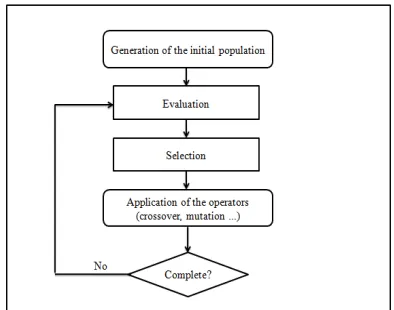
[image:2.612.100.297.426.581.2]We present the mechanisms involved in evolutionary algorithms in the flowchart in Figure1.
Figure 1: Flowchart Of An Evolutionary Algorithm
In precisely, the contribution of our work consists of the design and implementation of symmetric encryption systems with EA as basic tools.
2.2 Algorithm
An evolutionary algorithm generates an initial population P of μ individuals, and then makes the population P (generations) evolves following a repeated pattern.
• For every generation:
1) Select for reproduction: is chosen in the current population P, λ individuals which become parents (mating pool P’).
2) Vary operators: by applying the crossover and mutation on the individuals of P, a population P'' of λ children is obtained.
3) Evaluate the performance of elements of P'' (children).
4) Select for survival: the elements of P (current population) and P'' (children) the μ individuals are chosen among these elements which will generate the population P of the next generation.
3. DESCRIPTION OF OUR SYSTEM
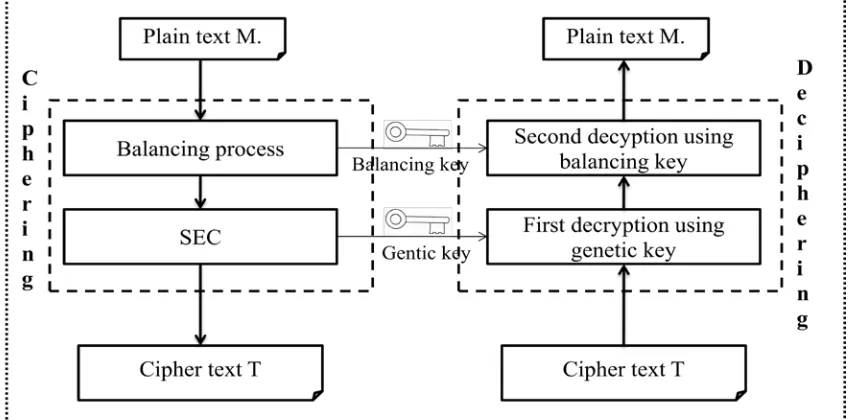
The Balancing Process (BP) consists of creating equilibrium between the lists of the characters positions that represent the genes of the system. The resistance of the system against attack by frequency analysis will be stronger and the system will become more robust.
We apply the BP on the characters of the plaintext, this process will generate an additional secret key which we call the balancing key, then we apply the SEC.
3.1 Formalisation of the Problem
Let T be a continuation of k characters and t1,t2,…, tn its different characters. Denote by Li( 1< i< n) the list of the different positions of ti in T before the ciphering. L1,L2,…Ln is a partition of the set {1,2,…,n}. T can be represented by vector:
The goal of our works is to alter to the maximum the frequencies of apparition of the characters in the text T and establish more mess in their positions.
3.2 Our Ciphering System
This system is composed of two principal parts: the balancing and the application of evolutionary algorithm as descript in figure 2.
3.2.1 First part: Balancing
The Message M Before The Balance Can Be Represented By The Vector Below:
The objective of this algorithm is to balance the lists so that all resulting lists have almost the same cardinal.
While the key size is not exceeded:
- The balancing will be applied to EL U Ep as follows:
o Let us indicate initially the lists which we need to balance. These lists are composed of LP1, LL1,…, LPf, LLf such as f is taken randomly in {1,2,…, min(Nm,Np)}, Lp1, Lp2,…, Lpf are selected in Ep in increasing order of their size, in
alternation with LL1, LL2,…, LLf which are taken in EL in the same order, while taking account of the following iterative processing:
r ←1; E← ∅ repeat
E ← E U Lpr U LLr
If size of E ≤ Sk the r ←r+1
Until r=f or size of E is bigger than Sk f ← r
We next equilibrate the smaller list of Ep with the largest list of El. After the balancing process, these two lists will be deleted from Ep and El. The balancing process is again applied to the smaller list of Ep with the largest list of El, which will be deleted too, and so on…
o Applying balancing to the lists above as follows:
- Let us take randomly a list lm in Em and compute its cardinality Nm=card (Lm)
- Let Lp the list to balance with Ll
Suppose that Ll = {p1, p2, …, pm},
Let us take randomly an index r in {1,2, ..., m}
Let Np=card (Lp); While card(Lp) < Nm . Put pk in the list Lp: Lp ← pr , r+1 ; Add the quadruplet:
( [Ll] ; [Lp] ;Np ; r ) to the balancing key.
o Repeat the process of balancing on: -Ep← Ep-{ Lp}.
-El← El-{ Ll}.
Until reaching the size of the desired key Sk. - If we indicate by FO the number of
balancing applied then the generated key representative of these operations is a set of FO quadruplet of the from:
- ([Lil], [Lip], Nip, ri)
The new ciphered text, Tf, will be denoted by the following:
(cf1, Lf1) (cf2, Lf2) …… (cfm, Lfm)
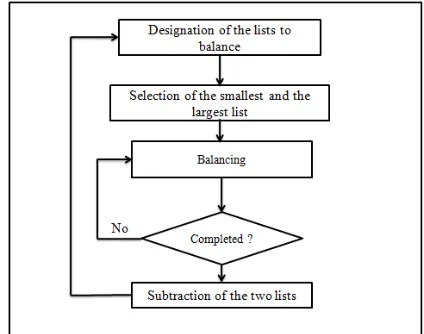
[image:3.612.312.524.279.446.2]We present the mechanisms involved in balancing process in the flowchart in Figure 3.
Figure 3: Flowchart of the Balancing Process
3.2.2 Second part: Application of Our Evolutionary Algorithm SEC
Let M be the message to be encrypted. M is a sequence of n characters. This message can be formed only of numbers, such as bank codes or a mixture of numbers and literary phrases including punctuation.
Let c1, c2,…, cm be the different characters of M. Denote by Li(1 ≤ i ≤ m) the list of different positions of the character ci in M before the ciphering and card(Li) the number of occurrences of ci in M.
We notice that: Li∩ Lj= ø si i ≠ j, ∀i, j ϵ {1, 2, …, m}.
Then L1, L2,…, Lm is a partition of the set {1, 2, …, n}.
The message M can be represented by the vector below:
The goal of SEC is to change the appearance frequencies of the characters at a maximum level in the message M and to establish the maximum disorders over their positions. In order to make it happen, we must repeatedly change the distribution lists over the different characters of M. In other words, we must find a permutation σ of {1, 2, …, m} such that the difference between the cardinal of the new list Lσ(i) assigned to the character ci and the cardinal of the initial list Li reaches the maximum level. In this case, we are confronted with a combinatorial optimization problem. Nevertheless, the evolutionary algorithms are very effective in this kind of problem. So, they will be applied to permutations’ problems [1] [10].
SEC Algorithm :
1) Coding
Use an individual (or chromosome) as a vector of size m.
Genes are the lists Lpi(1 ≤ i ≤ m).
Lpi is the ith gene which contains the new positions that will take the character ci.
2) Initialization
Creation of the initial population P0 consists of q individuals: X1, X2,…,Xq.
Let Original-Ch be the chromosome which genes are L1,L2,…, and Lm lists (placed in this order).These lists represent the message before the application of the algorithm. We apply permutations on Original-Ch in order t get an initial population formed by q potential solutions.
Set i :=0;
3) Evaluation of individuals
Let Xj is an individual of Pi whose genes are: Lj1,Lj2,…,Ljm.
The evaluation function F is defined on the set of individuals Xj by:
F(Xj) =∑𝑛𝑖=1card(Lji) – card(Li)
4) Selection of the best individuals
The conventional method of the roulette wheel retains the strongest individuals. A Control function is introduced to eliminate the individuals in whom the value of only a minority of genes have changed in comparison with the initial chromosome: Original-Ch [6].
Since this problem is narrowed to a permutation problem with constraints, the genetic operators have been adjusted to this kind of problems
5) Crossover MPX(Maximal Preservative X) This cross is applied to selected individuals with a very precise rate. The best rate is about 60% to 100% [7].
6) Transposition Mutation
Choosing the mutation consists of randomly swaping two genes of a chromosome. This operator is applied to individuals from crossing with an appropriate rate, preferably from 0.1% to 5% [7].
Place new offspring in a new population Pi+1.
Repeat steps 2, 3 and 4 until a stopping condition.
7) Stopping condition
The function F is bounded because 0≤ F(X) ≤ 2*m, for each individual X.
In fact, the function F has a maximum since it is bounded. According to some researches, the convergence result of fitness function is made but it can be a value close to Max, which can be experimentally determined. Final-Ch denotes the final solution given by our evolutionary algorithm. Final-Ch denotes the final solution given by our evolutionary algorithm. From Original-Ch and Final-Ch, the symmetric key is constructed. This key is called a genetic key [1].
3.3 Deciphering
Decryption is performed in two basic steps:
Step One: decryption by using the genetic key, can find the original message T’ from the message T’’.
Second step: decryption by using the balancing key allows to find the message T from the encrypted message T’.
• First decrypion
We represent the encoded text T’ by a vector of list. Let‘s by C’1, C’2, …, C’m the different characters of T’ and by L’1,L’2,…, L’m their respective lists of positions. Thanks to the genetic key the characters are going to recover their lists of corresponding positions in the text Tf obtained after the first part of ciphering [7].
Indeed, the key can be represented by a vector, that we denote Key, of size m such that:
The character C’p1 is going to be associated to the list L’1.
The character C’p2 is going to be associated to the list L’2.
…
The character C’m1 is going to be associated to the list L’m.
Thus we get the text Tf. • Second decryption
Thanks to the balancing key which is clear and direct, For each element ([Lil], [Lip], Nip, ri) of balancing key, we can immediately reconstruct the true positions of lists Lfi of each character. Thus we obtain initial text T.
4.EXPERIMENTSRESULTS
4.1. Convergence
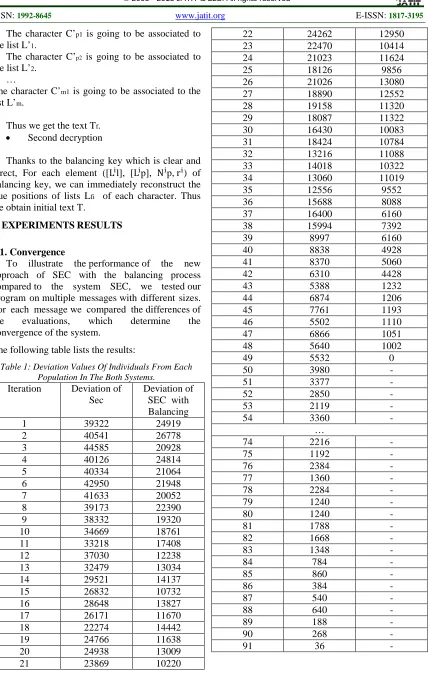
To illustrate the performance of the new approach of SEC with the balancing process compared to the system SEC, we tested our program on multiple messages with different sizes. For each message we compared the differences of the evaluations, which determine the convergence of the system.
[image:5.612.98.528.66.739.2]The following table lists the results:
Table 1: Deviation Values Of Individuals From Each Population In The Both Systems.
Iteration Deviation of Sec
Deviation of SEC with Balancing
1 39322 24919
2 40541 26778
3 44585 20928
4 40126 24814
5 40334 21064
6 42950 21948
7 41633 20052
8 39173 22390
9 38332 19320
10 34669 18761
11 33218 17408
12 37030 12238
13 32479 13034
14 29521 14137
15 26832 10732
16 28648 13827
17 26171 11670
18 22274 14442
19 24766 11638
20 24938 13009
21 23869 10220
22 24262 12950
23 22470 10414
24 21023 11624
25 18126 9856
26 21026 13080
27 18890 12552
28 19158 11320
29 18087 11322
30 16430 10083
31 18424 10784
32 13216 11088
33 14018 10322
34 13060 11019
35 12556 9552
36 15688 8088
37 16400 6160
38 15994 7392
39 8997 6160
40 8838 4928
41 8370 5060
42 6310 4428
43 5388 1232
44 6874 1206
45 7761 1193
46 5502 1110
47 6866 1051
48 5640 1002
49 5532 0
50 3980 -
51 3377 -
52 2850 -
53 2119 -
54 3360 -
…
74 2216 -
75 1192 -
76 2384 -
77 1360 -
78 2284 -
79 1240 -
80 1240 -
81 1788 -
82 1668 -
83 1348 -
84 784 -
85 860 -
86 384 -
87 540 -
88 640 -
89 188 -
90 268 -
The figure bellow represents a graph of the different values of the differences between the individuals of every generation.
[image:6.612.93.306.220.328.2]We can notice that the system SEC with balancing reaches total convergence after only 49 iterations. Otherwise, without balancing process, the system SEC stops at the 91st repetition with an optimum value of 36
Figure 4: Comparison Of The Deviation Of The System SEC With And Without Balancing Process
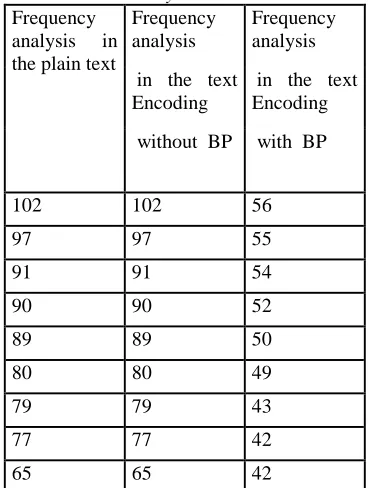
[image:6.612.102.287.480.724.2]4.2. Comparison Of The Frequencies Analysis The comparison of the frequencies analysis is the main indicator of new system’s performance. The table and the figure below compare the analysis of frequencies that belong to an unencrypted and encrypted text by the new system and the encrypted text by SEC.
Table 2 : The Frequency Analysis In The New And The Old System SEC
Frequency analysis in the plain text
Frequency analysis
Frequency analysis
in the text Encoding
in the text Encoding
without BP with BP
102 102 56
97 97 55
91 91 54
90 90 52
89 89 50
80 80 49
79 79 43
77 77 42
65 65 42
62 62 40
44 44 39
36 36 38
32 32 37
29 29 37
27 27 35
26 26 35
24 24 33
21 21 31
20 20 31
20 20 30
20 20 30
20 20 29
15 15 29
15 15 28
15 15 28
14 14 28
14 14 28
13 13 27
11 11 27
11 11 26
11 11 26
11 11 25
10 10 25
10 10 24
8 8 21
8 8 21
7 7 21
4 4 20
3 3 20
1 1 20
According to this comparison, the changes of frequencies appearing in the system using BP are now obvious.
5. CONCLUSION
Through this work, we were able to achieve an encryption system which consists of defining a new algorithm based on the balancing of the initial lists of the SEC system.
Our system generates another secret key that we call "key balancing" which reinforces the genetic key.
From the results of the occurrences frequencies of the characters obtained, we have proved the robustness of the new system against any attack by the frequencies analysis.
REFERENCES
[1] F.Omary, A.Tragha, A.Lbekkouri, A.Bellaachia, A.Mouloudi « An Evolutionist Algorithm to Cryptography». Brill Academic Publishers – Lecture SeriesAnd Computational Sciences Volume 4, 2005, pp.1749-1752
[2] F.Omary, A.Tragha, A.Lbekkouri, A.Bellaachia, A.Mouloudi « A New Ciphering Method Associated with Evolutionary Algorithm». Lecture Notes in Computer Science – Publisher : Springer Berlin / Heidelberg –ISSN: 0302-9743 –Subject :Computer Science-Volume 3984/ 2006. [3] F.omary, A.Tragha, A.Bellaachia, A.Mouloudi.
« Design and Evaluation of Two Symmetrical Evolutionist-Based Ciphering Algorithms ». International Journal of Computer Science and Network Security (IJCSNS) February 28, 2007 pp 181-190.
[4] Hans DelfsetHelmut Knebl, « Introduction to Cryptography :Principles and Applications». [5] Gareth Jones , « Genetic and Evolutionary
Algorithms ». University of Sheffield, UK [6] Menezes A.J., Oorschot, P.C. van et Vanstone
S.A., « Handbook of Applied Cryptography».(CRC Press, 1997).
[7] Thesis F.Omary, « Applications des algorithmes évolutionnistes à la cryptographie». University of science- Rabat 2006.
[8] Goldberg D.E, Genetic Algorithms in Search, Optimisation& Machine Learning. Addison-Wesley Publishing Company,Inc,1989.
[9] Florin G. et Natkin S.les techniques de la cryptographie.CNAM 2002.
Figure 2: Diagram Of Our Encryption System
[image:8.612.104.527.420.598.2]