S T U D Y P R O T O C O L
Open Access
Virtual reality as an adjunct to anesthesia in
the operating room
Adeel Faruki
*, Thy Nguyen, Samantha Proeschel, Nadav Levy, Jessica Yu, Victoria Ip, Ariel Mueller,
Valerie Banner-Goodspeed and Brian O
’
Gara
Abstract
Background:Advancements in virtual reality (VR) technology have resulted in its expansion into health care. Preliminary studies have found VR to be effective as an adjunct to anesthesia to reduce pain and anxiety for patients during upper gastrointestinal endoscopies, dental procedures and joint arthroplasties. Current standard care practice for upper extremity surgery includes a combination of regional anesthesia and intraoperative propofol sedation. Commonly, patients receive deep propofol sedation during these cases, leading to potentially avoidable risks of over-sedation, hypotension, upper airway obstruction, and apnea. The objective of this study is to evaluate the effectiveness of VR technology to promote relaxation for patients undergoing upper extremity surgery, thereby reducing intraoperative anesthetic requirements and improving the perioperative patient experience.
Methods:In this single-center, randomized controlled trial, 40 adult patients undergoing upper extremity
orthopedic surgery will be randomly allocated to either intraoperative VR immersion or usual care. VR immersion is designed to provide patients with a relaxing virtual environment to alleviate intraoperative anxiety. All patients receive a peripheral nerve block prior to surgery. Patients in the intervention group will select videos or immersive environments which will be played in the VR headset during surgery. An anesthesia provider will perform their usual clinical responsibilities intraoperatively and can administer anesthetic medications if and when clinically necessary. Patients in the control arm will undergo perioperative anesthesia according to standard care practice. The primary outcome is the difference in intraoperative propofol dose between the groups. Secondary outcomes include postoperative analgesia requirements and pain scores, length of stay in the postanesthesia care unit, overall patient satisfaction and postoperative functional outcomes.
Discussion:It is unknown whether the use of VR during upper extremity surgery can reduce intraoperative anesthetic requirements, reduce perioperative complications, or improve the postoperative patient experience. A positive result from this clinical trial would add to the growing body of evidence that demonstrates the effectiveness of VR as an adjunct to anesthesia in reducing intraoperative pain and anxiety for multiple types of procedure. This could lead to a change in practice, with the introduction of a nonpharmacologic intervention potentially reducing the burden of over-sedation while still providing a satisfactory perioperative experience.
Trial registration:ClinicalTrials.gov,NCT03614325. Registered on 9 July 2018.
Keywords:Propofol, Virtual reality, Monitored anesthesia care, Regional, Upper extremity surgery
© The Author(s). 2019Open AccessThis article is distributed under the terms of the Creative Commons Attribution 4.0 International License (http://creativecommons.org/licenses/by/4.0/), which permits unrestricted use, distribution, and reproduction in any medium, provided you give appropriate credit to the original author(s) and the source, provide a link to the Creative Commons license, and indicate if changes were made. The Creative Commons Public Domain Dedication waiver (http://creativecommons.org/publicdomain/zero/1.0/) applies to the data made available in this article, unless otherwise stated.
* Correspondence:[email protected]
Background
Virtual reality (VR) offers novel solutions in health care and has been gradually implemented into medical edu-cation, rehabilitation, and management of mental health and chronic pain [1]. VR is believed to create an immer-sive experience that can restrict the mind from process-ing acute pain and has been shown to be superior to simpler distraction methods in reducing pain scores for inpatients with any source of pain greater than 3/10 [2]. In preliminary studies, VR has been found to be safe and effective as an adjunct to standard sedative and analgesic protocols to reduce pain and anxiety for patients during upper gastrointestinal endoscopies, dental procedures, dressing changes for burns, and during the first stage of labor [3–6]. To date, it is unknown whether the use of VR during upper extremity surgery as an adjunct to standard anesthetic practice can reduce intraoperative anesthetic requirements and improve the perioperative patient experience.
Currently, the standard anesthesia practice for upper extremity surgical cases involves the combination of re-gional anesthesia and monitored anesthesia care. The goal of the regional anesthetic is to prevent both sensa-tion and motor funcsensa-tion to the operative region, which minimizes pain and discomfort for the patient and im-proves operating conditions for the surgeon. With an in-sensate and immobile extremity, patients undergoing upper extremity surgeries ideally would only require additional anesthetic agents to reduce intraoperative anxiety. In daily practice, however, it is common for patients to receive doses of intravenous sedatives such as propofol that may be out of proportion to their require-ments for anxiolysis, potentially increasing the risk of over-sedation, hypotension, upper airway obstruction, apnea and postoperative delirium [7–9]. Such avoidable risks are common with excessive sedation and can result in serious morbidity. In fact, 21% of monitored anesthesia care claims in the Closed Claims Database were related to respiratory depression due to an absolute or relative overdose of sedative medications [10]. Using reduced doses of propofol for sedation during hip sur-gery has been shown to reduce the incidence of postop-erative delirium by 50% [9]. Therefore, an intervention that could reduce intraoperative sedative requirements could prove to be valuable in reducing the risk of post-operative adverse events after upper extremity surgery.
The objective of this study is to evaluate the effective-ness of VR technology to reduce intraoperative sedative requirements during upper extremity surgery.
Methods/design
Study design
The Virtual Reality in the Operating Room trial is a ran-domized, controlled, single-center clinical trial of adult
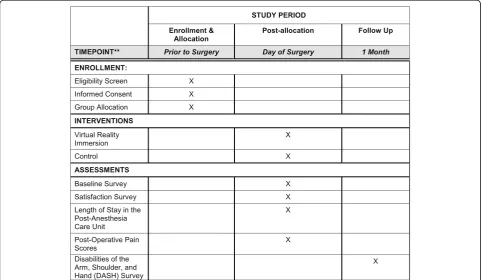
orthopedic surgical patients undergoing upper extremity surgery. Individuals will be randomized in a 1:1 alloca-tion to either undergo immersion relaxaalloca-tion via the intraoperative use of VR or usual care. The primary out-come of this study will be the difference in intraopera-tive propofol dose between the groups. Secondary outcomes include postoperative analgesia dose require-ments, postoperative pain scores, length of stay in the postanesthesia care unit (PACU) and overall patient satisfaction. Additionally, at 1 month postoperatively, functional outcomes will be evaluated via telephone ad-ministration of the Disabilities of the Arm, Shoulder, and Hand (DASH) assessment. A study schematic is provided in Fig.1.
Setting
This study is being conducted at the Beth Israel Deacon-ess Medical Center (BIDMC) in Boston, Massachusetts, USA. The BIDMC is a 700-bed tertiary care academic facility which serves as a teaching hospital for Harvard Medical School. More than 1800 upper extremity ortho-pedic surgeries are performed at the BIDMC every year.
Study registration
Institutional Review Board (IRB) approval was obtained from the Committee on Clinical Investigations at the BIDMC (IRB protocol number 2018-P-000398). This trial was registered on the National Institutes of Health
ClinicalTrials.gov website on 3 August 2018 with the identifier NCT03614325. Upon completion of the trial, results will be reported following the Consolidated Standards of Reporting Trials guidelines and the Standard Protocols Items: Recommendations for Interventional Tri-als (SPIRIT) checklist (Additional file1 and Fig.2) [11,12]. The trial is currently active and ongoing, and any amend-ments made to the protocol will be reported to and approved by the BIDMC IRB.
Inclusion and exclusion criteria
preoperatively in the surgery clinic or via telephone. Pa-tients will not be offered compensation for participation in the trial.
Randomization
Following informed consent, patients are randomized in a 1:1 allocation using block randomization of equal sizes to either intraoperative VR immersion or usual care con-trol. The Research Electronic Data Capture (REDCap) randomization module will be used to implement the study randomization scheme prior to any study interven-tions taking place. REDCap is a secure, web-based appli-cation that supports data capture for research studies and allows customization to support the development of the electronic case report form [13]. Each patient is
randomized via REDCap software after enrollment. The data manager will input the patient into REDCap after enrollment and determine into which group the patient will be enrolled. The randomization sequence is un-known to research members ahead of time. The alloca-tion will only be informed to research members after the patient is enrolled and assigned. Considering the nature of the intervention, treatment allocation is unblinded; therefore, a protocol for unblinding participants is not applicable.
Drop-out criteria
After providing informed consent, the patient can volun-tarily withdraw from the study. Additionally, if the anesthesia team or investigators determine that the
Fig. 1Study schematic. PACU postanesthesia care unit, VR virtual reality
[image:3.595.65.538.88.212.2] [image:3.595.57.540.433.713.2]patient is no longer eligible to participate as a result of cancelled surgery or meeting an exclusion criterion, the patient will be withdrawn from the study.
Study intervention: virtual reality immersive relaxation
Patients randomized to the VR immersion group will be asked to wear the VR headset and view the program-ming of their choice for the entire procedure as an ad-junct to standard anesthesia practice. The software used in this study was created by VR Health USA, and is de-signed to promote relaxation and calmness. Some of the immersive VR environments that have been created with the software include sitting on a beach, in a peaceful meadow or forest, or on a mountaintop. In addition, a li-brary of short videos is available for patients to view via a web-based user interface. A study team member will be available at all times intraoperatively to assist with the device programming and technical issues. An anesthesia provider will perform their usual clinical re-sponsibilities, including closely monitoring the patient throughout the procedure, and is free to administer anesthetic medications if clinically necessary or when re-quested by the patient. Both the patient and the anesthesia provider can decline to continue with the VR programming at any time. This is not considered a drop-out criterion and the patient’s results will be ana-lyzed based on the intention-to-treat. At the conclusion of the surgery, the VR headset will be removed and post-operative care will begin according to the current stand-ard care practice.
Control arm: usual care
Patients randomized to the control group will undergo perioperative anesthesia according to the current stand-ard care practice at the BIDMC.
Clinical management in both groups
In both groups, patients will receive regional anesthesia preoperatively in accordance with standard practice. Patients may receive anxiolytic medications such as mid-azolam during the placement of the nerve block at the discretion of the regional anesthesia team. All intraoper-ative anesthetic management and medication adminis-tration decisions will be determined by the treating provider. All patients will be monitored (vital signs and capnography) according to American Society of Anesthesiologist standards.
Multiple data points, including airway interventions and use of airway assist devices, will be abstracted from the anesthesia medical record.
Data collection
To assess primary and secondary outcomes, data on intraoperative propofol dose, length of PACU stay,
administration of postoperative analgesia, pain scores and patient satisfaction will be collected. Additionally, information regarding patient demographics (including, but not limited to, age, gender, race, body mass index and comorbidities), surgical characteristics, intraopera-tive vital signs, medication administration and postoper-ative outcome data will be reviewed from patients’ medical records. Postoperative pain scores, documented on a scale of 0 to 10 by nursing staff in the PACU, will be abstracted from the medical records. There are no plans to prevent drop-outs or loss to follow-up during the trial. All study data will be stored anonymously and managed in a REDCap database hosted at the BIDMC. The database is audited and monitored for timeliness, completeness and accuracy.
Research team members met on a regular basis to dis-cuss enrollment of patients. The data manager/statisti-cian (AM) and data quality manager met regularly to assess and monitor the data quality. With a trial of this size and the low risk to participants, the study design team members did not feel it was necessary to have a safety monitoring or steering committee. No interim analysis or trial audit will be performed during the trial. The trial is low risk for harm and therefore no post-trial care or compensation provisions are needed for trial par-ticipants experiencing harm from their participation.
Missing data from the perioperative course is not an-ticipated as the patients will undergo anesthesia with an anesthetic and medical record. If the patient is lost to follow-up 1 month postprocedure then their data will not include DASH assessment information.
Reporting of compliance and adverse events
accordingly. These symptoms will be recorded as adverse events.
Statistical analysis
Sample size calculation
Based on preliminary data from a related study evaluat-ing the use of VR immersion for major joint surgery, we anticipate that we may be able to achieve a 30% reduc-tion in intraoperative propofol dose between groups [15]. Using a two-sided α of 0.05, 80% power, an effect size of 30%, with mean propofol doses of 155 mg/h (standard deviation (SD) 45 mg/h) and 108.5 mg/h (SD 45 mg/h) we anticipate needing a sample size of 32 pa-tients. To account for anticipated drop-out, we will add 8 patients to the calculated sample size for a total planned enrollment of 40 patients, with 20 in each of the two groups.
Data analysis
We will use SAS software version 9.3 or later (SAS Institute, Cary, North Carolina, USA) to conduct all ana-lyses. Descriptive statistics of the data will be evaluated and presented using mean (± SD) and median (inter-quartile range) for variables not normally distributed. Continuous data will be compared using parametric or nonparametric t tests as appropriate. Categorical data will be expressed using proportions and compared using a Chi-square test or Fisher’s Exact test.
Analysis of primary outcome
Our primary outcome, total intraoperative propofol dose, will be normalized to the duration of the proced-ure. It will be analyzed as a continuous variable and differences in dose between groups will be assessed using attest or Wilcoxon Rank Sum test, depending on the normality of the data. Although randomization is ex-pected to account for potential differences between groups, we will use univariate and multivariable linear regression modeling to adjust for differences that persist after randomization, if necessary. The analysis of the data will not be performed until all data have been col-lected, at which point the primary outcome of total in-traoperative propofol dose, the secondary outcomes of PACU length of stay, medications given in PACU, pain scores in PACU, satisfaction surveys and DASH assess-ment will all have been docuassess-mented into the anesthesia and medical records or into REDCap. Therefore, the statistical analysis cannot be biased by the data analyst and thus it is not necessary to blind the data analyst.
Analysis of secondary outcomes
Secondary outcomes including length of PACU stay, doses of medications administered, and pain scores will be expressed as continuous variables. Secondary outcomes
with continuous variables will be assessed using attest or Wilcoxon Rank Sum test to compare the two groups, depending on the normality of the data.
Doses of medications will be documented during PACU length of stay as total milligrams dosed. Medica-tions include dexmedetomidine, propofol, remifentanil, hydromorphone, fentanyl, midazolam, morphine, intra-venous acetaminophen, ondansetron and ketorolac. The total dose of each medication given will be analyzed as a continuous variable.
Patient satisfaction will be evaluated from a REDCap survey using quantitative scales to assess the level of agreement with prompted statements regarding pain, nausea, anxiety and overall experience, using slide bars with visible anchors of ‘strongly disagree’ (0), ‘neutral’ (50) and ‘strongly agree’ (100) (Additional file 4). The data from the survey will be used as continuous variables for analysis.
We will evaluate adherence to the randomization as-signment and, should any patient receive an intervention different from their randomization assignment, a per-protocol analysis will be performed as an additional sec-ondary analysis. Therefore, the study team will analyze the patient for the intervention received instead of the randomization assignment. Functional success of the surgery will be assessed using the DASH question-naire (Additional file4) at 1 month postsurgery and dif-ferences between groups will be analyzed [16].
Discussion
This study will be the first to evaluate the potential for VR technology to reduce intraoperative propofol require-ments for patients undergoing upper extremity surgery. Patients undergoing upper extremity surgery are at risk for over-sedation, potentially resulting in postoperative adverse events. By decreasing the amount of propofol sed-ation patients receive, the risk of adverse events may be reduced. A positive result of this study would add to the growing body of evidence that demonstrates the effective-ness of VR as an adjunct to standard sedative and anal-gesic protocols in reducing pain and anxiety. Possible uses for VR intraoperatively include patients with significant anxiety and patients who are at increased risk for compli-cations during deep sedation secondary to medical comor-bidities such as severe pulmonary hypertension.
intraoperative propofol dose as the primary outcome. Al-though a significant reduction in dose would be statisti-cally relevant, this may not directly correlate with clinically relevant outcomes (e.g., reduced complication rates). Despite these limitations, we chose total intraopera-tive propofol dose as our primary outcome because it is an objective, quantifiable measure for which we performed a robust power calculation. Since propofol has the ability to cause dose-dependent respiratory depression, we be-lieve it would be clinically plausible that a sizeable reduc-tion in propofol dose could decrease the risk of airway complications. For this proof-of-concept trial, it would be impractical to recruit the large number of patients needed at a single center to accurately detect a significant differ-ence in perioperative complication rates. Therefore, we thought it best to first perform a randomized controlled trial powered to assess a significant reduction in propofol dosing after the implementation of VR. The results of this trial could be used to aid in the design of a larger clinical trial aimed at investigating whether the use of intraopera-tive VR can influence clinical outcomes.
There are various potential limitations with VR technol-ogy that may contribute to a nonimmersive environment, such as device connectivity issues. This could possibly interfere with patient relaxation and subsequent satisfaction if commonly encountered. Another potential limitation is that patients are unable to interact directly with the soft-ware. Our study is also susceptible to selection bias since patients who enroll voluntarily understand they potentially will not receive the standard care of intraoperative propofol anesthetic. As such, the cohort of patients enrolling into the study may have less anxiety than the general population at baseline, influencing the generalizability of our secondary outcomes such as patient satisfaction. Lastly, as with any study at a single institution, there is a possibility that our re-sults may not be generalizable.
To date, it is unknown whether the use of VR during upper extremity surgery can reduce intraoperative anesthetic requirements, reduce perioperative complica-tions, or improve the perioperative patient experience. A successful result of the proposed trial could spur future in-vestigations which could lead to a change in practice, with the introduction of a nonpharmacologic, patient-led inter-vention to potentially reduce the burden of over-sedation while still providing a satisfactory perioperative experience.
Supplementary information
Supplementary informationaccompanies this paper athttps://doi.org/10. 1186/s13063-019-3922-2.
Additional file 1.SPIRIT checklist.
Additional file 2.WHO Trial Registration Data Set - Structured Summary.
Additional file 3.Informed Consent Form.
Additional file 4.Surveys and DASH Questionnaire.
Abbreviations
BIDMC:Beth Israel Deaconess Medical Center; DASH: Disabilities of the Arm, Shoulder and Hand; IRB: Institutional Review Board; PACU: Postanesthesia care unit; REDCap: Research Electronic Data Capture; SD: Standard deviation; SPIRIT: Standard Protocols Items: Recommendations for Interventional Trials; VR: Virtual reality
Acknowledgements
The authors acknowledge the contributions from the staff of the BIDMC Center for Anesthesia Research Excellence, who assisted greatly in regulatory compliance, data collection and participant assessments. In addition, the authors would like to thank the members of the BIDMC Department of Orthopedics—Division of Hand and Extremity Surgery. Without their efforts this study would not have been possible.
Trial registration information
ClinicalTrials.gov, NCT03614325. Registered on 9 July 2018,https:// clinicaltrials.gov/ct2/show/record/NCT03614325?view=record. World Health Organization registration data set listed in Additional file2.
Trial status
This is protocol version 1.0 (3 August 2018). First recruitment date, 4 December 2018. Approximate recruitment completion, 15 October 2019.
Authors’contributions
All authors have contributed to the conception or design, acquisition, analysis, or interpretation of data or manuscript preparations for this study. BO is the principal investigator and conceived the idea for this trial. AF, TN, SP, NL, JY, VI, AM, VB-G, and BO drafted, reviewed and finalized the study protocol. BO and AM developed the statistical analysis plan. AF, TN, SP, NL, JY, VI, AM, VB-G, and BO have been involved in drafting and critically revising the manuscript. All authors have read and approved the final version of this manuscript. Only authors who were critically involved in the drafting and re-vision of this manuscript were considered for authorship. There is no intended use of any professional writers for this manuscript.
Funding
VR Health USA provides access to VR equipment and software at no cost for use by study participants. No members of the study staff have any financial relationship with the company. Protocol development, execution and adherence, as well as scientific content development, are supported by the Center for Anesthesia Research Excellence within the BIDMC Department of Anesthesia, Critical Care and Pain Medicine. VR Health USA was not involved in the study design, data collection, analysis, results interpretation or decision to submit manuscript for publication. Investigator funding is provided by Dr. O’Gara, who is funded by a Foundation for Anesthesia Education and Research Mentored Research Training Grant. He is the principal investigator and is directly involved in study design, data collection, management, analysis/interpretation of data and is an author of the manuscript.
Availability of data and materials
Data from the current study is available from the corresponding author upon reasonable request. The study team will have access to and will maintain the final trial dataset.
Ethics approval and consent to participate
This study has been approved by the Committee on Clinical Investigations at the BIDMC (IRB protocol no. 2018P000398). Written informed consent will be obtained from all study participants (Additional file3). Written informed consent is obtained by the principal investigator and/or research team members given specific training to gain consent. Consent for collection or use of biological specimens is not applicable for this study. Participants’data collected during this randomized control trial will not be used in future studies.
Consent for publication
Competing interests
The authors declare that they have no competing interests.
Received: 4 September 2019 Accepted: 20 November 2019
References
1. Pourmand A, Davis S, Lee D, Barber S, Sikka N. Emerging utility of virtual reality as a multidisciplinary tool in clinical medicine. Games Health J. 2017; 6(5):263–70.
2. Tashjian VC, Mosadeghi S, Howard AR, Lopez M, Dupuy T, Reid M, et al. Virtual reality for management of pain in hospitalized patients: results of a controlled trial. JMIR Ment Heal. 2017;4(1):e9.
3. Vázquez J, Wiederhold B, Miller I, Wiederhold M. Virtual reality assisted anaesthesia during upper gastrointestinal endoscopy: report of 115 cases. Semanticscholar. 2017;(January):75–82 Available from:https://pdfs. semanticscholar.org/f4d7/9089a6d2082061040311ce69d1d52934bdbb.pdf. Cited 2018 Nov 28.
4. Furman E, Roma Jasinewicius T, Bissada NF, Victoroff KZ, Skillicorn R, Buchner M. Virtual reality distraction for pain control during periodontal scaling and root planing procedures. J Am Dent Assoc. 2009;140(12):1508– 16 Available from:https://www.sciencedirect.com/science/article/abs/pii/ S0002817714615555?via%3Dihub. Cited 2018 Nov 28.
5. Morris LD, Louw QA, Grimmer-Somers K. The effectiveness of virtual reality on reducing pain and anxiety in burn injury patients: a systematic review. Clin J Pain. 2009;25(9):815–26 Available from:http://www.ncbi.nlm.nih.gov/ pubmed/19851164. Cited 2018 Nov 28.
6. Frey DP, Bauer ME, Bell CL, Low LK, Hassett AL, Cassidy RB, et al. Virtual reality analgesia in labor: the VRAIL pilot study—a preliminary randomized controlled trial suggesting benefit of immersive virtual reality analgesia in unmedicated laboring women. Anesth Analg. 2019;128(6):e93–6. 7. De Wit F, Van Vliet AL, De Wilde RB, Jansen JR, Vuyk J, Aarts LP, et al. The
effect of propofol on haemodynamics: cardiac output, venous return, mean systemic filling pressure, and vascular resistances. Br J Anaesth. 2016;116(6): 784–9.https://doi.org/10.1093/bja/aew126.
8. Lodenius Å, Ebberyd A, Hårdemark Cedborg A, Hagel E, Mkrtchian S, Christensson E, et al. Sedation with dexmedetomidine or propofol impairs hypoxic control of breathing in healthy male volunteers. Anesthesiology. 2016;125(4):700–15.
9. Sieber FE, Zakriya KJ, Gottschalk A, Blute MR, Lee HB, Rosenberg PB, et al. Sedation depth during spinal anesthesia and the development of postoperative delirium in elderly patients undergoing hip fracture repair. Mayo Clin Proc. 2010;85(1):18–26.
10. Bhananker SM, Posner KL, Cheney FW, Caplan RA, Lee LA, Domino KB. Injury and liability associated with monitored anesthesia care: a closed claims analysis. Anesthesiology. 2006;104(2):228–34.
11. Chan A-W, Tetzlaff JM, Altman DG, Laupacis A, Gøtzsche PC , Krleža-JerićK, et al. SPIRIT 2013 Statement: Defining Standard Protocol Items for Clinical Trials. Annals of Internal Medicine. 2013;158(3):200.
12. Chan A-W, Tetzlaff JM, Gotzsche PC, Altman DG, Mann H, Berlin JA, et al. SPIRIT 2013 explanation and elaboration: guidance for protocols of clinical trials. BMJ 2013;346:e7586–e7586.
13. Harris PA, Taylor R, Thielke R, Payne J, Gonzalez N, Conde JG. Research Electronic Data Capture (REDCap)—a metadata-driven methodology and workflow process for providing translational research informatics support. J Biomed Inform. 2009;11(2):687–701.
14. Oculus Go. Health and safety before using the headset. :1–15. Available from:https://www.oculus.com/legal/health-and-safety-warnings. Cited 2018 Nov 28.
15. Chan PY, Scharf S. Virtual reality as an adjunctive nonpharmacological sedative during orthopedic surgery under regional anesthesia: a pilot and feasibility study. Anesth Analg. 2017;125(4):1200–2.
16. Hudak PL, Amadio PC, Bombardier C. Development of an upper extremity outcome measure: the DASH (disabilities of the arm, shoulder, and head). Am J Ind Med. 1996;29(6):602–8.
Publisher’s Note