ISSN: 1992-8645 www.jatit.org E-ISSN: 1817-3195
SOFTWARE APPLICATION DESIGN AND 3D MODELING
FOR EVACUATION OF PEOPLE FROM EDUCATIONAL
INSTITUTION
1E.N. AMIRGALIYEV, 2А.U. KALIZHANOVA, 3A. KH. KOZBAKOVA, 4G.B. KASHAGANOVA, 5
ZH.S. AITKULOV, 6 O.V. ZHIRNOVA.
1,2,3,4,5,6
Kazakh National Research Technical University named after K.I. Satpayev
E-mail: 1
[email protected],
2[email protected], [email protected], [email protected]
,
5
[email protected], [email protected]
ABSTRACT
Evacuation is one of people protection means. Evacuation of people from dangerous areas. The urgency of the evacuation as a way to protect the population in war and peace times over recent years, has not decreased, but increased. The practice of modern life suggests that the population is increasingly exposed to the dangers of natural disasters, accidents and catastrophes in industry and transport. The article is devoted to the design of software applications and 3D modeling for the evacuation of people in case of emergency. The article deals with the general provisions on evacuation and the main components of the designed application software and modeling.
Keywords: CASE Means, Design, Evacuation, Software, Software Design, Use Case, Game Engine.
1. INTRODUCTION
Evacuation as a protection means was being used a long time ago.
The practice of modern life suggests that the population is increasingly exposed to the dangers of natural disasters, accidents and catastrophes in industry and transport. For instance, natural calamities: earthquakes, floods, snow slides, mud slows, landslides, vast forest fires. In these cases usually we have to resort to evacuation. Evacuation measures are possible in case of accidents at nuclear power plants, at emissions and spills of poisonous substances (emergency chemically hazardous substances) and biologically harmful substances, at large fires in the petrochemical and oil refineries [8]. Become lately more frequent, fires in educational institutions show that security assurance of the students at any emergency situation, to a larger extent, depends on timely and unobstructed evacuation and demands scientifically grounded plan of evacuation. Evacuation plan means a prefabricated plan with denoted paths of evacuation, evacuation and emergency exits, with set up rules of people’s behavior, order and sequence of actions in emergency. Modern state of research is characterized by usage of a computer. Sufficient contribution into evacuation computer
based simulating models development was made by V.V. Kholschevnikov, D.A.. Samoshin, R. Fahy, Е. Kuligowski et alii.
2. POPULATION EVACUATION IN CASE OF EMERGENCY
ISSN: 1992-8645 www.jatit.org E-ISSN: 1817-3195 view of organizing unobstructed movement of
people upon evacuation. Solution of these tasks for education institutions buildings is complicated due to presence of time moments when people proceed from one premise to another, for example, during the space time between the lessons.
Thus, development of new models and methods of people evacuation in education institutions buildings at nonstationarity of people distribution per building premises, allowing assessment of the time table from the point of view of unobstructed evacuation is an acute task.
Current evacuation models are broken down into three categories: motion models (simulate only people flow motion), partially-behavioral (there is simulated as well human behavior) and behavioral (simulate the process of decision-making by a human being and human being behavior). Models of motion: FPETool, EVACNET4, Takahashi's Fluid Model, PathFinder, TIMTEX, WAYOUT, Magnetic Model, EESCAPE, EgressPro, ENTROPY Model, and STEPs. Partially-behavioral models: PEDROUTE / PAX- PORT, EXIT89, Simulex, GridFlow, ALL SAFE. Behavioral model : CRISP, ASERI, BFIRES-2, buildingEXODUS, EGRESS, EXITT, VEgAS, E-SCAPE, BGRAF, EvacSim , Legion, Myriad. [9].
The task considers the evacuation of people from an educational institution in an emergency situation. The main feature of the buildings of the institution is a non-stationary distribution of people in the interior areas related to training schedule. It requires an assessment of the training schedule in terms of the free flow of people. As mentioned above, the topic is and will be relevant, since, unfortunately, accidents happen more often. To solve this problem there will be used mathematical methods and models of traffic flow of people inside the building. Depending on the purpose of facilities, we should distinguish between two basic types of evacuation - gradual and simultaneous. The difference between them is that the former can take place individually for each user, whereas a combined movement of people characterizes the second one. In the first case, there is possible an individual speed, in the second one it is excluded, since any attempt to deviate from the general rate is accompanied by a partial dense crowd of people, which, in turn, slows down the movement and extends the time of the evacuation.
The overall process of mass facilities evacuation takes place not monotonously, but with characteristic peculiarities common to the various stages of an escape route. In sequential order the
evacuation traffic can be divided into the following four stages:
-premise evacuation,
-floor evacuation with one or several premises,
- floor groups, evacuation through evacuation routes,
- external evacuation of the building.
The practical significance of above stages is determined by local conditions, at that in some cases, some stages may even be absent. The role of the first stage increases proportionally to the capacity of the evacuated space, and in the presence of indoor sources of danger, this stage becomes the most important. The second stage is acquiring significance with the path length increase of the floor and its total capacity, independent on the capacity and number of separate premises. The extension in the path length increases the role of the third stage, which becomes complicated, therewith by grouping of the common system of escape routes. Role of the first stage is determined by a building location levels in the urban area and in the system of public paths
In all cases and at all stages the evacuation process should proceed as much as possible in short period and in an organized manner.
The first stage of evacuation covers the movement from its start to the exit from the premises of the evacuees. At this stage, the evacuation time depends on three main factors: the average density of people in the room that affects the initial rate of evacuation motion: path lengths within the premises, or more precisely – values of the ultimate distance from the exits, flow capacity and withdrawal per minute. The duration of the first stage at a given density of people is determined by two factors: the maximum distance of places from the exit and flow capacity per minute. Estimated time of evacuation should take into account both factors, and priority is given to the one, which requires a substantial period of time. [1].
ISSN: 1992-8645 www.jatit.org E-ISSN: 1817-3195 The third stage is the final one within the
building and covers connection of evacuated floor or group of floors with access to the outside. During the evacuation of several floors, there are feasible two communication systems - separate, with each floor serviced by separate staircases, and common, when each stairway serves all floors, also possible combination of the two systems. Separate system is designed to localize the fire danger and panic within one floor. This system achieves not only floors internal disunity, which can be fully fire resistant isolated from one another, but as well, limits the risk of the fire spread through stairwells connecting group of floors. Complete paths separability makes the evacuation of buildings, using the system herein, similar to the evacuation of one floor. The duration of the complete evacuation of the building in the presence of the three phases is determined by the following factors: the estimated duration of the first phase, the estimated duration of the second stage and the path length within the third phase and flow capacity outside per minute [2].
The fourth stage of the evacuation - from the exit to the outside of the building to the scattering of evacuees in the overall urban motion - is characterized by a relatively greater security and therefore does not always require time limit [3].
3. STATEMENT OF EVACUATION PROBLEM
Let us consider a ten-floor educational institution. Let us suppose that it is needed to evacuate people from the building proceeding from the emergency, Since the alarm announced during the lessons, thereafter all classrooms are occupied. Every auditorium admits 30 students. Every floor has 25 auditoriums, which in total- 250. There are 4 stair wells between the floors. The building has 4 exits, two of them-main, two-emergency. Figure 6 shows educational building.
4. DESIGNING
UML – unified graphical modeling language for describing, visualizing, designing and documenting of object-oriented systemsтем. UML supports software modeling process based on object-oriented approach, arranges interrelation of conceptual and program notions, reflects the problems of complex systems scaling [4].
Business processes modeling assumes studying of internal and external business components and their interaction. There is used a
business model in UML for received data documenting.
Business processes modeling is the first stage of unified development process, the outcome of which is establishing the context for the remained part of the project. Upon system designing business processes modeling helps not to forget the main motivations of system construction.
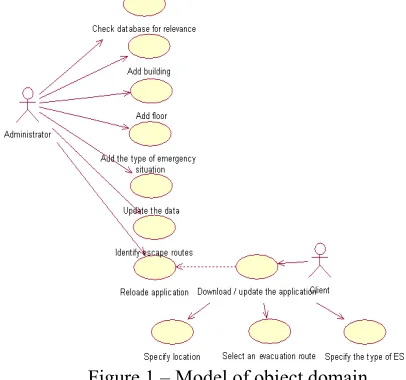
[image:3.612.315.518.226.416.2]By means of CASE- Rational Rose facilities there is constructed the model of object domain (Figure 1).
Figure 1 – Model of object domain
An administrator adds a building into an application software code. Subsequent to it, an administrator adds building floors plans or checks their actuality. If the base is not feasible, an administrator updates data. An administrator adds types of emergencies and evacuation paths for each floor.
After having changed an application, an administrator updates application and adds it to the external resource.
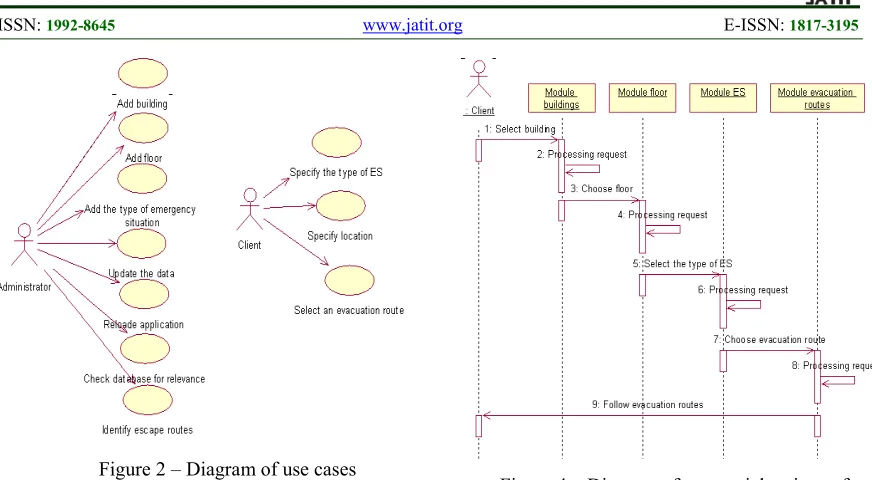
A user loads or updates an application from the external resource. At starting up an application, a user denotes own location and type of emergency. Further, a user selects evacuation path and follows it. Use cases are necessary at the stage of forming the requirements to the software. Every use case is a potential requirement to the system and unless detected, it is impossible to plan its implementation.
ISSN: 1992-8645 www.jatit.org E-ISSN: 1817-3195
Figure 2 – Diagram of use cases
Sequence diagram (Figure 3) represents the process of actions sequential execution by an administrator upon software code changing.
Figure 3 – Diagram of sequential actions by an administrator.
[image:4.612.96.322.366.539.2]Sequence diagram (Figure 4) shows the process of sequential actions of the user.
Figure 4 – Diagram of sequential actions of the user
On class diagrams there are also shown class attributes, class operations and constraints, which are superimposed on connections between the objects. Class diagram is on the Figure 5.
Figure 5 – Class diagram
Class diagrams represent the central link of object-oriented methods. Class diagram determines the system object types and different static relationships, existing between them. There are two basic types of static relationships:
– associations (for instance, a client can place an order)
– subtypes (a client may be private).
Usage of 3D modeling software tools allowed developing visual volumetric image of an educational institution.
[image:4.612.96.517.371.554.2]ISSN: 1992-8645 www.jatit.org E-ISSN: 1817-3195 motion among three-dimensional objects. Master
packages of three-dimensional graphics possess quite wide capabilities in creating animation, allowing visualization of people movement in an educational institution.
The article described design and development of application for people evacuation from educational institutions in cases of people distribution nonstationarity in the premises, giving the possibility to evaluate time-table from the point of view of unobstructed evacuation, being the acute task for people’s safety. Application under design is designated for fast and utmost effective evacuation of people from an educational institution.
[image:5.612.312.522.77.222.2] [image:5.612.313.523.265.385.2] [image:5.612.313.521.351.597.2]5. APPLICATION OF 3D MODELING FOR DEVELOPING THE SYSTEM OF EVACUATION FROM THE BUILDING
Figure 6 shows 10-floor educational institution. Let us suppose that it is necessary to evacuate people from it in connection to the happened emergency. Since the alarm announced during the lessons, thereafter all classrooms are occupied. Every auditorium admits 30 students. Every floor has 25 auditoriums, which in total- 250. There are 4 stair wells between the floors. The building has 4 exits, two of them are main, two emergency ones.
Process of evacuation from an educational institution has been developed in 3D modeling, using instrumental means of three-dimensional graphics Autodesk Maya.
By means of three-dimensional graphics we can create a very similar copy of a definite object and develop new, even unreal representation of the object not existed to this moment,
Autodesk Maya is an instrumental system of dimensional graphics and computerized three-dimensional animation, possessing, as well, the functional of powerful editor of three-dimensional graphics. Set of useful instruments, contained in Autodesk Maya, makes organization and support necessary for postproduction and development of games and 3D animation, creation of visual effects of working processes completely simple. And that, in its turn, sufficiently increases productivity. As a result, there might be extremely reduced terms of work and achieved unprecedented peaks in creativeness.
Figure 6 – Educational institution. Main exit.
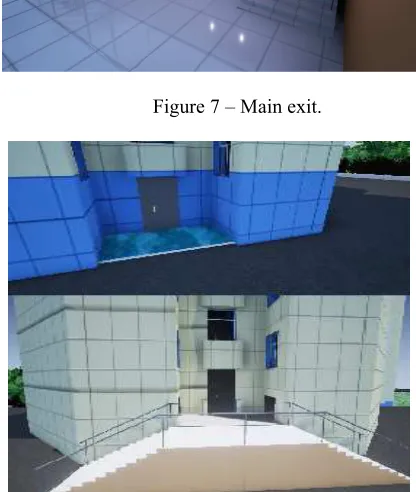
Figure 7 – Main exit.
ISSN: 1992-8645 www.jatit.org E-ISSN: 1817-3195
Figure 9 – Passages of educational institution.
People’s motion animation in Autodesk Maya is fulfilled by means of Unreal Engine software.
Game engine. Game engine is a central software component of computer and video games or other interactive applications with graphics, processed in real time. It provides main technologies, simplifies development and often gives the game the ability to run on multiple platforms, such as game consoles and desktop operating systems, for example,
GNU/Linux
,Mac
OS X
andMicrosoft Windows
.Main functionality is usually provided with a game engine, which includes
layout engine
(«Tree Visualizer»)
, physics engine, sound,scripts, animation, artificial intelligence, net code, memory management and multithreading. Often, at the expense of reusing of one game engine, you can save resources for creation of multiple different games.
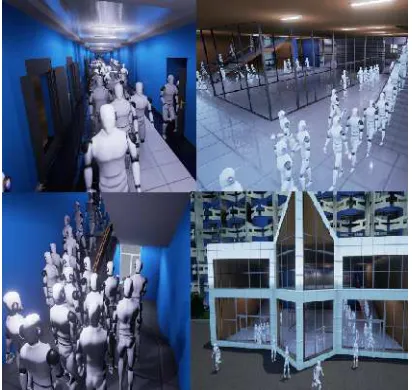
Figure 10. Evacuation of people from educational institution
6. CONCLUSION
Important problem of evacuation model creation is the technics of evacuation simulation.
In the work hereby we present the software application design in UML (Unified Modeling Language) and 3D modeling for people evacuation from an educational institution. Design description: of conceptual scheme of information system, there is conducted requirements analysis (use case diagram),
static modeling of information system (class diagram),
dynamic simulation of information system (sequence and interaction diagram).
Graphic display of an educational building in 3D is an efficient form of visualization of the premise interior. It has some degree of informativeness and allows to produce fully external and internal characteristics of the building. Development of modern safety techniques in the places of floc demands elaboration of new research methods, and, in particular, simulation of methods and evacuation processes optimization at emergency situation occurrence.
[image:6.612.92.298.507.702.2]ISSN: 1992-8645 www.jatit.org E-ISSN: 1817-3195
REFRENCES:
[1] Belyayev S. V. Dense population buildings evacuation – М.: All-Union academy of Architecture, 1938.
[2] Milinsky А.I. Normalization principle of evacuating people from public buildings– Information manual of Fire Safety Research Institute. М., 1964.
[3] Velikovsky L.B., Holschevnikovk V.V. Evacuation from high buildings// «Architecture of the USSR » – 1969 – #1. [4] Khassan Goma UML- real-time software
design, parallel and distributed applications – DMK-1press, 2011. – 704 p.
[5] Khvan Т.А., Khvan P.А. Health and safety – М.: Publishing House «Phoenix », 2010. – 414p.
[6] Lobachyev А.I. Health and safety – М.: Publishing House «Yurait», 2009. – 367p. [7] 2015- International Conference on Control,
Automation and Systems (ICCAS 2015), Busan, Korea, 2015. –p.p. 1587-1592.
[8] Vestnik KazNTU #3(109), 2015. –p. 58-63. [9] Kuligowski E. Review of 28 Egress Models /