A STUDY ON EFFECT OF E-LEARNING AND TRADTIONAL
LEARNING ON ACHIEVEMENT IN MATHEMATICS
Annie Kavitha.L Research Scholar
University of Madras, Chennai-5
This study examines the effect of e-learning and traditional learning on achievement in
mathematics. This study provides descriptive data on students’ achievement in mathematics
from their learning (e-learning/traditional). The sample constitute of 266 students drawn
from five schools from Pondicherry. Random sampling technique is adopted to select the
sample. The researcher conducted pre-test on four concepts in mathematics. Based on the
pre-test score, students were divided into two groups, students learning by Traditional
method (group A) and students following the E-learning method (group B). Group A was
subjected to the traditional class room teaching and group B was exposed to E-learning
process. After teaching, the researcher conducted the post-test for all the 266 students. The
answer scripts were evaluated and the scores obtained by each individual were tabulated
concept-wise. The findings of the study indicate that E-learning students performed better
than the traditional learning students. There is significant difference between E-learning and
Traditional learning methods. Comparing the performance of English and Tamil medium
students following the e-learning method, it is found that the English medium students
performed better than Tamil medium students.
Key words: E-learning, traditional learning
INTRODUCTION
Mathematics is the foundation of science and technology that have made our life more
That is why Kothari Commission (1966) rightly recommended the study of mathematics
compulsory for all, for the first ten years of schooling. The new technologies have brought
about changes in pedagogy and curriculum content and have been instrumented in increased
academic productivity and teaching effectiveness. E-learning from end to end the web world
has opened up a lot of opportunities for the people. There are more than a few benefits
associated with e-learning. For students it acts as boon in getting knack of easier said than
done topics as well as saving time. For teachers e-learning helps in learning the right skill
required to teach students. Many schools nowadays are turning up the web world and
teaching students online which has changed the entire spectrum of teaching methods. This
medium of e-learning has made studying very easy. One can study at their own set time and
place.
Need of the study
The most important fact that emerges out of the state schools is that usual complaint that
children find mathematics learning to be most difficult and most significant. In this
competitive world the parents tend to go from pillar to post, to find mathematics experts to
provide extra guidance and coaching to their wards. With the high expectations of their
children securing top marks in subjects like mathematics. At all levels mathematics teaching
develops spirit of enquiry required for any walk of life. In our country, the parents are very
particular to send their children to professional courses like engineering, medicine, charted
accountancy, master of business administration, etc. The school, the parent and the significant
others keep thinking only of these professions for themselves, whatever may be the marks
secured in mathematics and the other relevant subjects.
The first and the most important reason for not learning mathematics is poor teaching.
Teaching is ineffective because it is inadequately planned and sometimes exhibit violations of
learning. Some teachers are poorly motivated. Some teachers teach the subject
(Mathematics) rapidly without giving time to think. Some teachers ignore the fact that pupils
are individuals with varied backgrounds, talents and interests and attempt to teach everyone
the same material, the same rate, in the same way. In this age of rapid change and
uncertainty, teachers need to adapt to change if they are to survive and keep pace with new
Objectives
To study the differences in the achievement in mathematics of the students with respect to the
method of teaching (E-learning/Traditional)
To study the mathematics achievement of the students with respect to gender and medium of
instruction (English/Tamil)
To study the interaction effect of method of teaching and gender / medium of instruction of
the XI standard students on their post test scores in mathematics
Limitations
1. The study is restricted to a sample chosen only from Pondicherry
2. The investigation is restricted to XI standard students
3. The pre-test and post-test questionnaire is prepared by the investigator
Design of the study
Descriptive method of research is appropriate to study the Effect of E-learning and
Traditional learning on achievement in mathematics of XI standard students.
Sample
The sample constitute of 266 students drawn from five schools from Pondicherry. Random
sampling technique is adopted to select the sample.
Tools Used
The investigator adopted the questionnaire method which falls under the preview of inquiry
method.
1. Study material–XI standard mathematics text book by government of Tamil Nadu
2. For the pre-test and post-test, the investigator used the questionnaire method
3. The investigator also collected the personal information of the students using
questionnaire method
The reformulated test paper was administered to all 266 students based on four concepts
namely Trignometrical equations, Properties of triangles, Solutions of triangles, Inverse
trignometrical functions. The researcher evaluated all the answer scripts carefully. The scores
obtain were tabulated systematically for each student, considering the scores obtained
concept-wise and also the total score for all the four concepts taken together. Based on the
pre-test score students were divided into two groups, students learning by Traditional method
(group A) and students following the E-learning method (group B)
Group A was subjected to the traditional class room teaching, revolving around the lecture
method and group B was exposed to E-learning process which was basically “interactive” in
nature with total multimedia support. The E-learning students had the advantage of acquiring
more knowledge related to the topic. After teaching, the researcher conducted the post-test
for all the 266 students. The answer scripts were evaluated and the scores obtained by each
individual were tabulated concept wise and also for the entire questions (40) covering all four
concepts.
Analysis of data
The entire data collected in order to study the Effect of E-learning and Traditional learning on
achievement in mathematics of XI standard students with respect to gender, medium of
instruction. The data were analyzed with the help of mean, standard deviation, t-test, F-test
techniques of the statistics. The descriptive analysis, differential analysis and two-way
ANOVA were carried out based on the objectives and hypotheses of the study.
Table: 1 Consolidated post-test results with respect to method of learning
Post test total scores
Method
E-learning Traditional learning
N 131 135
Mean 20.97 19.96
SD 5.786 5.364
t 1.96*
Significance 0.05
Table 2: Consolidated post-test results with respect to gender
Post test total scores
Gender
Girls Boys
N 95 171
Mean 20.30 20.59
SD 5.235 5.843
t 0.548
Significance NS
[image:5.595.66.533.229.636.2]The above table shows that there is no significant differences in post test total mean score of the boys and girls at 0.05 level of significance.
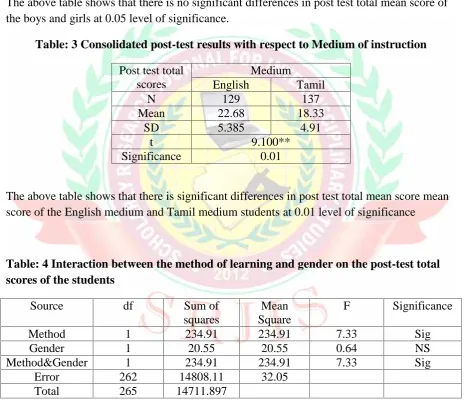
Table: 3 Consolidated post-test results with respect to Medium of instruction
Post test total scores
Medium
English Tamil
N 129 137
Mean 22.68 18.33
SD 5.385 4.91
t 9.100**
Significance 0.01
The above table shows that there is significant differences in post test total mean score mean score of the English medium and Tamil medium students at 0.01 level of significance
Table: 4 Interaction between the method of learning and gender on the post-test total scores of the students
Source df Sum of
squares
Mean Square
F Significance
Method 1 234.91 234.91 7.33 Sig
Gender 1 20.55 20.55 0.64 NS
Method&Gender 1 234.91 234.91 7.33 Sig
Error 262 14808.11 32.05
Total 265 14711.897
Table: 5 Interaction between method of learning and medium of instruction on the post-test total scores of the students
Source df Sum of
squares
Mean Square
F Significance
Method 1 70.88 70.88 2.714 Sig
Medium of Instruction
1 2164.11 2164.11 82.85 Sig
Method & Medium of Instruction
1 3758.57 3758.57 143.90 Sig
Error 262 12065.99 26.12
Total 265 14546.94
The above table shows that there is significant interaction between the method of learning and medium of instruction on the post test total scores of the students
Major Findings of the Study
1. E-learning students performed better than the traditional learning students in their
post-test total mean scores. There is significant difference between E-learning and
Traditional learning methods. Hence it can be inferred that the achievement level of
the students depends upon the method of teaching and learning. The achievement
level of E-learning students is more than that of the traditional learning XI standard
students in mathematics.
2. Achievement level of XI standard students in learning a topic in mathematics is
irrespective of gender difference
3. Comparing the performance of English and Tamil medium students following the
e-learning method it is found that the English medium students performed better than
Tamil medium students
4. Comparing the performance of English and Tamil medium students following the
traditional learning method it is found that the English medium students performed
better than Tamil medium students
5. E-learning English medium students performed better than the English medium
students following Traditional method
Need to reduce the dropouts
Need to reduce the burden of government on education
Need to make learning student centred
Need to extend learning beyond time and space
Conclusion
E-learning is an essential tool for learning mathematics in the 21st century, and all schools
must ensure that all their students have access to technology. Effective teachers maximize the
potential of e-learning to develop students’ understanding, stimulate their interest, and
increase their proficiency in mathematics. When e-learning is used strategically, it can
provide access to mathematics for all students. It may be concluded that the achievement
level of the XI standard students in mathematics depends heavily upon the method of
teaching. It has been inferred by this study, to improve the achievement level of the XI
standard students in mathematics, e-learning must be implemented in teaching learning
process. This study shows that the achievement level of girls is higher in e-learning and boys
in traditional learning. It can also be concluded that the achievement level of students in
e-learning does not depend on gender difference. The finding of the study also shows that, on
the whole, the achievement level of English medium students is higher than the Tamil
medium students. There is an urgent need to improve the achievement level of the school
students’ particularly Tamil medium schools, using the major findings of the study, supported
by e-learning and other web-based teaching-learning technique.
References
Bates, T. (2001). National strategies for e-learning in post secondary education & training.
Paris:UNESCO
Becker,J.,& Ravitz,J. (1999). The influence of computer &Internet use on teachers’
pedagogical practices and perceptions. Journal of research on computing in Education. 31(4),
356-84
Best, J.W (1997). Research in education. New Delhi Prentice–Hall of India Private Limited.
Collis, B (1985b). Sex related differences in attitudes towards computers: Implications for
Dereshiwsky, M.I. (2001). Identifying online assessment practices & perceptions. Education
at a Distance, 15(10).
Retrieved from http://www.us. Dia.org/ED magazine/illuminactive/JANOI ISSUE/ticle 02.
html.
Dhankar,R. (2000). Challenges of Information and Communication Technologies. Journal of
All India Association for Educational Research.
Ettiger,A., & Holton, V.(2004). E-learning– the findings and future. Berkhamsted Ashridge
Virtual Learning Resource Centre.
George,K.J., (2007) Relative effect of e-learning traditional learning on achievement in
Physics of 11thstandard students.
Gotschell, M. (2000). E-learning strategies for executive education & corporate training.
Fortune, 141(10), S5-S59.
IDC Worldwide corporate e-learning market forecast and analysis, 1999-2001. Retrieved
September 29, 2001.form.
http://www.idc.com:8080/services/press/PR/GSV 02270/pv.stm.
Jayanthi, M.L.N., & Padmanaban.T. (October 2007). Education through e-learning. Edutrcks,
7(2).
Kathuia,R. (2007). Maths the e-learning way. Teacher plus 1(15)
Koper, E.J.R. (2003). A Sustainable Approach to e-learning. London kogan.
Lokesh Koul, (1993). Methodology of Educational Research. New Delhi, Vikas Publications