PERFORMANCE OF MIMO MC-CDMA SYSTEM WITH
CHANNEL ESTIMATION AND MMSE EQUALIZATION
1
N. TAMILARASAN
,
2L. NITHYANANDAN1Department Electronics and Communication Engg., Shri Krishnaa College of Engg. and Tech
Puducherry
2
Department Electronics and Communication Engg., Pondicherry Engg College, Puducherry
E-mail: [email protected], [email protected]
ABSTRACT
The quality of a wireless link can be described by three basic parameters, namely transmission rate, transmission range and transmission reliability. With the advent of multiple-input multiple-output (MIMO) assisted Multicarrier code division multiple access (MC-CDMA) systems, the above-mentioned three parameters may be simultaneously improved. The MC-CDMA combined with the MIMO technique, has become a core technology for future mobile radio communication system. However, possible potential gain in spectral efficiency is challenged by the receiver’s ability to accurately detect the symbol due to inter symbol interference (ISI). Multipath propagation, mobility of transmitter, receiver and local scattering cause the signal to be spread in frequency, different arrival time and angle, which results in ISI in the received signal. This will affect overall system performance. The use of MC-CDMA mitigates the problem of time dispersion. However, still it is necessary to remove the amplitude and phase shift caused by channel. To solve this problem, a multiple antenna array can be used at the receiver, not only for spectral efficiency or gain enhancement, but also for interference suppression. This can be done by the, efficient channel estimation with strong equalization. This paper proposes MIMO MC-CDMA system, Minimum mean square error (MMSE) equalization with pilot based channel estimation. The simulation result shows improved Bit error rate (BER) performance when the sub carrier (SC) and antenna configuration were increased.
Keywords: MC-CDMA, ISI, MMSE Equalization And Pilot Based Channel Estimation
1. INTRODUCTION
The performance of a wireless communication system can be substantially improved by MIMO antenna techniques. Antenna diversity is an effective way to achieve spatial diversity. MC-CDMA, on the other hand, is also a promising technology for the next generation wireless communication systems, which is a combination of orthogonal frequency division multiplexing (OFDM) and code division multiple access (CDMA). By benefiting from both techniques, MIMO MC-CDMA possess many advantages in terms of insensitivity to frequency selective channels, frequency diversity, efficient utilization of bandwidth and ability to flexibly generate high data rates within a fixed bandwidth.
In the high data rate transmission system the frequency selective fading effect due to multi-path propagation causes the ISI. In order to reduce the ISI effect, the cyclic prefix is utilized to modify the frequency selective fading into frequency flat fading. The systems need an estimation of the frequency selective fading coefficients to
counteract fading and interference to improve system performance and capacity.
One of the most critical and challenging parts of the receiver is to obtain the channel state information accurately and promptly for detection of information symbols. Since the overall system BER performance depends heavily on the estimation accuracy, the channel tracking capabilities (for time variant channels), and the compensation efficiency. Especially, for the MIMO MC-CDMA system the accurate channel estimation and equalization is much more critical in the overall system performance since orthogonality has been applied on both space and frequency domain. Hence, the ability of the system to recover and maintain the orthogonal properties make into a key factor for achieving the robust high data capacity communication links.
ISSN: 1992-8645 www.jatit.org E-ISSN: 1817-3195
based, blind and semi blind channel Estimation. The blind channel estimation is carried out by evaluating the statistical information of the channel and certain properties of the transmitted signals. Blind Channel Estimation has its advantage in that it has no overhead loss but it has less accuracy, it is only applicable to slowly time-varying channels due to its need for a long data record. In training based channel estimation algorithms, training symbols or pilot tones that are known a priori to the receiver, are multiplexed along with the data stream for channel estimation. Semi-blind techniques make use of both pilots and the natural constraints to efficiently estimate the channel. These methods use pilots to obtain an initial channel estimate and improve the estimate by using a variety of a priori information. Thus, in addition to the pilots, semi-blind methods use the cyclic prefix, time and frequency correlation, Gaussian assumption on transmitted data, virtual carriers for channel estimation and subsequent data detection. Among the various channel estimation technique pilot based channel estimation is to be considered a good solution because of its more accuracy.
Differentiate demodulation without channel estimation is used in [1] which results SNR loss of up-to 3 db. Chang- yi yang et al has derived the channel tracking method using kalman filter which results in better estimation accuracy but suffer from computational complexity and delay [2,3]. Various authors have reported the effect of channel estimation error and phase noise [4-7]. Some authors have tried channel estimation using known training sequence and training algorithm for MIMO-OFDM system [8-10]. Andrea Conti and Barbara Masini discussed Partial equalization for MC-CDMA wireless Systems in which only partial compensation of phase distortion carried out to avoid noise but sufficient compensation of phase distortion must take place to avoid noise[11,12]. In [13], author has explained orthogonality restoring combining technique for MC-CDMA system, this system totally avoids multiuser interference but it enhances noise. Equalization based on Zero forcing and MMSE [14] was explained for single carrier transmission system only. Among the various equalization methods for MIMO and MC-CDMA, MMSE is considered to be a good solution for data recovery since it can effectively reduce the ISI and utilize the diversity of the frequency-selective channel [15].
From the literature survey it is observed most of the author’s discussed either channel estimation or equalization for the system. But the performance of
the system depends on both estimation and equalization. In our previous work [16] equalization for MIMO MC-CDMA was explained and simulation has been done for different SC and antenna configuration with idle channel estimation. In this paper for the same MIMO MC-CDMA system the channel estimation has been incorporated with equalization. This paper discusses the both channel estimation and equalization for the MIMO-MC-CDMA system. The rest of the paper is organized as follows; system model is described in section II, the simulation result and discussion is in section III and the conclusion is in section IV.
[image:2.612.314.519.261.316.2]2. SYSTEM MODEL
[image:2.612.316.513.357.425.2]Figure 1: Simple Model of MIMO MC-CDMA Transmitter
Figure 2: Simple Model of MIMO MC-CDMA Receiver
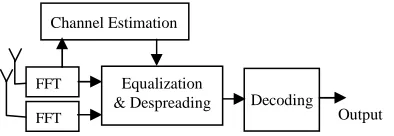
Figures 1 and 2 show the simple model of MIMO MC-CDMA transmitter and receiver respectively. The transmitter of MIMO MC-CDMA consists of BPSK/QPSK modulator, Direct sequence spreader and OFDM modulator. In these schemes the pilot sequence are very important for the performance. After modulating, the data stream is multiplied by a spreading sequence. The length of this spreading code is usually identical to the number of SC. The pilot signals are multiplexed to the data streams, after OFDM modulation the signals are transmitted through multiple antennas.
The received signal is demodulated using Fast Fourier transform (FFT). After OFDM demodulation the user data symbols and pilot symbols are recovered by despreading with corresponding spreading codes. The required transfer function for channel estimation and equalization is recovered from pilot sequence. Finally the original data stream is recovered by dividing the received signal by channel response. At the receiver end, the demodulator process the channel equalized waveform and reduces each waveform to a scalar (or) a vector that represents an
Data in Encoding Spreading
IFFT Pilot
Insertion
IFFT
FFT Equalization & Despreading
FFT
Channel Estimation
Decoding
0 5 10 15 10-4
10-3 10-2 10-1 100
Eb/No (dB)
B
E
R
2 x 2 4 x 4 2 x 2 MMSE 4 x 4 MMSE
estimation of the transmitted data symbol. The detector, which follows the demodulator, decides whether the transmitted bit is a 0 or 1.
Consider a MIMO MC-CDMA system having Nc
subcarrier and
T R
N
×
N
MIMO system, thetransmitted signal after modulation can be expressed as
2
1 1
( )
( )
(
) cos(
)
(1)
c T b c s
s N N E
k n N T
i k n
T s n
s t
b i c
u
t
iT
ω
t
∞
=−∞ = =
=
−
∑
∑ ∑
where Eb and Ts are the bit energy and symbol
duration respectively, uTs(t) represents a
rectangular waveform with amplitude 1 and pulse duration Ts, bk(i) is the i
th
transmitted data bit, cn
is the spreading code,
T
N
is the transmittingantenna, ωn = 2πf0+ 2π(n - 1)∆f is the radian
frequency of the nth SC, and the frequency spacing is ∆f = 1/Ts.
The received signal r(t) through receiving antenna
R
N
l is given by2
1 1
.
(
) cos(
)
(2)
( )
( )
( )
s
c R b c s
T s n n
N N E
n k n N T
i k n
u
t
iT
t
r t
t
h b i c
ω
ϕ
η
∞= −∞ = =
−
+
=
+
∑
∑∑
Where hn is the SC flat fading gain, φn is the SC
fading phase and η(t) is Additive white Gaussian
noise (AWGN) with single-sided power spectral density N0. After phase compensation, the receiver
performs amplitude correction using equalizer coefficient. The received signal after FFT is given by
( )
( )
( )
( ),
0,1,..,
c1 (3)
Y k
=
X k H k
+
W k
k
=
N
−
The received pilot signals YP(k) are extracted from Y(k), the channel transfer function H(k) can be obtained from the information carried by HP(k) with the knowledge of the channel responses H(k). The transmitted data samples X(k) can be recovered by simply dividing the received signal by sample response. Finally the signals are equalized by MMSE technique [16].
3. SIMULATION RESULT AND DISCUSSION
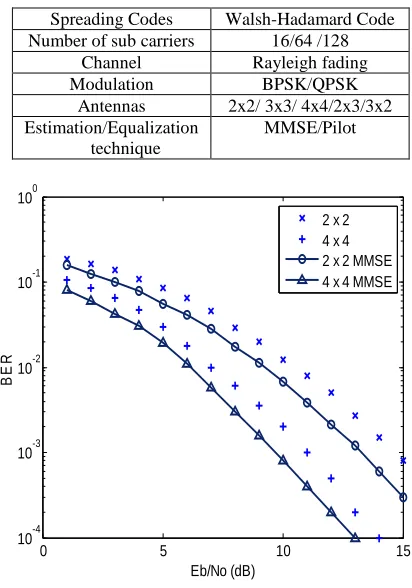
[image:3.612.313.519.212.506.2]The system with diversity technique for MIMO MC-CDMA is simulated using MATLAB with the parameters given in Table 1. The result shows the BER performance with respect to energy per bits to spectral noise density (Eb/No) of the system with/ without channel estimation under Rayleigh fading channel.
Table 1: Simulation Parameters
Spreading Codes Walsh-Hadamard Code Number of sub carriers 16/64 /128
Channel Rayleigh fading Modulation BPSK/QPSK
Antennas 2x2/ 3x3/ 4x4/2x3/3x2 Estimation/Equalization
technique
MMSE/Pilot
Figure 3: Error Performance (BPSK, 16 SC)
ISSN: 1992-8645 www.jatit.org E-ISSN: 1817-3195
0 5 10 15
10-4 10-3 10-2 10-1 100
Eb/No (dB)
B
E
R
2 x 2 4 x 4 2 x 2 MMSE 4 x 4 MMSE
0 5 10 15
10-4 10-3 10-2 10-1 100
Eb/No (dB)
B
E
R
2 x 2 4 x 4 2 x 2 MMSE 4 x 4 MMSE
0 5 10 15
10-4 10-3 10-2 10-1 100
Eb/No (dB)
B
E
R
2 x 2 4 x 4 2 x 2 MMSE 4 X 4 MMSE
0 5 10 15
10-4 10-3 10-2 10-1 100
Eb/No (dB)
B
E
R
2 x 2 4 x 4 2 x 2 MMSE 4 x 4 MMSE
Figure 4: Error Performances (BPSK, 64 SC)
Figure 5: Error Performances (BPSK, 128 SC)
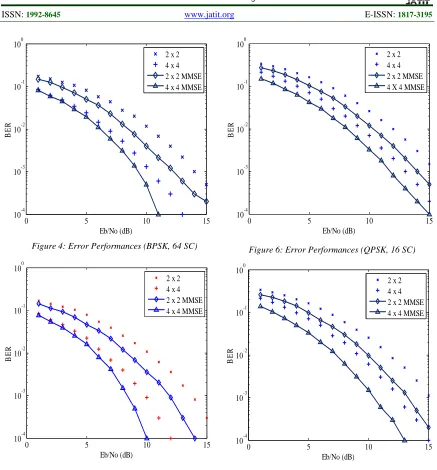
Figure 3 shows the BER performance of MIMO MC-CDMA with (line graph) or without (legend graph) MMSE channel estimation and equalization for BPSK modulation for different antenna configuration. It is noticed that when the number of antennas are increased, the performance of the system is increased due to the exploitation of space diversity. From the graphs it is evident that the system with MMSE estimation performs better due to the reduction of ISI. The same system is tested for different SC also, which is shown in figures 4 and 5. From figures 3, 4 and 5 it is observed that the performance of the system gradually increases due to the increase in number of SC i.e as frequency diversity increases.
[image:4.612.89.526.67.537.2]
Figure 6: Error Performances (QPSK, 16 SC)
Figure 7: Error Performances (QPSK, 64 SC)
0 5 10 15 10-4
10-3 10-2 10-1 100
Eb/No (dB)
B
E
R
2 x 2 4 x 4 2 x 2 MMSE 4 x 4 MMSE
Figure 8: Error Performances (QPSK, 128 SC)
0 5 10 15
10-4 10-3 10-2 10-1 100
Eb/No(dB)
B
E
R
3 x 2 3 x 3 2 x 3 2 x 3 MMSE 3 x 2 MMSE 3 x 3 MMSE
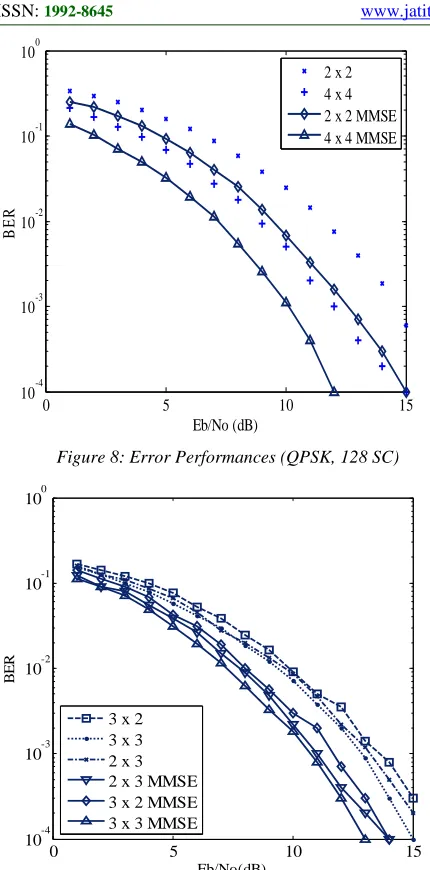
Figure 9: Error Performances (BPSK, 128 SC) of the System with Different Combinations of Transmit and Receive Antenna
performs better. Comparing with our previous work it is clear that the performance is slightly poor as the estimation here closely matches with the realistic situation.
4. CONCLUSION
It is well known that the wireless channel causes an arbitrary time and frequency dispersion, attenuation, amplitude distortion and phase shift in the received signal. The use of MIMO MC-CDMA mitigates the effect of time dispersion. Still it is necessary to remove the ISI to increase overall system performance. In this paper the performance of MIMO MC-CDMA signals in frequency
selective fading channels with pilot based channel estimation and MMSE equalization is discussed to compensate the ISI. The result shows the performance of the system with two different modulations. From the simulation results it is inferred that the system with pilot based channel estimation and MMSE equalization reduces the BER of MIMO MC-CDMA in the Rayleigh fading channel as ISI is drastically reduced. The proposed channel estimation technique can be, in general, used for channels with high selectivity in both frequency and time by simply using appropriate pilot patterns. The minimum complexity and superior channel tracking capability of the proposed technique enables MIMO MC-CDMA receiver to process huge data rate in highly selective channels with better performance.
REFRENCES:
[1] Mohammed El-Hajjar and Lajos Hanzo, “Dispensing with channel estimation”, IEEE
Trans. Veh. Technol., Magazine I, June 2010.
[2] Chang-Yi Yang and Bor-Sen Chen, “Robust MC-CDMA Channel Tracking for Fast Time-Varying Multipath Fading Channel”,
IEEE Trans. Veh. Technol., Vol. 59, No. 9,
Nov. 2010, pp. 4658-4664.
[3] Eric Pierre Simon, Laurent Ros, Hussein Hijazi, Jin Fang, Davy Paul Gaillot and Marion Berbineau, “Joint Carrier Frequency Offset and Fast Time-Varying Channel Estimation for MIMO-OFDM Systems”,
IEEE Trans. Veh. Technol., Vol. 60, No. 39,
Mar. 2011, pp. 955-964.
[4] Roberto Corvaja and Ana García Armada, “SINR Degradation in MIMO-OFDM Systems with Channel Estimation Errors and Partial Phase Noise Compensation”, IEEE Trans. on wireless commun., Vol. 58, No. 8, Aug. 2010, pp. 2199-2203.
[5] R. Corvaja and A. García Armada, “Effect of multipath and antenna diversity in MIMO-OFDM systems with imperfect channel estimation and phase noise compensation”, Elsevier Physical Commun., Vol. 1, No. 4,
Dec. 2008, pp. 288-297.
[6] S. Bittner, E. Zimmermann and G. Fettweis, “Iterative phase noise mitigation in MIMO-OFDM systems with pilot aided channel
[image:5.612.93.308.76.511.2]ISSN: 1992-8645 www.jatit.org E-ISSN: 1817-3195
[7] P. Liu, S. Songping, and Y. Bar-Ness, “A phase noise mitigation scheme for MIMO WLANs with spatially correlated and imperfectly estimated channels”, IEEE Commun. Lett., Vol. 10, No. 3, Mar. 2006, pp. 141-143
[8] Xianhua Dai, Han Zhang and Dong Li, “Linearly time-Varying Channel Estimation for MIMO/OFDM Systems Using Superimposed Training”, IEEE Trans. on Commun., Vol. 58, No. 2, Feb. 2010, pp. 681-693.
[9] Benjamin R. Hamilton, Xiaoli Ma, John E. Kleider and Robert J. Baxley, “OFDM Pilot Design for Channel Estimation with Null Edge Subcarriers”, IEEE Trans. on wireless commun., Vol. 10, No. 10, Oct. 2011, pp. 3145-3150.
[10] Francesco Montorsi and Giorgio Matteo Vitetta, “On the Performance Limits of Pilot-Based Estimation of Band limited Frequency-Selective Communication Channels”, IEEE Trans. on
Commun., Vol. 59, No. 11, pp. 2964-2969,
Nov. 2011.
[11] Barbara M. Masini and Andrea Conti, “Combined Partial Equalization for MC-CDMA Wireless Systems”, IEEE Commun.
Lett., Vol. 13, No. 12, Nov. 2011, pp. 884-886.
[12] Flavio Zabini, Barbara M. Masini and Andrea Conti, “Partial equalization for MC-CDMA systems in non-ideally estimated correlated fading”, IEEE Trans. Veh.
Technol, Vol. 59, No. 8, Oct. 2010, pp.
3818-3830.
[13] Qinghua Shi and Q. T. Zhang, “Error Probability of Multicarrier CDMA with Orthogonality Restoring Combining Over Nakagami-m Fading”, IEEE Trans. on
wireless commun, Vol. 6, No. 9, Sept. 2007,
pp. 3268-3276.
[14] Jieling Wang, Hong Yang, and Kechu Yi, “Multipath Combining Scheme in Single- Carrier Transmission Systems”, IEEE Commun. Lett., Vol. 13, No. 9, Sept. 2009.
[15] Keli Zhang, Yong Liang Guan, and Qinghua Shi, “Complexity reduction for MC-CDMA with MMSE”, IEEE Trans. Veh. Technol, Vol. 57, No. 3, May 2008, pp. 1-4
[16] Tamilarasan. N and Nithyanandan. L, “Performance of the MIMO-MC-CDMA System with MMSE Equalization”, Int. J. on
Recent Trends in Engineering and Technology,