MULTI-LEVEL TRUST ARCHITECTURE FOR MOBILE
ADHOC NETWORKS BASED ON CONTEXT-AWARE
1 A.RAJESH, 2 DR. N. MOHAN KUMAR
1Research Scholar, ANNA University Chennai, India,
1 Associate Professor / Department of Computer Science and Engineering, 2
Professor /Department of Electronics and Communication Engineering, 1,2 S.K.P. Engineering College, 1,2 Thiruvannamalai, 1,2 Tamil Nadu, 1,2 India.
E-mail: [email protected] , [email protected]
ABSTRACT
Mobile ad hoc networks (MANETs) are not favorable to centralized trust architecture and literature review provides several security framework and solutions for trust management. However, there is no unified architecture for MANET to exploit deployed security models based on trust. This study presents compelling trust architecture in which a trust based security model is superimposed with three trust models such as a low-level trust model, a medium-level trust model, and a high-level trust model based on context-aware security. The low-level trust model meets the necessary security requirements using direct observations. The medium-level trust model ensures medium security level using direct observations and recommendation messages. The high-level trust model provides a highly secured system with high complexity and computational cost. The proposed work is formulated based on the application context to determine the trust-level in geographic routing protocol. The proposed trust is fully distributed and application context dependent and dynamic in nature. The proposed multi-level trust model is integrated with Position based Opportunistic Routing (POR) Protocol that selects the trusted next hop in the routing path. The correctness of the proposed scheme is analyzed using network simulator (NS-2). Proposed work increases packet deliver ratio and throughput significantly.
Keywords: Mobile Ad Hoc Networks, Geographical Routing, Trust Management, Context-aware Trust, Trust based Security
1. INTRODUCTION
MANET has gained more attention due to its salient features like infrastructure less and multi-hop communication. On the other hand, it is susceptible to a highly error prone wireless broadcasting channel, and actively changing network topology. Conventional topology based MANET routing protocols is not efficient with the node’s mobility. Route maintenance is usually difficult due to the highly dynamic network topology. Hence, topological routing is not efficient and scalable. The idea of trust is significant to routing protocol developers in which introducing trust relationship among nodes is a challenging task to optimize the network metrics.
Trust is defined as a confidence level
(relationship) among the nodes that take part in the routing. These relationships are determined based on facts gathered from the history of previous interactions among the nodes. If the interactions are true to the protocol, the value of trust among
these nodes will be accumulated. Trust of a node may be represented as a measure of belief over the actions of its neighboring nodes, and also considers the importance of context. The trust value plays a vital role in the routing. In MANET routing protocol, trust values are mainly associated with two events such as trust request and trust recommendation. Each node maintains a trust record related to these two events. The source node may even use the trust record to detect the malicious activities in the routing.
evaluation of trust in geographical routing is straightforward compared to that of in topological routing. The MANETs are susceptible to security threats due to the network dynamics, de-centralized architecture and broadcasting nature. However, security techniques developed for fixed networks are not suitable for MANETs due to its dynamic characteristics. Trust computation is a crucial factor in the design and analysis of the secure ad hoc routing system.
Trust is a context dependent factor. In MANET, different levels of trust are preferred in routing depending on the application. MANETs are used in several applications such as a military battlefield, collaborative works, and the personal area network (PAN). For instance, routing messages in military applications require a higher level of security compared to that of in the local level. MANET applications considered in this study are the application in the local level, such as home networks, military applications that maintain a constant information network among soldiers, vehicles and headquarter information, and finally, a collaborative work that includes the office environment.
If the MANET is deployed in a home network, the security requirement in this scenario will be low. In this application, the routing process is accompanied to a low-level of trust and low computational cost. The establishment of MANET
in a collaborative environment (business
environment), need for cooperation among various users are essential to exchange information. The routing in this application should be accompanied over a medium-level of trust. Obviously, military-based applications require a high-level of security during routing. It involves a high computational cost. The various levels of trust computation are not restricted to only these applications. In this study, a fully distributed application context-aware trust based security model is presented. The proposed trust based security model decides the trust-level of geographic routing protocol based on the application context. It divides the trust-level into low, medium and high to provide security based on the application context. The aim and objectives of study are to design unified trust architecture for the MANET based on POR routing protocol. The trust management strategy deals about the application specific, context specific, by knowing the aware of the condition of the participating nodes.
The commonly used reputation based trust model is watchdog and pathrater [12]. Watchdog monitors the node’s activities and behavior and pathrater gather reputation values and reacts accordingly. A new notion of developing a routing protocol introduces a trust
manager component based on the trust
management system [3]. It determines the trust relationships among nodes in the network on observing its neighbor’s behavior in the routing process through direct and indirect ways. The major drawback of this trust management approach is that it does not implement the approach. Later, it also developed a reputation system called cooperation of nodes fairness in dynamic ad hoc networks (CONFIDANT) [4]. CONFIDANT also determines the value of trust using direct and indirect monitoring. Using these observations, it detects the malicious nodes. CONFIDANT additionally introduces an incentive scheme to reward the genuine nodes that cooperate in the routing process.
In [13], a context aware technique detects the selfish nodes. Dynamic Source Routing (DSR) is extended based on a context aware approach to punish the non-cooperating nodes. It also discards the unwanted route information to reduce the attack probability. It exploits un-keyed hash functions to identify the malicious nodes. This approach uses an inference scheme to rate the accuse level of the node. This rating prevents further service by the accused nodes. The source node uses digital signatures to broadcast the information about the detected malicious nodes. The use of digital signatures is not feasible in the resource constraint MANET. The commonly used Ad hoc on demand Distance Vector (AODV) is extended with a trust model called Trusted AODV (TAODV) [11]. AODV deploys the trust model to maintain the node’s routing activities in the network. TAODV establishes the trust value among the nodes in the form of opinions. The opinions are subjective and dynamic in nature. The opinion of one node over the other may increase positively for normal communications. The opinion may decrease with their malicious activities. It involves in exchange of trust recommendations among the nodes. TAODV reduces the computation overhead by avoiding the node’s request and certificate verification.
attackers effectively. It also suggested a framework that computes and distributes the trust-value without the aid of trusted routing protocol. A secure routing protocol (SRP) is enhanced with
Quality of Service (QoS) and forms a
trustworthiness based Quality of Service (TQoS) routing protocol [18]. It enables a secure route set up with the addition of TQoS routing metrics. The messages involved in routing are secured with public and shared keys. It particularly detects internal attacks in routing. The work in [14], evaluates and compares the performance of a set of trust based reactive protocols. A trust architecture that enhances the reliability of a packet forwarding process in the presence of malicious nodes was presented in [19]. It is mainly based on the formation of opinion from first and second hand information. A trust framework in [10] computes trust among the nodes subjectively. It is based on the watchdog mechanism. A formal trust model is based on the information obtained from the Global Computing (GC) environment [6]. An approach in [9] collects the basic requirements for developing a trust model in ubiquitous and ad hoc networking.
A decentralized security management system evaluates trust value derived from the human notion [5]. A hybrid secured system [16] for ad hoc network, involves in both chained authentication and distributed authentication. If a node cannot determine the trust-level of its neighbor using the distributed authentication, it uses chained authentication. Trust Enhanced security Architecture for MANET (TEAM) is a unified architecture that exploits the benefit of the installed security architecture [1]. The trust model of TEAM comprises of key management mechanisms and cooperation model. An agent based trust and the reputation management (ATRM) approach exploits a clustered sensor network as supporting architecture [2].
2. CONTEXT-AWARE MULTI-LEVEL
TRUST METHOD
The proposed research work has proposed application context to decide the level of trust in routing. Designing security protocols for civilian
MANET is differing from the military. Trust as the confidence level that any participating entity is capable of carrying out reliably, and securely. Hence, the levels of trust requirement differ from one application to another depending on the contexts. In an application dependent context, trust is the measurable and quantifiable component of
an entity regarding sincerity, security,
completeness and reliability of a trustee in a context aware application. The trust-value of a node is calculated to select the trusted Next-Hop in POR.
2.1 Trusted Next-Hop Selection in POR
Now-a-days, POR is commonly applied in MANET and sensor networks. POR selects the Next-Hop using greedy forwarding approach for data forwarding. In greedy forwarding approach, the source node selects Next-Hop within its transmission range such that it is close to the destination and far away from it. POR is susceptible to different levels of attacks with respect to their impacts on routing. The common attacks are location falsifying attacks, packet dropping and misrouting attacks. This approach includes the multi-level trust model in the execution of POR. A node initially selects its neighbor list for selecting a Next-Hop. The multi-level trust model enables POR to select highly trusted Next-Hop to avoid routing attacks.
2.2 Multi-level Trust Model
Figure 1: Multi-Level Trust Models For Security Services
The variations in the trust computational complexity satisfy various security requirements at various levels. This work focus on distributed trust computation approaches rather than centralized approaches. The POR protocol can be designed with different trust based security levels such as, Low, Medium and High, and it is application-context dependent as shown in Figure 1. The proposed trust based security model is integrated in the routing of POR that enables POR in selecting highly trusted Next Hop. The POR protocol is vulnerable to routing attacks. Therefore, this study presents multi-level trust model for POR by selecting highly trusted Next-Hop in routing.
2.3 Representation of a multi-level trust model for security
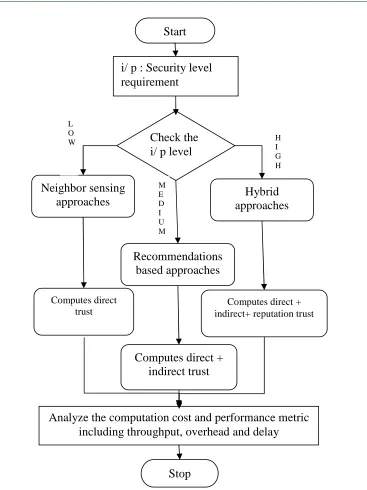
To detect routing attacks, a fully distributed trust based security model is presented as shown in the Figure 2. Various trust-levels and network metrics are listed out in the table 1. If the security level is low, it is enough to calculate the trust value of a node through direct observations. The medium-level of trust model is used where the medium security level is required. The medium-level of security may be satisfied with the recommendation based approaches in addition to direct observations. The medium-level trust model should be able to satisfy the low-level security requirements also. The high-level security environment deploys high-level trust model as it has a high probability of attacking scenarios. The high-level trust model considers the reputation value in addition to recommendation and direct observations.
Table 1: Multi-level trust models, computations and applications
Security Trust level Functional units Computation cost Overhead applications
Low Low Direct observation Low Low Local level (Home networks) Medium Medium Direct observation+
recommendation
Medium Medium Collaborative work (Office environment) High High Direct observation+
recommendation reputation (second hand opinions)
High High Military applications Collaboration
applications Home
applications
Military applications
Multi-Level
Medium Level
[image:4.612.82.556.634.721.2]Figure 2: Computation Flow Of Multi-Level Trust Model
2.4 Low-Level trust model
This model provides only the basic security services. It must be implemented to any system by default. This trust model is modeled with low computation cost and low level security. This trust model is used in energy constraint environments. This trust model provides security in low-level. Since trust computation process does not involve much complexity, the computational
cost will be low. Distributed trust computation based on neighbor monitoring provides security in a basic level with minimized computational cost. In neighbor monitoring based trust computation, each node observes its neighbor for every event occurrence, and stores its behavioral report in its cache. Each node compares its own monitored detail on an event occurrence with the monitored detail it received from the trustee node, and also from its immediate neighbors. In the direct
Start
i/ p : Security level
requirement
Check the
i/ p level
Neighbor sensing
approaches
approaches
Hybrid
Recommendations
based approaches
Computes direct trust
Computes direct +
indirect trust
Computes direct + indirect+ reputation trust
Analyze the computation cost and performance metric
including throughput, overhead and delay
Stop
L O W
M E D I U M
observation based trust computation, a node computes trust based on the degree of deviations among the observation it received from its neighbors.
Every node calculates the trust value of its neighbors by analyzing their behaviors. For instance, in Figure 3, node A monitors the behavior of node B through direct interactions and computes the direct trust value. For every new event, node A monitors the behavior of node B and adds the monitored behavior to its local
[image:6.612.180.403.267.394.2]monitoring record cache. Observations in the cache may change over time based on the behavior observed. The evaluation is performed on the basis of packet forwarding strategy if both are direct neighbors. Here, ‘Node A’ is Trust Evaluator or Trustor and ‘Node B’ is Trustee. Trust Evaluator sends ‘N’ packets to Trustee for the forwarding action to Destination. Now, Trust Evaluator observes the behavior of Trustee and assesses the following statistics. Initially, node A decides B’s trust level based on the packet forwarding result.
Figure 3: Neighbor node monitoring for low-level trust computation
[
] [
]
{
}
P
Packet Forwarding Result = FR = Pf-Pd-Pi-Pm / Ps - Pc
Ps-The number of packets sent by trust
evaluator
Pf-The number of packets forwarded by the
trustee
Pc-The number of packets dropped by the
trustee as a result of congestion
Pd-The number of packets delayed by trustee
Pi-The number of anonymously injected
packets
Pm-The number of packets misrouted
The techniques that use direct observations to detect the misbehaving nodes may fail to detect attacks due to the following reasons ambiguous collisions, and receiver collisions. In ambiguous collision, a node is prevented from overhearing its neighbor’s activities. In receiver collision, a node can ensurethat its neighbor has forwarded the packet, but it cannot ensure whether the third node received it. In the limited transmission power problem, a forwarding node limits its transmission power so that its transmission can be overheard by the sender but not by the receiver. To solve these problems, a common honest observer is used to assist the trust calculation. A common honest observer (ho) is the common neighbor of nodes involved in direct observations over the geographic routing and its range is limited to a path length of 3. ‘ho’ observes the behavior of nodes involved in direct observation and report to the trustor node. The report has the value of 0 or -1. These problems of direct observations have direct impact on the value of FRP. Based on the report provided by the ‘ho’, the value of FRP changes. The FRP value remains unchanged if it provides a positive report, i.e. ho= 0. On the other hand, the FRP value reduces to half if it provides a
B
C
A
Direct interactions betweentwo nodes
negative report, i.e. ho = -1. The modified value of FRP is represented as [FRP]m and given by:
[
]
P oL P m
P o
FR ; if h = 0
T = FR
=
FR /2 ; if h = -1
(2)
TL is the resultant value of the low-level trust evaluation. If the value of TL is greater than the thresholdvalue, trustee is marked as trusted Next-Hop in the path of geographic routing. Otherwise, it is considered as malicious node. On detecting the malicious node, the trustor selects alternative node as trusted Next-Hop. The threshold value for detecting low-level attack δ= 0.4.
2.5 Medium-Level Trust Model
Medium-level trust model is used when a
medium level of security is required. The
computational cost for trust computation is medium. It initially computes the trust based on direct observations. The direct and indirect trust computation satisfies the medium security requirements. The trust relationship among nodes
can be computed indirectly using the
recommendation factor. A trust computation technique that depends on local voting is suggested in [8]. A trust network graph G is created in which it connects a node with another node, if the distance between them is one hop distance. If node B is the target node for trust computation, node A collects the belief values on B from B’s neighbors and aggregates, resulting in a single trust value.
Figure 4: Direct And Indirect Trust Computation For Medium-Level Trust Model
[
]
(
)
(
P m A / B)
(
(
[
P]
m)
C / B)
(
(
[
P]
m)
D / B)
M
F R + R e c F R + R e c F R
T =
T h e n u m b e r o f R e c o m m e n d e r s + 1
(3)
In Figure 4, node A aggregates the recommendations obtained from nodes C and D about node B. The effective direct observation of node A on node B (([FRP]m)A/B) is derived from equations (1) and (2). In this case, node C and D
act as recommenders. To provide
recommendations on node B, node C and D should have direct observations on B. Therefore, (([FRP]m)C/B) and (([FRP]m)D/B) may be calculated
by following the procedures in equations (1) and (2). The node C and D forwards the value of direct observation as recommendations to node A using Recommendation Exchange Protocol (REP) and
represented as (Rec([FRP]m)C/B) and
(Rec([FRP]m)D/B).
In REP, recommendations are only exchanged among the neighbors [15]. It minimizes
A
C
D
B
Step 1: Node A determines the direct
trust on node B
the recommendation error probability as it involves processing of only smaller number of the recommendations. Moreover, a node may compare the received recommendations with its own observations to compute the trust-level. This comparison is accurate as nodes compute the trust-level of neighboring nodes such that it has previous knowledge about them. REP uses a minimum number of messages that reduce both network traffic and energy consumption.
The messages are transmitted to only the neighbor i.e. one hop away. Thus, avoiding flooding in multi-hop communication. REP consists of three message types, Trust Request (TREQ), Trust Reply (TREP), and Trust Advertisement (TA). If two nodes contact for the first time, each transmits TREQ message to the other node. The node that has trustee as a neighbor, sends back the reply message, TREP in which it has the recommendation about the trustee. In order to avoid collisions, reply message is sent after waiting for a period, TWAIT, and it waits for receiving TREQ messages from other nodes.
The major problem with the
recommendation based approach is that the recommender may be a dishonest node. The trustor should check for it before considering the recommendation values. The trustor node A compares its own direct observation on B with the recommendations received from C and D. If A’s direct observation coincides with the received recommendations, the recommender is an honest node otherwise it is a dishonest node.
In the equation (3), the recommended values and direct observation value are aggregated to effectively judge the state of the recommender and trustee. In case, if trustee is a malicious node,
it may behave in good manner to trustor and not to the recommenders. Therefore, there is a chance for trustor to mark recommenders as malicious. To avoid this false judgment, all the trust values are aggregated with respect to its own observation value and the values obtained from the total number of recommenders. This trust model prevents the routing from medium-level attacks.
To meet the medium level of security
requirements, the level of threshold value is increased. If the value of TM is greater than the threshold value,δ, trustee is considered as trusted Next-Hop in the geographic routing. The threshold value for a medium-level trust model δ= 0.50.
2.6 High-Level Trust Model
This level of trust is preferred in a military environment. The high-level trust model has more computing complexity and also provides a strong security level. The direct, indirect and reputation scheme satisfies the high level security requirements. As it involves direct and indirect observations on node behavior, it can be referred as hybrid approach. This trust model is required only if there is a “high” requirement of security.
This trust model has resulted in high
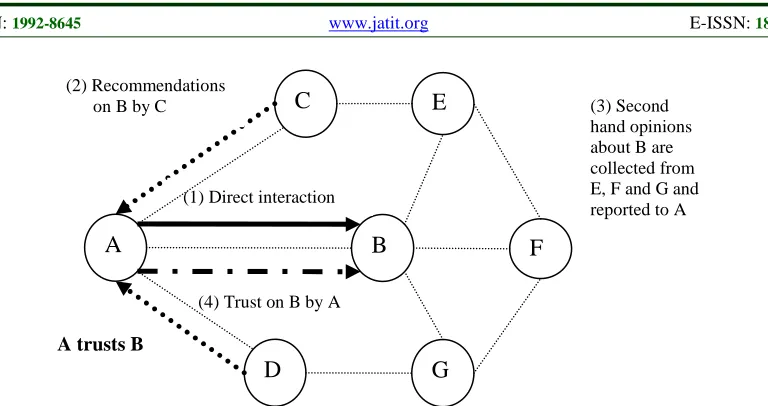
Figure 5: Hybrid approach for high-level trust computation
The trust computation technique based on a linear grouping is self-evaluated trust and trust evaluated by other nodes (neighbors) (0≤ TM ≤1) for MANET as in the equation (3). In addition, second hand opinions are also collected on the trustee. The second hand opinion is formed not only considering the past behavior. However, it also considers the behavior of trustee over a period. The reputation value helps in making accurate decisions as the second hand opinions are not measured instantaneously. The high-level trust value of node B calculated by node A is given by TH.
H M r B /( A )
T =αT + T (4)
In equation (4), Tr is the trust value calculated using reputation values. The reputation values are gathered by considering nodes as reputation requestors and reputation suppliers. It compares the reputation results to the results
gained from direct observations and
recommendation results.
The reputations are second hand opinions obtained from the non- immediate one hop neighbors of the trustor nodes. In the Figure 5, the second hand opinion of trustee node B is collected from nodes E, F and G. The second hand opinion is represented as TSH. The second hand opinions are aggregated and forwarded to node A.
( )
r B /A E B F B G B
T = T S H → + T S H → + T S H → (5)
Tr (B/A) is aggregated using Weighted average technique. In Weighted average technique,
the Weighted average of weighted trust evaluation by all neighboring nodes on node B is taken as the value of Tr (B/A). Every node retains a trust table containing details about each of its neighbors. In the trust table, values are recorded for a number of events. The trustor evaluates the trust-level based on the security requirement and values in the trust table. This high-level trust model can detect the attacks like wormhole, a black hole and Denial of Service (DoS). Malicious nodes can be detected if the computed trust-level drops below a threshold value. The range of threshold value should be higher than that of the medium-level trust model. The high-level trust model has a threshold value of 0.80. The evaluated trust value is then included in the routing function to ensure that it forwards the message only to the trusted node, thus provides security in routing.
3. RESULTS
To evaluate the performance of the multi-level trust model with POR, the critical environment is simulated by varying the attacker fraction using the Network Simulator (NS- 2). Network under the routing protocol POR without trust and with the trust model is simulated for the comparative analysis in the presence of attackers. The nodes are deployed randomly in the square region of size 2500m X 2500m. The nodes follow a random way point mobility model with the pause time of 25 sec and the speed of 10 m/s. Performance of the proposed trust model is experimented in the network consists of various proportion of attacker nodes are considered. Low, Medium and a high-level trust model consists of a maximum of 25, 75, and 125 attacker nodes
A
D
C
B
(1) Direct interaction (2) Recommendationson B by C
(4) Trust on B by A
E
G
F
(3) Second hand opinions about B are collected from E, F and G and reported to A
respectively. Each node is capable of 150m transmission range. Simulation is performed at the Traffic rate of 512bytes/sec with 60 CBR flows. Since the trust is evaluated in three levels based on
the application context, the comparative
[image:10.612.80.303.216.409.2]performance of trust against the POR without trust is evaluated.
Table 2: Simulation Parameters Of The Multi-Level Trust Model
Parameter Values
Total Number of Nodes
500
Network Area 2500m X 2500m
Size of Packet 512 bytes
Mac Type 802.11
Routing Protocol POR
Transport Agent UDP
Application Agent CBR
speed 10m/s
Mobility model Random
Way Point
Transmission Range 150m
Simulation Time 500seconds
Table 2 illustrates the Simulation Parameters of the multi-level trust model. Packet Delivery Ratio (PDR), overhead, and average end-to-end delay, are considered as the performance metrics to evaluate the effectiveness of the multi-level trust model. Evaluate these metrics by varying the attacker fraction to prove the effectiveness of the proposed trust model in the dynamic MANET environment.
3.1 Attacker Model For Simulation:
The MANET nodes communicate with each other through a restricted bandwidth and error prone wireless medium. These features of MANET motivate the attackers to launch several attacks on the network. The trust management system plays a major role in decision making, and hence, it has become an attractive target for adversaries. This work considers the network as a directed graph G (V, E) in which V represents the participating nodes and E represents the trust relationship links. The graph G is termed as the “Trust Graph”. The modeled trust graph is different from the physical graph. Assume that ‘n’ represents the total number of nodes in the network and hence, |V|= n. Therefore, each node in
the network is labeled with indices V= {1,2,3… n}. This work does not depend on any centralized entity. On the other hand, the nodes in the network compute the trustworthiness of other nodes based on their previous communications and second hand information. For instance, the node ‘A’ can rate the trustworthiness of node ‘B’ after requesting some files based on the response made by node ‘B’. The direct link between node A and B in graph G is represented as (AB), and it also represent the direct trust relation. If any two nodes in the network have no contacts i.e. (AB)∉ E, the trust value between them is uncertain. Let T represent the trust rating of one node on another node and trust relations are asymmetric i.e. T (AB)
≠ T (BA). This work considers three levels of attacks and corresponding trust models. The threshold value for low level, medium level and high level attacks are represented as δL, δM, andδH respectively. If any of the node in the network has less than the corresponding threshold value, it is considered as an attacker. For simulation purpose, this work assumes attackers of 5%, 15% and 25 % of ‘n’ in the low, medium and high-level trust model respectively.
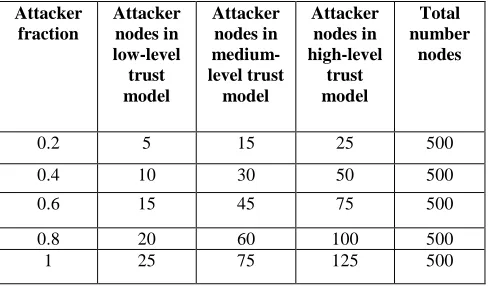
[image:10.612.307.551.581.724.2]Let nL, nM and nH represent the number of attackers in the low, medium and high-level trust model. The attackers have the ability to rate the genuine node as “bad” and malicious as “good”. The attackers can improve their T value by genuinely participating in the routing. On the other hand, if the attackers continue to show signs of constant malicious behavior, the trust model eliminates the attacker from the network. The performance of proposed trust model is evaluated using the parameter called attack fraction. The relation between attacker fraction and number of attackers in each model is shown in table 3.
Table 3: Number Of Attacker Nodes In Each Model
Attacker fraction
Attacker nodes in low-level trust model
Attacker nodes in medium-level trust
model
Attacker nodes in high-level
trust model
Total number
nodes
0.2 5 15 25 500
0.4 10 30 50 500
0.6 15 45 75 500
0.8 20 60 100 500
3.2 Performance Analysis
This section explains the performance valuation of the proposed scheme and compares with POR. This section also compares the performances among the proposed multi-level trust models.
3.2.1 Packet delivery ratio
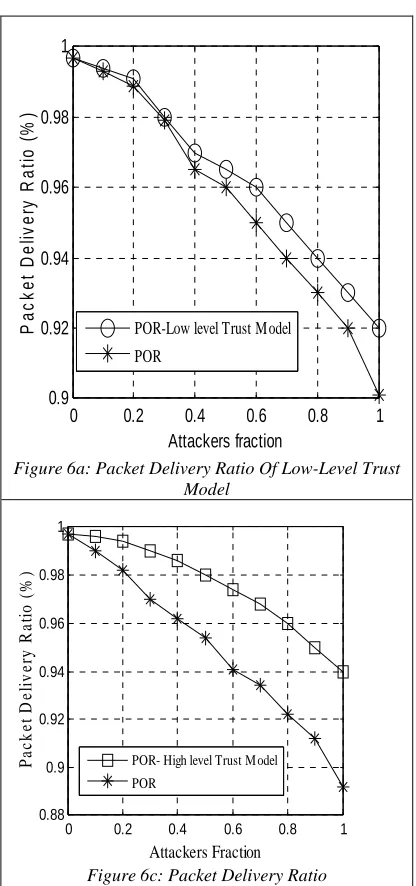
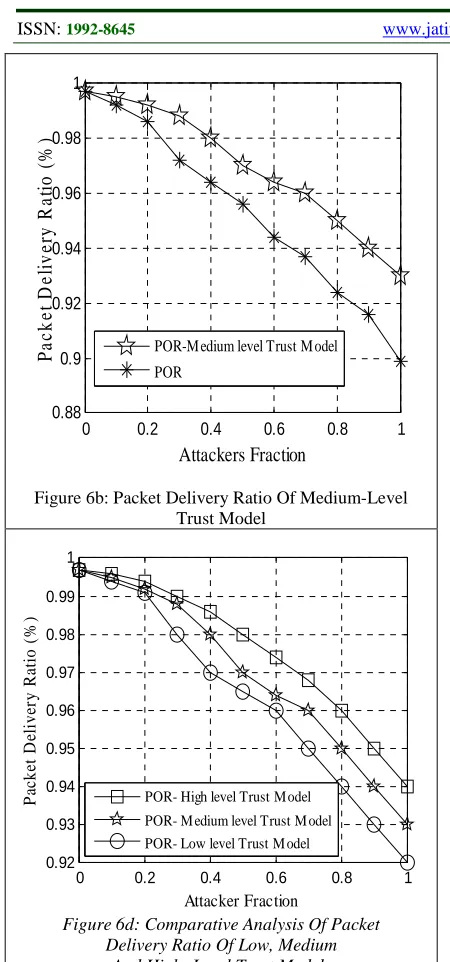
In sub section of Figure 6 shows the performance of the multi-level trust model and the effect of the packet delivery ratio with respect to various attacker fraction scenarios. Figure 6a shows the PDR of low-level trust model. POR with a low-level trust model achieves a higher packet delivery ratio than the simple POR. However, increment in the proportion of attackers decreases the packet delivery ratio in both the cases. The Figure 6b shows the effect of the PDR for medium-level trust model. The medium trust model involves the trust evaluation mechanism that prevents the medium and low-level attacks in the routing path. Therefore, the medium-level trust model provides better PDR compared to simple POR. The Figure 6c shows the effect of PDR for high-level trust model. POR with a high-level trust model detects all kind of attacks from low-level to high-level. This feature greatly reduces the packet failures in the network and achieves higher PDR in the network compared to simple POR. The Figure 6d depicts the effect of the PDR for various attacker fraction scenarios. Gradual increment of attacker proportion in the network affects the process of packet delivery by invoking various attacks over the network.
POR with a high-level trust model achieves a superior PDR compared to other levels of trust model. This is due to the sophisticated computation of trust, and it includes the functionality of low and medium-level trust computation in order to select the most trusted next hop. Consequently a high-level trust model protects the network from all kinds of threat imposed by the attacker.
0 0.2 0.4 0.6 0.8 1
0.9 0.92 0.94 0.96 0.98 1
Attackers fraction
P
a
c
k
e
t
D
e
liv
e
ry
R
a
ti
o
(
%
)
POR-Low level Trust Model
[image:11.612.316.524.99.542.2]POR
Figure 6a: Packet Delivery Ratio Of Low-Level Trust Model
0 0.2 0.4 0.6 0.8 1 0.88
0.9 0.92 0.94 0.96 0.98 1
Attackers Fraction
P
a
c
k
e
t
D
e
li
v
e
ry
R
a
ti
o
(
%
)
POR- High level Trust M odel
POR
0 0.2 0.4 0.6 0.8 1 0.88
0.9 0.92 0.94 0.96 0.98 1
Attackers Fraction
P
a
c
k
e
t
D
e
li
v
e
ry
R
a
ti
o
(
%
)
POR-M edium level Trust M odel
[image:12.612.82.307.67.548.2]POR
Figure 6b: Packet Delivery Ratio Of Medium-Level Trust Model
0 0.2 0.4 0.6 0.8 1
0.92 0.93 0.94 0.95 0.96 0.97 0.98 0.99 1
Attacker Fraction
P
ac
k
et
D
el
iv
er
y
R
at
io
(
%
)
POR- High level Trust M odel
POR- M edium level Trust M odel
POR- Low level Trust M odel
Figure 6d: Comparative Analysis Of Packet Delivery Ratio Of Low, Medium
And High- Level Trust Models
Figure 6: Illustration Packet Delivery Ratio Parameter
3.2.1 Overhead
In sub section of Figure 7 shows the effect of overhead of the multi-level trust model with respect to various attacker fraction scenarios. A low-level trust model involves the packet forwarding analysis which invokes a specific overhead in the network during the direct observation process. Fig 7a shows the overhead of the low-level trust model. Report from the common honest observer is invoked for accurate calculation of trust and hence, increases the overhead in the network. Thus, Overhead in POR
0 0.2 0.4 0.6 0.8 1 8000
8500 9000 9500 10000 10500 11000
Attacker Fraction
O
v
er
h
ea
d
(
P
ac
k
et
s)
POR
POR-Low level trust Model
Figure 7a: Overhead of low-level trust model
0 0.2 0.4 0.6 0.8 1 8000
8500 9000 9500 10000 10500 11000
Attackers Fraction
O
v
er
h
ea
d
(
P
ac
k
et
s)
POR- High level Trust Model
[image:13.612.95.521.67.671.2]POR
Figure 7c: Overhead of high-level trust model
0 0.2 0.4 0.6 0.8 1 8000
8500 9000 9500 10000 10500
Attackers Fraction
O
v
er
h
ea
d
(
P
ac
k
et
s)
POR-M edium level Trust M odel
POR
Figure 7b: Overhead of medium-level trust model
0 0.2 0.4 0.6 0.8 1
8000 8500 9000 9500 10000 10500 11000
Attackers Fraction
O
v
er
h
ea
d
(
P
ac
k
et
s)
POR-High Level Trust M odel
POR-M edium Level Trust M odel
POR-Low Level Trust M odel
Figure 7d: Comparative analysis of overhead of low, medium and high-level trust models
Figure 7: Illustration of overhead parameter
3.2.2 Average End To End Delay
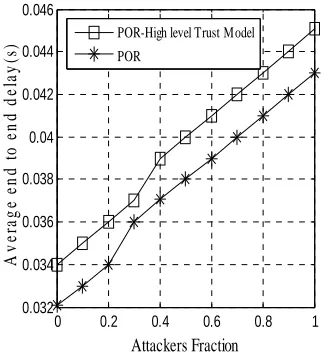
In sub section of Figure 8 shows the effect of the average end-to-end delay of multi-level trust with respect to various attacker fraction scenarios. The high computation carried out by the trust model causing the delay in the network. In simple POR next hop is selected on the basis of greedy forwarding technique. However, in a low-level trust model, computation is performed with direct observation and report from a common honest observer. Next hop is selected only based on the result of computation increases the average end to end delay in the network compared to simple POR. On the other hand, POR with a low-level trust model ensures the data delivery over the trusted path with some delay as depicted in Figure 8a. The Figure 8b shows the effect of average end-to-end delay for medium-level trust model with respect to various attacker fractions. A considerable amount of time is incurred during the recommendation exchange process using REP protocol increases the time involved in the next hop finding process. Therefore, average end-to-end delay is higher in POR with a medium-level trust
model compared to simple POR. Most
[image:13.612.104.278.490.661.2]the evaluation of trust since more complex metrics are involved, and it is due to the involvement of the process of reputation value gathered from nodes in the network. Therefore, there exists much higher delay in the implementation of POR with a high-level trust model when compared to simple POR. The Figure 8d. shows the average end-to-end delay caused due to various trust level computation scenarios. The highly dynamic condition link breakage forces the discovery of
new next-hop. Additional time is consumed for the calculation of trust for the new next-hop along with the time taken for a regular next-hop calculation process designed for a greedy forwarding process. Time required for new next-hop calculation is significantly high when the complexity of trust computation is improved. Therefore, the average end-to-end delay is
increased with the trust level.
0 0.2 0.4 0.6 0.8 1
0.032 0.034 0.036 0.038 0.04 0.042 0.044 0.046 Attackers Fraction A v e ra g e e n d t o e n d d e la y (s
) POR-High level Trust Model
[image:14.612.92.254.229.405.2]POR
Figure 8a : Average end-to-end delay of low-level trust model
0 0.2 0.4 0.6 0.8 1
0.032 0.034 0.036 0.038 0.04 0.042 0.044 0.046 Attackers Fraction A v e ra g e e n d t o e n d d e la y (s
) POR-High level Trust Model
POR
Figure 8c : Average end-to-end delay of high-level trust model
.
0 0.2 0.4 0.6 0.8 1
0.03 0.032 0.034 0.036 0.038 0.04 0.042 0.044 Attackers Fraction A v e ra g e e n d t o e n d d e la y ( s)
POR-Medium level Trust Model
POR
Figure 8b : Average end-to-end delay of medium-level trust model
0 0.2 0.4 0.6 0.8 1 0.03 0.032 0.034 0.036 0.038 0.04 0.042 0.044 0.046 Attackers fraction A v er ag e en d t o e n d d el ay ( s)
POR High level Trust Model
POR Medium level Trust Model
POR Low level Trust Model
Figure 8d : Comparative analysis of average end-to-end delay of low, medium and
[image:14.612.329.491.453.640.2]high- level trust models
[image:14.612.95.260.470.658.2]
4. CONCLUSION
This study proposed a multi-level trust model for MANET with geographic routing that can be applied to enhance the trust measure in the routing process. It presents an effective application context-aware trust based security model. The proposed trust architecture meets various levels of security requirements in the geographic routing, POR. The proposed work does not require exact time synchronization, complex hashing and authentication techniques. The proposed approach is fully distributed. The proposed multi-level trust model is designed in three levels based on context-aware security. Three levels of trust model include low, medium and high. Each of these levels ensures a security level that satisfies the context’s
security requirements. The proposed work
facilitates the POR to select only the trusted node as the Next Hop, thus preventing several routing attacks. The performance of the proposed trust model is compared with the POR in the presence of attacking nodes to prove its superiority. The simulation is performed by varying the number of attackers to show the effectiveness of the proposed work. The simulation results prove that the proposed multi-level trust model prevents the network from routing attack, thus maintaining high throughput and packet delivery ratio.
REFERENCES
[1] Balakrishnan, V., V. Varadharajan, U. Tupakula and P. Lucs, 2007. “TEAM: Trust enhanced security architecture for mobile ad-hoc networks”. Proceedings of the 15th
Conference on Networks, November 19-21,
2007, Adelaide, SA., pp: 182-187.
[2] Boukerch, A., L. Xu and K. EL-Khatib, 2007. “Trust-based security for wireless ad hoc and sensor networks”. Comput. Commun., 30: 2413–2427.
[3] Buchegger, S. and J.Y. Le Boudec, 2002a. “Nodes bearing grudges: Towards routing security, fairness and robustness in mobile ad hoc networks”. Proceedings of the 10th
Euromicro Workshop on Parallel, Distributed and Network-Based Processing, January 2002,
IEEE Computer Society, pp: 403-410.
[4] Buchegger, S. and J.Y. Le Boudec, 2002b. “Performance analysis of the CONFIDANT protocol”. Proceedings of the 3rd ACM
International Symposium on Mobile Ad Hoc Networking and Computing, June 9-11, 2002,
Lausanne, Switzerland, pp: 226-236.
[5] Cahill, V., E. Gray and J.M. Seigneur, C.D. Jensen and Y. Chen et al., 2003. “Using trust for secure collaboration in uncertain environments”. IEEE Pervasive Comput.
Mag., 2: 52- 61.
[6] Carbone, M., M. Nielsen and V. Sassone, 2003. “A formal model for trust in dynamic
networks”. Proceedings of the 1st
International Conference on Software Engineering and Formal Methods, September
22-27, 2003, Brisbane, Queensland, Australia, pp: 54-61.
[7] Ghosh, T., N. Pissinou and K.S. Makki, 2005. “Towards designing a trusted routing solution in mobile ad hoc networks”. Mobile. Networks
Applic., 10: 985-995
[8] Jiang, T. and J.S. Baras, 2006. “Trust evaluation in anarchy: A case study on autonomous networks”. Proceedings of the
25th International Conference on Computer Communications, April 2006, Barcelona, Spain, pp: 1-12.
[9] Lamsal, P., Yla-Jaaski, A. and T. Hasu (Eds.). Helsinki 2002. “Requirements for Modeling Trust in Ubiquitous Computing and Ad Hoc Networks. In: Ad Hoc Mobile Wireless
Networks-Research Seminar on
Telecommunications Software”, University of Technology, Espoo
[10] Li, J., R. Li and J. Kato, 2008. “Future trust management framework for mobile ad hoc networks”. Commun. Mag., 46: 108-114. [11] Li, X., M.R. Lyu and J. Liu, 2004. “A trust
model based routing protocol for secure ad hoc networks”. Proceedings of the IEEE
Conference on Aerospace, Volume 2, March
6-13, 2004, Big Sky, Montana, USA., pp: 1286-1295.
[12] Marti, S., T.J. Giuli, K. Lai and M. Baker, 2000. “Mitigating routing misbehavior in mobile ad hoc networks”. Proceedings of the
6th Annual International Conference on Mobile Computing and Networking, August
6-11, 2000, Boston, MA., USA., pp: 255-265. [13] Paul, K. and D. Westhoff, 2002. “Context
aware detection of selfish nodes in DSR based ad-hoc networks”. Proceedings of IEEE
Global Telecommunications Conference,
[14] Pirzada, A.A., C. McDonald and A. Datta, 2006. “Performance comparison of trust-based reactive routing protocols”. IEEE Trans.
Mobile Comput., 5: 695- 710.
[15] Velloso, P.B., R.P. Laufer, D. de O. Cunha, O.C.M.B. Duarte and G. Pujolle, 2010. “Trust management in mobile ad hoc networks using a scalable maturity-based model”. Trans.
Network Serv. Manage., 7: 172-185.
[16] Wang, G., Q. Wang, J. Cao and M. Guo, 2007. “An effective trust establishment scheme for authentication in mobile ad-hoc
networks”. Proceedings of the 7th
International Conference on Computer and Information Technology, October 16-19,
2007, Aizu-Wakamatsu, Fukushima, pp: 749-754.
[17] Yang, S., C.K. Yeo and B.S. Lee, 2012. “Toward reliable data delivery for highly dynamic mobile ad hoc networks”. IEEE
Trans. Mobile Comput., 11: 111-124.
[18] Yu, M. and K.K. Leung, 2009. “A trustworthiness-based qos routing protocol for wireless ad hoc networks”. Trans. Wireless
Commun., 8: 1888-1898.
[19] Zouridaki, C., B.L. Mark, M. Hejmo and R.K.
Thomas, 2005.” A quantitative trust
establishment framework for reliable data packet delivery in MANETs”. Proceedings of
the 3rd ACM Workshop on Security of Ad Hoc and Sensor Networks, November 7, 2005,