S T U D Y P R O T O C O L
Open Access
A double-blind, randomized,
placebo-controlled trial of a computer-based
Interpretation Bias Training for youth with
severe irritability: a study protocol
Simone P. Haller
1*, Joel Stoddard
2, Caroline MacGillivray
3, Kelsey Stiles
4, Gretchen Perhamus
1, Ian S. Penton-Voak
5,
Yair Bar-Haim
6,7, Marcus R. Munafò
5,8,9and Melissa A. Brotman
1Abstract
Background:Severe, chronic, and impairing irritability is a common presenting clinical problem in youth. Indeed, it was recently operationalized as disruptive mood dysregulation disorder (DMDD) in the DSM-5. However, to date, there are no evidence-based treatments that were specifically developed for DMDD. The current randomized controlled trial assesses the efficacy of a computer-based cognitive training intervention (Interpretation Bias Training; IBT) in youth with DMDD. IBT aims to reduce irritability by altering judgments of ambiguous face-emotions through computerized feedback. IBT is based on previous findings that youth with irritability-related psychopathology rate ambiguous faces as more hostile and fear producing.
Methods/design:This is a double-blind, randomized controlled trial of IBT in 40 youth with DMDD. Participants will be randomized to receive four IBT sessions (Active vs. Sham training) over 4 days. Active IBT provides computerized feedback to change ambiguous face-emotion interpretations towards happy interpretations. Face-emotion judgments are performed pre and post training, and for 2 weeks following training. Blinded clinicians will conduct weekly clinical ratings. Primary outcome measures assess changes in irritability using the clinician-rated Affective Reactivity Index (ARI) and Clinical Global Impressions-Improvement (CGI-I) scale for DMDD, as well as parent and child reports of irritability using the ARI. Secondary outcome measures include clinician ratings of depression, anxiety, and overall impairment. In addition, parent and child self-report measures of depression, anxiety, anger, social status, and aggression will be collected.
Discussion:The study described in this protocol will perform the first RCT testing the efficacy of IBT in reducing irritability in youth with DMDD. Developing non-pharmacological treatment options for youth suffering from severe, chronic irritability is important to potentially augment existing treatments.
Trial registration:ClinicalTrials.gov, ID:NCT02531893. Registered on 25 August 2015.
Keywords:Irritability, Children and adolescence, Cognitive training, Interpretation bias, Randomized controlled trial, RCT, DMDD, Face-emotion
* Correspondence:[email protected]
1Section on Mood Dysregulation and Neuroscience, Emotion and
Development Branch, National Institute of Mental Health, 9000 Rockville Pike, Building 15K, Bethesda, MD 20892, USA
Full list of author information is available at the end of the article
Background
Irritability, defined as an increased proneness to anger and outbursts relative to peers [1,2], is highly prevalent [3–7] and impairing in youth [8]. Irritability in youth predicts the development of depression and anxiety [3, 4, 7], suicidality [9,10], and is linked to overall reduced academic and socioeconomic functioning [11]. Given the functional impairment and association with negative outcomes, chronic irritability is a significant public health concern [3–5,11,12].
Despite this pressing clinical and public health need, there is remarkably little treatment research on pathological irri-tablity [1,2,13,14]. Recently, disruptive mood dysregulation disorder (DMDD), with a core feature of chronic irritability, has been introduced into the Diagnostic and Statistical
Manual of Mental Disorders 5 (DSM-5 [15]). DMDD
provides a diagnostic category for trials of treatments targeting severe and impairing irritability in youth that may be readily translated into clinical practice. Currently, non-pharmacological treatment strategies for DMDD are in-vestigational, with no evidence-based cognitive trainings to treat the irritability characteristic of DMDD.
Rational for treatment intervention
Clinically, irritability is characterized by a low threshold for angry, reactively aggressive responses to provocations [14]. One of the most established findings in youth with irritability-related psychopathology is that they are more likely to judge ambiguous social stimuli as hostile [14, 16]. Compared to healthy youth, chronically irritable youth preferentially attend towards threatening (i.e., angry) faces [17], and rate ambiguous faces as fear-inducing [18] or threatening (i.e., interpretation bias; [19]). A substantial body of work has shown that these biased interpretations of ambiguous social stimuli elicit and potentiate angry, aggressive responses in youth [16,20]. Hence, biases in interpreting social stimuli may serve to maintain irritability [14, 19] and provide a po-tential target for novel interventions.
One promising set of novel interventions relies on computer-based technology to change biases in informa-tion processing through repeated exposure to“corrective” feedback (e.g., [21]). This approach has shown promise in the treatment of anxiety (e.g., [22]). In the study described in this protocol, we will test whether such an approach can be used to shift biased interpretations of face-emotions in DMDD and thereby reduce irritability.
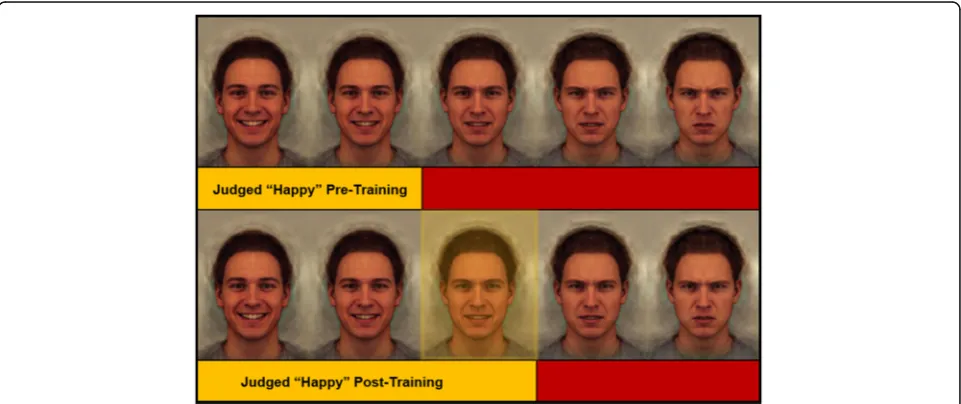
The Interpretation Bias Training (IBT) task [23] is a method to both quantify and train face-emotion inter-pretation bias. In this task, participants are presented with face-emotions morphed from very happy to very angry across a continuum of 15 stimuli (see Fig.2for ex-ample stimuli). Participants are instructed to make quick, binary happy-angry judgments for each face
morph that appears on the screen. Morphs are presented in random order. Data indicate that both healthy partici-pants and psychiatric patients categorize each morph re-liably [23]. The morph in the continuum at which each participant’s judgment switches from happy to angry has been termed “balance point” (BP) and represents a measure of interpretation bias. For instance, participants who rate only a few faces along the happy-angry con-tinuum as happy before switching their judgment to pre-dominantly angry responses would have a low BP, i.e., an increased bias towards perceiving ambiguous faces as angry. This IBT task can also be used to change face-emotion interpretations by providing trial-by-trial, computer-based feedback to shift the participant’s BP along the continuum of face morphs.
In other phenotypes in youth, such as disruptive behav-ioral problems, preliminary data suggest that shifting par-ticipants’BP may reduce anger and aggression [24]. In a randomized controlled trial (RCT) of 46 adolescents who were in residential treatment because of aggressive behav-ior and high-risk of criminal behavbehav-ior, Penton-Voak et al. [24] reported that four sessions of Active compared to Sham training on the IBT task shifted participants’BP to-ward happy and away from angry judgments. Further, Ac-tive training was associated with a significant reduction in both self-rated anger and aggressive behavior rated by blinded residential treatment staff.
In a recent preliminary study, Stoddard et al. [19] ex-tended this work to youth with DMDD. In a series of pilot experiments, Stoddard and colleagues demonstrated a dif-ference in BP between DMDD (n= 63) and healthy youth (n= 26), with DMDD youth exhibiting a bias towards angry judgments. Additionally, Stoddard and colleagues tested the feasibility of training irritable youth in an open pilot trial. In 14 DMDD youth, four sessions of Active training resulted in a shift in BP, which persisted for 2 weeks post training. Clinical data were consistent with an improvement in parent-reported irritability over the course of the open pilot trial. While promising, these data are preliminary and do not test efficacy, supporting a test of IBT on irritability in DMDD in a RCT. Thus, the ob-jective of the current study, described in this protocol, is to assess the efficacy of IBT in reducing irritability in youth with DMDD in a double-blind, randomized, placebo-controlled design. The IBT RCT compares Active training, which encourages a shift in face-emotion inter-pretations toward happy judgments, to Sham training, where feedback does not encourage change in a person’s pre-training face-emotion interpretations.
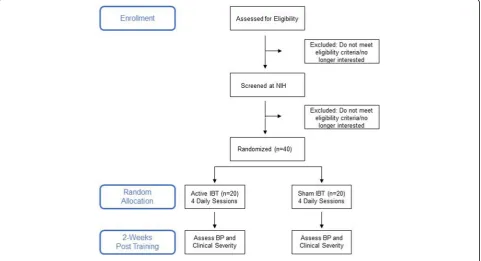
Methods/design Design
augmentation to standard of clinical care (i.e., psycho-tropic medications and/or psychotherapy) for DMDD (see Fig.1). Forty youth with current DMDD will be random-ized (1:1) to receive four IBT sessions (Active vs. Sham, in a double-blind design) over 4 days followed by weekly mood ratings and BP assessments for 2 weeks. Primary outcome measures in this trial assess changes in irritability using the Clinician Affective Reactivity Index (Clinician ARI) and Clinical Global Impressions-Improvement for DMDD (CGI-I; [25]), as well as parent- and child-report of irritability (child- and parent-rated ARI; [26]). Additional file 1 provides the SPIRIT checklist for this trial.
Recruitment
Patients will be recruited nationwide through Institutional Review Board (IRB)-approved postcards, mailings, an-nouncements in newsletters and bulletin boards or centers, and contacts with support groups and approved websites. Information leaflets may be posted electronically on web-sites such as National Institutes of Health (NIH) or Na-tional Institute of Mental Health (NIMH) websites, advocacy support group websites (e.g., National Alliance on Mental Illness (NAMI), Children and Adults with Attention Deficit/Hyperactivity Disorder), publications’websites (e.g.,
Washington Parent). Researchers (MAB) also give presenta-tions to the public and mental health professionals regard-ing our research and recruitment efforts for studies.
Informed consent and assent will be obtained from parents and youth, respectively, before any trial-specific
procedures are performed. All participants will be ad-vised that research is entirely voluntary, that they may withdraw participation at any time. Families will be paid for participation.
At screening and during enrollment of the IBT RCT, participants will be informed of, and agree to, maintain their current mental health treatment regimen 2 weeks prior to the start of the IBT RCT and through the sec-ond follow-up visit.
Participants
Inclusion criteria
Participants must be between the ages of 8–17 years and currently meet full DSM-5 diagnostic criteria for DMDD as assessed by a structured clinical interview (Kiddie-Schedule for Affective Disorders and Schizo-phrenia Present and Lifetime Version; K-SADS-PL; [27]), with an additional supplement to assess the pres-ence of DMDD [28]. Additionally, based on record re-view and interre-views with child and parent, the research team must agree that the child’s response to their current treatment is no more than minimal as opera-tionalized by a DMDD CGI-S (1-month version) score of 3 or more. Patients must be fluent in English; both parents and youth must provide written informed con-sent and ascon-sent, respectively.
Exclusion criteria
Participants will be excluded if the irritability symptoms are due to the direct physiological effects of a drug, or
[image:3.595.58.540.458.719.2]to a general medical or neurological condition. Addition-ally, participants will not be eligible if they meet DSM 5-criteria, as assessed by the K-SADS-PL (Kaufman et al., 1997), for schizophrenia, schizophreniform disorder, schizoaffective illness, autism spectrum disorder, post-traumatic stress disorder, current major depressive dis-order, or if they meet criteria for alcohol or substance abuse 3 months prior to enrollment. Participants will be excluded from the study if they exhibit cardinal bipolar symptoms or have an IQ below 70 as assessed by the Wechsler Abbreviated Scale of Intelligence (WASI; [29]). Patients must not have planned changes in out-patient psychiatric treatment regimen, which can include psychotropic medications and/or psychotherapeutic in-terventions, 2 weeks prior to enrollment and throughout the 3 weeks of the RCT training and post-training follow-up assessments.
Intervention
The IBT task assesses and trains happy-angry interpreta-tions of face emointerpreta-tions. There are two versions of the task, an assessment version (Assessment Task) and a training version (Training Task, either Active or Sham). The task stimuli for both tasks consist of the same set of 15 face-emotion pictures, or “face morphs” (see Fig. 2 for example stimuli [30]). Face morphs were created from two prototypical happy and angry composite im-ages of 20 individual male faces from the Karolinska Di-rected Emotional Faces [24, 30]. These happy and angry prototypical images were used as endpoints to generate a continuum of 15 images from unambiguously happy to unambiguously angry.
Assessment Task
In the Assessment Task, morphs are presented three times in random order for a total of 45 trials. Each trial consists of a fixation cross (1500–2500 ms), image pres-entation (150 ms), visual noise mask (250 ms), and a screen (no time limit) where a person is required to make a forced-choice response of“happy” or“angry” via keyboard button press. The Assessment Task takes ap-proximately 2.5 min. The Assessment Task measures the participant’s BP, i.e., the morph at which the participant shifts their judgment from predominantly happy to pre-dominately angry, with the continuum of morphs coded on an integer scale from the happiest endpoint = 1 to the angriest endpoint = 15. The BP can be estimated in real time during a training session as the proportion of happy responses to total responses multiplied by 15.
Training Task
The Assessment Task is administered before and after each Training Task to measure BP pre and post each training session. In both the Active and the Sham train-ing version of the task, the stimuli and timtrain-ing are the same as the Assessment Task. The difference is that feedback is provided to the participant on every trial after their response. Feedback consists of a message say-ing “Right!/Wrong!” Consistent with previous IBT trials (e.g., [24]), in the Sham training, feedback is based on the participant’s original BP, as measured using the As-sessment Task before training (i.e., the feedback is con-sistent with the participant’s pre-training BP). In the Active training, feedback is based on a modified version of the participant’s pre-training BP. Specifically, the Ac-tive training is designed to shift the participant’s BP so
[image:4.595.58.539.501.703.2]that two ambiguous morphs that were rated angry at pre training will be rated as happy post training. The feed-back is based on the participant’s pre-training BP; hence two ambiguous images in the center of the morph con-tinuum that the participant judged as angry pre training will instead be considered happy for the purposes of feedback. In the Training Task, each morph will be pre-sented twice in random order to create a training block. There are six training blocks of 30 trials each summing to a total of 180 training trials.
Outcome measures
In addition to primary outcome measures assessing changes in irritability (ARI and CGI-I), this trial includes several secondary outcome measures. Secondary out-come measures include clinician ratings of depression, (Children’s Depression Rating Scale, CDRS; [31]), anxiety (Pediatric Anxiety Rating Scale, PARS; [32]), and impair-ment (Clinical Global Impressions-Severity for DMDD, CGI-S; [25]; Children’s Global Assessment Scale, CGAS; [33]). Additionally, parent-report measures of anxiety (Screen for Childhood Anxiety Related Emotional Disorders-parent, SCARED; [34]) and aggression (Modi-fied Overt Aggression Scale, MOAS; [35]) and child self-report measures of depression (Children’s Depres-sion Inventory, CDI; [36]), anxiety (Screen for Childhood Anxiety Related Emotional Disorders-child, SCARED; [34]), anger (State-Trait Anger Expression Inventory-2 Child and Adolescent, STAXI-2 C/A; [37]). We will also collect information on social status (Kids in My Class Questionnaire, [38]; MacArthur Scale of Subjective Social Status; [39]) and intent attributions (Hostile Attribution Bias [HAB]) using a hypothetical-situations instrument [40].
Study procedure
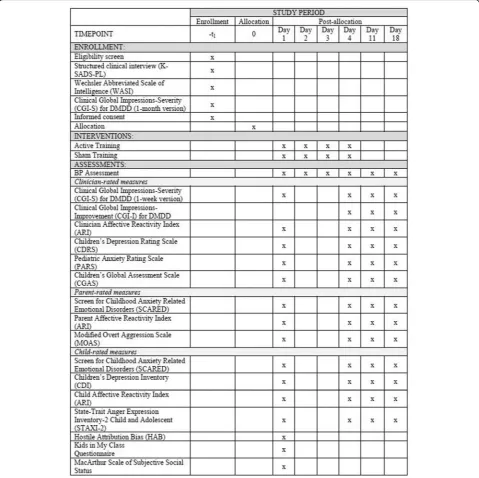
Figure1provides a flow diagram of the study design, Fig.3 provides a detailed schedule of enrollment, interventions and assessments. Participants will first complete a pre-training clinical screening before being enrolled in the protocol and randomized. Participants will be allocated to receive four IBT sessions (Active vs. Sham training in a double-blind design) over 4 days. Participants will complete a series of clinician- and self-report ratings pre and post training days followed by weekly clinical ratings and BP assessments for two additional weeks post train-ing. The endpoint for primary outcome measures will be the DMDD CGI-I and ARI on the first follow-up visit (i.e., day 11). Figure3 provides an overview of clinician-, par-ent-, and child self-report measures administered at the different time points. Participants’intervention allocation for the entire cohort will only be unblinded upon comple-tion of the IBT study.
Pre-training screening visit
Participants and their parents will visit the NIH for a pre-training clinical assessment to determine eligibility to enroll in the IBT RCT. A trained masters- or doctoral-level clinician will conduct interviews with the participant and their parent including a current diagnos-tic interview (i.e., K-SADS-PL) and a clinical rating on the DMDD CGI-S.
Training visits (days 1–4)
Custom IBT software, written in Tcl (www.tcl.tk) (see also [19]), will be packaged with stimuli for Mac and PC com-puters. During visit day 1, participants will complete the first session of IBT using either their own laptop com-puter or a NIH comcom-puter. All IBT data will be quality checked post training. Stimulus presentation timings will be inspected for each training session to ensure that tim-ing of face displays is precise on non-NIH equipment. During this visit, participants and their parents are inter-viewed by clinicians for clinical ratings for irritability (cARI), depression CDRS), anxiety (PARS), overall func-tional impairment (CGAS), and severity of irritability and outbursts (CGI-S for DMDD, 1-week version). Partici-pants and parents will also complete self-report forms. On day 2 and day 3, participants will complete one session of IBT, both sessions will be completed at home. The final training session on day 4 will again be onsite. On day 4, the participant and their parent will again be interviewed by clinicians for clinical ratings for irritability (cARI), de-pression (CDRS), anxiety (PARS), overall functional im-pairment (i.e., CGAS), severity of irritability and outbursts (CGI-S for DMDD), and improvement (CGI-I for DMDD). The CGI-I interval will cover the time from day 1 through day 4, and the rating will be relative to the day-1 CGI-S. During this visit, participants and parents will again complete all self-report forms. To allow for rea-sonable flexibility, during days 1–4, participants may re-schedule up to two training sessions by extending the training period to day 5 or 6 to complete four once-daily sessions within a 6-day window. The participant com-pletes rescheduled training sessions at home and self- and parent-report measures will be completed online. Clinical ratings may be done by phone.
Follow-up visits
1-week post training (day 11)
2-weeks post training (day 18)
This follow-up is completed from home and deter-mines whether training effects persist for 2 weeks. Participants will begin this session with an Assess-ment Task to measure BP. Next, the participant and their parent will be interviewed for clinical ratings. The CGI-I interval is the past week, and the rating is relative to the day-1 CGI-S. Participants and parents will complete self-report measures online.
Allocation
Intervention allocation sequence will be created via a computer-based random number generator. Randomization will be performed in blocks of 10 participants with a 1:1 ratio within blocks. Study personnel not involved in other aspects of the study will perform randomization. The document with the allocation sequence will be unavailable to those that en-roll or otherwise interact with study participants. Training tasks will be prepared by study personal not otherwise
[image:6.595.58.538.89.567.2]involved in the study and IBT training tasks (Active vs. Sham) will be formatted identically. Trial participants, out-come assessors, data analysts, and research assistants inter-acting with families will be blind to participants’intervention allocation. The blind is not broken for the entire cohort until completion of the IBT RCT.
Statistical analyses
Analysis of data/study outcomes
Primary outcome measures are ARI and CGI-I. We will analyze both primary outcomes measures as a function of training group (Active vs. Sham) and time point (pre training and 1 week following training (day 11)). All data will be analyzed in accordance with the intention-to-treat principle. Following Stoddard et al. [19] and Pollak and Kistler [41], we will fit a logistic curve to the binary happy-angry judgment data to derive the BP. We will examine associations among BP, clinical ratings, and treat-ment condition. We expect any symptom changes in the Active training group to be associated with shifts in BP.
Power analysis
The open pilot trial [19] found a large effect of IBT on outcome (d= 1.2 for CGI-I). Because studies with similar computer-based approaches (see [42] for a meta-analysis) have found more moderate effect sizes in RCTs, we expect an effect size ofd= 0.8 tod= 1.0. Power analyses suggest that 20 per group will be sufficient to detect differences at alpha = 0.05, beta = 0.20. Dropouts will be replaced for an
n= 40 of participants who completed the trial.
Ethics
Study procedures were approved by the National Institute of Mental Health (NIMH) Institutional Review Board (IRB). Risks associated with participation in this RCT are considered minimal. Adverse experiences include mild psychological distress and discomfort when responding to interview questions or completing questionnaires, or boredom during the IBT task. The principal and associate investigators will monitor patients closely throughout their participation in the RCT. After completing the RCT, all participants will be offered four Open Active IBT ses-sions, delivered on the same schedule as in the RCT and using the same primary outcome measures. For the Open Active IBT, while the principal and associate investigators will continue to monitor the patient, community providers are overseeing the patients’care.
Participants will be informed of their RCT interven-tion allocainterven-tion upon compleinterven-tion of the trial.
An independent safety monitor will surveil data and safety. Audits of this treatment protocol will be con-ducted on a regular basis.
Discussion
This study is the first RCT of IBT in youth with DMDD. Chronic irritability, such as observed in DMDD, is se-vere and impairing for affected youth and their families, yet available treatment options are limited (Brotman et al., 2017). The inclusion of DMDD in the DSM-5 dem-onstrates the need to develop evidence-based treatments to target severe, pathological irritability. The current protocol describes the first double-blind RCT aimed to test the efficacy of IBT in reducing irritability in youth with DMDD. Forty youth are randomized to receive either four Active IBT or Sham IBT sessions in a double-blind design. Active IBT is designed to shift participants’ pre-training BP along a face-morph continuum towards making increasingly happy judgments on ambiguous face morphs. Sham training does not change the participants’ pre-training BP. BP is measured 2 weeks following treat-ment. Primary outcome measures assess changes in irrit-ability pre to post training and 2 weeks after training using the clinician ARI and CGI-I for DMDD, as well as parent- and child-reports of irritability using the ARI. Sec-ondary outcome measures include clinician ratings of de-pression, anxiety, and impairment. Parent- and child self-report measures of depression, anxiety, anger, social status, and aggression are also collected.
In this RCT, IBT is an augmentation to stable commu-nity treatment (pharmacological and/or psychosocial). Developing non-pharmacological treatment options for youth suffering from severe, chronic irritability is par-ticularly important to minimize psychotropic medication exposure with profound side effects on the developing brain. Additionally, computer-based interventions have the potential to help bridge the treatment gap in psycho-logical care as an easily accessible, cost-effective tool.
Trial status
The protocol (15-M-0182, Psychological Treatments for Youth with Severe Irritability) received final IRB ap-proval in August 2015, after which trial recruitment commenced. Recruitment is expected to be completed by January 2019.
Limitations
provide evidence for the mechanism by which active IBT may be efficacious. Lastly, we will only assess IBT as an add-on to stable community treatment. Participants enrolled in the trial will be concurrently taking a variety of different medications, including psychotropic medica-tions. However, as discussed, we do require medications to remain stable throughout the trial.
Additional file
Additional file 1:SPIRIT 2013 Checklist: Study protocol for a double-blind, randomized, placebo-controlled trial of a computer-based Interpretation Bias Training for youth with severe irritability. (DOC 123 kb)
Abbreviations
ARI:Affective Reactivity Index; BP: Balance point; CDI: Children’s Depression Inventory; CGAS: Children’s Global Assessment Scale; CGI-I: Clinical Global Impressions-Improvement for DMDD; CGI-S: Clinical Global Impressions Severity for DMDD; DMDD: Disruptive mood dysregulation disorder; DSM 5:Diagnostic and Statistical Manual of Mental Disorders 5; HAB: Hostile Attribution Bias; IBT: Interpretation Bias Training; IRB: Institutional Review Board; K-SADS: Kiddie-Schedule for Affective Disorders and Schizophrenia; MOAS: Modified Overt Aggression Scale; NIH: National Institutes of Health; NIMH: National Institute of Mental Health; PARS: Pediatric Anxiety Rating Scale; RCT: Randomized controlled trial; SCARED: Screen for Childhood Anxiety Related Emotional Disorders; STAXI-2 C/A: State-Trait Anger Expression Inventory-2 Child and Adolescent
Acknowledgements
The authors would like to thank Dr. Ellen Leibenluft and Dr. Daniel S. Pine for their valuable contributions and support throughout this study.
Funding
The authors’research is supported by the National Institute of Mental Health (NIMH) Intramural Research Program (ZIAMH002786–15, ZIAMH002778–17), conducted under NIH Clinical Study Protocols 15-M-0182 (ClinicalTrials.gov identifier: NCT02531893), 02-M-0021 (ClinicalTrials.govidentifier: NCT00025935), and 00-M-0198 (ClinicalTrials.govidentifier: NCT00006177). JS is supported by a career development award (K23MH113731).
Availability of data and materials
The datasets generated and/or analyzed during the current study are not currently publicly available. Data will be available in compliance with NIMH guidelines upon completion of the study.
Authors’contributions
MB, JS, YBH, IPV, and MM designed the study. MB, JS, SH, CM, KS, and GP implemented the design and/or oversee the data collection. SH and MB wrote the first draft of the manuscript. All authors contributed to and approved the final manuscript.
Ethics approval and consent to participate
Study procedures were approved by the National Institute of Mental Health Institutional Review Board. Informed consent and assent are obtained from parents and youth, respectively. Families are paid for participation.
Consent for publication
Not applicable.
Competing interests
The authors declare that they have no competing interests.
Publisher’s Note
Springer Nature remains neutral with regard to jurisdictional claims in published maps and institutional affiliations.
Author details
1Section on Mood Dysregulation and Neuroscience, Emotion and
Development Branch, National Institute of Mental Health, 9000 Rockville Pike, Building 15K, Bethesda, MD 20892, USA.2Department of Psychiatry, University of Colorado School of Medicine, Aurora, USA.3Lewis Katz School
of Medicine, Temple University, Philadelphia, USA.4Department of
Psychology, University of California, Los Angeles, USA.5School of
Experimental Psychology, University of Bristol, Bristol, UK.6School of Psychological Sciences, Tel Aviv University, Tel Aviv, Israel.7Sagol School of
Neuroscience, Tel Aviv University, Tel Aviv, Israel.8MRC Integrative
Epidemiology Unit, University of Bristol, Bristol, UK.9UK Centre for Tobacco
and Alcohol Studies, University of Bristol, Bristol, UK.
Received: 15 June 2018 Accepted: 3 October 2018
References
1. Brotman MA, Kircanski K, Leibenluft E. Irritability in children and adolescents. Annu Rev Clin Psychol. 2017a;13:317–41.
2. Brotman MA, Kircanski K, Stringaris A, Pine DS, Leibenluft E. Irritability in youths: a translational model. Am J Psychiatr. 2017b;174(6):520–32. 3. Brotman MA, Schmajuk M, Rich BA, Dickstein DP, Guyer AE, Costello EJ,
Leibenluft E. Prevalence, clinical correlates, and longitudinal course of severe mood dysregulation in children. Biol Psychiatry. 2006a;60(9):991–7. 4. Brotman MA, Schmajuk M, Rich BA, Dickstein DP, Guyer AE, Costello EJ, et
al. Prevalence, clinical correlates, and longitudinal course of severe mood dysregulation in children. Biol Psychiatry. 2006b;60(9):991–7.
5. Copeland WE, Shanahan L, Egger H, Angold A, Costello EJ. Adult diagnostic and functional outcomes of DSM-5 disruptive mood dysregulation disorder. Am J Psychiatry. 2014;171(6):668–74.
6. Copeland WE, Brotman MA, Costello EJ. Normative irritability in youth: developmental findings from the Great Smoky Mountains Study. J Am Acad Child Adolesc Psychiatry. 2015;54(8):635–42.
7. Vidal-Ribas P, Brotman MA, Valdivieso I, Leibenluft E, Stringaris A. The status of irritability in psychiatry: a conceptual and quantitative review. J Am Acad Child Adolesc Psychiatry. 2016;55(7):556–70.
8. Leibenluft E. Severe mood dysregulation, irritability, and the diagnostic boundaries of bipolar disorder in youths. Am J Psychiatry. 2011;168(2):129–42. 9. Pickles A, Aglan A, Collishaw S, Messer J, Rutter M, Maughan B. Predictors of
suicidality across the life span: The Isle of Wight study. Psych Med. 2010; 40(09):1453–66.
10. Orri, M., Galera, C., Turecki, G., Forte, A., Renaud, J., Boivin, M., .Geoffroy, M. C. (2018). Association of childhood irritability and depressive/anxious mood profiles with adolescent suicidal ideation and attempts. JAMA Psychiatry 75(5): 465–473.
11. Stringaris A, Cohen P, Pine DS, Leibenluft E. Adult outcomes of youth irritability: a 20-year prospective community-based study. Am J Psychiatry. 2009;166(9):1048.
12. Stringaris A, Goodman R. Longitudinal outcome of youth oppositionality: irritable, headstrong, and hurtful behaviors have distinctive predictions. J Am Acad Child Adolesc Psychiatry. 2009;48(4):404–12.
13. Leibenluft E. Pediatric irritability: a systems neuroscience approach. Trends Cogn Sci. 2017;21(4):277–89.
14. Leibenluft E, Stoddard J. The developmental psychopathology of irritability. Dev Psychopathol. 2013;25(4 Pt 2):1473–87.
15. American Psychiatric Association. Diagnostic and Statistical Manual of Mental Disorders. 5th ed. Washington, DC: American Psychiatric Association; 2013. 16. Crick NR, Dodge KA. A review and reformulation of social
information-processing mechanisms in children's social adjustment. Psychol Bull. 1994; 115(1):74–101.
17. Hommer, R. E., Meyer, A., Stoddard, J., Connolly, M. E., Mogg, K., Bradley, B. P., Brotman, M. A. (2014). Attention bias to threat faces in severe mood dysregulation. Depress Anxiety,31(7), 559–565.
18. Brotman MA, Rich BA, Guyer AE, Lunsford JR, Horsey SE, Reising MM, Thomas LA, Fromm SJ, Towbin K, Pine DS, Leibenluft E. Amygdala activation during emotion processing of neutral faces in children with severe mood dysregulation versus ADHD or bipolar disorder. Am J Psychiatry. 2010;167(1):61–9.
19. Stoddard J, Sharif-Askary B, Harkins EA, Frank HR, Brotman MA, Penton-Voak IS, Leibenluft E. An open pilot study of training hostile interpretation bias to treat disruptive mood dysregulation disorder. J Child Adolesc
20. Wilkowski BM, Robinson MD. The cognitive basis of trait anger and reactive aggression: an integrative analysis. Personal Soc Psychol Rev. 2008;12(1):3–21. 21. Bar-Haim Y, Lamy D, Pergamin L, Bakermans-Kranenburg MJ, Van Ijzendoorn
MH. Threat-related attentional bias in anxious and nonanxious individuals: a meta-analytic study. Psychol Bull. 2007;133(1):1.
22. Hakamata Y, Lissek S, Bar-Haim Y, Britton JC, Fox NA, Leibenluft E, et al. Attention bias modification treatment: a meta-analysis toward the establishment of novel treatment for anxiety. Biol Psychiatry. 2010;68(11):982–90.
23. Penton-Voak IS, Bate H, Lewis G, Munafo MR. Effects of emotion perception training on mood in undergraduate students: randomised controlled trial. Br J Psychiatry. 2012;201(1):71–2.
24. Penton-Voak IS, Thomas J, Gage SH, McMurran M, McDonald S, Munafo MR. Increasing recognition of happiness in ambiguous facial expressions reduces anger and aggressive behavior. Psychol Sci. 2013;24(5):688–97. 25. Walkup JT, Labellarte MJ, Riddle MA, Pine DS, Greenhill L, Klein R, Klee B.
Fluvoxamine for the treatment of anxiety disorders in children and adolescents. N Engl J Med. 2001;344(17):1279–85.
26. Stringaris A, Goodman R, Ferdinando S, Razdan V, Muhrer E, Leibenluft E, Brotman MA. The Affective Reactivity Index: a concise irritability scale for clinical and research settings. J Child Psychol Psychiatry. 2012;53(11):1109–17. 27. Kaufman J, Birmaher B, Brent D, Rao UMA, Flynn C, Moreci P, et al. Schedule
for affective disorders and schizophrenia for school-age children-present and lifetime version (K-SADS-PL): initial reliability and validity data. J Am Acad Child Adol Psych. 1997;36(7):980–8.
28. Wiggins JL, Brotman MA, Adleman NE, Kim P, Oakes AH, Reynolds RC, Chen G, Pine DS, Leibenluft E. Neural Correlates of Irritability in Disruptive Mood Dysregulation and Bipolar Disorders. Am J Psychiatry. 2016;173(7):722–30. 29. Wechsler D. WASI Manual. San Antonio: Psychological Corporation; 1999. 30. Lundqvist D, Litton JE. The Averaged Karolinska Directed Emotional Faces
-AKDEF, CD ROM from Department of Clinical Neuroscience, Psychology section, Karolinska Institutet; 1998. isbn:91-630-7164-9.
31. Poznanski EO, Mokros HB. Children’s Depression Rating Scale, Revised (CDRS-R). Los Angeles: Western Psychological Services; 1996.
32. Research Units on Pediatric Psychopharmacology Anxiety Study Group. The Pediatric Anxiety Rating Scale (PARS): development and psychometric properties. J Am Acad Child Adolesc Psychiatry. 2002;41(9):1061–9. 33. Shaffer D, Gould MS, Brasic J, Ambrosini P, Fisher P, Bird H, Aluwahlia S. A
children's global assessment scale (CGAS). Arch Gen Psychiatry. 1983;40(11): 1228–31.
34. Birmaher B, Brent DA, Chiappetta L, Bridge J, Monga S, Baugher M. Psychometric properties of the Screen for Child Anxiety Related Emotional Disorders (SCARED): a replication study. J Am Acad Child Adolesc Psychiatry. 1999;38(10):1230–6.
35. Kay SR, Wolkenfeld F, Murrill LM. Profiles of aggression among psychiatric patients: I. Nature and prevalence. J Nerv Mental Dis. 1988;176(9):539–46. 36. Kovacs, M. (1992). Children’s Depression Inventory: Manual. Multi-Health
Systems.
37. Spielberger CD. STAXI-2: State-trait Anger Expression Inventory-2. Odessa: Psychological Assessment Resources; 1999.
38. Kochenderfer B, Ladd G. Peer victimization: cause or consequence of school maladjustment? Child Dev. 1996;67:1305–17.
39. Adler, N., Stewart, J. (2007). The MacArthur Scale of subjective social status. MacArthur Research Network on SES & Health. Retrieved fromhttp://www. macses.ucsf.edu/Research/Psychosocial/subjective.php.
40. Crick NR. Relational aggression: The role of intent attributions, feelings of distress and provocation type. DevPsych. 1995;7(02):313.
41. Pollak SD, Kistler DJ. Early experience is associated with the development of categorical representations for facial expressions of emotion. Proc Natl Acad Sci. 2002;99(13):9072–6.