953
PROCESS INNOVATION ORGANIZATIONAL EVOLUTION
IN MANUFACTURING ENTERPRISES UNDER THE
CIRCUMSTANCE OF INFORMATIONIZATION BASED ON
LOTKA-VOLTERRA MODEL
1, 2
KEXIN BI, 1DI FENG, 1QUANZHEN BAO
1
School of Economics & Management, Harbin Engineering University, Harbin 150001, Heilongjiang,
China
2
School of Management, Harbin University of Science and Technology, Harbin 150080, Heilongjiang,
China
ABSTRACT
In order to conform to the requirements of the development of information era, the influence of informationization on innovation organization in manufacturing enterprises has gradually become the focus of the study. Based on the theory of innovation organization and organizational routine, this article summarizes process innovation organizational characteristic in manufacturing enterprises under the condition of informationization, and proposes process innovation organizational evolution mechanism in manufacturing enterprises under the condition of informationization, and constructs the Lotaka-Volterrra model of process innovation organizational evolution in manufacturing enterprises under the circumstance of informationization, then uses Matlab software to simulate the influence of different parameters. This article will contribute to process innovation organizational transformation and evolution in manufacturing enterprises under the condition of informationization.
Keywords: Informationization, Manufacturing Enterprise, Process Innovation Organization,
Organizational Evolution, Lotka-Volterra Model
1. INTRODUCTION
Process innovation organization is the system composed of human and material resources which manages process innovation information[1]. The development of informationization has brought great changes for the survival and development environment of process innovation organization[2]. Under the circumstance of informationization, the development and utilization of information resources and information technology is helpful for process innovation organization to identify critical resources and develop dynamic capability, and promote process innovation organizational evolution.
Concerning study on the connotation of process innovation organizational evolution, One perspective is based on Darwin's natural selection research, which considers that the changes of external environment which brought by informationization promote process innovation organizational evolution, and complicated hypercompetitive brought by the rapid development
of information technology and the network economy puts forward severe challenges to process innovation organization, making traditional functional organization reform into flow-oriented process organization and virtual process innovation alliance[3, 4], another perspective is based on Lamarck's “use it or lose it” research, process innovation organization transforms actively in order to adapt to external environment which brought by informationization. Through the use of the new leadership and mode of resource configuration, process innovation organization restructures department and organizational strategy and so on, in order to achieve significant improvements on production process or product delivery process and adapt to the requirements of the development of informationization era[5].
954 etc. explains sense, interpretation, preparation and activities of process innovation organizational change in the application of information technology from individual, group and organization three aspects[7]. In further studies, process innovation organizational form in different evolution stages is studied. Richard puts forward that with the extensive application of information technology, process innovation organization evolves from traditional functional, business type, matrix organization to process model and virtual network organization[8]. O’Reilly considers that organic organization should be used in the stage of exploratory process innovation, and mechanical organization should be used in the stage of exploitative process innovation, binary process innovation organization is presented so as to adapt to the change brought by network environment [9].
For the research on course of process innovation organizational evolution, Hodgson considers that the essence of process innovation organizational evolution is variation—selection—retention, globalization and informationization in manufacturing enterprises require process innovation organization realize the process of evolution rapidly[10]. Greiner divides the process of evolution into five phases: creativity, direction, delegation, coordination and collaboration, and each evolutionary period is characterized by the dominant management problem that must be solved before growth can continue[11]. Richard supports that the widespread use of information technology and network technology, which are elements of successful transformation, improve success rates of process innovation organizational evolution[8]. Feldman, etc. and Zhanjun Gao, etc. put forward that as genes of organizational evolution, organizational routine evolutes through many stages of organizational learning regression cycle, which is affected synthetically by in intra- and inter-organizational stimulation and innovative information based on the existing organizational routine [12, 13].
Although the scholars at home and abroad use a variety of theory to search technology innovation organization, organizational evolution and organizational change under the condition of informationization from perspectives of the evolutionary economics, management science, sociology theory, research on technology innovation organization under the condition of information is still in the primary stage. Study on organizational evolution law under the condition of information and how informationization impact process innovation organizational development are
still in blank field. This study conforms to the requirements of the development of informationization era, which will contribute to process innovation organizational transformation and upgrade.
2. PROCESS INNOVATION
ORGANIZATIONAL
CHARACTERISTICS AND EVOLUTION MECHANISM UNDER THE CONDITION OF INFORMATIONIZATION
2.1 Process Innovation Organizational Characteristics under the Condition of Informationization
Adaptive process innovation organization under the condition of informationization helps managers make decision on process innovation strategy, so as to improve process innovation performance and the core competitive advantage, etc. Specific characteristics variable of process innovation organizational design is the primary premise of process innovation organizational formation. Consequently, based on the conclusion of Daft and Mazzarol, this paper analyzes process innovation organizational characteristics under the condition of information from strategy, structure, process and culture four dimensions[8, 14].
2.1.1 Strategic characteristics of process
innovation organization under the condition of informationization
955
2.1.2 Structure characteristics of process innovation organization under the condition of informationization
Process innovation organizational structure means the structure system formed in the scope of duties, responsibilities and rights that the members develop cooperation in the course of process innovation in order to achieve the goals of process innovation, in the technology innovation process division of labor cooperation, in the subject area, responsibility and rights by the formation of the structure system. The rapid development of information and communication technology has brought increasingly fierce market competition. The traditional organizational structure bears overweight hierarchy chain load, and top management seldom responds to problem or opportunity. Therefore, process innovation organization under the condition of informationization needs flat organizational structure, through the decrease of hierarchy between the leadership and staff management and the increase of transmission speed of information resources between the superior and the subordinate managers, realizing process innovation organization shifts from vertical organizational structure to horizontal organizational structure
2.1.3 Process characteristics of process
innovation organization under the condition of informationization
Process innovation organization process means a series of process innovation link or step that completes a task, event or activity of process innovation. The development of informationization in manufacturing enterprise makes information network cover the departments and position, which contributes to thoroughly redesign or improve innovation business process and realize business process reengineering of process innovation and improve information transfer speed and business process efficiency [1, 16].Consequently, process innovation organization requires business process designing oriented by task, and simplifies workload of each section in process innovation business process, and gradually eliminates traditional business process oriented by function, realizing process innovation organization shifts from function-oriented to task-oriented .
2.1.4 Culture characteristics of process
innovation organization under the condition of informationization
Process innovation organization culture is crucial component of process innovation competitive advantage, whose importance lies in the fact that it
can affect innovation behavior of research staff and function of process innovation organization without direct and imposed control[5, 17]. With the extensive application of information technology, traditional stiff process innovation organization culture cultivated in the stable environment in the past already can't adapt to the rapid change of the market demand brought about by informationization. Therefore, process innovation organization managers conduct organizational culture change on purpose, realizing process innovation organizational culture shifts from stiff to adaptive in order to meet the new requirement and implement process innovation strategy.
2.2 Process Innovation Organizational Evolution Mechanism in Manufacturing Enterprises under the Condition of Informationization
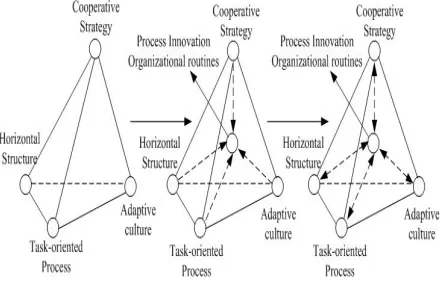
[image:3.612.314.534.563.704.2]Organization is a complex system. Organizational strategy, structure, process and culture are the most important and related four variables, and any variable change will cause other variables change[8, 18]. Through the analysis of process innovation organization characteristics under the condition of informationization, it is consider that process innovation organization is evolutionary system which contains cooperative strategy, horizontal structure, task-oriented process and adaptive culture. These four elements synergy with each other under the influence of external environment, which makes the internal system produce a similar gene with transmissibility— process innovation organizational routine[19, 20]. Meanwhile, process innovation organizational routine will be embedded in a variety of organizational phenomenon after formation, which covers the organizational structure, rules, procedures, strategic, culture and many other aspects. On that basis, process innovation organization is constructed and operates[21]. As shown in Figure 1.
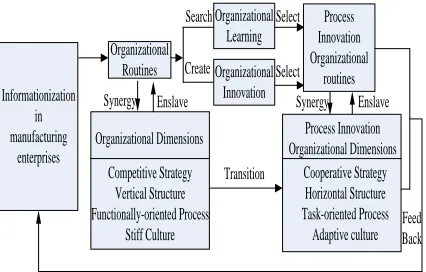
956 From perspective of evolutionary economics, process innovation organizational evolution is interaction between hierarchy entities determined by organizational routines actually under the condition of limited resources, which is change process from traditional organizational routines to process innovation organizational routines. There are two main ways in the change of organizational routine—“search” and “create”. Search means process innovation organization looks for suitable for their needs and matches with organizational existing knowledge structure from the existing technology and routines, which are absorbed and integrated and become part of the organizational routines. Create means process innovation organization explores new technology and routines through research and development. Search and create can be achieved by organizational learning and innovation. After comparison and selection in organization, process innovation organizational routines are eventually adopted.
Under the condition of informationization, the development and utilization of information resources and information technology not only contributes to search and creation of process innovation organization routines, but also contributes to process innovation organization routines dominate on organizational strategy, structure, process and culture. Consequently, under the condition of informationization, with the evolvement of organizational routines, process innovation organization transforms from cooperating strategy, vertical organizational structure, function-oriented process, and stiff culture to competitive strategy, horizontal organizational structure, task-oriented process and adaptive culture. As shown in Figure 2.
Informationization in manufacturing
enterprises
Organizational Routines
Organizational Dimensions
Competitive Strategy Vertical Structure Functionally-oriented Process
Stiff Culture Synergy
Organizational Learning
Organizational Innovation
Process Innovation Organizational
routines Search
Create
Transition Select
Enslave
Select
Process Innovation Organizational Dimensions
Cooperative Strategy Horizontal Structure Task-oriented Process Adaptive culture Synergy Enslave
[image:4.612.86.299.540.676.2]Feed Back
Figure 2: Formation Mechanism Of Process Innovation Under The Condition Of Informationization
3. THE LOTAKA-VOLTERRRA MODEL
OF PROCESS INNOVATION
ORGANIATIONAL EVOLUTION IN
MANUFACTURING ENTERPRISES UNDER THE CIRCUMSTANCE OF INFORMATIONIZATION
3.1 Basic HypothesesModel Specification
Hypothesis 1 the evolution of process innovation organization is affected by itself, the potential alternative organizations and existing complementary organizations. Given the time and space, the evolution is affected by process innovation organization routines.
Hypothesis 2 the evolution of process innovation organization under the circumstance of informationization is not only affected by the information resource utilization and the information technology application, but also by the alternative and complementary effects. Affected by the alternative effect, the process innovation organization would deviate from the original evolution path and interfered by the new process innovation; affected by the complementary effect, there would be an additive effect between the process innovation organization and its’ complementary organization, which can promote the evolution speed an amplitude of the process innovation organization.
Hypothesis 3 the state variables of the process innovation organization evolution can be represented by the fitness of process innovation organization, and evaluated by the aspects such as the organization strategy (Ost), organizational structure (Os), organization process(Op) and organizational culture(Oc), the fitness of process innovation organization changes with time.
3.2 Model Specification
957 cultural of organization. The process innovation organization fitness function is Fi=F(Osti(r), Osi(r), Opi(r), Oci(r)), r(t) represents process innovation organization routine, and Fi (t) is a function of time.
Based on this function, i
dF
dt indicates the relative development velocity of the process innovation organization evolution. Then, based on the principle of logistic, we could construct a model to describe the evolution of process innovation organization as following.
1
( )
n
i ij j i
j i
i i i
i
M F F
dF r F
dt M
α
β =
− −
=
∑
(1)In this model,
F
i represents the fitnessof process innovation organization
i
;β
i represents the coefficient of information resource development and information technology application influenceon the fitness of process innovation
organization;
γ
i represents natural growth rateof process innovation organization;
M
i represents maximum fitness of process innovation organizationi
under the existing circumstance of informationization;α
represents competition (synergistic) coefficient among the processinnovation organizations; i ij
j F F
α = represents
competition (synergistic) effect between process innovation organization
i
andj
, we can judge the relation between process innovation organizationi
andj
is competition or coordination by the sign ofα
. As a matter of convenience, we only consider the evolution between two process innovation organizations (A and B) under the circumstance of informationization, and the equation set of evolution as follows:1 1 12 2 1 1 1 1
1
2 2 21 1 2 2 2 2
2
( )
( )
dF M F F
F
dt M
dF M F F
F
dt M
α β γ
α β γ
− −
=
− −
=
(2)
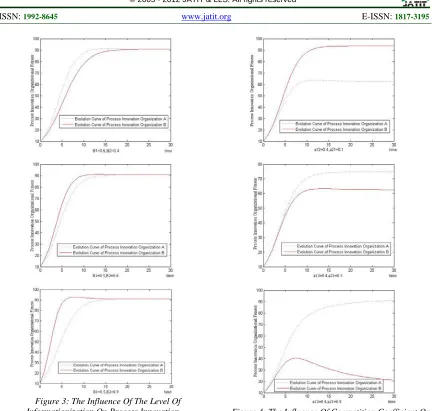
According to the analysis above, we use Matlab7.1 software to simulate equation (2), and apply software to describe process innovation organizational evolution path curve with different parameters. First of all, in order to investigate the influence of different level of informationization on process innovation organizational fitness, suppose the maximum fitness of process innovation organization is 100, as the coefficient of
information resources development and information technology application affect on the fitness of innovation organization changes, we can draw the fitness curve of process innovation organization applying Matlab7.1. As the diagram 3 shows: as the time changes, with larger coefficient of information resources development and information technology application affect on the fitness of innovation organization, the time for the fitness of innovation organization to reach maximum is shorter, and the velocity of the process innovation organization is faster.
958 Figure 3: The Influence Of The Level Of
[image:6.612.92.524.65.476.2]Informationization On Process Innovation Organizational Evolution
Figure 4: The Influence Of Competition Coefficient On Process Innovation Organizational Evolution
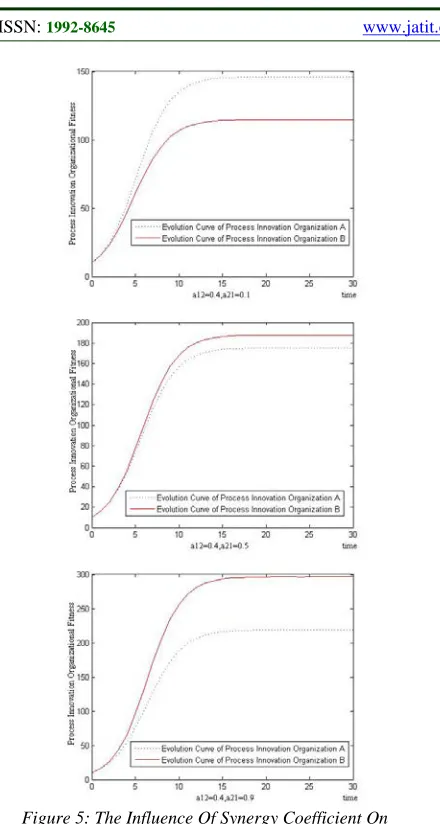
959 Figure 5: The Influence Of Synergy Coefficient On
Process Innovation Organizational Evolution
4. CONCLUSION
Applying the theory of organization and organizational routines, this article has summarized organizational characteristics in manufacturing
enterprises under the condition of
informationization, which are cooperative strategy, horizontal structure, task-oriented process and adaptive culture. Then this article has put forward that evolution mechanism of process innovation organization is transformation process from traditional organizational routines to process innovation organizational routines through searching and creation, and has constructed the Lotaka-Volterrra model of process innovation organizational evolution in manufacturing enterprises under the circumstance of informationization, and has used matlab software to simulate the influence of different parameters. Conclusions are as follows: (1) As time goes on,
the larger influence coefficient of information resources development and information technology application on the fitness of innovation organization is, the shorter that time of fitness of innovation organization up to maximum is, and the faster the velocity of process innovation organizational evolution is. (2) With the improvement of development and utilization of information resources and information technology, traditional process innovation organization has been gradually replaced by advanced process innovation organization. (3) The improvement of development and utilization of information resources and information technology promotes the exchange of market information and technical knowledge, and improves synergy coefficient between process innovation organizations. In the process of organizational evolution, process innovation organization parties have mutual influence with each other and play the role of catalyst. Eventually the fitness of process innovation organization parties has been remarkably improved.
ACKNOWLEDGEMENTS
This work was supported by National Science Foundation of China (71273073, 71073041 and 70873024), Natural Science Foundation for the Youth (71202037), National Ministry of Education Doctoral Fund (200802171067), National Soft Science Research Program (2012GXS4D080), Heilongjiang Provincial Education Department Humanities and Social Sciences project (11544054), Heilongjiang Province Natural Science Foundation (G201210), and Heilongjiang Province philosophy social science research project (11E111).
REFERENCES:
[1] Kexin Bi, Nuan Wen, Ping Huang. Study on the process-based organization structure of process innovation organization of manufacturing enterprises base on the informationization condition, Studies in Science of Science, Vol. 30, No. 3, 2012, pp.474-480.
[2] Kexin Bi, Di Feng. Power source of process innovation organization evolution in manufacturing enterprises: the impact of informationization, International Review on Computers and Software, Vol. 7, No. 4, 2012, pp. 1728-1736.
960 Studies in Science of Science, Vol 27, No. 4, 2009, pp.598-603.
[4] A. Madapusi, D. D'souza. The influence of ERP system implementation on the operational performance of an organization, International Journal of Information Management, Vol. 32, No. 1, 2012, pp. 24-34.
[5] Xiaopeng Ji, Yun Fan, Renjing Liu. An empirical research on driven force of organizational cultural evolution, Nankai Business Review, Vol 14, No. 4, 2011, pp.50-58. [6] Feirong Wang, Jin Chen. Analysis of influence
and trend of network environment on innovation organization , Science of Science and Management of S. & T., Vol. 6, 2006, pp. 50-54. [7] J. R. C. Kuntz, J. F.S. Gomes. Transformational change in organisations: a self-regulation approach, Journal of Organizational Change Management, Vol. 25, No. 1, 2012, pp. 143-162. [8] R. L. Daft, K. E. Weick. Toward a model of organizations as interpretation systems, The Academy of Management Review, Vol. 9, No. 2, 1984, pp. 284-295.
[9] Charles A. O’Reilly III, Michael L. Tushman. Ambidexterity as a dynamic capability: resolving the innovator’s dilemma, Research in Organizational Behavior, Vol. 28, No. 1, 2008, pp. 185-206.
[10] G. M. Hodgson. Darwinian Coevolution of organizations and the environment, Ecological Economics, Vol. 69, No. 4, 2008, pp. 700-706. [11] L. E. Greiner. Evolution and revolution as
organizations grow, Harvard Business Review, Vol. 5, 1998, pp. 55-66.
[12] M. S. Feldman, B. T. Pentland. Reconceptualizing organizational routines as a source of flexibility and change, Administrative Science Quarterly, Vol. 48, No. 1, 2003, pp. 94-118.
[13] Gao Zhanjun, Li Yuan. Research on organizational routine and its evolution, Science Research Management, Vol. 28, 2007, pp. 142-147.
[14] T. Mazzarol. Creating the innovative organisation, CEMI Discussion Paper 0401, 2004, pp. 2-17.
[15] Wanhong Li, Kexin Bi, Xia Cao. The process innovation power sources in manufacturing enterprises based on IT driver, Science Research Management, Vol. 12, 2011, pp. 17-25.
[16] Lingling Zhang, Jian Lin. A study on the relationship model of information technology, enterprise strategy, business process and organization structure, Systems Engineering, Vol. 20, No. 2, 2002, pp. 63-68.
[17] E. Ogbonna, B. Wilkinson. The false promise of organizational culture change: a case study of middle managers in grocery retailing, Journal of Management Studies, Vol. 40, No. 5, 2003, pp. 1151-1178.
[18] H. J. Leavitt, B. M. Bass. Organizational psychology, Annual Review of Psychology, Vol. 15, pp. 371-398.
[19] R. R. Nelson, S. G. Winter. Evolutionary theorizing in economics, The Journal of Economic Perspectives, Vol. 16, No. 2, 2002, pp. 23-46
[20] Yueru Ma, Weibo Cheng, Jie Dai. An entropy model for the evolution of compensation management system, Journal of Systems & Management, Vol. 21, No.1, 2012, pp. 48-55. [21] Barbara Levitt, James G. March. Organizational
learning, Annual Review of Sociology, Vol. 14, 1988, pp. 319-340.
[22] Hongna Tian, Kexin Bi. The evolution of green process innovation system for the manufacturing industry based on self-organization theory, Science Research Management, Vol. 33, No. 2, 2012, pp. 18-25. [23] A. Sahaym, H. K. Steensma, M. A. Schilling.