INVESTIGATION OF TACIT KNOWLEDGE MEASUREMENT
METHODS
1
ABDULLAH MOHAMMED RASHID, 2ZAINUDDIN BIN HASSAN, 3ALI TAHA Al-OQAILY
1, 2, 3 Universiti Tenaga Nasional , Selangor, Malaysia
1, 2, 3 College Of Information and Communication Technology
E-mail: 1 [email protected] ; [email protected];2 [email protected] ;
ABSTRACT
The knowledge management services are important to provide competitive advantages for institutions of higher learning organizations. However most organizations are facing challenges to manage and to develop the tacit knowledge that to support services and products quality due to weaknesses of knowledge measurement processes. The main objective of this study is to investigate the roles of knowledge and effectively knowledge measurement factors in the university environment. The quantitative data collected using questionnaire from Tenaga Nasional (UNITEN) in Malaysia as a case study was analyzed finding tacit knowledge measurement factors. The significant results show that the knowledge measurement factors are not applied efficiently, thus the opportunity to use the available tacit knowledge resources for best knowledge implementations would be missed.
Keywords: Knowledge Management, knowledge Measurement, Success Factors, Tacit Knowledge .
1. INTRODUCTION
Knowledge can be defined as a combination of experience, values and expert insight that assist evaluate and incorporate new experience and information [2]. Knowledge not only documents in repositories , it also resided in people’s minds as network of thinking , experience, commitment , competence and deed ,it is demonstrated through their actions. Generally knowledge divided to several types, the most popular types are explicit and tacit knowledge [10]. Explicit knowledge is experience that is formalized, well-documented, archived, codified and easily accessed by others because it can be expressed in words and numbers that can be managed [4]. Tacit knowledge is the most valuable type of knowledge as experience, thinking and competency which can help people to find best solutions and reduce opportunities of repeating mistakes [3,8]. Most organizations face challenges to manage their tacit knowledge resources due to difficulty to measure the tacit knowledge because tacit knowledge is intangible, and the tacit knowledge is kept through many sources i.e. experiences, and skills. However, knowledge measurement is a crucial factor to
manage the tacit knowledge on the organizations. Most organization aims to identify tacit knowledge
assists for employees that maximize the organization competitive advantages over other organizations in same field i.e. hospital compete with other hospitals and university compete with other universities [19]. Thus, the main objective of tacit knowledge measurement is identifying the employees’ tacit levels then improves the employee’s knowledge to increase the performance. The main question of this study, are the organizations apply the measurement methods of knowledge effectively to manage and develop their tacit knowledge assists? The answer of this question shows the importance of tacit knowledge measurement factor in the organization.
2. RELATED WORKS
organization need to evaluate the employee’s tacit
knowledge to ensure about their employee’s performance supported the organization objectives. The complexity of tacit determinates such as experience years and qualifications levels cause difficulty to evaluate the tacit knowledge. However, there are no standard methods to measure the tacit knowledge accurately.
On other hand, knowledge measurement is main process to ensure that continuously improve the knowledge (tacit and explicit) that lead to acceptance the dynamic change in businesses strategies and working environment [7 , 13] . Businesses strategies and working environment are frequently changing to achieve the competitive advantage with other organizations. Thus, knowledge (tacit and explicit) should manage occasionally to achieve the organization requirement based on work environment. Moreover, explicit knowledge is the key source of tacit knowledge development. Thus, knowledge needs to managing efficiently to satisfy the employees’ tacit levels. Also tacit knowledge is needs to be evaluated to retrieve efficient explicit knowledge. There is significant relation between knowledge measurement and organization strategies, they are basic success factors of knowledge management systems implantations in companies [9, 13, 19].
Moreover, the success aspect of knowledge management in businesses organizations is knowledge evaluation that is considered as key factors of success of knowledge management implementations [21, 11 , 14]. Regarding to education the knowledge measurement is the most important success factor of knowledge management implementations in universities’ environment [1, 20 , 6 , 7] Also, improvement processes of knowledge (tacit and explicit) via measurement processes are crucial for knowledge management application in a university’s environment [15].
3. STUDY PURPOSE
This study is conducted to investigate the roles of knowledge measurement factors in the university environment that apply tacit knowledge in the organization. The domain of this study is the higher educational organization i.e. universities, to ensure that the tacit knowledge is used in correct ways and support education processes. The leaderships or managers need to identify the current level of employee’s tacit knowledge. Then
manage the knowledge resources to support the employee’s tacit levels that will increase working activities performance such as efficient organizational structure. However, many universities have difficulty to manage their tacit knowledge because they have not aware of measure employees’ tacit knowledge then develop, share and transfer in term of management.
4. DATA COLLECTION
This research uses only quantitative approach (questionnaire) to collect research data from two colleges in Universiti Tenaga Nasional (UNITEN) in Malaysia; information technology and business administration colleges. The data were collected from the academic staff in these colleges. The study’ questionnaire was adopted from [7] study based on 5 - Likert scale (1 ) SD for Strongly Disagree , (2) D for Disagree , (3) N for Neutral , (4) A for Agree and (5) SA for Strongly Agree . The questionnaire consists from 23 items divided into 4 sections; (1) Demographic Data, (2) knowledge management culture, (3) Tacit Knowledge Conversion, and (4) Tacit knowledge Measurement. The numbers of responses for this questionnaire were 47 responses.
5. DATA ANALYSIS
5.1 Questionnaire Reliability
The questionnaire reliability defined as stable interrelation between items responses [18]. For example, the random answers of items considered as unstable responses. The Cronbach alpha is efficient method to measure the reliability of the questionnaire. The acceptable coefficient alpha could be more than 0.7 [18]. Table 1: shows that the coefficient alpha of collected data is 0.78 based on 47 responses and 23 scaled items of questionnaire. Thus, the questionnaire of this research is reliable.
Table 1: Coefficient Alpha of Questionnaire
Questionnaire Items
Responses Number
Coefficient alpha
23 47 0.78
5.2 Demographic Data
qualification levels could be efficient enough to
support the research development. With regards to the respondents’ gender, the number of female respondents is 24 (51%) of the total respondents while the number of male respondents 23 (49%). Thus, the collected data reflect the opinions of both genders. However, the culture of female workers may differ of male workers.
With regards to the respondents’ ages, Most of respondents’ ages are between 25-35 years. Thus, the presented data from the respondents will be efficient for future development i.e. the respondents will work in the university for long time. The respondents who ages more than 45 years represent 30% of all respondents. Followed by 21% of respondents who ages between 36-45 years. Thus, the collected data reflect the opinions of various workers generations.
According to Figure 1, most of respondents have PHD (47%) and (45%) have Master qualifications. Thus, the provided responses reflect the academic staff opinions based on their teaching and researching activities. Figure 1 illustrates the qualification levels.
Figure 1: Qualification Levels
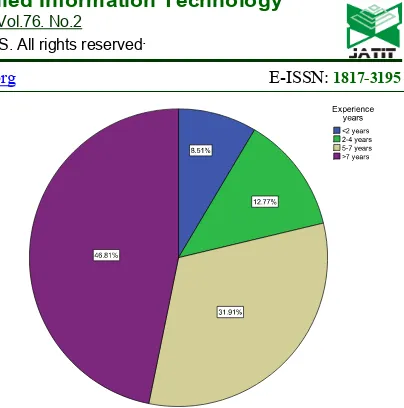
[image:3.595.307.509.76.280.2]With regards to the experience years of the respondents, 47% of total respondents have more than 7 years of experience, followed by 32% of all respondents with 5-7 years of experience. There were 13% of respondents having 2-4 years of experience followed by 8% with less than two years’ experience. Thus, the majority of the study participants have more than 5 years of experience. Therefore, this segment of staff is mature enough to provide the needed information for the study. Figure 2 illustrates the experience years’ variable.
Figure 2: Experience Years Variable.
With regards to the respondents’ faculty, the number of respondents who belong to COIT facility is 24 (51%) while the number of respondents who belong to BA faculty is 23 (49%). Thus, the collected data reflect the opinions of respondents from different fields’ perspective.
5.3 Knowledge Management Culture
reusing knowledge is actively promoted on a
day-to-day basis, and Individuals are visibly rewarded for knowledge sharing and reuse).
5.4 Tacit Knowledge Conversion
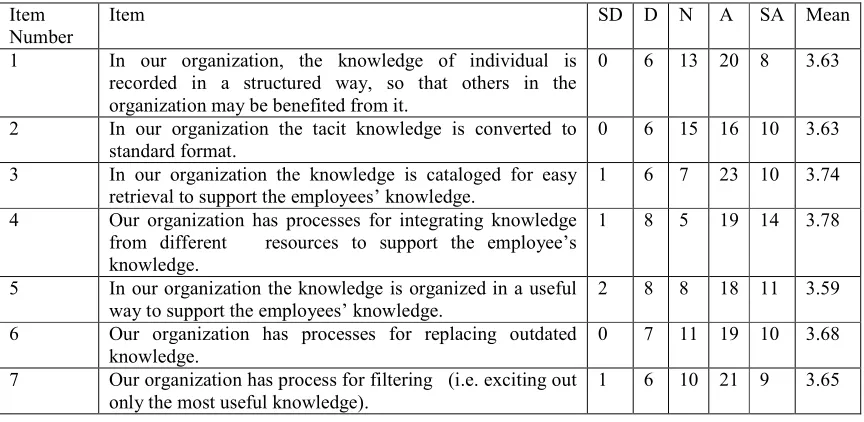
This part consists from 7 items to ensure that, tacit knowledge is important in UNITEN University. Tacit knowledge importance can be seen clearly through the processes and procedures to convert the tacit knowledge to explicit knowledge to develop, improve and share. Table 3 presents the frequencies and means of tacit knowledge conversion items. Overall items shows that the respondents are agree that the tacit knowledge management and conversion is important in the organization.
According to items number 1 (In our organization, the knowledge of individual is recorded in a structured way, so that others in the organization may be benefited from it), 2 (In our organization the tacit knowledge is converted to standard format), and 3 (In our organization the knowledge is cataloged for easy retrieval to support the employees knowledge) show that the organization focus on convert the tacit knowledge to accessed documents and manage these documents efficiently to provide the knowledge sharing between the employees.
According to items 4 (Our organization has a processes for integrating knowledge from different resources to support the employee’s knowledge), and 5 (In our organization the knowledge is organized in a useful way to support the employees knowledge), the organization care about develop the tacit knowledge of employees using supportive methods such as external sources of knowledge. Also, items 6 (Our organization has a processes for replacing outdated knowledge), and 7 (Our organization has process for knowledge filtering) show that the organization focus on provide efficient and accurate knowledge to develop the employee’s tacit knowledge. Overall items prove that the respondents are agreeing that the tacit knowledge conversion is important in the organization.
5.5 Tacit knowledge Measurement
This part consists from 7 items to distinguish that, UNITEN University has to managing tacit knowledge based on efficient measurement methods or not .Table 4 provides the items frequencies and means of this part.
Item Number
Item SD D N A SA Mean
1 In our organization, the knowledge of individual is recorded in a structured way, so that others in the organization may be benefited from it.
0 6 13 20 8 3.63
2 In our organization the tacit knowledge is converted to standard format.
0 6 15 16 10 3.63
3 In our organization the knowledge is cataloged for easy retrieval to support the employees’ knowledge.
1 6 7 23 10 3.74
4 Our organization has processes for integrating knowledge from different resources to support the employee’s knowledge.
1 8 5 19 14 3.78
5 In our organization the knowledge is organized in a useful way to support the employees’ knowledge.
2 8 8 18 11 3.59
6 Our organization has processes for replacing outdated knowledge.
0 7 11 19 10 3.68
7 Our organization has process for filtering (i.e. exciting out only the most useful knowledge).
1 6 10 21 9 3.65 Item
Number
Item S
D
D N A S A
Mea n 1 Recording and sharing knowledge is a routine for all
lecturers.
2 1 3 21 20 4.19
2 Change is accepted as part of working life. 1 1 1 27 17 4.23 3 All lecturers are co-operative and helpful when asked
for some information or advice.
1 2 2 25 17 4.17
4 Knowledge sharing seen as strength and knowledge hoarding as a weakness.
0 0 6 24 17 4.23
5 There is good intra-team communication and sharing of knowledge.
1 1 8 24 13 4.00
6 Good knowledge management behavior like sharing, reusing knowledge is actively promoted on a day-to-day basis.
1 2 5 23 16 4.08
7 Bad knowledge management behavior is actively discouraged.
0 3 8 20 16 4.04
8 Individuals are visibly rewarded for knowledge sharing and reuse.
1 7 11 15 13 3.69
9 All lecturers at all levels in the university participate in some kind of a community or communities of practice.
[image:5.595.94.507.163.396.2]0 4 11 17 15 3.91
[image:5.595.83.515.455.666.2]Item Number
Item SD D N A SA Mean
1 There is a participative goal setting, measurement and feedback for tacit knowledge.
0 16 16 10 5 3.08
2 The individuals committed to continual improvement of the tacit knowledge.
1 7 12 17 10 3.59
3 There is a constant flow\ generation of new tacit knowledge within the organizational context.
2 23 11 8 3 2.78
4 The tacit knowledge assets committed for ongoing training and development.
2 20 5 16 4 3.00
5 The tacit knowledge assets are evaluated continually. 8 23 9 6 1 2.34 6 There are specific variables to measure the tacit
knowledge in the UNITEN (i.e. Qualification level).
6 23 8 9 1 2.48
7 The current tacit knowledge measurements help to determine the lecturers’ roles and responsibilities in the university.
7 19 6 9 6 2.74
5.6 Results Discussion
According to questionnaire results, the academic staff in UNITEN University has positive culture to adopt new solutions of knowledge management services in order to improve their working activities and enhance the working outcomes. Thus, they have the ability to learn and implement new applications of knowledge management in the working environment. On the other hand, the academic staff believes that tacit knowledge is important key to produce efficient services and products of the university. Therefore, the development and management of tacit knowledge is important to provide the competitive advantages over other universities. Moreover, the tacit knowledge measurement is necessary to manage the tacit assists in the university in order to understand how to develop the employees’ skills and experiences of researching and teaching activities. Also the tacit knowledge measurement supports the leaders’ decisions to insight and structure the working tasks based on their tacit levels. However, there are no effective methods to measure the employees’ tacit knowledge in the university. Thus, the university has not good understanding of the tacit resources which lead them to manage and develop the tacit knowledge of the employees depend on traditional methods such as the employees’ years of experience and the jobs roles. The lack of knowledge measurement lead to minimize the efficiency of knowledge management activities in the university due to inaccurate
evaluation of tacit knowledge assists. Therefore, the development of tacit knowledge measurement methods is necessary to develop the employees’ knowledge and manage the working roles and responsibilities based on the employees levels of knowledge.
5.7 Recommendations
employees activities, and supervisors observing
evaluations for employees’ working activities.
5.8 Conclusion
The intangible knowledge (tacit knowledge) becomes the main compete factor between the universities because the tacit knowledge residing in the employees minds and cannot imitated it. Furthermore, [17] underlines the increased attention focused on tacit knowledge and organizational learning to get the competitive advantage. There is difficulty in measure the tacit knowledge levels based on their working tasks due to complexity of tacit knowledge determinants. The tacit knowledge intangible or not physical for that it’s difficult to deal with it, also the tacit knowledge is residing in the employees mental for that it has difficulty to measure. Thus, knowledge is differing according to difference of employees’ knowledge resources and practices. The practical method of tacit knowledge measurement could be efficient solution to measure the real competitive values of businesses and improve these values to maximize the competitive advantage over other businesses in same field.
REFERENCES:
[1]Abdullah, D. H. & Sinha, RR (2009), Knowledge management and intellectual capital emerging perspectives (Eds.),“Critical factors for KM implementation: An L&T, E&C division case study”(pp. 53-71). Institute of management technology, Ghaziabad.
[2] Gammelgaard, J. and Ritter, T. (2000), ‘‘Knowledge retrieval process in multinational consulting firms’’,Danish Social Sciences Research Council, Frederiksberg, Denmark, available at: http://web.cbs.dk/departments/int/
seminarpapers/JG-Knowledge.pdf (accessed 4 September 2004).
[3] Awad E.M. &Ghaziri H. (2004) Knowledge Management.Sternberg, R.J. (1997), Successful Inteligence, Penguin Putnam, New York, NY Pearson Prentice Hall, Upper Saddle River, NJ.
[4] Duffy, J. (2001). The tools and technologies needed for knowledge management. Information Management Journal, 35(1), 64-67.
[5] Heaidari, M., Moghimi, S. M., &Khanifar, H. (2011). The critical success factors in implementing knowledge management: agricultural organization in Islamic Republic of Iran. British Journal of Science, 1(2), 54-75.
[6] Lehner, F., & Haas, N. (2010).Knowledge management success factors–proposal of an empirical research. Electronic Journal of Knowledge Management, 8(1), 79-90. [7] Mathi, K. (2004). Key success factors for
knowledge management. University of Applied Sciences, Offenburg, thesis, Master of Business Administration in International Business Management and Consulting. [8] Leonard, D., & Sensiper, S. (1998). The role of
tacit knowledge in group innovation. California management review, 40(3), 113.
[9] Monavvarian, A., & Khamda, Z. (2010). Towards successful knowledge management: people development approach. Business Strategy Series, 11(1), 20-42.
[10] Nonaka, I., H. Takeuchi. 1995. The Knowledge-Creating Company_How Japanese Companies Create the Dynamics of Innovation.Oxford University Press, Oxford, UK.
[11] Razi, M. J. M., & Karim, N. A. (2010).An Instrument to Assess Organizational Readiness to Implement Knowledge Management Process. In Knowledge management: theory, research and Practice, Proceedings Knowledge management 5th International Conference (pp. 323-328). [12] Sternberg, R.J. (1997), Successful
Inteligence, Penguin Putnam, New York, NY [13] Yaghoubi, N. M., &Maleki, N. (2012).Critical
Success Factors of Knowledge Management. [14] Zheng, W., Yang, B., & McLean, G. N.
(2010).Linking organizational culture, structure, strategy, and organizational effectiveness: Mediating role of knowledge management. Journal of Business Research, 63(7), 763-771.
[15] Zwain, A. A. A., Teong, L. K., & Othman, S. N. (2014). TQM Practices and Organisational Knowledge Creation: An Empirical Study of Iraqi Higher Education Institutions. Asian Journal of Business and Accounting, 7(1), 1. [16] Tobin, P. K., &Volavsek, P. (2006).
Knowledge management measurement in
South African
[17] Pisano, G. P. (1994). Knowledge integration
and the locus of learning: An empirical analysis of process development.Strategic Management Journal, 15.
[18] Levitt, P., & Mary, C. Waters. 2002. The changing face of home: the transnational lives of the second generation.
[19] Al-oqaily, A. T., Hassan, Z. B., Rashid, A. M., & Al-sulami, Z. A. (2014). Success Factors of Knowledge Management in Universities (A Case Study: Jordanian Private Universities). Middle-East Journal of Scientific Research,22(7), 994-1002.
[20] Nonaka, I., & Von Krogh, G. (2009). Perspective-tacit knowledge and knowledge conversion: Controversy and advancement in organizational knowledge creation theory. Organization science, 20(3), 635-652