Pneumococcal Capsular Serotypes That Account for a High Global
Disease Burden
Fabiana C. Pimenta,aAlexis Roundtree,aAhmet Soysal,bMustafa Bakir,bMignon du Plessis,cNicole Wolter,cAnne von Gottberg,c Lesley McGee,aMaria da Gloria Carvalho,aBernard Bealla
Respiratory Diseases Branch, Centers for Disease Control and Prevention, Atlanta, Georgia, USAa; Division of Pediatric Infectious Diseases, Marmara University School of Medicine, Istanbul, Turkeyb; Center for Respiratory Diseases and Meningitis, National Institute for Communicable Diseases, National Health Laboratory Service, Johannesburg, South Africac
We developed and validated a real-time PCR assay consisting of 7 triplexed reactions to identify 11 individual serotypes plus 10
small serogroups representing the majority of disease-causing isolates ofStreptococcus pneumoniae. This assay targets the 13
serotypes included within the 13-valent conjugate vaccine and 8 additional key serotypes or serogroups. Advantages over other serotyping assays are described. The assay will be expanded to 40 serotypes/serogroups. We will provide periodic updates at our protocol website.
T
he pneumococcal capsular serotype is an essential parameter for vaccine-related disease surveillance. Conventional sero-typing is difficult and not applicable for culture-negative clinical specimens. Conventional PCR assays targeting serotype-specific genes (1–4) are useful for serotyping isolates and clinical speci-mens (5–12); however, real-time PCR is faster and more sensitive (13–17). Here we describe a triplexed real-time multiplexed PCR (rmPCR) assay that provides advantages over previously de-scribed assays.Twenty-one oligonucleotide sets targeting 21 serotypes/sero-groups (Table 1) were designed using publishedcpssequences, Primer Express version 3.0 (Applied Biosystems, Foster City, CA), and Beacon Designer (Premier Biosoft International, Palo Alto, CA). Probes were 5=labeled with 6-carboxyfluorescein (FAM), hexachloro-6-carboxyfluorescein (HEX), 6-carboxy-X-rhoda-mine (ROX), or indodicarbocyanine (CY5). Black hole quencher 1 or 2 was placed either at the 3=end of the probe or internally on a thymidine base. If internally quenched, the 3=end was capped with a phosphate group to prevent probe extension. Due to issues pertaining to sensitivity, specificity, and annealing temperature, it was necessary for five probes to contain locked nucleic acids. Primers/probes were synthesized at the CDC Biotechnology Core Facility.
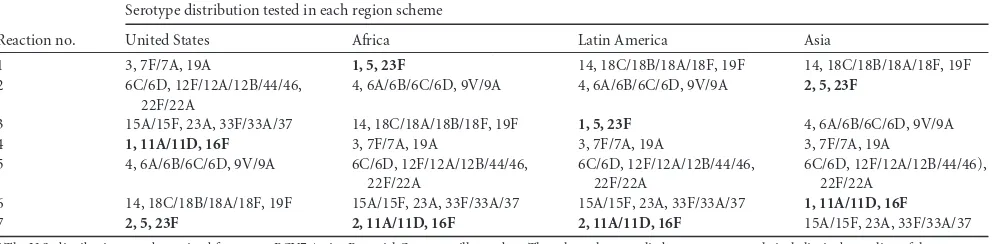
The 21 serogroups/serotypes were grouped into seven triplex reactions in four different regional schemes (Table 2). Reaction mixtures contained 5l of DNA, primers/probes, 12.5l Invitro-gen-Platinum Quantitative PCR SuperMix-UDG master mix, 1.5
l MgCl2(50 nM), and water for a final 25-l volume. Amplifi-cation in the Stratagene Mx3005P employed a temperature of 95°C for 10 min, followed by 40 cycles at 95°C for 15 s and 60°C for 1 min. Primer and probe concentrations were formulated to ob-tain the highest DNA dilution yielding a cycle threshold (CT) value ofⱕ35.
Assay validation employed 967 pneumococcal strains repre-senting 78 capsular serotypes and 5 capsule-deficient strains lack-ing type-specific biosynthetic genes (Table 3). Of these, 803 were collected through invasive pneumococcal disease surveillance in the United States (http://www.cdc.gov/abcs/index.html). In addi-tion, 169 isolates from Brazil, India, Kenya, Mongolia,
Mozam-bique, Nepal, Peru, and Thailand were included. Forty-three isolates of 15 related species, which includedStreptococcus pseudo-pneumoniae (10),Streptococcus gordonii (6),Streptococcus mitis (4),Streptococcus oralis(3),Streptococcus cristatus(2), Streptococ-cus sanguinis(2), Streptococcus parasanguinis (3), Streptococcus salivarius(3),Streptococcus vestibularis(3),Streptococcus infantis (1),Streptococcus australis(1),Streptococcus intestinalis(1), Strep-tococcus peroris(1),Streptococcus sinensis(1), andStreptococcus oligofermentans (1), were tested. Finally, 11 strains of undeter-mined species within the Mitis group (based upon 16S rRNA gene sequences and DNA reassociation data [18]) were tested. DNA was extracted using the Qiagen DNA minikit (Qiagen Inc., Valen-cia, CA) (18). A loopful of bacteria from a blood agar plate after overnight growth was resuspended in lysis buffer containing 0.04 g/ml lysozyme and 75 U/ml of mutanolysin and incubated for 1 h at 37°C. The remaining extraction procedure was performed by following the kit manufacturer’s instructions. Serial dilutions of DNAs were prepared in PCR-grade water to obtainCTvalues in the range of 20 to 30. Specific amplification for serogroups/sero-types within each triplex reaction was assessed against all strains, with no cross-reactivity observed between serogroups/serotypes in monoplex or triplex reactions. No amplification was observed for any assay when testing capsule-deficient pneumococci and nonpneumococcal strains.
A total of 377 cerebrospinal fluid (CSF) samples and 104 blood culture broth (BLB) samples were obtained in accordance with the CDC Institutional Review Board, including 256 CSF samples ob-tained from Turkish meningitis surveillance (our unpublished data). The remaining specimens, including culture-negative BLB specimens that had Gram stain and/or latex test results consistent
Received31 October 2012Returned for modification19 November 2012
Accepted30 November 2012
Published ahead of print5 December 2012
Address correspondence to Bernard Beall, [email protected].
Copyright © 2013, American Society for Microbiology. All Rights Reserved.
doi:10.1128/JCM.02927-12
on May 16, 2020 by guest
http://jcm.asm.org/
TABLE 1 Primer and probe information for the real-time multiplex PCR serotyping assay a GenBank accession no. (gene) Coordinates Primer/probe ID Sequence (5 = –3 = ) Probe dye Probe special chemistry Quencher (3 = )n M CR931632 ( wzy ) 9875–10035 1-F TTTCATCCCTATGTGTGGTATAG 300 1-R GCTTTAGAAGGTAGAGTTAACAAC 300 1-Probe TGCCAAAGCCAGCCAT FAM LNA b BHQ1 100 CR931633 ( wzy ) 10342–10452 2-F TGTTATCCCATATAAGAACCGAGTGT 300 2-R AAAATTACCCCAAAAGCTATCCAA 300 2-Probe TTGCAATT“T”CAATTTTTTTGCCCCAATCTC FAM/HEX c “T” d⫽ BHQ1 BHQ1 200 CR931634 ( galU ) 8564–8648 3-F CCACTAAAGCTTTGGCAAAAGAAA 300 3-R CCCGAACGTAAAGCTTCTTCA 300 3-Probe TTGTAGACCGCCCCACAA“T”TCATTTTGT HEX “T” d⫽ BHQ1 BHQ1 200 CR931635 ( wzy ) 10521–10734 4-F GCTTCTGCTGTAACTGTTGTGC 300 4-R CACCACCATAGTAACCAAAGTTCC 300 4-Probe TTCCACAAAAGAAGAGCCTACAGGTAACCCCA ROX/CY5 e BHQ2 100 CR931637 (wzy) 7001–7082 5-F CATGATTTATGCCCTCTTGCAA 300 5-R GACAGTATAAGAAAAAGCAAGGGCTAA 300 5-Probe TCTTCTTCTCA“T”CGTTTCCGCATGCTTTT FAM/HEX c “T” d⫽ BHQ1 BHQ1 200 CR931639 ( wciP ) 8796–8900 6A/6B/6C/6D-F GTT TGCACTAGAGTATGGGAAGG 200 6A/6B/6C/6D-R TAGCCTTTCTGAAAACATTTAGCG 200 6A/6B/6C/6D-Probe TGTTCTGCCC“T”GAGCAACTGGTCTTGTATC FAM “T” d⫽ BHQ1 BHQ1 200 EF538714 ( wciN ) 7102–7250 6C/6D-F TTGGGATGATTGGTCGTATTAG 200 6C/6D-R CTCTTCAATTAGTTCTTCAGTTCG 200 6C/6D-Probe CCACGCAATTCGCCATC FAM LNA b BHQ1 100 CR931643 ( wzy ) 14101–14204 7F/7A-F ATGAAGGCTTTGGTTTGACAGG 200 7F/7A-R ATTCTCGCCATCAATTGCATATTC 200 7F/7A-Probe ACACCACTATAGGCTGTTGAGACTAACGCACA ROX/CY5 e BHQ2 100 CR931648 ( wzx ) 11767–11920 9V/9A-F AGGTATCCTATATACTGCTTTAGG 300 9V/9A-R CGAATCTGCCAATATCTGAAAG 300 9V/9A-Probe ACACATTGACAACCGCT HEX LNA b BHQ1 100 CR931653 ( wzy ) 12015–12121 11A/11D-F AAATGGTTTGGATATGGTTTGTTTGG 300 11A/11D-R AGTGCTAACTGTAAAACTTGATTATGAG 300 11A/11D-Probe ATTCCAACTTCTCCCAATTTCTGCCACGG ROX/CY5 e BHQ2 100 CR931660 ( wzx ) 15066–15145 12F/12A/12B/44/46-F GCACCCACGGGTAAATATTCTAC 300 12F/12A/12B/44/46-R CAACTAAGAACCAAGGATCCACAG 300 12F/12A/12B/44/46-Probe TGCCCACCAACACCAGGTCCAGGT ROX/CY5 e BHQ2 200 CR931662 ( wzy ) 7920–8007 14-F AGAGTGTATGAGGAATCC 300 14-R ATATATCTACTGTAGAGGGAAT 300 14-Probe CGCCAAGTAACA“T”TTCCATTCCATT FAM “T” d⫽ BHQ1 BHQ1 100
on May 16, 2020 by guest
http://jcm.asm.org/
CR931663 ( wzy ) 7839–7968 15A/15F-F AATTGCCTATAAACTCATTGAGATAG 200 15A/15F-R CCATAGGAAGGAAATAGTATTTGTTC 200 15A/15F-Probe CCCGCAAACTCTGTCCT FAM LNA b BHQ1 100 CR931668 ( wzy ) 12016–12214 16F-F TAATGTTATGACCTTGGTAATCTTCCC 300 16F-R TCCCAAAGGATAATCAATAACTTTTAGAAG 300 16F-Probe AGCCATAAGTCT“T”CCAAATGCTTAACCGCT HEX “T” d⫽ BHQ1 BHQ1 100 CR931673 ( wzy ) 12934–13081 18C/18A/18B//18F-F TCGATGGCTAGAACAGATTTATGG 200 18C/18A/18B/18F-R CCATTGTCCCTGTAAGACCATTG 200 18C/18A/18B/18F-Probe AGGGAGTTGAATCAACCTATAATTTCGCCCC HEX BHQ1 100 CR931675 ( wzy ) 9492–9580 19A-F CGCCTAGTCTAAATACCA 200 19A-R GAGGTCAACTATAATAGTAAGAG 200 19A-Probe TATCAATGAGCCGATCCGTCACTT FAM BHQ1 100 CR931678 ( wzy ) 11131–11350 19F-F TGAGGTTAAGATTGCTGATCG 300 19F-R CACGAATGAGAACTCGAATAAAAG 300 19F-Probe CGCACTGTCAATTCACCTTC ROX/CY5 e LNA b BHQ2 100 CR931682 ( wcwV ) 11780–11868 22F/22A-F TCTATTAAATAACCCATTGGAATTGAAACG 200 22F/22A-R TCGCAATTGAAGACCACATAAACTG 200 22F/22A-Probe TCCGTAAT“T”CGCTTATGGGCACATTCTCCA HEX “T” d⫽ BHQ1 BHQ1 200 CR931683 ( wzy ) 8626–8711 23A-F CTCCCCTCCATTACCCATTTGG 200 23A-R TGAAGAAAGTGCTGTTTGTGAACC 200 23A-Probe AGCTAGAAC“T”CCCACACTCCCTACTCCCA ROX/CY5 e “T” d⫽ BHQ2 BHQ2 100 CR931685 ( wzy ) 9049–9274 23F-F GACAGCAACGACAATAGTCATCTC 300 23F-R TCCATCCCAACCTAACACACTTC 300 23F-Probe ATTGTGTCCA“T”AACCCTTCGTCGTATTTCCAAAG ROX/CY5 e “T” d⫽ BHQ2 BHQ2 200 CR931702 ( wzy ) 11778–11882 33F/33A/37-F GGAACTGGTTCAGCAACTATACG 200 33F/33A/37-R GGTTCTAAGACCGTCTGAAATACC 200 33F/33A/37-Probe CCCCAAATAGGAC“T”TTTCTGCCATGCCAAA HEX “T” d⫽ BHQ1 BHQ1 200 aAbbreviations: FAM, 6-carboxyfluorescein; HEX, hexachloro-6-carboxyfluorescein; ROX, 6-carboxy-X-rhodamine; CY5, indodicarbocyanine; BHQ, b lack hole quencher; ID, identification; LNA, locked nucleic acid. bLocked nucleic acid nucleotides are underlined. cThe probe for serotype 2 is labeled with FAM for the triplex reaction formulated for the Africa and Latin America regions and HEX for the triplex reactio n formulated for the U.S. and Asia regions; the probe for serotype 5 is labeled with FAM for the triplex reaction formulated for the U.S. and Asia regions and HEX for the triplex reaction formulated for the Africa and Latin America regions. d“T,” black hole quencher placed internally on the thymidine base. eProbe is labeled with CY5 if ROX is used as a reference dye.
on May 16, 2020 by guest
http://jcm.asm.org/
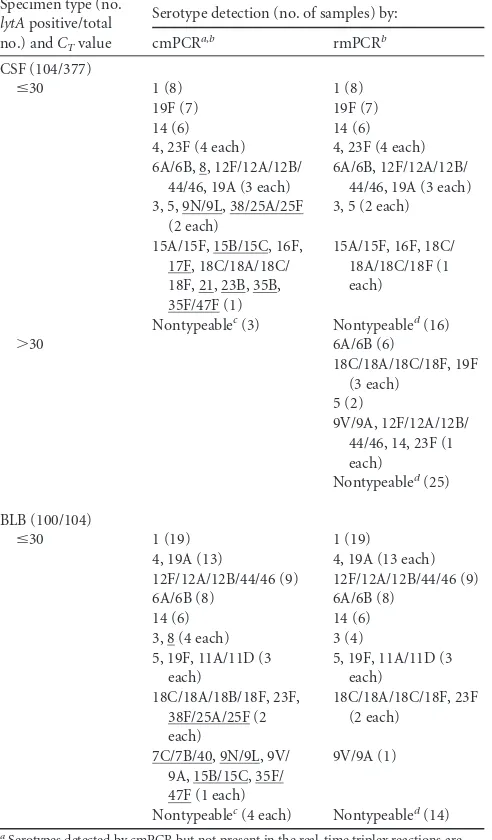
with pneumococcal diagnosis, were from invasive bacterial dis-ease surveillance at the National Institute for Communicable Dis-eases in South Africa (http://www.nicd.ac.za). For clinical speci-mens, 200l of specimen or 50l of BLB was added to 100l of Tris-EDTA buffer containing 0.04 g/ml lysozyme and 75 U/ml mutanolysin (Sigma Chemical Co.), and the mixture was incu-bated for 1 h at 37°C. DNA extraction was performed by following Qiagen DNA minikit instructions. DNA extracted from BLB was diluted to 1:1,000 to avoid PCR inhibition often observed from specimens with extremely high pneumococcal DNA concentra-tions (our unpublished data). DNA extracts with real-time PCR lytA assay (18) (www.cdc.gov/ncidod/biotech/strep/protocols .htm)CTvalues ofⱕ30 were subjected to both conventional mul-tiplex PCR (cmPCR) (1) (http://www.cdc.gov/ncidod/biotech /strep/protocols.htm) and rmPCR serotyping. Positive lytA results were obtained for 104/377 (27.6%) CSF samples and 100/ 104 (96.1%) BLB samples (Table 4). Specimens withlytA CT val-ues of⬎30 were subjected to rmPCR and retested using individual monoplex real-time PCRs. As expected, rmPCR was negative for
the serotypes/serogroups 7C/7B/40, 8, 9N/9L, 15B/15C, 17F, 21, 23B, 35B, 35F/47F, and 38F/25A/25F (not included in the rmPCR assay), which were cmPCR positive. Serotypes targeted by both rmPCR and cmPCR yielded identical positive results verified by monoplex real-time PCR. Positive real-time PCR serotyping reac-tions (single or triplexed) generally resulted inCTvalues that were approximately the same as the predetermined lytA CT values; however, variation of up to 3CTvalues was observed for rmPCR in 13 (12.5%) CSF samples in a comparison withlytA CTvalues. Thirty randomly selectedlytA-negative extracts were rmPCR neg-ative (data not shown).
To determine the lower limit of detection (LLD), DNA was extracted from a suspension of overnight blood agar growth (in 0.85% saline) prepared at a density equivalent to a 0.5 McFarland standard (⬃1.5⫻108CFU per ml), from which 10-fold serial dilutions were made. After vortexing, DNA was extracted from 200l of serial dilution suspensions (18). Real-time PCRs for each serotype/serogroup were performed in triplicate, with monoplex and triplex reactions run simultaneously. The LLD for each assay was the highest dilution that yielded aCTvalue ofⱕ35. When tested in monoplex format, the assays for serotypes/serogroups 1, 6A/6B/6C/6D, 7F/7A, 9V/9A, 11A/11B, 12F/12A/12B/44/46, 15A/ 15F, 23A, and 23F reliably presented an LLD of⬃7.5 cell genome equivalents per reaction. In monoplex format, the assays for sero-types/serogroups 2, 3, 4, 5, 6C/6D, 14, 16F, 18C/18A/18B/18F, 19A, 19F, 22F/22A, and 33F/33A/37 presented an LLD of⬃15 cell genomes per reaction. Each of the 21 individual reactions pre-sented an LLD of⬃15 cell genome equivalents per reaction when tested in triplex format. When using thermocyclers that require master mix with ROX reference dye, used in combination with CY5 as a fluorescent dye, the LLD was⬃150 genome equivalents per reaction for the serotype 4 assay. This discrepancy was not observed for master mix kits without ROX reference dye.
[image:4.585.42.546.88.210.2]rmPCR offers advantages over cmPCR, including greater sen-sitivity and containment, in which amplification products are not potential contaminants for subsequent PCRs. Also, rmPCR offers more specificity in requiring hybridization to a probe in addition to amplification primers. Specificity is a concern, since related streptococcal strains carry homologs of pneumococcal capsular type-specific loci (19). Drawbacks of rmPCR relative to cmPCR include expense and limited multiplexing. A useful rmPCR assay (16) offers three 4-plex assays targeting the 13 serotypes included
TABLE 2Triplexed assays for 21 common pneumococcal serotypes or serogroups designed for current serotype distributions within 4 different
geographic regionsa
Reaction no.
Serotype distribution tested in each region scheme
United States Africa Latin America Asia
1 3, 7F/7A, 19A 1, 5, 23F 14, 18C/18B/18A/18F, 19F 14, 18C/18B/18A/18F, 19F
2 6C/6D, 12F/12A/12B/44/46,
22F/22A
4, 6A/6B/6C/6D, 9V/9A 4, 6A/6B/6C/6D, 9V/9A 2, 5, 23F
3 15A/15F, 23A, 33F/33A/37 14, 18C/18A/18B/18F, 19F 1, 5, 23F 4, 6A/6B/6C/6D, 9V/9A
4 1, 11A/11D, 16F 3, 7F/7A, 19A 3, 7F/7A, 19A 3, 7F/7A, 19A
5 4, 6A/6B/6C/6D, 9V/9A 6C/6D, 12F/12A/12B/44/46,
22F/22A
6C/6D, 12F/12A/12B/44/46, 22F/22A
6C/6D, 12F/12A/12B/44/46), 22F/22A
6 14, 18C/18B/18A/18F, 19F 15A/15F, 23A, 33F/33A/37 15A/15F, 23A, 33F/33A/37 1, 11A/11D, 16F
7 2, 5, 23F 2, 11A/11D, 16F 2, 11A/11D, 16F 15A/15F, 23A, 33F/33A/37
aThe U.S. distribution was determined from post-PCV7 Active Bacterial Core surveillance data. The other schemes relied upon our own relatively limited sampling of these
regions. Assays indicated in bold indicate serotypes assayed within different triplex reactions used within more than one region scheme.
TABLE 3Streptococcus pneumoniaeisolates used to validate the
real-time multiplex serotyping PCR assay
S. pneumoniaeserotype(s)
No. of isolates
testeda
1, 3, 4, 5, 6C, 7F, 9V, 11A, 12F, 14, 15C, 16F, 18C, 19A, 19F, 22F, 23A, 23F, 33F
30
6A, 6B, 15A, 15B, 18A, 23B 20
18B 15
7C, 9A 14
38 13
2, 13, 37 11
21, 24F 10
11B, 28A, 35A 8
18F, 19B, 20, 31 7
7A, 15F, 35B, 39 6
8, 9L, 9N, 10A, 10F, 17F, 22A, 25F, 35F, nontypeable 5
33A, 34 4
24B, 28F, 46 3
6D, 12A, 24A, 25A, 35C, 47F 2
7B, 10C, 11C, 11D, 17A, 19C, 32F, 33C, 40, 41A, 42, 43, 44
1
a
The number indicates the total number of isolates tested for each serotype in the row such that the entire number tested equals 967.
on May 16, 2020 by guest
http://jcm.asm.org/
[image:4.585.40.286.508.704.2]within the 13-valent conjugate vaccine PCV13. Although our as-say employs only triplexed reactions, it includes the PCV13 types and 8 additional important serotypes/serogroups. Our assay pro-vides better resolution of serogroup 6 through distinguishing 6A/6B from 6C/6D. This is important, since vaccination with the 7-valent conjugate vaccine does not protect against emergent se-rotype 6C (7,20). Our assay includes serotype 2, which, although rare among U.S. disease isolates, is a significant cause of meningi-tis in Bangladesh (21) and Mongolia (our unpublished data).
An-other useful rmPCR assay (22) identifies 16 serotypes/serogroups, including PCV13 serotypes/serogroups and 3 additional targets. While it identifies serotype 8 and serogroup 15B/15C, not cur-rently included in our rmPCR scheme, it does not identify sero-groups 6C/6D, 11A/11D, 12F/12A/12B/44/46, 15A/15F, 22F/22A, and 33F/33A/37. Unlike our assay, it coidentifies 9N/9L with 9V/9A (our assay identifies only 9V/9A). Yet another useful real-time PCR serotyping scheme, which offers identification of 21 serogroups/serotypes (13) that overlap extensively with our assay but are only monoplexed, is available.
Our rmPCR assay appears best suited for regions where con-jugate vaccines have not yet been implemented. For example, of serotyped invasive U.S. isolates collected during 1999 prior to PCV7 implementation, 92.8% (3,812/4,106) were among our rmPCR assay types (unpublished U.S. Active Bacterial Core sur-veillance data). For isolates collected during 2008, this fell to 79.3% (2,939/3,708), and the percentage declined further after implementation of PCV13, at which point sampling of 2011 and 2012 isolates shows that 74.2% (2,581/3,480) were covered by rm-PCR. In contrast, our cmPCR assay (1) detects 40 serogroups/ serotypes that encompass 99.9% (3,476/3,480) of this 2011-to-2012 sampling. Although our rmPCR assay is being expanded to all 40 cmPCR serotypes, it is useful in its current form. We will provide updates athttp://www.cdc.gov/ncidod/biotech/strep/pcr .htm.
REFERENCES
1.Carvalho MDG, Pimenta FC, Jackson D, Roundtree A, Ahmad Y,
Millar EV, O’Brien KL, Whitney CG, Cohen AL, Beall BW. 2010.
Revisiting pneumococcal carriage using broth-enrichment and PCR tech-niques for enhanced detection of carriage and serotypes. J. Clin.
Micro-biol.48:1611–1618.
2.Jin P, Xiao M, Kong F, Oftadeh S, Zhou F, Liu C, Gilbert GL.2009.
Simple, accurate, serotype-specific PCR assay to differentiateStreptococcus
pneumoniaeserotypes 6A, 6B, and 6C. J. Clin. Microbiol.47:2470 –2474.
3.Kong F, Brown M, Sabananthan A, Zeng X, Gilbert GL.2006. Multiplex
PCR-based reverse line blot hybridization assay to identify 23
Streptococ-cus pneumoniaepolysaccharide vaccine serotypes. J. Clin. Microbiol.44:
1887–1891.
4.Zhou F, Kong F, Tong Z, Gilbert GL. 2007. Identification of
less-commonStreptococcus pneumoniaeserotypes by a multiplex PCR-based
reverse line blot hybridization assay. J. Clin. Microbiol.45:3411–3415.
5.Ansaldi F, de Florentiis D, Canepa P, Zancolli M, Martini M, Orsi A,
Durando P, Icardi G.2012. Carriage ofStreptococcus pneumoniae7 years
after implementation of vaccination program in a population with very
high and long-lasting coverage, Italy. Vaccine30:2288 –2294.
6.Azzari C, Moriondo M, Indolfi G, Massai C, Becciolini L, de Martino
M, Resti M.2008. Molecular detection methods and serotyping
per-formed directly on clinical samples improve diagnostic sensitivity and
reveal increased incidence of invasive disease byStreptococcus pneumoniae
in Italian children. J. Med. Microbiol.57:1205–1212.
7.Carvalho MDG, Pimenta FC, Gertz RE, Jr, Joshi HH, Trujillo AA, Keys
LE, Findley J, Moura IS, Park IH, Hollingshead SK, Pilishvili T,
Whit-ney CG, Nahm MH, Beall BW.2009. PCR-based quantitation and clonal
diversity of the current prevalent invasive serogroup 6 pneumococcal se-rotype, 6C, in the United States in 1999 and 2006 to 2007. J. Clin.
Micro-biol.47:554 –559.
8.Lee JH, Kim SH, Lee J, Choi EH, Lee HJ.2012. Diagnosis of
pneumo-coccal empyema using immunochromatographic test on pleural fluid and serotype distribution in Korean children. Diagn. Microbiol. Infect. Dis.
72:119 –124.
9.Miernyk K, Debyle C, Harker-Jones M, Hummel KB, Hennessy T,
Wenger J, Rudolph K. 2011. Serotyping ofStreptococcus pneumoniae
isolates from nasopharyngeal samples: use of an algorithm combining microbiologic, serologic, and sequential multiplex PCR techniques. J.
Clin. Microbiol.49:3209 –3214.
[image:5.585.40.286.91.511.2]10. Njanpop Lafourcade BM, Sanou O, van der Linden M, Levina N,
TABLE 4PCR serotyping results forlytA-positive CSF and blood
culture broth (BLB) specimens with conventional and real-time mPCR
Specimen type (no.
lytApositive/total
no.) andCTvalue
Serotype detection (no. of samples) by:
cmPCRa,b rmPCRb
CSF (104/377)
ⱕ30 1 (8) 1 (8)
19F (7) 19F (7)
14 (6) 14 (6)
4, 23F (4 each) 4, 23F (4 each)
6A/6B, 8, 12F/12A/12B/ 44/46, 19A (3 each)
6A/6B, 12F/12A/12B/ 44/46, 19A (3 each) 3, 5, 9N/9L, 38/25A/25F
(2 each)
3, 5 (2 each)
15A/15F, 15B/15C, 16F, 17F, 18C/18A/18C/ 18F, 21, 23B, 35B, 35F/47F (1)
15A/15F, 16F, 18C/ 18A/18C/18F (1 each)
Nontypeablec(3) Nontypeabled(16)
⬎30 6A/6B (6)
18C/18A/18C/18F, 19F (3 each)
5 (2)
9V/9A, 12F/12A/12B/ 44/46, 14, 23F (1 each)
Nontypeabled(25)
BLB (100/104)
ⱕ30 1 (19) 1 (19)
4, 19A (13) 4, 19A (13 each)
12F/12A/12B/44/46 (9) 12F/12A/12B/44/46 (9)
6A/6B (8) 6A/6B (8)
14 (6) 14 (6)
3, 8 (4 each) 3 (4)
5, 19F, 11A/11D (3 each)
5, 19F, 11A/11D (3 each)
18C/18A/18B/18F, 23F, 38F/25A/25F (2 each)
18C/18A/18C/18F, 23F (2 each)
7C/7B/40, 9N/9L, 9V/ 9A, 15B/15C, 35F/ 47F (1 each)
9V/9A (1)
Nontypeablec(4 each) Nontypeabled(14)
aSerotypes detected by cmPCR but not present in the real-time triplex reactions are
underlined.
bThese cmPCR and rmPCR reactions were all performed employing African schemes
(described for the cmPCR assay at http://www.cdc.gov/ncidod/biotech/files/pcr-Africa-clinical-specimens.pdf).
c
Nontypeable was defined by a reaction yielding no serotype/serogroup-specific band visible on agarose gel when tested for all 40 assays by conventional multiplex PCR.
d
Nontypeable was defined by noCTvalue for any of the 21 serotype/serogroup assays.
The underlined samples in the preceding column, along with the nontypeable samples, were rmPCR nontypeable.
on May 16, 2020 by guest
http://jcm.asm.org/
Karanfil M, Yaro S, Tamekloe TA, Mueller JE.2010. Serotyping pneu-mococcal meningitis cases in the African meningitis belt by use of
multi-plex PCR with cerebrospinal fluid. J. Clin. Microbiol.48:612– 614.
11. Saha SK, Darmstadt GL, Baqui AH, Hossain B, Islam M, Foster D,
Al-Emran H, Naheed A, Arifeen SE, Luby SP, Santosham M, Crook D.
2008. Identification of serotype in culture negative pneumococcal menin-gitis using sequential multiplex PCR: implication for surveillance and
vac-cine design. PLoS One3:e3576. doi:10.1371/journal.pone.0003576.
12. Siira L, Kaijalainen T, Lambertsen L, Nahm MH, Toropainen M,
Virolainen A.2012. From Quellung to multiplex PCR, and back when
needed, in pneumococcal serotyping. J. Clin. Microbiol.50:2727–2731.
13. Azzari C, Moriondo M, Indolfi G, Cortimiglia M, Canessa C, Becciolini
L, Lippi F, de Martino M, Resti M.2010. Realtime PCR is more sensitive
than multiplex PCR for diagnosis and serotyping in children with culture
negative pneumococcal invasive disease. PLoS One5:e9282. doi:10.1371
/journal.pone.0009282.
14. Blaschke AJ, Heyrend C, Byington CL, Obando I, Vazquez-Barba I,
Doby EH, Korgenski EK, Sheng X, Poritz MA, Daly JA, Mason EO,
Pavia AT, Ampofo K.2011. Molecular analysis improves pathogen
iden-tification and epidemiologic study of pediatric parapneumonic empyema.
Pediatr. Infect. Dis. J.30:289 –294.
15. Marchese A, Esposito S, Coppo E, Rossi GA, Tozzi A, Romano M, Da
Dalt L, Schito GC, Principi N.2011. Detection ofStreptococcus
pneu-moniaeand identification of pneumococcal serotypes by real-time
poly-merase chain reaction using blood samples from Italian childrenⱕ5 years
of age with community-acquired pneumonia. Microb. Drug Resist.17:
419 – 424.
16. Moore CE, Sengduangphachanh A, Thaojaikong T, Sirisouk J, Foster D,
Phetsouvanh R, McGee L, Crook DW, Newton PN, Peacock SJ.2010.
Enhanced determination ofStreptococcus pneumoniaeserotypes
associ-ated with invasive disease in Laos by using a real-time polymerase chain
reaction serotyping assay with cerebrospinal fluid. Am. J. Trop. Med. Hyg.
83:451– 457.
17. Resti M, Moriondo M, Cortimiglia M, Indolfi G, Canessa C, Becciolini
L, Bartolini E, de Benedictis FM, de Martino M, Azzari C, Italian Group
for the Study of Invasive Pneumococcal Disease.2010.
Community-acquired bacteremic pneumococcal pneumonia in children: diagnosis and serotyping by real-time polymerase chain reaction using blood samples.
Clin. Infect. Dis.51:1042–1049.
18. Carvalho MDG, Tondella ML, McCaustland K, Weidlich L, McGee L,
Mayer LW, Steigerwalt A, Whaley M, Facklam RR, Fields B, Carlone G,
Ades EW, Dagan R, Sampson JS.2007. Evaluation and improvement of
real-time PCR assays targetinglytA,ply, andpsaAgenes for detection of
pneumococcal DNA. J. Clin. Microbiol.45:2460 –2466.
19. Carvalho MDG, Jagero G, Bigogo G, Junghae M, Pimenta FC, Moura I,
Roundtree A, Li Z, Conklin L, Feikin D, Breiman R, Whitney CG, Beall
B.2012. Potential nonpneumococcal confounding of PCR-based
deter-mination of serotype in carriage. J. Clin. Microbiol.50:3146 –3147.
20. Park IH, Moore MR, Treanor JJ, Pelton SI, Pilishvili T, Beall B, Shelly
MA, Mahon BE, Nahm MH.2008. Differential effects of pneumococcal
vaccines against serotypes 6A and 6C. J. Infect. Dis.198:1818 –1822.
21. Saha SK, Al Emran HM, Hossain B, Darmstadt GL, Saha S, Islam M,
Chowdhury AI, Foster D, Naheed A, El Arifeen S, Baqui AH, Qazi SA,
Luby SP, Breiman RF, Santosham M, Black RE, Crook DW. 2012.
Streptococcus pneumoniaeserotype-2 childhood meningitis in Bangladesh:
a newly recognized pneumococcal infection threat. PLoS One7:e32134.
doi:10.1371/journal.pone.0032134.
22. Tarragó D, Fenoll A, Sánchez-Tatay D, Arroyo LA, Muñoz-Almagro C,
Esteva C, Hausdorff WP, Casal J, Obando I.2008. Identification of
pneumococcal serotypes from culture-negative clinical specimens by
novel real-time PCR. Clin. Microbiol. Infect.14:828 – 834.