ScholarWorks @ Georgia State University
ScholarWorks @ Georgia State University
Educational Policy Studies Dissertations Department of Educational Policy Studies
Spring 5-16-2014
The Teacher Cadet Program: Qualitative Insights in Sequence and
The Teacher Cadet Program: Qualitative Insights in Sequence and
Scope
Scope
Patsy Lewis
Follow this and additional works at: https://scholarworks.gsu.edu/eps_diss
Recommended Citation Recommended Citation
Lewis, Patsy, "The Teacher Cadet Program: Qualitative Insights in Sequence and Scope." Dissertation, Georgia State University, 2014.
https://scholarworks.gsu.edu/eps_diss/107
ACCEPTANCE
This dissertation, THE TEACHER CADET PROGRAM: QUALITATIVE INSIGHTS OF SEQUENCE AND SCOPE, by PATSY D. LEWIS, was prepared under the direction of the candidate’s Dissertation Advisory Committee. It is accepted by the committee members in partial fulfillment of the requirements for the degree Doctor of Philosophy in the College of Education, Georgia State University.
The Dissertation Advisory Committee and the student’s Department Chair, as representatives of the faculty, certify that this dissertation has met all standards of excellence and scholarship as determined by the faculty. The Dean of the College of Education concurs.
_______________________________ _______________________________
Joyce E. Many, Ph.D. Bob Michael, Ph.D.
Committee Chair Committee Member
_______________________________ _______________________________
Nicholas Sauer, Ph.D. Jami Berry, Ph.D.
Committee Member Committee Member
_______________________________ Date
____________________________________________ William Curlette, Ph.D.
Chairperson, Department of Educational Policy Studies
____________________________________________ Paul A. Alberto, Ph. D.
Interim Dean
AUTHOR’S STATEMENT
By presenting this dissertation as a partial fulfillment of the requirements for the
advanced degree from Georgia State University, I agree that the library of Georgia State University shall make it available for inspection and circulation in accordance with its regulations governing materials of this type. I agree that permission to quote, to copy from, or to publish this dissertation may be granted by the professor under whose direction it was written, by the College of Education's director of graduate studies and research, or by me. Such quoting, copying, or publishing must be solely for scholarly purposes and will not involve potential financial gain. It is understood that any copying from or publication of this dissertation which involves potential financial gain will not be allowed without my written permission.
NOTICE TO BORROWERS
All dissertations deposited in the Georgia State University library must be used in accordance with the stipulations prescribed by the author in the preceding statement. The author of this dissertation is:
Patsy D. Lewis 2720 Quillians Drive Gainesville, GA 30506
The director of this dissertation is:
Dr. Joyce E. Many
Associate Dean of Undergraduate Studies and Educator Preparation College of Education
Vitae
Patsy D. Lewis
ADDRESS: 2720 Quillians Drive Gainesville, GA 30506
EDUCATION:
Ph.D Georgia State University
Educational Policy Studies
Ed.S North Georgia College and State University Educational Leadership
NBCT National Board for Professional Teaching Standards English Language Arts/Adults Young Adults
M.A.T. Piedmont College
Masters of Arts in Teaching, English
B.A. North Georgia College
Secondary English Education
PROFESSIONAL EXPERIENCE:
2012-present Assistant Principal and Academic Coach White County Middle School, Cleveland, GA
2009-2012 English Teacher
White County Ninth Grade Academy, Cleveland, GA
2009-2012 Site Director
Mountain Education Center High School, Dahlonega, GA
2009-2010 Substitute Teacher/Graduation Coach
Mountain Education Center High School, Dahlonega, GA
2007-2009 Graduation Coach
White County High School, Cleveland, GA
2001-2008 Adjunct Professor
1988-2007 English Teacher
White County High School, Cleveland, GA
PROFESSIONAL SOCIETIES AND ORGANIZATIONS:
1988-Present Professional Association of Georgia Educators
2003-2013 National Board Certified Teacher
PRESENTATIONS
Lewis, P.D. & Allen, Stacey. (2008). Thinking outside the box to reach at-risk students.
Presented at the Graduation Coach Conference, Macon, GA.
Lewis, P.D. & Chastain, Lori. (2006). Making the Teacher Cadet Program a reality. Presented at
ABSTRACT
THE TEACHER CADET PROGRAM: QUALITATIVE INSIGHTS
IN SEQUENCE AND SCOPE
by Patsy D. Lewis
The Teacher Cadet Program began in South Carolina as a means of introducing high
school students to teaching. Although implemented in 1986, little research exists about the
perspectives of stakeholders in the Teacher Cadet Program. The purpose of this study was to
explore the participants’ perspectives concerning the structure and experiences offered in the
TCP and describe how those experiences influenced college and career decisions.
This qualitative case study investigated how 46 Teacher Cadet participants in a rural
public high school perceived their experiences in the TCP. The study examined the stories of
four participants who represented each of the groups studied. Data collection methods included
survey information, interviews, and focus group discussions analyzed using a
constant-comparative approach. Focusing on a single site allowed the researcher to explore the stories of
program participants and uncovered three elements they viewed as the most important
characteristics of the program: the contributions of hands-on experiences, the significance of
early exposure to the field of teaching, and the importance of the relationships that were
established. Study results provided a framework for understanding the affects of the Teacher
Cadet Program on participants. The findings documented overall positive perceptions. This study
added to the body of knowledge about the perspectives of stakeholders in the Teacher Cadet
Program in regards to the value participants placed on their experiences and subsequently how
THE TEACHER CADET PROGRAM: QUALITATIVE INSIGHTS
IN SEQUENCE AND SCOPE
by Patsy D. Lewis
A Dissertation
Presented in Partial Fulfillment of Requirements for the Degree of
Doctor of Philosophy in
Educational Leadership in
the Department of Educational Policy Studies in
the College of Education Georgia State University
Copyright by Patsy D. Lewis
ii TABLE OF CONTENTS
List of Tables ... vi
Chapter 1 INTRODUCTION ...1
Background of the Problem ...2
A Statement of the Problem ...8
Purpose of the Study ...13
Methodology ...14
Definition of Terms ...15
Significance of Study ...16
Summary ...17
Chapter 2 LITERATURE REVIEW ...18
Teacher Recruitment ...18
Identifying Potential Teachers ...19
Growing-Your-Own ...20
Teacher Cadet Program ...23
Teacher Preparation ...27
Improving Teacher Preparation ...29
Clinical Practice ...31
Research Questions ...37
Chapter 3 METHODOLOGY ...38
iii
Context for the Study ...42
Participants ...46
Current Students...47
Teacher Cadet Alumni ...47
Supervising Teachers ...48
Additional Key Informants ...49
Data Sources and Data Collection ...50
Focus Groups ...51
Interviews ...52
Data Analysis ...54
Role of the Research ...55
Trustworthiness ...58
Credibility ...58
Triangulation ...58
Transferability ...59
Dependability ...60
Reflexivity ...60
Confirmability ...60
Representation ...61
Chapter 4 RESEARCH FINDINGS ...63
iv
Teacher Cadet Perspectives ...64
Supervisors’ Perspectives ...68
Supervisors Only ...69
Former Teacher Cadets/Supervisors’’ Perspectives ...72
Comparisons Across Supervisor Groups ...76
Perceived Values of the Teacher Cadet Program: Emerging Themes ..78
Theme 1: The Importance of the Hands-on Experience ...79
Theme 2: The Significance of Early Exposure to the Field of Education ...92
Theme 3: The Significant Role of Forming Relationships ...97
Summary ...104
Chapter 5 DISCUSSION ...105
Limitations ...106
Recognizing and Valuing the Key Structures and Experiences of the Teacher Cadet Program ...108
Valuing Hands-on Experiences...110
Providing for Early Exposure to Educational Contexts ...111
Building and Appreciating Relationships ...112
v
Implications and Conclusions ...116
Summary ...119
References ...121
vi
LIST OF TABLES
TABLE PAGE
1 Likert Scale Means and Percentages from Teacher Cadet Survey Questions ...65
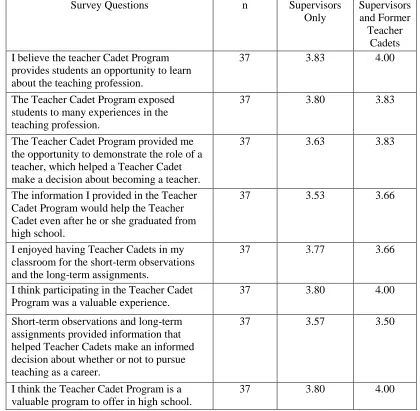
2 Likert Scale Means and Percentages from Supervisor Only Survey Questions...70
3 Likert Scale Means and Percentages from Supervisors Who Were Former
Teacher Cadets Survey Questions……….…74
CHAPTER 1
INTRODUCTION
Throughout the country, colleges and universities have searched for answers to the
current dilemmas facing the recruitment of future teachers and the effectiveness of
teacher preparation to ensure a high quality workforce of educators who choose to stay in
the field. Recruitment programs have worked to attract candidates who want to become
teachers and are prepared for the rigors of the profession (Byrd, 2002; Lewis, 1992;
McCaw, Freeman & Philhower, 2002; Schmitz, Nourse, & Ross, 2012; Swanson, 2011),
while schools of education have restructured programs to make the curriculum more
relevant hoping such transformations will improve teacher preparation (American
Association of Colleges for Teacher Education [AACTE], 2010; Grossman, 2010;
Hovland & Chandler, 2008; The National Council for Accreditation of Teacher
Education [NCATE], 2010). Specifically, reform in teacher education has recently
emphasized the importance of recruiting dedicated young people and providing them
with clinical preparation consisting of opportunities for early and sustained hands-on
experiences in classroom (AACTE, 2010; Grossman, 2010; Hovland & Chandler, 2008;
NCATE, 2010). Within this context, certain teacher recruitment programs provide early
exposure to the teaching profession in order to attract talented students into the field of
education. The Teacher Cadet Program, developed in 1985 for high school students, is
one model, which takes this approach. Using this premise, teacher effectiveness connects
to both teacher preparation and the recruitment of candidates who understand the field
Haselkorn, 2009; Johnson & Birkeland, 2003; Liu, Johnson, & Peske, 2004); therefore,
this inquiry focuses on exploring stakeholders’ perspectives in one Teacher Cadet
Program. Teacher preparation begun as early as high school immerses students into the
field of teaching and provides them with vital clinical experiences that will help shape
their ideas about teaching. The intent of this research was to understand the perspectives
of stakeholders in the Teacher Cadet Program with the hope of revealing the value of the
program and to possibly identify effective elements to incorporate into teacher
preparation programs. Research on the early field experiences of the Teacher Cadet
Program could also potentially add to the body of literature on clinical teacher
preparation. Therefore, the purpose of this study was to investigate the perspectives of
stakeholders in the Teacher Cadet Program on program participants and describe whether
stakeholders felt that providing preservice teachers with early clinical experiences during
their high school years presented a viable addition to teacher preparation programs.
Background of the Problem
After working as the Teacher Cadet Program facilitator at a rural high school in
the North Georgia area, the idea of conducting research about the experiences of
participants in the program became intriguing. This high school began a Teacher Cadet
program in the 1996-1997 school year. The Teacher Cadet Program (TCP) consisted of a
two-year curriculum developed under an articulation agreement with local universities.
According to the agreement, first-year participants received classroom instruction using
materials similar to those used by college professors in Introduction to Education courses.
Participants also served as student interns with field experiences, which included
consisted of placement in the Teacher Apprenticeship class and the completion of a
one-year internship with a teacher of the student’s choice.
While facilitating the Teacher Cadet Program for ten years, it was apparent that the
program affected participants. Some students knew immediately that they did not want a
career in education and transferred into other electives at the end of the first semester.
Other students seemed to develop a drive to teach, which often resulted in volunteer
opportunities while they were high school students and beyond. An extension of this
occurred when participants in the program left for college only to return to the district as
educators once they received their initial teacher certification. Over the years, I presumed
that the Teacher Cadet Program influenced participants, but I was not aware of research,
which conducted in that area. In the following section, I will describe what I was
subsequently able to find in the literature with regard to that program.
In beginning to investigate the Teacher Cadet Program, it became evident that little
information existed on the TCP except for general program descriptions and suggestions
for implementation. I inquired into current research on the Teacher Cadet Program
through the Georgia Department of Education. This department assigned individuals to
act as liaisons to TCP program coordinators throughout the state. In an e-mail
conversation with the state liaison, (personal communication, February 22, 2007) she
noted numerous educators in Georgia with valuable experience in the Teacher Cadet
Program who would prove to be excellent contacts, but the liaison had no knowledge of
any studies that had been conducted since the implementation of the Teacher Cadet
Program in Georgia schools. A similar conversation occurred with the liaison for the
indicated that he and a Family and Consumer Science Specialist, were working together
to revise curriculum for Georgia Teacher Cadet Programs. The Work-Based Learning
Specialist had no knowledge of educational research in the vocational field directly tied
to the Teacher Cadet Program. With the Teacher Cadet contacts at the Georgia
Department of Education exhausted, the next focus targeted resources outside of Georgia.
The Teacher Cadet Program began during 1985-1986 in South Carolina with a pilot
that consisted of four high schools. Later, the North Carolina Association of Educators
trained 150 teachers or contacts; approximately 125 sites representing 55 counties
(NCAE, 2011). Following the lead of South Carolina and North Carolina, Georgia
created a similar program and placed it under the auspices of Teacher Apprenticeship,
part of the work-based learning initiative. According to Standards and Guidelines for
Work-Based Learning Programs in Georgia, work-based learning programs include three
components: (1) school-based learning with classroom instruction in both academic and
occupational areas, (2) work-based learning with structured work, and (3) connecting or
career development activities (Georgia Department of Education, 2005, p. 1-2). Although
established in 2005, these guidelines are still true today. The Teacher Cadet Program
satisfied each of the three components through academic classroom instruction and
clinical experiences in a classroom setting that connected to career development.
Investigating the literature about the Teacher Cadet Program revealed general
program information and suggestions for implementation based upon the South Carolina
program (South Carolina Center for Education, Recruitment, and Advancement, 2003).
Further research revealed that other states have also implemented similar programs. In
Ten years later, the number of states that offered Teacher Cadet Programs grounded in
the framework established by the South Carolina program had grown to include 33 states
(South Carolina Center for Educator Recruitment, Retention, and Advancement, 2013).
The website for South Carolina Center for Educator Recruitment, Retention, and
Advancement also known as CERRA, provided real-time data gathered from the
2011-2012 Teacher Cadets in South Carolina. As students completed the Teacher Cadet
Student Pre-Survey for the 2012-2013 school year, data updated automatically. In
January 2013, the website data indicated 178 schools were involved in the Teacher Cadet
Program, and 2,192 students had completed the survey. The ethnicity breakdowns of
participants were 66.8% White, 25.4 Black or African-American, 2.8% Hispanic, 2.7%
other, 1.8% Asian, and .5% American Indian or Alaskan Native. Further data gathered
from the survey questioned students about their future goals. The survey indicated that
36.7% of the participants planned to pursue a career in teaching, 18% planned to pursue
medicine, 19.2% other, 12.0% undecided, 5.6% Business Management, 4.3% Allied
Health, and 4.2% Engineering (South Carolina Center for Educator Recruitment,
Retention, and Advancement, 2013).
References to the Teacher Cadet Program noted in various education journals
emphasize how the program can result in growing your own teachers or, in other words,
discussions of the Teacher Cadet Program as a vehicle for recruitment. Several of these
journal entries are explored below. Georgia’s Grow-Your-Own Teacher Programs
Attract the Right Stuff (Swanson, 2011) discusses a variety of programs such as Future
Educators of America, a student organization that has collaborated with Phi Delta Kappa,
programs discusses providing important opportunities for students to explore careers in
education.
Byrd (2002) writes about the Teacher Cadet Program as a survey course that could
provide an opportunity for teachers to use a taxonomy as a framework for developing
instructional units. Byrd encourages teachers of the Teacher Cadet program and Teacher
Cadet students to apply the taxonomy discussed in the article as a means to model,
examine, analyze, and reflect upon various approaches to teaching. The article was
informative but not a research study.
Other articles also provide descriptive overviews and recommendations for Teacher
Cadet Programs. For instance, Lewis (1992) provides information about the Teacher
Cadet Program origination and describes it as a means for recruiting students into
teaching. Lewis explains how the program developed as an educational reform of the
1980s and continues to attract top students into the field of education. Aspects of the
article discuss university partnerships, networking within the state, and curriculum.
Although not a research study, the article does highlight positive aspects of the Teacher
Cadet Program such as obvious program effects and the inroads the program is making
into minority recruitment.
The use of such programs to recruit minorities occurs in another teacher-training
program similar to the Teacher Cadet Program, The Crenshaw Training Academy in Los
Angeles, California (Mitchell, 1988). Addressing more than just teacher preparation at
the high school level, The Crenshaw Training Academy has developed a teacher
education program for minorities that specifically addresses the recruitment of
listed general information about the Teacher Training Magnet school on its website citing
the program as a Los Angeles Unified School District program designed to help prepare
high school students for a career in teaching. The website describes Crenshaw High
School as an ideal location for a teacher-training program since it is central to four
universities that work closely with students. According to Mitchell (1988), those
universities include UCLA, USC California State University, Los Angeles and
Immaculate Heart College. Similarly, another grow-your-own program mentioned in the
Mitchell (1988) article refers to the Central Washington University and Renton School
District Future Teacher Academy (FTA). The FTA began in 2009 to address the
increasing gap between the number of minority teacher candidates and minority students
in the Renton School District. The purpose of the program was to introduce minority high
school students to teaching careers. The program creators measured success of the
program by the number of students who graduate from high school and matriculate to a
community college or four-year university (Schmitz, Nourse, & Ross, 2012). Again,
although the descriptions of these programs were informative, research on the
participants’ perspectives on the programs or the value of the programs was not evident.
Finally, the Illinois Institute for Rural Affairs publishes the Rural Research Report
in collaboration with Western Illinois University. McCaw, Freeman, and Philhower,
(2002) discuss the Teacher Cadet Program in the context of rural education and provide
suggestions for growing your own teachers. The publication mentioned the South
Carolina Teacher Cadet program and referred to other programs that focused on
recruiting high school students into the field of teaching. Although this edition referenced
not a research study.
While the use of Teacher Cadet Programs have grown since the creation of the
program in 1985, literature about the Teacher Cadet Program has revealed no
research-based information indicating how exposure in clinical settings during high school
influenced participants. Therefore, I decided there was a need to investigate in what ways
the Teacher Cadet Program influenced participants because there was a gap in the
knowledge base.
A Statement of the Problem
The Teacher Cadet Program provides high school students, who have an interest in
the teaching profession, an opportunity to study introductory education concepts and
participate in numerous field experiences in K-8 classrooms. The intent is to enable
prospective teachers to have opportunities to explore the field of education through
hands-on interaction in real-life classrooms. The importance of rich, field-based
experiences as a vital element in teacher preparation has become an increasingly
important topic in teacher preparation across the country. Both educators and
nonprofessionals interested in the reform of teacher education emphasize the critical
importance of the clinical aspect of teacher preparation. The importance of this issue to
the public appears as articles in magazines and newspapers tout the benefits of clinical
preparation for preservice teachers. For instance, The Washington Post published an
article in November 2010 discussing proposed changes in teacher preparation at the
collegiate level. The article emphasized that teachers, like doctors, should receive their
training through clinical practice. In November 2010, NCATE released a report of the
panel determined that the nation must reform teacher preparation programs and place an
emphasis on clinical practice. The report called for five initiatives that will be the
foundation of the reform. These initiatives included 1) more rigorous accountability 2)
strengthening candidate selection and placement 3) revamping curricula, incentives, and
staffing 4) supporting partnerships and 5) expanding the knowledge base to identify what
works and support continuous improvement. At the release of the report findings, eight
states, which include California, Colorado, Louisiana, Maryland, New York, Ohio,
Oregon, and Tennessee, had signed letters of intent to implement the new agenda
(NCATE, 2010). Also in 2010, the American Association of Colleges for Teacher
Education (AACTE) released a policy brief that detailed the need for clinical preparation
of teachers. The policy brief discussed changes in teacher preparation, offered evidence
of the importance of strong clinical preparation, and described an effective clinical
preparation program (AACTE, 2010).
Another report commissioned by the National Education Association Center for
Teacher Quality (2009) also focused on the clinical experience of teacher preparation.
The report consisted of findings based on a review of historical documents, websites, and
interviews from 12 pre-collegiate teacher recruitment programs. One of the programs
reviewed is the South Carolina Teacher Cadet Program. The report was quick to indicate
that although many of the 12 programs, including South Carolina’s Teacher Cadets, have
been in existence for several decades, few have the necessary funding or data collection
required to formally review the program (National Education Association Department of
As shown in these recent documents, teacher education literature currently stresses
the importance of reforming teacher preparation through attention to field experience and
clinical practice. An examination of this literature reveals three important themes: (a) the
importance of connecting theory with clinical practice, (b) the intersections of field
experiences and the resulting teacher quality and effectiveness, and (c) an emphasis on
early field experiences with diverse learners as a way to recruit for teacher for diverse
classrooms. Of these, the most prevalent topic in the literature seems to be the importance
of connecting theory with clinical practice. Between 2008 and 2012, numerous studies
appeared in education journals about clinical practice (Hudson, 2012; Lingam, 2012;
Sandoval-Lucero et al., 2011; Stronge, Ward, and Grant, 2011; Zeichner, 2010). During
that time, reports released by NCATE and AACTE also concentrated on the importance
of clinical preparation. Both policy briefs recommend a shift from the focus on course
work to practical hands-on experiences (AACTE, 2010; NCATE, 2010).
Hudson (2012) studied ten first-year teachers to determine how universities can
better support their needs. Findings indicated that the beginning teachers believed their
university course work needed to provide practical training in combination with theory.
The teachers discussed the need for having hands-on experiences concerning setting up a
classroom, managing student behavior, and parent communications. In scholarship
exploring the boundaries between collegiate course work and field placement in K-12
schools. Zeichner (2010) argues for a new approach to teacher preparation where
academic course work is no longer the primary source of knowledge, and field
placements receive equal priority. Zeichner contends that the revised approach will better
The impact of rich clinical experiences on teacher quality and effectiveness is
another theme relevant in current literature. Sandoval-Lucero et al. (2011) studied the
relationship between the pathways teachers choose to prepare for a career in teaching and
their preparedness and intention to remain in teaching. Participants in the study
experienced one of three pathways to teaching: traditional, professional development
school, or teacher-in-residence. Regardless of the pathway, participants agreed that their
most vital preparation came from being in the classroom setting and the relationships
they established with other educators in that setting. Stronge, Ward, and Grant (2011)
conclude that, “The common denominator in school improvement and student success is
the teacher” (p. 351). Another article stressing the importance of teacher quality and
effectiveness describes a study of beginning teachers’ perceptions of their training
program. The study reveals that the success and failure of education centers on the
classroom teacher. Again, the researchers conclude that the competence of teachers
depends primarily upon the quality of their teacher preparation program, and the way
theory merges with application (Lingam, 2012).
Recruitment for a diverse teacher workforce, which may refer to diversity as a
cultural aspect or a specific discipline, appears an additional underlying idea in much of
the current literature examining effective and early field-based opportunities. Gomez,
Strage, Knustson-Miller, and Garcia-Nevarez (2009) concentrate on placement in early
field experiences with culturally and linguistically diverse students. The research findings
indicate that early field experiences are significant in helping teachers examine their
desires to teach. These experiences can help candidates explore and clarify goals by
researchers caution that one should thoughtfully consider early field experiences because
placement can lead to outcomes that may or may not be the initial goal of the experience
(Gomez et al., 2009).
Miksza and Austin (2010) investigated a pre-collegiate music teacher initiative that
interviewed 11 high school students who served as sectional coaches during a 12-week
middle school band program. The early field experience provided opportunities for high
school students to serve in supervised teaching assignments. The research findings
conclude that eight of the 11 students actively pursued admission into music education
programs indicating that the early field experience had a positive influence on student
participants. In another study focusing on high school programs, Zascavage, Winterman,
Armstrong, and Schroeder-Steward (2008) examine the relationship between high school
students who participated in support groups for students with special needs and
recruitment of these students as future special educators. The findings of the study
indicate that using this approach is a cost effective and pro-active means for addressing
teacher recruitment in special education through early field experience.
Although the research such as studies mentioned above addresses the importance of
early field experiences in helping future educators make connections between theory and
practice, in contributing the quality and effectiveness of teachers, and in recruiting
teachers to work with diverse students and across diverse fields, none of the research
discusses such experiences within Teacher Cadet Programs. The attention to the
importance of clinical experiences within the current conversations on teacher education
reform, combined with a lack of research on the Teacher Cadet Program in particular,
Purpose of the Study
Although numerous high schools implement the Teacher Cadet Program, no one
has researched the influence of the program on stakeholders. This circumstance creates a
situation that deserves further investigation. If the goal of a teacher preparation program
is to prepare educators who are committed to the profession, it would seem logical to
identify those interested in teaching at an early age, expose them to clinical experiences,
and present opportunities for them to explore aspects of the teaching profession.
According to information about the design of the Teacher Cadet Program, this occurs, but
research is needed which explores how the educational experiences within this program
affect stakeholder perspectives participants.
In addition to providing important information on the Teacher Cadet Program
specifically, this study will also fill a gap in the literature by providing important
information on the perceived importance of early field experiences as a valuable element
of the clinical preparation of teachers. Thus far, the influence on high school students
who have participated in Teacher Cadet Program clinical experiences has not been
researched in teacher education literature. If students are intrigued with the idea of
teaching, early exposure could provide them with a means to determine if the field of
education was a possible career option for them. Furthermore, early exposure might
increase retention rates in the field because students who entered a collegiate education
program would do so having had previous educational experiences through the Teacher
Cadet Program. Students who participate in early field experiences may possess a
personal understanding of the various aspects of teaching and consequently may enter a
simply supposition because researchers have not conducted studies into the affects of
early field experiences, which occur in the high school years of the future preservice
candidates.
Although the Teacher Cadet Program has become a popular introductory experience
for future educators across the country, there is a lack of research on the perspectives of
stakeholders and how they perceive its importance. At the same time, while reform in
teacher education has called for increased attention to the clinical preparation of teachers,
little attention has been given to the value of early field experiences provided in programs
such as the Teacher Cadet Program. Therefore, the purpose of this study was to explore
the perspectives of stakeholders in the Teacher Cadet Program and to explore
stakeholders’ perspectives of the value of the early field experiences provided in the
program. The following questions guided the research investigation:
1. What are the stakeholders’ perspectives of the structure and the experiences
offered in a Teacher Cadet program?
2. What value do stakeholders see in those experiences?
3. In what ways do current and former Teacher Cadets feel their subsequent
career or college plans and experiences were affected by their participation?
Methodology
The research design was a qualitative study focusing on participants’ experiences in
a specific Teacher Cadet Program offered at a secondary school in North Georgia.
Purposive sampling procedures were used to identify research participants. Specifically,
participants were comprised of current students, graduates of the program, and
program participants gathered through focus groups and interviews. Secondary data
sources used during the research study include a questionnaire designed to aid in the
selection of key informants. The procedures followed to collect data included an initial
meeting used to explain the context of the study and provide an opportunity for potential
participants to complete consent forms and a survey. Stakeholders wrote their names on
the survey making division into focus groups easier. The focus groups met to discuss the
results of the survey and to respond to specific interview questions. As needed, members
of the focus group participated in member checks in order to provide more information or
to clarify previous statements.
Data analysis occurred through thematic analysis. Coding and category systems
assist the process of inductive analysis to elicit emerging themes (Krathwohl, 1998).
Using suggestions from Charmaz (2006), codes were used to analyze data with key
concepts sorted into categories and subcategories. Using an Excel spreadsheet, I created
nine worksheets within the database to organize participant data. On the theme analysis
sheet, I color-coded data into three distinct categories. Identifying characteristics were
removed from all participant data sources. I assigned all participants a pseudonym to
protect the identities of the education agency and study participants. I housed research
documentation collected from study participants in a locked cabinet whenever not in use.
I analyzed data collected during the study as soon as possible after collection, beginning
with the initial surveys. The on-going analysis guided subsequent data collection.
Definition of Terms
Terms that will appear in this study, which may be unfamiliar are listed next with
Teacher Cadet Program: Teacher Cadet Program refers to a specific two-year
program of study offered to high school students. During the first year, students
enroll in two courses: Examining the Teaching Profession (1st semester) and
Contemporary Issues in Education (2nd semester). The second year of the
program consists of an internship called Teaching as a Profession Internship
(Georgia Department of Education, 2013b).
Articulation agreement: Articulation agreement refers to an agreement between
a high school and a postsecondary institution regarding the awarding of both
secondary and postsecondary credit for a dual enrollment course (Georgia
Department of Education, 2013a).
Significance of the Study
With so much interest in placing Teacher Cadet Programs at the high school level, it
is curious that researchers have not investigated the affect of the TCP on stakeholders.
Why has this program been implemented into numerous high schools without research
into stakeholders’ perceptions concerning the value of the program? Greater
understanding of the affect of the TCP on participants could help inform school systems
in making decisions regarding whether such programs should be included in course
offerings. The research would be beneficial to states in times of budget crunches because
it would provide data about the viability of the program and if school resources were
being used efficiently. If as Swanson (2011) stated, “teachers tend to return to the area in
which they were raised” (p. 119), then the conclusions drawn from a research study about
the perspectives of stakeholders in the Teacher Cadet Program could reveal implications
information could promote an atmosphere of collaboration with local universities and
colleges encouraging a partnership that would be beneficial to both groups. Nationally,
findings from a research study about the perspectives of stakeholders in the Teacher
Cadet Program may provide insights for recruiting teachers in difficult to staff schools
and attracting a diversity of individuals into the field of teaching.
Summary
Chapter 1 introduced the need to conduct a research study on the perceptions
concerning the Teacher Cadet Program. In this chapter, I presented the background of the
problem, which indicates a gap in the knowledge concerning how the Teacher Cadet
Program affects program participants. Numerous studies do exist, examining clinical
experiences within teacher preparation programs, and many recommend changes in the
existing format for training preservice teachers. Although research supports the notion
that teacher preparation programs should include more opportunities for clinical practice,
none of the existing studies provides information about the clinical aspects of the Teacher
Cadet Program.
The next chapter presents a review of the related literature. The chapter begins with
an exploration of the teacher recruitment literature as it relates the identification of
potential teachers and growing-your-own. The following section of this review provides
background information on the Teacher Cadet Program, its South Carolina origination,
and its evolution in states like North Carolina and Georgia. Finally, a review of current
research related to teacher preparation precedes a section of literature focused on the
importance of field and clinical experiences connected to theory, teacher quality, and
CHAPTER 2
LITERATURE REVIEW
In this chapter, I review relevant literature related to the Teacher Cadet Program.
The chapter begins with an exploration of teacher recruitment literature as it relates to the
identification of potential teachers and growing-your-own. Next, literature directly
related to the Teacher Cadet Program (TCP), its origination in South Carolina, and its
evolution in states like North Carolina and Georgia follows. A discussion of current
research related to teacher preparation follows. Finally, I discuss current research related
to the importance of field and clinical experiences in teacher preparation as it connects to
theory, teacher quality, and effectiveness. The chapter summary serves to provide a
synopsis of the literature as it pertained to the study.
Teacher Recruitment
In teacher recruitment, one of the first steps is to identify the pool of potential
teachers who would be willing and qualified to teach. Numerous programs have
developed since the prediction of a teacher shortage for 2000-2010 (Darling-Hammond &
Berry, 1999; U.S. Department of Education, 2000). Unforeseen economic conditions
postponed the predicted shortage, but educators hired in the late 1970s and early 1980s
who have postponed retirement will ultimately retire and fulfill the teacher shortage
prophecy. Their retirement will add to the attrition rate and create a need for newly
prepared teachers. Arne Duncan (2010a) addressed a group of prospective teachers at the
2010 Future Educator’s Association National Conference in San Antonio, Texas. In the
speech, Duncan told students, “We anticipate over the next five to eight years needing as
between 100,000 moving up to 200,000 teachers across the country…” Duncan (2010a)
ended the address telling students that, “this is a huge opportunity, particularly in a tough
economy, to come in and make a difference. This is really a call to service.” In “Bridging
the Generation Gap,” Johnson and Kardos (2005) referenced the same generational shift.
For the first time since the late 1960s and early 1970s, the proportion of new teachers in
the teaching force is growing as the first generation of career teachers has reached
retirement. Although economic downturns have extended the retirement age of some
educators, the generational shift is beginning to occur.
Identifying Potential Teachers
Quezada, Galbo, Russ, and Vang (1996) analyzed teacher recruitment efforts
focusing on K-12 students using a survey to identify the quantity and quality of teacher
recruitment programs designed as early outreach initiatives. The study surveyed 380
K-12 schools within the service area of a university in north central California. According to
the research findings, few steps have been taken to identify potential teachers at an early
age. Research recommendations included (a) Teachers must promote positive aspects of
the teaching profession; (b) Teacher education programs should incorporate teacher
recruitment models for K-12 students into preservice and in-service teacher education;
and (c) Student teachers are an untapped resource for becoming active role models in
developing future teachers. This research study addressed the need for early identification
of educators, but it did not refer to the Teacher Cadet Program or the influence of such a
program on participants.
In a literature review, not a research study, Darling-Hammond and Berry (1999)
Teacher Cadet Program is mentioned as well as other programs such as North Carolina
Teaching Fellows, Teach Boston, and the Summerbridge National Project, which also
utilized early identification of potential teachers. The review revealed that the evaluations
of the Teacher Cadet Program focused primarily upon the degree to which the program
has influenced the participants’ career decisions, not the influence of the program on the
participants or their perspectives as proposed in this study. Another important aspect of
the Darling-Hammond review specified that teachers are the individuals who most often
influence students to consider a career in teaching, which was echoed in additional
literature (Darling-Hammond & Berry, 1999; Galbo, Demetrulius, & Crippen, Spring,
1990; Lortie, 1975; Metlife, 2006; Page & Page, 1984).
Growing-Your-Own
“Growing-your-Own” is a phrase used to describe programs that address teacher
recruitment through efforts to identify and prepare potential teachers within a given
community (Lemke, 1994). It is a term that appeared throughout the literature reviewed
for this study. The premise by Grant (2001) that “you cannot reap what you have not
sown” may be Biblical, but it describes the necessity of early identification and
preparation of potential teachers. Although the South Carolina Teacher Cadet Program is
one of the first programs to embrace this philosophy, other programs exist that adhere to
the same ideas. A report submitted by National Commission on Teaching and America’s
Future (1996) discussed effective high school recruitment programs, some of which
concentrated on minority teacher recruitment such as the Bridge Program from Kean
College, California State University’s Saturday program, Calvin Coolidge High School,
Illinois. Chicago teachers who had received the Golden Apple Award for excellence in
teaching recruited high school students during their junior year of high school. The
Golden Apple recipients mentored the students through the rest of high school, into the
college years, and through five years of actual teaching. The 1996 program boasted a 90
percent retention rate; the minority retention rate was 80 percent. The program is now
statewide and involves 22 private and public campuses.
In a separate literature review of successful minority programs, Kauffman (1988)
also references the Bridge Program from Kean College, California State University’s
Saturday program, Calvin Coolidge High School, and Crenshaw Academy. Both the
report and the literature review reflected information about the need for minority teacher
recruitment and the importance of growing your own teachers.
Programs such as Future Educators of America, Pathways to Teaching Careers,
Teacher Cadets and Troops to Teacher provide opportunities for students to explore
careers in education through grow-your-own type initiatives (Swanson, 2011). Swanson’s
research examines these types of program through the lens of Holland’s Self-Directed
Search inventory. The purpose of the research was to identify the personality profile of
students in Future Educator of America programs in Georgia using Holland’s inventory.
The study focused on examining the personality profile of FEA students in Georgia to
determine if their profile corresponded with the personality profile of in-service
educators. The findings from the research study indicate that Georgia’s FEA members
share the same Holland code as teachers who were currently working in schools. These
findings support that grow-your-own teacher programs attract individuals who have a
Project Nueva Generación is another type of grow-your-own recruitment program.
Skinner (2010) describes a nine-year-old partnership between a community-based
organization and a teacher education program, which resulted from the need to connect
teacher candidates with urban communities hence growing their own teachers. In 2006,
Project Nueva Generación graduated two students who accepted jobs with the Chicago
Public Schools. As of May 2009, nine students were graduates of the program, and 55
students were in the pipeline to graduate. Although not a research study, the article
describes the importance of grow-your-own programs related to the recruitment and
retention of teachers. The article focused on the importance of partnerships between
Logan Square neighborhood schools, the Bilingual Education Program at Chicago State
University, and minority students within the teacher education program.
North Carolina Teaching Fellows (2011) was created to reverse the decline in North
Carolina high school students entering collegiate teaching programs. North Carolina
Teaching Fellows Program has been touted as one of the most ambitious statewide
recruitment programs. According to data on the website, there were Teaching Fellows in
99 of 100 public school systems in North Carolina. The North Carolina Teaching Fellows
provides $6,500 yearly scholarship to outstanding high school seniors who agree to teach
four years in one of North Carolina’s public schools or government schools upon
graduating from college. The Teaching Fellows program is sequential beginning in the
freshman year. Structured observations and tutoring are part of the field experiences. The
program provides pre-student teaching experiences in the same school until graduation.
“This continuity and sequence provides public school experiences that foster a greater
Teaching Fellows Program, 2011, p. 2). The information recorded from this selection is a
program description not a research study, but it does describe the importance of growing
your own teachers, which is at center of the Teacher Cadet program researched in this
study.
In a program evaluation of the North Carolina Teaching Fellows Program, Henry,
Bastian, and Smith (2013) noted participants from this program (a) have significantly
higher academic qualifications; (b) teach in schools and classrooms with greater
concentrations of higher performing and lower poverty students; (c) produce larger
increases in student test scores in all high school exams and in 3rd-8th grade mathematics
exams; and (d) remain in North Carolina public schools longer than other teachers. The
researchers summarized their findings stating that the Teaching Fellows Program has had
a positive effect on education in North Carolina, but program evaluation should occur
every four years to determine the extent to which the above statements remain true. This
policy brief supported the same concepts about the importance of growing your own
teachers as seen in previously reviewed literature within this chapter.
Teacher Cadet Program
In the early eighties, Ernest Boyer (1983) published a report called High School,
which addressed the declining number of South Carolina students who were entering
education programs in college. Boyer felt that it was too late to approach university
students about entering education as a career. Instead, he recommended establishing a
cadet-teaching program in South Carolina high schools, which would provide educational
teachers. Four sites were chosen to pilot a course that was called Teacher Cadets because
of Dr. Boyer’s recommendation in High School (1983).
Lewis (1992) provides information about the Teacher Cadet Program origination
and describes it as a means for recruiting students into teaching. Lewis explains how the
program developed as an educational reform of the 1980s and continues to attract top
students into the field of education. Aspects of the article discuss university partnerships,
networking within the state, and curriculum. The article is not a research study; however,
it does highlight positive aspects of the Teacher Cadet Program such as obvious program
effects on recruitment and the inroads the program is making into minority recruitment.
Over the last two decades, Teacher Cadet programs have spread across states as a
way to attract individuals into considering a career in education. The South Carolina
Center for Teacher Recruitment (SCCTR) website (2010) emphasizes the Teacher Cadet
Program is a teacher recruitment program for high school students. The website listed
eighteen states that have a type of cadet-teaching program patterned after the program
that began at Conway High School in Horry County, South Carolina. According to the
website, the Teacher Cadet Program now included 149 high schools, and it served over
2,500 high school juniors and seniors yearly.
The Center for Educator Recruitment, Retention, and Advancement (2010) or
CERRA provided information on how to start a Teacher Cadet Program, scholarships,
general resources, instructor information, and curriculum. The 2009-2010 Teacher Cadet
Data indicated that the Teacher Cadet Program has grown from the original four pilot
schools to include 170 high schools reflecting a Teacher Cadet course offering in 75% of
45,000 students have participated in TCP. According to the website, one student from
every five students who participated in the TCP has earned a South Carolina teaching
certificate, and in 2008-2009, 4,043 teachers employed by South Carolina public schools
were former Teacher Cadet Program participants.
The North Carolina Association of Educators or NCAE (2011) is a website that
provides information about the Teacher Cadet Program in North Carolina. Through a site
license and a contract with South Carolina Center for Teacher Recruitment, NCAE has
permission to modify the Teacher Cadet curriculum to better meet the needs of the
students in North Carolina. The North Carolina Teacher Cadet Program receives funding
from the North Carolina General Assembly, and it is part of the North Carolina
Foundation of Public School Children.
According to NCAE (2011), the association considers the Teacher Cadet Program
as an introduction or orientation to the teaching profession. It views the program’s main
purpose as one of recruitment. NCAE encourages students who demonstrate high
academic ability and the appropriate personality traits found in good teachers to pursue
education as a career. The website documents the impact of the Teacher Cadet program
on its participants statistically through increasing SAT scores, larger numbers of students
pursuing education as a career, and a developing community of teachers, students, and
colleges. Students enrolled in the North Carolina Teacher Cadet Program must be rising
seniors with a GPA of 3.0 on a four-point scale.
After the initial introduction of the program to Georgia public schools in 1990,
additional program implementations followed in several counties in 1996, 1998, and
conversation with the former State Coordinator for Georgia Youth Apprenticeship
Program (personal communication, February 22, 2007) reported that in 2006, roughly
700 students were involved in the teacher apprenticeship program throughout the state in.
Approximately 60 school systems with about 80 high schools participate in the program.
Organization of the Teacher Cadet Programs in Georgia uses the same structure and
curriculum found in South Carolina and North Carolina. The Teacher Cadet Program is a
learner-centered program. McCombs and Whisler (1997) define learner-centered
education as:
the perspective that couples a focus on individual learners (their
heredity, experiences, perspectives, backgrounds, talents, interests,
capacities, and needs) with a focus on learning (the best available
knowledge about learning and how it occurs and about teaching
practices that are most effective in promoting the highest levels of
motivation, learning, and achievement for all learners). (p.9)
The curriculum used in the course is Experiencing Education, 9th Edition written
and revised by South Carolina Teacher Cadet instructors. The curriculum is separates into
three themes, which focus on experiencing the learner, the profession, and the classroom
(Center for Educator Recruitment, Retention, and Advancement, 2010). Characteristic of
a learner-centered classroom, students explore a variety of educational topics in a safe
environment; the instructor is no longer the dominant figure in the classroom but a
facilitator. Students create meaning as they explore their own learning styles, seek new
information, and participate in meaningful experiences as they pursue knowledge through
preparation allows students to safely explore the field of teaching through the guidance of
a trained classroom teacher.
Teacher Preparation
Beginning as early as 1963, researchers were addressing the need for better teacher
preparation programs (Howard, 1963), and the call to improve teacher preparation is still
being heard today. Since the release of A Nation at Risk (National Commission On
Excellence in Education, 1983), which outlined the inconsistencies in American
education and called for innovations in recruiting the best and brightest candidates into
teaching, researchers have explored the relationship between teacher quality and
effectiveness. Many of these researchers believe that the most important variable in a
student’s educational success is the effectiveness of the teacher (Alliance for Excellent
Education, 2008; Ashby, 2002; Berry, 2010; Hammond, 2000;
Darling-Hammond & Berry, 1999; Darling-Darling-Hammond, Holtzman, Gatlin, & Heilig, 2005;
Duncan, 2010a; Duncan, 2010b; Ferguson, 1991; Glassberg, 1980; Massachusetts
Teachers Association, 2008; Williams, 2000). Since the goal of the Teacher Cadet
Program is to provide a means for introducing high school students into the field of
education, the emphasis is on the preparation of potential educators. The preparation one
receives directly effects if the candidate decides to teach, and if so, the teacher he or she
ultimately becomes. Shulman and Sykes (1983) describe the importance of teachers in
the reform of teacher education programs:
The teacher must remain the key…Debates over educational policy
are moot, if the primary agents of instruction are incapable of
them, no television system will clone and distribute them, no
scripted lessons will direct and control them, no voucher system
will by pass them. (p. 504)
The preparation one receives directly affects teacher quality. Effective teacher
preparation may determine if the candidate decides to teach, and if so, the teacher he or
she ultimately becomes. According to Bandura (1997), self-efficacy refers to a person’s
beliefs in his or her own abilities to complete a specific task, and it is the foundation for
career choices. People pursue careers because of the skills they possess and their
self-efficacy toward job performance. The relationship between teaching and self-self-efficacy
connects to teacher preparation. When an individual with the skill sets required for
teaching enters the profession, his or her success links to job performance. Occupational
success manifests in confidence. As the preservice teacher’s confidence improves, new
career opportunities are considered. Bandura (1997) indicated that individuals would
show a greater interest in their career choices and would perform better educationally in
their career preparation. He further explained that the individual would have a greater
staying power in his or her chosen profession.
Although complex factors influence career decisions, intrinsic factors are most
influential in determining if a person entered teaching or if a teacher stayed in teaching
(Bergsma & Chu, 1981; Harms & Knobloch, 2005; Kiggins, 2007). Lortie (1975)
identified five themes, which influence why people teach. Those themes included: 1) the
service theme, serving other people and making a difference in their lives; 2) the
interpersonal theme, working with individuals and making a difference in their lives; 3)
lives and education (a coach being involved in teaching people about sports, someone
who liked literature, teaching English, etc.) 4) the time compatibility theme, having a job
that is compatible with people’s needs or desires (having summer breaks to allow one to
travel, having a schedule that allows one the time to have a profession and also raise
children); and 5) the market benefit theme, making an income on which to live.
Researchers have explored two of the five themes, working with young people and
being of service, in numerous studies (Alexander, Chant & Cox, 1994; Harms &
Knobloch, 2005; Kiggins, 2007; Page & Page, 1984). Benefitting from the themes found
in Lortie’s 1975 work, Bernhardt (2010) further investigated why individuals enter the
teaching profession. The Bernhardt study investigated the commitment of two educators
to teaching. Although each educator remained deeply committed to the profession, the
study explored their devotion to the field and followed the diverse pathways they
traveled. One educator remained in a high school English classroom, yet the other
became a professor at a university. Both educators revealed that their goals in pursuing a
career in education revolved around positively influencing the lives of students, echoing
Lortie’s continuation theme.
This research emphasized reasons a person might choose to enter the teaching
profession. In discussing the Teacher Cadet Program with study participants, the themes
developed by Lortie were reoccurring in participant comments concerning the value they
placed on experiences in the Teacher Cadet program.
Improving Teacher Preparation
In 1998, Congress amended the Higher Education Act (HEA) to include improving
continue to restructure programs to improve teacher preparation (Ashby, 2002; Kennesaw
State University, 2010; North Georgia College and State University, 2009; North Georgia
College and State University, 2010; University System of Georgia, 2010), and state
organizations like GA P-16 have continued to upgrade the quality of teacher preparation
(Darling-Hammond, 2000). Ashby (2002) reported that many teacher preparation
programs leave teachers feeling unprepared; therefore, the quality of teacher training is
critical. Darling-Hammond (1996) and Lieberman and Miller (2000) view teaching as a
key in educational reform, which would require investments in stronger teacher
preparation programs.
According to the National Commission on Teaching and America’s Future (1996),
teacher expertise is the most important factor in student achievement. The report
discussed how quality teacher preparation equates to quality teaching and that fully
prepared teachers are more highly rated and more effective with students than those who
lack one or more of the elements of formal teacher education. National Commission on
Teaching and America’s Future (1996) and Darling-Hammond et al., (2005) assert that
immersion of potential teachers in the elements of formal teacher education, which
include subject matter preparation, knowledge about teaching and learning, and guided
clinical experience is critical. Furthermore, those teachers who are better prepared enter
and stay in teaching at higher rates (Darling-Hammond, 1992; Darling-Hammond, 1998;
Darling-Hammond & Berry, 1999; National Commission on Teaching and America's
Future, 1996). Johnson and Birkeland (2003) maintain that teachers would only stay in
teaching if they felt valued and successful. Data recovered from National Commission on
plans to stay in teaching. If the first-year teacher felt well prepared, he or she was more
likely to continue pursuing a career in teaching than those who felt poorly prepared.
Literature suggests emphasizing the role of clinical practice in teacher preparation.
Clinical Practice
The importance of rich, field-based experiences as an essential element in teacher
preparation has become an increasingly important topic throughout the country. Both
educators and nonprofessionals have emphasized the importance of the clinical aspect of
teacher preparation. Blue Ribbon Panels formed to explore the effectiveness of moving
toward a more clinical approach in preparing teachers while articles appear in magazines
and newspapers touting the benefits of a more clinical preparation for preservice teachers.
Between 2008 and 2012, numerous studies appeared in education journals about
clinical practice. During that time, reports released by NCATE and AACTE also
concentrated on the importance of clinical preparation. Both policy briefs recommended a
shift from the focus on course work to practical hands-on experiences (American
Association of Colleges for Teacher Education, 2010; The National Council for
Accreditation of Teacher Education, 2010). Literature on the importance of clinical
experience in teacher preparation focused on three themes: connecting theory with
clinical practice, teacher quality and effectiveness, and recruitment for teacher diversity.
The most prevalent topic in the literature as it related to the Teacher Cadet Program is
connecting theory with clinical practice.
Hovland and Chandler (2008) describe a jointly funded project through the South
Dakota Department of Education, Black Hills State University, and Spearfish School
opportunities for preservice and novice teachers to observe classroom teachers engaging
with their students through a one-way mirror system. The one-way mirrors installed on
the back walls of two elementary classrooms created an observation room positioned
between the two. This environment provided preservice and novice teachers the
opportunity to observe instructional delivery from veteran teachers and discuss the
decisions made, note evidence supporting those judgments, and relate those observations
to their own teaching. The project continues presently and is a different approach to
clinical preparation of teachers. This approach echoes the clinical practices supported in
the Teacher Cadet Program with the exception that the Cadet is actively engaged in the
classroom, not a passive observer like those in the Teacher Learning Center project.
A report commissioned by the National Education Association Center for Teacher
Quality focused on the clinical experience of teacher preparation. The report consists of
findings based on a review of historical documents, websites, and interviews from 12
pre-collegiate teacher recruitment programs. One of the programs reviewed is the South
Carolina Teacher Cadet Program. The report is quick to indicate that although many of
the 12 programs, including South Carolina’s Teacher Cadets, have been in existence for
several decades, few have the necessary funding or data collection required to formally
review the program (National Education Association Department of Teacher Quality,
2009). This report suggests the importance in further researching the perspectives of
stakeholders in the Teacher Cadet Program.
The article by Grossman et al (2009) describes the importance of clinical practice in
supporting the development of skilled practice in novice teachers. The authors
the courses work in conjunction not in isolation. The article argues for changes in the
traditional format of teacher education programs.
Lampert (2010) explores definitions of the word practice as it pertains to teaching.
The purpose of the essay is to present the various meanings of practice as it relates to
teaching and encourage readers to discuss how practice must look in learning how to
teach. Lampert contrasts practice with theory and considers the development of teaching
practices in novice teachers. The essay concludes by stressing that understanding the
work of teaching as it relates to practice will be challenging and requires collective
problem solving and the development of a common language.
Grossman (2010) addresses the design of clinical experience in teacher preparation.
In the policy brief, Grossman acknowledges that all teacher education programs provide
opportunities for clinical practice through field experiences, but the nature of those
experiences vary from program to program. Grossman examines elements of clinical
practice including records of practice such as videos or teacher logs, length of practice,
and quality of practice in regards to the supervising teacher and opportunities he or she
provides for the intern.
The Washington Post published an article in November 2010 discussing proposed
changes in teacher preparation at the collegiate level. The article emphasized that
teachers, like doctors, should receive their training through clinical practice. The article
based much of its information on the Blue Ribbon Panel report from The National
Council for Accreditation of Teacher Education (NCATE).
In November 2010, NCATE released a report of the Blue Ribbon Panel on clinical