ScholarWorks @ Georgia State University
ScholarWorks @ Georgia State University
Applied Linguistics and English as a Second
Language Dissertations Department of Applied Linguistics and English as a Second Language
Summer 5-7-2010
Cognitive Factors Contributing to Chinese EFL Learners’ L2
Cognitive Factors Contributing to Chinese EFL Learners’ L2
Writing Performance in Timed Essay Writing
Writing Performance in Timed Essay Writing
Yanbin Lu
Georgia State University
Follow this and additional works at: https://scholarworks.gsu.edu/alesl_diss
Recommended Citation Recommended Citation
Lu, Yanbin, "Cognitive Factors Contributing to Chinese EFL Learners’ L2 Writing Performance in Timed Essay Writing." Dissertation, Georgia State University, 2010.
https://scholarworks.gsu.edu/alesl_diss/13
L2 WRITING PERFORMANCE IN TIMED ESSAY WRITING
by
YANBIN LU
Under the Direction of Sara Weigle
ABSTRACT
This study investigated cognitive factors that might influence Chinese EFL learners’
argumentative essay writing in English. The factors that were explored included English (L2)
language proficiency, Chinese (L1) writing ability, genre knowledge, use of writing strategies,
and working memory capacity in L1 and L2. Data were collected from 136 university students
who received a battery of tests in two sessions. The tests consisted of timed essay writing tasks in
L1 and L2, post-writing questionnaires for genre knowledge and use of strategies in the writing
process, a timed grammaticality judgment task for L2 grammar knowledge, a receptive
vocabulary test and a controlled-production vocabulary test for L2 vocabulary knowledge, and
working memory span tasks in L1 and L2. Quantitative analyses using correlations,
strategies. L1 writing ability and working memory capacity have slight impact as explanatory
variables for L2 writing performance in the timed essay writing task.
INDEX WORDS: Cognitive factors, EFL learners, L2 writing, L1 writing, L2 language
COGNITIVE FACTORS CONTRIBUTING TO CHINESE EFL LEARNERS’
L2 WRITING PERFORMANCE IN TIMED ESSAY WRITING
by
YANBIN LU
A Dissertation Submitted in Partial Fulfillment of the Requirements for the Degree of
Doctor of Philosophy
in the College of Arts and Sciences
Georgia State University
Copyright by Yanbin Lu
L2 WRITING PERFORMANCE IN TIMED ESSAY WRITING
by
YANBIN LU
Committee Chair: Sara Weigle
Committee: Diane Belcher
Eric Friginal
Lucy Pickering
Electronic Version Approved:
Office of Graduate Studies
College of Arts and Sciences
Georgia State University
DEDICATION
ACKNOWLEDGEMENTS
I am deeply indebted to a great many individuals who have helped me during my doctoral
study. First of all, I would like to express my sincere gratitude to my advisor, Dr. Sara Weigle, for
her guidance, support, understanding, insights, patience, and encouragement in every step of my
dissertation journey. Without her and the enormous time and effort she put in, I would not have
accomplished this dissertation.
I am also grateful for having an exceptional doctoral committee and wish to thank Dr.
Diane Belcher, Dr. Eric Frignal, and Dr. Lucy Pickering for their comments and insights as well
as their encouragement and support despite their busy schedules. My gratitude also goes to Dr.
Gayle Nelson, who brought me into this wonderful community and provided continual
encouragement and support all along.
I am very appreciative to the Department of Applied Linguistics for providing me with
the financial support and opportunities to teach in the IEP as well as undergraduate programs.
Many thanks also go to the TOEFL Grants and Awards Committee at Educational Testing
Service and the Dissertation Grant Program at Georgia State University for providing grants to
support the completion my dissertation project.
I would like to thank my fellow doctoral students in the Applied Linguistics program,
especially Amanda Baker, Liang Guo, Jack Hardy, Eliana Hirano, Guiling Hu, Meg Montee,
Kate Moran, Joseph Lee, Man Li, Jason Litzenberg, Lauren Lukkarila, Caroline Payant, Pam
Pearson, Amanda Lanier Temples, Weiwei Yang, Lijuan Ye, Cheongmin Yook, and many others.
I enjoyed working together with them and will remember the wonderful times in the GTA room
and Man Li for their insightful discussions on my project as well as their continued
encouragement, emotional support, and sustained friendship.
I would also like to extend my heartfelt thanks to my colleagues and friends in Beijing,
especially Wenxia Zhang and Weimin Zhang, who helped me considerably during my data
collection, including recruiting participants and essay raters and arranging facilities for testing
sessions. I also wish to thank Yang Hu, Jiping Liang, Baoxia Liu, Ru Xing, Meilan Zhang,
Weimin Zhang, Zhipeng Zhang for rating all the essays.
Last but not least, I wish to express my special thanks to my family, to my mother and my
brother for their sincere support and encouragement all these years. I am especially indebted to
my husband, Huaming Wen, for his sustained love, understanding and faith in me as well as his
sacrificial support all these years, and to our daughter, Luou Wen, for being strong during the
times when I was away from her and for the joy and company she brought me during her two
years’ stay with me in Atlanta. We have lived on three continents during the six years of my
TABLE OF CONTENTS
ACKNOWLEDGEMENTS ... v
LIST OF TABLES ... x
LIST OF FIGURES ... xii
1 INTRODUCTION ... 1
1.1 Context of the Study ... 1
1.2 Research Questions ... 7
1.3 Significance of the Study ... 8
2 REVIEW OF REVELANT LITERATURE ... 11
2.1 Theoretical Frameworks in L2 Writing Research ... 11
2.2 Conceptions of Second Language Proficiency and Writing Expertise ... 17
2.3 Review of Relevant Studies ... 21
2.4 Summary ... 32
3 METHODOLOGIES AND MATERIALS ... 33
3.1 Participants ... 33
3.2 Instruments ... 34
3.2.1 Timed Essay Writing in L1 and L2 ... 35
3.2.2 Writing Strategies Questionnaire ... 36
3.2.3 Operation Span Tasks for Working Memory Capacity ... 39
3.2.4 Vocabulary Size Tests ... 42
3.2.5 Timed Grammaticality Judgment Task ... 43
3.4 Scoring ... 46
3.5 Statistical Analysis ... 52
4 RESULTS ... 55
4.1 Preliminary Data Analysis ... 55
4.1.1 Demographic Information of the Participants ... 55
4.1.2 Descriptive Statistics and Reliability of the Variables ... 57
4.1.3 Inter-rater Reliability ... 61
4.2 Exploratory Analyses of the Relationships among the Variables ... 62
4.2.1 Research Question 1: Relationship between Writing Ability and Workign Memory Capacity ... 62
4.2.2 Research Question 2: Relationship between L1, L2 Writing Ability And L2 Language Knowledge ... 63
4.2.3 Research Question 3: Relationship between L1, L2 Writing and The Use of Strategies ... 69
4.2.4 Research Question 4: Relative Importance of the Selected Variables to L2 Writing Performance... 76
5 DISCUSSION AND CONCLUSION ... 84
5.1 Summary of the Findings and Discussion ... 84
5.1.1 Research Question 1 ... 84
5.1.2 Research Question 2 ... 87
5.1.3 Research Question 3 ... 94
5.1.4 Research Question 4 ... 98
5.2 Implications ... 100
5.2 Limitations and Suggestions ... 102
REFERENCES ... 106
APPENDICES ... 119
Appendix A ESSAY WRITING PROMPTS ... 119
Appendix B QUESTIONNAIRES ... 120
Appendix C TASKS FOR WORKING MEMORY CAPACITY ... 129
Appendix D VOCABULARY SIZE TESTS ... 133
Appendix E MATERIAL FOR GRAMMATICALITY JUDGMENT TASK ... 144
Appendix F ESSAY RATING SCALES ... 146
Appendix G CORRELATIONS MATRIX ... 149
LIST OF TABLES
Table 3.1 Structure of the Writing Strategies Questionnaires ... 38
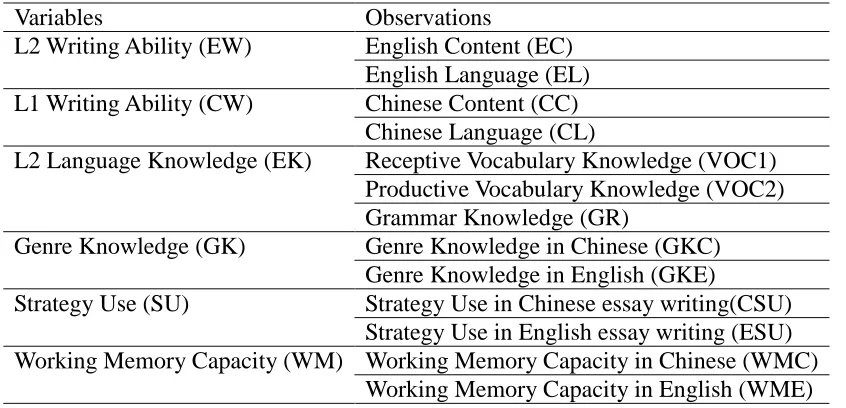
Table 3.2 Variables and Corresponding Observations ... 54
Table 4.1 Characteristics of the Participants ... 56
Table 4.2 Self-evaluation of English Proficiency Overall, English Writing Ability, and Chinese Writing Ability ... 57
Table 4.3 Self-report of Hours per Week Spent on English and Chinese Writing ... 57
Table 4.4 Descriptive Statistics of the Observed Variables ... 58
Table 4.5 Reliability and Item Statistics ... 59
Table 4.6 Reliability and Item Statistics of Measures after Adjustment ... 61
Table 4.7 Descriptive Statistics of Measures after Adjustment ... 61
Table 4.8 Inter-rater Reliabilities for Chinese Essay Ratings ... 62
Table 4.9 Inter-rater Reliabilities for English Essay Ratings ... 62
Table 4.10 Correlations between Working Memory Capacity and Writing Scores in L1 and L2 63 Table 4.11 Correlations between Content and Language Scores in L1 and L2 ... 64
Table 4.12 Crosstabulation of Chinese Writing Band and English Writing Band ... 65
Table 4.13 Descriptive Statistics of English Writing Scores across Chinese Writing Bands ... 66
Table 4.14 Relationship among EK, CW and EW across EK levels ... 67
Table 4.15 Correlations between Subscales for L2 writing and L2 language knowledge ... 68
Table 4.16 Regression Summary for GR, VOC1 and VOC2 Predicting EC and EL ... 68
Table 4.17 Correlations between Subscales for Strategy Use and Writing Performance ... 69
Table 4.19 Frequencies and Percentages of Yes-No Answers to Item #26 & #33 ... 72
Table 4.20 ItemsShowing Significant Differences in Chinese versus English Revision ... 73
Table 4.21 Use of L1 in L2 Essay Writing ... 74
Table 4.22 RotatedComponent Matrix for Revision Items... 75
Table 4.23 Correlationsbetween EC / EL and Revision Strategies ... 76
Table 4.24 Descriptive Statistics of the Latent Variables ... 78
Table 4.25 Pearson Correlation Coefficients of the Latent Variables ... 78
Table 4.26 Model Summary from Stepwise Multiple Regression ... 79
Table 4.27 Model Summary from Backward Multiple Regression ... 80
LIST OF FIGURES
Figure 2.1 Hayes-Flower (1980) writing model ... 12
Figure 2.2 Hayes (1996) writing model ... 14
Figure 2.3 Grabe and Kaplan’s (1996) model of writing... 15
Figure 2.4 Bachman & Palmer’s (1996) model of CLA ... 19
Figure 4.1 Contrast of Numbers of Yes/No Answers to Difficulty and Revision ... 72
Figure 4.2 Normal Probability Plot of Regression Standardized Residual ... 82
CHAPTER 1
INTRODUCTION
Context of the Study
Writing in one’s native language (L1) is a complex cognitive activity. The metaphor of a
writer as a busy switchboard operator trying to juggle a number of demands and constraints
(Flower & Hayes, 1980) vividly describes the dynamics of a writer in action. Writing in a
second/foreign language (L2) is even more demanding, more difficult, and less effective, due to
the additional constraints arising from the writer’s L2 proficiency (Silva, 1993). In the past
decades, research into L2 writing has flourished, yet most of the studies have focused on the
social/cultural or pedagogical aspects of writing. As Schoonen et al. (2009) noted, cognitively
oriented research on writing is a young but growing field, and a central issue is to define a
―blueprint of the writer‖ (p. 77), that is, what individual factors are involved in both L1 and L2
writing. This study aims at contributing to this growing area of research by exploring the
relationship among various factors involved in L2 writing from a cognitive perspective.
A number of studies have investigated explanatory variables for L2 writing in various
contexts (e.g., Cumming, 1989; Sasaki & Hirose, 1996; Schoonen et al., 2003, 2009; Yun, 2005),
and many researchers have proposed models of writing to illustrate the factors involved in
writing and their interplay in the writing process (e.g., Bereiter & Scadamalia, 1987; Hayes,
1996; Hayes & Flower, 1980 for L1 writing; Grabe & Kaplan, 1996; Sasaki, 2002 for L2 writing;
also see Shaw & Weir, 2007 and Weigle, 2002 for summaries of writing models). Cognitive
approaches to writing focus on the cognitive factors that are important for the individual writer in
developing writing expertise. In this study, four major factors were selected for investigation—
L1 writing ability, L2 language knowledge, use of writing strategies and working memory
Within the previous literature on L2 writing research, L1 writing ability and L2 language
proficiency are the two most frequently investigated variables. The influence of L1 writing on a
language learner’ L2 writing has been a primary concern since Kaplan’s (1966) seminal
exploration of the different rhetorical patterns of writings produced by culturally and
linguistically distinct groups of writers. Since then, a great number of studies have been carried
out. In terms of second language acquisition (SLA), the influence of L1 on L2 learning has been
considered negative transfer or interference; that is, the quality of L2 writing might be negatively
influenced by a learner’s L1 rhetoric patterns. However, according to Cummins’ (1979, 1981)
proposal of Interdependence Hypothesis, which postulates that there is a common underlying
proficiency in terms of one’s cognitive and linguistic abilities and that L1 background serves as
the basis for L2 learning, one might hypothesize that a learner’s L2 writing ability is dependent
upon his/her L1 writing ability.
Empirical studies on the role of L1 writing ability on a learner’s L2 writing have yielded
controversial results. Many studies (e.g., Cumming, 1989; Schoonen et al., 2003; Sasaki &
Hirose, 1996; Yun, 2005) have found evidence for the Interdependence Hypothesis, showing
varying degrees of contributions of L1 writing ability to L2 writing performance. Nevertheless,
contrary to those studies which found some sort of correlation between L1 and L2 writing, some
other studies (e.g., Carson, Carrell, Silberstein, Kroll, & Kuehn, 1990; Pennington & So, 1993)
did not find a clear relationship between L1 and L2 writing products in their investigations of L2
learners’ writing performance. Both Carson et al. (1990) and Pennington and So (1993) used
Chinese native speakers as their participants, which raised the question of whether such
controversial findings resulted from the differences among the participants’ L1 in different
A learner’s L2 language knowledge1
is another explanatory variable that has been widely
investigated with mixed results. For example, Cumming (1989) and Schoonen et al. (2003)
reported that for their participants (French and Dutch L1, respectively) L2 writing performance
was highly correlated with L1 writing ability, more than with their L2 linguistic knowledge. In
contrast, Sasaki and Hirose (1996) and Yun (2005) found that for their participants (Japanese and
Korean L1, respectively) L2 proficiency seemed to play a more important role than L1 writing
ability in L2 writing performance. Pennington and So (1993) also claimed that L2 proficiency
was a much better predictor than L1 writing ability for their Chinese L1 participants. Therefore,
additional empirical research is needed in order to elucidate the respective role of L1 writing
ability and L2 proficiency on a learner’s L2 writing performance.
A third frequently examined factor is the use of writing strategies in the process of
writing. Process-oriented studies on L2 writing have found that the quality of L2 writing is more
closely related to learners’ writing strategies rather than their L2 proficiency. These researchers
maintain that the determining factor of L2 writing quality is not the learners’ linguistic
competence, but their composing competence (see Krapels, 1990 and Roca de Larios, Murphy &
Marin, 2002, for critical reviews of studies on L2 writing process research). Composing
competence may not be the same as writing strategies, yet the effective use of writing strategies
is a good indicator of one’s composing competence. Studies into the writing process and writing
strategies have shown that skilled writers use different skills, behaviors and procedures from
unskilled writers (Roca de Larios et al., 2002). However, most of the studies into the writing
process and writing strategies used qualitative methods such as think-aloud or stimulated recall
for data elicitation and investigated small numbers of participants whose results were hardly
generalizable. Using questionnaires to measure writing strategies has the potential to reach a
larger number of participants and thus conduct studies on a larger scale than is possible through
think-aloud or stimulated recall. In addition, there is a need for a catalogue which embraces the
fullest possible range of writing strategies, even though the lack of such a catalogue was pointed
out by Leki (1995) over a decade ago.
A fourth variable that is gaining interest in L2 writing research is working memory
capacity. Working memory, as a theoretical construct in the field of cognitive psychology, refers
to the storage and processing mechanism for complex cognitive activities such as reading and
writing. The concept of working memory, first proposed by Baddeley and Hitch (1974), involves
―the temporary storage and manipulation of information that is assumed to be necessary for a
wide range of complex cognitive activities‖ (Baddeley, 2003, p. 189). It is postulated that
working memory is both a processing and storage mechanism, which consists of a central
executive, responsible for the control and regulation of attention, and two subsystems, the
phonological loop and visuo-spatial sketchpad, responsible for maintaining phonological and
visual representations (Baddeley & Hitch, 1974; Baddeley, 1986). The coordinated functions of
the three components are posited to facilitate the performance of complex cognitive tasks, with
the central executive playing the most important role. According to Hayes (1996), working
memory plays a central role in the activity of text generation and occupies the central position in
his model of writing. Within this model, working memory serves as a maintaining and processing
interface of different kinds of knowledge involved in the writing process. Such a central role of
working memory is also demonstrated in Kellogg’s (1996) model of working memory in writing,
who argued that all the three components of Baddeley’s (1986) working memory model were in
It is also posited that working memory has a limited capacity. Research in cognition as
information processing suggests that cognitive resources are limited, and if processing capacity
is being used for one function, other functions can only make use of whatever capacity is left
over (Bereiter & Scardamalia, 1987). McCutchen (1996) proposed a capacity theory of writing
on the basis of a comprehensive review of the role of working memory in the process of
composition. She postulated that while composing a text, a writer coordinates within working
memory the planning goals and language generation processes to retrieve words and organize
them into appropriate text. That is, writing imposes considerable processing and storage demands
on the writer. Due to overall resource limitations within the working memory system, fewer
resources will be available for storage when more resources are devoted to processing and vice
versa. Therefore, if either processing or storage functions are compromised, overall writing
performance will suffer.
It seems logical to assume, then, that for language learners, when they are writing in L2,
they must use part of their cognitive capacity to focus on the language so that other functions,
such as higher order functions for organization and discourse, cannot be engaged at full capacity.
Commenting on broader concerns of text construction, Freedman, Pringle, and Yalden (1983)
asserted that ―constraints of writing, without full proficiency, in a second language may impose
psychological limitations on people’s abilities to conceptualize their intended meaning and its
organization as discourse‖ (p. 10). Weigle (2005) postulated that ―adults writing in their first
language have automatic access to lexical and syntactic resources, while for many second
language writers, particularly at lower levels of proficiency, these processes are not as automatic
so writers need to focus conscious attention on them, making it difficult to access strategies and
136). It is possible that more attention to language will result in less attention to more global
writing functions.
Working memory capacity also differs among different individuals, and people with
greater working memory capacity may be better able to handle tasks which demand complex
cognitive abilities. For example, Daneman and Carpenter (1980) found that one’s reading span (a
measure of working memory capacity) correlates with one’s reading comprehension. The usual
term for the measure of working memory capacity is ―working memory span‖ (Daneman &
Carpenter, 1980). In working memory span studies, participants are typically required to carry
out processing and storage simultaneously. The most typical span task is the reading span test
initiated by Daneman and Carpenter (1980), in which the participants read out a set of sentences
while remembering the last word in each sentence for subsequent immediate recall at the end of
each set. Other measures such as listening span, speaking span, writing span, and operation span
(in which the participants do mental arithmetic and remember words for recall) have also been
used in empirical studies.
A number of studies with L2 learners have suggested that working memory plays a role
in second language acquisition (e.g., N. Ellis, 1996, 2002; Harrington & Sawyer, 1992; Mackey,
Philp, Egi, Fujii, & Tatsumi, 2002; Miyake & Friedman, 1998; Osaka & Osaka, 1992; Service,
1992; Service, Simola, Metsaenheino, & Maury, 2002; Van den Noort, Bosch, & Hugdahl, 2006;
Williams, 1999). Most of the studies investigating working memory capacity and second
language acquisition focus on phonological short-term memory (e.g., Mackey et al., 2002; N.
Ellis, 1996), reading comprehension (e.g., Harrington & Sawyer, 1992), grammar learning (e.g.,
McDonald, 2006), sentence parsing (e.g., Juffs, 2004, 2005), or oral production (O’Brien,
relationship between working memory capacity and L2 writing ability. Therefore, part of the
aims of this study is to fill in this gap by exploring the effect of working memory capacity on L2
writing performance.
In summary, research into the factors that influence an L2 learner’s writing performance
abounds, but results are more diverging than converging. In addition, studies in the field of L2
writing tend to focus on the variables such as L1 writing ability, L2 proficiency, and use of
strategies in the writing process, whereas the role of working memory is usually investigated by
researchers in the field of cognitive psychology. This study is an attempt to integrate the various
fields of inquiry to explore the relationships among the various cognitive factors involved in L2
writing and to examine how much each of the factors contributes to the latent variable of L2
writing ability.
Research Questions
The purpose of this study is to combine language assessment and second language
acquisition as well as research in cognitive psychology to explore some of the components of the
writing expertise of L2 learners in an attempt to determine how these components contribute to
the learners’ L2 writing performance. The factors selected for investigation were L1 writing
ability, L2 language proficiency, use of writing strategies L1 and L2, and working memory
capacity. Specifically, the current study investigates the following research questions:
1. What is the relationship between Chinese EFL learners’ L1 writing ability, L2 writing
ability and their working memory capacity in L1 and L2?
2. What is the relationship between Chinese EFL learners’ L1 writing ability, L2 writing
ability and their L2 language proficiency?
3. What is the relationship between Chinese EFL learners’ L1 writing ability, L2 writing
ability, and their use of writing strategies in L1 and L2?
a. What are the similarities and differences between the use of writing strategies in
4. What is the relative importance of the investigated variables in the explanation of L2 writing performance? How much does each of the variables contribute to Chinese EFL learners’ L2 writing performance?
Chinese EFL learners were chosen as target population for this study on account of the
following reasons: first, contradictory results regarding the importance of L1 in L2 writing have
been reported with Chinese L1 participants and those with other native languages; second, China
has the largest population of EFL learners; however, no study has investigated the explanatory
factors for Chinese EFL learners’ L2 writing performance.
Significance of the Study
This study is an interdisciplinary study which connects different fields such as second
language writing, language assessment, and cognitive psychology. The investigation into the
selected cognitive variables of EFL learners’ writing performance has a number of implications
which contribute theoretically, methodologically and pedagogically to the relevant fields of
applied linguistics.
Theoretically, this study contributes to a better understanding of the various factors
involved in L2 writing from a cognitive perspective. Some of the factors (e.g., L2 proficiency,
strategy use in L2 writing process, etc.) have been examined by L2 writing researchers whereas
others (e.g., working memory capacity) have been investigated by cognitive psychologists. By
integrating these factors in one study, a better, though not thorough, understanding of what
makes a good L2 writer could be reached. As Grabe (2001) pointed out in his ―Notes towards a
theory of second language writing‖, there is still a lack of ―a predictive model of the construct of
writing that would be directly and transparently useful for research agendas, instructional
practices, curricular planning, and assessment efforts‖ (p. 48). This study does not aim to
writing performance from the measures used in this study.
Methodologically, a battery of tests was compiled and/or constructed in order to measure
the various contributing factors of L2 learners’ writing performance. Item analysis was
conducted for these instruments, and reliability and validity of these measures were examined.
The examination of a post-writing questionnaire for eliciting the writing strategies that the
participants used during the writing process contributes to the construction and further
improvement of such a questionnaire. The modeling of L2 writing ability as measured by the
timed essay writing task adapted from TOEFL TWE writing prompts will enhance our
understanding of the construct of this type of writing task, and in turn, will provide useful
information for test developers as well as test users.
Pedagogically, the results from this study will have significant implications for L2
writing instruction. It would be helpful for both teachers and learners of L2 writing to have
information about the contributing variables of L2 writing and their relative importance as well
as the effective writing strategies used by successful L2 writers during the writing process.
Teachers will be able to design their curriculum and plan their lessons accordingly. For example,
if L2 language knowledge is found to be the most important predictor of L2 writing performance,
teachers should highlight the priority of improving the students’ L2 language proficiency in L2
writing instruction. EFL learners will benefit from learning about effective writing strategies and
practice accordingly.
Despite these potential significances, it has to be pointed out that the current study
focused on the cognitive aspects of writing only and investigated a group of Chinese college
students who were learning English as a foreign language, so the scope of this study is limited to
study solves the puzzle of what makes a good L2 writer, but hopefully this study contributes one
or two pieces to the solving of this puzzle and some strokes to the painting of the blueprint of an
CHAPTER 2
REVIEW OF RELEVANT LITERATURE
This chapter consists of three main sections. The first section introduces the theoretical
frameworks used in L2 writing research. The second section reviews concepts of second
language proficiency and writing expertise. The third section reviews studies related to the
selected explanatory factors: L1 writing ability, L2 language proficiency, use of writing strategies,
and working memory capacity.
Theoretical Frameworks in L2 Writing Research
It is generally acknowledged that second/foreign language writing research has developed
on the basis of two distinct theoretical perspectives: L1 writing theories or models and theoretical
constructs in the field of second language acquisition research related to literacy transfer (Roca
De Larios et al., 2002). A number of researchers have proposed models of writing in an attempt
to describe the components of the writing process and their interactions. In this section, I will
review the writing models proposed by Hayes and Flower (1980) and Hayes (1996), whose work
was based on studies done in L1 writing, and Grabe and Kaplan (1996), whose model took
second/foreign language into consideration. I will also introduce the Interdependence Hypothesis
and the Threshold Hypothesis by Cummins (1979, 1981), who proposed these two hypotheses to
explain the language transfer issues among bilingual learners.
Models of Writing
Hayes and Flower (1980)
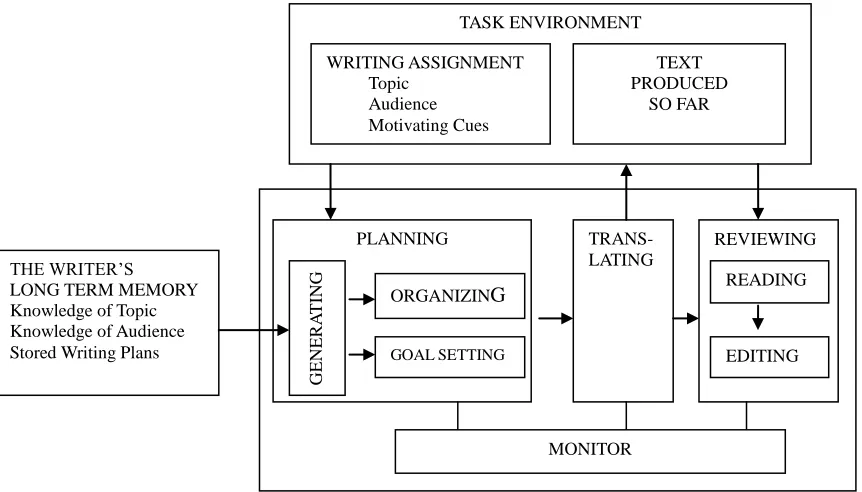
The influential model of writing that Hayes and Flower (1980) devised from their
analysis of writers ―thinking aloud‖ protocols consists of three major parts: the task environment,
which includes the writing assignment and the text produced so far, and the writer’s long term
memory, which includes knowledge of topic, knowledge of audience, and stored writing plans,
are the context in which the writing process operates. The cognitive process, which is the nucleus
of the model, consists of three major components—Planning, Translating, and Reviewing. In the
Planning process, the writer takes information from the task environment and the long-term
memory and uses it to generate ideas, set goals, and establish a writing plan. In the Translating
process, the writer transforms the information, ideas, and plans into written text (this process was
later called ―Text Generation‖ in Hayes, 1996). In the Reviewing process, the writer reads and
edits what has been produced to improve the quality of the text. It should be noted that Hayes
and Flower emphasized that the process described in the model is recursive rather than
successive. The whole writing process, including Planning, Translating, and Reviewing, may
appear as a part of an Editing sub-process. Thus, writing involves a complex intermixing of
[image:27.612.73.504.432.678.2]stages, which is controlled by the Monitor.
Figure 2.1 Hayes-Flower (1980) writing model
TASK ENVIRONMENT
WRITING ASSIGNMENT Topic
Audience Motivating Cues
TEXT PRODUCED
SO FAR
THE WRITER’S LONG TERM MEMORY Knowledge of Topic Knowledge of Audience Stored Writing Plans
PLANNING
GENERA
TING ORGANIZING
GOAL SETTING
TRANS- LATING
REVIEWING
READING
EDITING
Hayes and Flower’s model is important in that it served as a basis for later research into
writing processes, including second language writing process research. A great many of later
studies (e.g., McCutchen, 1994, 1996; Sasaki & Hirose, 1996; Zamel, 1983) were designed
according to the process stages postulated in their model. In fact, this model has created the
terms most commonly used by researchers in dealing with the writing process—especially the
distinction between planning, formulation and revision.
Hayes (1996)
Hayes proposed a new model in 1996, which he claimed to be ―a framework that can
provide a better description of current empirical findings than the 1980 model‖ (p. 1). In this
revised model, two major components—the task environment and the individual—are identified
(see Figure 2.2). The cognitive processes in the new model now include text interpretation,
reflection, and text production. Text Interpretation is the process by which source texts are read
and internal representations are formulated. Reflection is a process of mental activities by which
new internal representations are created from existing internal representations. And Text
Production is the process by which the product of reflection is transcribed and elaborated into
texts. These three processes are involved not only in drafting a piece of writing but also in
revising one’s writing as well.
Apart from other major revisions, the most important difference between the new model
and the old one is that the new model emphasizes the central role of working memory in writing.
Drawn heavily on Baddeley’s (1986) model of working memory, the working memory in the
new writing model consists of phonological memory (for phonologically coded information),
visual/spatial sketchpad (for visually or spatially coded information), and semantic memory (for
Figure 2.2 Hayes (1996) model
is to retrieve information from long-term memory and other environments and to carry out
cognitive processes within its limited capacity. The role of working memory will be revisited in a
late section when a review of studies on working memory and writing is presented.
Grabe and Kaplan (1996)
Attempting to integrate the cognitive processing of a writer, the linguistic and textual
resources for a writing task, and the contextual factors that strongly shape the nature of writing,
Grabe and Kaplan (1996) proposed a model of writing on the basis of a more general model of
model are two major components: context for language use and verbal working memory of the
language user (see Figure 2.3). Context, as the external factor, comprises situation and language
performance output. The former is further composed of participants, setting, task, text, and topic,
and the latter accounts for the actual textual output produced as a result of the processing in
[image:30.612.100.369.212.523.2]verbal working memory.
Figure 2.3 Grabe and Kaplan’s (1996) model of writing
The verbal working memory is a different concept from the working memory in Hayes’
(1996) model, which was built on Baddeley’s (1986) conception. The verbal working memory in
Grabe and Kaplan’s (1996) model is constituted by three subcomponents: internal goal setting,
context with ―verbal processing,‖ which draws on ―language competence‖ and ―knowledge of
the world‖ and integrates the activated resources through ―on-line processing assembly.‖ The
result of verbal processing is ―internal processing output‖ and this processing output in turn
becomes textual output as external performance. Both processing and textual output are
compared to the goals set in the goal setting component which interacts with external situation
and internal verbal processing.
In this model, the verbal working memory is the locus of internal operations for linguistic
processing, and the relationships among the components are depicted clearly in terms of their
interactions. Despite some self-acknowledged limitations of this model (such as lack of details as
to how the various subcomponents of language competence interact with each other and with
world knowledge and processing mechanisms), Grabe and Kaplan’s (1996) model represents an
effort to incorporate social context, cognitive processing and textual product into a single model
of writing from the perspective of communicative language use. Their emphasis on situation and
language competence allows for a wider range of application of this model to account for not
only L1 but also L2 writing.
Cummins’ Hypotheses of Language Transfer
Interdependence Hypothesis
Cummins’ notion of language transfer is expressed in two hypotheses: the Developmental
Interdependence Hypothesis and the Linguistic Threshold Hypothesis. The Interdependence
Hypothesis, also known as ―Common Underlying Proficiency (CUP) model,‖ posits that ―the
literacy-related aspects of a bilingual’s proficiency in L1 and L2 are seen as common or
interdependent across languages‖ (Cummins, 1981, pp. 23-24). Basically, it assumes a common
language performance. When such a cognitive/academic proficiency is acquired in one language,
it is transferrable to another language. In other words, L2 literacy skills (such as reading and
writing) are partially dependent on the literacy already developed in the L1.
Threshold Hypothesis
Cummins’ Threshold Hypothesis postulates that ―those aspects of bilingualism which
might positively influence cognitive growth are unlikely to come into effect until the child has
attained a certain minimum or threshold level of competence in a second language‖ (1979, p.
229). In other words, in the acquisition of L2 literacy, a certain threshold or level of L2
proficiency must first be achieved if L1 literacy skills are to be transferred. Within this
hypothesis, the level of a learner’s L2 linguistic competence may act as an intervening variable
in mediating the development of cognitive abilities and literacy skills.
It follows from these hypotheses that both L1 writing ability and L2 language proficiency
are important in a learner’s L2 writing development. Cummins’ theory has been generated from
and supported by studies involving bilingual children from a developmental perspective of their
L1 and L2 proficiency. The applicability of this theory to the context of adult L2 learners merits
further research.
Conceptions of Second Language Proficiency and Writing Expertise
Many researchers have explored and defined the construct of second language ability in
different ways at different times. In this section, I will first review some influential models of
second language ability which define the construct of language ability for the purpose of
assessment and then narrow it down to components of second language writing expertise.
Early models such as those proposed by Lado (1961) and Carroll (1961) focused on
language. Second language proficiency was viewed in terms of skills (i.e., reading, writing,
listening, and speaking) and components (or elements) of language knowledge (e.g., grammatical
structure, vocabulary, pronunciation, etc.). In contrast to the skills/components model of second
language proficiency, Oller (1979) argued for an integrative notion of language proficiency (the
unitary trait hypothesis). He proposed the concept of ―pragmatic expectancy grammar,‖ which
refers to the knowledge that ―causes the learner to process sequences of elements in a language
that conform to the normal contextual constraints of that language‖ (p. 38). His efforts to
integrate language processing and language use highlight the importance of cognitive factors in
second language proficiency. Unfortunately, as Purpura (1999) noted, he did not explicate the
cognitive processes affecting second language acquisition or performance; nor did he explain
how these processes could be incorporated into a comprehensive model of second language
ability.
Canale and Swain (1980) proposed a model of second language proficiency which
identified strategic competence as one of the three major components of communicative
competence, the other two being grammatical competence and sociolinguistic competence. Later,
Canale (1983) revised the model and added discourse competence to refer to cohesion and
coherence. Canale and Swain were the first to include strategic competence into a model of
language ability; nevertheless, their model is inadequate in that, as Chalhoub-Deville & Deville
(2005) pointed out, while it is possible to view grammatical competence in terms of knowledge,
it is difficult to conceptualize the other competences in their models.
On the basis of earlier work, Bachman (1990) and Bachman and Palmer (1996)
formulated the influential model of communicative language ability (CLA). The CLA model
characteristics of language users on the one hand, and between these characteristics and the
characteristics of the language use task and setting on the other (see Figure 2.4). The key
components constituting characteristics of individual language users include topical knowledge,
language knowledge, personal characteristics, affective schemata, and strategic competence
(those in the bold circle). Strategic competence is placed at the center of the diagram, providing
links for other components within the individual as well as links with the characteristics of the
language use task and setting. Bachman and Palmer (1996) defined strategic competence as ―a
set of metacognitive components, or strategies, which can be thought of as higher order
executive processes that provide a cognitive management function in language use, as well as in
[image:34.612.181.431.345.690.2]other cognitive activities‖ (p. 70).
Bachman and Palmer’s (1996) model presents a cognitive perspective of communicative
language use. These cognitive factors would therefore apply to writing, one of the four essential
language skills, which involves productive language use. In an attempt to structure the writing
context and the skills, knowledge, and processes involved in writing, Grabe and Kaplan (1996)
compiled a detailed taxonomy specifically for the description of the nature of academic writing.
Among their twelve categories, two of them are most relevant to my current study—linguistic
knowledge and writing process strategies. Linguistic knowledge includes the knowledge of the
written code (orthography, spelling and punctuation), knowledge of phonology and morphology,
vocabulary, syntactic/structural knowledge. Writing process strategies refer to the executive
control or metacognitive strategies, among which monitoring text production, considering task
problems, re-reading already produced texts and editing texts are just a few of the subcategories.
Summarizing from a cognitive perspective on writing, Weigle (2005) outlined the
essential areas of knowledge that are involved in both L1 and L2 writing. These areas of
knowledge include language knowledge, topic, genre, audience knowledge, task schemas and
metacognition. Language knowledge includes linguistic knowledge, such as knowledge of
vocabulary, grammar and orthography, as well as functional knowledge of language such as
discourse knowledge and pragmatic knowledge. Weigle (2005) also pointed out the important
role of working memory in writing, which will be discussed in another section later on the
relationship between working memory and writing.
All in all, the review of writing models, language transfer hypotheses, and language
proficiency models helped provide an understanding of the construct of L2 writing and the
possible cognitive variables that contribute to L2 writing. Four aspects were selected for the
proficiency, use of writing strategies in the writing process and working memory capacity. In the
next section, previous studies in L2 writing in relation to these four aspects are reviewed.
Review of Relevant Studies
Research on L1 and L2 Writing Ability and L2 Proficiency
Many studies have investigated a composite of variables that interplay in a learner’s L2
writing performance, especially on the relationship between writing skills (both in L1 and L2)
and L2 proficiency. In his seminal review, Silva (1993) examined 72 reports of empirical studies
on L1 and L2 writing in an attempt to develop a clear understanding of the nature of L2 writing.
More recently, Roca de Larios, Murphy, and Marin (2002) and Polio (2003) provided a critical
examination of more recent empirical studies on L2 writing. Even such extensive reviews cannot
conclude with a simple statement regarding the relationship between L1 and L2 writing skill and
L2 proficiency, because the issues involved are complicated and the studies reviewed produced
mixed results.
Empirical studies on the relationship between L1and L2 writing and L2 language
proficiency have yielded inconsistent results. Many studies (e.g., Cumming, 1989; Schoonen et
al., 2003; Sasaki & Hirose, 1996; Yun, 2005) have found varying degrees of contributions of L1
writing ability to L2 writing performance. For example, Cumming (1989) found that learners’ L1
writing expertise had a significant effect on the quality of L2 writing for his French participants.
Sasaki & Hirose (1996) also found a significant correlation between Japanese university
students’ L1writing ability and their L2 writing performance (r = .43). This result was
corroborated in Yun’s (2005) study with Korean participants, who found similar correlations
between L1 and L2 writing performance (r = .42).
writing, some other studies (e.g., Carson et al., 1990; Pennington & So, 1993) did not find a clear
relationship between L1 and L2 writing products in their investigations of L2 learners’ writing
performance. In their exploratory study using multiple regression analysis, Carson et al. (1990)
found that L1 writing ability was not a significant predictor for L2 writing ability for both
Japanese and Chinese participants. They examined the written products of 48 Chinese and 57
Japanese students in both their L1 and L2 (English). Their results showed only a weak positive
correlation (r = .230, p < .05) for the Japanese participants but no significant correlation (r =
-.019, n.s.) for the Chinese participants. Another study with Chinese L1 students by Pennington
and So (1993) presented similar results. In their examination of the writings produced by six
Singaporean college students in both their L1 (Chinese or English) and L2 (Japanese),
Pennington and So did not find a clear relationship between the quality of their L1 and L2
written products. They concluded that writing quality in L2 was correlated to learners’ general
proficiency level in L2 but not to the quality of the written products in L1.
L2 proficiency has also been widely investigated in L2 writing research, and the results
are also mixed. Cumming (1989) reported that his French participants’ L1 writing expertise
(measured by written composition in their L1—French) and L2 proficiency (measured by an oral
interview) accounted for large but separate portions of the variance in participants’ L2
composition. L1 writing ability and L2 proficiency are found to be independent of each other.
Participants with professional-level L1 writing expertise produced higher quality writing in L2
(English) than those with no such expertise, and such effect was consistent over three different
types of writing (letter, argument, and summary writing). Schoonen et al. (2003) discovered with
their Dutch L1 participants that L2 writing proficiency (measured by three written compositions
compositions in L1), more than with either their L2 linguistic knowledge (measured in terms of
vocabulary, grammar and orthography) or the accessibility of this L2 knowledge (measured by
reaction time in word retrieval and sentence building).
In contrast, Sasaki and Hirose (1996) found that Japanese participants’ L1 writing ability
(measured by a written composition in L1) only explained 18.3% of the variance in their L2
composition scores, whereas their L2 proficiency (measured by a comprehensive English
language test for learners of English, which consisted of items on structure, listening and
vocabulary) explained 52.1% of the variance, and that the unique contributions of L2 proficiency
and L1 writing performance toward the variance in EFL writing performance were found to be
even more remarkably different—32.6% and 1.5% respectively. Therefore, L2 proficiency seems
to play a more important role than L1 writing ability in L2 writing performance. Yun (2005),
adopting a structural equation modeling approach, also found that for her Korean participants, L2
proficiency was a much better predictor than L1 writing ability as an explanatory variable for L2
writing performance. Yun concluded that her data and analyses provided empirical evidence for
the linguistic threshold hypothesis (Cummins, 1979, 1991), which postulates that a certain
minimum level of L2 competence is required before L1 skills can transfer to L2 performance.
It is possible that participants in Yun’s (2005) and Sasaki and Hirose’s (1996) studies
were more constrained by their L2 proficiency than those in Cumming’s (1989) and Schoonen et
al.’s (2003) studies. It is also possible that these controversial results were due to the language
typology of participants’ L1s—French and Dutch are more closed related to English, all of which
belong to the Indo-European family; whereas Korean, Japanese and Chinese belong to different
language families. Still another possibility is that these discrepancies arose from the various
measured L2 proficiency in a different way—Yun with a cloze test, Sasaki and Hirose with a
comprehensive English Language Test for learners of English (the structure, listening and
vocabulary sections), Cumming with an oral interview and Schoonen et al. with a vocabulary test,
an orthographic knowledge test and a grammatical knowledge test, thus making their results
difficult to compare. Therefore, additional empirical research is required in order to explicate the
relative importance of L1 writing ability and L2 language proficiency to a learner’s L2 writing
performance.
Research on the Use of Writing Strategies and L2 Writing
The use of writing strategies during the writing process is another frequently examined
factor in L2 writing research. Despite those studies which show that learners’ L2 proficiency is a
major factor of learners’ ESL/EFL writing performance, some early studies in second language
writing process research reported that learners’ writing did not seem to be influenced by their L2
linguistic proficiency (e.g., Jacobs, 1982; Raimes, 1985; Zamel, 1983). Instead, the quality of L2
writing has been found to be more closely related to learners’ composing competence (see
Krapels, 1990 and Roca de Larios et al., 2002 for reviews of studies on L2 writing process).
Expert L2 writers with less language proficiency are not impeded in their use of global cognitive
strategies in writing by their lesser ability in language; by the same token, inexperienced writers
with greater fluency in English are not able to tap into more effective writing processes by virtue
of their greater proficiency in English (Leki, 1996).
Research into the writing process and writing strategies of skilled/expert and
unskilled/novice writers has produced mostly consistent findings. In general, expert writers are
found to spend more time planning and revising their work than novice writers. They tend to
planning, generating, rereading, and revising, etc. At the discourse level, they pay more attention
to the content, the organization, and the choice of words and phrases. When they revise, they
tend to edit globally for content and organization rather than simply making surface local
changes to the text. Skilled writers also tend to take into account the reader’s expectations and
handle their writing accordingly. They are also found to have a more highly developed schemata
for the genres in which they are writing than less skilled writers (Weigle, 2005; also see Roca de
Larios, et al, 2002 for a synthesis of studies on skilled-unskilled distinction).
Most of the process-oriented studies employed qualitative methods such as think-aloud or
stimulated recall for data elicitation. Data collected through qualitative methods can yield
detailed information about writing process and writing strategies; however, such data are usually
collected from a small number of participants and would inevitably carry individual participants’
idiosyncrasies. Using questionnaires to measure writing strategies has the potential to reach a
larger number of participants and thus conduct studies on a larger scale. Petrić and Czárl (2003)
reported their attempt to construct and validate such a questionnaire, but they had to admit that
the questionnaire they developed failed to consider the contextual factors involved in the writing
process and therefore elicited relative and uninformative responses. As Leki (1995) advocated
fifteen years ago, there is still a need for a catalogue which incorporates the fullest possible range
of writing strategies.
Research on Working Memory and Writing
The complexity of writing has been depicted by Flower and Hayes (1980) as juggling the
demands and constraints of a busy switchboard operator. Scardamalia (1981) has also described
how complex the task of writing is: ―Too many interdependent skills are involved, and all seem
punctuation, word choice, syntax, textual connections, purpose, organization, clarity, rhythm,
euphony, and reader characteristics would seemingly overload the information processing
capacity of the best intellects‖ (p. 81).
In order for writers to carry on such a variety of processes simultaneously, automatization
of many parts of the writing process needs to be obtained so that the processing task can be
achieved with slight conscious attention (Posner & Keele, 1973, cited in Bereiter, 1980). Such
performance would also require certain level of working memory capacity. In an attempt to
analyze the information processing load in writing, Scardamalia (1981) examined the
coordination of content schemes in expository writing among 10-14 year old children. She found
that children who are presumably capable of handling three to five content schemes
simultaneously in speaking tend to manage only one to three in writing. This would suggest that
they are so busy with other (possibly low-order) processing needs (such as spelling out the words)
that they have little attentional capacity left for higher order concerns with content.
Such a capacity theory of working memory has been supported by research such as Just
and Carpenter (1992) in reading comprehension and McCutchen (1996, 2000) in writing. Based
on a review of past studies, McCutchen (1996) concluded that many developmental and
individual differences in writing skill could be explained with a capacity theory of writing. In
complex tasks such as reading and writing, comprehension and composition impose considerable
processing and storage demands. With a limited working memory capacity, novice writers are
unable to deal with the complex demands imposed by the writing processes. They are
constrained by the limitations and tend to depend on knowledge-telling strategies (as proposed
by Bereiter & Scardamalia, 1987) and engage in non-interactive processes. In contrast, skilled
extensive knowledge about topic, genre, and routines for coordinating writing processes.
Therefore, they are able to move beyond the limits of short-term working memory and tap the
resources of long-term working memory (McCutchen, 2000).
Ransdell and Levy (1999) employed complex working memory measures to investigate
the role that working memory plays in reading comprehension and text composition. They
proposed a resource flexibility model, and concluded from their study that
language skills require shared working memory capacity, but differ in resource allocation priorities given to the demands of remembering, reading, and writing. In particular, writing requires resource flexibility in order for the writer to successfully attend to higher level demands such as, organization of sentences, paragraphs, and entire essays. In contrast, attending to lower-level details, such as spelling, grammar, and punctuation, are less dependent on individual differences in resource flexibility. (p. 111)
Extending this notion of working memory capacity in writing to second language writers,
Weigle (2005) posited that for many second language writers, particularly those with lower L2
proficiency, their access to L2 lexical and syntactic resources is not yet automatic, so they need
to pay conscious attention to these processes. With a limited capacity of working memory, this
consumption of attention in turn hinders their access to higher level strategies and knowledge
bases that might be available to them when writing in their first language (p. 136).
In the field of second language acquisition, many of the studies investigating the role of
working memory capacity focus on phonological short-term memory (PSTM) (e.g., Mackey et
al., 2002; N. Ellis, 1996), reading comprehension (e.g., Harrington & Sawyer, 1992; Miyake &
Friedman, 1998), grammar learning (e.g., McDonald, 2006), sentence parsing (e.g., Juffs, 2004,
2005), or oral production (O’Brien et al., 2006). Various measures for working memory capacity
have been employed (see discussion on these measures in the following section) and results tend
L2 than in their L1 and that L2 span generally correlates with L2 comprehension (but see Juffs
2004, 2005 for contradictory findings with sentence parsing).
Working memory span has proved to be a good predictor of a wide range of complex
cognitive skills. Harrington and Sawyer (1992) administered reading span tasks to native
Japanese learners of English in both L1 and L2. Their results showed that both span measures
correlated with each other and that those readers with higher L2 reading span did better on the
L2 reading comprehension tasks as measured by TOEFL grammar and reading sections. Similar
correlations were also reported by Miyake and Friedman (1998), who tested L2 sentence
interpretation with Japanese learners of English. Mackey et al. (2002) examined the relationship
between working memory capacity in L1 and L2 and the noticing of interactional feedback.
Their analyses yielded high positive correlations between L1 and L2 working memory scores
and marginally significant relationship between working memory scores and noticing.
McCutchen and her colleagues conducted empirical studies to examine developmental
and individual differences in working memory capacity, linguistic fluency, and writing skill in
both children and adults (McCutchen, 1994; McCutchen, Covill, Hoyne, & Mildes, 1994). Their
results showed that for both age groups, large working memory spans were associated with better
writing. In a study to determine the type of working memory measures that predict individual
differences in writing performance, Randsdell and Levy (1999) used reading, speaking, and
writing span tests to measure participants’ working memory capacity. Their experimental results
showed that all the span measures can predict both reading comprehension and writing
performance.
The working memory research in SLA shows a major interest in reading comprehension,
widely accepted that writing involves complex cognitive efforts. The few studies that did focus
on the relationship between working memory capacity and L2 writing used measures for
working memory capacity (such as reading, speaking or writing span) that are correlated with L2
language proficiency. In the next section, measures for working memory capacity that are
commonly used in research will be reviewed.
Measures of Working Memory Capacity
In terms of methodology, a number of tasks have been used to measure one’s working
memory capacity, which originated from research in cognitive psychology. Both simple span
tasks (such as digit and word span) and complex span tasks (such as listening and reading span)
have been developed. Simple span tasks involve mere storing and recall of strings of digits or
words and are believed to tap into the more traditional concept of short-term memory for storage.
Complex span tasks involve both processing of auditory or visual stimuli and storing and recall
of digits or words and are believed to be able to tap into both storage and processing capacity of
working memory.
There are many types and variations of complex span tasks, such as backward digit span
(recalling strings of digits in a reverse order as presented), backward word span (recalling strings
of words in a reverse order as presented), alpha span (recalling target words in alphabetical order)
(see Conway, Kane, Bunting, Hambrick, Wilhelm, & Engle, 2005 for a more elaborated
overview of working memory span tasks). According to Gass and Mackey (2007), three
commonly used types of complex span tasks are operation span, counting span, and sentence
span. Operation span tasks (Turner & Engle, 1989) require participants to verify arithmetic
operations (sometimes correct and sometimes not) and try to remember words presented after
(generally two through five equations). Counting span tasks (Case, Kurland, & Goldberg, 1982)
require participants to count shapes and remember the total number of shapes for later recall.
Sentence span tasks (Daneman & Carpenter, 1980) involve comprehension of sentences and
recall of words (either the last word of each sentence or an unrelated word presented after each
sentence). Sentences can be presented as either auditory (listening span) or visual (reading span)
stimuli.
One of the most widely used working memory tasks is the Reading Span Test (a specific
type of sentence span tasks), developed by Daneman and Carpenter (1980). It was designed to
tap both the storage and processing functions of working memory. In the original version of
reading span test, participants were instructed to read aloud sets of sentences while trying to
remember the final word of each sentence. The sentences were presented on cards, one sentence
on each card. At the end of a set (ranging from two to five or six), a blank card would appear,
signaling the participant’s turn to recall the final words seen in that set in correct order. The task
contained three sets each of two to six sentences. The participants began with the two-sentence
set and worked up to the more difficult ones (those with more sentences). The task was
terminated when the participants failed all three sets at a particular level. The level at which the
participant was correct on two out of three sets was taken as the measure of his/her reading span.
Later versions of reading span tests introduced acceptability judgment of sentences
(Turner & Engle, 1989; Waters, Caplan, & Hildebrandt, 1987, cited in Waters & Caplan, 1996),
recalling of an unrelated word or letter following each sentence (e.g., Engle, Tuholski, Laughlin,
& Conway, 1999; Kane, Hambrick, Tuholski, Wilhelm, Payne, & Engle, 2004), randomization of
presentation order (Engle, Cantor, & Carullo, 1992), and different scoring methods of the
have been found to be a reliable and valid measure of working memory capacity.
Stimulated by the question whether working memory capacity is task dependent, that is,
whether different measures/tasks yield different results in one’s working memory capacity, Engle
and his colleagues developed and validated operation span tasks for measuring working memory
capacity. The first operation span task (Turner and Engle, 1989) used mathematical operations to
replace the sentences in Daneman and Carpenter’s (1980) task while retaining the task demands
(processing some information and remembering and recalling a set of target words). More
specifically, in the operation span task, participants are required to read aloud a mathematical
equation and verify if the equation is correct or not (e.g., (9/3)-2=1 or (9/3)-2=3). Immediately
after the participant says Yes or No to the equation, a word is shown. The participant is instructed
to read aloud the word and try to memorize it for later recall. Then another mathematical
equation is presented and the participant repeats the process until the end of a set (ranging from
two to five or six equations and words) when the participant is prompted to recall all the words in
that set.
Turner and Engle’s (1989) experiments showed that working memory capacity measured
with the operation span task correlated highly with scores on reading comprehension as well as
the working memory capacity measured with the reading span task. Regression results suggested
that both spans were similar in their ability to predict reading comprehension. Analyses with
stepwise multiple regression even demonstrated a larger contribution of operation span than
reading span to the prediction of reading comprehension (Entering operation span first accounted
for 16.03% of the variance while reading span added 3.26%. Entering reading span first
accounted for 13.42% of the variance while operation span added 5.87%). Therefore, it may be
comprehension. More importantly, working memory capacity seems to transcend task, and
processing differences may result from individual differences in working memory capacity.
Summary
In this chapter, writing models proposed by Hayes and Flower (1980), Hayes (1996), and
Grabe and Kaplan (1996) as well as the Interdependence Hypothesis and the Threshold
Hypothesis proposed by Cummins (1979, 1981) were introduced as theoretical frameworks for
the current study. Models of second language proficiency and writing expertise were also
reviewed to provide further understanding of the construct of L2 writing. As a result, four aspects
were selected as explanatory variables for L2 writing performance for the current study. The
review of the previous studies in L2 writing in relation to these four aspects provided further
rationale for their selection as explanatory variables for investigation as well as a foundation for
CHAPTER 3
METHODOLOGIES AND MATERIALS
In order to investigate the research questions, a battery of tests was used to measure a
number of Chinese EFL learners’ writing ability in both L1 (Chinese) and L2 (English), their
working memory capacity in L1 and L2, vocabulary size in L2 (both receptive and productive),
grammar knowledge in L2, and the use of writing strategies in the process of writing (as
measured by post-writing questionnaire). Specifically, the actual procedure of data collection for
the study is spelled out in the following sections.
Participants
The data for this study were collected from students enrolled at several universities in
Beijing, China in the fall semester, 2009. The target population for this study is adult Chinese
EFL learners of academic English. Chinese EFL learners were targeted as participants on the
account that a) some studies with Chinese L1 participants showed contrary results to other
studies with different native languages, b) most studies in this field were conducted in ESL
settings rather than EFL settings, and c) China has the largest population of EFL learners.
College students were considered for sampling because a lot of literature investigated this group
of people (as opposed to middle school or high school students) and academic writing is
important for college study. In addition, they are adult, learning English for academic purposes;
they had learned EFL for at least six years in the secondary school and obtained a certain degree
of proficiency (they all passed the College Entrance Examinations including the subject of
English); and they are expected to have the motivation to improve their English (they are
expected to pass an exit exam of English proficiency test, which includes essay writing as an