Georgia State University
ScholarWorks @ Georgia State University
Public Health Theses School of Public Health
Fall 11-16-2010
A Survey of Georgia Adult Protective Services Staff
Regarding Elder Abuse Laws and Policies:
Determining Training Needs
Judith Kerr
Institute of Public Health
Follow this and additional works at:https://scholarworks.gsu.edu/iph_theses Part of thePublic Health Commons
This Thesis is brought to you for free and open access by the School of Public Health at ScholarWorks @ Georgia State University. It has been accepted for inclusion in Public Health Theses by an authorized administrator of ScholarWorks @ Georgia State University. For more information, please contact
Recommended Citation
Kerr, Judith, "A Survey of Georgia Adult Protective Services Staff Regarding Elder Abuse Laws and Policies: Determining Training Needs." Thesis, Georgia State University, 2010.
i
A Survey of Georgia Adult Protective Services Staff Regarding Elder Abuse Laws
and Policies:
Determining Training Needs
Judith Kerr
B.A., Georgia State University, 2007
A Thesis Submitted to the Graduate Faculty of Georgia State University in Partial Fulfillment
of the Requirements for the Degree
Master of Public Health
Atlanta, GA 30303
ii Abstract
Background: The aging population is a rapidly growing demographic. Isolation and limited autonomy render many of the elderly vulnerable to abuse, neglect and exploitation. As the population grows, so does the need for Adult Protective Services (APS). This study was conducted to examine current knowledge of Georgia older adult protection laws and to identify training opportunities to better prepare the APS workforce in case detection and intervention.
Methods: A primary survey was developed in partnership with the Georgia Division of Aging Services‟ leadership to identify key training priority issues APS caseworkers and investigators. A 47-item, electronic questionnaire was delivered (using Psychdata) to all APS employees via work- issued email accounts. Descriptive analyses, t-tests, and chi-square analyses were conducted to determine APS employees‟ baseline knowledge of Georgia‟s elder abuse policies, laws, and practices as well as examine associations of age, ethnicity, and educational attainment with knowledge. A p-value of <0 .05 and 95% confidence intervals were used to determine statistical significance of the analyses performed.
Results: In total, 92 out of 175 APS staff responded to the survey (53% response rate). The majority of respondents were Caucasian (56%) women (92%). For over half the survey items, paired sample t-tests revealed significant differences between what APS staff reported as known and what APS staff members indicated they needed to know more about in terms of elder abuse and current policies. Chi-square tests revealed that non-Caucasians significantly preferred video conferencing as a training format (44% compared to 18%), [χ2(1) = 7.102, p < .008] whereas Caucasians preferred asynchronous online learning formats (55% compared to 28%) [χ2(1) =5.951, p < .015].
Conclusions: Results from this study provides the Georgia Division of Aging with insights into specific content areas that can be emphasized in future trainings. Soliciting input from intended trainees allows public health educators to tailor and improve training sessions. Trainee input may result in optimization of attendance, knowledge acquisition, and intervention practices regarding APS service delivery. This in turn can enhance APS staff efficiency and response to cases of violence against older adults.
iii
A Survey of Georgia Adult Protective Services Staff Regarding Elder Abuse Laws
and Policies:
Determining Training Needs
By
Judith Kerr
Approved:
Sheryl Strasser, PhD, MPH, MSW, CHES, CPHQ Committee Chair
Patricia King Committee Member
iv
Acknowledgements
I would like to extend my greatest appreciation to my thesis chair, Dr. Sheryl Strasser. Only through her guidance, wisdom, positive words, and encouragement have I completed this project. I would also like to thank my committee member, Patricia King from Adult Protective Services for her dedication to the elderly and enthusiasm towards advancements in the field. I would also like to extend my gratitude to Dr. Barbra Baumstark, Director of the Bio-Bus program at Georgia State University. Through her guidance I have learned it is not enough to know the sky is the limit, it must also be taught to others. Finally I would like to thank the Institute of Public Health for providing me an avenue through which to earn my Masters degree.
v
Authors’ Statement
In presenting this thesis as a partial fulfillment of the requirements for an advanced degree from Georgia State University, I agree that the Library of the University shall make it available for inspection and circulation in accordance with its regulations governing materials of this type. I agree that permission to quote from, to copy from, or to publish this thesis may be granted by the author or, in her absence, by the professor under whose direction it was written, or in his
absence, by the Associate Dean, College of Health and Human Sciences. Such quoting, copying, or publishing must be solely for scholarly purposes and will not involve any potential financial gain. It is understood that any copying from or publication of this dissertation which involves potential financial gain will not be allowed without written permission of the author.
vi
Notice to Borrowers
All these deposited in the Georgia State University Library must be used in accordance with the stipulations described by the author in the preceding statement.
The author of this thesis is:
Judith Kerr
200 Lady Helen Ct. Fayetteville, GA, 30214
The Chair of the committee for this thesis is:
Dr. Sheryl Strasser
Users of this thesis who not regularly enrolled as student as Georgia State University are
required to attest acceptance of the preceding stipulation by signing below. Libraries borrowing this thesis for the use of their patrons are required to see that each user records here the
information requested.
NAME OF USER ADDRESS DATE TYPE OF USE
vii
Curriculum Vitae
Judith Kerr
200 Lady Helen Ct., Fayetteville, GA 30214
Education
Georgia State University, Atlanta GA
Master of Public Health, Health Promotion and Behavior Dec. 2010
Bachelor of Arts in Psychology & Sociology May 2007
Research Experience
Training Survey for Georgia's Adult Protective Services' Staff Sept. 2010- Nov. 2010
Student Investigator
Georgia State University, Institute of Public Health
Idea Lab August 2006- May 2007
Research Assistant
Georgia State University, Department of Psychology
Gambling Study May 2007-June2007
Research Assistant
Georgia State University, Department of Psychology
Professional Experience
Bio Bus Program, Atlanta, GA September 2007– Present
Teaching Fellow
Fulton County Department of Health and Wellness, Office of Emergency Preparedness
viii
TABLE OF CONTENTS
ACKNOWLEDGEMEN... iv
LIST OF TABLES ... ix
LIST OF FIGURES ...x
INTRODUCTION ...2
1.1 Background ...2
1.2 Purpose of Study ...3
1.3 Research Questions ...4
REVIEW OF THE LITERATURE ...5
2.1 Elder Abuse Defined ...5
2.2 Risk Factors ...7
2.3 Theories Related to Persistence ...9
2.4 Reporting Abuse ...12
2.5 Adult Protective Services ...14
METHODS ...21
3.1 Data Source ...21
3.2 Study Measures ...22
3.3 Analysis ...23
RESULTS ...26
4.1 Georgia Adult Protective Services Employee Demographics ...26
4.2 Current Knowledge versus Needed Knowledge ...28
4.3 Preferred Method of Training and Demographic Correlates ...33
DISCUSSION AND CONCLUSION ...35
5.1 Discussion ...35
5.2 Study Limitations ...37
5.3 Recommendations ...38
5.4 Conclusion ...39
ix
LIST OF TABLES
Table 1 Common Principles of APS Programs ...19
Table 2 Initial and Recoded Demographic Information ...25
Table 3 APS Demographic Profile ...37
Table 4 Paired Sample t Test for Current Versus Needed Knowledge Among PS Employees ....30
Table 5 Suggested Content Areas for Training Modules ...32
Table 6 Rank of Preferred Training Modalities by APS Staff Members ...33
x
LIST OF FIGURES
2 CHAPTER I INTRODUCTION
1.1 Background
Adult Protective Services (APS) are first responders in cases of abuse, exploitation and
neglect (ANE) of the elderly and adults with disabilities (Teaster et al, 2006; Teaster, Wangmo,
& Anetzberger, 2010). The majority of APS programs, about 90%, serve adults deemed
vulnerable due to their age or ability status. However, there are few programs that provide
services to the either the elderly, age 60 years or older (or 65 years or older in some states) or
adults with disabilities ages 18-59 (or ages 18-64 years in some states) through separate
programs (Teaster et al, 2006; Otto, 2002). APS are state level programs created under federal
mandate (Teaster et al, 2006). Limited federal oversight in the development of APS programs
yielded programs that are state specific and vary greatly across state lines (Mixson, 1995; Otto,
2002). Nonetheless, amid the variation, there are common guiding principles found in most APS
programs (Otto, 2002; Mixson, 1995). In 2004, The National Adult Protective Services
Administrators (NAPSA) published Ethical Principles and Best Practice Guidelines for APS
service providers. These guidelines charge the APS to treat clients with respect and honesty and
to ensure the maintenance of autonomy while simultaneously providing protection (Mixson,
2010; McClennen, 2010; Ethical principles and, 2004).
Adhering to basic principles of APS program delivery has proven to be a challenging task
for many APS employees. While elder maltreatment legislation and programs share features with
child maltreatment, elder maltreatment has distinct challenges (Nerenberg, 2002). The elderly
3
however, intervention must be accepted and, alternately, can be rejected by the clients due to
their adult status (Nerenberg, 2002). Providing the least disruptive intervention while
simultaneously ensuring a safe environment for the client often puts APS staff members in a
highly stressful situation. Even when a client refuses intervention, APS employees face societal
pressure to remedy the threats faced by their clients. In turn, APS staff members are often
frustrated by the inability to improve their client‟s situation, particularly in cases where the
client‟s cognitive ability is questionable and harm is apparent (Nerenberg, 2002, Mixson, 1995).
1.2 Purpose of Study
This study responds to the recommendation put forth by the National Association of
Adult Protective Service Administrators (NAAPSA), in partnership with the National Center on
Elder Abuse (NCEA), to provide comprehensive training for new and experienced APS
employees and their supervisors (Otto, Castano, & Marlatt, 2002). Constructed from the
methodology and instruments used in past research to address APS staff proficiency in carrying
out their duties (Payne, 2008), this study will establish baseline data specific to Georgia APS
staff demographic characteristics, knowledge levels and training preferences. The primary
purpose of this study is to ascertain the level of knowledge Georgia APS staff members have
pertaining to service delivery, compared to the level of knowledge these staff members need in
order to provide the best service to clients. In addition to measuring knowledge, this study will
assess training needs as well as preferred training methods of APS workers. Finally, this study
extends national baseline data published in the 2002 Report on State Adult Protective Services
Training Programs (Otto, Castano, Marlatt, 2002). Providing baseline data specific to Georgia
4
APS employees. Improved training will result in staff members‟ increased ability to best provide
services to the elderly in need of assistance (Otto, Castano, Marlatt 2002).
1.3 Research Questions
The purpose of this study is to gather data from Georgia (GA) APS staff members in
order to answer the following questions:
I. What is the demographic profile of GA APS staff members?
II. What are the greatest training needs for GA APS staff members that exist in terms of
service delivery?
III. What are general learning preferences among GA APS staff members, and are those
5 CHAPTER II
REVIEW OF THE LITERATURE
2.1 Elder Abuse Defined
The aging population in America is a rapidly growing demographic. In 2010, about 40
million persons in the population, or 13%, were age 65 and older (Vincent and Velkoff, 2010).
Projections speculate that by year 2050, the aged population will more than double to about 88.5
million people or about 20% of the population (Vincent and Velkoff, 2010). This population
growthcan be attributed to the aging of the large “baby-boomer” generation, and improvements
in medical technology, which, as a result, have contributed to increased life span (Daichman,
Aguas, Spencer, 2008; Dauenhauer, Mayer, Mason, 2007). As the elderly population increases,
so will the number of people living with chronic illnesses, resulting in a greater need for APS.
To date, the APS has already begun to feel an increased reliance on their services. A recent
report published by Teaster et al, (2006) found that during a 4-year period, there was a 16%
increase in the reporting of ANE to the APS nationally (Park et al, 2010). Complementary to
these findings, Jogerst et al, (2003) found that states with mandated reporters receive
significantly more reports to APS than states that do not mandate reporting.
The aged population is a potentially vulnerable population in that some elderly lack
autonomy and the ability to access care or needed services (Epstien, 2001). Limited autonomy
contributes to inability to protect one‟s self from abuse, neglect and exploitation (Teaster et al,
2006). Elder maltreatment is highly problematic in that it is associated with distress and
increased mortality in victims and psychological morbidity in caregivers (Cooper et al, 2008).
Currently, there is no standard definition of elder abuse, however, common features of widely
6
Bonnie, & Wallace, 2003; Elder Maltreatment, 2010). For example, the US National Academy
of Sciences defines elder abuse as “ intentional actions that cause harm or create a serious risk of
harm (whether or not harm is intended), to a vulnerable elder by a caregiver or other person who
stands in a trust relationship to the elder, or failure by a caregiver to satisfy the elder‟s basic
needs or to protect the elder from harm” (Bonnie, & Wallace, 2003). This definition is
illustrative of acts of omission as in the case of neglect as well as acts of commission as in the
various types of abuse (Lachs & Pillemer, 1995; Daichman, Aguas, Spencer, 2008).
Categorization of elder abuse is typically as follows: physical abuse, sexual abuse,
psychological/emotional abuse, exploitation, neglect and abandonment (Daichman, Aguas,
Spencer, 2008; Lachs & Pillemer, 1995; Elder Maltreatment, 2010).
Physical Abuse (including sexual abuse): Inappropriate restraint, physical harm or injury
to an older person, including non-consensual sexual contact (Daichman, Aguas, Spencer,
2008; Elder Maltreatment, 2010).
Psychological/ Emotional Abuse: Acts carried out with the intention of causing
emotional pain such as verbal aggression, threats, and humiliating statements (Daichman,
Aguas, Spencer, 2008; Lachs & Pillemer, 1995).
FinancialExploitation: Illegal/ unauthorized use of funds/resources of an elderly
individual (Daichman, Aguas, Spencer, 2008).
Neglect (Active): The intentional withholding of essential provisions such as food, water,
medication and shelter in an attempt to cause physical and/or emotional distress in an
7
Neglect (Passive): Failure to provide adequate care to an elderly individual due to poor
training or lack of knowledge (Daichman, Aguas, Spencer, 2008).
Abandonment: Desertion of an elderly person by a caregiver (Elder Maltreatment, 2010).
Research and general understanding of elder maltreatment lag behind other forms of
family violence by at least 20 years (Daichman, Aguas and Spencer, 2008). Ehrlich &
Aneetzberger further substantiate this assertion by bringing light to the fact that the majority of
laws pertaining to protection and reporting were enacted decades following the initial entrance of
the problem into public attention (Ehrlich & Anetzberger, 1991; Mixson, 2010; Mixson 1995).
Alternatively, Bonnie and Wallace (2003), emphasize that while the progression of
research, knowledge and policies pertaining to elder maltreatment lag behind those of child
abuse and intimate partner violence, the progress that is being made follows the pattern of
progression these more evolved fields experienced. Meaning that while elder maltreatment has
not made the same progress as child maltreatment and intimate partner violence, the progress is
in fact being made (Bonnie & Wallace, 2003).
2.2 Risk Factors
Factors associated with maltreatment are multidimensional. There are commonly cited
individual, relationship and social level risk factors associated with elder maltreatment.
According to an ecological approach to elder maltreatment, understanding the various levels of
contributing factors to abuse will help to provide a complete understanding of the problem as
well as target areas for prevention (Daichman, Aguas and Spencer 2008;Elder Maltreatment,
8 Individual Level Risk Factors
On the part of the perpetrator, common risk factors include history of child abuse, history
of hostility or aggression, alcohol abuse, mental illness and inadequate training to be a caretaker
(Bonnie & Wallace, 2003; Reay & Browne, 2001; Lachs & Pillemer, 1995; Teaster et al, 2006).
The National Elder Abuse Incident Study published 1998 found that women were more likely to
be perpetrators of neglect while men were more likely to be perpetrators of all other types of
elder abuse.
Individual level risk factors of the victim include functional and cognitive impairment,
aggressive/hostile behavior toward caregiver, past caregiver abuse, alcohol abuse, being over the
age of 80 and being a woman (Wolf & Li, 1999; Reay & Browne 2001; Bonnie & Wallace,
2003; Teaster et al, 2006; Daichman, Aguas and Spencer, 2008). When considering gender as a
risk factor Bonnie and Wallace (2003, p. 60) noted that it is unclear if gender is a factor due to
the differential mortality between men and women or because women are truly more likely to be
victims of abuse.
Relationship Level Risk Factors
A comprehensive study by Teaster et al. published in 2006 outlined interpersonal level
factors correlated with elder maltreatment. These factors include victim and caretaker living
together, history of aggressive relationship between victim and perpetrator, perpetrator
dependence on the victim and perpetrator being a family member of the victim (Bonnie &
Wallace, 2003; Teaster et al, 2006).
Environmental Level Risk Factors
On the social level, social isolation puts both perpetrator and victim at an increased risk
9
(2002) isolation may be both a cause and consequence of abuse. Social isolation lends itself to
an environment devoid of social support. Social support both mitigates effects of stress as well
as allows for interactions that may lead to the detection of abuse (Daichman, Aguas and Spencer,
2008). Conversely, living in a crowded environment with limited privacy is also an
environmental risk factor associated with abuse (World Report on, 2002). Ageism, or the
marginalization of the elderly, is also a widely cited environmental level risk factor for abuse
(Lachs and Mason, 2008; World Report on, 2002; O‟Brien, 2010).
2.3 Theories Related to Persistence
Ecological Model
The Ecological model investigates the intersectionality of individual and interpersonal
level factors occurring within environmental, social, historical and behavioral contexts to
culminate in elder maltreatment. The socio-cultural context in which elder maltreatment occurs,
maps the individual factors of the person at risk for abuse and those of their trusted other, or
caretaker (Bonnie & Wallace, 2003). The individual characteristics of each person influences
both individual behavior and interpersonal interaction. Elder maltreatment is a function of the
power dynamic, status inequality and type of relationship shared by the victim and perpetrator.
This is, in turn influenced by each person‟s individual characteristics (Bonnie & Wallace, 2003).
These interactions are simultaneously influenced by the larger environment, such as the region of
the country in which the individuals reside, the type of housing in which they reside, and ethnic
group affiliation (Bonnie & Wallace, 2003). Prominent theories of abuse elaborate on specific
components of this general model of interactions to describe the dynamics at play in situations of
10 Exchange Theory
The exchange theory also identifies risk factors that are present outside a single abusive
episode. The exchange theory examines the power dynamic between the elderly and his/her
caretaker (Pillemer, 1985). This theory reasons that caretaker dependency on the elderly
prompts feelings of powerlessness. As a result, power is regained through abuse. Pillemer
(1985) suggests this is especially true in the case a child who has not had the ability to live
independently of a parent. Living with parents as an adult is contrary to social norms and may
spark feelings of inadequacy in the adult child that are minimized by episodes of violence
(Pillemer, 1985).
Routine Activities Framework
The Routine Activities framework approaches elder maltreatment as a criminal act. Elder
maltreatment occurs in the presence of three factors: a motivated offender, a suitable target and
the lack of a capable guardian (Payne & Gainey, 2006). This model claims any individual is
capable of being a motivated offender especially if the elderly person has a resource the offender
will benefit from or if the offender is under large amounts of pressure in caring for the elderly.
Likewise, a suitable target can be anything from the weaker, elderly person or their material
resource. A capable guardian runs the gamut from a supervisor, another adult, or a camera
capturing activities in the elderly persons‟ environment (Payne & Gainey, 2006).
Social Learning/ Transgenerational Theory
According to the Social Learning and Transgenerational theories, abuse is a learned
behavior modeled to children in the home environment. When children from an abusive
11
with the learned norm of aggression may come together to result in elder maltreatment
(Mildenberger & Wessman, 1986; Fisher & Lab, 2010).
Psychopathological Model
The Psychopathological Model posits that the perpetuation of abuse on the part of the
abuser is due to psychological impairment. The perpetrator may suffer from mental illness,
substance abuse addiction and, potentially, unresolved psychiatric problems; all of which are
characteristics highly correlated with elder maltreatment (Mildenberger & Wessman, 1986;
Fisher & Lab, 2010).
Ageism/ Functionalism/ Political Economy Theory
Theories of ageism posit that the elderly are less valued in society and are therefore less
protected (O‟Brien, 2010; World Report on, 2002). The Political Economy and Functionalism
theories add that the changing role of the aging population removes elderly from the workforce
and reduces their independence. Stereotypes of the aged as frail, and having limited cognitive
coherence are often times the rationale for ignoring signs of abuse. Associating characteristic
signs of abuse with age- related illness rather than maltreatment, allows the maltreatment to
persist without detection (Lachs and Mason, 2008; World Report on, 2002; O‟Brien, 2010).
The multitude of theories on elder maltreatment is insufficient in capturing all facets of
maltreatment. Each theory may prove true in some instances or for a particular type of
maltreatment, however, there has yet to be a theory universal to all situations of abuse (Filinson,
12 2.4 Reporting Abuse
Underreporting of abusive episodes further compounds the general problem of ANE
(Bonnie and Wallace, 2003). Inconsistent definitions of what is considered abuse across state,
ethnic and economic lines add to reporting difficulties (Daichman, Aguas, Spencer, 2008). What
is reported, who reports and how reports are made differs across state APS programs as guiding
definitions for those programs differ (McClennen, 2010, p.278). Dakin and Pearlmutter (2009)
conducted focus groups with white, black and Latina women and found that ethnic background
also influences individual definitions of abuse. For example, acts that constituted financial
exploitation in the eyes of working class black and white women were considered “caring for
one‟s family” by working class Latinas. Aside from exploitation, Dakin & Pearlmutter, (2009)
found ethnicity also influenced differential sensitivity to verbal and emotional abuse.
Mandated Reporters
As of 2006, every state and territory, barring five- Colorado, New Jersey, New York,
North Dakota, and South Dakota, has legally mandated reporters of ANE (Stiegel & Klem,
2007). While the majority of states mandate persons to report acts of ANE, those designated to
report differs across states. Designated reporter, ranging from medical professionals to “any
person,” in some states and commonly include social workers, such as those found working for
APS (Stiegel & Klem, 2007; McClennen, 2010, p.278). Typically, the report‟s identity is
confidential and reporting in good faith protects the reporter from litigation. Failure to report is
punishable by a criminal misdemeanor.
Physicians played a primary role in reporting cases of child abuse; however, they have
yet to approach elder maltreatment reporting with the same rigor (Rodriguez et al, 2006;
13
evidence of elder maltreatment may go unseen because the elderly are easily isolated from
individuals other than their caretakers (Lachs and Mason, 2008). Even when reporting is
mandatory and abuse is suspected, practitioners may choose not to report (Lachs et al, 1998;
Rodriguez et al, 2006).
Physicians purposefully abstain from reporting potential cases of elder maltreatment in
order to preserve rapport with the patient and his/her family (Rodriguez, 2006). Additionally,
some physicians do not perceive protective services as having adequate capacity to manage cases
of maltreatment (Rodriguez et al, 2006; Lachs et al, 1998). Some physicians assume reporting
will result in an unwanted re-location of the victim or may cue caseworkers to confront
perpetrators without properly protecting the aged individuals from retaliation. On the part of the
caseworkers, however, ethical guidelines charge caseworkers to respect the autonomy of
cognitively functional adults. Therefore, the victim‟s refusal of APS intervention may bar APS
employees from resolving maltreatment (McClennen, 2010, p. 278).
Self-Reports
Under reporting is also due, in part, to the victim as well as the individuals with whom
the individuals interacts (O‟Brien, 2010). Often times, elder maltreatment happens at the hands
of a family member (Lynette et al, 2009). The victim may decide not to report maltreatment due
to dependence on the abuser, family loyalty, fear of consequences of reporting, embarrassment
associated with being abused, and desire to stay in the home (Bonnie & Wallace, 2003; Reay &
Browne, 2001). Even in cases where the elderly individual lives alone, abuse may still occur in
14
Self-neglect is the refusal or inability to maintain health and safety, provide one‟s self
with adequate food, water, clothing, shelter, personal hygiene, and manage financial affairs
(Dong et al, 2009, Mixson, 2010). According to a national survey of APS programs conducted
in 2004, self-neglect is the most commonly investigated and substantiated form of elder
maltreatment (Teaster et al, 2006). Self-neglect covers a range of behaviors including hoarding,
lack of utilities (e.g. light, water, gas) and laying in one‟s own filth (Dyer et al, 2007). Those
who self-neglect are represented across the spectrum of cognitive functioning and do not/refuse
to realize the potential consequences of their behaviors. These individuals typically interface
with the medical system only after an emergency event has occurred (Dong et al, 2009). Cases
of self-neglect are often brought to the attention of the APS by one or more individuals including
family members, health or legal professionals, community members or anyone who comes into
contact with an elderly individual and perceives inadequate self-care (Dyer et al, 2007; Dong et
al, 2009). As with addressing other types of maltreatment, APS efforts to address self-neglect
are limited by the clients‟ decisions to accept or refuse care (O‟Brien, 2010; McClennen, 2010,
p.278).
2.5 Adult Protective Services
Adult Protective Services is a local agency that intervenes on behalf of abused, exploited
and neglected adults (Teaster, Wangmo, & Anetzberger, 2010). Since the early 1980‟s every
state has had an office tasked with providing protective services to the vulnerable, adult
population (Otto, 2002). Elder abuse first became an issue of governmental concern in the 1940‟
and „50‟s (Bonnie & Wallace, 2003. p.13; Mixson, 2010). However, elder maltreatment
15
providing equal resources to marginalized groups in the 1960‟s (Teaster, Wangmo, Anetzberger,
2010); ). In 1961, the White House Conference on Aging put forth a call for more attention from
social, medical and legal agencies given to the needs of older persons (Mixson, 1995; Teaster,
Wangmo, Anetzberger, 2010; Otto, 2002; Segal, 2009). The first response to this call came in
1962 with the passage of the Public Welfare Amendments to the Social Security Act (Teaster,
Wangmo, Anetzberger, 2010); Bonnie & Wallace, 2003.p.13). The Public Welfare Amendments
provided financial support to states that established protective services for adults with
developmental disabilities who were incapable of managing their personal affairs and were
abused, neglected or exploited (Teaster, Wangmo, Anetzberger, 2010) Bonnie & Wallace,
2003.p.13). Three years later, the establishment of Older Americans Act was further federal
support of the elderly and disabled populations (Segal, 2009).
Social Security Act
Following the Public Welfare Amendments in 1962, further amendments were made to
the Social Security Act. In 1975, federal funding for APS became available to each state through
the Social Security Act Title XX, later known as Social Services Block Grant (SSBG) (Mixson,
1995; Teaster, Wangmo, Anetzberger, 2010). States wrongfully perceived this funding stream to
be indicative of increased federal technical assistance in managing APS programs funded
through the grant (Otto, 2002). Initially, money provided to states through Title XX were
provided to address five goals, elder abuse among them (Mixson, 2010). Conversion of Title XX
to SSBG in 1987 widened the spectrum of activities and services states could provide in order to
pull down funding (Mixson, 2010). Broadening the scope of programs able to satisfy funding
16
services supported through this grant (Mixson, 2010). For example, SSBG are distributed to the
states in support of state level Child and Adult Protective Services Programs. The percentage of
grant funding distributed to each protective program is left up to the discretion of each state.
(Mixson, 1995; Teaster, Wangmo, & Anetzberger, 2010). The absence of federal regulations
related to the distribution of grant funds and cultural paternalism towards children has resulted in
the bulk of SSBG funding spent on child services. Such practices are illustrated by reports from
1990 that indicate, on average, states were only spending 4% of monies received from SSBG on
adult protective services (Otto, 2002).
Older Americans Act
The Older Americans Act (OAA) of 1965 mandated funding for community based
services for the elderly. The aim of the act is to provide services in a comprehensive manner that
allows the elderly to maintain their independence and remain in their homes and communities
(Segal, 2009; Georgia Department of; Segal, 2009). The OAA is responsible for a variety of
local programs that sustain the elderly in the community. From under the umbrella of the
National Aging Services Network, nutritional services, transportation services, adult day care,
personal care, case management, information and assistance contacts and homemaker services
are rolled out through local level programs.
At its inception, the OAA did not specifically address elder maltreatment, however, in the
1980‟s and early 1990‟s, the OAA delineated funds for addressing elder maltreatment in the
institutional setting (Teaster, Wangmo, Anetzberger, 2010). Title II of the OAA established
Administration on Aging (AoA) as the lead federal agency designated to advocate on behalf of
17
prevention (Teaster, Wangmo, & Anetzberger, 2010; Georgia Department of). The AoA,
established in 1973, coordinates community services for the elderly through Area Agencies on
Aging (AAA), or local entities that carry out programs and streamline resources through local
public and private entities (Segal, 2009, p.280). Amendments to the OAA in 1987 stipulated
distinct authorization of services targeted towards elder ANE (Administration on Aging, 2009).
In 1992, reauthorization of OAA established Title VII of the act. Title VII, the
Vulnerable Rights Protection Title, calls for enhanced coordination of elder advocacy programs
designated under previous titles of the OAA in an effort to develop a stronger system dedicated
to vulnerable adults (Adult Protective Services, 2010; Mixson, 1995). The 1992 amendments to
Title II of the OAA also established the National Center on Elder Abuse (NCEA) as a national
repository dedicated to the compilation and provision of information and materials to support
efforts to ameliorate elder maltreatment (Administration on Aging, 2010). NCEA is a
consortium of experts and advocates dedicated to addressing elder maltreatment. A leading
partner of the NCEA is National Adult Protective Services Administrators (NAPSA) a non-profit
organization with members in each state and territory of the United States (Who/What is, 2010).
Formed in 1987, NAPSA is dedicated to providing a forum for APS employees to gain
knowledge, share experiences and increase public awareness of APS and the clients they served
(Otto, 2002; Who/What is, 2010). Information sharing and collaboration of NCEA and its
partners is in step with recent amendments to the OAA focusing on long-term, strategic planning
using a multi-disciplinary approach to support the elderly population (Administration on Aging,
18 General APS Activities and Services
The absence of federal guidance, lack of influential legislation pertaining to elder
maltreatment, and limited funding resulted in APS programs that vary across states. APS
programmatic variation exists with regard to services provided, laws that govern those services,
divisions under which protective services are found, target populations of APS programs, and
what constitutes abuse (Otto, 2002; Mixson, 1995). For example, the majority of APS services
are typically found within the department of social services, but about one-third houses APS in
the state units on aging (Otto, 2002). Notwithstanding these differences, there are a number of
consistent features found across APS programs (Otto, 2010; Mixson, 1995).
Adult Protective Services primarily focuses on the individual client and the preservation
of her autonomy and status in the community (Otto, 2002; NAPSA, 2005). Focus on autonomy
and individual rights of the client is a paramount feature of APS service delivery that allows
clients to refuse services, even when APS assessment indicate they are needed (Nerenberg,
2002). APS staff members perform routine activities in an effort to maintain the elderly
population in the community and provide protection. These activities include receiving reports,
conducting investigations, evaluating risks to clients, assessing the clients‟ capacity to
understand his/her current situation and agree to services, developing and implementing case
plans, counseling clients, arranging for external services and benefits and continual monitoring
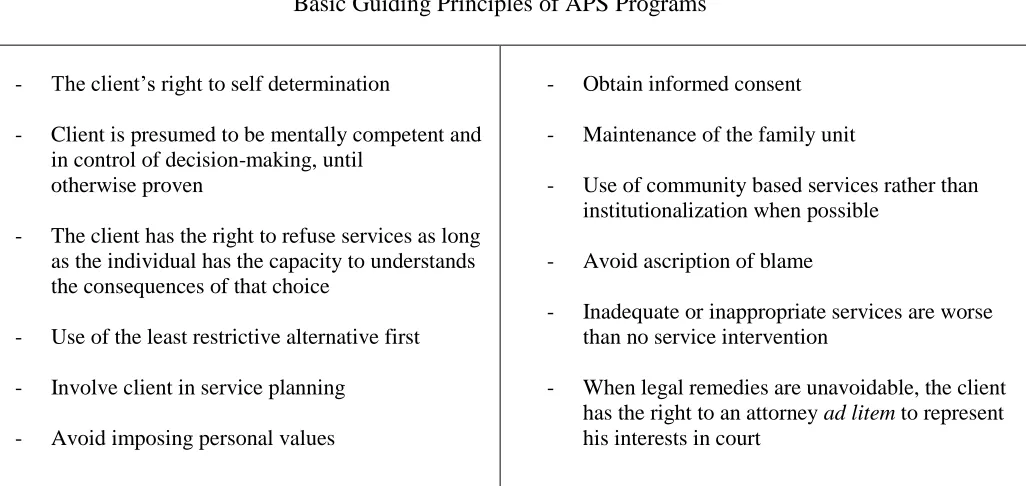
of service delivery (Mixson, 1995; Otto, 200; NAPSA, 2005). Table 1 lists common principles
found in most APS programs.
Adult Protective Services is modeled from a social work approach applied within a
systems framework (Mixson, 1995; Otto, 200; Filinson & Ingman, 1989). A social work
19
Table 1Common Principles of APS Programs
Application of this approach within a systems framework implies utilization of the perspective
that the client does not exist alone. Especially in the case of the elderly, important social
networks typically involve the family unit (Filinson & Ingman, 1989). The maltreatment
suffered by the elderly and the solutions to the maltreatment must be considered within the
environment and relationships in which the aged individual resides (Filinson & Ingman, 1989).
According to the systems approach, APS employees working in direct service provision should
manage cases with services provided through formal and informal community-based networks
(Filinson & Ingman, 1989). Mixson (1995) cautions that in taking a systems approach to elder
maltreatment, limitations within the system translate to limitations in service delivery (Mixson,
1995).
Basic Guiding Principles of APS Programs
- The client‟s right to self determination
- Client is presumed to be mentally competent and
in control of decision-making, until otherwise proven
- The client has the right to refuse services as long
as the individual has the capacity to understands the consequences of that choice
- Use of the least restrictive alternative first
- Involve client in service planning
- Avoid imposing personal values
- Obtain informed consent
- Maintenance of the family unit
- Use of community based services rather than
institutionalization when possible
- Avoid ascription of blame
- Inadequate or inappropriate services are worse
than no service intervention
- When legal remedies are unavoidable, the client
has the right to an attorney ad litem to represent
his interests in court
20 Adult Protective Services Employee Proficiency
In 2001, the National Association of Adult Protective Services Administrators (NAAPSA
or NAPSA) conducted phone interviews with state APS administrators gathering their opinions
on two questions: “what do you see as the most significant problems facing the field of Adult
Protective Services at this time?” and “what assistance do you need to improve protective
services to vulnerable adults?” (National association of, 2003). The two most commonly cited
problems facing state APS service delivery were insufficient state/federal funding and staffing
issues/problems. The two most commonly cited solutions were increase federal and state
funding for APS and improvements in training and best practice models (National association of,
2003).
Training is key in ensuring APS staff members are able to effectively functions in all
capacities required for service delivery. According to National Center on Elder Abuse, the
charge to APS employees to respond to potential cases of elder maltreatment or maltreatment of
adults with disabilities, investigate, and intervene with protective services when necessary is
challenging work often done with limited resources (Adult Protective Service, 2007). Valid
protocols allow mandated reporters to readily identify abuse and coordinate appropriate
improvement strategies for victims (Ehrlich & Anetzberger, 1991). APS employees have the
ability to request a multitude of services on behalf of their clients. Therefore, knowledge of
services available to the elderly and proficiency in accessing those services is imperative
(Ehrlich & Anetzberger, 1991). Otto, points out “that APS caseworkers are only as effective as
21 Chapter III
METHODOLOGY
3.1 Data Sources
In the state of Georgia, APS is part of the Division of Aging Services housed in the
Department of Human Resources. State variation in APS programmatic features make it
imperative that Georgia APS training needs are assessed through research questions answered by
APS staff members who serve communities similar to those found in Georgia under the same
regulations. In accordance with this criterion, Georgia APS staff members were surveyed
directly for the most accurate representation of their service area and training needs. To gain
understanding of the training needs of Georgia APS employees, a brief, one-time, electronic
questionnaire entitled “Elder Abuse Training Survey for Georgia Adult Protective Services‟
Staff” was delivered indiscriminately to all 175 APS workers via work issued email accounts.
Surveys were emailed to APS employees following a department-wide monthly meeting where
the surveys and their importance were an item on the meeting agenda. A week following the
primary email distribution of the survey, a second round of emails were distributed to the entire
sample pool to prompt APS staff to participate in the survey if they had not already done so. The
link to the survey was included in each email and remained active for one month, from October
through November 2010, after which, the link would no longer lead participants to the survey.
The questionnaire was delivered with an introductory paragraph describing the goals of the study
and the training implications of the data gained. Of the 175 surveys administered to Georgia
22
insufficiently completed and were therefore dropped from analysis; the final sample size was 92
APS employees yielding a complete response rate of 52.6%.
3.2 Study Measures
The survey delivered to GA APS employees was developed by input from a variety of
sources. The structure of the survey, the progression of questions and the way in which
questions were asked, were modeled after surveys found in the literature, specifically those
aimed at training needs. The content of the questions were developed through collaboration
between the Division of Aging Services leadership and Georgia State University, Institute of
Public Health research partners. From multiple iterations, a final, 47- item survey was developed
that would sufficiently establish baseline information pertaining to GA APS employee
demographics and training needs. The final version of the survey gathers information on GA
APS demographic characteristics and training needs by addressing four target areas.
The first section of the survey sampled the perception of staff‟s knowledge by asking 26
questions that assess current knowledge versus needed knowledge pertaining to APS service
delivery. The section heading reads “how much do your fellow APS staff members know about
the following” for both current knowledge and needed knowledge columns of each question,
participants have the choice of selecting 1= they need almost no knowledge, 2= they need a little
knowledge, 3= they need some knowledge, 4= they need a lot of knowledge.
The second section of the questionnaire asked questions related to frequent partners used
by APS staff members. Respondents were provided with a list of social services and asked to
indicate the frequency at which each service is typically contacted. Participants chose from
23
The third section of the survey gathered information on training practices and policies at
APS. Respondents were asked, “How would you describe the minimum standards for training
currently in place for all APS staff?” Response categories included- no policy, staff is
encouraged to seek training, some staff are required to attend training, depending upon the topic,
all staff are required to attend training, or not applicable.
The final section of the questionnaire gathered demographic information as well as
preferred training methods. Respondents were asked to identify their preferred method of
training by marking all the applicable items. Participants were asked “What type of training
delivery methods would you prefer (select all that apply)?” Response categories included video
conferences, video tapes, web-based- asynchronous, web-based-live, classroom led/ instructor
lead work-shops, self-study workbooks, and other with a field for elaboration.
3.3 Analysis
Surveys submitted by participants were collected and stored electronically via PsychData
and downloaded into SPSS version17.0 for analysis. Alpha levels of <0.05 was used for all
statistical tests. Univariate analyses were performed to reveal descriptive statistics regarding the
study population. These analyses categorized and identified frequencies and central tendencies
around age distribution of APS staff members, length of time staff members have worked for
APS, educational level and race of staff members as well as regional descriptions of service
areas.
Differences in current versus needed knowledge were analyzed using paired sample
t-tests. Each participants‟ response to each of the 26 items directly addressing current knowledge
24
means total. Due to repeated sampling of the same participants from one study population,
paired sample t-tests was an appropriate analytical tool. This test reveals whether the differences
in the reported means of current knowledge versus those of needed knowledge for each of the 26
questions are significantly different from zero.
Cross-tabulations were conducted to investigate desired training methods along
demographic lines. Specifically, chi-squared analyses were used to find associations between
demographic information and training preferences. For the purposes of this analysis,
demographic variables were re-coded in a variety of ways that differed from the original coding
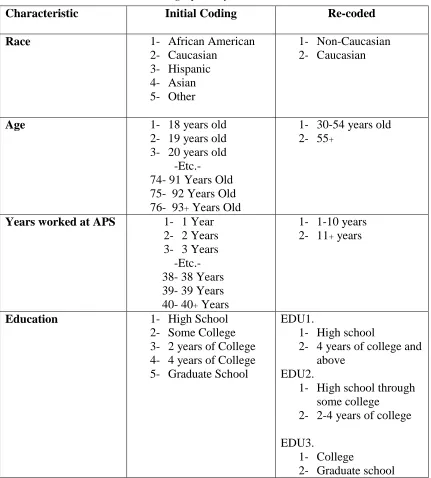
of the data. The re-coding structure is illustrated in table 2. Specifically, race, years worked at
APS, age, and education were re-coded to form more condensed and representative groups found
within the study population.
Race was re-coded from four original categories- African-American, Caucasian, Hispanic
and Asian to dichotomous categories- Caucasian and Caucasian. Group one, or
non-Caucasian, included African-American, Hispanic and participants who indicated they were of an
Other race not listed. Both the Hispanic and Other categories were represented by one individual
each and were therefore quantified with African-American participants in the non-Caucasian
category. Original coding of years worked at APS contained 40 categories. Category 1
representing one year working at APS and subsequent categories followed chronologically in
one-year intervals, with the final category, category 40, representing 40 years or greater. This
measure was re-coded into two categories; Category 1 representing those working for APS from
1-10 years and Category 2 representing working for APS for 11 or more years. Originally, age
was coded into 76 categories, 1 representing 18 years of age and subsequent categories following
25
youngest employee was 30 years of age, ages18-29 were immediately eliminated from analysis.
The remaining participants were re-coded into two even groups. Group one represented APS
employees ages 30-54 and group two represented APS employees ages 55 and older. Education
was re-coded from the original five categories a number of ways to discern the effects different
educational levels on training preferences.
Characteristic Initial Coding Re-coded
Race 1- African American
2- Caucasian 3- Hispanic 4- Asian 5- Other 1- Non-Caucasian 2- Caucasian
Age 1- 18 years old
2- 19 years old 3- 20 years old
-Etc.- 74- 91 Years Old 75- 92 Years Old 76- 93+ Years Old
1- 30-54 years old 2- 55+
Years worked at APS 1- 1 Year 2- 2 Years 3- 3 Years
-Etc.- 38- 38 Years 39- 39 Years 40- 40+ Years
1- 1-10 years 2- 11+ years
Education 1- High School
2- Some College 3- 2 years of College 4- 4 years of College 5- Graduate School
EDU1.
1- High school
2- 4 years of college and above
EDU2.
1- High school through some college
2- 2-4 years of college
EDU3.
1- College
[image:35.612.92.523.232.710.2]26 Chapter IV
RESULTS
Results from the questionnaire distributed to GA APS employees measuring baseline
demographic information and training needs are explained below. The results presented address
the three research questions posed at the onset of the study and outlined in chapter one of this
paper.
4.1Georgia Adult Protective Services Employee Demographics
Prior to recoding demographic variables from initial categories, frequency statistics were
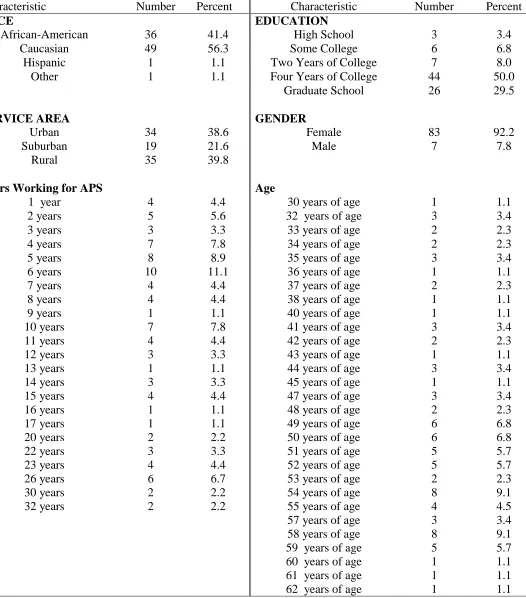
run on the following demographic markers: age, gender, highest level of education, service area
and number of years worked for GA APS. An overwhelming majority of participating APS
employees are women (92%) with college (50%) or graduate school (30%) education. Over half
of APS staff self-identify as Caucasian (56%), followed by African American (41%), Hispanic
(1%) and other (1%). The majority of respondents have worked for APS between 1 and 15 years
with a mean of 11.5 years, a median of 8.5 years and a reported mode of 6 years. The mean age
of GA APS staff is 32.8 years (SD=10) with ages ranging from 30 years old to 62 years old.
According to respondents, APS employees deliver services equally in rural (39.8%) and urban
(38.6%) areas and less so in suburban areas (21.6%). Results of frequency statistics under initial
27
Characteristic Number Percent Characteristic Number Percent
RACE EDUCATION
African-American 36 41.4 High School 3 3.4
Caucasian 49 56.3 Some College 6 6.8
Hispanic 1 1.1 Two Years of College 7 8.0
Other 1 1.1 Four Years of College 44 50.0
Graduate School 26 29.5
SERVICE AREA GENDER
Urban 34 38.6 Female 83 92.2
Suburban 19 21.6 Male 7 7.8
Rural 35 39.8
Years Working for APS Age
1 year 4 4.4 30 years of age 1 1.1
2 years 5 5.6 32 years of age 3 3.4
3 years 3 3.3 33 years of age 2 2.3
4 years 7 7.8 34 years of age 2 2.3
5 years 6 years 7 years 8 years 9 years 10 years 11 years 12 years 13 years 14 years 15 years 16 years 17 years 20 years 22 years 23 years 26 years 30 years 32 years 8 10 4 4 1 7 4 3 1 3 4 1 1 2 3 4 6 2 2 8.9 11.1 4.4 4.4 1.1 7.8 4.4 3.3 1.1 3.3 4.4 1.1 1.1 2.2 3.3 4.4 6.7 2.2 2.2
35 years of age 36 years of age 37 years of age 38 years of age 40 years of age 41 years of age 42 years of age 43 years of age 44 years of age 45 years of age 47 years of age 48 years of age 49 years of age 50 years of age 51 years of age 52 years of age 53 years of age 54 years of age 55 years of age 57 years of age 58 years of age 59 years of age 60 years of age 61 years of age 62 years of age
[image:37.612.50.576.100.698.2]28 4.2 Current Knowledge versus Needed Knowledge
Following the establishment of baseline demographic characteristics of GA APS staff,
reported, perceived knowledge of components of service delivery was compared to
self-reported needed knowledge. A series of paired-sample t-tests were conducted to compare the
knowledge APS employees currently have to the knowledge needed in order to carry out job
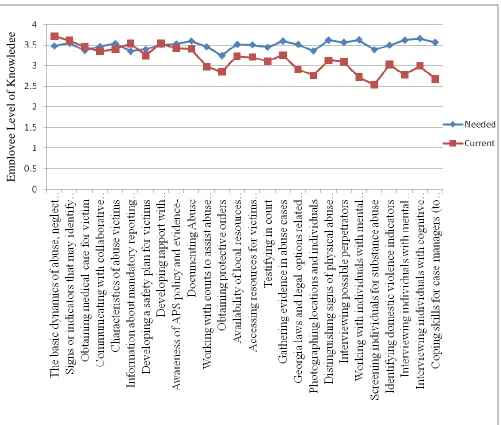
functions. Figure1 provides a graphical representation of the results of the paired-sample t-tests
assessing knowledge. The lines on the graph with boxes at each mean is representative of
perceived current knowledge APS staff rate themselves as having, while the line with diamond
markings at each mean represents self-reported, needed knowledge. Results of each
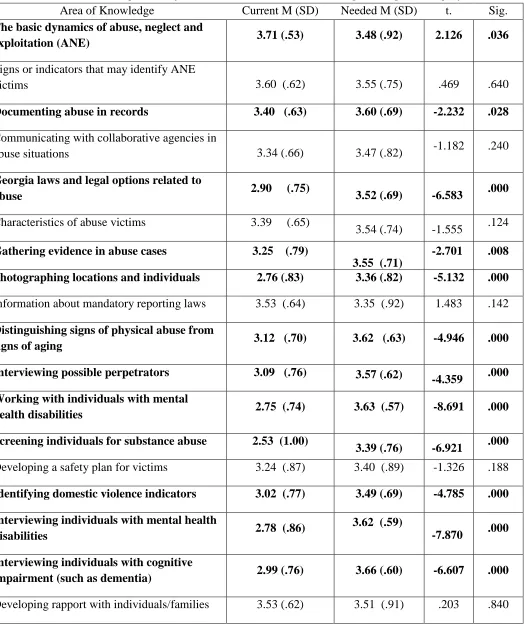
paired-sample t-test are depicted in table 5; significant differences in current versus needed knowledge
are bolded.
Significant differences between current and needed knowledge were identified in
eighteen out of twenty-six items measuring knowledge had. Of the 18 areas of knowledge with
significant differences, on only one measure, Basic dynamics of abuse, neglect, and exploitation
(ANE), did APS staff members‟ current knowledge (M=3.71, SD=.53) exceeded needed
knowledge (M=3.4831, SD=.92), t(88)=2.13, p< 0.05 (two tailed) at a statistical level. For the
remaining 17 knowledge areas, APS staff members knew significantly less than what was needed
pertaining to service delivery. These 17significant items can be condensed into four, more
general categories.
APS staff indicated the greatest knowledge needs are in areas of evidence collection,
29
four categories contains at least two items reported as areas of needed knowledge. Cross training
contains the fewest items and serving clients with mental health disabilities has the most.
Em
ployee
Le
ve
l of
Kno
wle
[image:39.612.78.579.170.595.2]dge
30
Table 4 Paired Sample t Test for Current Versus Needed Knowledge Among APS Employees
Area of Knowledge Current M (SD) Needed M (SD) t. Sig. The basic dynamics of abuse, neglect and
exploitation (ANE) 3.71 (.53) 3.48 (.92) 2.126 .036
Signs or indicators that may identify ANE
victims 3.60 (.62) 3.55 (.75) .469 .640
Documenting abuse in records 3.40 (.63) 3.60 (.69) -2.232 .028
Communicating with collaborative agencies in
abuse situations 3.34 (.66) 3.47 (.82) -1.182 .240
Georgia laws and legal options related to
abuse 2.90 (.75) 3.52 (.69) -6.583 .000
Characteristics of abuse victims 3.39 (.65)
3.54 (.74) -1.555 .124
Gathering evidence in abuse cases 3.25 (.79)
3.55 (.71)
-2.701 .008
Photographing locations and individuals 2.76 (.83) 3.36 (.82) -5.132 .000
Information about mandatory reporting laws 3.53 (.64) 3.35 (.92) 1.483 .142
Distinguishing signs of physical abuse from
signs of aging 3.12 (.70) 3.62 (.63) -4.946 .000
Interviewing possible perpetrators 3.09 (.76) 3.57 (.62)
-4.359 .000
Working with individuals with mental
health disabilities 2.75 (.74) 3.63 (.57) -8.691 .000
Screening individuals for substance abuse 2.53 (1.00)
3.39 (.76) -6.921 .000
Developing a safety plan for victims 3.24 (.87) 3.40 (.89) -1.326 .188
Identifying domestic violence indicators 3.02 (.77) 3.49 (.69) -4.785 .000
Interviewing individuals with mental health
disabilities 2.78 (.86)
3.62 (.59)
-7.870 .000
Interviewing individuals with cognitive
impairment (such as dementia) 2.99 (.76) 3.66 (.60) -6.607 .000
31
Working with courts to assist abuse victims 2.97(.76) 3.46 (.72) -4.767 .000
Obtaining protective orders 2.85 (.86) 3.25 (.78) -3.496 .001
Availability of local resources (including
resources for individuals with special needs) 3.22 (.69) 3.52 (.73) -3.042 .003
Accessing resources for victims (including
resources for individuals with special needs) 3.20 (.66) 3.51 (.77) -2.987 .004
Obtaining medical care for victim 3.45 (.67) 3.37 (.83) .740 .461
Testifying in court 3.10 (.72) 3.45 (.75) -3.079 .003
Awareness of APS policy and evidence-based
practice 3.42 (.69) 3.53 (.77) -1.120 .266
Coping skills for case managers (to avoid
32
Theme of Training Module Specific Items Addressed
Evidence Collection
- Documenting abuse in records - Gathering evidence in abuse cases - Interviewing possible perpetrators - Photographing locations and
individuals
Legal Procedures
- Georgia laws and legal options related to abuse
- Working with courts to assist abuse victims
- Obtaining protective orders - Testifying in court
Serving Clients with Cognitive Impairments
- Working with individuals with mental health disorders
- Screening individuals for substance abuse
- Interviewing individuals with mental health disorders
- interviewing individuals with cognitive impairment (such as dementia)
- Availability of local resources (including resources for individuals with special needs)
- Accessing resources for victims (including resources for individuals with special needs)
Cross training - Distinguishing signs of physical abuse from signs of aging - Identifying domestic violence
indicators
- Coping skills for case managers (to avoid burn-out and/or vicarious victimization)
33
Table 6Rank of Preferred Training Modality by APS Staff Members
4.3Preferred Method of Training and Demographic Correlates
In addition to identifying areas where APS staff training is needed, it was of interest to
discern the preferred method of training as reported by survey participants. To that end,
cross-tabulations were performed to identify associations between demographic markers identified
earlier during analysis- race, age, gender, years worked at APS, service area, education - and
preferred training methods. Prior to investigating demographic associations, preferred training
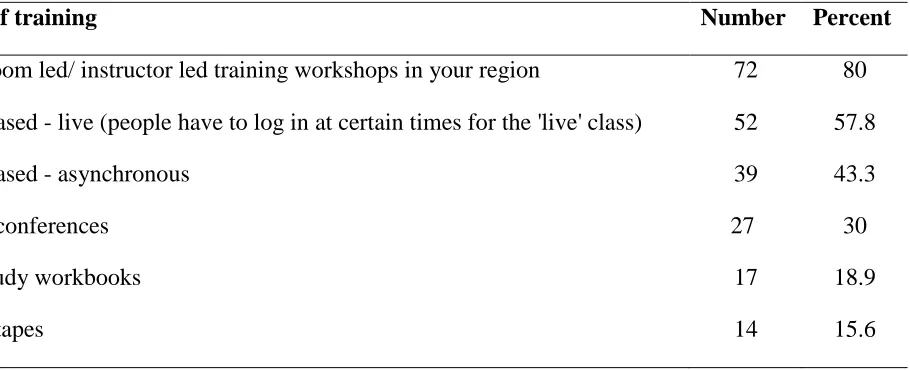
methodology was found using frequency statistics shown in table 5 below. Training preferences
were assessed with the question what type of training delivery methods would you prefer (select
all that apply)? Each training option was treated as a dichotomous variable in that it could either
be selected or not selected. Dichotomous demographic characteristics, gender, age and race,
demographic characteristics, service area, years working for APS, and education were each
assessed for associations with training methodology in a 2-by-2 table. To compensate for
overestimates of the chi-squared values associated with 2-by-2 analysis conducted with SPSS
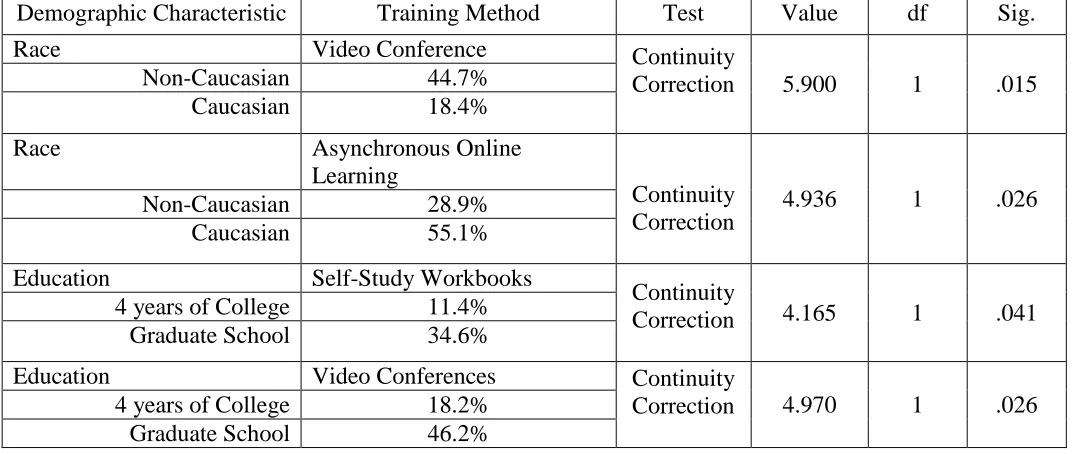
version 17.0, continuity correction statistic was used to assess significance. Chi-square tests
revealed that non-Caucasians significantly preferred video conferencing as a training format
Type of training Number Percent
Classroom led/ instructor led training workshops in your region 72 80
Web-based - live (people have to log in at certain times for the 'live' class) 52 57.8
Web-based - asynchronous 39 43.3
Video conferences 27 30
Self-study workbooks 17 18.9
34
(44% compared to 18%), [χ2(1) = 5.900 p < .015] whereas Caucasians preferred asynchronous
online learning formats (55% compared to 28%), [χ2(1) =4.936, p < .026].
Significant associations were also found between training preferences and educational
attainment. Education level was associated with a number of training preferences. Staff
members with graduate level education were more likely than those with 4 year college
education to choose self-study workbooks as a viable training option ( 34.6% compared to
11.4%), [χ2(1)=4.165 , p< .041]. Staff members with a Graduate education were also more likely
to choose video conferences (46.2% compared to 18.2%), [χ2 (1)=4.970 , p< .026] than
employees with 4-year college education. All training preferences associated with training
methodology are shown below in table 7.
Demographic Characteristic Training Method Test Value df Sig.
Race Video Conference Continuity
Correction 5.900 1 .015
Non-Caucasian 44.7%
Caucasian 18.4%
Race Asynchronous Online
Learning
Continuity Correction
4.936 1 .026
Non-Caucasian 28.9%
Caucasian 55.1%
Education Self-Study Workbooks
Continuity
Correction 4.165 1 .041 4 years of College 11.4%
Graduate School 34.6%
Education Video Conferences Continuity
Correction 4.970 1 .026 4 years of College 18.2%
[image:44.612.39.577.402.629.2]Graduate School 46.2%
35 Chapter V
DISCUSSION AND CONCLUSION
5.1 Discussion
This study provides insight into features of Georgia‟s Adult Protective Services program.
The collaborative process of creating the survey, APS staff response to the survey and the data
gained are all important components needed to develop a protocol to guide future engagement of
APS in an effort to improve service delivery.
Collaboration between Georgia State University‟s Institute of Public Health and the
Division of Aging reflects academic and practical entities working synergistically to accomplish
a common goal. These efforts, if properly managed, have the potential to result in service
delivery that is informed by research and research that is conducted in a practical environment.
The rate at which participants responded to the survey and the number of respondents may also
be indicative of the potential borne out of the relationship between these two institutions.
A paramount feature of this project is that it engages an important population that has yet
to undergo formal investigation pertaining to baseline markers, gaps in knowledge and training
modalities. One week following initial distribution of the survey to APS staff, a subsequent
email announcement was delivered to staff members encouraging participation in the survey.
Without any additional reminders, 137 people agreed to take the survey before the link became
inactive. Within two weeks, the survey captured the attention of almost 80% of the total
population and 97% of those who completed the survey correctly. This response rate is
36
important feature as training methodologies are evaluated for effectiveness and staff members
are sampled on fidelity.
Fixsen et al (2005), leaders in the field of implementation, have well documented the
importance of engaging the target audience in processes of change. Addressing self-reported
needs with the preferred learning techniques of the target audience is likely to result in greater
adherence to and acceptance of training modules than if staff members were not included in
training development.
Training modules should address items that differed significantly between current
knowledge versus needed knowledge. Collapsing each of the 17 individual items where more
knowledge is needed into four content areas will organize training sessions as well as potentially
minimize the time needed to acquire specific skills and information. The organization of these
four content areas- evidence collection, legal procedures, serving clients with mental health
disabilities and cross training- may be further condensed if needed due to the overlap of potential
information conveyed.
While there were significant associations between demographic characteristics and
training methods, it is important to look at the population size from which those significant
findings occurred. It stands to reason that the effects seen may be due to sample size rather than
demographic markers. For example, individuals with graduate level education were more likely
than those with 4 years of college education to prefer self-study workbooks as a mode of
training. However, upon closer investigation of this association, it becomes evident that the
37
effect seen. Analysis of training methods more commonly preferred by participants, using the
same tests, demonstrated a lack of these associations.
If leadership in the Division of Aging Services does in fact intend to use this data as a
guideline for future training modules, it may be most beneficial to look at the rank order of
training by the raw numbers rather than by demographic associations; this methodology will best
capture the learning preferences of APS staff. Specific to the training needs identified in this
study, it may be advantageous to begin with classroom based training and determine subsequent,
supplemental training modalities in the future as needed. Along the same lines, to deal with
budgetary issues commonly cited by public agencies, the Division of Aging Services should also
consider live web-based training. Web-based training was the second most preferred training
and its usage may capture the learning preferences of the most staff members while using the
least amount of resources by eliminating time and travel costs associated with attending
classroom trainings as well as those associated with hosting an outside trainer.
5.2 Study Limitations
The study conducted is not without limitations. Response bias is a major limitation of
this study. Of 175 potential participants, 92 participants or 53% fully completed the
questionnaire and were included in the analysis. The information from this study used to
establish baseline demographics and training needs only represents slightly more than half of the
APS staff population. It is uncertain if those individuals missed by the survey are
demographically similar to those who were captured, just as it is uncertain if knowledge areas
and preferred training methods reported in the survey are reflective of those who were not