Georgia State University Georgia State University
ScholarWorks @ Georgia State University
ScholarWorks @ Georgia State University
Managerial Sciences Dissertations Department of Managerial Sciences
Spring 5-21-2010
To Forbear or not to Forbear? A Behavioral Perspective of
To Forbear or not to Forbear? A Behavioral Perspective of
Multimarket Competition
Multimarket Competition
Ana Elisa A. Iglesias
Georgia State University
Follow this and additional works at: https://scholarworks.gsu.edu/managerialsci_diss
Recommended Citation Recommended Citation
Iglesias, Ana Elisa A., "To Forbear or not to Forbear? A Behavioral Perspective of Multimarket Competition." Dissertation, Georgia State University, 2010.
https://scholarworks.gsu.edu/managerialsci_diss/19
Permission to Borrow
In presenting this dissertation as a partial fulfillment of the requirements for an advanced degree from Georgia State University, I agree that the Library of the University shall make it available for inspection and circulation in accordance with its regulations governing materials of this type. I agree that permission to quote from, or to publish this dissertation may be granted by the author or, in his/her absence, the professor under whose direction it was written or, in his absence, by the Dean of the Robinson College of Business. Such quoting, copying, or publishing must be solely for scholarly purposes and does not involve potential financial gain. It is understood that any copying from or publication of this dissertation which involves potential gain will not be allowed without written permission of the author.
Notice to Borrowers
All dissertations deposited in the Georgia State University Library must be used only in accordance with the stipulations prescribed by the author in the preceding statement.
The author of this dissertation is:
Ana Elisa Arouca Iglesias 35 Broad Street, Suite 1026 Atlanta, GA 30303
The director of this dissertation is:
Professors William Bogner and Pamela Barr Department of Managerial Sciences
35 Broad Street, 10th floor Atlanta, GA 30303
Users of this dissertation not regularly enrolled as students at Georgia State University are required to attest acceptance of the preceding stipulations by signing below. Libraries borrowing this dissertation for the use of their patrons are required to see that each user records here the information requested.
TO FORBEAR OR NOT TO FORBEAR?
A BEHAVIORAL PERSPECTIVE OF MULTIMARKET COMPETITION
by
Ana Elisa Arouca Iglesias
A Dissertation
Submitted in Partial Fulfillment of the Requirements for the Degree
of
Doctor of Philosophy
in the Robinson College of Business
of
Georgia State University
GEORGIA STATE UNIVERSITY ROBINSON COLLEGE OF BUSINESS
Copyright by Ana Elisa Arouca Iglesias
ACCEPTANCE
This dissertation was prepared under the direction of the Ana Elisa Arouca Iglesias Dissertation Committee. It has been approved and accepted by all members of that committee, and it has been accepted in partial fulfillment of the requirements for the degree of Doctoral of Philosophy in Business Administration in the Robinson College of Business of Georgia State University.
Dean H. Fenwick Huss
DISSERTATION COMMITTEE
William Bogner (co-chair)
Pamela Barr (co-chair)
Martin Grace
ABSTRACT
Multimarket competition has become a substantial part of the modern economy. As such, it
has drawn the attention of academics in both economics and strategy fields. Many studies have
found empirical evidence of mutual forbearance in several industries, but despite its importance,
its behavioral roots have not been explored. In my dissertation I integrate the reality of
boundedly-rational decision makers into the mutual forbearance hypothesis. I apply an outgrowth
of the behavioral theory of the firm – the shifting focus model of risk taking – to the study of
competitive behavior. I propose a behavioral model of multimarket competition that focuses on
corporate strategic decisions - market entry and exit decisions, regardless of entry mode (e.g.
acquisitions) or exit mode (e.g. divestitures). This approach provides a granular view of changes
in the business scope of the firms in terms of product and geographic markets served. I test my
hypotheses in the U.S. property liability insurance industry over a 12-year period (1998-2008).
I argue that firms follow the mutual forbearance logic as long as their performance goals are
satisfied. However, under conditions of adversity, firms shift attention to recovering from the
performance shortfall and their actions deviate from the mutual forbearance predictions. This
dissertation shows that underperforming firms with abundant slack take longer to forbear, and
underperforming firms with limited slack start forbearing sooner, as predicted. By bridging
behavioral and competitive perspectives to the study of market entry and exit decisions, I
DEDICATION
To my husband Jose Luis and my daughter Liz
Glory be to him whose power, working in us, can do infinitely more than we can ask or imagine.
ACKNOWLEDGEMENTS
First of all, I would like to thank my advisors and mentors, Professors William Bogner and Pamela Barr. Bill, I will be forever grateful for your relentless support and mentorship. You gave me the space to explore my own ideas, but would not let me lose my focus. It is hard to put into words my appreciation for everything you have done for me.
Pam, I have always admired your work, even before I joined the doctoral program and I feel privileged that I got to know you. You are a role model for me, as a professor and an individual. I hope to be able to provide even a fraction of your support and guidance to my students. Thank you for everything!
I would also like to thank Professor Martin Grace. Dr. Grace, I am fortunate that you agreed to listen to my ideas about multimarket competition four years ago. Your expertise in the insurance industry and intellectual guidance has been instrumental in the development of my dissertation.
I am also indebted to Professor Javier Gimeno. Javier, your work inspired me in the early years of my doctoral program and I am grateful that you agreed to participate in my dissertation committee. Despite your busy schedule and the fact there is an ocean between us, you have always had your door open to listen and give advice. Thank you for your confidence in me.
I would also like to express my gratitude to the entire the faculty of the Department of Managerial Sciences at Georgia State for their constant support and guidance over the course of my doctoral program, especially Lisa Lambert, who would always give me not only great technical advice, but also a word of wisdom, and Karynne Turner, who have always had time for me.
My family and I have faced some extraordinary financial circumstances while I was completing my dissertation. I wish to thank my parents, sisters, and my Aunt Helena and Uncle Jose, who went above and beyond in providing for my family.
TABLE OF CONTENTS
CHAPTER 1 – INTRODUCTION ... 11
CHAPTER 2 – LITERATURE REVIEW ... 14
2.1 Multimarket competition: core concepts and mechanisms ... 14
2.2 Multimarket contact and competitive behavior ... 18
2.2.1 The 1978-1999 period ... 18
2.2.2 The 1999-2008 period ... 22
2.3 Competitive antecedents of market entry and exit ... 27
2.3.1 Form of relationship ... 27
2.3.2 Moderators ... 31
2.3.3 Empirical setting ... 33
2.3.4 Empirical testing ... 34
2.4 Behavioral antecedents of market entry and exit ... 36
2.5. Conclusion: Gaps in current research and opportunities for future research ... 38
2.5.1 Market entry and exit as changes in a firm‟s business scope ... 38
2.5.2 The overlooked argument in corporate strategy literature ... 40
2.5.3 A behavioral perspective of multimarket competition ... 40
CHAPTER 3 – THEORY DEVELOPMENT AND HYPOTHESES ... 42
3.1 Performance relative to aspiration level, slack, and risk taking ... 43
3.2 Market Entry ... 45
3.2.1 The mutual forbearance null hypothesis for market entry ... 46
3.2.2 Performance below aspiration level and high slack ... 48
3.2.3 Firm performance below aspiration level and low slack ... 49
3.2.4 Firm performance above aspiration level ... 51
3.3 Market Exit ... 52
3.3.1 The mutual forbearance null hypothesis for market exit ... 52
3.3.2 Firm performance below aspiration level and high slack ... 56
3.3.3 Firm performance below aspiration level and low slack ... 57
3.3.4 Firm performance above aspiration level ... 58
3.4 Conclusion ... 59
CHAPTER 4 – RESEARCH CONTEXT ... 61
4.1 Selecting a contextual setting for empirical analysis ... 61
4.1.1 Research requirements ... 61
4.1.2 The U.S. property and liability insurance industry ... 63
4.2 The U.S property and liability insurance industry ... 65
4.2.1 Industry overview ... 65
4.2.2 Property liability insurance products ... 68
4.2.3 Insurance operations ... 69
4.2.3.1 Organizational forms ... 69
4.2.3.3. Value chain ... 71
4.2.4. Regulation ... 72
CHAPTER 5 – DATA AND METHODOLOGY ... 75
5.1 Data source and operationalization ... 75
5.2. Sample... 77
5.3. Measurement ... 79
5.4. Data Analysis ... 84
5.4.1 Logistic regression modeling ... 85
5.4.2 Event history modeling ... 87
5.5 Model Specification and Estimation ... 92
CHAPTER 6 – RESULTS AND DISCUSSION ... 98
6.1 Results ... 98
6.1.1 Market Entry ... 98
6.1.2 Market Exit ... 110
6.2 Discussion ... 118
6.2.1 Competitive antecedents of market entry and exit ... 119
6.2.2 Behavioral antecedents of market entry and exit ... 121
6.2.3 To forbear or not to forbear? ... 123
6.2.4 Diversification through a geo-product lens... 124
CHAPTER 7 – CONCLUSION ... 127
7.1 Implications... 127
7.2 Limitations and opportunities for future research ... 132
CHAPTER 1 – INTRODUCTION
Multimarket competition, “a situation where firms compete against each other simultaneously
in several markets” (Karnani & Wernerfelt 1985, p. 87) has become a substantial part of the
modern economy. As such, it has drawn an increased attention of academics in both economics
and strategy fields (Baum and Greve 2001). The main assumption in multimarket theory is that
firms avoid competitive attacks against those rivals they encounter across several markets,
because of their increased interdependence – the so-called mutual forbearance hypothesis
(Edwards 1955). For example, if firm A attacks B in market X where B is dominant, firm B may
react not retaliating A in market X, but in market Y, where A has more to lose. Thus, in order to
avoid the risk of retaliation, firms forbear from attacking each other in order to reap the benefits
of decreased rivalry (Karnani & Wernerfelt 1985).
Multimarket contact has been shown to result in a decreased rivalry among competitors,
reflected in higher prices (e.g. Evans and Kessides, 1994), higher profits (e.g. Piloff 1999), and
higher growth (Haveman and Nonnemaker 2000). The benefits of having multimarket contact
also suggest that firms pursue market entry and exit, i.e. to expand and contract its scope of
businesses, according to the level of multimarket contact with competitors (e.g. Baum and Korn
1996). In spite of evidence in favor of the mutual forbearance hypothesis with respect to market
entry and exit, a broad question that arises is: Will firms always forbear from entry into a new
market or exit from markets because of the threat of retaliation? Or more specifically, my
research question is:
What are the boundary conditions of the mutual forbearance hypothesis with respect to
The mutual forbearance hypothesis has strong behavioral implications as it predicts how
managers make entry and exit decisions under conditions of extended interdependence with
rivals, or essentially, how managers pursue risk under such conditions. For example, entering
into a target market can be considered a risky decision (Greve, 2000) and exiting from a focal
market reflects risk aversion (Shimizu, 2007). Such behavioral roots of the mutual forbearance
hypothesis are not adequately accounted for in the IO-based analysis of competitive dynamics.
Predicting risk behavior according to firm performance and aspiration levels, the behavioral
theory of the firm provides a natural contrast with the IO tradition and, therefore presents an
opportunity to set out and test in the real world alternative hypotheses that are not fully
consistent with each other.
This dissertation also acknowledges that research on multimarket competition has more
extensively explored market entry decisions than exit decisions. Because the behavioral theory of
the firm has significant value to add to our understanding of exit, I investigate whether and how
firm performance relative to aspiration level influences the effect of multimarket contact on
market exit decisions.
The remainder of the dissertation is organized as follows. Chapter 2 provides a review of
multimarket competition research. It begins by describing core concepts and mechanisms in
multimarket competition. I then review empirical studies on the relationship between
multimarket contact and competitive behavior, with a particular emphasis on market entry and
exit. I also provide an overview of studies on the behavioral theory of the firm and corporate
strategy. The chapter concludes with a discussion of research issues that this dissertation seeks to
Chapter 3 provides a theoretical model of behavioral boundary conditions for the mutual
forbearance hypothesis with respect to market entry and exit. First, I describe the research model
and present the definition of multimarket contact. I then develop hypotheses that juxtapose the
dominant perspective of multimarket competition from IO economics with alternative
interpretations from the behavioral theory of the firm.
Chapter 4 describes the contextual setting in which the theoretical model will be tested. First,
the research requirements and challenges for testing the theoretical model are presented. Next, I
explain why the U.S. property and liability insurance industry is an appropriate empirical setting.
Concluding the chapter, I provide a brief description of the industry.
The methodologies for empirical analyses are introduced in Chapter 5, the results are
presented in Chapter 6, and the dissertation is concluded in Chapter 7, in which theoretical and
CHAPTER 2 – LITERATURE REVIEW
2.1 Multimarket competition: core concepts and mechanisms
The theoretical roots of multimarket competition date back in the 1950‟s, coming from
economics and sociology traditions. The idea that the multiplicity of contacts among firms can
decrease the intensity of competition was first introduced by Edwards (1955). He hypothesized
that multimarket rivals are attentive to how competitive moves in a given market impacts
competition in other markets, and will tacitly coordinate their actions for the mutual benefit of all
parties. Thus, firms competing with one another in several markets develop an extended
interdependence in that competitive moves in one market may cause response in other markets.
Extended interdependence is also known as multimarket contact (MMC) – an important
construct in multimarket competition. The implication is that as the level of multimarket contact
increases, the level of rivalry decreases – the so-called mutual forbearance hypothesis.
In the mutual forbearance logic, multimarket contact creates a deterrence mechanism
(Karnani & Wernerfelt 1985), since firms are less likely to act aggressively due to the threat of
retaliation in other markets. This effect has paramount importance because firms that can limit
competitive pressures, that is to say decrease the level of rivalry, are typically able to earn higher
rates of return than those that cannot (Porter 1980).
In their seminal paper, Bernhein and Whinston (1990) developed a game-theoretic model of
mutual forbearance in which they formalize the conditions for the development of extended
interdependence among firms. They contend that in situations where markets are identical, firms
are identical, and technology exhibits constant returns to scale, multimarket contact does not aid
of equal multimarket contacts alone does not help sustain forbearance. Hence, MMC may
facilitate cooperation only if some conditions are met. First, it is important the presence of
asymmetries either between the markets in which the same firms repeatedly interact with one
another (e.g. asymmetries in rates of growth or decline) or between the firms within and across
the multiple markets in which they interact (e.g. asymmetries in costs or demands). With
asymmetries, rivals are motivated to cooperate as each firm expands in markets where it is strong
and retreats from markets where it is weak. The presence of asymmetries underlies an important
construct in multimarket competition - spheres of influence. Because not all markets are equally
important to a given firm, firms may informally recognize the other‟s primacy of interest in
markets important to the other, hoping that its own interests will be similarly respected. For
example, firm A will let firm B to dominate an important market for B, hoping that B will let A
to dominate in an important market for A.
By extension, repeated interaction is another condition for mutual forbearance. When the
probability of continuing interaction is high, firms may be able to transfer incentive constraints
from a market where cooperation is sustainable to another where it is not – the transfer of market
power mechanism. However, the sustainability of cooperation depends on the credibility of the
punishment threat, so that firms do not have incentives to deviate from the competitive
equilibrium. Indeed, one of the main assumptions of the model is that defections are always
detected and punished – the perfect monitoring condition. In addition, none of the firms should
be able to gain more from deviating from its punishment strategy that it would subsequently lose
as a result of its deviation. In sum, it is both the prospect of gains stemming from cooperation
New theoretical advances in multimarket competition have refined and expanded the
Bernheim and Whinston‟s model. Matsushima (2001) has challenged the perfect monitoring
condition, showing that multimarket contacts can hold collusive equilibrium in place even when
firms cannot perfectly monitor their rivals. He theoretically proves that the collusive equilibrium
can be sustained if multimarket contacts make it easier to detect such defections. For example,
defection is less likely when a focal firm has many multimarket contacts in the focal market,
because the number of contacts increases the likelihood that the defection can be discovered.
Another condition that has been challenged is the asymmetry condition. Using
game-theoretical modeling, Spagnolo (1999) proves that, irrespective of whether there are asymmetries
of any kind, multimarket contact always facilitates collusion when firms‟ objective are concave,
i.e. firms are risk averse. This may be explained as follows. First, a strictly concave objective
function makes the strategic interactions interdependent: firms' evaluation of profits in one
market depends on profits realized in other markets. Second, the expected utility losses from
simultaneous retaliations in more markets are larger than (the sum of) those from independent
retaliations. Since incremental losses weigh more heavily than incremental gains when the
objective function is concave (Kahneman and Tversky 1979), multimarket contact gives firms
incentives to respect the tacit agreements. Evidently, the effect of multimarket contact is
strengthened under conditions of asymmetry or any other conditions postulated by Bernheim and
Whinston (1990).
Finally, an important condition for mutual forbearance to take place is that firms must have
internal coordination mechanisms (Jayachandran et al. 1999). As Golden and Ma (2003, 480) put
ensures that unit managers make decisions consistent with the corporation‟s goals, thus avoiding
unnecessary cross-market retaliation from rivals.
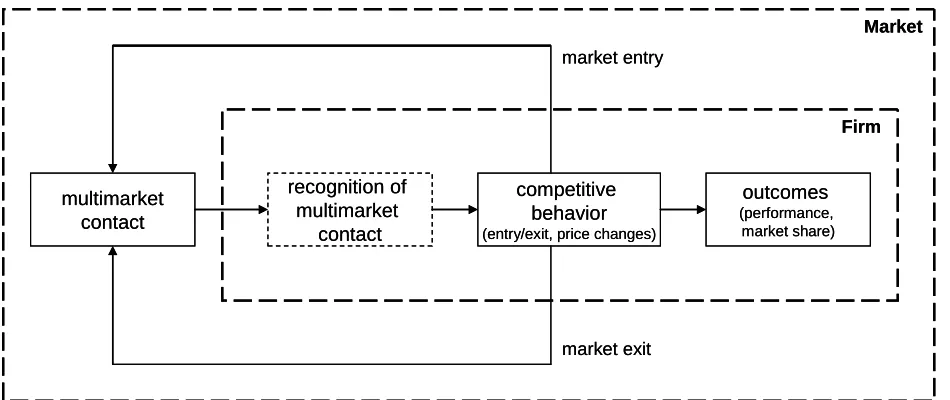
The basic model of multimarket competition is shown in Figure 2.1. This figure illustrates
that the extent to which firms are interdependent affects their competitive decisions which may
involve aggressive or cooperative behaviors. These decisions may involve changes in price or
changes in a firm‟s scope of businesses (e.g. Baum and Korn 1996). In this case, the multimarket
structure is impacted as firms enter and exit from markets. Finally, competitive behavior
influences organizational outcomes, such as enhanced performance (e.g. Gimeno and Woo 1996)
or stability in market shares (e.g. Heggestad and Rhoades 1978).
multimarket contact
recognition of multimarket
contact
outcomes
(performance, market share)
Firm Market
competitive behavior
(entry/exit, price changes) market entry
market exit
multimarket contact
recognition of multimarket
contact
outcomes
(performance, market share)
Firm Market
competitive behavior
(entry/exit, price changes) market entry
[image:18.612.71.546.344.544.2]market exit
Figure 2.1 – Basic model of multimarket competition
In the next section, I review empirical work on this relationship, using a well known
terminology for extended interdependence: multimarket contact. Multimarket contact is broadly
defined here as a focal firm‟s encounters with its focal market‟s rivals in markets outside focal
structure, but, rather, is experienced differently by firms with different product and/or geographic
scopes.
2.2 Multimarket contact and competitive behavior
In the next paragraphs, I review empirical studies that examine the relationship between
multimarket contact and competitive behavior published in the past thirty years. First, I provide a
broad literature review on multimarket competition, organized in two periods: 1978-1999 and
1999-2008. For the first period I relied on two articles that summarize past quantitative findings
(Jayachandran et al., 1999; Korn and Baum, 1999), and for the second period, I conducted a new
literature search. After broadly reviewing the studies from both periods, I focus on empirical
studies that examine the main constructs of this dissertation – market entry and exit – which are
reviewed in turn.
2.2.1 The 1978-1999 period
Two articles summarize quantitative findings for this period: Jayachandran et al. (1999) and
Korn and Baum (1999). The former identified twenty studies, whereas the latter identified
nineteen studies (Table 1). Thirteen articles figure in both reviews, meaning that Jayachandran
et al. (1999) cites seven articles not cited by Korn and Baum (1999), and that Korn and Baum
(1999) cites six articles not cited by Jayachandran et al. (1999), as shown in Table 2.1. A close
analysis of the non-cited papers offers possible explanations for those papers not being cited in
the reviews. Jayachandran et al. (1999) only cite journal articles. Consequently, conference
papers are not cited (Gimeno and Korn 1994; Whitehead 1978). However, the review does not
1990; Scott 1991) and one study not supporting it (Strickland 1985). Korn and Baum (1999) does
not cite studies published in 1999 (Gimeno 1999; Gimeno and Woo 1999), possibly because they
were available in the same year as the review‟s publication. However, the review does not cite
five articles featuring important evidence of multimarket competition (Fernandez and Marin
1998; Jans and Rosenbaum 1996; Parker and Roller 1997; Sandler 1988; Singal 1996). The final
[image:20.612.69.546.281.490.2]list of articles contains twenty-five empirical studies, as shown in Table 2.2.
Table 2.1 – Articles featured in literature reviews on multimarket competition (1978-1999)
Articles cited in Korn and Baum (1999) and Jayachandran et al. (1999)
Articles cited in Korn and Baum (1999) only
Articles cited in Jayachandran et al. (1999) only
Heggestad and Rhoades (1978) Scott (1982)
Alexander (1985) Feinberg (1985)
Rhoades and Heggestad (1985) Mester (1987)
Barnett (1993)
Hughes and Oughton (1993) Evans and Kessides (1994) Gimeno and Woo (1996) Baum and Korn (1996)
Boeker, Goodstein, Stephan, Murmann (1997)
Baum and Korn (1999)
Whitehead (1978) Strickland (1985) Martinez (1990) Scott (1991)
Cotteril and Haller (1992) Gimeno and Woo (1994)
Sandler (1988) Singal (1996)
Jans and Rosenbaum (1996) Parker and Roller (1997) Fernandez and Marin (1998) Gimeno (1999)
Gimeno and Woo (1999)
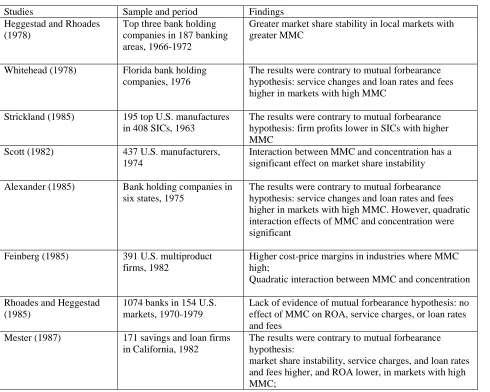
Empirical work in both economics and strategy fields captured in the combined list
presented some conflicting results about the occurrence of mutual forbearance among firms. Five
studies found results contrary to mutual forbearance hypothesis (Alexander 1985; Mester 1987;
Rhoades and Heggestead 1985; Strickland 1985; Whitehead 1978). However, twenty studies
carried out in diverse industry settings found evidence of mutual forbearance (Heggestad and
Rhoades 1978; Scott 1982; Feinberg 1985; Sandler 1988; Martinez 1990; Scott 1991; Cotteril
1994; Baum and Korn 1996; Gimeno and Woo 1994; Jans and Rosenbaum 1996; Boeker,
Goodstein, Stephan, and Murmann 1997; Parker and Roller 1997; Fernandez and Marin 1998;
Baum and Korn 1999; Gimeno 1999; Gimeno and Woo 1999). According to Jayachandran et al.
(1999), one possible explanation for the lack of support might be the use of cross-sectional rather
than longitudinal data. Indeed, four out of five studies use cross-sectional settings except for
Rhoades and Heggestead (1985), all other, and not surprisingly, empirical evidence based on
longitudinal studies has largely supported the deterrence effect of multimarket contact on the
[image:21.612.68.558.329.721.2]intensity of competition.
Table 2.2 – Empirical studies on multimarket competition (1978-1999)
Studies Sample and period Findings
Heggestad and Rhoades (1978)
Top three bank holding companies in 187 banking areas, 1966-1972
Greater market share stability in local markets with greater MMC
Whitehead (1978) Florida bank holding companies, 1976
The results were contrary to mutual forbearance hypothesis: service changes and loan rates and fees higher in markets with high MMC
Strickland (1985) 195 top U.S. manufactures in 408 SICs, 1963
The results were contrary to mutual forbearance hypothesis: firm profits lower in SICs with higher MMC
Scott (1982) 437 U.S. manufacturers,
1974
Interaction between MMC and concentration has a significant effect on market share instability
Alexander (1985) Bank holding companies in six states, 1975
The results were contrary to mutual forbearance hypothesis: service changes and loan rates and fees higher in markets with high MMC. However, quadratic interaction effects of MMC and concentration were significant
Feinberg (1985) 391 U.S. multiproduct
firms, 1982
Higher cost-price margins in industries where MMC high;
Quadratic interaction between MMC and concentration
Rhoades and Heggestad (1985)
1074 banks in 154 U.S. markets, 1970-1979
Lack of evidence of mutual forbearance hypothesis: no effect of MMC on ROA, service charges, or loan rates and fees
Mester (1987) 171 savings and loan firms
in California, 1982
The results were contrary to mutual forbearance hypothesis:
When MMC was accompanied by high concentration, the intensity of competition was greater
Sandler (1988) 123 U.S. airline markets, before (1974-1976) and after (1978-1980) deregulation
MMC is related positively to rivalry
Martinez (1990) 100 largest bank holding companies, 1984-1989
Greater stability in size rankings of banks in local markets with greater MMC
Scott (1991) 64 U.S diversified firms in
35 oligopolistic industries, 1950
MMC leads to better firm performance; diversified sellers‟ concentration has its strongest effect on profits earned within an industry when MMC among the sellers is high
Cotteril and Haller (1992) 20 largest U.S. supermarket chains, 1971-1981
Lower market entry rates when the number of other large chains in the market already high
Barnett (1993) Life history of every firm in the CPES sector of the telephone industry, 1981-1986
Lower exit rates from state markets with higher MMC.
Hughes and Oughton (1993)
418 U.K. manufacturers in 134 three-digit SIC industries, 1979
Price-cost margins and industry rate of return on capital higher in industries with higher MMC
Singal (1996) 14 mergers among airline
companies, 1984-1987
Airlines earned higher yields when MMC higher
Evans and Kessides (1994)
1000 largest U.S. airline city-pair routes, 1984-1988
Major airlines set higher fares on routes with higher MMC
Baum and Korn (1996) 40 California commuter airlines, 1979-1984
Lower entry and exit rates from routes where MMC with competitors higher;
interaction between MMC and spheres of influence was significant, whereas interaction between MMC and concentration was insignificant
Gimeno and Woo (1994, 1996)
48 airlines in 3171 U.S. city-pair routes, 1984-1988
Major airlines earned higher yields on routes where their MMC with competitors higher; Strategic similarity moderately increases rivalry
Jans and Rosenbaum (1996)
25 U.S. regional cement markets, 1974-1989
Interaction between MMC and concentration has a significant positive effect on price
Boeker, Goodstein, Stephan, Murmann (1997)
286 California hospitals in 163 product markets (services), 1980-1986
Lower exit rates from product markets where MMC with competitors higher
Parker and Roller (1997) U.S. mobile telephone industry
In examining mutual forbearance, researchers have measured the intensity of competition
using different approaches. Some studies infer the operation of mutual forbearance from higher
profits (Hughes and Houghton 1993; Feinberg 1985; Scott 1982, 1991), higher prices (Evans and
Kessides 1994; Fernandez and Marin 1998; Jans and Rosenbaum 1996; Parker and Roller 1997),
higher yields (Gimeno and Woo 1994, 1996; Singal 1996), greater market share stability
(Heggestad and Rhoades 1978), and greater stability in size rankings (Martinez 1990).
Rather than examining the outcomes, other studies measure the intensity of competition
through actual market entry and/or exit behavior (Barnett 1993; Boeker et al. 1997; Baum and
Korn 1996), applying the mutual forbearance hypothesis in the following way: Firms are less
likely to enter new markets in which the multimarket contact with incumbents is high, and are
less likely to exit from current markets in which the multimarket contact is high.
2.2.2 The 1999-2008 period
Empirical work conducted during this period is shown in Table 2.3. An interesting
characteristic of this period is that studies move away from traditional industries (e.g.
(1998) Spain concentration; and a negative effect at high levels of
concentration
Baum and Korn (1999) 15 California commuter airlines, 1979-1984
Inverted U-shaped relationship between rates of market entry and exit and MMC; Interactions (MMC and relative MMC, MMC and relative firm size) were significant
Gimeno (1999) 48 airlines in 2897 U.S. city-pair routes, 1984-1988
Reciprocal MMCs decreases rivalry (high prices) and increases market share sustainability more than nonreciprocal MMCs
Gimeno and Woo (1999) 28 airlines in 3000 U.S. city-pair routes, 1984-1988
manufacturing and banking), examining multimarket competition in empirical settings as diverse
as the prescription drug industry (Shankar 1999), the software industry (Young et al. 2000),
newspapers chains (Fu 2003), and fast food chains in Texas (Kalnins 2004). Also, studies look at
multimarket issues in countries other than the U.S., such as Canada (Li & Chuang, 2001; Li &
Greenwood, 2004), Japan (Greve 2000, 2006), Norway (Greve, 2008b), and Spain (Fuentelsaz &
Gomez 2006), and many examine multimarket behavior across countries (Chintagunta &
Desiraju 2005; Gimeno, Hoskisson, Beal, & Wan, 2005; Yu & Cannella 2007). Broadening the
scope of multimarket studies has greatly contributed to the field. For example, there is now
mounting evidence of mutual forbearance in under-researched industries as well as other
countries, a situation that strengthens the theoretical validity of multimarket constructs and that
adds more reputation to research on competition in multimarket contexts.
Similarly to earlier studies, some empirical studies infer mutual forbearance from evidence of
decreased rivalry or enhanced performance. Findings of these studies do not differ substantially
from those reported by Jayachandran et al. (1999) and Korn and Baum (1999). In general, the
evidence of mutual forbearance under conditions of high multimarket contact is still supported,
in terms of both decreased rivalry (Chintagunta and Desiraju 2005; Shankar 1999) and enhanced
performance (Fu 2003; Gupta 2001; Li and Greenwood 2004; Pilloff 1999).
Table 2.3 – Empirical studies on multimarket competition (1999-2008)
Studies Sample and period Findings
Korn and Baum (1999) 15 California commuter airlines in 105 competitor dyads, 1979-1984
Pilloff (1999) 6233 U.S. banks, 1992-1995 MMC outside of a reference market lessens competition in the reference market and hence enhances performance (ROA) of a focal bank
Shankar (1999) 23 entries and 59 incumbent
responses from the U.S. prescription drug industry, 1970s and the 1980s
A brand‟s introductory marketing spending is lower if the entering firm has MMC with the incumbents.
Greve (2000) 174 Tokyo-based banks in 20
geographic markets, 1894-1936
Density dependence, imitation of large firms‟ decisions, and momentum are sufficient for predicting branch location decisions.
Organizations are likely to establish multimarket contacts with single-market competitors, but unlikely to do so with multimarket competitors, contradicting the mutual forbearance hypothesis
Haveman and Nonnemaker (2000)
321 California savings and loan companies in 58 counties, 1977-1991
Inverted U-shaped relationship between rates of market growth and entry and MMC; interaction between MMC and market dominance was positively significant
Young, Smith, Curtis, Grimm, Simon (2000)
152 observations of 20 U.S. software firms, 1987-1991
Less attacks in product markets where MMC with competitors higher, and faster retaliation in product markets where MMC with competitors higher
Gupta (2001) 1738 projects with 8943 bids in
highway procurement auctions in Florida, 1981-1986
Propensity to collude increases with MMC as repeated contacts among firms are found to have a positive effect on the winning low bid which leads to higher profit.
Li and Chuang (2001) 232 Canadian general insurance companies,
1992-1998
Multimarket firms‟ performance in a given market depends on the number and simplicity of their strategic actions – both absolutely and vis-à-vis those of others competing in the market unit.
Audia, Sorenson, Hage (2001)
All American shoes manufacturing plants, 1940-1989
As the degree of multimarket contact increases, the likelihood of firm exit declines.
Gimeno (2002) 28 airlines in 3000 U.S. city-pair routes, 1984-1988
Multimarket contacts established by chance have the same effect on competition as intentional multimarket contacts
Fu (2003) 465 daily newspapers in the
U.S. midwestern states, 1998
Evidence of spheres of influence: strong linkage between the MMC and reduced circulation competition. Also, advertising rates are distinctly higher in MMC markets
Stephan, Murmann, Boeker, Goodstein (2003)
395 hospitals in California in 163 product markets (services)
For instance, Fu (2003) found that newspaper chains reduce circulation competition. From the
spheres of influence logic, newspaper chains decrease the level of rivalry in non-core markets in Kalnins (2004) 978 units of 3 fast-food chains
in Texas, 1980-1995
Lower entry rates into locations with same franchise branches present (i.e. markets with large divisional MMC)
Li and Greenwood (2004) 276 Canadian general insurance companies, 1993-1998
Main effects: Multimarket competition per se results in lower performance.
Moderators: Resource similarity positively moderates the relationship between MMC and performance
MMC between dissimilar firms may fail to deter competitive aggression because they have not developed familiarity with each other, which enables forbearance and raises performance
Chintagunta and Desiraju (2005)
Observations on antidepressants (Prozac, Zolotf, and Paxil) across the U.S., the U.K., Germany, France, and Italy
Evidence of spheres of influence: Market
interactions in the U.S. market soften competition in the Italian market, but make the interactions between brands more competitive in the U.K. market.
Gimeno, Hoskisson, Beal, Wan (2005)
43 U.S. telecommunications firms in 5 countries, 1985-1995
Domestic market positions of focal firms and prior movers influence mimetic international entry behavior.
Gimeno, Chen, Bae (2006) 54 US airlines in 4,994 domestic city-pair markets, 1979-1995
Firms faced with intense rivalry reposition themselves away from the most similar
competitors in terms of served markets (those with high market overlap)
Greve (2006) 174 Tokyo-based banks,
1894-1936
Firms avoid extensions of MMC beyond the minimum of 2 contacts
Firms enter markets with competitors that have high intentional contact.
Fuentelsaz and Gomez (2006)
77 Spanish savings banks, 1986-1999,
34,529 bank-market-year observations
Main effect: There is an inverted U-shaped relationship between MMC and market entry rate Moderators: The effect of MMC is greater when multimarket rivals are more dissimilar, and is lesser when contacts are reciprocal.
Yu and Cannella (2007) 13 largest global automobile firms, 27 countries, 1995-2001
The degree of MMC an MNE has with a given rival is positively related to its response speed.
Greve (2008b) 329 firms from the insurance
industry in Norway, 1912-1986
Defection from mutual forbearance is more likely in markets where the focal firm has few
(Gimeno, 1999). Advertising rates are also found to be relatively higher in MMC markets (Fu
2003). Pilloff (1999) also reports enhanced firm performance in a longitudinal study of 6,000
U.S. banks. He found that a firm‟s presence in markets outside the firm‟s core market lessens
competition, thus leading to enhanced firm performance.
Of particular importance, recent empirical work has challenged some of the mutual
forbearance assumptions. For example, in its original conceptualization, the mutual forbearance
model assumes perfect monitoring, that is to say, defections from the collusive equilibrium are
always detected and punished (Bernheim and Whinston 1990). However, Matsushima (2001)
theoretically proved that collusive equilibrium can be held under conditions of imperfect
monitoring if the likelihood of being discovered is high. Greve (2008b) tested this argument by
conducting his research in an empirical context with less observable pricing and quality – the
insurance industry in Norway – and found support for these ideas.
Another important point about recent research on multimarket competition is that studies
within strategy field, different than those within IO economics (e.g. Evans and Kessides 1994),
use information on actual competitive actions to measure competitive behavior, rather than
inferring mutual forbearance from higher prices, for example. Young, Smith, Curtis, Grimm and
Simon (2000), providing an empirical test of Chen‟s (1996) propositions, found that under
conditions of high MMC with competitors, an attack is less likely, but if it occurs, the retaliation
will be faster. In a large scale study, Yu and Cannella (2007) found similar results among the
thirteen largest global automobile manufacturers operating in 27 countries. Li and Chuang
(2001) examined the impact of competitive interaction among multimarket firms at the market
their strategic actions – both absolutely and vis-à-vis those of others competing in the market
unit.
Market entry and exit, as observable events of competitive behavior (Chen 1996) have been
extensively investigated. Since this dissertation focuses on the relationship between multimarket
contact and market entry/exit decisions, empirical research on this relationship is summarized
and reviewed in the next section.
2.3 Competitive antecedents of market entry and exit
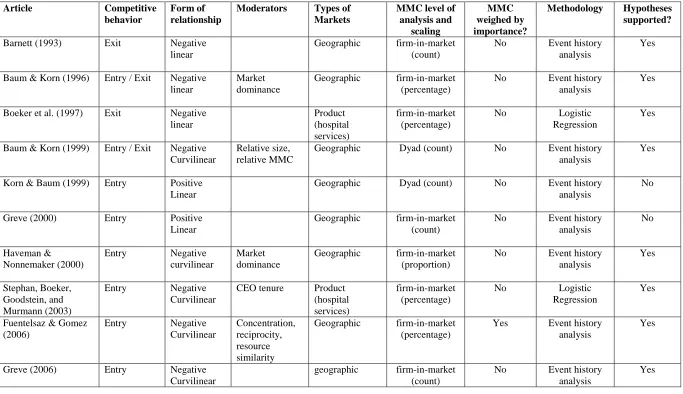
Table 2.4 presents detailed information about each study on the relationship between
multimarket contact and market entry/exit: form of relationship, types of markets, moderators,
empirical setting, and empirical testing issues (MMC‟s level of analysis and scaling, whether
MMC is weighed by importance, methodology used, and whether hypotheses are supported).
2.3.1 Form of relationship
Eight studies examine market entry decisions only (Korn and Baum 1999; Greve 2000;
Haveman and Nonnemaker 2000; Stephan et al. 2003; Fuentelsaz & Gomez 2006; Greve 2006),
two studies examine market exit decisions only (Barnett 1993; Boeker et al. 1997), and two
studies examine both market entry and exit decisions (Baum and Korn 1996, 1999).
Studies have predicted different forms of relationship between multimarket contact and
market entry/exit. Earlier empirical work has examined the dampening effects of multimarket
contact on rates of entry and exit (Barnet 1993; Baum and Korn, 1996; Boeker et al. 1997), as
they hypothesize a negative linear relationship between the constructs. Results support the
contact increases. Indeed, the theoretical logic in earlier work has been primarily built on the
forbearance effect that is created once multimarket contact levels are high. However, it does not
explain how multimarket structures are created in the first place (Korn & Baum 1999). As
Stephan et al. (2003, p. 404) put it: “Firms and their managers, not only find themselves in
multimarket structures, but must construct them as well.”
In filling this gap, recent studies have proposed a revised relationship between multimarket
contact and competitive behavior. Studies have consistently found an inverted-U-shaped rather
than a negative linear relationship between multimarket contact and market entry (Baum & Korn
1999, Greve 2006; Haveman & Nonnemaker 2000; Stephan et al. 2003; Fuentelsaz & Gomez
2006), as shown in Figure 2.2. This relationship is characterized by escalation of competition
below a certain threshold for which the likelihood of competing aggressively reaches its
maximum, and de-escalation of competition above this threshold, when firms recognize the
interdependence of their markets, and because of the threat of retaliation, do not engage in
aggressively competitive behavior.
In
te
n
sity
o
f
co
m
p
e
titi
o
n
MMC Threshold
In
te
n
sity
o
f
co
m
p
e
titi
o
n
MMC Threshold
Evidently, there are alternative explanations for market entry and exit. Some studies propose
behavioral models with competing hypotheses in which the initiation and further expansion of
multimarket contact have antecedents other than the level of multimarket contact (Greve 2000;
Korn & Baum 1999), and, at the extreme, these decisions can be attributed to chance (Korn &
Baum 1999). Researchers in this stream draw from organizational ecology, behavioral, and
institutional theories, and argue that if multimarket contact is such a pervasive construct, it is
important to examine other causes for its creation and existence.
Korn & Baum (1999) examines the influence of chance, behavioral, and mimetic processes
in the creation of multimarket structures. They found that multimarket structures will emerge as
a result of chance but that subsequent market entry will be determined by mimetic processes.
Similarly, Greve (2000) examine market entry decision by proposing four competing predictions.
Market entry decisions can be influenced by density of firms in the focal market (the
organizational ecology argument), mimetic processes in which firms will seek legitimacy (the
institutional argument), momentum processes in which firms will repeat behaviors that have
Table 2.4 – Empirical research on MMC and Market Entry/Exit
Article Competitive
behavior
Form of relationship
Moderators Types of
Markets
MMC level of analysis and
scaling
MMC weighed by importance?
Methodology Hypotheses
supported?
Barnett (1993) Exit Negative
linear
Geographic firm-in-market (count)
No Event history
analysis
Yes
Baum & Korn (1996) Entry / Exit Negative linear
Market dominance
Geographic firm-in-market (percentage)
No Event history
analysis
Yes
Boeker et al. (1997) Exit Negative
linear Product (hospital services) firm-in-market (percentage)
No Logistic
Regression
Yes
Baum & Korn (1999) Entry / Exit Negative Curvilinear
Relative size, relative MMC
Geographic Dyad (count) No Event history
analysis
Yes
Korn & Baum (1999) Entry Positive Linear
Geographic Dyad (count) No Event history
analysis
No
Greve (2000) Entry Positive
Linear
Geographic firm-in-market (count)
No Event history
analysis
No
Haveman & Nonnemaker (2000)
Entry Negative
curvilinear
Market dominance
Geographic firm-in-market (proportion)
No Event history
analysis
Yes
Stephan, Boeker, Goodstein, and Murmann (2003)
Entry Negative
Curvilinear
CEO tenure Product
(hospital services)
firm-in-market (percentage)
No Logistic
Regression
Yes
Fuentelsaz & Gomez (2006)
Entry Negative
Curvilinear
Concentration, reciprocity, resource similarity
Geographic firm-in-market (percentage)
Yes Event history
analysis
Yes
Greve (2006) Entry Negative
Curvilinear
geographic firm-in-market (count)
No Event history
analysis
firms will seek deterrence (the forbearance argument). He found that market entry decisions
involve momentum and mimetic processes, and mutual forbearance benefits are the least concern
for decision-makers.
Interestingly, by focusing on the bottom line of multimarket strategies – the performance
effect of intentional and unintentional multimarket contacts – Gimeno (2002) was able to
reconcile both views on the emergence of multimarket contacts. Using the typology of strategies
developed by Mintzberg et al. (1985), he views the intentional market expansion as a deliberate
strategy, and the unintentional market expansion determined by chance, as an emergent strategy.
He examined the influence of these strategies on subsequent performance and found that
multimarket structures will lead to a higher level of performance, regardless of the type of
strategy pursued. In other words, the performance effect is determined by the realized strategy.
2.3.2 Moderators
Equally importantly, studies have also examined whether and how moderators influence the
relationship between multimarket contact and market entry and exit. Baum & Korn (1996) and
Haveman & Nonnemaker (2000) found a significant positive moderating effect of market
dominance on market entry, meaning that the effect of multimarket contact will be stronger in
markets dominated by a very few firms, which is consistent with IO expectations (Porter 1980).
Asymmetry in competitors‟ size also has an impact on the mutual forbearance effect. For
example, Baum and Korn (1999) found that as multimarket contact increases, smaller
competitors will be less likely to enter and more likely to exit from a larger competitors‟ markets. Moreover, asymmetry in a firm‟s level of multimarket contact with a given competitor
multimarket contact and market entry. Specifically, Baum and Korn (1999) found that firms
direct their competitive efforts towards low multimarket contact competitors as a consequence of
forbearing from rivalrous actions with competitors with which they have higher multimarket
contact. Similarly, the operation of the spheres of influence was found significant as the
reciprocity of contacts amplifies the dampening effect of multimarket contact on market entry
rates (Fuentelsaz & Gomez 2006).
Theoretical studies have long emphasized the importance of bringing resource similarity into
competitive dynamics theory (Chen 1996; Jayachandran et al., 1999), and empirical studies have
confirmed the significant effects of resource similarity on the relationship between multimarket
contact and intensity of competition. For example, multimarket contact is more influential on
competitive actions of firms with dissimilar resources (Fuentelsaz & Gomez, 2006), as the
information provided by the multimarket contacts might be the only mechanism in achieving
tacit coordination when interfirm dissimilarity impairs the interpretation of mutual forbearance
signals.
Only one study examines the effects of risk preferences on the mutual forbearance
hypothesis. Stephan et al. (2003) focus on the role of a firm‟s CEO in pursuing strategic change,
represented by entry into new markets. They argue that newer and longer-tenured CEOs are
likely to have different preferences for particular competitive actions. Whereas the former has a
mandate for change and are less likely to abide by the tacit agreements with competitors, the
former are more likely to rely on what worked for them in the past. Consequently, longer-tenured
CEOs would be more sensitive to the implications of multimarket contact than newer CEOs.
In sum, current research in market entry and exit have examined the moderating effects of
independent variables at the market- (market dominance), the firm- (CEO tenure), and the dyad
levels (relative size, relative multimarket competition, and resource similarity).
2.3.3 Empirical setting
The majority of studies examines market entry and exit in geographic markets (Barnett 1993;
Baum and Korn 1996, 1999; Korn and Baum 1999; Greve 2000, 2006; Haveman and
Nonnemaket 2000; Fuentelsaz and Gomez 2006). Only two studies analyze entry into and exit
from product markets (Boeker et al. 1997; Stephan et al. 2003), specifically the hospital services.
It is important to understand the empirical context in which the studies have been conducted. I
was able to identify characteristics of the industries under observation in seven studies (Barnett
1993; Baum and Korn 1996, 1999; Korn and Baum 1999; Fuentelsaz and Gomez 2006; Greve
2000, 2006), but for the remaining studies (Boeker et al. 1997; Haveman and Nonnemaker 2000;
Stephan et al. 2003), I had to search for authors‟ previous articles.
Baum and Korn (1996, 1999) tested their hypotheses using data describing city-pair market
changes of commuter air carriers operating in California from 1979 to 1984. In this period,
federal deregulation triggered an intense period of reorientation and competitive interaction.
Fuentelsaz and Gomez (2006) look at entry behavior into new geographic markets in the Spanish
savings banks industry after industry‟s deregulation – when restrictions to branching were
eliminated – between 1986 and 1999. They explicitly report that multimarket contact in 1986
was almost inexistent. Greve (2000, 2006) examine the establishment of Tokyo-based banks in
20 geographic markets. Haveman and Nonnemaker (2000) use data from the savings and loan
faced deregulatory initiatives that transformed their competitive environment from placid and
constrained to uncertain and volatile (Haveman 1993). Finally, Stephan et al. (2003) examined
hospitals in California in the period between 1980 and 1986. This was a particularly turbulent
period for the U.S. health care sector in which new regulations intensified competition
(Goodstein, Boeker, and Stephan 1996).
In sum, although the reviewed studies use data from different time periods and different
industries (thrifts, savings banking, airlines, hospitals), they have one aspect in common: that the
industries under observation were experiencing intense regulatory changes and heightened
competition.
2.3.4 Empirical testing
Empirical work on multimarket competition has used different measures of the multimarket
contact construct, as shown in Table 2.4. The possible levels of multimarket contact measure are
summarized in Table 2.5: market level, firm-in-market level, and dyad level. A market level of
multimarket contact captures the level of multimarket contact among all incumbents in a market.
Such a level of measure reflects the IO economics roots of the multimarket competition
literature. IO economists have a deep-rooted interest in discovering whether concentration in a
particular industry poses antitrust dangers to consumers (Scherer and Ross 1980). None of the
studies use measures at this level of analysis because market-level multimarket contact is an
Table 2.5 – Levels of Analysis of Multimarket Measures
Level Notation Definition Cross-level relationship
Dyad level
ijm
MMC
Number of markets in which firms i and j meet outside focal marketm
The most basic level
Firm-in-market level
im
MMC
Number of markets in which firm meets all its competitors outside ifocal market m
The sum of dyad level across all markets outside focal market m
Market level
m
MMC
Number of markets in which all firms meet each other outsidefocal market m
The sum of dyad level across all firms and markets outside focal market m
Firm-in-market level of measure captures a focal firm‟s contact with all its rivals across all
markets. This level of measure is suitable for studies of the competitive activity of firms within
specific markets (Gimeno and Jeoung 2001). The majority of studies analyze the effects of
multimarket contact at the firm-in-market level (Barnett 1993; Baum and Korn 1996; Boeker et
al. 1997; Greve 2000, 2006; Haveman and Nonnemaker 2000; Stephan et al. 2003; Fuentelsaz
and Gomez 2006). Dyad level of measures focuses on the competitive interaction between two
firms, representing the most basic level of analysis (Gimeno and Jeoung 2001). Only two studies
examine multimarket competition at this level: Baum and Korn (1999) and Korn and Baum
(1999). Gimeno and Jeoung (2001) argue that the dyadic level may be more appropriate in
examining actions that are dyadic in nature, such as attack against a specific rival.
Studies differ in how they capture the level of multimarket contact. In its most basic form,
multimarket contact describes the count of multimarket contacts that a firm has with incumbents
outside the focal market (Barnett 1993; Greve 2000, 2006), whereas some studies calculate the
percentage of multimarket contact, i.e. the ratio of the count of multimarket contacts to the total
number of markets in which they operate (Baum and Korn 1996; Boeker et al. 1997; Stephan et
potential entrant to a target market operates in 5 markets. If this potential entrant already
encounters with one of the target market‟s incumbent in 3 markets, they have a multimarket
contact of 60%. The level of multimarket contact would go down to 6% if the focal firm
operates in 50 markets, and the count measure of multimarket contact would still be 3 in both
situations.
According to the mutual forbearance logic, some contacts may be more important than
others. Hence, some studies weigh the contacts according to their strategic importance in an
attempt to model how managers weigh their market entry and exit decisions (e.g. Fuentelsaz and
Gomez 2006). Yet Gimeno and Jeoung (2001) urge researchers to weigh their multimarket
measures only when there are theoretical grounds, because the use of different scales and
weights can alter the distribution of the measures.
Finally, in estimating the effect of multimarket contact on market entry and exit, studies
have applied two different methodologies: logistic regression modeling (Boeker et al. 1997;
Stephan et al. 2003) and event history analysis (Barnett 1993; Baum and Korn 1996, 1999; Korn
and Baum 1999; Greve 2000, 2006; Haveman and Nonnemaker 2000; Fuentelsaz and Gomez
2006). The use of either methodology does not seem to impact the expected results since the
inverted-U-shaped curve was found in studies using both types of methods. The differences and
suitability of these methodologies are discussed in more detail in Chapter 5.
2.4 Behavioral antecedents of market entry and exit
Market entry and exit decisions are considered corporate strategic decisions and, as such, are
Schendel, & Teece, 1994). The behavioral perspective has been applied to the study of such
decisions. Regarding market entry, Haleblian, Kim, Rajagopalan (2006), using a sample of U.S.
commercial banking industry, found that acquisition performance positively influenced the
likelihood of a firm‟s making a subsequent acquisition. Iyer and Miller (2008) examined the
effect of performance relative to aspiration level – the attainment discrepancy (Lant, 1992) – and
found that acquisition activity increases as performance rises among firms performing below
aspiration level, but fall among firms performing above aspiration level in a sample of U.S.
manufacturing firms.
Using different terms to define market exit (e.g. sell-offs, spin-offs, divestiture, divestment),
many studies support a negative relationship between firm performance and exit, in that as firm
performance decreases, the likelihood of exit increases (Montgomery and Thomas 1988;
Ravenscraft and Scherer 1991; Chang 1996; Steiner 1997). The main rationale is that external
pressures in the form of low company profits help break down the divestment barriers.
While some studies focus on the effect of firm performance, others look at both the business
unit and firm performance levels. Some studies also analyze relative performance, that is to say,
the business unit performance related to the core business performance or the core industry
performance. For example, Duhaime and Grant (1984) found that low competitive and financial
strength of the business unit relative to industry peers can trigger exit decisions, and Markides
(1992) found that a firm is more likely to divest business units the higher the profitability and
advertising intensity of its core industry. However, Cho and Cohen (1997) raise an important
characteristic of the relationship between units. They argue that because of cross subsidization
from profitable business units, firms do not sell off poorly performing business units until the
Current research on the relationship firm performance and market exit decisions pay now
more attention to the interaction effects of performance and other independent variables. Sanders
(2001), for example, defines firm performance as a situational characteristic that affects the
divestiture decisions. Observing 250 firms from the Standard and Poor‟s 500 (S&P 500), he
found that poor performance not only results in negatively framed decisions, but also increases
the CEO's role in such negative outcomes. Shimizu and Hitt (2005) investigated factors that
constrain and facilitate divestment of business units as performance decreases. They found that
factors contributing to organizational inertia (e.g. size and age) delay the divestiture of poorly
performing acquired units, but factors that decrease organizational inertia (e.g. new CEO) are
found to accelerate the divestiture of poorly performing units. In a recent study, Shimizu (2007)
proposes a multi-level model that integrates arguments from three distinct theories: prospect
theory, behavioral theory of the firm and the threat-rigidity thesis. Studying the divestiture of
formerly acquired units, he found that these decisions are influenced by psychological and
organizational factors that increase or decrease the likelihood of divestiture as unit performance
decreases.
2.5. Conclusion: Gaps in current research and opportunities for future research
In the next paragraphs, I identify gaps in prior research and explain how this dissertation seeks to
address them.
2.5.1 Market entry and exit as changes in a firm‟s business scope
Across all corporate strategy studies reviewed, there is one recurring theme: entry and exit
acquired and exit implies that business units are being sold, spun-off, or carved-out and assets
are being transferred to new owners. Thus, the focus is more on the adjustment in ownership than
the adjustment in the scope of the firm. Yet the central question posed by theoretical and
empirical research in corporate level strategy is: “In what product markets and businesses should
the firm compete?”
When focusing on ownership changes, one overlooks the possibility that changes in a firm‟s
business portfolio may not involve transfer of ownership, as firms can enter into new markets or
exit from markets by internally restructuring. For example, MBNA in England decided to
withdraw from the consumer lending market, but it has not sold its business unit. Rather, it has
internally restructured its operations by transferring 400 employees to other areas of the
company (Gleeson 2007).
The conceptualization that closely approaches the idea of entry and exit decisions as changes
in a firm‟s scope is the one adopted in multimarket studies (e.g. Baum and Korn 1996; Gimeno
and Woo 1996). In this dissertation, every firm is conceived to occupy a market domain, defined as “the set of markets in which a firm operates” (Baum and Korn 1996, p. 256). This definition is
aligned with D‟Aveni‟s (2001, p. 4) definition of a firm‟s business portfolio as a “geo-product
portfolio, consisting of geo-product markets”. A company‟s geo-product portfolio represents “the
company‟s position on the competitive space delineated by geographies and by the company‟s
products and services” (D‟Aveni 2001, p. 4). This definition of market provides a granular view
of the changes in the scope of the firm in terms of product and geographic markets served.
and market exit is conceptualized as the withdrawal from a given market, regardless of how exit
is pursued (e.g. sell-off, dissolution, internal restructuring, etc).
2.5.2 The overlooked argument in corporate strategy literature
Few strategic decisions draw so much attention from the corporate world and can have such
an influence on a firm‟s success as corporate diversification decisions. Accordingly, the
relationship between diversification and firm performance as well as the investigation of its
antecedents are at the core of much of corporate strategy research (Palich, Cardinal, Miller,
2000).
In line with arguments first advanced by Penrose (1959) and Teece (1982), most research
emphasizes the role of internal determinants of diversification, such as firm-specific resources
and capabilities (e.g. Miller, 2004; Farjoun, 1998; Markides and Williamson 1996; Robins and
Wiersema 1995). However, the influence of the competitive context on diversification decisions
is also a noteworthy factor (Gimeno, Hoskisson, Beal, and Wan, 2005). For instance,
profitability in a focal business depends not only on a firm‟s economies of scope, but also on its
rivals‟ economies of scope and its competitive interaction with their rivals (Gimeno and Woo,
1999; Li and Greenwood, 2004). Hence, this dissertation seeks to fill this gap by focusing on the
competitive antecedents of corporate strategic decisions.
2.5.3 A behavioral perspective of multimarket competition
Research in multimarket competition has been instrumental in bringing the competitive