Georgia State University
ScholarWorks @ Georgia State University
Respiratory Therapy Theses Department of Respiratory Therapy
8-11-2015
Cultural Competency Among Undergraduate and
Graduate Respiratory Therapy Students
Ziyad Alshehri
Follow this and additional works at:https://scholarworks.gsu.edu/rt_theses
This Thesis is brought to you for free and open access by the Department of Respiratory Therapy at ScholarWorks @ Georgia State University. It has been accepted for inclusion in Respiratory Therapy Theses by an authorized administrator of ScholarWorks @ Georgia State University. For more information, please [email protected].
Recommended Citation
Alshehri, Ziyad, "Cultural Competency Among Undergraduate and Graduate Respiratory Therapy Students." Thesis, Georgia State University, 2015.
ACCEPTANCE
This thesis, CULTURAL COMPETENCY AMONG UNDERGRADUATE AND GRADUATE RESPIRATORY THERAPY STUDENTS, by Ziyad Alshehri, RRT-NPS, was prepared under the direction of the Master’s Thesis Advisory Committee of the Respiratory Therapy department at Georgia State University. It is accepted by the committee in partial fulfillment of requirements for the Master’s of Science degree in Respiratory Therapy at Byrdine F. Lewis School of Nursing and Health Professions, Georgia State University.
The Master’s Thesis Advisory Committee, as representatives of the faculty, certifies that this thesis has met all standards of excellence and scholarship as determined by the faculty.
Date
Lynda T. Goodfellow, Ed.D., RRT, FAARC Committee Chair
Date
Ralph D. Zimmerman, MSM, RRT-NPS Committee Member
Date
AUTHOR’S STATEMENT
In presenting this thesis as partial fulfillment of the requirements for the advanced degree from Georgia State University, I agree that the library of Georgia State University shall make it available for inspection and circulation in accordance with its regulations governing materials of this type. I agree that permission to quote, to copy from, or to publish this thesis may be granted by the professor under whose direction it was written, by the Byrdine F. Lewis School of
Nursing & Health Professions director of graduate studies and research, or by me. Such quoting, copying, or publishing must be solely for scholarly purposes and will not involve potential financial gain. It is understood that any copying from or publication of this thesis, which involves potential financial gain, will not be allowed without my written permission.
Author
NOTICE TO BORROWERS
All these deposited in the Georgia State University Library must be used in accordance with stipulations prescribed by the author in the preceding statement. The author of this
thesis is:
Ziyad Alshehri, RRT-NPS 136 Summer Crossing Dunwoody, GA 30350
The director of this thesis is:
Lynda T. Goodfellow
Associate Dean for Academic Affairs
Byrdine F. Lewis School of Nursing and Health Professions Georgia State University
Atlanta, Georgia 30303-4019
Users of this thesis not regularly enrolled as students of Georgia State University are required to attest acceptance of the preceding stipulation by signing below. Libraries borrowing this thesis for use of their patrons are required to see that each user records here the information requested:
CULTURAL COMPETENCY AMONG UNDERGRADUATE AND GRADUATE RESPIRATORY THERAPY STUDENTS
A thesis submitted by
Ziyad Alshehri, BSRT, RRT-NPS
in partial fulfillment of requirements for the degree of Masters of Science
in Health Sciences
in
The Department of Respiratory Therapy Under the supervision of Dr. Lynda T. Goodfellow
in the
Byrdine F. Lewis School of Nursing and Health Professions Georgia State University,
CULTURAL COMPETENCY AMONG UNDERGRADUATE AND GRADUATE RESPIRATORY THERAPY STUDENTS
By
Ziyad D Alshehri
(Under the Direction of Dr. Lynda T. Goodfellow) ABSTRACT
Background: In the United States, minorities are numerous and account for 28% of the population. It is well known that some of the cultural elements are related to the patients’ health. Therefore, it is an obligation of healthcare providers to become culturally competent to improve minorities’ overall healthcare.
PURPOSE: This study was conducted to assess the cultural attitudes, skills, and knowledge of undergraduate and graduate respiratory therapy (RT) students at an urban university located in the southeastern United States.
METHODS: The study used a descriptive exploratory design with a self-reporting survey. The survey instrument used was a short version of the Cultural Competence Self-Assessment “ASK” (Attitude–Skills–Knowledge) Scale. The survey was administered to a convenience sample of first and second-year BSRT and MSRT students attending an accredited RT program. The survey consisted of 24 items on a five-point Likert scale. The collected data were analyzed using descriptive statistics and independent samples t-test.
RESULTS: Fifty-three students were surveyed; around two-thirds of the respondents were female. Sixty-eight percent of respondents were BSRT and 22% were MSRT students. First-year students accounted for 56.6% of the respondents and second-year students accounted for 43.4%. The majority of the respondents were under the age of 25. The respondents reported to be ready to practice in the attitude and skills subscale (4.49±.49, 4.20±.62 respectively) but they need practice based on the knowledge subscale (3.80±.86). The statistically significant findings were found between first-year and second-year
respondents in the skills subscale, knowledge subscale, and the total scale. However, there were no statistically significant difference between BSRT and MSRT students.
CONCLUSION: This study found that respondents made progress throughout the RT program. Also, it found that level of education has no effect on cultural competency. This may be because student’s level of cultural competence improves as they advance in their clinical course work and their educational training. The results may assist R T educators to recognize the students’ needs for more information to improve their cultural competency.
ACKNOWLEDGMENTS
I would like to sincerely thank my thesis chair, Dr. Lynda Goodfellow for her support and guidance. I consider myself fortunate to have her as a committee chair. I also wish to express my deep appreciation to my committee members, Prof. Ralph Zimmerman and Prof. Robert Murray for sharing their insights, expertise and time to facilitate this process. A special thanks for Dr. Leung and Dr. Cheung for giving me the permission to use their instrument. Finally, I owe gratitude for the support of my family and friends for cheering me along.
Ziyad Alshehri
Summer 2015
Table of Contents
LIST OF TABLES ... vi
LIST OF FIGURES ... vii
CHAPTER I ...1
Introduction ...1
Purpose of the Study ... 2
Statement of Problem ... 3
Study Questions ... 3
Significance ... 4
Assumptions ... 4
Summary ... 4
CHAPTER II ...6
Review of Literature ...6
Retrieval of Literature ... 6
Culture and Cultural competency ... 6
Cultural Competency in the Health Professions ... 9
Cultural Competency in Respiratory Care ... 11
Health outcomes ... 12
Summary ... 14
CHAPTER III: ... 15
Methodology ... 15
Introduction ... 15
Instrumentation and Research Design ... 15
Sample ... 17
Protection of Human Subjects ... 17
Procedure ... 17
Summary ... 18
CHAPTER IV ... 19
Findings ... 19
Description of Sample... 19
Missing data ... 22
Cultural Competency ASK Instrument Findings ... 22
Research Questions ... 25
Question 1. ... 26
Question 2. ... 26
Question 3. ... 27
Question 4. ... 28
Conclusion... 28
CHAPTER V ... 29
Interpretation of Findings ... 29
Overview of the Study ... 29
Findings Related to Research Question 1. ... 30
Findings Related to Research Question 2. ... 31
Findings Related to Research Question 3. ... 31
Findings Related to Research Question 4. ... 32
Implications for Research ... 32
Recommendations for Future Study ... 33
Limitations... 33
Conclusion... 33
References ... 35
Appendix A: ASK Instrument (short version) and Demographics ... 37
Appendix B: Cover Letter ... 40
Appendix C: permission ... 42
LIST OF TABLES
Table 1: Demographic Data of Undergraduate Degree Respiratory Therapy (BSRT) and Graduate Degree Respiratory Therapy (MSRT) Students (n= 53)
Table 2: Attitude
Table 3: Skills
Table 4: Knowledge
Table 5: Means of ASK Subscales (n=53)
Table 6: Comparing Means by Gender (male n=18 and female n=35)
Table7: Comparing Means for Bachelor Students by Year
Table 8: Comparing Means for Master Students by Year
Table 9: Comparing Means by Level of Education (BSRT n=36 and MSRT n=12)
Table 10: Comparing Means for All Students by Year of Education
LIST OF FIGURES
Figure 1: Students’ Race in Each Year.
Figure 2: Age of Students in Each Year.
CHAPTER I
Introduction
According to the 2010 Census, approximately 28% or 85 million people in the United States are composed of minorities (U.S. Census Bureau, 2010). The minorities are mainly groups such as Asians, African Americans, Hispanics or Latinos, Native Americans, and Middle
Easterners. The continuous change of the demographic landscape of United States produces a notable diverse population with respect to culture. It is known that culture has an impact on overall healthcare outcomes (Betancourt, Green, Carrillo, & Park, 2005). Cultural elements that have been identified in relation to health care include race and ethnicity, age, gender, religion, socioeconomic status, sexual orientation, and disability. Therefore, it is imperative that
healthcare providers become culturally competent to improve minorities’ overall healthcare. Respiratory Therapists (RTs), as other healthcare providers, are increasingly working with multicultural patients (Birnbaum, 2012).
RTs provide care to patients regardless of race, ethnicity, age, or gender and need to be well informed of different cultures. Knowledge about different cultures raises the respiratory therapist’s confidence to work with all patients. A strong sense of cultural norms allows RTs to better approach situations involving culturally diverse patients. Without self-confidence, RTs may be weak in improving and maintaining health and preventing disease. Accordingly, a culturally self-confident respiratory therapist (RT) increases patient satisfaction and quality of healthcare as well as overcoming limitations of racial and ethnic disparities.
Improved connection with patients through cultural competence leads to better
communication, increased trust, and improved diagnoses and treatments of disease (Hagman, 2006; Renfrew et al., 2013). The quality of healthcare should improve as healthcare
professionals, such as RTs, become aware of the cultural factors that affect patients’ perceptions and presentation of illness and pain. In addition, the therapist becomes aware of the cultural barriers that may hinder treatment adherence. (Birnbaum, 2012).
With evidence-based health care guiding the activities of registered respiratory therapists, the Commission on Accreditation for Respiratory Care (CoARC) focuses on competency-based education, which encourages RT programs to produce competent respiratory care practitioners. A recent American Association for Respiratory Care (AARC) task force identifies cultural competence as one of the specific competencies needed by RTs upon entry into practice (Barnes, Gale, Kacmarek, & Kageler, 2010).
Cultural competence in health care has developed as an approach for providing effective health care and improving outcomes of a culturally diverse people by addressing and reducing the factors that may contribute to racial or ethnic disparities in health care (Betancourt, Green, & Carrillo, 2002). Cultural competence as it applies to health care is described as “the ability to provide care to patients with diverse values, beliefs and behaviors, and to tailor care delivery to patients’ social, cultural, and linguistic needs” (Cooper, Vellurattil, & Quiñones-Boex, 2014). Each patient is essentially different and in acknowledging their uniqueness, it is possible to customize health care towards the goal of satisfying their individual needs based on these cultural elements.
Purpose of the Study
The purpose of the study is to assess the attitudes, skills, and knowledge pertaining to the cultural competency of undergraduate and graduate RT students at Georgia State University (GSU). Cultural competence is an important tool to improve health care outcomes despite the
existence of a culturally diverse population of patients who utilize the health care system.
Implication of cultural competence for RTs’ long term is believed to translate to higher standards in terms of delivering quality health care to patients.
The assessment of cultural competency for RT students is also important in evaluating the continuous improvement of the RT students’ performance. Through assessment, it is possible to identify strengths and weaknesses of RT students, both undergraduate and graduate, which can pave the way to identifying concrete plans of action that will result in actual improvement of health care outcomes through cultural competence.
Statement of Problem
A literature review revealed no published data on cultural competence for RT students. With the continuous change in the demographic landscape of the US population, several minority groups are underrepresented among health care professionals. Despite repeated calls for health care providers to provide culturally competent services, many studies have documented disparities in health care among minorities (Betancourt, Corbett, & Bondaryk, 2014; Cabana, Lara, & Shannon, 2007; George, 2001). To keep up with the changes occurring in healthcare, RTs, as all health care professionals, need to advance knowledge and skills in developing a stronger sense of cultural competency.
Study Questions
The following research questions were investigated for this study:
1. What is the degree of cultural attitude, skill, and knowledge of undergraduate RT students?
2. What is the degree of cultural attitude, skill, and knowledge of graduate RT students? 3. How does cultural competence differ between undergraduate and graduate students? 4. Do RT students’ perceptions and understanding of cultural competency improve as they
progress through the RT program?
Significance
Respiratory care is a profession with a western centric background and an evidence-based medical model approach to client care. This study advances RT education by contributing
information about how current curricula improve students’ cultural awareness. Cultural
competency is essential for RT students who are likely to provide care to patients from different cultural backgrounds.
Assumptions
Cultural competency among respiratory therapists is encouraged by CoARC. It is recommended that cultural competency be integrated in RT programs. For these reasons, students preparing for graduation from RT programs should exhibit a higher level of comfort with an understanding about cultural awareness topics as opposed to their peers beginning their first year in the RT program. It is anticipated that RT students are able to provide care to patients from cultures different from their own. In addition, it is expected for the research respondents to respond fairly and to the best of their ability in the survey.
Summary
The impact of culture and diversity on the overall health care of minority groups has been linked to several cultural elements such as race and ethnicity. Therefore, it is crucial that healthcare
professionals become culturally competent to improve minorities’ overall healthcare (Birnbaum, 2012). RT students are anticipated to work with people from different cultural backgrounds. Therefore, knowledge about cultural differences increases the RT students’ confidence to work with all patients. It also contributes to health improvement and disease prevention for all patients.
CHAPTER II
Review of Literature
Retrieval of Literature
This chapter will present a literature review on cultural competency, cultural competency in health professions, and health outcomes. The review of literature was conducted via PubMed, CINHAL, Medline, and Google Scholar using a combination of the following key terms: framework, model, cultural sensitivity, cross-cultural, transcultural, cultural awareness,
measures, evaluation, cultural diversity, multicultural, cultural competence, respiratory therapy, respiratory care, culturally congruent care, and healthcare. This investigation was helpful in answering the following research questions:
1. What is the degree of cultural attitude, skill, and knowledge of undergraduate RT students?
2. What is the degree of cultural attitude, skill, and knowledge of graduate RT students? 3. How does cultural competence differ between undergraduate and graduate students? 4. Do RT students’ perceptions and understanding of cultural competency improve as they
progress through the RT program?
Culture and Cultural competency
Culture is shaped by a set of influences such as race, ethnicity, language, gender, and socioeconomic status (Betancourt et al., 2002). Culture can be defined as a combination pattern of learned beliefs and behaviors that can be shared amongst groups (Betancourt et al., 2002). Members of a cultural group tend to interpret the meaning of symbols and behaviors in similar ways (Norton & Marks-Maran, 2014). Culture may influence how people express their pain.
Chinese patients, for example, may be unwilling to complain of pain because they consider expression of strong emotion to be signs of weak character (Remus, 2004).
An important factor in dealing with health care matters is the level of understanding present among health care providers and their patients. It is important to be able to identify and differentiate how health care providers perceive disease and how patients perceive disease. The health care provider perceives illness as an abnormality of the body whereas the patient’s perception is based on his or her cultural background as affected by the surrounding. Culture controls a person’s perspective on health and disease (George, 2001). Ideas on the rules set for caring for ill patients, whom to seek for assistance, and perception and physical understanding of health and illness are influenced by culture as well (Birnbaum, 2012). With the influence of cultural background, both health care providers and patients develop more of these perceptions in relation to their experiences as shaped by their interpretations of various circumstances in the delivery of health care. Culture also may influence how patients perceive the causation of the illness. For example, some patients may see supernatural, evil eye, or evil spirits as the main cause of their illness (McLaurin, 2002).
Cultural competence is defined as “the process in which the healthcare provider continuously strives to achieve the ability to effectively work within the cultural context of a client (individual, family or community)” (Campinha-Bacote, 1999, p. 203). Cultural
competence as it applies to healthcare is described as “the ability to provide care to patients with diverse values, beliefs and behaviors, and to tailor care delivery to patients’ social, cultural, and linguistic needs”(Cooper et al., 2014, p. 2). Compinha-Bacote (1999) identifies and defines the five constructs of cultural competence as awareness, knowledge, skill, encounters, and desire. “Cultural desire refers to the motivation of healthcare professionals to engage in the process of
becoming culturally competent. Cultural awareness is defined as the deliberate self-examination and in-depth exploration of personal biases, stereotypes, prejudices and assumptions that people hold about individuals who are different from them. Cultural knowledge is the process of seeking and obtaining a sound educational base about culturally diverse groups. A cultural encounter is the act of directly interacting with clients from culturally diverse backgrounds. Cultural skill refers to the ability to collect relevant cultural data regarding the clients presenting problem, as well as accurately performing a physical assessment in a culturally sensitive manner” (Hayward & Li, 2014, p. 24).
Despite the variety of definitions, cultural competence in health care education usually focuses on three areas: attitudes, knowledge, and skills (Engebretson, Mahoney, & Carlson, 2008; Jones, Cason, & Bond, 2004; Loftin, Hartin, Branson, & Reyes, 2013). Developing and improving these areas of cultural competence play an important role in supporting health care providers who are aware of the ethnic and cultural norms that may affect the assessment and diagnosis of their patients (Engebretson et al., 2008; Loftin et al., 2013).
Many educational and organizational institutions have identified the importance of cultural competence to their health care students. The Commission on Collegiate Nursing
Education and the National League for Nursing Accrediting Commission (NLNAC) has outlined requirements for ensuring that undergraduate and graduate nurses are able to provide culturally competent nursing care. Furthermore, the National League for nursing (NLN) and the American Association of College of Nursing (ACCN) have specified cultural competency as a core
competency for Nurses (Mareno & Hart, 2014).
Some studies have examined the relationship between education level and cultural competence (Mahabeer, 2009; Mareno & Hart, 2014). Mahabeer (2009) has shown positive
associations between level of education and cultural awareness, and cultural competence. Another study by Schim, Doorenbos, and Borse (2005) was done to study variables associated with cultural competence among hospice nurses. They found a significant association between diversity training and cultural competence behavior.
Cultural Competency in the Health Professions
No known studies have been found in respiratory care. However, cultural competency has been widely studied in other healthcare professions. Some examined the relationship between the level of education and cultural competency (Mahabeer, 2009; Mareno & Hart, 2014; Schim et al., 2005). Other studies examined the level of cultural attitude, skills, and knowledge among healthcare workers and students (Cheung, Shah, & Muncer, 2002; Mahabeer, 2009; Rasmussen, Lloyd, & Wielandt, 2005).
Cheung et al. (2002) designed a questionnaire to study occupational therapy (OT) students’ perceptions of cultural awareness and their view of cultural issues. They investigated 51 undergraduate students in Britain and discovered a lack of cultural knowledge and skills despite the positive attitude towards cultural influences. Another study by Rasmussen et al. (2005) investigated Australian OT students’ perceptions of cultural awareness using Cheung et al. (2002) questionnaire. The study included 293 undergraduate OT students. The results showed a positive attitude towards cultural influences and the need for more information regarding cultural differences.
Mareno and Hart (2014) conducted a study on 365 nurses with undergraduate and graduate degrees to compare the level of cultural awareness, knowledge, skills, and comfort when working with patients from diverse populations. Generally, nurses with undergraduate degrees
had slightly lower levels of cultural competency; however, the only statistically significant difference was found on the cultural knowledge subscale. Mahabeer (2009) also conducted a study to assess the degree of cultural competency of 58 hemodialysis nurses and found that the nurses were significantly culturally aware and highly motivated to be culturally competent; but they lacked the cultural knowledge about the preferred health practices of the people served . The study shows that the majority of the respondents (52.6%) indicated that their level of education had influenced their level of cultural competency; and the majority of the respondents (86.2%) indicated that their work experience did have an influence on their level of cultural competence. Finally, another study examined healthcare providers at urban hospitals in Ontario (Canada) and Michigan (US) to observe variables connected with cultural competence. The majority of the participant were nurses. However, physicians, nutritionists, occupational or physical therapists, clerical workers, and other administrators were included. The study found that prior training in cultural competency and higher educational attainment are significantly associated with cultural competence between both Ontario and Michigan healthcare providers (Schim et al., 2005). Finally, Sarafis and Malliarou (2013) studied the cultural self-efficacy of 136 bachelor nursing students at a Greek University. The researchers recruited students in their first and fourth year of college to evaluate whether the students’ perception of cultural self-efficacy changed. Since the first-year students had limited cultural knowledge as compared to 4th-year students, the study found that students’ cultural awareness improved as they progress through the program.
Cultural Competency in Respiratory Care
RT was officially recognized over 60 years ago. The profession of respiratory care began in the late 1940s as an on-the-job training profession, and it was referred to as oxygen
technicians. The job tasks were to ensure safe oxygen use and to administer oxygen via oxygen tents or nasal catheters. In 1946, the Inhalation Therapy Association (ITA) was formed in the state of Illinois, which was developed over time in 1986 to become the American Association for Respiratory Care (AARC). Nowadays, RTs are academically trained and their curricula include evidence-based respiratory physiology treatment of the lung. RTs apply their knowledge and training to assess, prevent, treat, manage, control, and educate patients with cardiopulmonary problems. RTs practice care in most healthcare facilities such as acute care, long-term acute care, rehabilitation centers, and home healthcare (Kacmarek et al., 2009).
The AARC created a task force in an effort to develop a strategic plan for the field of respiratory care in the US. The task force studied the future role of the RT for 2015 and beyond. The task force also addresses cultural competency as one of the important competencies needed by newly graduated RTs (Kacmarek, Barnes, & Durbin, 2012).
Despite the lack of cultural competency studies in respiratory care, the AARC supports cultural competency in two position statements (AARC, 2013, 2014). The Statement of Ethics and Professional Conduct requires RTs to provide care without discrimination (AARC, 2014). In addition, the AARC embraces diversity and multiculturalism in all of its forms, and it encourages respect and cultural competence for cultural diversity (AARC, 2013).
Health outcomes
Poor quality in health care can be a result of conflict between clients and providers due to lack of cultural competence. Financial challenges could further add damage since the size of the minority population directly affects the money needed in order for the services to be provided to them (Remus, 2004). Federal and local governments in financing and managing healthcare see cultural competence as a method of increasing access to high-quality care for all patients by eliminating the cultural and linguistic barriers. Experts feel that cultural competence can improve health outcomes by making it more effective and efficient (Betancourt et al., 2005). Better service through cultural competence can lead to an improved relationship between the patients and the providers as well (Betancourt & Cervantes, 2009).
According to the National Healthcare Disparities Report (NHDR) (2013), three key themes emerged: consistent alarming disparities in health care quality and access, continuous presence of gaps in quality and access in spite of progress being made, and identify areas in greatest need of progress to ensure continued improvements in quality and progress on reducing disparities. These themes could be explained by comparing the mortality and morbidity measures between minorities and nonminority group. For instance, African American women are more likely to die from breast cancer when compared to white women (Collins, Hall, & Neuhaus, 1999). African Americans and Hispanics are two to six times more likely to die from asthma when compared to whites (DHHS, 2000). Moreover, infant death rates are higher for African Americans and American Indians or Native Alaskans (DHHS, 2000). The infant mortality rate for American Indians and Alaska Natives is almost double that of Caucasian whereas the mortality rate for African Americans is more than double (DHHS, 2000). In addition, there is a higher mortality rate from colorectal cancer for African Americans, followed by Native
Alaskans, and then by Hawaiians than for White Americans (Baquet & Commiskey, 1999). These are few example that could be related to patients’ racial and ethnic differences. These statistics play a major role in informing the health care industry regarding problems in providing quality health care in relation to varying cultural backgrounds of patients.
The assumption could be that these health outcomes are the result of racial and ethnic differences. One of the factors affecting racial and ethnic disparity would be socioeconomic status. Other components of racial and ethnic disparities include patient and physician
communication, type of health care services, and utilization of health care services. Moreover, the representation of ethnic minority groups within the health care profession is significantly lower than that of the non-minority group. Bringing all these factors together returns to the general pattern of minority groups receiving less quality health care thus affecting overall health and well-being of their population as seen in the gaps.
The goal of the health care industry is to provide quality health care to all. In delivering quality health care, communication is essential. The relationship between the patient and the health care provider can be improved through communication. The delivery of quality health care can also be strengthened through communication and decreased health disparities. Evidence suggests that patient-physician communication can affect patient satisfaction, adherence, and subsequently health outcomes(Stewart et al., 1999). According to the Institute of Medicine report, a patient-centered approach has a direct link to health care quality and patient adherence to medical advice, including the practice of preventive measures and taking medication (Institute of Medicine, 2001 and 2002).
Summary
Cultural diversity exists. Diversity translates to differences in various aspects of life. In the case of the US population, health care is among the major aspects significantly affected by cultural diversity. In providing the quality health care that every person needs, the health care industry must respond accordingly to the needs of every patient. Cultural diversity has proven to be a challenge for both patients and health care providers to meet. Therefore, in the particular case of RT undergraduate and graduate students, it is important to develop their program towards high and sustainable cultural competence. Many studies have identified how cultural differences hindered communication needed in delivering quality health care and thus, it is important that RT students be made aware during their studies and throughout their careers of cultural
competence. Through cultural competence, the RTs may also be able to respond properly to the needs of the growing population of the minority. Cultural competence may also improve the quality of healthcare that is provided to each patient.
CHAPTER III:
Methodology
Introduction
This study conducted an exploratory and descriptive examination about the extent of attitude, skill, and knowledge of RT students pertaining to cultural competency by answering the following questions:
1. What is the degree of cultural attitude, skill, and knowledge of undergraduate RT students?
2. What is the degree of cultural attitude, skill, and knowledge of graduate RT students? 3. How does cultural competence differ between undergraduate and graduate students? 4. Do RT students’ perceptions and understanding of cultural competency improve as they
progress through the RT program?
Instrumentation and Research Design
The survey instrument used in this study was a short version of the Cultural Competence Self-Assessment “ASK” (Attitude–Skills–Knowledge) Scale (Leung & Cheung, 2013). The short version scale contains 24items whereas the original scale contained 97items. The Cultural
Competence Self-Assessment Scale (ASK) focuses on assessing three subscales: attitude (A), skill (S), and knowledge (K). In order to answer the research questions of this study, a modified version of the ASK scale was administered to RT students.
This study was a prospective, cross-sectional, descriptive design with a self-reporting survey. The tool for this study consisted of two sections, the survey instrument and demographic section. The survey was slightly modified from the short version of the Cultural Competence Self-Assessment “ASK” Scale. The ASK scale consists of 24-items divided under three
subscales: attitude (A), skill (S), and knowledge (K). The demographic section consisted of fill in the blank and circled items regarding age, number of clinical courses completed, gender,
academic level in the program, and educational level.
Validity and reliability of the ASK instrument were performed by Leung and Cheung (2013). A series of internal consistency reliability tests were performed to examine the
reliability. The Cronbach’s alpha of the study was 0.972 suggesting that the items have very high internal consistency. The instrument was validated using factor analyses (Leung & Cheung, 2013). Permission for use and modification of the ASK scale was obtained from Dr. Patrick Leung, University of Houston Graduate College of Social Work (appendix C).
In an attempt to reduce bias, the researcher distributed the questionnaire himself, so the students did not feel obliged to take the survey. Also, he informed the students that their
participation was strictly voluntary, and they could refuse to participate or stop taking the survey at any time without penalty. The researcher distributed the surveys to Bachelor of Science in Respiratory Therapy (BSRT) and Master of Science in Respiratory Therapy (MSRT) students at the contributing school to assess their readiness in each of the following subscales: cultural attitude, skill, and knowledge.
Sample
A convenience sample was drawn from undergraduate and graduate RT students attending an accredited on-campus program in an urban university located in the Southeastern part of the United States. The sample for this study was consisted of 57 RT students in various levels of their undergraduate and graduate respiratory therapy programs. In convenient sampling, subjects are chosen based on availability.
Inclusion criteria are students who were enrolled in the undergraduate degree program, graduate degree program and enrolled in a clinical practice course. Exclusion criteria included students from other levels of respiratory therapy programs, such as bridge and alternate learning methods, such as distance or online.
Protection of Human Subjects
The study obtained Institutional Review Board approval from Georgia State University where the researcher was matriculating. Consent was obtained from each student after clarifying the purpose and ensuring confidentiality of the data. The rights of the subjects were protected at all times. Participation was strictly voluntary.
Procedure
The survey was conducted in a classroom at the end of class without the professor present. To reduce bias, the researcher personally administered and distributed the survey packets to students. The survey packets consisted of a cover letter with an explanation of the study and the instrument survey. No identifying information was recorded on the survey instruments to ensure the anonymity of each participant. The researcher collected survey instruments after completion of the survey.
Data Collection and Analysis
The main goals of this study were to examine the degree of awareness, knowledge, and attitude of undergraduate and graduate RT students, and to evaluate the changes in the students’ perceptions as they progress through the RT program. A decision was made to conduct the survey to the first-year students during the last day of the case presentation class and to conduct the survey for second-year students during the exit day, which was the last day before
graduation. These days were chosen to make sure that both first and second-year students had some clinical experience that might help in answering the survey. The data was analyzed using the statistical program of Statistical Package for the Social Sciences (SPSS) version 22.
Summary
This chapter presented information on the sample, instruments, and data analyses used in this study. This study included two levels of education (bachelor and master). Each level was divided into first-year and second-year students. The instrument evaluated three subscales: attitude, skills, and knowledge. The values of the subscales were averaged to be used in the analysis.
CHAPTER IV
Findings
The purpose of this study was to understand the level of cultural competency (Attitude, skills, and knowledge) among undergraduate degree respiratory therapy (BSRT) and integrated master’s degree respiratory therapy (MSRT), and to compare the degree of cultural competency in first-year students to second-year students. Demographic information of the sample and results of the descriptive statistical analyses are presented in this chapter.
This investigation was intended to answer the following research questions: 1. What is the degree of cultural attitude, skill, and knowledge of undergraduate RT
students?
2. What is the degree of cultural attitude, skill, and knowledge of graduate RT students? 3. How does cultural competence differ between undergraduate and graduate students? 4. Do RT students’ perceptions and understanding of cultural competency improve as they
progress through the RT program?
Description of Sample
The study was conducted in an urban university, where both BSRT and MSRT programs consist of four continuous semesters that focus on respiratory care. Fifty-seven ASK surveys were completed. A review of straight-line behavior revealed four (7%) respondents answered without variance. Therefore, those data were eliminated, and reduced the total number of valid surveys to 53 (as shown in Table 1).
Table 1
Demographic Data of Undergraduate Degree Respiratory Therapy (BSRT) and Graduate Degree Respiratory Therapy (MSRT) Students (n= 53)
Characteristic n (%)
Gender
Male 18 (34%)
Female 35 (66%)
Year of Study
First-year 30 (56.6%) Second-year 23 (43.4%) Level of Education
BSRT 36 (67.9%)
MSRT 12 (22.6%)
Missing 5 (9.4%)
Race
Asian 8 (15.1%)
Black and African-American 14 (26.4%) Caucasian 16 (30.2%)
Other 15 (28.3%)
Age
19-25 30 (56.6%)
26-30 14 (26.4%)
31-35 4 (7.5%)
36-40 1 (1.9%)
40+ 4 (7.5%)
Thirty (56.6%) of the respondents were first-year students and 23 (43.4%) of the respondents were second-year students. Sample demographics were obtained through an
additional questionnaire included with the survey. The sample included 37.5% (n =18) first-year (junior BSRT), and 37.5% (n =18) second-year (senior BSRT) undergraduate students.
Moreover, first-year graduate students (MSRT) accounted for 14.6% (n =7) and 10.4% (n =5) second-year. Participant gender characteristics included: 35 women (66%), 18 men (34%). The
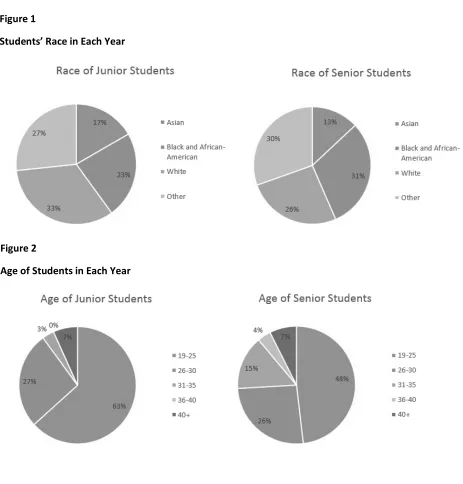
sample was diverse as shown in Figure 1. Most of the respondents’ ages are between 19 and 25 years old as shown in Figure 2.
Figure 1
Students’ Race in Each Year
Figure 2
Age of Students in Each Year
Missing data
Five students did not state their level of education. One student did not answer one of the 24 survey questions. All these data were kept since they can be used for different comparisons.
Cultural Competency ASK Instrument Findings
The overall scores yield similar results to other studies; students had high positive attitude but they lack the knowledge toward different cultures (Cheung et al., 2002; Mahabeer, 2009; Rasmussen et al., 2005). The percentages were very different amongst subscales (attitude, skills, and knowledge). RT students had the highest score on attitude followed by skills, then knowledge. The attitude subscale data showed 86.8% of the students were ready to practice or competent. The percentage slightly decreased under skills subscale to 73.6%. However, the last subscale (knowledge) showed that around half the students lack cultural knowledge. By looking at the overall score, we found that around 71.7% of RT students were ready to work with patients from different cultural backgrounds.
The attitude assessment items in Table 2 showed that RT students’ highest scores were item seven (I listen) and item 5 (I maintain a positive attitude toward my patients). The item that scores the lowest was item one (I continue learning about my patient's culture).
Table 2
Attitude Assessment
Items Mean Std. Deviation
7. I listen. 4.83 0.43
5. I maintain a positive attitude toward my patients. 4.72 0.74 8. I value my patient's cultural expectations. 4.66 0.68 3. I am open to hear about other people's ideas. 4.64 0.52 4. I value input from patients to clarify the perceptions of the
problem.
4.55 0.72
6. I am open to discuss the cultural meaning of case termination. 4.40 0.93 2. I am open to hear about my patient's self-evaluation. 4.36 0.83 1. I continue learning about my patient's culture. 3.77 1.01
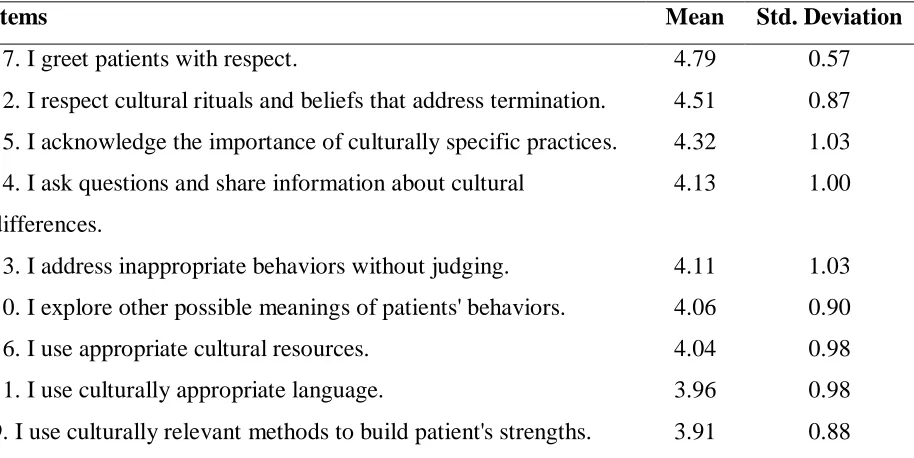
The skills assessment items in Table 3, showed that RT students’ highest score was item 17 (I greet patients with respect). The items that scored the lowest were item 9 (I use culturally relevant methods to build patient's strengths) and item 11 (I use culturally appropriate language).
Table 3
Skill Assessment
Items Mean Std. Deviation
17. I greet patients with respect. 4.79 0.57 12. I respect cultural rituals and beliefs that address termination. 4.51 0.87 15. I acknowledge the importance of culturally specific practices. 4.32 1.03 14. I ask questions and share information about cultural
differences.
4.13 1.00
13. I address inappropriate behaviors without judging. 4.11 1.03 10. I explore other possible meanings of patients' behaviors. 4.06 0.90 16. I use appropriate cultural resources. 4.04 0.98 11. I use culturally appropriate language. 3.96 0.98 9. I use culturally relevant methods to build patient's strengths. 3.91 0.88
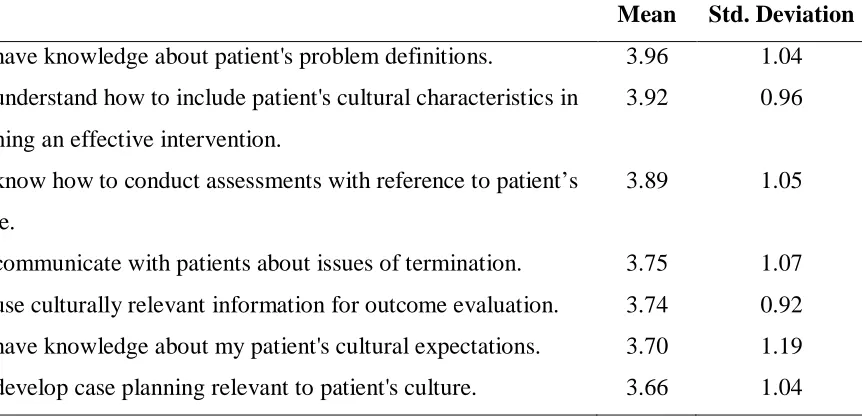
[image:34.612.82.539.481.710.2]The knowledge assessment items in Table 4 showed that RT students’ score were low in all items. However, item 21 (I have knowledge about patient's problem definitions.) was the highest score and item 22 (I develop case planning relevant to patient's culture) was the lowest score.
Table 4
Knowledge Assessment
Items Mean Std. Deviation
21. I have knowledge about patient's problem definitions. 3.96 1.04 18. I understand how to include patient's cultural characteristics in
designing an effective intervention.
3.92 0.96
20. I know how to conduct assessments with reference to patient’s culture.
3.89 1.05
19. I communicate with patients about issues of termination. 3.75 1.07 23. I use culturally relevant information for outcome evaluation. 3.74 0.92 24. I have knowledge about my patient's cultural expectations. 3.70 1.19 22. I develop case planning relevant to patient's culture. 3.66 1.04
The findings in Table 5 showed that RT students scored means of 4.49 (SD .49) on attitude, 4.20 (SD .62) on skills, 3.80 (SD .86) on knowledge, and total of 4.18 (SD .57).
Table 5
Means of ASK Subscales (n=53)
Mean Std. Deviation
Attitude 4.49 0.49
Skills 4.20 0.62
Knowledge 3.80 0.86
Total 4.18 0.57
[image:36.612.80.524.455.584.2]By comparing female respondents to male respondents in Table 6, the findings showed that females score slightly higher means than male respondents do. The only statistically significant difference was seen in skills subscale with a mean of 4.33(SD .47) for females and a mean of 3.96 (SD .81) for males with p-value of 0.04.
Table 6
Comparing Means by Gender (male n=18 and female n=35)
Male Mean±SD Female Mean±SD P value
Attitude 4.38±0.62 4.55±0.41 0.22 Skills* 3.96±0.81 4.33±0.47 0.04 Knowledge 3.79±0.96 3.81±0.80 0.95 Total 4.05±0.72 4.25±0.47 0.22 * Significant at P < .05
Research Questions
This research study was designed to answer three questions regarding the cultural attitudes, skills, and knowledge of undergraduate and graduate RT students, and one question to
compare those who had recently entered an RT program to those who has completed the program.
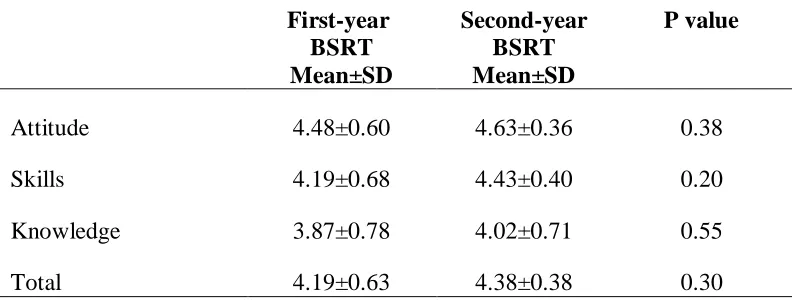
Question 1. Research question one inquired, “What is the degree of cultural attitude, skill, and knowledge of undergraduate RT students?” As seen in Table 7, first-year
[image:37.612.72.470.354.504.2]undergraduate respondents score means of 4.48 (SD .6) on attitude, 4.19 (SD .68) on skills, 3.87 (SD .78) on knowledge, and total of 4.19 (SD .63). Second-year undergraduate participant on the other hand score means of 4.63 (SD .36) on attitude, 4.43 (SD .4) on skills, 4.02 (SD .71) on knowledge, and total of 4.38 (SD .38).
Table 7
Comparing Means for Bachelor Students by Year
First-year BSRT Mean±SD
Second-year BSRT Mean±SD
P value
Attitude 4.48±0.60 4.63±0.36 0.38 Skills 4.19±0.68 4.43±0.40 0.20 Knowledge 3.87±0.78 4.02±0.71 0.55 Total 4.19±0.63 4.38±0.38 0.30 * Significant at P < .05
Question 2. Research question two inquired, “What is the degree of cultural attitude, skill, and knowledge of graduate RT students?” First-year graduate respondents score means of 4.36 (SD .46) on attitude, 3.75 (SD .38) on skills, 3.18 (SD .77) on knowledge, and total of 3.79 (SD .44). Second-year graduate participant on the other hand score means of 4.25 (SD .49) on attitude, 4.42 (SD .35) on skills, 4.23 (SD .42) on knowledge, and total of 4.31 (SD .29). The independent t-test showed significant difference between first-year and second-year master
students in skills, knowledge, and the total as seen in Table 8.
Table 8
Comparing Means for Master Students by Year
First-year MSRT Mean±SD
Second-year MSRT Mean±SD
P value
Attitude 4.36±0.46 4.25±0.49 0.71 Skills* 3.75±0.38 4.42±0.35 0.01 Knowledge* 3.18±0.77 4.22±0.42 0.02 Total* 3.79±0.44 4.31±0.29 0.04 * Significant at P < .05
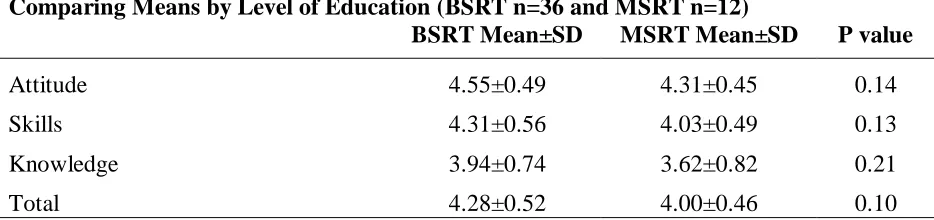
Question 3. Research question three inquired, “How does cultural competence differ between undergraduate and graduate students?” Undergraduate respondents scored means of 4.55 (SD .49) on attitude, 4.31 (SD .56) on skills, and 3.94 (SD .74) on knowledge, and total of 4.28 (SD .52). Graduate respondents on the other hand scored means of 4.31 (SD .45) on attitude, 4.03 (SD .49) on skills, and 3.62 (SD .82) on knowledge, and total of 4.00 (SD .46) as seen in Table 9.
Table 9
Comparing Means by Level of Education (BSRT n=36 and MSRT n=12)
BSRT Mean±SD MSRT Mean±SD P value
Attitude 4.55±0.49 4.31±0.45 0.14 Skills 4.31±0.56 4.03±0.49 0.13 Knowledge 3.94±0.74 3.62±0.82 0.21 Total 4.28±0.52 4.00±0.46 0.10 * Significant at P < .05
[image:38.612.73.540.556.666.2]Question 4. Research question four inquired, “Do RT students’ perceptions and
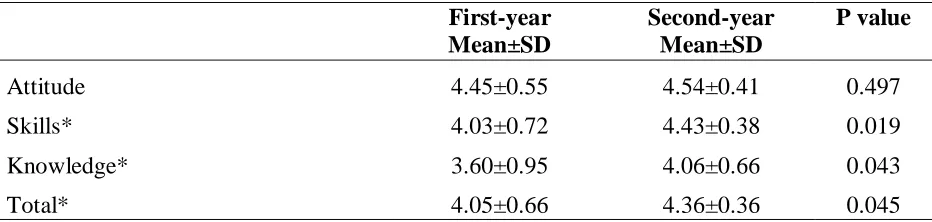
[image:39.612.74.540.347.458.2]understanding of cultural competency improve as they progress through the RT program?” First-year respondents score means of 4.45 (SD .55) on attitude, 4.03 (SD .72) on skills, and 3.60 (SD .95) on knowledge, and total of 4.05 (SD .66). Second-year participant on the other hand score means of 4.54 (SD .42) on attitude, 4.43 (SD .38) on skills, and 4.06 (SD .66) on knowledge, and total of 4.36 (SD .36). The independent t-test showed significant difference between first and second-year students in skills, knowledge, and the total with p value of 0.019, 0.043, and 0.045 respectively as seen in Table 10.
Table 10
Comparing Means for All Students by Year of Education
First-year Mean±SD
Second-year Mean±SD
P value
Attitude 4.45±0.55 4.54±0.41 0.497 Skills* 4.03±0.72 4.43±0.38 0.019 Knowledge* 3.60±0.95 4.06±0.66 0.043 Total* 4.05±0.66 4.36±0.36 0.045 * Significant at P < .05
Conclusion
About three-quarters of the RT students, who responded to this study were ready to practice cultural competency as determined by the total scores. The mean of the total score was 4.18±0.57. The students’ replies pattern presented the subscales in the following order from high to low: Attitude, skills and knowledge. The results of this study indicated that students’ scores did not show any statistically significant differences between BSRT and MSRT. However, there were statistically significant differences between first-year and second-year students. In chapter five, the results of this study are discussed.
CHAPTER V
Interpretation of Findings
This chapter will present the discussion of findings conferred in Chapter IV. The chapter is divided into five major sections, including overview of the study, discussion of findings, implications for research, recommendation for future research, study limitations, and conclusion.
Overview of the Study
The purpose of this study was to conduct an exploratory and descriptive examination about the degree of attitude, skill, and knowledge of RT students pertaining to cultural competency. This study was guided by the following questions:
1. What is the degree of cultural attitude, skill, and knowledge of undergraduate RT students?
2. What is the degree of cultural attitude, skill, and knowledge of graduate RT students? 3. How does cultural competence differ between undergraduate and graduate students? 4. Do RT students’ perceptions and understanding of cultural competency improve as they
progress through the RT program?
The survey instrument utilized by this study was the ASK Cultural Co mpetenc y Assessment Scale (Short Version) developed by Leung and Cheung (2013). The purpose of this study was to understand the degree of attitude, knowledge, and skill when working with individuals of culturally different backgrounds. However, the instrument was slightly modified to better suit RT students. The demographic section was added to the survey to help answer the research questions (Appendix A).
Respondents in the study were selected based on a convenience sample of first and second-year undergraduate (BSRT) and graduate (MSRT) respiratory therapy students attending an accredited respiratory therapy program at an urban university located in the southeastern United States. The researcher administered and distributed the survey packets to fifty-seven students of both BSRT and MSRT. The survey packets consisted of a cover letter (Appendix B) with an explanation of the study and the instrument survey.
The items’ means in each subscale were measured and used to rank the items from highest to lowest. The attitude subscale items ranking could be influenced by the diversity of the sample and the fact that this study was conducted in a big urban university. In addition, continue learning is a self-motivating method. Therefore, lacking the knowledge about the effect of culture on health outcome might decrease the self-motivation to learn more about cultures. The items on the skills subscale that might be linked to students’ attitude such as (I greet patients with respect) scored higher than the items that might relate to cultural information and knowledge. In knowledge subscale, it is unclear to see item 21 as the highest score, and item 22 as the lowest score. Having the knowledge about patients’ problem definitions, could be the base for developing the right plan for patients.
Findings Related to Research Question 1. The first research question asked, “What is the degree of cultural attitude, skill, and knowledge of undergraduate RT students?” The total result of ASK scale revealed that both first and second-year BSRT students felt comfortable to toward working with culturally diverse patients. Also, both groups’ scores were higher in attitudes than skills and knowledge subscales. These findings were supported by the results of Rasmussen et al. (2005) who indicated that undergraduate OT students demonstrated a positive attitude toward cultural influences, but they lack the knowledge. First-year BSRT felt prepared in
attitude and skills subscales but were not prepared on knowledge subscale. Second-year students were confident on all subscales. The subscales’ means were slightly higher in senior BSRT respondents than juniors were. This result indicated that students’ cultural competence progressed over the period of the program even though the differences were not statistically significant.
Findings Related to Research Question 2. The second question asked, “What is the degree of cultural attitude, skill, and knowledge of graduate RT students?” The total result of ASK scale showed that first-year MSRT students did not feel confident to work with culturally diverse patients, but second-year MSRT felt confident. First-year MSRT students had a high attitude toward culture, but they had low cultural skills and knowledge. On the other hand, second-year MSRT students showed that they felt comfortable on all subscales (attitude, skills, and knowledge). Second-year MSRT students’ highest score was on skills subscale. There were statistically significant differences between first-year and second-year MSRT students in skills, knowledge and the total means. These findings showed that the RT program developed the graduate students’ cultural competence over the duration of the program.
Findings Related to Research Question 3. The third question asked, “How does cultural competence differ between undergraduate and graduate students?” The total result of ASK scale revealed that both BSRT and MSRT students felt prepared comfortable toward working with culturally diverse patients. In addition, both groups felt comfortable in attitude and skills subscales, but they were not prepared in knowledge subscale. The results showed that BSRT students’ means were higher than MSRT in all subscales. This finding was different from other studies that showed that higher level of education positively affects cultural competency. Mareno and Hart (2014) found that undergraduate scores were lower than graduate students. Schim et al.
(2005) also found a positive relationship between the level of education and level of cultural competency. The dissimilarity between my finding and those findings could be due to the limitation in the sample size especially the number of MSRT respondents. However, there were no statistically significant differences between the two groups.
Findings Related to Research Question 4. The fourth question asked, “Do RT students’ perceptions and understanding of cultural competency improve as they progress through the RT program?” The total result of ASK scale revealed that first-year and second-year students felt prepared. First-year students had high attitude and skills toward culture, but they had low cultural knowledge toward working with culturally diverse patients. On the other hand, second-year students showed that they felt confident on all subscales (attitude, skills, and knowledge). Both groups’ means were highest on attitude and lowest on knowledge. There were statistically significant differences between first and second-year students in skills, knowledge, and the total means. The findings showed that second-year students’ scores were higher than second-year scores. This finding was supported by the result of Sarafis and Malliarou (2013) who indicates that as nursing students progress during the program, and they grew cultural awareness and sensitivity and became culturally competent.
Implications for Research
The results of this study highlight the cultural competency areas of strengths and weaknesses. The study contributes to the literature as it proposes the need to enhance the students’ cultural knowledge. Therefore, respiratory therapy faculty should work toward
improving the areas of weaknesses by employing the student’s positive attitude to improve their knowledge and skills. More cultural education and training should be integrated into the program
to improve the students’ cultural knowledge and skills. Additionally, findings of this study will add to the literature given that it is the first study examining cultural competency in RT students.
Recommendations for Future Study
Further research is recommended due to the lack of research in the subject of cultural competency for the respiratory care profession. Replication of this study is strongly
recommended to generalize these findings with a larger sample size involving a number of accredited BSRT and MSRT programs. Studying rural areas and comparing them to urban could help understand other factors that may affect cultural competency.
Limitations
This study was limited by several factors. The sample size was limited, and the sample was selected from only one institution. The relatively small sample size must be taken into account with regard to the comparison of different classes of students. The study also involved a one-time measurement. Multiple measurements over time (i.e., before the term begins and after completion) would provide further information.
This study could not measure whether cultural competency improves health outcome or not. A longitudinal study on RT students is needed to evaluate if cultural competency enhance students’ communication with culturally diverse patients, and consequently improve the patients’ health outcome.
Conclusion
To my knowledge this was the first study investigating on the self-reported cultural competency of RT students, and it was an attempt to understand how students perceive their cultural competency. Thus, it adds to the limited body of knowledge on the cultural competence of RT professionals. The students found to have a positive attitude toward cultural competency,
thought they might have the necessary skills. However, they had limited cultural knowledge. The finding of the knowledge area raises concerns as to whether students’ cultural competency learning materials as they progress through the program need to be reviewed and improved. This study should encourage faculty to reflect on the content and methods of teaching on the topic of cultural competency and assess if improvements can be made to provide better education throughout the duration of the program.
References
AARC, A. A. f. R. C. (2013). Position Statement: Cultural Diversity
from http://c.aarc.org/resources/position_statements/documents/cultural_diversity2013.pdf AARC, A. A. f. R. C. (2014). AARC Statement of Ethics and Professional Conduct. from
https://www.aarc.org//app/uploads/2015/05/aarc-statement-of-ethics-and-professional-conduct.pdf
Baquet, C. R., & Commiskey, P. (1999). Colorectal cancer epidemiology in minorities: a review. Journal of the Association for Academic Minority Physicians : the official publication of the Association for Academic Minority Physicians, 10(3), 51-58.
Barnes, T. A., Gale, D. D., Kacmarek, R. M., & Kageler, W. V. (2010). Competencies needed by graduate respiratory therapists in 2015 and beyond. Respir Care, 55(5), 601-616.
Betancourt, J. R., & Cervantes, M. C. (2009). Cross-cultural medical education in the United States: key principles and experiences. Kaohsiung J Med Sci, 25(9), 471-478. doi:
10.1016/s1607-551x(09)70553-4
Betancourt, J. R., Corbett, J., & Bondaryk, M. R. (2014). Addressing disparities and achieving equity: cultural competence, ethics, and health-care transformation. Chest, 145(1), 143-148. doi: 10.1378/chest.13-0634
Betancourt, J. R., Green, A. R., & Carrillo, J. E. (2002). Cultural competence in health care: emerging frameworks and practical approaches (Vol. 576): Commonwealth Fund, Quality of Care for Underserved Populations.
Betancourt, J. R., Green, A. R., Carrillo, J. E., & Park, E. R. (2005). Cultural competence and health care disparities: key perspectives and trends. Health Aff (Millwood), 24(2), 499-505. doi:
10.1377/hlthaff.24.2.499
Birnbaum, L. (2012). The Perceived Cultural Self-Efficacy of Respiratory Therapists and Nurses: a Comparative Study.
Cabana, M. D., Lara, M., & Shannon, J. (2007). Racial and ethnic disparities in the quality of asthma care.
Chest, 132(5 Suppl), 810s-817s. doi: 10.1378/chest.07-1910
Campinha-Bacote, J. (1999). A model and instrument for addressing cultural competence in health care.
J Nurs Educ, 38(5), 203-207.
Cheung, Y., Shah, S., & Muncer, S. (2002). An Exploratory Investigation of Undergraduate Students' Perceptions of Cultural Awareness. The British Journal of Occupational Therapy, 65(12), 543-550. Collins, K. S., Hall, A. G., & Neuhaus, C. (1999). US minority health: A chartbook.
Cooper, L.-A., Vellurattil, R. P., & Quiñones-Boex, A. (2014). Pharmacy Students’ Perceptions of Cultural Competence Encounters During Practice Experiences. American journal of pharmaceutical education, 78(2).
DHHS, U. S. (2000). Eliminating Health Disparities in the United States: U.S. Department of Health and Human Services, Heath Resources and Services Administration.
Engebretson, J., Mahoney, J., & Carlson, E. D. (2008). Cultural competence in the era of evidence-based practice. Journal of Professional Nursing, 24(3), 172-178.
George, M. (2001). The challenge of culturally competent health care: Applications for asthma. Heart & Lung: The Journal of Acute and Critical Care, 30(5), 392-400.
doi: http://dx.doi.org/10.1067/mhl.2001.118364
Hagman, L. W. (2006). Cultural self-efficacy of licensed registered nurses in New Mexico. J Cult Divers, 13(2), 105-112.
Hayward, L. M., & Li, L. (2014). Promoting and Assessing Cultural Competence, Professional Identity, and Advocacy in Doctor of Physical Therapy (DPT) Degree Students Within a Community of Practice.
Journal of Physical Therapy Education, 28(1), 23-36.
Jones, M. E., Cason, C. L., & Bond, M. L. (2004). Cultural attitudes, knowledge, and skills of a health workforce. J Transcult Nurs, 15(4), 283-290. doi: 10.1177/1043659604268966
Kacmarek, R. M., Barnes, T. A., & Durbin, C. G., Jr. (2012). Survey of directors of respiratory therapy departments regarding the future education and credentialing of respiratory care students and staff. Respir Care, 57(5), 710-720. doi: 10.4187/respcare.01360
Kacmarek, R. M., Durbin, C. G., Barnes, T. A., Kageler, W. V., Walton, J. R., & O'Neil, E. H. (2009). Creating a vision for respiratory care in 2015 and beyond. Respir Care, 54(3), 375-389.
Leung, P., & Cheung, M. (2013). Factor analyzing the “ASK” cultural competency self-assessment scale for child protective services. Children and Youth Services Review, 35, 1993-2002. doi:
10.1016/j.childyouth.2013.09.014
Loftin, C., Hartin, V., Branson, M., & Reyes, H. (2013). Measures of cultural competence in nurses: an integrative review. The Scientific World Journal, 2013.
Mahabeer, S. A. (2009). A descriptive study of the cultural competence of hemodialysis nurses. Cannt j, 19(4), 30-33.
Mareno, N., & Hart, P. L. (2014). Cultural Competency Among Nurses with Undergraduate and Graduate Degrees: Implications for Nursing Education. Nursing Education Perspectives, 35(2), 83-88. doi: 10.5480/12-834.1
McLaurin, J. (2002). Cultural competency in practice. MCN Streamline, 8, 1-4. NHDR. (2013, 2013/05/07/
). 2012 National Healthcare Disparities Report.
from http://www.ahrq.gov/research/findings/nhqrdr/nhdr12/highlights.html
Norton, D., & Marks-Maran, D. (2014). Developing cultural sensitivity and awareness in nursing overseas. Nurs Stand, 28(44), 39-43. doi: 10.7748/ns.28.44.39.e8417
Rasmussen, T. M., Lloyd, C., & Wielandt, T. (2005). Cultural awareness among Queensland
undergraduate occupational therapy students. Australian Occupational Therapy Journal, 52(4), 302-310. doi: 10.1111/j.1440-1630.2005.00508.x
Remus, B. (2004). Lack of cultural competency: A business and clinical risk. Journal of Healthcare Risk Management, 24(4), 5-12. doi: 10.1002/jhrm.5600240403
Renfrew, M. R., Taing, E., Cohen, M. J., Betancourt, J. R., Pasinski, R., & Green, A. R. (2013). Barriers to care for Cambodian patients with diabetes: results from a qualitative study. J Health Care Poor Underserved, 24(2), 633-655. doi: 10.1353/hpu.2013.0065
Sarafis, P. A., & Malliarou, M. M. (2013). Cultural self-efficacy of baccalaureate nursing students in a Greek University. Iranian Journal of Nursing and Midwifery Research, 18(6), 446-450.
Schim, S. M., Doorenbos, A. Z., & Borse, N. N. (2005). Cultural competence among Ontario and Michigan healthcare providers. Journal of Nursing Scholarship, 37(4), 354-360. doi: 10.1111/j.1547-5069.2005.00061.x
Stewart, M., Brown, J. B., Boon, H., Galajda, J., Meredith, L., & Sangster, M. (1999). Evidence on patient-doctor communication. Cancer prevention & control : CPC = Prevention & controle en
cancerologie : PCC, 3(1), 25-30.
Appendix A: ASK Instrument (short version) and Demographics
Part1: ASK instrument (Short version)
Use the following scale between 1 and 5 to assess your readiness in terms of Attitude, Knowledge and Skill when working with a specific family or patient:
1=totally unprepared; 2=somewhat unprepared; 3=prepared but need practice;
4=ready to practice; 5=competent.
Attitude assessment
1. I continue learning about my patient's culture. 1 2 3 4 5 2. I am open to hear about my patient's self-evaluation. 1 2 3 4 5 3. I am open to hear about other people's ideas. 1 2 3 4 5 4. I value input from patients to clarify the perceptions of the
problem. 1 2 3 4 5
5. I maintain a positive attitude toward my patients. 1 2 3 4 5 6. I am open to discuss the cultural meaning of case termination. 1 2 3 4 5 7. I listen. 1 2 3 4 5 8. I value my patient's cultural expectations. 1 2 3 4 5
Skill Assessment
9. I use culturally relevant methods to build patient's strengths. 1 2 3 4 5 10. I explore other possible meanings of patients' behaviors. 1 2 3 4 5 11. I use culturally appropriate language. 1 2 3 4 5 12. I respect cultural rituals and beliefs that address termination. 1 2 3 4 5 13. I address inappropriate behaviors without judging. 1 2 3 4 5 14. I ask questions and share information about cultural differences. 1 2 3 4 5 15. I acknowledge the importance of culturally specific practices. 1 2 3 4 5 16. I use appropriate cultural resources. 1 2 3 4 5 17. I greet patients with respect. 1 2 3 4 5
Knowledge assessment
18. I understand how to include patient's cultural characteristics in
designing an effective intervention. 1 2 3 4 5 19. I communicate with patients about issues of termination. 1 2 3 4 5 20. I know how to conduct assessments with reference to patient’s
culture. 1 2 3 4 5
21. I have knowledge about patient's problem definitions. 1 2 3 4 5 22. I develop case planning relevant to patient's culture. 1 2 3 4 5 23. I use culturally relevant information for outcome evaluation. 1 2 3 4 5 24. I have knowledge about my patient's cultural expectations. 1 2 3 4 5
Part 2: Demographic Questionnaire
Please circle the appropriate number or fill in where requested. Age: 1. 19-25
2. 26-30 3. 31-35 4. 36-40 5. 41+
Gender 1. Male 2. Female
Race 1. American Indian or Alaska Native 2. Asian
3. Black or African-American
4. Native Hawaiian or other Pacific Islander 5. White
6. Other ________
Education (a) Year/level in program:
1. First year (junior) 2. Second year (senior) (b) Educational level:
1. B.S RT
2. MS of health science