www.hydrol-earth-syst-sci.net/15/311/2011/ doi:10.5194/hess-15-311-2011
© Author(s) 2011. CC Attribution 3.0 License.
Earth System
Sciences
Impact of climate evolution and land use changes on water yield in
the ebro basin
J. I. L´opez-Moreno1, S. M. Vicente-Serrano1, E. Moran-Tejeda2, J. Zabalza1, J. Lorenzo-Lacruz1, and J. M. Garc´ıa-Ruiz1
1Instituto Pirenaico de Ecolog´ıa, CSIC (Spanish Research Council), Campus de Aula Dei, P.O. Box 202, Zaragoza 50080, Spain
2Departamento de Geograf´ıa, Universidad de Salamanca, Spain
Received: 1 March 2010 – Published in Hydrol. Earth Syst. Sci. Discuss.: 29 April 2010 Revised: 15 October 2010 – Accepted: 19 January 2011 – Published: 25 January 2011
Abstract. In this study the climatic and hydrological trends across 88 sub-basins of the Ebro River basin were analyzed for the period 1950–2006. A new database of climate in-formation and river flows for the entire basin facilitated a spatially distributed assessment of climate-runoff relation-ships. It constitutes the first assessment of water yield evo-lution across the whole Ebro basin, a very representative ex-ample of large Mediterranean rivers. The results revealed a marked decrease in river discharges in most of the sub-basins. Moreover, a number of changes in the seasonality of the river regime was found, resulting from dam regula-tion and a decrease in snowpack in the headwaters. Signifi-cant and positive trends in temperature were observed across most of the basin, whereas most of the precipitation series showed negative coefficients, although the decrease in mag-nitude was low. The time evolution of the residuals from em-pirical models that relate climate and runoff in each sub-basin provided evidence that climate alone does not explain the ob-served decrease in river discharge. Thus, changes in water yield are associated with an increase in evapotranspiration rates in natural vegetation, growth of which has expanded as a consequence of land abandonment in areas where agricul-tural activities and livestock pressure have decreased. In the lowlands of the basin the decrease in water yield has been ex-acerbated by increased water consumption for domestic, in-dustrial and agricultural uses. Climate projections for the end of the 21st century suggest a reduced capacity for runoff gen-eration because of increasing temperature and less precipita-tion. Thus, the maintenance of water supply under conditions of increasing demand presents a challenging issue requiring appropriate coordination amongst politicians and managers.
Correspondence to: J. I. L´opez-Moreno
1 Introduction
Mountains play a critical role in water resources availabil-ity in lowland areas of drainage basins. Altitudinal gradients in temperature and precipitation ensure that headwaters re-ceive more precipitation and have lower evapotranspiration rates than adjacent lowlands (Viviroli et al., 2004; De Jong et al., 2009; L´opez and Justrib´o, 2010). Moreover, in mountain regions at high and mid latitudes a large amount of precip-itation falls as snow, which is stored frozen in winter. The melting of snow during spring causes high river flows, even in areas where climate exhibits high interannual variability (L´opez-Moreno et al., 2004; Barnett et al., 2005).
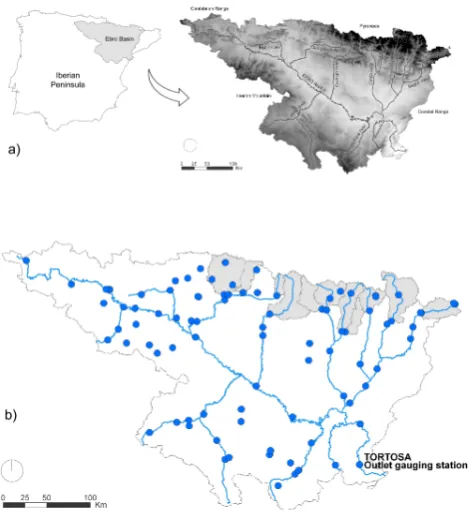
Fig. 1. Study area. (a) relief of the Ebro River basins and main tributaries of the Ebro River. (b) Gauging station network, and areas included as Pyrenean headwaters (in grey color).
that water availability would remain roughly stable over time, despite the occurrence of short-term oscillations in supply. However, there is clear evidence of a change in long-term climatic trends that is affecting the environment of Mediter-ranean mountains (Giorgi and Lionello, 2008), and changes in land cover have produced marked alterations in hydrolog-ical responses at the basin scale (Andr´eassian, 2004).
Climate projections for the coming decades point to warmer conditions over most of the Mediterranean moun-tains region (Giorgi, 2006), a marked decrease in snow ac-cumulation and the duration of snow cover (L´opez-Moreno et al., 2009a), and a generalized decrease in precipitation (Ragab and Prudhomme, 2002; Giorgi and Lionello, 2008), although the latter prediction is associated with large spa-tial and seasonal variations (L´opez-Moreno et al., 2008a and references therein; Nogu´es-Bravo et al., 2008) and substan-tial uncertainty. Moreover, large areas are likely to con-tinue to be subject to major land use and land cover changes, which in the Mediterranean region are mostly characterized by increasing vegetation in headwaters, as a consequence of land abandonment during the 20th century (Debussche et al., 1999; Beguer´ıa et al., 2003; Lasanta et al., 2005).
Increasing efforts are being made to quantify and under-stand the consequences of environmental change for the hy-drological response of mountain areas, and to assess its im-pact in the lowlands. This may improve the capacity to op-timize water use and enhance preparedness for future chal-lenges in water management. In this study climatic and
hydrological trends across the Ebro basin (northeast Spain) were analyzed. Changes in the runoff coefficients of 88 sub-basins of the Ebro River were used to investigate the evolu-tion of water yield since 1950, which enabled assessment of whether trends in runoff are driven by climatic factors, by the land cover changes that have occurred in the basin, or both. The Ebro basin is representative of Mediterranean basins that depend on water generated in mountain areas (mainly the Pyrenees), and are subject to enormous pressure on wa-ter resources because of the development of large irrigation areas and industrial zones, and the growth of major urban settlements. Previous studies have identified climate varia-tions and revegetation in headwaters as causes of decreasing river flows in Pyrenean rivers (Beguer´ıa et al., 2003; L´opez-Moreno et al., 2008b).
The availability of newly developed climate and river flow databases for the Ebro basin enabled us to conduct the first spatially distributed analysis to climate-runoff relationships, and to identify those sectors for which environmental change may have the most significant consequences for water avail-ability in the basin. The results are discussed in the context of climatic and environmental projections for the region in coming decades.
2 Study area
The study area comprises about 83 000 km2in the northeast of Spain and has very contrasting relief (Fig. 1a). The main unit is the Ebro Valley, which is a depression surrounded by high mountain ranges including the Cantabrian Range and the Pyrenees to the north (maximum elevations above 3000 m a.s.l.), the Iberian mountains to the south (maximum eleva-tions 2000–2300 m), and the Coastal Range to the east (max-imum elevations 1000–1200 m a.s.l.). The latter parallels the Mediterranean coast and abruptly encloses the Ebro Valley.
The heterogeneous topography, contrasting influences of Atlantic and Mediterranean conditions, and the influence of various large scale atmospheric patterns, like the North At-lantic Oscillation, the Mediterranean Oscillation and West-ern Mediterranean Oscillation (Vicente-Serrano and L´opez-Moreno, 2006; Vicente-Serrano et al., 2009), generate a com-plex spatial distribution of climate parameters. Large varia-tions in precipitation and evapotranspiration occur through-out the region (Ninyerola et al., 2005; Vicente-Serrano et al., 2007), and annual precipitation varies from 307 to 2451 mm yr−1. Most of the precipitation falls in autumn and spring, although in some areas the maximum precipitation occurs in winter and summer (L´opez-Moreno et al., 2008b). Average annual temperature varies from 0.8 to 16.2◦C.
considered in this study (Fig. 1; the Irati, Arag´on, Gallego, Cinca, ´Esera, Noguera Ribagorzana, N. Pallaresa and Segre rivers) occupy 11% of the surface of the Ebro valley, but generate 56% of the total runoff (mean value for the period 1950–2005). A recent paper of L´opez and Justrib´o (2010) analysed several Pyrenean headwaters concluding that pre-cipitation, the specific runoff, and the runoff coefficient were all greater in the mountains than in the adjacent lowlands, with respective differences of 70%, 180% and 60%. The relative abundance of water in the area led to the construc-tion of numerous dams to regulate the main rivers, which markedly altered river regimes and reduced flood occurrence (L´opez-Moreno et al., 2002). Most of the dams were built between the 1950s and the 1980s, leading to an increase in storage capacity from 500 to 3000 hm3; this represents ap-proximately half of the mean annual runoff of the Pyrenean rivers. This capacity enables the diversion of 1947 hm3yr−1 to irrigate 295 748 ha of land (77% of the irrigated area of the Ebro basin) and the generation of 62% of the hydropower produced in the region (L´opez-Moreno, 2006).
Until the middle of the 20th century most of the south fac-ing slopes below 1600 m a.s.l. were cultivated. The main hy-drological and geomorphological consequences of this were an intensification of soil erosion processes and an increase in the torrential nature of fluvial channels (Garc´ıa-Ruiz and Valero-Garc´es, 1998). For this reason most of the rivers are braided and have unstable channels. The subsequent abandonment of farmland, associated with depopulation, has been the most outstanding feature of the Spanish Pyrenees (Beguer´ıa et al., 2003; Lasanta et al., 2005; L´opez-Moreno et al., 2008), and by 1970 all the fields on hillslopes had been abandoned. These areas were then recolonized by shrubs, and induced afforestation took hold in many areas that were previously cultivated and grazed (Vicente-Serrano et al., 2004). As in the Pyrenees, generalized land abandon-ment and subsequent revegetation processes have occurred in all the mountainous areas that enclose the Ebro basin (Las-anta et al., 2006). Indeed, based on estimates of the evolution of the spring normalized difference vegetation index (NDVI), derived from NOAA satellite imagery (8 km spatial resolu-tion) since 1981, more than 45% of the surface area has been affected by a statistically significant increase in the vegeta-tion index, which is related to the increase in vegetavegeta-tion cover and its physiological activity (Nogu´es et al., 2010).
3 Data and methods
Climate trends were analyzed from monthly series of pre-cipitation (429) and temperature (55) from observatories lo-cated within the Ebro basin or in its immediate surroundings. The series were obtained through a process that included reconstruction, gap filling, quality control and homogeniza-tion testing with independent reference series (see Gonz´alez-Hidalgo et al., 2009).
The river flow evolution at 88 gauging stations managed by the Ebro Water Management Agency (Confederaci´on Hidrogr´afica del Ebro, CHE) was analyzed. In terms of cli-mate data there is a reasonable spatial coverage the entire Ebro basin (Fig. 1b). Despite the meteorological stations are evenly distributed, the highest sectors of the mountain areas remain poorly represented. This lack of observations at high altitude prevents us from reaching solid conclusions about a potential dependence of climatic evolution to elevation. The criteria for selection of a gauging station was that the series had commenced by 1950, encompassed at least 30 complete years, and any data gaps were able to be filled using data from neighboring gauging stations with which there was a Pearson-correlation coefficient of at leastr= 0.80.
To assess the evolution of temperature and precipitation in a spatially distributed fashion, monthly distributed lay-ers from 1950 to 2006 at a resolution of 1 km2were created by interpolating values from the various observatories. For this purpose we used multiple linear regression, in which a number of geographic (latitude and linear distances to the Mediterranean Sea and the Atlantic Ocean) and topographic (elevation) parameters were used as predictors of monthly temperature and precipitation (Daly et al., 1994, 1997; Ag-new and palutikof, 2007). The residuals (the difference be-tween the climatic variable measured at each weather station and the value predicted by the model) were subsequently ob-tained for each observatory and interpolated over the study area using local techniques (see Ninyerola et al., 2000 for more details). This procedure enabled us to make analyses for individual catchments, as opposed to a more conventional analysis based on station values.
test was then performed on the correlation-free series. Based on the sign of the trend (MK’s tau) and the level of signifi-cance (α; probability of rejecting the null hypothesis i.e. no trend in the data) we classified the series into 5 groups, fol-lowing the procedure of Westmacott and Burn (1997):
- SIT (strong increasing trend): tau≥0 andα≤0.05 - MIT (moderate increasing trend): tau≥0 and 0.05>
α≤0.10
- NST (non significant trend):α >0.10
- MDT (moderate decreasing trend): tau<0 and 0.05> α≤0.10
- SDT (strong decreasing trend): tau<0 andα≤0.05 The methodology proposed by Beguer´ıa et al. (2003) was used to infer the potential impact of land use changes on runoff generation in the various sub-basins of the Ebro basin. The method is based on removing the influence of the two most influential climatic parameters (temperature and precip-itation) from the annual river discharge series. Obviously, the selection of temperature and precipitation to synthesize cli-matic variability is a simplification of the reality since other variables like air humidity, wind speed or solar radiation may also affect the evaporation rates. However, the lack of long-term records of the aforementioned variables, and the as-sumed capability of combined precipitation and temperature to summarize the water balance at the basin scale at seasonal and annual basis (Droogers and Allen, 2002), prevented us to use more complex approaches in this study. The removal of climatic influence from runoff series was done using step-wise linear regression models for each sub-basin. The inde-pendent variables were the sum of annual precipitation and mean temperature of the area drained at each gauging sta-tion. The annual runoff in each sub-basin was the dependent variable. Series of residuals were evaluated to assess whether they exhibited significant trends. The occurrence of a signif-icant trend suggested that water yield had changed in time independently of the evolution of climatic conditions. Given that most of the factors that explain hydrological evolution (except climate) remain stationary in time (e.g. lithology) or change slowly (e.g. soil depth or soil characteristics), only the intense changes in land cover and vegetation occurred in the region in the last decades can explain the observed trends in water yield. This premise is only valid in basins where human activities are moderate and do not affect interannual hydrological behavior (pluriannual reservoirs, or diversions to agricultural areas or large urban settlements). Hence, this premise will apply in headwater catchments, whereas in the lower reaches of the Ebro River the trends in residuals may also be due to water consumption by cities and for agricul-tural activities.
The potential impacts of climate change in the Ebro basin where analyzed using simulations of temperature and pre-cipitation for the period 1960–2080 under emissions sce-nario A1B1 (moderate greenhouse gases emissions) from the HIRHAM5 model (Danish Meteorological Institute) at a spatial resolution of 25 km2. Simulations were down-loaded from the ENSEMBLES EU-funded project (http:// ensembles-eu.metoffice.com/). Changes in annual and sea-sonal temperature and precipitation were calculated by sub-tracting the long-term means of the time slice 1960–1990, to 2021–2050 and 2051–2080. Selection of this model was based on its ability to reproduce temperature and precip-itation over the Pyrenees and the center of the Ebro val-ley. Moreover, it was compared with a set of regional cli-mate model projections from the PRUDENCE dataset, as this model is representative of the mean sign and magnitude of the multimodel ensemble average (L´opez-Moreno et al., 2008a).
4 Results
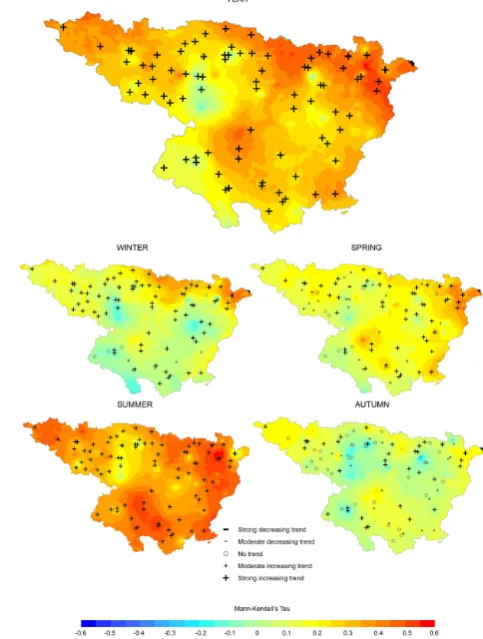
4.1 Trends in climatic and hydrological variables Figure 2 shows the trend of annual and seasonal precipita-tion across the Ebro basin during the studied period (1950– 2006). The evolution of precipitation shows that annual pre-cipitation was generally stable across most of the basin. Most of sub-basins exhibit negative MK tau coefficients, and any place has shown an upward trend. However, only a few small areas exhibited a statistically significant decrease (α <0.05). Only two small sub-basins in the northwest of the Ebro basin showed a moderate but significant decrease. Autumn was associated with a significant increase in precipitation in the east of the basin, with many sub-basins affected by moder-ate or large increases. However, the total precipitation for the area draining to the outlet gauging station did not show a significant trend. Negative but generally nonsignificant co-efficients were found for broad areas during winter and sum-mer. Only a few sub-basins, generally to the west, showed significant negative trends. A relatively stationary behavior was observed for spring precipitation. No clear changes in precipitation have been observed in spring.
The trends in temperature are shown in Fig. 3. Annual temperature showed a significant increase over most of the Ebro basin. The majority (86/88) of the areal sub-basin aver-ages exhibited moderate or large increases (a mean increase of 0.2◦C per decade for the entire basin). The MK tau values
Fig. 2. Trend of annual and seasonal precipitation for the Ebro basin during the studied period (1950–2006). The color scale shows the Mann-Kendall tau coefficients for each 1 km2 cell. The symbols show the sign of the trend for total precipitation in the area drained at each of the 88 gauging stations.
has become slightly colder in some areas in the center of the Ebro valley. Spring temperatures have increased markedly in the northeast of the study area, and significant increases have also occurred throughout the Pyrenees and in large areas of the Ebro Depression. In the southernmost areas tempera-ture has remained practically unchanged. In autumn, smaller areas and fewer basins have been affected by warmer tem-peratures. However, the temperature in some basins of the Pyrenees has increased substantially.
The temporal evolution of river discharges (Fig. 4) is in stark contrast to that of precipitation. Thus, a large decrease (p <0.05) was observed at the majority of gauging stations (55/88), five stations showed a moderate decrease, and 23 had negative but nonsignificant coefficients. Only at two sites was an upward trend recorded, possibly as a consequence of human interference with the river flows. Discharges at observatories at the outlet of the basin showed a large de-crease, indicating that a statistically significant decrease in river flows has occurred in the Ebro basin. Although there
Fig. 3. Trend of annual and seasonal temperature for the Ebro basin during the studied period (1950–2006). The color scale shows the Mann-Kendall tau coefficients for each 1 km2 cell. The symbols show the sign of the trend for the average temperature in the area drained at each of the 88 gauging stations.
was no clear pattern in the spatial distribution of stationary hydrological records, most of the gauging stations without significant trends are located in the lower reaches of several tributaries in the eastern Pyrenees.
[image:5.595.51.297.65.396.2]Fig. 4. Temporal evolution of river discharges.
4.2 Trends in water yield and its relationship to climate and land cover evolution
[image:6.595.311.545.66.288.2]Figure 5 shows the results of application of a stepwise linear regression to prediction of annual runoff from annual temper-ature and precipitation over the 88 sub-basins analyzed in the Ebro basin. Figure 5a shows the coefficient of determination for each regression, which indicates the variance explained by each climatic variable. As expected, there was large vari-ability (12–73%) across the basin with respect to the influ-ence of climate on the interannual evolution of discharge. Headwaters typically exhibited the greatest explained vari-ance, being the coefficients of determination punctually re-duced in gauging stations located in lower reaches of the Pyrenean tributaries and in the south and west of the basin, mainly due to dam operations and flow diversions for agri-cultural purposes. Nonetheless, the large scale nature of this study explained the occurrence of numerous exceptions as a consequence of uncertainties inherent in modeling monthly climatic layers, the regression model, and the unique cir-cumstances of the various gauging stations (potential water diversions or inflows). The coefficients of regression (data not shown) indicated that precipitation is a much more in-fluential driver of runoff variability, explaining 8–72% of the
Fig. 5. Results of the application of a stepwise linear regression for predicting annual runoff from annual temperature and precipitation over the 88 sub-basins analyzed in the Ebro basin. 5a: the coeffi-cient of determination for each sub-basin. (b) trends in the evolution shown by residuals in each sub-basin.
variance for the 88 gauging stations (mean value 46%); tem-perature explained a maximum of 18% of the variance (mean value 4%). In 40 sub-basins, temperature was not included as a significant variable. Figure 5b shows the signs and mag-nitude of the trend in the series of model residuals, i.e. the evolution of runoff series after the influence of climate had been removed. In 70 sub-basins there were large or moderate negative MK tau coefficients.
Based on the results presented above it is evident that the runoff coefficient has declined significantly in most of the sub-basins of the Ebro River. A generalized decrease in river flows during a period when precipitation has not changed in a significant manner can only be explained by a decrease in the water yield in the basin. Thus, the runoff coefficient reflects a spatial pattern that is even more marked than that observed for discharge (Fig. 6), involving a generalized decrease in water yield across the Ebro River basin (55 strong trends and 7 moderate trends). The seasonal patterns were practically identical to those found for trends in river discharges.
Fig. 6. Temporal evolution of runoff coefficient (water yield).
Figure 7 shows the annual runoff from Pyrenean headwa-ters ( between the Iraty and Segre rivers, see Fig. 1), the Ebro discharge in its lower reaches (Tortosa station) very close to the Mediterranean Sea (lower panel), and the evolution of the ratio between both series (upper panel). The annual series for the Pyrenean basins and the lower Ebro River showed statis-tically significant decreases, but it was more pronounced in the latter. Thus, there has been a marked increase in the ratio between the series. At the beginning of the analyzed period the Pyrenean discharges represented approximately 40% of that of the lowest gauging station of the basin, but during the last 20 years this has consistently exceeded 60%. The lower Ebro River reflects the effects of a marked loss in water yield capacity in the Pyrenees, the major consequences of cli-mate trends and land cover changes in other mountain areas including the Iberian mountains and the Cantabrian range, and an increase over time in the water consumed by large urban settlements (i.e. Zaragoza) and the irrigation areas of the Ebro Depression. Thus, the Ebro basin has an increasing dependence on the Pyrenees for water supply, but the latter is showing a decrease in its water yield capacity.
Fig. 7. Annual runoff from Pyrenean headwaters and the discharge of the Ebro River in its lower reaches (lower panel). Evolution of the ratio between the series (upper panel).
4.3 Climate change projections for the Ebro basin
Figures 8 and 9 show the changes in temperature and precip-itation, respectively, projected by the HIRHAM5 model un-der the A1B1 emissions scenario for two time slices (2021– 2050 and 2051–2080) compared with the 1960–1990 period. Figure 8 shows that a generalized increase in temperature is expected for the Ebro basin during this century. On an an-nual basis, warming is expected to be more intense in the Pyrenees and Iberian mountains, especially in the central and eastern areas where temperatures may increase 1.5–2◦C in the 2021–2050 time slice and up to 4◦C in the 2051–2080 period. The greatest increase in temperature is projected for spring and summer. In all seasons the mountainous areas (Pyrenees and Iberian mountains) will be most affected by warming, which may reach 2.5◦C and 5◦C in each of the time slice periods, respectively. Warming trends in autumn are lower, and winter is projected to be the period with the smallest temperature increase, which in the Pyrenees will be 1–1.5◦C in the 2021–2050 time slice and 2–2.5◦C in the 2051–2080 time slice. Nonetheless, such changes have been shown to be sufficient to significantly alter snow accumula-tion patterns in the Pyrenees (L´opez-Moreno et al., 2009).
[image:7.595.50.281.63.390.2]Fig. 8. Projected changes in temperature under the HIRHAM5 model (A1B emission scenario) for the time slices 2021–2050 and 2051–2080 compared with the 1960–1990 period.
[image:8.595.307.545.65.398.2]of the basin, which may receive a slight increase in precipi-tation. For the period 2051–2080 a decrease that may occa-sionally exceed 30% in the eastern part of the basin is pre-dicted to occur; further westward the decrease will be pro-gressively less pronounced. The greatest seasonal decreases in precipitation are expected to occur in autumn and spring, and to show the same eastward spatial pattern to that of an-nual precipitation values. Summer precipitation is expected to undergo small changes for the period 2021–2050, but is projected to decrease more rapidly by the end of the century. The greatest changes are projected to occur in the center of the Ebro valley. The changes in winter precipitation are pected to be small and to lack a defined spatial pattern, ex-hibiting trends with opposite signs in adjacent regions. In general, the model projects stable or slightly increasing pre-cipitation in the western Pyrenees and most of the Ebro basin, and a slight decrease in precipitation in the eastern Pyrenees and broad sectors of the Iberian mountains.
Fig. 9. Projected changes in precipitation under the HIRHAM5 model (A1B emission scenario) for the time slices 2021–2050 and 2051–2080 compared with the 1960–1990 period.
5 Discussion
This study provides evidence that runoff has declined in most of the Ebro basin since the second half of the 20th century. In this context the hydrological role of the mountains, in par-ticular the Pyrenees, is increased. Thus, runoff generation in the Pyrenees is decreasing, but the pressure on its water resources has increased as its contribution to the Ebro River has gained in importance in recent decades.
[image:8.595.49.293.67.407.2]to explain temporal evolution of river discharges is very lim-ited. For precipitation, trends show negative coefficients, but they were generally not significant. Moreover, the existence of lags between climatic conditions and the runoff response may difficult a direct comparison of seasonal climatic and hydrological trends in some medium and large river basins. Nonetheless, it is necessary to consider the consistency of the results in most of the analyzed sub-basins, independently of their surface, physical characteristics and water management regime; and also the agreement in the results when the an-nual series are considered, which are practically unaffected by lags since there is no evidence of times of response as long as one year in the study area or similar neighbouring basins (Vicente-Serrano and L´opez-Moreno, 2006; Lorenzo, 2010). Thus, we can confirm that climate alone does not ex-plain the magnitude of the decrease in river discharges. The likely explanations are: (i) an increase in water consumption by urban areas, agriculture, industry and tourism in recent decades; and (ii) an increase in water consumption by natural vegetation, which has expanded in areas where grazing and traditional agriculture have disappeared. Given that most of the runoff is derived from the mountainous river headwaters, which are practically unregulated, revegetation appears to be the most plausible explanation for the magnitude and spatial dimension of the hydrological changes that have occurred. The effect of vegetation on runoff generation is not fully un-derstood, as it changes markedly among sites in response to the specific climatic conditions, vegetation type and the structure of the landscape (Andr´eassian, 2004; Cosandey et al., 2005). However, it is generally accepted that afforesta-tion causes a decrease in runoff generaafforesta-tion and an attenuated response to rainstorm events (Ranzi et al., 2002; Beguer´ıa et al., 2003; Gallart and Llorens, 2003; Andr´eassian, 2004), which is directly attributable to changes in evapotranspira-tion and infiltraevapotranspira-tion rates (Calder, 1992; Fohrer et al., 2001). In addition to changes in the annual amount of water, marked changes were detected in the seasonality of river flows. The reported decrease in snow accumulation during winter and spring in the Pyrenees (L´opez-Moreno, 2005) ap-parently influenced the results presented here. In view of the climate evolution during winter (Figs. 2 and 3), the sta-ble or upward evolution of river discharges in headwaters in the north of the basin (the Pyrenean area) may be asso-ciated with the increased temperature recorded in that area, which could negatively affect the ratio of snowfall to rainfall and result in less water being stored during winter (L´opez-Moreno, 2005). Spring had amongst the largest decreases in river flows and runoff coefficients, which is consistent with less flow from snowmelt. A similar shift in the seasonal distribution of water resources has been detected in many mountainous areas where snow cover has declined in recent decades (Barnett et al., 2005; Birsan, 2005). However, it is noteworthy that in areas where the density of vegetation is increasing, the greatest evapotranspiration demand occurs in spring and summer, which may exacerbate the hydrological
changes associated with changes in snow cover. Decreases in runoff coefficients also affect numerous sub-basins where snow plays a secondary role, which suggests an increase in actual evapotranspiration. The evolution of discharges dur-ing summer differed from the annual pattern and the climate evolution. Thus, in many sub-basins a marked decrease in runoff was detected, but several gauging stations in the east of the basin, the lower reaches of the Pyrenean tributaries and the main stream of the Ebro River did not show a significant changes. Such contrasting evolutions may be associated with dam regulation designed to maintain ecological discharges, even in areas were precipitation has decreased and tempera-tures have markedly increased (L´opez-Moreno et al., 2004; L´opez-Moreno and Garc´ıa-Ruiz, 2007).
The prospects for the future are quite uncertain, as the cli-mate scenarios point to a reduced capacity for runoff gener-ation as a consequence of increased temperature (which af-fects evaporation rates) and less precipitation. According to the results, temperature has not played a major role in the hy-drological evolution of the basin. However, the strong warm-ing conditions projected for the region can cause an increas-ing influence of temperature in a next future, as it has been already detected in other Mediterranean basins (Lespinas et al., 2010). Moreover, revegetation is far to conclude. Large areas covered by shrub are prone to evolve toward forest, and abandonment of grazing in the subalpine belt, together with warmer conditions, may result in the tree line shifting to a higher altitude and a major duration of the vegetative period (Cheddadi et al., 2001, Gaucherel et al., 2008).
The findings for this region reinforce the need (noted dur-ing the G¨oschenen workshop and in this special issue) to in-crease our understanding of changes occurring in mountain hydrology. Research on environmental change and hydro-logical functioning conducted in the Pyrenees over several decades has advanced knowledge of hydrological changes at various spatial scales, including in experimental plots, exper-imental catchments, and at the basin scale (Beguer´ıa et al., 2003; Lasanta et al., 2006; Garc´ıa-Ruiz et al., 2008). How-ever, there are many components of the hydrological system that remain poorly understood as a consequence of the lack of hydrometeorological data (especially in the high mountain belt) and the difficulties associated with estimating actual evapotranspiration, snow water equivalents and groundwater recharge at a basin scale. We concur with the view expressed in the introductory article to this special issue (Viviroli et al., 2010), that there is also a lack of basic information neces-sary to conduct appropriate hydrological modeling of factors including soil depth, and to reconstruct the land cover evolu-tion during the 20th century.
the imposition of water restrictions been necessary. How-ever, previous research has demonstrated that adjustments to reservoir management will not remain a solution for much longer, as the outflows from dams have already been reduced to the minimum ecological levels in most of the big reser-voirs (L´opez-Moreno et al., 2004, 2008). The creation of new reservoirs does not appear to be a solution as the ex-isting dams already occupy the most appropriate locations, and the flooding of valleys, especially if it involves popula-tion displacement, is firmly opposed by the broad community (Iba˜nez-Prat, 2003). In this context, water managers must seek to optimize the available water resources and improve the dam management schemes, many of which were de-signed under hydrological conditions very different from the current ones. Towards this goal, the implementation in 1996 of a real-time hydrologic information system at the basin scale (SAIH: http://195.55.247.237/saihebro/index.php) rep-resented a significant advance in optimizing management capacity under extreme hydrological events (droughts and floods). A combination of this system with reliable seasonal climatic forecasts could be crucial in improving the manage-ment of hydraulic infrastructure. In recent years substantial effort has been devoted to the accurate prediction of sea-sonal climate and river flows using numerical models and statistical approaches, and significant advances have been achieved (Rodwell and Doblas-Reyes, 2006; Gamiz-Fortis et al., 2008). However, the predictions are still associated with a high degree of uncertainty, which hinders their full application in management.
Politicians also have an important role to play in support-ing the work of scientists and managers, by promotsupport-ing re-duced water consumption and strengthening the legal and in-stitutional frameworks related to water management. They must realize that obvious water-related problems are very likely to occur in the basin, and appreciate the effect that human activity in the region has on water resources avail-ability. Changing water resources and demand will require investment in improved management, water economy and water recycling policies. Maintenance and improvement of climate, hydrology and land cover monitoring networks is necessary to enable adjustment of water management strate-gies and water demand to the temporal variability of water resources. An increase in periods of water scarcity in the Ebro basin could result in conflicts among different water uses, territories and administrations responsible for control and use of the available water. Strong institutional frame-works will be necessary to coordinate socially, economically and environmentally sustainable water management. Acknowledgements. We would like to thank Jos´e C. Gonz´alez-Hidalgo from the Universidad de Zaragoza for providing the precipitation database used in this study. We would also like to thank the Confederaci´on Hidrogr´afica del Ebro and Miguel
´
Angel Garc´ıa Vera for providing the hydrological data, and the Agencia Nacional de Meteorolog´ıa for providing the temperature data used in this study. This work has been supported by the
research projects CGL2006-11619/HID, CGL2008-01189/BTE, and CGL2008-05112-C02-01/CLI financed by the Spanish Com-mission of Science and Technology and FEDER, EUROGEOSS (FP7-ENV-2008-1-226487), ACQWA (FP7-ENV-2007-1- 212250) financed by the VII Framework Programme of the European Commission, “Las sequ´ıas clim´aticas en la cuenca del Ebro y su respuesta hidrol´ogica” and “La nieve en el Pirineo Aragon´es y su respuesta a la variabilidad clim´atica” financed by “Obra Social La Caixa” and the Arag´on Government.
Edited by: A. Shamseldin
References
Agnew, M. D. and Palutikof, J. P.: GIS-based construction of base line climatologies for the Mediterranean using terrain variables, Clim. Res., 14, 115–127, 2007.
Andr´eassian, V.: Waters and forests: from historical controversy to scientific debate, J. Hydrol., 291, 1–27, 2004.
Barnett, T. P., Adam, J. C., and Lettenmaier, D. P.: Potential impacts of a warming climate on water availability in snow-dominated regions. Nature 438, 3003–309, 2005.
Beguer´ıa, S., L´opez-Moreno, J. I., Lorente, A., Seeger, M., and Garc´ıa-Ruiz, J. M.: Assessing the effects of climate oscillations and land-use changes on streamflow in the Central Spanish Pyre-nees, Ambio 32, 283–286, 2003.
Birsan, M.-V., Molnar, P., Burlando, P., and Pfaundler, M.: Stream-flow trends in Switzerland, J. Hydrol., 314(1–4), 312–329, 2005. Calder, I. R., Swaminath, M. H., Kariyappa, G. S., Srinivasalu, N. V., Srinivasa Murthy, K. V., and Mumtaz, J.: Measurements of transpiration from Eucalyptus plantations, India, using deu-terium tracing. En: Growth and Water Use of Forest Plantations, edited by: Calder, I. R., Hall, R. L., and Adlar, P. G., John Wiley & Sons Ltd., Chichester, Inglaterra, 196–215, 1992.
Cheddadi, R., Guiot, J., and Jolly, D.: The Mediterranean vegeta-tion: What if the atmospheric CO2increased?, Lands. Ecol., 16, 667–675, 2001.
Cosandey, C., Andre`ıassian, V., Martin, C., Didon-Lescot, J. F., Lavabre, J., Folton, N., Mathys, N., and Richard, D.: The hydro-logical impact of the mediterranean forest: A review of French research, J. Hydrol., 301, 235–249, 2005.
Croke, B., Cleridou, N., Kolovos, A., Vardavas, I., and Papamas-torakis, J.: Water resources in the desertification-threatened Mes-sara Valley of Crete: estimation of the annual water budget using a rainfall-runoff model, Environ. Model Softw., 15(4), 387–402, 2000
Cudennec, C., Leduc, C., and Koutsoyiannis, D.: Dryland hydrol-ogy in Mediterranean regions – A review, Hydrol. Scien. J., 52, 1077–1087, 2007.
Daly, C., Neilson, R. P., and Phillips, D. L.: A statistical-topographical model for mapping climatological precipitation over mountainous terrain, J. Clim. Appl. Meteor., 33, 140–158, 1994.
Daly, C., Taylor, G. H., and Gibson, W. P.: The PRISM approach to mapping precipitation and temperature. Proceedings of the 10t h Conference on Applied Climatology, Reno, NV, American Me-teorological Society, 10–12, 1997.
environments, Hydrol. Proces., 23, 955–961, 2009.
Debussche, M., Lepart, J., and Dervieux, A.: Mediterranean land-scape changes: Evidence from old postcards, Global Ecology and Biogeography 8, 3–15, 1999.
Droogers, P. and Allen, R. G.: Estimating reference evapotranspi-ration under inaccurate data conditions, Irrigation and Drainage Systems, 16, 33–45, 2002.
Fohrer, N., Haverkamp, S., Eckhardt, K., and Frede, H. G.: Hydro-logic response to land use changes on the catchment scale, Phys. Chemis. Earth (B), 26, 577–582, 2001.
Gallart, F. and Llorens, P.: Observations on land cover changes and water resources in the headwaters of the Ebro catchment, Iberian Peninsula. Phys. Chem. Earth, 29, 769–773, 2003.
G´amiz-Fortis, S., Pozo-V´azquez, D., Trigo, R. M., and Castro-D´ıez, Y.: Quantifying the Predictability of Winter River Flow in Iberia, Part II: Seasonal Predictability, J. Climate, 21 , 2503–2518, 2008. Garc´ıa-Ruiz, J. M. and Valero-Garc´es, B. L.: Historical geomor-phic processes and human activities in the central Spanish Pyre-nees. Mount. Res. Develop., 18(4), 309–320, 1998.
Garc´ıa-Ruiz, J. M., Beguer´ıa, S., L´opez-Moreno, J. I., Lorente-Grima, A., and Seeger, M.: Los recursos h´ıdricos superficiales del Pirineo aragon´es y su evoluci´on reciente:Geoforma Edi-ciones, Logro˜no, 191, 2001.
Garc´ıa-Ruiz, J.M., Reg¨u´es, D., Alvera, B., Lana-Renault, N., Serrano-Muela, P., Nadal-Romero, E., Navas, A., Latron, J., Mart´ı-Bono, C., and Arn´aez, J.: Flood generation and sedi-ment transport in experisedi-mental catchsedi-ments affected by land use changes in the central Pyrenees. J. Hydrol., 356, 245–260, 2008. Gaucherel, C., Guiot, J., and Misson, L.: Changes of the po-tential distribution area of French Mediterranean forests under global warming, Biogeosciences, 5, 1493–1504, doi:10.5194/bg-5-1493-2008, 2008.
Giorgi, F.: Climate change hot-spots, Geoph. Res. Lett., 33, L08707, doi:10.1029/2006GL025734, 2006.
Giorgi, F. and Lionello, P.: Climate change projections for the Mediterranean region, Glob. Planet. Change, 63, 90–104, 2008. Gonzalez-Hidalgo, J. C., Lopez-Bustins, J. A., Step´anek, P.,
Martin-Vide J., and de Luis, M.: Monthly precipitation trends on the Mediterranean fringe of the Iberian Peninsula during the second-half of the twentieth century (1951–2000), Int. J. Climatol., 29(10), 1415–1429, 2009.
Hirsch, R. M., Slack, J. R., and Smith, R. A.: Techniques of trend analysis for monthly water quality data, Wat. Resour. Res., 18(1), 107–121, 1982.
Ib´a˜nez, C. and Prat, N.: The environmental impact of the Spanish national hydrological plan on the lower Ebro river and delta, Wat. Resour. Develop., 19(3), 485–500, 2003.
Lasanta, T., Vicente, S., and Cuadrat, J. M.: Mountain Mediter-ranean landscape evolution caused by the abandonment of tradi-tional primary activities: A study of the Central Spanish Pyre-nees, Appl. Geogr., 25, 47–65, 2005.
Lasanta, T., Beguer´ıa, S., and Garc´ıa-Ruiz, J. M.: Geomorphic and hydrological effects of traditional shifting agriculture a mediter-ranean mountain, Central Spanish Pyrenees, Mount. Res. De-velop., 26(2), 146–152, 2006.
Lespinas, F., Ludwig, W., and Heussner, S.: Impact of recent cli-mate change on the hydrology of coastal mediterranean rivers in Southern France, Climatic Change, 99, 425–456, 2010. L´pez-Moreno, J. I., Beguer´ıa, S., and Garc´ıa-Ruiz, J. M.:
Influ-ence of the Yesa reservoir on floods of the Arag´n River, cen-tral Spanish Pyrenees, Hydrol. Earth Syst. Sci., 6, 753–762, doi:10.5194/hess-6-753-2002, 2002.
L´opez, R. and Justrib´o, C.: The hydrological significance of moun-tains: a regional case study, the Ebro River basin, northeast Iberian Peninsula, Hydrolog. Sci. J., 55 (2), 223–233, 2010. L´opez-Moreno, J. I. and Garc´ıa-Ruiz, J. M.: Influence of snow
ac-cumulation and snowmelt on streamflow in the central Spanish Pyrenees. Hydrol. Scien. J., 49, 787–802, 2004.
L´opez-Moreno, J. I.: Recent variations of snowpack depth in the Central Spanish Pyrenees, Artic. Antarc. Alp. Res., 37(2), 253– 260, 2005.
L´opez-Moreno, J. I. and Garc´ıa-Ruiz, J. M.: Hydrological effects of reservoirs in the Central Spanish Pyrenees, in: Robinson, P. J., Jones, J. A. A., and Woo, M.-K., Managing water resources in a changing physical and social environment., IGU Home of Ge-ography Publication Series, Societ`a Geografica Italiana, Rome, 177 pp., 103–114, 2007.
L´opez-Moreno, J. I., Goyette, S., and Beniston M.: Climate change prediction over complex areas: spatial variability of uncertainties and expected changes over the Pyrenees from a set of regional climate models, Int. J. Climatol., 28(11), 1535–1550, 2008a. L´opez-Moreno, J. I., Garc´ıa-Ruiz, J. M., and Beniston, M.:
Envi-ronmental Change and water management in the Pyrenees. Facts and future perspectives for Mediterranean mountains, Glob. Planet. Change, 66(3–4): 300–312, 2008b.
L´opez-Moreno, J. I., Goyette, S., and Beniston M.: Impact of cli-mate change on snowpack in the Pyrenees: horizontal spatial variability and vertical gradients, J. Hydrol., 374, 384–396, 2009. Lorenzo, J., Vicente-Serrano, S. M., L´opez-Moreno J. I., Beguer´ıa, S., Cuadrat, J. M., and Garc´ıa-Ruiz, J. M.: The impact of droughts and water management on various hydrological systems in the headwaters of the Tagus River (central Spain), J. Hydrol., 386(1–4), 13–26, 2010.
Mitasova, H. and Mitas, L.: Interpolation by Regularized Spline with Tension, Mathem. Geol., 25, 641–655, 1993.
Ninyerola, M., Pons, X., and Roure J. M.: Objective air temperature mapping for the Iberian Peninsula using spatial interpolation and GIS, Int. J. Climatol., 27(9), 1231–1242, 2007.
Nogu´es-Bravo, D., Lasanta, T., L´opez-Moreno , J. I., and Ara´ujo: Climate warming in Mediterranean mountains during the XXIst century. Ambio, 37(4), 280–285, 2008.
Ragab, R. and Prudhomme, C.: Climate change and water resources management in arid and semi-arid regions: Prospective and chal-lenges for the 21st century, Biosyst. Eng. 81, 3–34, 2002. Nogu´es-Bravo, Vicente-Serrano, S. M., and L´opez-Moreno, J. I.:
Climate change and Mediterranean mountains (ed. Vogiatza-kis), Mediterranean mountain environments, Willey-Blackwell, in press, 2001.
Ranzi, R., Bocchio, M., and Bacchi, B.: Effects on floods of recent afforestation and urbanisation in the Mella River (Italian Alps), Hydrol. Earth Syst. Scien., 6(2), 239–253, 2002.
Rodwell, M. J. and Doblas-Reyes, F. J.: Medium-Range, Monthly, and Seasonal Prediction for Europe and the Use of Forecast In-formation, J. Climate,19, 6025–6046, 2006.
Vicente-Serrano S. and L´opez-Moreno, J. I.:. Hydrological response to different time scales of climatological drought: an evaluation of the standardized precipitation index, Hydrol. Earth Syst. Sc., 9, 523–533, 2005.
Vicente-Serrano, S. M., Lasanta, T., and Romo, M.: Analysis of spatial and temporal evolution of vegetation cover in the Spanish central Pyrenees: Role of human management, Environ. Manag., 34, 802–818, 2004.
Vicente-Serrano, S. and L´opez-Moreno, J. I.: Influence of atmo-spheric circulation at different spatial scales on winter drought variability through a semiarid climatic gradient in Nort-east Spain, Int J. Climatol., 26(11), 1427–145, 2006.
Vicente-Serrano, S. M., Beguer´ıa, S., L´opez-Moreno, J. I., El Ke-nawy, A. M., and Angulo M.: Daily atmospheric circulation events and extreme precipitation risk in Northeast Spain: the role of the North Atlantic Oscillation, Western Mediterranean Os-cillation and Mediterranean OsOs-cillation, J. Geophys. Res., 114, D08106, doi:10.1029/2008JD011492, 2009.
Viviroli, D., Weingartner, R., and Messerli, B.: Assessing the hy-drological significance of the World’s mountains, Mount. Res. Develop., 23, 32–40, 2004.
Viviroli D., D¨urr H. H., Messerli, B., Meybeck M., and Weingart-ner, R.: Mountains of the world – water towers for humanity: typology, mapping and global significance, Wat. Resour. Res., 43(7), W07447, doi:10.1029/2006WR005653, 2007.
Von Storch, V. H.: Misuses of statistical analysis in climate re-search. In Analysis of Climate Variability: Applications of Sta-tistical Techniques, edited by: von Storch, H., Navarra, A., Springer-Verlag: Berlin, 11–26, 1995.
Westmacott, J. R. and Burn, D. H.: Climate change effects on the hydrologic regime within the Churchill-Nelson River Basin, J. Hydrol., 202, 263–279, 1997.
Yue, S., Pilon, P., and Cavadias, G.: Corrigendum to “Power of the Mann-Kendall and Spearman’s rho tests for detecting monotonic trends in hydrological series” [J. Hydrol., 259(2002), 254–271], J. Hydrol., 264 (1–4), 262-,263, 2002a.