http://dx.doi.org/10.4236/am.2013.411A4001
The Arithmetic Mean Standard Deviation Distribution:
A Geometrical Framework
R. Caimmi
Physics and Astronomy Department, Padua University, Padova, Italy Email: [email protected]
Received August 30, 2013; revised September 30, 2013; accepted October 7, 2013
Copyright © 2013 R. Caimmi. This is an open access article distributed under the Creative Commons Attribution License, which permits unrestricted use, distribution, and reproduction in any medium, provided the original work is properly cited.
ABSTRACT
The current attempt is aimed to outline the geometrical framework of a well known statistical problem, concerning the explicit expression of the arithmetic mean standard deviation distribution. To this respect, after a short exposition, three steps are performed as 1) formulation of the arithmetic mean standard deviation, , as a function of the errors,
1, 2, , n
x x x , which, by themselves, are statistically independent; 2) formulation of the arithmetic mean standard deviation distribution, f
d , as a function of the errors, x x1, 2,,xn; 3) formulation of the arithmetic meanstandard deviation distribution, f
d , as a function of the arithmetic mean standard deviation, , and the arithmetic mean rms error, m. The integration domain can be expressed in canonical form after a change of referenceframe in the n-space, which is recognized as an infinitely thin n-cylindrical corona where the symmetry axis coincides with a coordinate axis. Finally, the solution is presented and a number of (well known) related parameters are inferred for sake of completeness.
Keywords: Standard Deviation; n-Spaces; Direction Cosines; Quadrics
1. Introduction
Geometry is a branch of mathematics concerned with equations of shape, size, relative position of figures, and the properties of space. Geometry arose independently in a number of early cultures as a body of practical knowl- edge concerning lengths, surfaces, and volumes, with elements of a formal mathematical science emerging in the West as early as Thales. In Euclid time there was no clear distinction between physical space and geometrical space. Since the 19th-century discovery of non-Euclidean geometry, the concept of space has undergone a radical transformation.
Contemporary geometry deals with manifolds, spaces that are considerably more abstract than the familiar Euclidean space, which they only approximately resem- ble at small scales. Modern geometry has multiple strong bonds not only with physics, exemplified by the ties be- tween pseudo-Riemannian geometry and general relativ- ity (e.g., [1]), but also cosmology (e.g., [2]), dynamical systems (e.g., [3]), cristallography (e.g., [4]), and music (e.g., [5]), for instance.
Given
n1
independent variables, x x1, 2,,xn,0
x , and a function, F, the equation,
1,x2, ,x xn, 0
0F x , represents a hypersurface ( dimensions) within a hyperspace ( dimensions), which enlightens the strict connection between mathe- matical analysis and geometry. But the great difficulty in handling with geometry, expecially with regard to hy- perspaces
n
1 n
n3
, makes easier dealing with mathe- matical analysis leaving aside geometry. On the other hand, physical theories such as general relativity (e.g., [1]) and superstring theory (e.g., [2]) need a geometrical interpretation involving hyperspaces. Accordingly, fur- ther insight could be gained exploiting the geometrical framework of the problem under consideration, regard- less of the branch of knowledge.The current attempt is aimed to the investigation of the geometrical framework related to a well known problem of statistics, concerning the explicit expression of the arithmetic mean standard deviation distribution, under the safely motivated restriction of independent measures obeying a Gaussian distribution.
outlined in Section 2 together with three steps towards the solution. The first, second, third step are exploited in Sections 3, 4, 5, respectively. The solution of the prob- lem is shown in Section 6, where a number of (well known) related parameters are also inferred for sake of completeness. The conclusion is drawn in Section 7. Useful generalizations of ordinary analytic geometry to hyperspaces are shown in the Appendix.
2. The Problem
Let f m
dm be the distribution related to an assigned measure method and a specified statistical system, where the occurrence of the event, Ei, has been designed by thevalue of a random variable, i, . The special
case of Gaussian distribution, which well holds for inde- pendent measures, reads:
m 1 i n
2 2
1
d exp
2
2 m m
m m d ;
f m m m
(1)
where m is a generic measure and m, m2, m, are
the expected value, the variance, the rms error, respec- tively, of the distribution.
Expected value and rms error estimators are known to be the arithmetic mean, m, and the standard deviation,
, respectively, which read:
1
1 ;
n i i
m n
m (2)1 2 2 1
1
; 1
n i i n
(3)1
;
n i i i
i
m m
0; (4)where i mim is the deviation from the arithmetic
mean. It is worth emphasizing the bar over means the deviation is from the arithmetic mean: in itself is not an arithmetic mean. In addition, the following rela- tions hold:
Plim ; Plim m;
n m m n
(5) where has to be intended in statistical sense, according to Bernoulli’s theorem (e.g., [6], Chap. 3, 3; [7], Chap. 2, 13; [8], Chap. 2).
Plim
§ §
The arithmetic mean rms error and standard deviation read:
;
m m
n
(6)
; n
(7)
where the bar over means the standard deviation is
related to the arithmetic mean: in itself is not an arithmetic mean.
The substitution of Equation (2) into (4) yields the explicit expression of the deviation in terms of the measures, m m1, 2,,mn, as:
1
1 1
1 1
n
i i pi
p m
n n
mp; (8)where pi is the Kronecker symbol.
Using a theorem of statistics (e.g., [7], Chap. 8; [8], Chap. 2), the deviation distribution reads:
22
1 1
d exp
2 2
i i
i
i i i i
f
d ;
(9)
2 2 2 2
; 1 ;
i m m i n
(10) by use of Equation (6).
The substitution of Equation (3) into (7) yields the explicit expression of the arithmetic mean standard deviation in terms of the deviations, 1, 2,,n, as:
1 2 2 1
1 1
; 0 ;
1
n i i
n n
(11)and the arithmetic mean standard deviation distribution reads:
1
d d
n
n n D i i
i
f C f i;
(12)where the random variables, i,1 i n, are no longer independent via Equation (4), Cn is a normalization
constant and the integration domain, Dn, is made of the
whole amount of n-tuples,
1, 2,,n
which, via Equations (4), (11), define an interval, centered on , of infinitesimal amplitude equal to d.An explicit expression of the distribution, defined by Equation (12), is difficult to be found for two orders of reasons. First, as already mentioned, the deviations,
i
, are dependent random variables owing to Equation (4). Second, even
n1
deviations could not be con- sidered as independent, contrary to what might be suggested by an algebraic interpretation of Equation (4). Conversely, any deviation is a function of the measures,1 2 , as shown by Equation (8). Accordingly,
the arithmetic mean standard deviation, , , , n
m m m
, has to be expressed in terms of independent random variables.
Aiming to calculate the multiple integral on the right-hand side of Equation (12), three steps shall be performed as outlined below.
1) Express the arithmetic mean standard deviation, , as a function of the errors, x x1, 2,,xn, and outline the
geometrical framework.
1, 2, , n
x x x , and outline the geometrical framework. 3) Express the arithmetic mean standard deviation distribution, f
d , as a function of the standard deviation, , the arithmetic mean rms error, m, andoutline the geometrical framework.
In dealing with the geometrical framework, for sake of simplicity, the formalism has to be specified in the fol- lowing way. Hyperspaces with dimensions, hy- perplanes with dimensions, hyperlines with
n1
n
n1
dimensions, hereafter shall be quoted as -spaces, -planes, -lines, respectively. Hypervolumes with mensions, hypersurfaces with n dimen- sions, hyperlengths with
n 1
n1
n
n1
n
di
1
di ns, hereafter shall be quoted as
n1
-volum -surfaces,
1
-length ctively. When the denomination of a solid is preserved, it shall be intended the symmetry is also preserved. For instance, a n-cylinder is intended as hibiting a single symmetry axis similarly to an or- dinary cylinder.
mensio n es, e
nex
n
s, resp
The extension of usual formulation of analytic geo- metry to -spaces, which shall be needed in the fol- lowing, is outlined in Appendix.
3. Expression of
in Terms of
n
1 2
and Related Geometrical
Framework
x x
,
,
,
x
The generic deviation, i , in terms of the errors,
1, 2, , n
x x x , can be expressed as: ;
i xi xm
(13)
;
i i
x m m (14)
1
1
;
n m
i i
x m m x x
n
(15) according to the general definition of error. It is apparent the error of the arithmetic mean equals the arithmetic mean of the errors. The substitution of Equation (15) into (13) yields:1
1 ;
n
i i i
i
x x x x
n 0;
n1
(16) which shows the deviation of a measure from the arithmetic mean of the measures equals the deviation of the related error from the arithmetic mean of the errors. The right-hand side relation appearing in Equation (16) represents a n-plane passing through the origin within a
-space described by the reference frame,
Ox x1 2xnx
.The substitution of Equation (16) into (11) after some algebra yields:
2
2 1
2 2
1
1; 1;
1 1
n i i
x
x n
n
n n
which represents a one-sheet n-hyperboloid where the symmetry axis coincides with the coordinate axis, x, the equatorial semiaxis reads:
1 ; n
(18) and the equator is the intersection between the n- hyperboloid and the principal n-plane,
Ox x1 2xn
.The asymptotes of the n-hyperboloid are generatrixes of a
n1
-cone where the symmetry axis coincides with the coordinate axis, x, the vertex coincides with the origin, O, and the lateral n-surface reads:
2
2 1
2 2
1
0; 1;
1 1
n i i
x
x n
n
n n
(19) which may be considered as the equation of the
n1
-cone.The generatrixes lying on the principal plane,
Ox xi
, are expressed as:
: 0;
1 1
i i
x x
1; 1 ;
g n i
n
n n
n (20)
which can be extended to a generic direction,
x x1, 2,,xn
, by replacing xi with2 2 2 1 2 n
x x x x .
Using general formulation of analytic geometry ex- tended to
n1
-spaces, Equations (73) and (76), it can be seen the angle, , formed by the coordinate axis, x, and the n-plane, expressed by Equation (16), equals the angle, , formed by the coordinate axis, x, and the generatrixes of the
n1
-cone, expressed by Equation (20). Accordingly, the n-plane, expressed by Equation (16), is tangent to the
n1
-cone, expressed by Equa- tion (19), along a generatrix, gt, which can be deter-mined via the condition that the generic generatrix, g, lies on the n-plane, expressed by Equation (16).
Keeping in mind the
n1
-cone has vertex on the origin and symmetry axis coinciding with the coordinate axis, x, the equation of the generic generatrix reads:1 2
1 2
: n ;
n x
x x x
g
(21)
which implies xi
i
x. Accordingly, Equation (19)reduces to:
2 2 1
1
0; n
i i
x x
n
(22)that is equivalent to:
2 1
1 ;
n i i
n
2square coefficients, . Finally, the substi- tution of Equation (23) into (21) yields:
2 2 2 1, 2, , n
1 2
1 2
1 2 2
1
; n
i i
x x n x
g
: n
n x
(24)
and the generatrix of interest, ggt, can be determined
via the condition of parallelism between g and the n-plane, expressed by Equation (16).
Owing to Equation (79), the result is:
1
1 ;
n i i
n
(25) where, in the case under discussion of the generatrix, gt,
the coefficient, , equals the arithmetic mean of the coefficients, 1 2 . The further condition, ex-
pressed by Equation (23), necessarily implies
1 2 , as is needed to define a
straight line in the
, , , n
1 n
i 0
1n -space under the validity of Equations (23) and (25).
Accordingly, the generatrix of the
n1
-cone, de- fined by Equation (19), where the n-plane, defined by Equation (16), is tangent, can be expressed as:1 2
: ;
t n
g x x x x (26) which is the -sector1 of the first and 2n+1th 2n+1-ant2 of the reference frame,
n1
Ox x1 2x xn
.Let gtp be the projection of gt on the principal
n-plane,
Ox x1 2xn
. An explicit expression can beobtained erasing the additional coordinate, x, from the definition of gt, Equation (26). The result is:
1 2
:
tp n;
g x x x (27) which is the n-sector of the first and th -ant of the reference frame,
n
2 2n
Ox x1 2xn
n.
Let p0 be the straight 1
-line, intersection be-tween the n-plane, , defined by Equation (16), and the principal n-plane,
p 0
x . The expression of can be obtained by erasing the additional coordinate,
0
p
x, from Equation (16). The result is:
0 1
:
n i i
p x
0; (28)where p0 passes through the origin, as expected.
Let g ptp 0, 0 2, be the angle formed by
the straight line, gtp, and the straight -line, 0.
The particularization of Equation (73) to the case under discussion
(a1 a2
n1sin n 1 ; n n
(29)
which implies gtp is normal to 0.
In summary, the arithmetic mean standard deviation, p
, can be expressed as a function of the errors,
1, 2, , n
x x x , and their arithmetic mean, x, via Equation (17), which represents a one-sheet n-hyperboloid where the symmetry axis coincides with the coordinate axis, x, and the asymptotes are the generatrixes of a
n1
- cone, expressed by Equation (19), with vertex on the origin of the reference frame, (Ox x1 2...x xn ). The con-dition that the sum of deviations is null, Equation (16), defines a n-plane, , passing through the origin, which is tangent to the above mentioned -cone at the generatrix, t
p
n1
g , coinciding with the -sector of the first and 2n+1th 2n+1-ant, according to Equation (26). The straight
n1
n1
-line, intersection between the n-plane, , and the principal n-plane,p x0, is normal to the
projection of the generatrix, gt, on the principal n-plane,
0
x , according to Equation (29).
4. Expression of
f
d
in Terms of
n
1 2
, and Related Geometrical
Framework
x x
,
,
,
x
According to the above results, 1) the points,
x x1, 2,,x xn,
, related to a fixed value of thearithmetic mean standard deviation, , lie on a one-sheet
n1
-hyperboloid, defined by Equation (17), and 2) the points,
x x1, 2,,x xn,
, for which the sum ofdeviations from the arithmetic mean is null, lie on a n-plane, defined by Equation (16). The combination of Equations (15)-(17), yields:
2
2 2 2 2
1 1
1 1
;
n n
i
i i
x x x
n n i
(30)where the equatorial semiaxis of the
n1
-hyperboloid,, is defined by Equation (18).
In terms of the errors, x x1, 2,,xn, Equation (30)
represents the intersection between the above mentioned
n1
-hyperboloid and n-plane, projected on the prin- cipal plane, x0, as:2 1 1
1
2 2
2 2
1 1 1
1 :
1 1 2
;
n n ij
p i j
i j
n n i
i i j
i i j
i x x
n n
x x x
n n n
(31)
p1; n
a
a0;12 n1; 0)
yields: where, with regard to the middle side, the single sum is made of n square terms and the double sum of
1 2
n n mixed products. The
n1
-surface, ip, isthe domain of the distribution, f
d , depending on the arithmetic mean standard deviation, , via the er- 1In particular, 2-sector reads bisector, 3-sector reads trisector, 4-sectorreads quadrisector, and so on.
2
rors, x x1, 2,,xn
n1
. The related expression, Equation (31), is a -quadric where the coefficients of the first- degree terms are null and the symmetry axis coincides with the n-sector, gtp, defined by Equation (27).
The canonical form of the above mentioned
n1
- quadric can be attained changing the reference frame from
Ox x1 2xn
to
OX X1 2Xn
via rigid rota-tion around the origin, where the resulting coordinate axes, X X1, 2,,Xn, coincide with the principal axes of
the n-volume bounded by the
n1
-quadric and, with- out loss of generality, X1 may be chosen as symmetryaxis. To this aim, the direction cosines must be deter- mined where, in general, k is the cosine of the angle
formed by the resulting coordinate axis, X, and the starting coordinate axis, xk, 1 n, 1 k n.
The extension of standard relations involving direction cosines to n-spaces yields:
1 1
; ;
n n
k k k k
k
X x x X
(32)
; k
k k
x X
x X k ;
k
(33) and the condition of parallelism and orthogonality be- tween coordinate axes read:
1
1 , ;
n
k k X X
0,
(34)
;k jk j
1
n k
X X
j
(35)with regard to the starting reference frame,
Ox x1 2xn
,and:
1
1, ;
n
k k k k x x
(36)
0,k j k j
;1
n
x x k j
1 2
(37) with regard to the resulting reference frame,
OX X Xn
.The validity of Equations (34)-(37) implies the orthogonality of the Jacobian determinant:
11 12 1 21 22 2 1, 2,
J X X
1 2
, 1;
n n
n n nn
n
X (38)
where the positive value relates to a rigid rotation of the starting reference frame around the coordinate axis, x, i.e. within the principal n-plane, x0 , while the negative value relates, in addition, to an odd number of rigid rotations by an angle, , each around a different coordinate axis, xi, , i.e. outside the principal
n-plane,
1 i n
0 x .
Owing to Equation (27), the symmetry axis, X1,
coincides with the n-sector of the first and 2nth 2n-ant of the starting reference frame. Accordingly, related direc- tion cosines are equal and can be inferred from Equation (76) particularizing the straight lines, r and r, to the n-sector, gtp, and the coordinate axis, xi, 1 i n,
respectively, which implies g xtp i;
1 2 n 1; 0; 1; 0, i j 1 j i n;
0
; and Equation (76) reduces to:
1
cos ;
n
(39) which, in turn, implies:
11 12 1
1 ;
n
n
(40)
with regard to the direction cosines involving the coordinate axis, 1. The remaining coordinate axes,
2 3
X
, , , n
X X X
1 n
, can be arbitrarily selected, according to Equations (34) and (35), in that they are related to the principal axes of the
-circle, centered on the origin and normal to the coordinate axis, 1
2 nX . For this reason, the starting and the resulting reference frame are not needed to be congruent provided the Jacobian determinant is orthogonal according to Equation (38).
Following the above mentioned procedure with regard to the resulting reference frame,
OX X1 2Xn
, Equa-tion (32) takes the explicit expression:
1 1
1
1 1 1
;
1 1
n
n
k k
i k k
i
x X X
n k k i i
X (41)and the direction cosine, k , by definition, can be
inferred from Equation (41) replacing xk by k and k
X by the Kronecker symbol, k. The result is:
1 1
1
1 1 1
;
1 1
n
n
k k
i k k
n k k i i i
(42)
where the power,
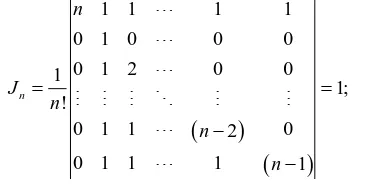
1n1, ensures congruence (not needed, as mentioned above) between the starting and the resulting reference frame.The substitution of Equations (40) and (42) into (38), after some determinant algebra, yields the explicit ex- pression of the Jacobian determinant, as:
1
1 1 1 1 1
1 1 0 0 0
1 1 2 0 0
1
; !
1 1 1 2 0
1 1 1 1 1
n n
J n
n
n
which, after additional determinant algebra, takes the expression:
1 1 1 1
0 1 0 0 0
0 1 2 0 0
1
1; !
0 1 1 2 0
0 1 1 1 1
n n J n n n (44)
in agreement with Equation (38).
Particularizing Equation (41) to , res- pectively, and performing the sum on the left and right- hand side, after some algebra yields:
1, 2, ,
k n
11 1 1 n n i i ;
x n X
(45)on the other hand, the invariance of the norm by chang- ing the reference frame implies the following:
2 1 1 ; n n i i i i x X
2(46) and the substitution of Equations (45) and (46) into (30) yields:
21 2 2 1 2 1 1 1 1 ; n n i i
X n X
n n
(47)which, using Equation (18), after some algebra produces:
2 2 2 1 n i iX n n n 2;
(48)that is the locus of -circles normal to the coordinate axis,
n2
1
X , centered therein, where the radius is:
1 2 1 2 1 21
Rn n n ; (49) in other terms, Equation (48) defines a n-cylinder where the symmetry axis coincides with the coordinate axis,
1
X , and the radius equals R.
In summary, the arithmetic mean standard deviation distribution can be expressed as a function of the errors,
1, 2, , n x x x , as:
d
1 2
d d1 2 d ;nn
n D n
f C
f x f x f x x x x(50) where Cn is a normalization constant, Dn the in-
tegration domain, expressed by Equation (31) which, turned into canonical form, Equation (48), represents a n-cylinder of infinite height, symmetry axis coinciding with the coordinate axis, X1, and radius defined by
Equation (49). Finally, f x
i dxid via Equation
, , are error distributions
1 i n
(1) as:
2 2
1 xi
expresse
d exp d ; 1 ;
2 2
i i i
m m
x x x i n
f
(51)
where m is the related rms error.
5. Expression of
f
d
in Terms of
,
m
, and Relate
trical Framew rk
bstitution of Equation (51) into (50) after little
d Geome
o
The su algebra yields:
df
2 1 1 2 2 2 1exp d d d ;
2 2 n n i i
n D n n n
m m
x
C x x x
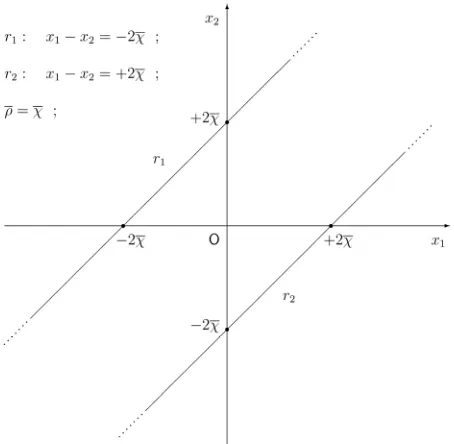
(52)the special case, n2, is shown in Figure 1. the re
With regard to sulting reference frame,
OX X1 2,,Xn
, after a change of variables (e; [8], Chap. 4) by use of Equation (46), Equation (52) translates into:
.g., [9], Chap. III, §4.10
2 1 2 21 2 1 2
1
d ex
2 2
, , , d d d
n
n i i
n n n
m m
n n
X
f C p
;
n
J X X X X X X
(53)where the integration domain, n, is an infinitely thin
try
n-cylindrical corona with symme axis, X1, and radius
defined by Equation (49).
Then the substitution of Equation (38) into (5 and (48) 3) yields:
2 2 2 1 1 2 2 1 d 2 1exp d d d ;
2 n
n n n
m
n m
f C
X n n
X X X
(54)the special case, n2, is shown in Figure 2. the p
With regard to rincipal
n1
-plane,
OX X2 3Xn
, the
n1
-surface of the
n1
-circle of radius, R, is (e.g., [10], Mathematical Appen- dix): 1 1 1 1 2 ; 1 1 2 n n n S R n (55)
where
rs the
is the Euler Gamma function, which satisfie following relations (e.g., [11], Chap. 39,
[image:6.595.70.256.116.210.2]Figure 1. The integration domain, D , with regard to the n reference frame,
Ox x1 2xn
, in the special case, n2.lines The straight lines, r , r , are the es of infinitely thin
bands, whose boun efined by the straight ,
1 2
deries are d ax
[image:7.595.64.279.421.629.2]r1:x1x2 2 d ; r2:x1x2 2
d
. The integration domain, D2, is defined by the above mentioned bands.Figure 2. The integration domain, n, with regard to the reference frame,
OX X1 2Xn
, in the special case, n2.lines The straight lines, r , r , are the es of infinitely thin
bands, whose boundar fined by the straight ,
1 2
ies are de ax
r1:X2 2 d ; r2:X2 2
d
; according to Equation (48). The integration domain, 2, is defined bys. the above mentioned band
r 1
r
r ; r 0; (56a)
i 1
i!; i 0,1 , 2,; (56b)
1 3 2 1
1 1
; ;
2 2i 2
i
i
(56c)
1 2
1 2 rexp
r r r r F
r ; (56d)
2 31 1 1 1 139 1
1 ;
12 188 51840
F r
r r r
(56e)
and the particularization of Equation (55) to the sim cases,
plest
1, 2, 3, 4,
n yields:
2 3
0 1 2
4
0; 2 ; ; ;
S S R S R S3 R (57) 3
with regard to points, segments, circles, sph pectively.
eres, res- In particular, n1 implies a single deviation from the mean, 10 according to Equation (4), then
1 0
R via E ions (11) and (49). Accordingly, the 0-circle coin es with the origin of the reference frame,
quat cid
Ox1 , the 0-surface of which is clearly null. Forthis reason, the undetermined expression, Rn100
as
1
n , a aring in Equation (55), may safely be put equal to 0, hence
ppe
0 0
S , in agreement w tion (57). On the other hand, Equations (17), (19), (20), lose their validity for n 1
ith Equa .
The
n1
-surface of an infinitely thin
n1
- circular corona can be determined by differentiating both sides of E uatioq n (55). The result is:
1
1 2
n
2
1
d 1 d ;
1 1
2
n n
S n R R
n
(58)
which is independent of the reference frame.
In summary, the arithmetic mean standard deviation distribution, f
d , may be expressed asin
a multiple tegral where the integration domain, n , is an
infinitely thin ncy indrical corona where the symmetry axis coincides with the coordinate axis,
- l
1
X , and the radius is defined by Equation (49). The result, expressed by Equation (54), after some algebra takes th form: e
1
2 1
1 2 3 2
2
exp d d d d ;
2 n
m m
m
n m
X
X X X X
2 2 1 2 1
1 1
d exp
2 2
n n n
n n C
f
circular section of the n-cyclindrical corona, respectively, hence n1Sn1.
6. The Solution
The substitution of E long but stimulating
quations (18), (58), into (59), after algebra yields:
2 21 2
d exp
1
n f
n
2
1 2 1 2
2 2
1 1
d ;
2 2
m
n
m m
n n
(60)
where
m m m
(6), and due
is the arithmetic mean rms error, Equation account has been paid to Equations
56c), together
(56a), ( with the normalization condition:
0 f d 1;
(61) which, after integration as outlin(59), is equivalent to:
ed above via Equation
1;
n
C (62) according to Equation (60) that, in a
related to a chi square distribu
ddition, can be tion with
n1
degrees of freedom.The expected values,
,
2 , can be deter- mined starting from the general definition:
0f
d ; (63)
2 2
0 f d ;
by substitution of Equation (60) into (6 long but stimulating algebra, the integratio
(64) 3) and (64). After
n yields:
1 22 n
;
1 1
2 2
m
n n
(65)
22 2
;
m m
n
(66) and the rms error of the arithmetic mean standard devia- tion distribution,
1 2 2
2
, after some al- gebra reads:
1 2 2
2
1 2
1 ;
1 2
2
m
n n
n
2 n 2
1 ;
1
2 2
2
n n
(68)
together with the inequalities:
1 2 1
n
2
1 1
1 n
2
1 2
; 1
2 2
2 n
n
n n
(69)
imply for Equation (67) the asymptotic expression (e.g., [8]):
1 ; 2n m
(70)
2 2
m
where the ratio, , is und Equations (67) and (69).
re
erstimated according to In summary, the arithmetic mean standard deviation distribution is explicitly expressed by Equation (60) and
lated expectation values,
,
2 , and rms error,
, are expressed by Equations (65)-(67), respectively. Finally, an asymptotic expression of is shown by Equ
n standard deviation distribution and have been determined following a
the current attempt appears unpublished) of the quoted
FERENCES
[1] C. W. Misner, J. A. Wheeler and K. S. Thorne, “Gravita- ation (70), where the value is understimated.
7. Conclusions
The arithmetic mea related parameters
procedure where the geometrical framework is clearly shown using typical formulation generalized to n-spaces. The integration has been performed after a change of reference frame, where the integration domain turns out to be an infinitely thin n-cylindrical corona that is sym- metric with respect to a coordinate axis.
Although alternative approaches grounded on mathe- matical analysis and statistics could appear shorter and less coumbersome, still the geometrical features are lost. A geometrical interpretation is essential in modern phy- sical, cosmological and elementary particle theories, such as general relativity, superstring theory and supersym- metric theory. In this view, an investigation of the geome- trical framework related to any field e.g., mechanics, sta- tistics, crystallography, music, could be of some utility.
8. Acknowledgements
A more extended version of in the last edition (in Italian,
(67)
by use of Equations (65) and (66).
The validity of the asymptotic expression (e.g., [8]):
text [8] by the author.
tion,” W.H. Freeman & Company, 1973.
[2] B. Greene, “The Elegant Universe: Superstrings, Hidden Dimensions, and the Quest for the Ultimate Theory,” W.W. Norton, 1999.
[3] J. Douthett and R. Krantz, “Energy Extremes and Spin Configurations for the One-Dimensional Antiferromag-netic Ising Model with Arbitrary-Range Interactions,” Jour- nal of Mathematical Physics, Vol. 37, No. 7, 1996, pp. 3334-3353. http://dx.doi.org/10.1063/1.531568
[4] A. M. Kosevich, “The Crystal Lattice: Phonons, Solitons, Dislocations, Superlattices,” WILEY-VCH Verlag GmbH & Co. KGaA, Weinheim, 2005.
[5] C. Callender, I. Quinn and D. Tymoczko, “Generalized Voice-Leading Spaces,” Science, Vol. 320, No. 5874, 2008, pp. 346-348.
http://dx.doi.org/10.1126/science.1153021
bles, and Sto-
ow,
mi, “Il Problema della Misura,” Diade, Nuova
de Mathèmatiques Supèrieures,”
Fractals: Forme, Hazard [6] A. Papoulis, “Probabilities, Random Varia
chastic Processes,” McGraw-Hill, New York, 1965. [7] B. Gnedenko, “The Theory of Probability,” Mir, Mosc
1978. [8] R. Caim
Vita, Padova, 2000. [9] V. Smirnov, “Cours
Tome II, Mir, Moscow, 1970. [10] B. B. Mandelbrot, “Les Objects
et Dimensions,” 2nd Edition, Flammarion, Paris, 1986. [11] M. R. Spiegel, “Mathematical Handbook of Formulas and
Appendix
Analytic Geometry Formulation Extended to -Spaces
n 1
Analytic geometry formulation extended to
n1
- spaces, used throughout the text, is outlined below. It shall be intended, but not explicitly mentioned where unnecessary, that the reference frame is
Ox x1 2x xn
.Let and be a generic straight line and n-plane, respectively, defined as:
r p
1 10 2 20 0 0
1 2
: n n ;
n
x x x x x x x x r
(71)
1
:
n i i i
p a x a x
A; (72)where P0
x10,x20,,xn0,x0
is a fixed pointbelonging to r and 1, 2, , n, ; a a1, 2,,an, a,
are specified coefficients. A;
Let rp, 0 2, be the angle formed by the straight line and the n-plane. Related trigonometric func- tions can be inferred from the explicit expression of the sine, as:
1
1 2 1 2 2 2 2 2
1 1
sin ;
n i i i
n n
i i
i i
a a
a a
(73)
which, in the case of interest
12 n0; 1; a1a2an 1n;
1; 0
a A , reduces to:
1
sin ; cos ;
1 1
n n
n (74) where r coincides with the coordinate axis, x, and
passes through the origin.
p
Let r be a generic straight line, defined as:
1 10 2 20 0 0
1 2
: n n ;
n
x x x x x x x x
r
(75)
where P0
x10,x20 ,,xn0,x0
is a fixed point belong-ing to r and 1 , 2, , n, , are specified coeffi-
cients.
Let rr, 0 2, be the angle formed by the straight lines, and . Related trigonometric functions can be inferred from the explicit expression of the cosine, as:
r r
1
1 2 1 2 2 2 2 2
1 1
cos ;
n i i i
n n
i i
i i
(76)
which, in the case of interest (j 0, 1 j i n;
1
i n n
; n1 ; i 0 , 1 i n ;
1
), reduces to: 1
cos ; sin ;
1 1
n
n n
(77)
where rgi is the generatrix, lying on the principal
plane,
Ox xi
, of the
-cone, defined byEquation (19), and r
1 n
coincides with the coordinate axis, x.
The condition of parallelism between the straight line, , and the n-plane, , reads:
r p
1
0;
n i i i
a a
(78)which, in the case of interest
(a1a2an1n;a 1), reduces to:
1
1
0;
n i i
n