
http://dx.doi.org/10.4236/wjcmp.2013.34030
Spin Configurations in the Rectangular Lattice
Gulistan Mert*, Hasan Sevki Mert
Department of Physics, Selcuk University, 42075 Campus, Konya, Turkey. Email: *[email protected]
Received July 30th, 2013; revised September 6th, 2013; accepted September 17th, 2013
Copyright © 2013 Gulistan Mert, Hasan Sevki Mert. This is an open access article distributed under the Creative Commons Attribu-tion License, which permits unrestricted use, distribuAttribu-tion, and reproducAttribu-tion in any medium, provided the original work is properly cited.
ABSTRACT
Using matrix method, the possible spin configurations have been determined for four sublattices in rectangular lattice taking into account only nearest-neighbor exchange interactions. We obtain collinear and non-collinear spin configura- tions in the ground and the first excited states for the three different propagation vectors. When k = 0, depending on the sign of exchange parameters, we find a ferromagnetic mode and three antiferromagnetic modes. When k = [1, 1] and [1.5, 1.5], we find non-collinear (canted) spin configurations. Moreover, we observe that spins of some sublattices in the excited state change their orientations.
Keywords: Spin Configuration; Exchange Interaction; Magnetic Mode; Magnetic Structure
1. Introduction
Bertaut’s matrix method enables possible magnetic modes associated with a given propagation vector in magnetic systems [1-3]. The symmetry properties of crystal gain importance. Moreover, method is valid for magnetic cells different from the chemical cells. For Bravais lattice, it reduces to Villain’s method [4]. From the other part, the results of this method are also agreed with that of group theory. The greatest advantage of this method is to con- sider fundamental interaction being isotropic classical Heisenberg and is also applicable when the chemical and magnetic cells are not identical. Moreover, isotropic terms as well as anisotropic terms can be expressed by a Ham- iltonian of a second order and problem can be reduced to an eigenvalue problem. Solving this eigenvalue equa-tion, one is able to find all possible magnetic config- urations. Townsend et al. dealt with triangular-spin struc- ture by the application of this method and predicted tri- angular-spin magnetic ordering for KFe3(OH)6(SO4)2 and
KFe3(OH)6(CrO4)2 [5]. Macroscopic (group theoretical)
and microscopic (matrix) methods were applied to the two-dimensional orthorhombic lattice with four spins by Darendelioğlu et al. and they determined that the four collinear modes are along the z-axis and the non-col- linear modes are in the xy-plane of the two-dimensional orthorhombic lattice [6]. Belorizky performed a system- atic research of the bilinear exchange Hamiltonian pro-
viding a ground state spin configuration for two and three dimensional lattices [7]. Yu et al. have given the phase diagram of the different spin configurations of a mag- netic bilayer system consisting of two ferromagnetic lay- ers, based on a phenomenological model [8]. On the other hand, many researchers studied experimentally whe- ther colinear and non-collinear structures exist in DyNiC2
and HoNiC2 compounds [9], in Mn5Ge3 compound [10],
in La1.5Sr0.5CoO4 [11] and in ɛ-FexN [12].
In this paper, we will apply the Bertaut’s matrix method to the four-sublattice model in rectangular lattice for the given propagation vectors in the ground and the first excited states as taking only nearest-neighbor ex- change interaction. The outline of this paper is as follows. In Section 2, we follow the matrix method of Bertaut and give the fundamental equations. In Section 3, we have determined possible spin configurations depending on the propagation vectors and the sign of exchange pa- rameters and found collinear and non-collinear (canted) spin configurations. Finally, Section 4 contains conclu- sions.
2. Matrix Method
We derive spin configurations of the four sublattices on rectangular lattice using the Bertaut’s matrix method [2]. We will assume that there is a classical interaction of Heisenberg type between the nearest-neighbor spins. Ha- miltonian is given by
2 ij i j ij
H
J S S , (1)where Jij is the exchange integral between spins at ri and rj. Si is the spin at point ri.
Using the translational symmetry of the system, one obtains:
,i i ij j
j
J
S k
k S k (2)where λi is a constant of proportionality, having the di- mension of an energy. After a Fourier transformation, Equation (2) can be written as matrix equation:
J k
S k
0,n
(3)
where λ is the diagonal matrix formed by the elements
λiδij ( ; n is the number of sublattices). Si(k) is a column vector being the Fourier transformations of the
Si(ri): 1, , i
1
exp 2
,i
i i i i
N
r i
S k S r k r (4)
1
exp 2
,i i i i i
N
k
S r S k k r
r
(5)
where N is the number of unit cells in the lattice. The hermitian interaction matrix J(k) is Fourier transforma- tion of Jij and whose matrix elements are defined as fol- lows:
exp 2
0
,i
ij ij i j
J
J i r
k k r (6)
where ri0 is a fixed reference point and the summation is
over all rj belonging to the same Bravais lattice j.
The expression of Si(k) depended on phase is given by:
1
ˆ ˆ exp
,2
i i ii
S k x y (7) where xˆ and yˆ are orthogonal unit vectors, i is the phase angle of sublattice i. The angle between two spins Si(ri) and Si(ri) in a one mode solution is given by
1, 2
2
ij i j i j
. r r k r r (8)
The matrix J(k) in Equation (3) still depends on the atomic coordinates. With following transformation of eigenvectors
exp
0 ,i i i i
Q S k k r
(9) one may construct a hermitian matrix η(k) which does not depend on the atomic coordinates:
k
Q0. (10)η(k) matrix elements contain Fourier transform of the exchange integrals between ions occupying the sublet- tices.
In the case of only one propagation vector k, the ref- erence spins are simply given by
io i
i
*
S r Q k Q k (11)
*
0 exp 0 exp
i i i i i i i0
S r S k k r S k k r (12)
i0 ˆcos
i0i
ˆsin
i0i
S r x k r y k r (13)
This equation is the main equation in order to find spin directions for the given k-vectors.
3. Results and Discussions
We consider the four magnetic ions (labeled as 1, 2, 3 and 4) localized rectangular lattice displayed in Figure 1
in which one shows also the corresponding exchange integrals. The ions occupy the positions: 1) x, y; 2) x, –y; 3) –x, –y; 4) –x, y. Our exchange integrals J1, J2 and J3
correspond to J12, J13 and J14, respectively. For this
specific case, we have taken the exchange parameters as follows: J1 = 0.05, J2 = 0.001 and J3 = 0.02 or J1 = –0.05,
J2 = –0.001 and J3 = –0.02.
Our interaction matrix has the form
11 12 13 14 1 2 3
21 22 23 24 1 3 2
31 32 33 34 2 3 1
41 42 43 44 3 2 1
0 0
0 0
J J J
J J J
J J J
J J J
(14)
We have to find the eigenvectors and eigenvalues of the matrix in Equation (14). The solution to this homogenous equations system depends on the satisfaction of the fol- lowing condition:
1 2 3
1 3 2
2 3 1
3 2 1
det 0
J J J
J J J
I
J J J
J J J
(15)
We have determined numerically eigenvalues i (i = 1, 2, 3, 4) and corresponding eigenvectors. The stability con- ditions of the calculated modes follow from the condition that must be a maximum (The quadratic form the coef- ficients of which are the second derivates of must be definite positive).
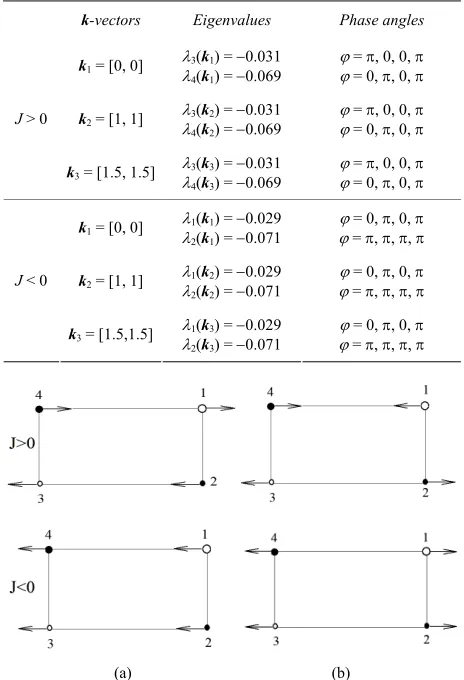
The obtained eigenvalues and eigenvectors are dis- played at Table 1 for the positive and negative values of exchange parameters and given k-vectors. The phase angles of four sublattices in the ground and the firstex- cited state for the positive and negative values of ex- change parameters are displayed at Table 2.
Table 1. Computationally obtained eigenvelues and their eigenvectors for given k-vectors and the positive and nega- tive values of exchange parameters.
k-vectors Eigenvalues Eigenvectors 1(k1) = 0.071 Q k1 1 1 2 1 2 1 2 1 2
2(k1) = 0.029 Q k2 1 1 2 1 2 1 2 1 2
3(k1) = 0.031 Q k3 1 1 2 1 2 1 2 1 2
k1 =
[0, 0]
4(k1) = 0.069 Q k4 1 1 2 1 2 1 2 1 2
1(k2) = 0.071 Q k1 2 1 2 1 2 1 2 1 2
2(k2) = 0.029 Q k2 2 1 2 1 2 1 2 1 2
3(k2) = 0.031 Q k3 2 1 2 1 2 1 2 1 2
k2 =
[1, 1]
4(k2) = 0.069 Q k4 2 1 2 1 2 1 2 1 2
1(k3) = 0.071 Q k1 3 1 2 1 2 1 2 1 2
2(k3) = 0.029 Q k2 3 1 2 1 2 1 2 1 2
3(k3) = 0.031 Q k3 3 1 2 1 2 1 2 1 2
J > 0
[image:3.595.55.286.122.642.2] [image:3.595.308.539.122.460.2] [image:3.595.310.536.498.672.2]k3 =
[1.5, 1.5]
4(k3) = 0.069 Q k4 3 1 2 1 2 1 2 1 2
1(k1) = 0.029 Q k1 1 1 2 1 2 1 2 1 2
2(k1) = 0.071 Q k2 1 1 2 1 2 1 2 1 2
3(k1) = 0.069 Q k3 1 1 2 1 2 1 2 1 2
k1 =
[0, 0]
4(k1) = 0.031 Q k4 1 1 2 1 2 1 2 1 2
1(k2) = 0.029 Q k1 2 1 2 1 2 1 2 1 2
2(k2) = 0.071 Q k2 2 1 2 1 2 1 2 1 2
3(k2) = 0.069 Q k3 2 1 2 1 2 1 2 1 2
k2 =
[1, 1]
4(k2) = 0.031 Q k4 2 1 2 1 2 1 2 1 2
1(k3) = 0.029 Q k1 3 1 2 1 2 1 2 1 2
2(k3) = 0.071 Q k2 3 1 2 1 2 1 2 1 2
3(k3) = 0.069 Q k3 3 1 2 1 2 1 2 1 2
J < 0
k3 =
[1.5, 1.5]
4(k3) = 0.031 Q k4 3 1 2 1 2 1 2 1 2
Figure 1. The rectangular lattice with the four sublattices and the magnetic interactions between neighboring ions.
results are displayed in Figures 2, 3 and 4.
Figure 2 shows the spin configurations of the ground
and the first excited state for the positive and negative values of exchange parameters when k1= [0, 0]. As it is seen by the figure, spin configurations have collinear
Table 2. The corresponding phase angles in the ground and the first excited states the positive and negative values of exchange parameters.
k-vectors Eigenvalues Phase angles
k1 = [0, 0] 3(k1) = 0.031 4(k1) = 0.069
= , 0, 0,
= 0, , 0,
k2 = [1, 1] 3(k2) = 0.031 4(k2) = 0.069
= , 0, 0,
= 0, , 0,
J > 0
k3 = [1.5, 1.5] 3(k3) = 0.031 4(k3) = 0.069
= , 0, 0,
= 0, , 0,
k1 = [0, 0] 1(k1) = 0.029 2(k1) = 0.071
= 0, , 0,
= , , ,
k2 = [1, 1] 1(k2) = 0.029 2(k2) = 0.071
= 0, , 0,
= , , ,
J < 0
k3 = [1.5,1.5] 1(k3) = 0.029 2(k3) = 0.071
= 0, , 0,
= , , ,
(a) (b)
Figure 2. Spin configurations for the propagation vector k1 = [0, 0] (a) in the ground state (b) in the first excited state.
(a) (b)
Figure 3. Spin configurations for the propagation vector k2 = [1, 1] (a) in the ground state (b) in the first excited state.
(a) (b)
Figure 4. Spin configurations for the propagation vector k3 = [1.5, 1.5] (a) in the ground state (b) in the first excited state.
cubic lattice and find a ferromagnetic and three antiferro- magnetic spin configurations at T = 0 K [13]. That the propagation vector of the configuration is zero means that in this configuration magnetic and chemical cells are identical. It is observed that spins of the sublattices 1 and 2 in the excited state have changed their orientations. Moreover, spins of the sublattices 1 and 2 in the case of J < 0 have changed their orientations.
Figure 3 shows the spin configurations of the ground
and the first excited state for the positive and negative values of exchange parameters when k2 = [0.5, 0.5]. We have non-collinear spin configurations (canted) spin con- figurations.
As it is seen from figure, one observes that spins of the sublattices 1 and 2 in the excited state have changed their orientations. Moreover, spins of the sublattices 1 and 3 in the case of J < 0 have changed their orientations.
Figure 4 shows the spin configurations of the ground
and the first excited state for the positive and negative values of exchange parameters when k2 = [1.5, 1.5]. Spin behaviors are similar to Figure 3 but their angles are different.
4. Conclusion
The Bertaut’s Matrix method is applied to rectangular lattice with the four sublattices as taking only nearest- neighbor exchange interaction. For certain values of these exchange parameters, the energies are obtained as a function of k. For every k-vector the corresponding ei- genvectors are also obtained and the phase angles of these sublattices are calculated for the ground and the first excited states. Finally, using the phase angles, the orientations and configurations of spins are determined. When k = 0, depending on the sign of exchange parame- ters, we found a ferromagnetic mode and three antiferro- magnetic modes. When k = [1, 1] and [1.5, 1.5], we found non-collinear (canted) spin configurations. It is observed that spins of some sublattices in the excited
state have changed their orientations.
REFERENCES
[1] E. F. Bertaut, “Configurations de Spin et Théorie des Groups,” Journal de Physique et le Radium, Vol. 22, No. 5, 1961, pp. 321-322.
http://dx.doi.org/10.1051/jphysrad:01961002205032100 [2] E. F. Bertaut, “Lattice Theory of Spin Configuration,”
Journal of Applied Physics, Vol. 33, No. 3, 1962, pp. 1138-1143. http://dx.doi.org/10.1063/1.1728635
[3] A. Kallel, H. Boller and E. F. Bertaut, “Helimagnetism in MnP-Type Compounds: MnP, FeP, CrAs and CrAs1−xSbx
Mixed Crystals,” Journal of Physics and Chemistry of Solids, Vol. 35, No. 9, 1974, pp. 1139-1152.
http://dx.doi.org/10.1016/S0022-3697(74)80132-0 [4] J. Villain, “La Structure des Substances Magnetiques,”
Journal of Physics and Chemistry of Solids, Vol. 11, No. 3-4, 1959, pp. 303-309.
http://dx.doi.org/10.1016/0022-3697(59)90231-8
[5] M. G. Townsend, G. Longworth and E. Roudaut, “Trian- gular-Spin, Kagome Plane in Jarosites,” Physical Review B, Vol. 33, No. 7, 1986, pp. 4919-4926.
http://dx.doi.org/10.1103/PhysRevB.33.4919
[6] H. Ş. Darendelioğlu and H. Yüksel, “Spin Configuration of Two-Dimensional Orthorhombic Lattice,” Journal of Physics and Chemistry of Solids, Vol. 54, No. 11, 1993, pp. 1599-1602.
http://dx.doi.org/10.1016/0022-3697(93)90355-U
[7] E. Belorizky, “Exact Ground State Spin Configurations for 2D and 3D Lattices with Nearest Neighbor Bilinear Exchange,” Solid State Communications, Vol. 96, No. 11, 1995, pp. 853-858.
http://dx.doi.org/10.1016/0038-1098(95)00588-9
[8] M. H. Yu and Z. D. Zhang, “Spin Configurations in the Absence of an External Magnetic Bilayer with in-Plane Cubic or Uniaxial Anisotropies,” Journal of Magnetism and Magnetic Materials, Vol. 195, No. 2, 1999, pp. 514- 519. http://dx.doi.org/10.1016/S0304-8853(99)00101-8 [9] J. K. Yakinthos, P. A. Kotsanidis, W. Schäfer, W.
Kock-elmann, G. Will and W. Reimers, “The Two-Component Non-Collinear Antiferromagnetic Structures of DyNiC2 and HoNiC2,” Journal of Magnetism and Magnetic Mate- rials, Vol. 136, No. 3, 1994, pp. 327-334.
http://dx.doi.org/10.1016/0304-8853(94)00306-8
[10] A. Stroppa and M. Peressi, “Non-Collinear Magnetic States of Mn5Ge3 Compound,” Physica Status Solidi (a), Vol. 204, No. 1, 2007, pp. 44-52.
http://dx.doi.org/10.1002/pssa.200673014
[11] K. Horigane, T. Uchida, H. Hiraka, K. Yamada and J. Akimitsu, “Charge and Spin Ordering in La2−xSrxCoO4
(0.4 < x < 0.6),” Nuclear Instruments and Methods in Physics Research A, Vol. 600, No. 1, 2009, pp. 243-245. http://dx.doi.org/10.1016/j.nima.2008.11.141
http://dx.doi.org/10.1016/j.cplett.2010.02.072
[13] E. Belorizky, R. Caslegno and J. Sivardiare, “Configura- tions of a Simple Cubic Lattice of Pseudo-Spins S = 1/2
![Figure 4. Spin configurations for the propagation vector k3 = [1.5, 1.5] (a) in the ground state (b) in the first excited state](https://thumb-us.123doks.com/thumbv2/123dok_us/7887141.741407/4.595.58.287.85.227/figure-spin-configurations-propagation-vector-ground-state-excited.webp)
