Munich Personal RePEc Archive
Network analysis of co-operation
between research institutions - example
of ESPON Programme
Płoszaj, Adam and Wojnar, Katarzyna
Centre for European Regional and Local Studies (EUROREG),
University of Warsaw
15 September 2009
Online at
https://mpra.ub.uni-muenchen.de/45433/
NETWORK ANALYSIS OF CO-OPERATION BETWEEN RESEARCH
INSTITUTIONS
–
EXAMPLE OF ESPON PROGRAMME
1ADAM PŁOSZAJ,KATARZYNA WOJNAR2
[email protected]; [email protected]
ABSTRACT
The aim of the paper is to characterise ESPON Programme (European Observation Network for Territorial Development and Cohesion) as a network-based international research programme and the evaluation of capacity of network analysis in studying scientific cooperation. Results of the study show that institutions involved in ESPON projects create a dense, closely interconnected network of co-operation. The network is dominated by a limited number of institutions, which are involved in large share of the projects and have the most expanded cooperation network. Spatial analysis proves that there is significant lack of institutions from Central-Eastern Europe in the Programme. Network analysis allowed to identify the most efficient methods for improving the presence of institutions representing new member states in the ESPON co-operation network.
INTRODUCTION
Network analysis is a method which is being applied increasingly frequently in analyses of various fields of cooperation, such as Internet, communications, economic cooperation, as well as scientific cooperation. The network analysis tools give a new perspective to studies on the nature of cooperation, going beyond the classical variables of, e.g. statistical analysis. Moreover, as compared to classical measurements, the network analysis allows to identify the structure of connections, and thus the social capital resulting from cooperation. This approach to include the spatial variables connected with collaboration studies, and as a consequence allows to adjust the public and social intervention programs to the existing formal and informal structures (Malerba, 2009).
Even tough network analysis is widely used by sociologists as well as organization and management theorists, it is still lacking reconnition in applied research (Eisenberg & Swanson, 1996; Provan et al., 2005). Network analysis may supply new information on the structure of connections between the actors in the network, proving itself useful in creation of cooperation systems and designing organizational structures. (Kadushin et at., 2005; Provan et al., 2005). This applies both to cooperation within a single institution, and cooperation between various institutions. Moreover, network analysis proves useful not only in describing the structure, but also analysing the functioning of the cooperation systems, behaviour of particular actors, as well as the impact of those phenomena on efficiency in meeting objectives of such cooperation (Cross et al., 2009).
In the academic literature network analysis is often used in describing scientific cooperation in various research programmes. The characteristic feature of these programmes is that they are jointly implemented by research institutions organized into consortia. The projects have their characteristic, as well as selection and implementation procedures. Most often the selection is based on competition, which means that from time to time there are calls for proposals, followed by tendering stage, selection stage, and then the winning consortia having specified time for implementation of the projects. Taking this into account, an important feature of the research programmes is their periodicity, allowing for repeated participation of the institutions in various projects and institutional configurations.
1
"This is the improved version of a paper publisher in Polish as: Ploszaj A., Wojnar. K. (2009). Analiza sieci współpracy ośrodków naukowo -badawczych –przykład programu ESPON, Studia Regionalne i Lokalne, nr. 4(38)/2009.
This article does not necessarily reflect the opinion of the ESPON Monitoring Committee. 2
OBJECTIVE OF THE PAPER
The aim of this paper is to characterise ESPON programme as a research programme based on international cooperation. ESPON programme is analysed against the background of results of other research programmes stimulating scientific cooperation, and in particular the EU Framework Programmes. The authors present the aims of the ESPON programme, its assumptions and institutional context, and the mechanisms used for stimulating cooperation. The empirical part of the paper consists of analysis of ESPON programme participation, conducted on three levels: individual research institutions, cities, and countries in which they are located. Another element of the analysis concerns cooperation in the Programme presented on the institutional level using basic measurements of centrality (degree centrality and betweenness centrality). The analyses proposed in the article are supposed to answer the following research questions:
What is the extent of participation of institutions, cities, and countries in ESPON programme? (is it"balanced” or dominated by some particular entities?)
What is the shape of cooperation network within the programme? (is it very centralized or consists of unconnected components?)
What potential effects on the programme, in terms of scientific results (adequacy of analyses for all countries included in the programme, the number of case studies), may have such involvement of its participating institutions?NETWORK ANALYSIS
–
THE BASICS
Each network consists of nodes and relationships between them. The nodes can be people, organizations or their units, events, projects, etc. The network nodes have some attributes, or features (in the case of organizations it is e.g. the number of employees, their competences, financial data, etc.). The forms of relations may include exchange of information, cooperation, participation in the same projects, but also mutual competition. The flows take place between the nodes and along the relations, so to say (for organizations they may include flows of funds, information, employees, etc.). The relations between the network nodes may be measured in many ways, among them by the frequency of interaction, its length, simple or complex character (e.g. overlapping social and organizational relationships) (Hörlesberger & Dachs, 2002). Development of network analysis gave rise to many specialist concepts (cf. e.g. Wasserman, Faust, 2007; Freeman, 2004). The article makes use of only some of the possibilities created by this research approach. In particular we use nodes centrality measures defining the position of nodes in the network in respect of their prestige, influence on other actors and access to information (or even control over information flow).
RESEARCH PROGRAMMES AS TOOLS FOR STRENGHTENING COOPERATION
Research programmes most widely analysed in the literature are the so-called EU Framework Programmes (Almendral, Oliveira, Lopez, Mendes, & Sanjuan, 2007; COWI A/S, 2009; Garas & Argyrakis, 2008;
Hörlesberger & Dachs, 2002; Kopcsa, Topolnik, & Schibany, 1999; Paier & Scherngell, 2008; Rønnest, 2009).
Other studies show that as a result of participation in Framework Programmes the institutions with no previous experience in such research programmes significantly change both their approach to science, research methodology, and organization of work. Rønnest underlines that institutions previously using sectoral approach, concentrated on basic research, with unclear relations between research institutions and business, and not focusing on communication and visibility of projects significantly changed their practices in consequence of their experiences in Framework Programmes. Participation in the programmes contributed to development of interdisciplinary approach, network cooperation, focus on applied research, increased cooperation with the public sector and business, greater awareness and professionalism in project management and sharing the results (Rønnest, 2009). Other analyses show that as compared to other national research systems (not concentrating on cooperation) the Framework Programmes give their institutional participants advantage over national institutions not cooperating internationally, on the one hand, and to increase impact of the results obtained by the cooperating institutions, on the other (Kopcsa et al., 1999).
Most frequently the research programmes financed from public funds are aimed at providing knowledge required by various stakeholders such as politicians and bureaucrats in decision-making, formulating public programmes, and strategic planning. The type of the research institutions implementing a given project may significantly influence the interpretation of the obtained results, and as a consequence the method of formulating recommendations for people dealing hands-on with the issues. Therefore it is particularly important to learn about the mechanisms affecting cooperation between research institutions and individual researchers representing these institutions. (Garas & Argyrakis, 2008).
The abovementioned examples prove that from the point of view of individual countries participation of their national institutions in research programmes focusing on cooperation is particularly important. It contributes to strengthening the country’s innovative, scientific and research potential. Moreover, as far as policy-making is concerned, it allows for formulating and promoting the perspective and interests of a given country through research reports’ conclusions and recommendations. Unfortunately, institutions representing the new member states are still underrepresented in the EU research programmes. Evaluation of Framework Programmes shows that the most important barrier for institutions from the new countries in joining the cooperation network is lack of key resources, which in this ace are particularly crucial, i.e. direct foreign contacts allowing to enter the network. Another important barrier is the language barrier (the majority of research programmes is conducted in English) (COWI A/S, 2009, pp. 44-45).
ESPON 2006 PROGRAMME AS A PLATROFM FOR SCIENTIFIC COOPERATION
The subject of analysis in this paper is the international cooperation of research institutions within ESPON 2006 Programme. ESPON stands for European Observation Network for Territorial Development and Cohesion. It is a research programme focused on to spatial development and related to EU Structural Funds. The Programme began in 2002 and the activities covered by its first edition, finished in 2006, were financed by the European Commission from the Community Initiative Programme INTERREG III, and partially by the member states plus Island, Norway and Switzerland. Its managing authority is located in Luxembourg.
ESPON, as compared to Framework Programmes, is several times smaller and its constitutive measures have significantly narrower scope. 128 research institutions from the whole Europe participated in 31 research projects within the Programme, as well as supporting and coordinating activities, since its launch in 2006. An important supporting structure for ESPON Programme is the network of national ESPON contact points, linking stakeholders and researchers in all member states. The representatives of ministries from all the countries involved in ESPON Programme as well as representatives of the European Commission from the Monitoring Committee are supposed to ensure practical usefulness of the conducted research.
well as on impact of the implemented policies on European regions and areas. This knowledge is supposed to directly support formulating and implementing strategic objectives. ESPON Programme is supposed to provide knowledge exceeding the standard, traditional analyses performed by the European Commission. Other objectives of the Programme include bringing together researchers, officials, and policy-makers in order to allow for better mutual understanding of their perspectives and creating a network of scientific cooperation in EU spatial studies and development (European Commission, 2004).
The main Programme document stresses the fact that ESPON is based on national and regional experience and resources, and that the cooperation between the scientific centres is supposed to contribute to sharing skills, knowledge, and experience, consequently bringing about beneficial synergy effects. The document explicitly states that the programme goals and optimum use of the financial and organizational resources can be adequately attained only by network cooperation. Moreover, the cooperation shall lead to mutual understanding of the perspectives and needs between stakeholders and scientists, as well as working out a common communication platform for the parties (European Commission, 2004).
Consequently, this means that the institutions conducting research projects within ESPON Programme have significant influence on the directions of future political decisions and strategic planning, in particular in respect to EU territorial development policy, as well as the EU Cohesion and Competition Policies. This also differentiates ESPON from the Framework Programmes, allowing ESPON results, to have potentially much more significant impact on the Community’s decision-making, despite its significantly smaller scale. This is one more reason for conducting a close analysis of its cooperation structures.
FORMAL CONTEXT OF COOPERATION WITHIN ESPON 2006 PROGRAMME
Before proceeding with the main part of analysis of the scientific cooperation within the ESPON 2006 programme we should shortly discuss the formal context of the cooperation, i.e. characterize the procedures regulating participation in activities within ESPON 2006 Programme.
The most important principle differentiating ESPON from other research programmes is the “one project – one research consortium” principle. The research topics are not proposed by research institutions, but strictly specified by the European Commission, as the project implementation is de facto commissioned by it. At the competition stage several competing consortia present their offers of research implementation.
Research consortia, or the Transnational Project Groups (TPGs), are formed in the process of self-organizing supported by the national contact points. Each such consortium consists of institutions representing at
least three various countries from the Programme’s area (EU + the partner countries). The consortia should cooperate with at least one contact point, preferably from the country of the lead partner, in order to allow for networking with other, parallel projects and the program coordination unit (ESPON Coordination Unit, 2003).
QUANTITATIVE ANALYSIS OF PARTICIPATION IN ESPON 2006 PROGRAMME
INSTITUTIONS
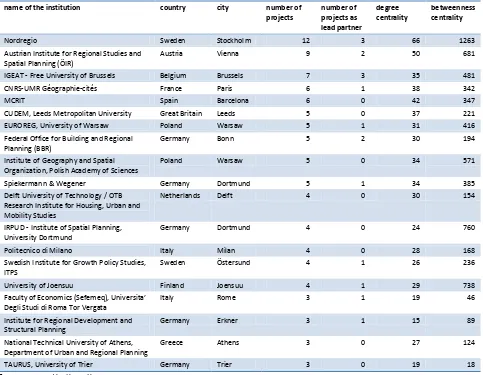
ESPON 2000-2006 programme included implementation of 31 projects by 228 project partners from 128 institutions. Individual projects were implemented by consortia of 2 to 14 partners. 87 institutions (69%) took part in only one project, while 22 of them (17%) took part in two projects. Only 19 institutions took part in 3 or more projects. The most active institution, NORDREGIO from Stockholm, participated in as many as 12 projects – i.e. one third of all of the implemented projects. The most active research institutions (participating in at least three projects) are presented in Table 1. The role of the lead partner was held by 25 out of 128 institutions3. 19 of them coordinated just one project. The following 4 institutions coordinated 2 projects each: Austrian Institute for Regional Studies and Spatial Planning (ÖIR), CNRS-UMR DATAR – Université Paris 7, ECOTEC - Research and Consulting Ltd. (Brussels), Federal Office for Building and Regional Planning (BBR). Lead partners of the greatest number of projects, i.e. 3, were: IGEAT - Institut
[image:6.595.58.541.293.668.2]de Gestion de l’environnement et d’aménagement du territoire, Free University of Brussels, and Nordregio.
Table 1. The research institutions most active in ESPON 2000-2006 programme
name of the institution country city number of
projects
number of projects as lead partner
degree centrality
betweenness centrality
Nordregio Sweden Stockholm 12 3 66 1263 Austrian Institute for Regional Studies and
Spatial Planning (ÖIR)
Austria Vienna 9 2 50 681 IGEAT - Free University of Brussels Belgium Brussels 7 3 35 481 CNRS-UMR Géographie-cités France Paris 6 1 38 342
MCRIT Spain Barcelona 6 0 42 347
CUDEM, Leeds Metropolitan University Great Britain Leeds 5 0 37 221 EUROREG, University of Warsaw Poland Warsaw 5 1 31 416 Federal Office for Building and Regional
Planning (BBR)
Germany Bonn 5 2 30 194
Institute of Geography and Spatial Organization, Polish Academy of Sciences
Poland Warsaw 5 0 34 571 Spiekermann & Wegener Germany Dortmund 5 1 34 385 Delft University of Technology / OTB
Research Institute for Housing, Urban and Mobility Studies
Netherlands Delft 4 0 30 154 IRPUD - Institute of Spatial Planning,
University Dortmund
Germany Dortmund 4 0 24 760 Politecnico di Milano Italy Milan 4 0 28 168 Swedish Institute for Growth Policy Studies,
ITPS
Sweden Östersund 4 1 26 236 University of Joensuu Finland Joensuu 4 1 29 738 Faculty of Economics (Sefemeq), Universita’
Degli Studi di Roma Tor Vergata
Italy Rome 3 1 19 46
Institute for Regional Development and Structural Planning
Germany Erkner 3 1 15 89 National Technical University of Athens,
Department of Urban and Regional Planning
Greece Athens 3 0 27 124 TAURUS, University of Trier Germany Trier 3 0 19 18 Source: prepared by the authors.
3
CITIES
Institutions implementing the projects within ESPON Programme were located in 85 cities (separate administrative centres). 46 of those urban centres (54%) were represented in only one project, 16 (19%) were represented in two projects, 14 (16.5%) in 3-5 projects, and 9 (10.6%) in 6 and more projects. The most active urban centre was definitely Stockholm – the institutions based there (Nordregio, EuroFutures and Frederiksson&Partners AB, The Royal Institute of Technology) were represented in 14 projects (i.e. in almost half of all research projects implemented within the ESPON 2006 Programme). Another urban centre with high representation in ESPON projects is Brussels (11 projects). Institutions from Athens, Warsaw, and Vienna participated in 10 projects, those from Dortmund in 9, and from Barcelona and Paris4 in 7. Institutions leading ESPON projects were based in 21 centres. Institutions from Stockholm and Brussels coordinated five projects perr each city, 3 projects were coordinated by institutions from Paris, and institutions from Bonn and Vienna coordinated 2 projects per each city.
COUNTRIES
ESPON 2000-2006 Programme included 29 countries (EU 27 + Norway and Switzerland), and institutions from all of these countries could have participated in the Programme. The number of countries from which no institution participated was, however, as high as seven (Bulgaria, Slovakia, Lithuania, Latvia, Estonia, Cyprus, and Malta). The projects were coordinated by institutions from 12 of the countries. As many as 6 projects were coordinated by Swedish institutions. Institutions from Belgium, France, and Germany coordinated 5 projects per each of the countries. Finnish institutions coordinated 3 projects, and Austrian and Italian – 2 projects per each of the countries. Spanish, Dutch, Portuguese, Polish, and Italian institutions coordinated one project per each country.
Map 1. Participation of institutions from European countries in ESPON 2000-2006 programme
Source: prepared by the authors.
4
Moreover, participant in one of the projects was LATTS - Laboratoire Techniques, Territoires, Sociétés à l'Ecole Nationale des Ponts et Chaussées in Marne-la-Vallée, located at the suburbs of Paris and belonging to the Paris agglomeration.
ESPON
projects’ partners
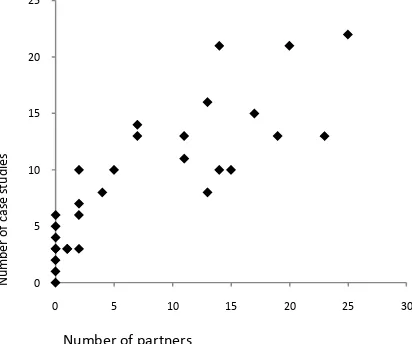
Greater of lesser participation from a given country or region in the implemented projects may as a consequence influence the quality of analyses realting to a given area. Local experts tend to know best the situation in their own country. Simultaneously, lack of local experts in some projects results in superficiality of analyses, or even obvious errors and blunders (cf. Gorzelak, Olechnicka 2009). Issues specific for individual countries may be presented in case studies – both at the national, regional, and local level. Case studies usually require more specific knowledge than analyses at the European level, and therefore most frequently local experts must be included. Thus countries being particularly active participants in ESPON projects (institutions from those countries taking part in many projects) will typically be more frequent subject of case studies within ESPON projects (cf. Fig. 1). The correlation demonstrates that participation in ESPON Programme brings not only benefits for particular institutions or prestige for the country, but more importantly provides opportunity for conducting detailed analyses of spatial phenomena which are crucial for that country.
Fig. 1. The number of project partners from a given country and the number of case studies devoted to that country
Source: prepared by the authors.
NETWORK OF INSTITUTIONS IN ESPON 2006 PROGRAMME
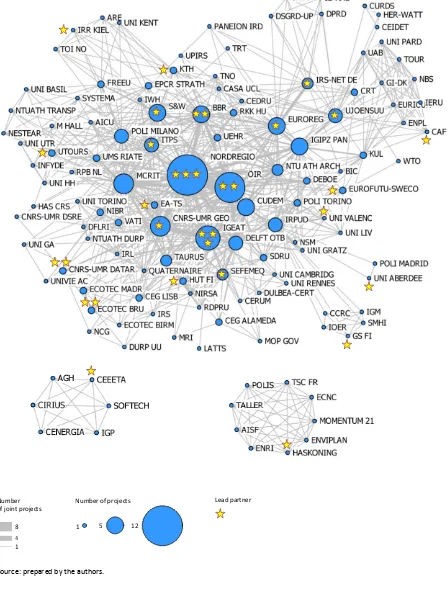
The institutions participating in ESPON projects form quite close cooperation network. Only 2 projects5 (out of 31) involved institutions not participating in any other ESPON project (cf. Fig. 2). The projects were:
“Energy services, networks and territorial impact EU energy policy ESPON” -ESPON 2.1.4, and “Territorial
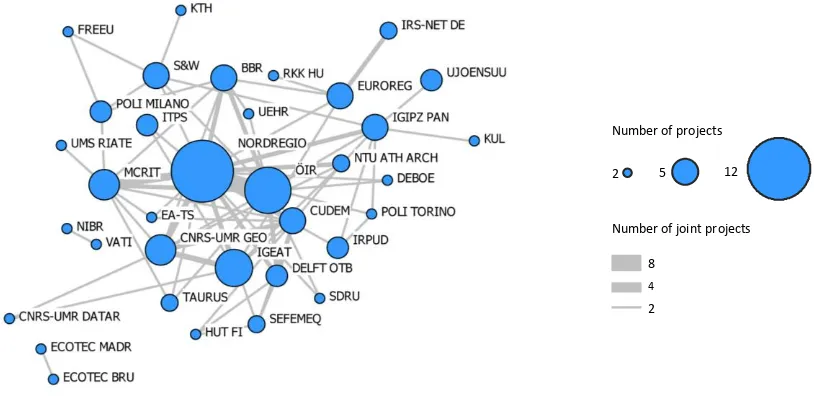
trends of the management of the natural heritage” - ESPON 1.3.2. In all other cases at least one institution also participated in at least one other project. Moreover, the cooperation structure turned out to include one large component joining, to greater or lesser extent, all the institutions engaged in 29 ESPON projects. The core of the cooperation network is formed by institutions mutually cooperating in more than one project. As many as 35 institutions cooperated at least twice with one or more other institutions (Fig. 3). Simultaneously 12 institutions cooperated in three (and more) projects with at least one other institution (Fig. 4). The cooperation is most frequently established between Nordregio and OIR – who implemented jointly as many as 8 projects. Frequent cooperation was also the case for: Nordregio and MCRIT (5 joint projects). Nordregio and CUDEM, Nordregio and CNRS-UMR GEO, CNRS-UMR GEO and IGEAT (4 joint projects per each pair).
5
The projects were: “Energy services, networks and territorial impact EU energy policy ESPON” -ESPON 2.1.4, and “Territorial trends of the management of the natural heritage” - ESPON 1.3.2.
0 5 10 15 20 25
0 5 10 15 20 25 30
li
czb
a
stu
di
ów
p
rzyp
ad
ku
liczba partnerówNumber of partners
N
u
m
b
e
r
o
f
ca
se
s
tu
d
ie
Fig. 2. Network of cooperation in ESPON projects (all institutions)6
Source: prepared by the authors.
6
For a list of acronyms, see annex I.
Number of projects
1 5 12
Number of joint projects
8
4
1
Fig. 3. Network of cooperation in ESPON projects (institutions mutually cooperating in at least two projects)
Source: prepared by the authors.
Fig. 4. Network of cooperation in ESPON projects (institutions mutually cooperating in at least three projects)
Source: prepared by the authors.
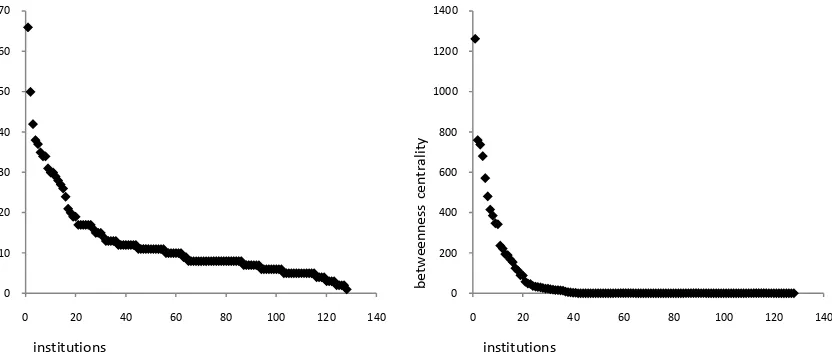
Particular institutions vary in terms of the number of other institutions they cooperated with as part of ESPON projects. The scope of cooperation expressed by the number of relations with other institutions is resulting from the number of projects, in which a given institution participated (correlation = 0.94). Therefore, it is not a surprise that the most extensive contact network is that of NORDREGIO – which cooperated with as many as 66 institutions, i.e. about half of all the institutions involved in ESPON projects(!). The second institution with the most extensive cooperation network is ÖIR (in this case the contact network is significantly smaller, amounting to 50 institutions). Detailed data for the most important institutions is presented in Table 1. The number of relations is also the simplest measure of (degree) centrality of the entity in the network (cf. Batorski 2008, p. 179). Greater involvement of a given institution in network relations (connections with a large number of nodes) means its greater centrality in and significance for the whole network. In the analysed case only a small portion of nodes have a large number of relationships (cf. Fig. 5). The special role of a few institutions most important for ESPON programme can be seen even more clearly if we take into account another measure of centrality, i.e. betweenness
Number of projects
12 5
2
Number of joint projects
8
4
2
Number of projects
12 5
3
Number of joint projects
8
4
[image:10.595.62.461.395.543.2]centrality. The measure pertains to frequency in which the entity occurs in the shortest paths between various pairs of nodes (Batorski 2008, p. 179). High value of betweenness centrality is usually interpreted as higher capacity of a given node to control the flow of information within the network. In the analysed case the betweenness centrality, similarly as the node degree, has high (0.89) level of correlation with the number of projects in which a given institution participated. The key institution in this case is again NORDREGIO. Moreover, according to this measure the dominance of the strongest institutions is more prominent than in the case of node degree (cf. Fig. 5 and 6). It should be emphasized that the situation is quite typical for networks of institutions participating in research programmes. Similar results for institutional network implementing projects within the 6th Framework Programme are demonstrated in Elena Besussi’s study (2006).
Source: prepared by the authors. Source: prepared by the authors.
SUMMARY
According to our analysis ESPON programme has a networking character, as expected. The institutions implementing the projects form a dense and closely cooperating network. However, the network is dominated by a couple of institutions, participating in the largest number of projects and having the most extensive cooperation networks. From the spatial perspective the Programme is clearly lacking research institutions from some Central and Eastern European countries (cf. Olechnicka, 2005).
The domination of some institutions (or, on other levels, research centres or countries) in the Programme may significantly affect the actual results of the projects. According to analyses, greater involvement of institutions from a given country results in more frequent presentation of that country (or its regions, cities, etc.) in case studies within particular projects. Moreover, considering the highly practical character of the analyses conducted within the Programme, as noted at the beginning of the paper (applying mostly to the opportunity of influencing political decisions at the EU level) greater presence in the Programme means greater ability to directly influence creation of the European spatial policy.
As a consequence, it should be stressed that the involvement of research centres from the new EU member states in ESPON programme is connected with the of research funding, participation in cooperation network, prestige, and also constitutes an important factor influencing perception of the spatial development perspective of these countries by the EU institutions. The conclusion is supported with the amount of factual and interpretative errors found during review of ESPON programme reports from the perspective of the new member states (Gorzelak, Olechnicka 2009). Analysis of the cooperation network
0 10 20 30 40 50 60 70
0 20 40 60 80 100 120 140
li czb a r e la cj i (d e g re e ) instytucje 0 200 400 600 800 1000 1200 1400
0 20 40 60 80 100 120 140
b e tw e e n n e ss ce n tr a li ty instytucje
[image:11.595.78.494.253.434.2]Fig. 5. Node degree (degree centrality) of the institutions conducting ESPON projects
Fig. 6. Betweenness centrality of the institutions conducting the projects
n u mb e r o f re lat io n s
may constitute a basis for indicating effective methods of including the institutions from the Central and Eastern Europe in the ESPON Programme projects. The most successful method in this case is to establish direct contacts with institutions having significant experience within ESPON Programme, i.e. institutions with nodal function in the programme’s scientific cooperation network. Successful instruments promoting direct contacts between institutions from the new member states and the nodal institutions include networking meetings and databases of potential project partners. The conclusion is particularly important for increasing effectiveness of the activities performed by the network of ESPON national contact points.
BIBLIOGRAPHY
Almendral, J. A., Oliveira, J. G., Lopez, L., Mendes, J. F. F., & Sanjuan, M. A. F. (2007). The network of scientific collaborations within the European framework programme. Physica A: Statistical Mechanics and its Applications, 384(2), 675-683.
Barabási A-L. (2003), Linked : how everything is connected to everything else and what it means for business, science, and everyday life, Plume, New York.
Batorski D. (2008), Metody analizy sieci i ich zastosowanie w ewaluacji, [in:] Haber A., Szałaj M., Środowisko i warsztat ewaluacji, PARP, Warszawa.
Besussi E. (2006), Mapping European Research Networks, UCL Working Papers Series (103/2006).
COWI A/S. (2009). Assessment of the Impact of the 6th Framework Programme on new Member States, Final Report: European Commission, DG RTD.
Cross, J. E., Dickmann, E., Newman-Gonchar, R., & Fagan, J. M. (2009). Using Mixed-Method Design and Network Analysis to Measure Development of Interagency Collaboration. The American Journal of Evaluation, 30(3), 310-329.
Eisenberg, M., & Swanson, N. (1996). Organizational network analysis as a tool for program evaluation. Evaluation and the Health Professions, 19, 488-506.
ESPON Coordination Unit. (2003). The ESPON 2006 Programme Complement.
Freeman L. C. (2004), The Development of Social Network Analysis: A Study in the Sociology of Science, Empirical Press, Vancouver.
Garas, A., & Argyrakis, P. (2008). A network approach for the scientific collaboration in the European Framework Programs. EPL, 84, 680-605.
Gorzelak G., Olechnicka A. (ed.) (2009), Polska z perspektywy badao ESPON – oceny, wnioski, rekomendacje, Wydawnictwo Naukowe SCHOLAR, Warszawa.
Hörlesberger, M., & Dachs, B. (2002). Behaviour of the Trans-border Co-operation within the European Framework-Programme.
European Commission. (2004). THE ESPON 2006 PROGRAMME. Programme on the spatial development of an enlarging European Union.
Kopcsa, A., Topolnik, M. C., & Schibany, A. (1999). Bibliometric Network Analysis (BibTechMon) of the 4th Framework Programme of the EU based on CORDIS data. Paper presented at the Workshop of the OECD-NIS Focus Group on Innovative Firm and Innovative Firm Networks.
Malerba, F. (2009). Network Analysis of Research Collaborations. Paper presented at the Taking stock and moving forward conference.
Olechnicka A. (2005), Polskie ośrodki naukowo-badawcze w programie ESPON, Studia Regionalne i Lokalne No. 4(22). Paier, M., & Scherngell, T. (2008). Modelling collaboration choice in European R&D networks:
Empirical insights from the EU Framework Programmes. Paper presented at the 1st ICC Conference on Network Modelling and Economic Systems.
Provan, K. G., Veazie, M. A., Staten, L. K., & Teufel-Shone, N. I. (2005). The Use of Network Analysis to Strengthen Community Partnerships. Public Administration Review, 65(5), 603-603.
Rønnest, A. K. (2009). Assessment on the impact of the 6th Framework Programme on new Member States. Paper presented at the Taking stock and moving forward.
ANNEX I. THE RESEARCH INSTITUTIONS IN ESPON 2000-2006 PROGRAMME
ACRONYM NAME COUNTRY CITY PROJECTS
AGH AGH, Wydział Paliw i Energii PL Kraków 1
AICU Alexandru Ioan Cuza University, Dep. Of Geography RO Iasi 1
AISF AISF – Forest Research IT Firenze 1
ARE Federal Office for Spatial Development (ARE) CH Bern 1 BBR Federal Office for Building and Regional Planning (BBR) DE Bonn 5
BIC BIC Lazio S.p.A. IT Lazio 1
CAF Università Ca´Foscari, Department of Economics (CAF) IT Venezia 1 CASA UCL Centre for Advanced Spatial Analysis University College London GB London 1 CCRC CCRC –Comissão de Coordenação da Região Centro PT Coimbra 1 CEDRU Centre for Urban and Regional Development Studies, Ltd. (CEDRU) PT Lisbon 1
CEEETA CEEETA PT Lisbon 1
CEG ALAMEDA CEG Centro de Estudos Geograficos, Alameda da Universidade PT Alameda 2 CEG LISB Centre for Geographical Studies (CEG), University of Lisbon, Faculdade de Letras, PT Lisbon 2 CEIDET Universidade de Aveiro / University of Aveiro, CEIDET, Departamento de Ambiente e Ordenamento PT Aveiro 1
CENERGIA Cenergia DK Herlev 1
CERUM CERUM – Centre for Regional Science – Umea University SE Umea 1 CIRIUS Cirius - Centro de Investiga?ões Regionais e Urbanas PT Lisbon 1 CNRS-UMR DATAR CNRS-UMR DATAR –Université Paris 7 FR Paris 2 CNRS-UMR DSRE CNRS-UMR Dynamiques sociales et recomposition des espaces FR Paris 1 CNRS-UMR GEO CNRS-UMR Géographie-cités FR Paris 6 CRT CRT - Centre for Regional and Tourism Research DK Nexo 2 CUDEM CUDEM, School of the Built Environment, Faculty of Arts and Society, GB Leeds 5 CURDS Centre for Urban & Regional Studies (CURDS), University of Newcastle GB Newcastle 1
DEBOE Philippe DeBoe Consultant BE Brussels 2
DELFT OTB Delft University of Technology/ OTB Research Institute for Housing, Urban and Mobility Studies NL Delft 4 DFLRI Danish Forest and Landscape Research Institute DK Hoersholm 1 DPRD University of Thessaly, Department of Planning and Regional Development DPRD GR Thessaly 1 DSGRD-UP Charles University in Prague, Department of Social Geography and Regional Development, Faculty of Science CZ Prague 1 DULBEA-CERT DULBEA-CERT Université Libre de Bruxelles BE Brussels 1 DURP UU Department of Social and Economic Geography - Umeå University SE Umea 1 EA-TS European Agency Territories and Synergies (EA-TS) FR Strasbourg 2 ECNC European Centre for Nature Conservation (ECNC) NL Tilburg 1 ECOTEC BIRM ECOTEC - Research and Consulting Ltd. (Birmingham) GB Birmingham 1 ECOTEC BRU ECOTEC - Research and Consulting Ltd. (Brussels) BE Brussels 2 ECOTEC MADR ECOTEC - Research and Consulting Ltd. (Madrid) ES Madrid 2 ENPL ENPL – University of Thessaly, Argonafton & Filellinon GR Thessaly 1 ENRI Eastern Norway Research Institute NO Lillehammer 1
ENVIPLAN ENVIPLAN GR Athens 1
EPCR STRATH EPRC - European Policies Research Centre, University of Strathclyde GB Strathclyde 2 EURICUR EURICUR – European Institute for Comparative Urban Research, Erasmus University Rotterdam NL Rotterdam 1 EUROFUTU-SWECO EuroFutures Frederiksson& Partners AB SE Stockholm 2 EUROREG EUROREG, Uniwersytet Warszawski PL Warsaw 5 FREEU Free University of Amsterdam NL Amsterdam 2 GI-DK GI-DK – University of Copenhagen DK Copenhagen 1
GS FI Geologian Survey of Finland FI Espoo 1
HAS CRS West Hungarian research Institute, Academy of Sciences (HAS CRS) HU Győr 1
HASKONING Royal Haskoning NL Nijmegen 1
ACRONYM NAME COUNTRY CITY PROJECTS
LATTS LATTS - Laboratoire Techniques, Territoires, Sociétés à l'Ecole Nationale des Ponts et Chaussées FR Marne-la-Vallée 1 M HALL Margaret Hall - Independent Consultant for GIS LUX Luxenburg 1
MCRIT MCRIT ES Barcelona 6
MOMENTUM 21 Momentum 21, Land Use Consultants GB London 1 MOP GOV Ministry of Environment and Spatial Planning. Office for Spatial development SI Ljubljana 1 MRI Metropolitan Research Institute MRI HU Budapest 1 NBS NBS – Nottingham Business School, Department of Strategic Management and Marketing, GB Nottingham 1 NCG National University of Ireland, Maynooth, The National Centre for Geocomputation IE Maynooth 1
NESTEAR NESTEAR FR Gentilly 1
NIBR Norwegian Institute for Urban and Regional Research (NIBR) NO Oslo 2 NIRSA National Institute for Regional and Spatial Analysis (NIRSA), NUI Maynooth IE Maynooth 1
NORDREGIO Nordregio SE Stockholm 12
NSM Nijmegen School of Management NL Nijmegen 1 NTU ATH ARCH National Technical University of Athens, School of Architecture, Department of Urban and Regional Planning GR Athens 3 NTUATH DURP Department of Urban and Regional Planning at the National Technical University of Athens GR Athens 1 NTUATH TRANSP National Technical University of Athens, Department of Transportation, Planning and Engeneering GR Athens 1 ÖIR Austrian Institute for Regional Studies and Spatial Planning (ÖIR) AT Vienna 9 PANEION IRD Institute of Regional Development GR Athens 1 POLI MADRID Universidad Politécnica de Madrid - Departamento de Economía y Ciencias Sociales Agrarias ES Madrid 1
POLI MILANO Politecnico di Milano IT Milano 4
POLI TORINO Politecnico di Torino IT Torino 2
POLIS Polis University Genova IT Genova 1
QUATERNAIRE Quaternaire, Porto PT Porto 1
RDPRU Regional Development and Policy Research Unit (RDPRU), University of Macedonia GR Thessaly 1 RKK HU Centre for Regional Studies of the Hungarian Academy of Sciences HU Pecs 2 RPB NL The Netherlands Institute for Spatial Research NL Den Haag 1 S&W Spiekermann & Wegener, Urban and Regional Research (S&W), Dortmund DE Dortmund 5 SDRU SDRU - Aristotle University of Thessaloniki GR Thessaly 2 SEFEMEQ Faculty of Economics (Sefemeq), Universita’ Degli Studi di Roma Tor Vergata IT Rome 3 SMHI Swedish Meteorological and Hydrological Institute - SMHI SE Norrköping 1
SOFTECH Softech. S.r.l. IT Bologna 1
SYSTEMA SYSTEMA - Systems Planning & Management Consultants SA GR Athens 1 TALLER Taller de Ideas Centro de Estudios Urbanos S.L. ES Madrid 1 TAURUS The TAURUS Institute at the University of Trier (TAURUS) DE Trier 3
TNO TNO Inro NL Delft 1
TOI NO Institute of Transport Economics NO Oslo 1 TOUR TOUR – Ernst-Moritz-Arndt Universität, Institut für Geographie und Geologie DE Greifswald 1 TRT TRT - Transportation and Territory S.r.l. IT Milano 1 TSC FR Territoires Sites et Cites FR Lumbres 1 UAB UAB –Universitat Autònoma de Barcelona, Departament de Geografia ES Barcelona 1 UEHR Institute of Urban Environment and Human Resourses (UEHR), Panteion University GR Athens 2
UJOENSUU University of Joensuu FI Joensuu 4
UMS RIATE UMS RIATE, Université Paris7– UFR GHSS FR Paris 2 UNI ABERDEE University of Aberdeen - Arkleton Centre for Rural Development Research GB Aberdeen 1 UNI BASIL University of Basilicata IT Potenza 1 UNI CAMBRIDG University of Cambridge, Department of Geography GB Cambridge 1 UNI GA Università G.d’Annunzio, Dipartimento di Economia e Storia del Territorio IT Pescara 1 UNI GRATZ University of Graz- Institut für Geographie und Raumforschung AT Graz 1 UNI HH University of Hamburg-Harburg, Working Group on City, Regional and Environmental Planning, DE Hamburg 1 UNI KENT University of Kent,Department of Economics, Keynes College GB Kent 1 UNI LIV University of Liverpool GB Liverpool 1 UNI PARD University of Pardubice, Faculty of Economics and Administration CZ Pardubice 1 UNI RENNES University of Rennes 1, Faculté des Sciences économiques FR Rennes 1 UNI TORINO Università di Torino – Dipartimento Interateneo Territorio IT Torino 1 UNI UTR University of Utrecht, Faculty of Geographical Sciences, Dept. of Urban and Regional Planning NL Utrecht 1 UNI VALENC University of Valencia, Department of Geography ES Valencia 1 UNIVIE AC Institute for Geography and Regional Research – University of Vienna AT Vienna 1 UPIRS Urban Planning Institute of the Republic of Slovenia - UPIRS SI Ljubljana 1 URTV University of Rome “Tor Vergata” URTV, Department of Economics and Institutions, Faculty of Economics IT Rome 1
UTOURS University of Tours FR Tours 2
VATI VÁTI, Hungarian Public Nonprofit Company for Regional Development and Town Planning HU Budapest 2 WTO WTO - World Tourism Organization ES Madrid 1