! i ; '. r ( ~· ( i i ' -~ · i ! • · 1 ·, • i ; .i i · I ) f' ! \ ~ ( , I t, I : ~ t ~ ·, { ) l ,\ ~ · . ' ' J ( j ' 1 • • • ' ' • 1 ' l • ~ I i J 1 • • l • · · , · { " · , 1 •
; ·I "·";
·~~Afl~~i~~~~~
1
~MT
(,,,.!
'!~:'
,. ..f((J;'·'.-'1~,,
.i .. ;,' ·; ':",:·
1
~F~1~~
1
s~A~~~~o·u~··,
'::e1(P,/)
DER EUROPAISCHEN GEMEINSCHAFTEN 11 ;1·1) DES COMMUNAUTES EUROPEENNES , / ' .
1 11.'.(J/•UUI'! !.•cl(l!/dq'(y•; fl Ill t'!;Cl!h <n:.•.tJrJll:\ ft.':;;··l[/. \Jl\ \ :.fl[;(:>1JI ! llllt':dlL"lU
r1·'1n·/
/(''.)i( KUI fM ff~ \l;\,\l Elll'.()i',\l'.CH( '.Vl~lS(H;,fj\(,[/l(!~·J:,r ll;\t l ( c·:.·•.•.:!;l/dJll f(u:;.:,/.'.~()'.Ji [IJ{'.(li'il!J,I'{~
( ~~':.\'.[( r\ ft:j;;_()f-r:\ ~tl~',<)ff~' j(1.)jJ(l,\~P·1(lti (dt,~}~f~\! tf:,t· flli:t'i-'-1'.· rli ·.l!','.•,1,{,L,~llfJ\t j f , ' l j 1 t1:,1,\~11ii/.~IJ.~
STATISTICAL INFORMATION
(. { ~ .1.•. ; t !.;
!·1·1:1':,j',Ulf Wlf~l)(ltfdl\(,[Mfit-J'.:CH/,jl ((),1.•,:.nJll/,' lU)!·J()l/i(./\ !U!\UHA IUK(!J()I ;(_()l'JU.",!)<llf u•.•,!Lf·j\( 1:::
~ :! :!1;·~ 1:·t1rn:! !)' t'trJ!Kc.n /\!l1f.~l< .. n11 flltt'.if•".J,t :H /~f{d.A,{,ff,qlt~r:Jll/~fl ( ( ) 1 ... nH·Jlf,\'!tli{{'i'r.\iJ;;11r-~!t'· 1·
1' '.i I!
~Ji' j I
~".:. t. '/ •. (
I
' . ' ! r • ! I .
I ' ; '. ~
' I Di l
. '. i \( I lf l r\' l ( < H'H ),'.~I(,:, 11 J::t ;1·; .
:I
:'/;!\.';I
I·t' r : ( ) ! _ J ,.
, I t ~ } r, l .' __ ... -, f-r-1-.,-, -, .,...! . -__ ~-, - \ - , ( - ) - . ~;.-. - _ ---~
~ J r
n ; )
1 t · 1 r ~ 1 ,, < , 1 ( /i 1 : .1 .'., i: · ,I DEL C\f<l.()~~[ [ DU.I (j)
:, i C.'.',l:_H)l ! l.Ji',Or',\I
-\
'
; ..'I o::>,'.'HJl'•~<,!t' f Uf\Uf' \-~( , ,• .·~ 1} r ~ i l , "... ' l I I ~, ( ~ r) :" r >I : ~ t.:.
''
. ~~ 1 r 1\'~ ii~\-' r 1;._t 1 l. ( 1\,~.~u. -.
':.)\Ii:,:' !:liltll'\!·,•. 111 ,\IC l._\) '.' .i,\ /, i
I ( ;
, [ \ ' t i ' '
...
.,
;
...
I .
i····
- '
.. ' ~ r_
-,.· .. -.,
..
.J (1)
ft()p/~!')( ~H. v,:!iZ 1 )Cl!/.: i '.r:,
J~.' I J :·J /, ! .1 I i t l Ji·'.. ( Ji, i ! f J ,' : ,
' I _•!(/\- fiJ::.()f't';f (,i/,q:;,'.' :;
" I ,.. ;Ff HHH DIJ u1,\::~l1.oi·J,: !: ,'·} , E14 ) ! , \ \ I fU::.<1:·,'..1/ :ii•;,
(~j
..
1~c>I·L;, ( lJi-',(Jf'i 1.>~ i ~ ( ) : , t '..1 . ' •• ., F ( " 'I Cl u; c (_)I!; J: ~I j A' i l J ':r > .
~ I I _,,.' ... •
/if
.:U~f'.!; DU ( l!.\;~['.Clil t I {)f ! ·;. 'l~ il' it·,\('< L\l;_l i ~Ji(.f li'; '>' < ,! :,'.;
1'/"
"
-:J_tL\f J\(1f!.•.•1r~~(:~,\~ r < <H.~t:r,:·:. ,c)
it·L ot t.'ttHi~C·I! :.11:'.'.:r;•ul !I .• l .-·
°"-~ #' • ...-'.if i·J)Clt/\P \!<)()~l, r\l<l,.~·.·.> tH i··J~~~ ~ l:.
\.•
·di. B ( H' i ~ l {) ~ l . /\ ( ! f : \ ( \. : I. ll 1 ... 1 ~ • i i \ ' L : ·' : ( ) ;
J;!.()f',\!)t Hf Wif\J\( IL.\i i·;~d ',q1r~·,r ?L-\1 i ':IJ' f'(l ~1.r,t'(u),';,'·('~,,~,.~,·~~\:~~·~(f'.-:-··. I tll'I·'.':
;!'.'I:·'
. ,,, " . ".1rfi .. ,.,.. ,,. "'!'f.Y., -""" l_ ' ' · " ,-, . •
.. _ f ~/dZC.(Jt'J [ r or l ','\CJr ~~ LUi~-~ ~.JS( HE (,f. r.-1 , : 1r ~ ·,', I
m 11 · N_ c.1/,:0
I ;j',\!)( I lf ..Vil( j ')( H/,I) \(,[t.'.l lt·l)U IAf I 1.',Uti:,UIE flJi',Of'f[NtH. {)[ I'U~ll~Gif
(().',\\J(j!!/,' !C•>!. 1\ 1 ( i• ... :c ,\
: ; ' ~ }i'.: 1·.{ --~~~~~--~--- (()/.V.\UiL\t.Jlt l\JIU)l'i[t4f·ll DU CIL',l\li<iil Ll l>f ''. "
.•1j;,1;:,· •11;.1,.1f·i !lll < ,\!U\!lt·H t Dt!i'/,((l/,\U lUl~Of,t':-f IJfl.\U~J',Ufl\f' VUOI\ l~UlfN f:~ '>I,\/,\ ll.J; .. u;,.:
:·r :i°'; l~:Ul.'i!rbr H,~f I (rn.•1,\Utl,\Uff_ rCONOfJ,l()Uf lUROPrtf'U.ff CO.'.\Ur._1J/,' fCONOl.',IC:, LUi'.Oi'F/c. fii:.1
·;>:::'~!: l·f'.',!l~lSCllid' !UP,UPt'..ISClff AfO.'AG(M[f~jSCHAff COM.'i,lJ~·U,U!F tUROPUi·Hl[ l>l !'UHilJ)il ;,1rn::1
'~ ;, i /,' i 1 )i~Ui't .. \ Df l l 1. tJt R c;1.", A! Of.'.!(,\ . f UP.OP( SE GUiifTN~CI 1 AP VOOf\ /d OOMU-JtRG:E C:Cl.'}.\LJN,\ U If L Uf,Of'if Ur; .'; :111; I ,",{!!k !iJi'.<)f'tdSCfH <At.~!itl'.< H1\tl ftJr\ KOltll lltlll '.l/ltl r <>!.llJtilL\' lllf\()Pl/, l)[L !/,[\COrl' f Df!\'/:
(;t .'!.~ l r h< It,...., V()()l\ KOi l t~ ( r llJl~Of'[ttH~l llJROPt.l';r. Ii! 'Nll\i'>i II,\:!'• .': I ( (l,',\Ul;i I/,' [ UJNUMi( /\ fUN.(lf'(·
1960 · No. 6
1 lAf' (O.','.MUt>l/dJ I E. HJ;·,C)h l'Nt..:t I >i i 'i '. , .!l, /.I (";!./'1\C A ~ E Uf~C;fi )f l;f~.'.Lf_ i·~..: .. c l 1r\~· '/<'
"•.:·Ji fl.11\UPAISCHt :,10,v.CIMliNSCH
'. ;; •''"! fl!i{.t)i':.1~ctlf (,[MEINStlfA!l tUI\ r'.<.lltU Ut~n '>lAlll ( (l.',<\\il1J/,1Jlf [lll\Ol'ffNN! PU CHAR!;'.Jr~ i ' 'Ji i ; , ;
;1i:,· f:Ui~OFlA Ud (/\f{t.\Ot'H l Dftl'ACCl/\10 lUll.Of'(S( G!MUN'>UL\f' VOUi'. ~:ouN LN SJ/,/,l fUitOi:-hU!•_ \ \ i . ' " ' i ' ' !:,,rl!,'d I CU.'.',MUN:,u1r l(ONOMIC)U[ lURoPrH~NE. COMUf'JITX ECON().'.~l( .... [tJROPf;', rufi.OF'f'.t I< ONO,'.\/\~: Ii! ( '.
·' i 1 11'-: { ) : '.:,,-. ,- i : /, 1 , .\\ ~ (-, r .·.~
r
1 t i "'<. t ';\ f 1"! ISTITUTO STATISTICO
:>1
oo~.'.rNrnc1L cm.~ BUREAU VOOR DE STATISTIEK'!!DELLE COMUNITA' EUROPEE co•,-.,_pjJ I,\' [IJf\()Vi ,\DER EUROPESE GEMEENSCHAPPEN ! . ' .
STATISTISCHES AMT
DER EUROPAISCHEN GEMEI NSCHAFTEN
Anschriften
Europiiische Wirtschaftsgemeinschaft
Brussel, avenue de Tervueren I 88a - Tel. 71 00 90 Europiiische Atomgemeinschaft
Brussel, rue Belliard 51 - Tel. 13 40 90
Europiiische G.~meinschaft Hir Kohle und Stahl Luxemburg, Hotel Star - Tel. 4 08 41
Zuschriften erbeten an :
Statistisches Amt der europaischen Gemeinschaften Avenue de T ervueren I 88a
Brussel I 5
STATISTICAL OFFICE
OFFICE STATISTIQUE
DES COMMUNAUTES EUROPEENNES
Adresses
Communaute economique europeenne
Bruxelles, I 88a, avenue de Tervueren - tel. 71 00 90
Communaute europeenne de l'energie atomique Bruxelles, 51, rue Belliard - tel. 13 40 90
Communaute europeenne du charbon et de l'acier Luxembourg, Hotel Star - tel. 4 08 41
Adresser la correspondance relative a cette publication :
Office statistique des Communautes europeennes 188a, avenue de Tervueren
Bruxelles ! 5
OF THE EUROPEAN COMMUNITIES
Addresses
European Economic Community
Brussels, I 88a, avenue de T ervueren - Tel. 71 00 90 Eurcpean Atomic Energy Community
Brussels, 51, rue Belliard - Tel. 13 40 90
European Coal and Steel Community Luxembourg, Hotel Star - Tel. 4 08 41
Any letter relating to this publication should be addressed to :
Statistical Office of the European Communities I 88a, avenue de Tervueren
ISTITUTO STATISTICO DELLE COMUNITA' EUROPEE
lndirlzzi
Comunita Economlca Europea
Bruxelles, l 88a, avenue de T ervueren - Tel 7 l 00 90
Comunita Europea dell'Energia Atomlca Bruxelles, 51, rue Belliard - Tel. 13 40 90
Comunita Europea del Carbone e dell' 6-cciaio Lussemburgo, Hotel Star -- Tel. 4 08 4 1
lndirlzzare la corrispondenza relativa a questa pubblicazione a :
lstituto Statistico delle Comunita Europee l 88a, avenue de Tervueren
Bruxelles 15
Brussels 15
BUREAU VOOR DE STATISTIEK DER EUROPESE GEMEENSCHAPPEN
Adressen
Europese Economische Gemeenschap
Brussel, Tervurenlaan 188a - Tel. 710090
Europese Gemeenschap voor Atoomenergie Brussel, Belliardstraat 51 - Tel. 13 40 90
Europese Gemeenschap voor Kolen er. Staal Luxemburg, Hotel Star - Tel. 4 08 4 I
Correspondentie betreffende deze publikatie gelieve men te richten aan het :
Bureau voor de Statistiek der Europese Gemeenschappen Tervurenlaan l 88a
31/:
33f'.97/
STATISTISCHES AMT OFFICE STATISTIQUE
DER EUROPA.ISCHEN GEMEINSCHAFTEN DES COMMUNAUTES EUROPEENNES
STATISTICAL INFORMATION
1960 · No. 6
STATISTICAL OFFICE
OF THE EUROPEAN COMMUNITIES
ISTITUTO STATISTICO DELLE COMUNITA' EUROPEE
METHODS OF FORECASTING
LONG-TERM ECONOMIC GROWTH
FOREWORD
This issue completes the eighth year of "Statistical Information".
Some readers may find the report which follows rather technical and, therefore, complicated; but the subject
considered by the experts - a critical analysis of methods of forecasting longterm economic growth
-is of such importance and their findings are set out so competently that the Stat-istical Office felt that their report should be circulated as widely as possible.
The experts are, of course, solely responsible for the study carried out.
We would ask readers of "Statistical Information" to excuse the slight delay in publishing this issue, caused by technical factors.
Luxembourg /Brussels, fst March 1961.
Rolf WAGENFOHR Director - General of the
Sir,
Monsieur Pierre Malvestiti
President of the High Authority of the European Coal and Steel Community, Luxembourg
In May 1958, the High Authority instructed the undersigned Group of Experts to prepare a report on long-term forecasting methods.
The scope of this report was defined as follows in a letter, dated 29th July 1958, from the chairman of the Group:
"The aim of your studies will be to lay down a method :
a) which can be used in all countries of the Community without undue preliminary work;
b) which will enable forecasts to be made on the basis of certain hypotheses formulated by the experts ... "
We believe that we have complied with these terms of reference by seeking to assemble the essential elements of a method suitable for use in each of the six members of the Community. We have not tried, therefore, to formulate a method of forecasting for the Community as a whole, but to establish an uniform methodological basis for national forecasts, to be combined subsequently in a forecast for the whole Community.
In the course of our studies we found differences not only between the methods used in the six countries but
also in the aims of long-term forecasting, the legal status of forecasting departments and the form of forecasts. We, therefore, decided to summarise work on the subject to date in the countries of the Community and, at the same time, to review the present state of knowledge and scientific methods for long-term forecasting.
While recognising that forecasts may have different purposes in the various countries, we have felt able to recommend some standardisation of long-term forecasting methods.
Such standardisation is essential to enable national forecasts to be compared and later to be checked for mutual consistency; it is made easier by the fact that the procedures used in the various countries have many points in common. At the same time, it must be :flexible enough to suit the economic policies and institutions of each country.
On this basis, we now have the honour, Sir, to transmit the report we were asked to prepare.
In so doing, we should like to draw special attention to a number of points.
First, our report does not claim to be exhaustive, because scientific research into long-term forecasting, although very active for some years, has not yet definitely formulated completely acceptable rules regarding methods.
However, a number of points concerning methods and possible solutions, which will be of interest to specialists only, are discussed in the various chapters and appendices. The whole report is briefly reviewed in the first chapter to facilitate application of the methods which we recommend. This summary sets out our main :findings.
Representatives from the following organisations also took part in our studies : - Organisation for European Economic Co-operation {O.E.E.C.);
- Commission of the European Economic Community;
- Commission of the European Atomic Energy Community.
Mr. Abraham, a member of the Power Economy Directorate of the High Authority, acted as secretary to the Group and drafted the report in final form. We wish to thank him most warmly for the highly efficient manner in which he has carried out his duties.
Yours faithfully,
Rudolf Regul, Luxembourg, Group Chairman,
Wilhelm Bauer, Essen Jean Benard, Poitiers
Vera Cao-Pinna, Rome Claude Gruson, Paris
Etienne S. Kirschen, Brussels. Pieter
J.
Verdoorn, The Hague.f./~·
CONTENTS
Sub-section Page
CHAPTER I : INTERPRETATION OF TERMS OF REFERENCE, METHOD OF
APPROACH, SUMMARY OF STUDY
A. INTERPRETATION OF TERMS OF REFERENCE
i) Aims of long-term forecasts
ii) Status of forecasting agencies .
iii) Types of forecast
1-3
B. BASIS AND STRUCTURE OF THE REPORT 4
C. SUMMARY OF STUDIES 5-6
i) General aspects of long-term forecasting
ii) Overall forecast of supply
iii) Forecast of demand and comparison of supply-and-demand
forecasts
iv) Transition to detailed forecasts by sectors of production
CHAPTER II : GENERAL ASPECTS OF LONG-TERM FORECASTING
Section I : PURPOSE OF LONG-TERM FORECASTING AND METHODS
USED
A. The concept of a normal trend .
7
8-10
B. Survey of three methods of long-term forecasting . H-17
a) Straightforward extrapolation
b) The use of information obtained by means of inquiries
c) The application of models
Section II : THE USE OF MODELS FOR DETAILED FORECASTS
A. Introduction
B. Problems of constructing and using a complete model of simultaneous equations
C. An iterative method .
D. Need for "consistency tests". Type of test according
to method and aim of long-term forecasting
E. The iterative method used in this report
18
19
20
21
22
13
14
14
14
15
16
17 17
19
20
25
25
26
26
30
32
34
34
34
36
36
CHAPTER III : OVERALL FORECAST OF SUPPLY
Section I : THEORETICAL CONSIDERATIONS
A. Choice of a model
B. Forecasting on the basis of complementarity
- Structure of forecasting equations
- Relationship between productivity of labour
and volume of output .
C. Forecasting with models allowing substitution
- Structure of forecasting equations
Section II : A CONCRETE MODEL FOR THE COMMUNITY
A. Scope of the production function
B. Numerical value of the exponents of the production
function .
- Difficulties with the use of existing material
- Re3earch by the Group
C. Proposed numerical values.
- Application to the non-agricultural sector
- Ratio of A to µ .
- Value of the trend coefficient .
Section III : PRACTICAL APPLICATION OF THE MODEL
A. Accounting plan
- Sectors
- Quantity of labour
- Capital
- Fixed capital formation
- Output
B. Estimate of quantity of labour .
- Total labour force
- Distribution of the labour force between the
sectors considered.
- Level of employment .
- Variations in average hours of work
C. Estimate of capital and output .
- Stock of capital in the base year
Sub-section Page
23
24-26
27-29
30
31-33
34-39
40-41
42-46
47-55
39
39
40
40
41
44
44
49
49
50
50
51
52
53
54
55
59
59
59 60 60 60 60
60
61
62 64 64
65
Sub-section Page
- Estimate of the capital stock and output of the
endogenous sector at the end of the period covered
by the forecast : 67
- Investment function 67
- Output of the endogenous sector 68
- Estimates for exogenous sectors 69
- Stock of capital and capital formation 69
- Volume of output 70
CHAPTER IV: FORECAST OF DEMAND AND COMPARISON OF SUPPLY-AND-DEMAND FORECASTS
Section I : GENERAL CONSIDERATIONS
Section II : FORMULATION OF FORECASTING HYPOTHESES FOR THE
COMPONENTS OF FINAL DEMAND
56-60
A. Introduction 61
B. Government expenditure 62-64
- General procedure
- Basic material for a forecast of all government
expenditure .
- Methods of forecasting .
C. Foreign trade balance 65-66
D. Private consumption. 67-79
- Introductory remarks
- Definition of private consumption
- Factors determining consumption expenditure
by classes of needs
- Sources for forecasts
Section III : FIRST COMPARISON OF FORECASTING HYPOTHESES FOR
SUPPLY-AND-DEMAND
A. Introduction 80
B. Aggregation of forecasts of private consumption
by categories of needs 81-82
C. Compatibility-of-output forecasts for exogenous sectors with the corresponding items in final
demand 83
D. Balance between overall resources and uses 84-87
E. Conclusions 88
73
77
77
78
78
78 80
81
82
82 83
83 86
89
89
89
90
91
Sub-section Page
APPENDIX : CONCLUSIONS DRAWN FROM FRENCH FORECASTS OF CONSUMPTION BY CATEGORIES OF NEEDS
- Introduction - Food . - Clothing - Accommodation - Health and welfare
- Transport and Communications - Culture, leisure, recreation
- Hotels, cafes, restaurants and miscellaneous
89
90 91
93 93
94
95 96
CHAPTER V : TRANSITION TO OUTPUT BY SECTORS AND RETURN TO THE OVERALL FORECAST
10
Section I : GENERAL CONSIDERATIONS
A. Introduction
B. Stages of the procedure
Section II : BREAKDOWN OF FINAL DEMAND BY CATEGORIES OF PRODUCTS
A. Classification of products
B. Breakdown of the main elements in final demand into classes of products at constant prices
97
98
99
- Private consumption 100
- Government consumption and investment 101 - Gross fixed capital formation of undertakings
and households 102
- Foreign trade, basic hypotheses 103
Section III : TRANSITION FROM FINAL DEMAND BY PRODUCTS TO OUTPUT BY SECTORS
A. General procedure 104
B. Study of intermediate demand
- Basis of study 105
- Problem of technical coefficients 106
- Adjustment of the input-output trade table
for the terminal year . .107-108
C. Relationship between output and manpower 109
D. Study of the expected growth of output and
demand by sectors . 110
- Contribution of industrial experts . 111 - First approach to the problem of prices 112
93
93
94
95 95 97
98
98
99
101
101
101
102
102
103 103 103
103 104
105
106 106 108
108
110
1.
2.
3.
4.
5.
6.
7.
8.
9.
10.
11.
12.
13.
14.
Sub-section
Section IV: RETURN TO THE OVERALL FORECAST
A. Introduction 113
B.
Revision of the basic hypotheses 114c.
Study of alternative solutions 115D. Consistency tests .116-123
Section
v :
CONCLUSION - SIGNIFICANCE OF DETAILEDLONG-TERM FORECASTS IN THE LIGHT OF FRENCH EXPERIENCE
A. Forecasts including "decisions" .
B. Forecasts not including "decisions"
.124-125
126
TABLES
Chap.
Overall interrelations between resources and uses I et V
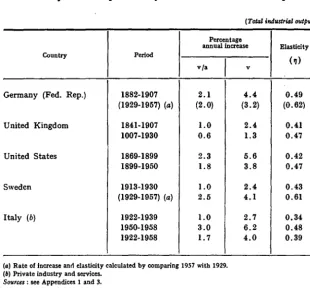
Elasticity of labour productivity in relation to volume of production III
France : Industrial productivity and volume of output III
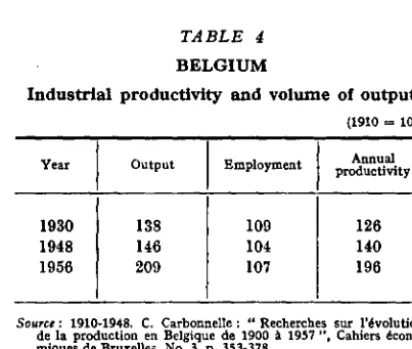
Belgium : Industrial productivity and volume of output III
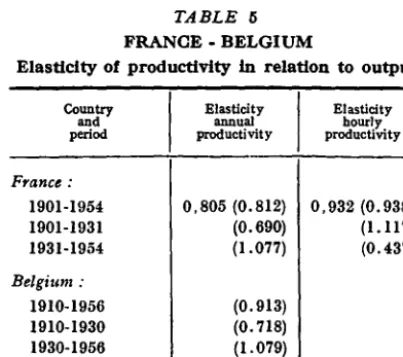
Elasticity of productivity in relation to output - France-Belgium III
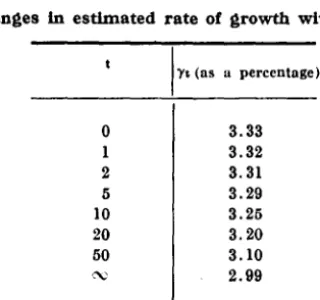
Changes in estimated rate of growth with time 569
Temporary increase in labour productivity III
Composition of gross domestic product at factor cost in 1957 III
Numerical value of the exponents of the production function and of the correlation
coefficient III
Results of cross-section analysis III
Accounting plan III
Estimate of the stock of fixed capital in the countries of the Community III
Functional breakdown of government expenditure IV
Explanatory lay-outs used in forecasts of private consumption by classes of needs . IV
Page
112
112
112
113
114
117
117
118
Page
21et107
42
43
43
44
47
48
49
53
54
59
66
79
96
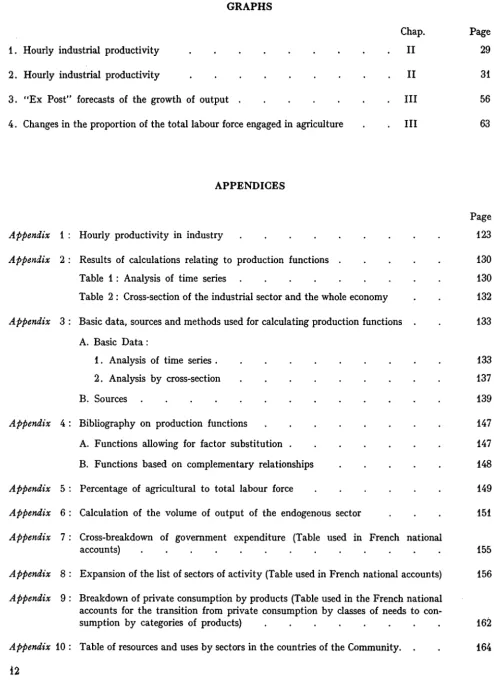
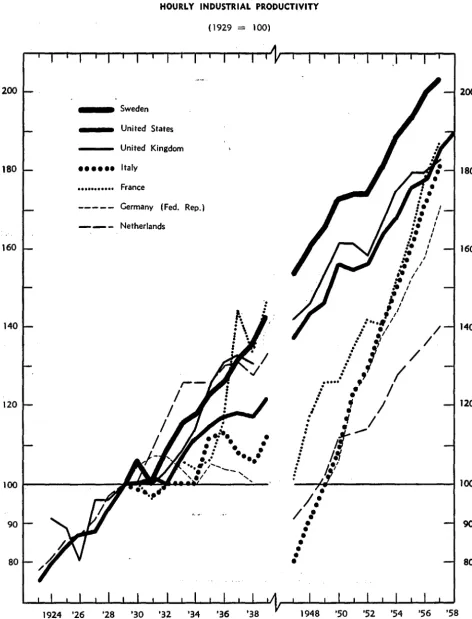
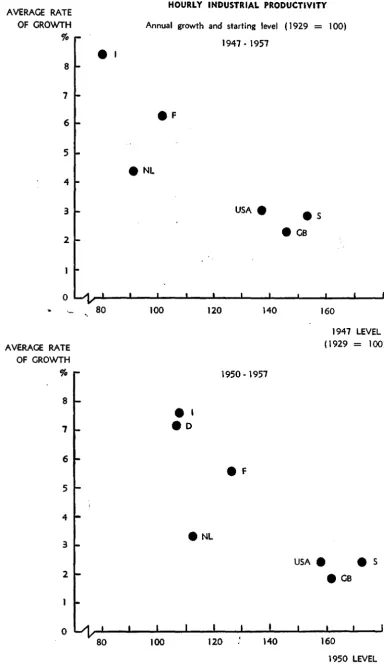
GRAPHS
1. Hourly industrial productivity
2.
Hourly industrial productivity3. "Ex Post" forecasts of the growth of output
4.
Changes in the proportion of the total labour force engaged in agricultureAPPENDICES
Appendix 1 : Hourly productivity in industry
Appendix 2 : Results of calculations relating to production functions
Table 1 : Analysis of time series
Table 2 : Cross-section of the industrial sector and the whole economy
Chap.
II
II
III
III
Appendix 3 : Basic data, sources and methods used for calculating production functions A. Basic Data :
1 . Analysis of time series .
2. Analysis by cross-section
B. Sources
Appendix 4: Bibliography on production functions
A. Functions allowing for factor substitution
B. Functions based on complementary relationships
Appendix 5 : Percentage of agricultural to total labour force
Appendix 6 : Calculation of the volume of output of the endogenous sector
Appendix 7: Cross-breakdown of government expenditure (Table used in French national
Page
29
31
56
63
Page
123
130
130
132
133
133
137
139
147
147
148
149
151
accounts) 155
Appendix 8 : Expansion of the list of sectors of activity (Table used in French national accounts) 156
Appendix 9: Breakdown of private consumption by products (Table used in the French national accounts for the transition from private consumption by classes of needs to
con-sumption by categories of products) 162
Appendix 10: Table of resources and uses by sectors in the countries of the Community. 164
[image:14.591.50.545.49.750.2]CHAPTER ONE
INTERPRET A TI ON OF TERMS OF REFERENCE, METHOD OF APPROACH SUMMARY OF STUDIES
A - INTERPRETATION OF TERMS OF REFERENCE
1. By its terms of reference to the group of experts, the High Authority stated its intention that all forecasts made by the various European institutions in collaboration with the competent authorities in member countries should be based on jointly-formulated methods, allowing comparison between countries.
We believe that we have complied with these terms of reference by seeking to assemble the elements of a method suitable for use in each of the six countries of the Community.
We have not tried, therefore, to define a method of forecasting directly applicable to the Community as a
whole or a specific method for each country, but to work out a uniform methodological basis for national
forecasts, to be combined subsequently into a forecast for the whole Community.
Any method of forecasting must be related to the particular target. Economic forecasting is not a self-con-tained activity but is always designed to provide more or less accurate information as a basis for a decision, or a number of decisions, to be taken by undertakings, governments or international organisations. The form and method of forecasting depend not only on the basic data used but also on the kind of decision to be taken.
These two fundamental points - the kind of decision to be taken and the type of basic data available
-must, therefore, be stated clearly, first of all with reference to the work of the High Authority itself. The latter has to make forecasts, partly to keep in touch with the general economic trend of the countries of the Com-munity, but principally to assess the prospects in terms of which separate coal and steel production targets have to be set and more general proposals formulated for energy policy. The problem is similar for the European Atomic Energy Community for matters within its province. Beyond the special requirements of these two communities, the European Economic Community wishes to compare the long-term forecasts of its six member countries, in order to discover any inconsistencies. The basic data for forecasts must be pro-vided by the member countries.
In view of the foregoing, the High Authority's long-term forecasts must be :
- sufficiently detailed to show clearly the elements on which coal and steel production targets mainly
depend;
- produced by combining national forecasts, which must be compiled on a co-ordinated basis to make
forecasting possible.
2. This led us to consider the manner in which member countries produce their forecasts, and the possibility of co-ordinating the latter. Forecasts differ quite substantially from country to country; their aims are not the same, the agencies responsible differ as regards administrative status and methods used, and the actual forecasts are produced in different forms.
i) Aims of long-term forecasts
The aim of forecasts in their general form is to deduce the main lines of economic progress as determined by the main growth mechanisms, namely, the increase of the labour force, and particularly of the industrial labour force, the growth of fixed capital and technical progress.
In most cases, forecasting aims are now also considered to include identification of the structural changes
which accompany economic growth.
In some countries, forecasts also have to form the basis for government planning and, particularly, for financial
measures to promote what are considered to be necessary changes in the structure of industry, agriculture
and commerce. In addition, they have to provide basic data for production sectors using long-term capital
and therefore needing te take account of the government's economic development plans.
ii) Status of forecasting agencies
In some countries, forecasts are produced by public bodies with varying and still indeterminate powers of
co-ordination over all State economic services. They may even be required to work in conjunction with private firms or their representative associations.
In other countries, the responsible agencies are government services associated with the departments
respon-sible for the implementation of economic policy and with undertakings, but playing no active part in formulating government decisions and investment programmes.
In yet other cases, long-term forecasts are produced by private research institutes working independently.
iii) Types of forecast
A very general distinction can be made between, first, an overall forecast estimating the future level of a few major aggregates, such as gross domestic product, private and government consumption, capital resources
and capital formation for a whole economy and, secondly, a more detailed forecast analysing the future course
of the various components of final and intermediate demand in order to arrive at conclusions regarding
output trends in the various sectors and branches of the economy, the labour and capital requirements of those sectors and branches, and the growth of imports of the various classes of commodities.
3. In some countries, the overall estimate is the main stage of the procedure. In its most developed form,
the aim is to compute the rate of growth and future level of the various aggregates by means of a series of func-tional relationships expressing the interaction of the most representative variables of general economic progress. The purpose of the detailed forecast is then to provide a transposed image of the overall growth hypothesis, which can be used direct by individual economic sectors for their own forecasts.
In other countries, the overall forecast is regarded only as a preliminary stage, and is merely a first exploration
providing a .basis for formulating one or more growth hypotheses. The purpose of the detailed forecast is then to study the possibility of implementing these hypotheses, by assembling complete data regarding the growth conditions of final demand and output and comparing them by the application of a number of consistency tests, so that the overall forecast finally becomes a synthesis of all data assembled concerning conditions of growth for each element in demand and each branch of production. Government plans are, of course, included in these data :
- plans which, although not linked with a growth target, form part of the premises of economic growth :
- specific measures to achieve a growth target and forming part of a co-ordinated programme.
B - BASIS AND STRUCTURE OF THE REPORT
4. The Group's task was, therefore, to find a common basis and points of comparison between studies differing substantially as regards aims, form and body responsible.
We thought this to be possible because, regardless of the approach adopted, the various forecasts raise a number of common problems and use techniques which overlap to a certain extent.
The common problems relate mainly to the actual purpose of a long-term forecast, the fundamental hypotheses on which it is based, the kind of techniques likely to be used and the general manner in which those techniques can be applied. These general aspects of long-term forecasting are dealt with in Chapter II.
As regards the techniques used in forecasting, a basis for comparison can be found by studying the methods
adopted for detailed forecasts.
Under the practice currently followed in the Community, detailed forecasts are not obtained by solving a system
of simultaneous equations expressing the interaction of the various categories of demand and supply; they are, rather, the culmination of a series of successive approximations and of an iterative process leading, by stages only, to a final estimate of the future level of the different variables. A detailed forecast therefore, implies an overall pattern based on the overall forecast.
We, therefore, concluded that we should, in any case, define a method of producing an overall forecast, because
this first stage is necessary for all countries, either to fulfil the main purpose of forecasting by identifying the main lines of future growth, or as an exploratory procedure to determine the basic hypothesis for a detailed forecast.
The methods to be used for the overall forecast are discussed in Chapters III and IV. Under the title "Overall estimate of supply" we have tried in Chapter III, to construct a model to be used essentially for computing
the future output of non-agricuUural undertakings.
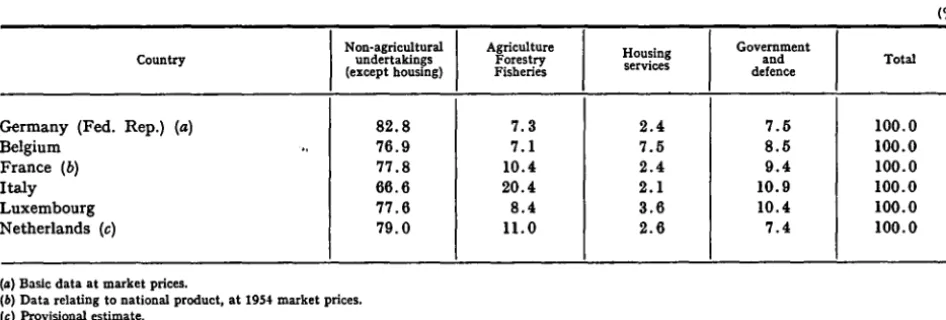
For this aggregate, averaging 80
%
of gross domestic product in the Community, we were able to recommenda number of methods and formulae, the theoretical basis of which has been discussed in detail in economic literature. They have also been checked statistically for a number of countries.
An overall forecast of gross domestic product is then arrived at by adding an estimate for the sectors which we
regard as exogenous, namely agriculture, public services, and housing.
In Chapter IV we show how a semi-overall estimate of demand can be fitted to this overall forecast of output,
by adding to the first estimates for capital formation, analysing public demand, formulating a hypothesis for the foreign trade balance and computing the probable growth of private consumption by main classes of needs. This part of the report concentrates on the procedure to be followed and the flexible codification of the criteria to be applied when estimating the main components of final demand. This section concludes with a suggested method for a preliminary comparison of the supply and demand forecasts.
We then considered at length whether our attempt to find a common basis for forecasts should extend to the detailed forecasts, and should, therefore, cover special growth conditions for the individual elements in final and intermediate demand and, correspondingly, for the various branches of production.
We found that national procedures vary most widely on this point. At this stage differences between "pure" forecasts and those forming the basis of government planning become more marked and it becomes very difficult to lay down uniform methods because of the diversity of the basic data available and the techniques which can be applied.
We are, however, aware of the need to define a framework and a method for the transition from overall to detailed forecasts.
This second stage must clarify and develop the overall forecast, indicate structural changes as a guide to
govern-ment action and provide undertakings with fuller details of the prospects with which they will be faced. In
the case of the High Authority, this stage must provide the necessary information on iron and steel, coal and energy in general and must allow the incorporation of special studies of these sectors into a general economic pattern.
Furthermore, it is only at the stage of growth forecasts that national growth hypotheses can validly be compared by a detailed analysis of foreign trade prospects.
The present report is only a first contribution to the solution of these problems.
First, the procedure suggested in Chapter IV for the semi-overall estimate of demand assists the transition
to detailed forecasts by suggesting an estimate by main classes of use, particularly for private consumption.
In this way, detailed forecasts can be started by breaking down these estimates into separate products.
Secondly, Chapter V quotes, as an example, the procedure used for detailed forecasts in France. Without expressing any final opinion regarding the application of these methods in the other member countries, the Group consider that this contribution offers a useful guide to the techniques which can be used and the con-clusions which can be drawn from detailed forecasts.
The general tenor of the report can now be defined in the light of the foregoing remarks. It recommends a
procedure for the solution of a detailed growth model by a series of successive approximations. It divides
the forecasting process into a number of stages which vary in complexity, starting with an overall forecast of supply and concluding with a detailed forecast by elements of demand and sectors of production. Each stage has a separate model but the models for all stages are linked with each other. At the overall stage, the main emphasis is on econometric systematization, but more use is made of direct estimates for the detailed forecasts.
C - SUMMARY OF STUDIES
5. In conclusion, we thought it useful to summarise our studies and the results obtained.
We began by reviewing the present state of long-term forecasting in the countries of the Community, noting
differences and possible points of similarity.
As indicated in the previous sub-section, we consider that a common basis can be found primarily at the overall
forecast level, but that the transition to detailed forecasts raises problems.
In order to comply with our terms of reference, we next had to undertake a series of statistical studies to provide
a basis for the formulation of proposals regarding methods.
These studies comprised an empirical check of the various types of overall production function and an attempt to classify data from the input-output tables available in the countries of the Community according to a sim-plified nomenclature providing a basis for comparison between the various countries. The basic material and results of these studies are set out in the appendices.
For our work on production functions we had to collect or construct sufficiently long time series for output,
employment and capital resources for a number of member countries.
Here we found the existing data to be inadequate, particularly in the matter of figures for the capital resources. Chapter III therefore contains an urgent recommendation that the governments of the six member countries
should take steps, in conjunction with the Statistical Office of the European Committee, to estimate their country's
capital resources.
16
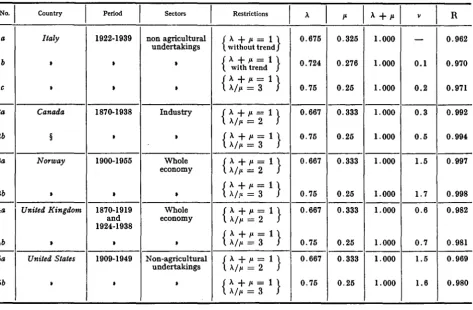
From our calculations using the available basic material we concluded we concluded that it is preferable to analyse economic growth by means of functions allowing substitution between the labour and capital factors, but that studies only give statistically valid results when restrictions are imposed on the numerical values of certain parameters.
As regards input-output tables, our studies show that the difficulty of standardising the tables for the various
Community countries is not primarily a matter of differences in nomenclature but rather of differences in the principles followed in the evaluation of transactions and the treatment of imports. Our attempt at harmo-nisation was confined to the nomenclature for the time being.
These statistical studies have some intrinsic value, insofar as they help to clarify certain aspects of the present economic structure and of earlier economic growth.
Withiri our terms of reference, however, they could not be regarded as the basis of methodological studies
relating to long-term forecasting. The results of our studies and discussions on this particular point can be summarised as a series of proposals concerning :
i) The general aspects of long-term forecasting;
ii) The overall forecast of supply;
iii) The demand forecast and comparison of the supply and demand forecasts;
iv) The transition to detailed forecasts.
i) General aspects of long-term forecasting
a} Long-term forecasts exclude cyclical and chance fluctuations and are concerned with the normal growth which can be expected with full employment of the factors of production.
b) The premise of full employment assumes that unemployment is reduced to what can be regarded as a
reason-able minimum for each country. It does not imply an identical level of unemployment in all countries.
c) Of the various forecasting techniques - extrapolation of trends, use of information obtained by inquiry,
application of models - the last-named should be preferred as a general basis for long-term forecasting. The
forecast then takes the form of a series of functional relationships expressing the interaction of the different variables.
d) With the detailed forecasts there is the difficulty that a complete econometric model cannot usually be
constructed direct from the basic data. We therefore, recommend a series of successive approximations,
using an iterative process with a specific model at each stage. These specific models will be linked and solved
in a fixed order, with the possibility of returning to a previous stage.
e) Any serious analysis of prospects must consider the consistency of the estimates produced. Consistency
tests will check the probability of the results obtained and also the compatibility of estimates for the same
variable at different stages of the forecast, if the method of successive approximations is used.
ii) Overall forecast of supply
a) The first stage in the process of successive approximations will be a forecast of total output. At this stage
the model must be kept simple, and will differentiate only between the non-agricultural sector and the three sectors treated as exogenous i.e. agriculture, public services and housing.
b) We reconunend that the estimate for non-agricultural undertakings should be based on a production function explaining the growth of output in terms of the growth of labour and capital and of a time trend which is con-sidered to represent the influence of all other factors, and of technical progress in particular.
In its general form, this function is written as :
where
v a t k
,\
µ v
= = = = = = =
volume of output, quantity of labour,
A p. Vt
v=.Bake
time, which is considered to represent all other factors, and technical progress in particular, capital resources,
labour elasticity of output, capital elasticity of output,
annual rate of increase of the residual trend.
For forecasting purposes, we recommend that only the number of persons employed should be included in variable "a", and that a variable "h" representing hours of work, should be added to the formula. Forming the differ-ential of the function so modified we have :
.
.
v a k h
-="--+µ-+r-+v
v a k h
where
v
- = annual rate of output increase,
v
a
- = annual rate of increase in the number of workers,
a
k
- = annual rate of capital increase,
k
h
- = annual rate of variation in hours of work;
h
"- , µ , r = elasticity of output in relation to the various factors of production,
v = rate of increase of the residual trend.
c) The estimate of the rate of increase of the output of non-agricultural undertakings then involves :
- The determination of numerical values for the parameters .\, µ, r and v.
On the basis of empirical studies, we propose that the value of ..\. and µ should be 2 /3 and 1 /3 respectively.
The value of r need not be the same for all countries. It is noted, for guidance, that a value of0,7 was recorded
for one member country.
Previous experience gives values ranging from 0,1
%
to 1.6%
for 11. In our opinion the new impetus givenby the establishment of the common market justifies raising these figures to 0,5
%
and 2%
respectively. Ifforecasters in certain countries wish to use values outside these limits they should explain clearly the nature
of their choice and give their reasons. If such values are adopted for exploratory purposes the forecasts for
other countries should include variants based on these hypotheses.
- An estimate of the growth of the independent variables a, k and h.
Changes in variable "a", the number of workers, will be estimated exogenously on the basis of direct demo-graphic and economic data, allowing for the anticipated agricultural and public labour force.
The growth of variable "k", capital resources, should preferably be estimated by means of an investment function linking output and capital formation over the whole economy or directly in the non-agricultural sector.
Variable "h" average hours of work, must be estimated direct.
d) At this stage, the estimates for the exogenous sectors - agriculture, public services and housing - will be
provisional hypotheses arrived at in various ways. These hypotheses will have to be reviewed at subsequent stages of the forecast.
e) An estimate of gross domestic product is finally obtained by aggregating the estimates for the non-agricultural
sector and the three exogenous sectors.
iii) Forecast of demand and comparison of the supply-and-demand forecasts
a) At this stage, a forecasting hypothesis has to be formulated for the main components of final demand i.e. private public consumption, gross fixed capital formation, increase in stocks and foreign trade balance.
These estimates will form part of a functional analysis preparing for the transition to detailed forecasts.
Some calculations, such as those for public consumption and the foreign trade balance, will be more clearly exogenous than others.
b) The main elements for the estimate of fixed capital formation will already have been obtained in connection with
the forecast of total supply, because the capital resources, will have been estimated by means of an investment function linking output and capital formation. Public capital formation will be estimated as part of the func-tional analysis of public expenditure (see d) below) and housing capital formation as part of the estimate of housing expenditure (see f) below).
c) Increase in stocks will be covered by a straightforward hypothesis based on the increment of domestic product during the terminal year of the period covered by the forecast.
d) Estimates of government consumption and capital formation can be arrived at by a study confined to final
demand and therefore covering current consumption of goods and services, expenditure on staff and purchases of capital goods. However, when these estimates have to prepare for the transition to detailed forecasts and must be suitable for full consistency tests, it may be preferable to include the analysis of final demand in
a wider study covering all public expenditure (including transfers), sub-divided into the main administrative
functions i.e. general administration, education, economic policy, welfare, national defence etc.
Expenditure on the different functions will be estimated, as appropriate, according the aims pursued or the
general characteristics of economic growth, or on the basis of discussions with experts from certain sectors.
c) In the case of foreign trade, it may be sufficient at this stage to estimate only the balance of such trade on
the basis of certain economic and political requirements or targets, In some cases, it will be preferable to
estimate separately:
- either imports, in relation to domestic product, relative price levels and a time trend,
- or exports, in relation to the domestic product of customer countries, relative price levels and a time trend.
/) The volume of total private consumption may either be calculated as a residual figure, representing the difference
between domestic product and the sum of all other elements in final demand, or may be computed independently.
In the latter case, the fraction of the total product absorbed by private consumption may be treated either
as a premise of economic policy or as a structural constant.
In all cases, consumption must be analysed by main classes of commodity (food, clothing, etc.).
The necessary material is provided by retrospective series, family budget inquiries and international compa-risons.
According to circumstances and the data available, one or more of the following factors will be used as a variable explaining the growth of a particular class of expenditure :
- population,
- available income per head, represented for practical reasons by total consumption per head or per consumption
unit,
- the distribution of incomes,
- relative prices,
- the effects of economic and social policy,
- spontaneous variations in consumption habits,
- the total stock of durable consumer goods.
The significance of each individual factor and the extent to which its influence can be incorporated as a quantitative term in the forecasting analysis, differ not only as between commodities but also as between countries. No uniform rules can, therefore, be proposed. For guidance, the report summarises the results of studies carried out in France.
g) When estimates have been made for output and the various elements in final demand, a preliminary
comparison will be made of the results so far obtained.
The main points to be considered are:
- the consistency of the results obtained by aggregating the various estimates of consumption by classes
of commodity;
- the compatibility of the output forecasts for the exogenous sectors (agriculture, housing and public services)
with the corresponding items in final demand;
- the compatibility of the estimates for the foreign trade balance, imports and exports when they have been
arrived at separately;
- the equilibrium of total resources and uses.
The probability of the levels forecast for the different variables will be checked and corrections made to equalise supply and demand, while at the same time ensuring at least roughly consistent relationships between the various components.
iv) Transition to detailed forecasts by sector of production
a) We recommend that the detailed forecasts should be produced in each country by methods enabling all data
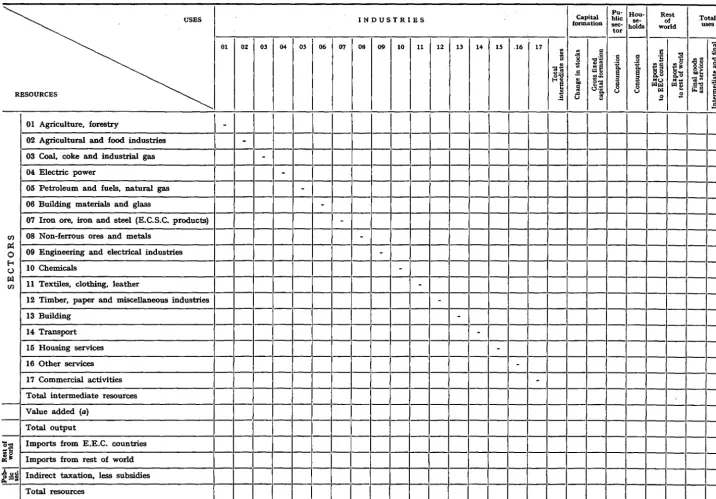
to be re-grouped in a simplified table of relationships between resources and uses, sub-divided into seventeen sectors of economic activity. The model proposed in table 1 is based on study of inter-industry relationships,
fJl
i:i:::
0
E-<
c.>
TABLE 1
Overall interrelation between resources and uses
USES INDUSTRIES
01 I 02 I 03 I 04 I 05 I 06 I 07 I 08 I 09 I 10 I 11 I 12 I 13 I 14 I 15 I .16 I 11 I
"' ~ " al ... o;a
r-@
:: .s RESOURCES01 Agriculture, forestry
Capital formation
"' g
..
~
-o+:....
.!! ~
_g
-;.e
"
..
eai1:1
<-'·j.
...
c.> <J
Pu-
,Hou-blic
se-sec- holds tor
...
"'
l
.9ii.
e
~
~ 0c.> c.>
Rest of world tl
""
]~j
!I§[8 8,<;
HU
,._
f.:af.;a ~e
f.:!
s
s
.Total uses a! ~ii].~ 'g~
....
.. i: .:l'tl
a! 51
:a
1:1"'""
·-"
"1
"'"'
j ..
02 Agricultural and food industries i i i i i i i 1 i r 1 1 1 1 1 1 1 1 1 1 1 1 i • • -1 - - -1 - - -1 - - -1 - - -1 - - -1 - - -1 I I
03 Coal, coke and industrial gas 1 1 1 1 1 1 1 1 1 1 1 1 • i i •
- ~.----1--1--·--·--04 Electric power 1 1 i - - i - - i - -1- -1- -1- -1- - 1 - - 1 - - 1 - - 1 - - 1 - - 1 - - 1 - - 1 - - 1 - - 1 - 1
05 Petroleum and fuels, natural gas l l r i i i i i i i i 1 1 1 1 1 1 1 1 1 1 1 i i i
-I
06 Building materials and glass l i i i i i i i 1 1 1 1 1 1 1 1 1 1 1 1 1 i i i i -07 Iron ore, iron and steel (E.C.S.C. products) 1 l l l l l l l l r 1 1 1 1 1 1 1 1 1 1 1 1 1 1 1-I I 1 1 1 1 1 1 1 1 1 1 1 1 1 1 1 1 1 1 1 1 1 1 1 • •
-08 Non-ferrous ores and metals
I I I l 1 1 1 1 1 1 1 1 1 1 1 1 1 1 1 1 1 1 1 1 1 • •
-09 Engineering and electrical industries 1 i i i i i i i i 1 1 1 1 1 1
-I l l 1 1 1 1 1 1 1 1 1
-10 Chemicals
I.ii
I
1 1 1 1 1 1 1 1 1 1 1 1 1 1 1 1 1 1 1 1 1 1 1 1 · ·-rn 11 Textiles, clothing, leather
1- - - 1 - - 1 - - 1 - - 1 - - 1 - - 1 - - 1 - - 1 I 1 1 1 1 1 1 1 1 1 1 1 1 1 1 1 1
-12 Timber, paper and miscellaneous industries
I I I 1 1 1 1 1 1 1 1 1 1 1 1 1 1 1 1 1 1 1 1 1 • • • -I 13 Building 1 l ! 1 1 1 1 1 1 1 1 1 1 1 1 1 1 1 1 1 1 1 1 1 • •
-14 Transport
I I I I 1 1 1 1 1 1 1 1 1 1 1 1 1 1 1 1 1 1 1 1 1 1 • -1 15 Housing services 1 _ _ 1 _ _ 1 _ _ 1 _ _ 1 _ _ 1 _ _ 1 _ _ 1 _ _ 1 _ _ 1 _ _ 1 _ _ 1 _ _ 1 _ _ 1 _ _ 1 _ _ 1 _ _ 1- -1 1 1 1 1 1 1 1 1
-16 Other services
I 1 1 1 1 1 1 1 1 1 1 1 1 1 1 1 1 1 1 1 1 • 1 • • • •
-17 Commercial activities
I l 1 1 1 1 1 1 1 1 1 1 1 1 1 1 1 1 1 1 1 1 1 • • • •
-Total intermediate resources
- - 1 1 1 1 1 1 1 1 1 1 1 1 1 1 1 1 1 1 1 1 1 1 • 1 · · ·
-Value added (a)
Total output 1 i i i i i i i 1 1 1 1 1 1 1 1 1 1 1 1 r 1 i • • • -<;;g Imports from E.E.C. countries l l l l l l l 1 1 1 1 1 1 1 1 1 1 1 1 1 1 • • • • --:: !l .. II: I 1 - - 1 - - 1 - - 1 - - 1 - - 1 - - 1 - - 1 - - 1 - - 1 I
II:: mports from rest of world - - - -1- -1-
-1--1--1--1--1--1--1--1--1--1--•--•--•--;. uu I dir . - - 1 - - 1 - - 1 - - 1 - - 1 - - 1 - - 1 - - 1 - - 1 - - 1 - - I
ii! ::151 n ect taxation, less subsidies - -1-
[image:23.791.43.760.40.539.2]-which have developed rapidly in most of our countries since the basic work of Leontief. We recommend the use of this table, particularly for the international comparison.
b) In the present state of theoretical and empirical studies we were unable to formulate a common
methodo-logical basis for the forecasts by branches of production.
One of the major gaps in the existing material is the shortage of information on production functions by sectors and on the causes and effects of variations in relative prices. We urgently recommend a thorough study of both these subjects.
c) In Chapter V the method at present used by the French Government services is described as an example of a forecasting procedure whereby estimates of output by branches are arrived at by successive approxi-mations and the detailed information so obtained is then used to revise the overall forecast.
While unable to advise the application of this pattern in all the Community countries, we nevertheless recommend that all concerned should study it in detail. In this description they will find useful guidance on means of overcoming difficulties in the construction of a complete econometric model by a procedure comprising the following stages :
- breakdown of final demand by categories of products,
- study of intermediate demand with the help of a table of inter-industry relationships,
- estimate of output, productive investment and labour requirements by sectors, with the help of an
input-output and by consultation of experts,
- return to the overall forecast on the basis of information obtained during the detailed forecast; revision
of hypotheses formulated in the overall forecast, study of alternative solutions and consistency tests.
6. These are our main recommendations, which should be regarded as a first contribution only. We hope, however, that our suggestions, as summarised above and developed in subsequent chapters, will be of assistance in long-term forecasting.
Before closing this introductory section, we wish to add to these recommendations, forming the practical result
of our studies, two general conclusions, which emerge from our discussions as a whole.
The preference expressed in this report for the application of models and the importance attached to con-sistency tests in the case of forecasts by successive approximations, reflect our desire that long-term forecasts should follow a logical pattern respecting inter-relationships between the different variables and ensuring the consistency of all estimates.
To this end, we have used econometric relationships wherever this has seemed possible and opportune.
On the other hand, we have abandoned such formulae whenever, at a given stage of the forecast, they have seemed to be too general or based on assumptions which cannot certainly be regarded as permanent in future, even though they have proved so in the past.
In such cases, we have recommended direct estimates, where, in addition to quantitative data, the element
of fudgment, based on knowledge which cannot be measured statistically and on the powers of deduction, and even the "flair", of the forecaster, play an important part. The value of a procedure using successive approxi-mations lies precisely in the fact that it allows comparison of various approxiapproxi-mations, some based on functional relationships adequately proved to be reliable and of general application and others resulting from direct esti-mates, in which the element of judgment and knowledge of exogenous and intentional factors play a significant part.
Our second conclusion relates to the distinction between what might be called a pure forecast, concerned
essentially with estimating "spontaneous" economic growth, and a forecast more concerned with "decisions"
which includes certain target-variables and is designed to give guidance to the government in achieving those targets. These, of course, are the two extremes, between which many intermediate positions are possible, and indeed are adopted in practice in the industrialised countries of the West.
The report shows that the techniques to be used for these two types of forecast overlap to a considerable extent, but we feel that we should draw attention to a major difference of emphasis.
A "pure" forecast is not required to specify ways and means of implementing a growth policy. It merely
stipulates the conditions of growth and, on the basis of what is known of the behaviour of all centres of decision on which growth depends, weighs the chances of those conditions being fulfilled.
Simply by virtue of its existence and its statement of the conditions of growth, such a forecast may induce the various centres of decision on which economic growth depends to move in the direction of consistent growth. Nevertheless, a pure forecast must consider the possibility that decentralised decisions, however enlightened, may be incompatible with each other or, for some reason, may not ensure regular growth. The forecast must assess these risks and their effect on rates of growth.
During the past years known to us, the decisions on which growth depends have not always been consistent. The rate of growth actually achieved, therefore includes the weight of such inconsistencies so that the systematic interpretation of historical experience is a valuable instrument for the establishment of pure forecasts.
In forecasts taking account of decisions, such systematic interpretation of the past is regarded only as a starting point. Forecasts of this kind do not, of course, ignore the firmest and most permanent structural relationships deduced from the past, but treat them as "limiting factors". However, the essential feature of this type is that it defines a consistent complex of targets and means of eliminating the inconsistencies which have hitherto held back economic growth. A badly-constructed forecast is merely a programme of action whose effects
are uncertain. If, on the other hand, the means are in general clearly shown to be adequate and fully
appli-cable, the targets laid down can be accepted as forecasts.
A "pure" forecast will generally tend to lay more emphasis on functional relationships using parameters with numerical values deduced from observed facts; a forecast taking account of decisions will rely more on direct estimates which allow the inclusion of exogenous and intentional elements.
In this report, which is concerned with methods, no preference had to be stated for either type of forecast. The fact that its completion has proved possible tends to show that the two types should not be impossible to reconcile provided their essential characteristics are clearly stated.
We wish to bring this point to the particular attention of the High Authority whose duties involve both fore-casting and the definition of "general targets", that is, the systematic interpretation of the past and the taking into account of certain objectives.
CHAPTER II
GENERAL ASPECTS OF LONG-TERM FORECASTING
Section I - Purpose of long-term forecasting and methods used
7. To put our reconunendations into proper perspective, we shall first examine some of the main features of long-term forecasting and then set out the advantages and disadvantages of the various methods suggested. Our remarks will be confined at this point to the main considerations by which we were guided in framing our reconunendations, with particular emphasis on the possibility of using models as the medium for a long-term forecast.
A - THE CONCEPT OF A NORMAL TREND
8. The first point to be noted is the fundamental difference between short and long-term forecasts.
Throughout the remainder of this report the latter term is used to mean estimates covering a period of not less than ten years, i.e. extending beyond fluctuations attributable to cyclical or chance factors.
Forecasts covering so long a period are needed as a guide in taking certain decisions regarding investment and long-term policy. To the extent that they throw light on the economic conditions likely to prevail after the transitional stage of the European Economic Conununity, such forecasts are of undoubted value and, from this standpoint, are regarded as most important by the three European Conununities.
When seeking to establish the difference between this type of forecast and short-term estimates, two elements must be distinguished in the trend of the aggregates to be forecast. The first component is the normal trend
to be expected if full use of production factors is maintained (1). The second, which may be regarded as
super-imposed on the first, reflects the influence of changes in the general level of economic activity and also represents the influence of change factors such as wars and political tension.
In short-term forecasting an exact estimate of cyclical trends and of the influence of chance factors is the essential requirement, but as the period covered by the forecast lengthens these elements become less important and are replaced by the most accurate forecast possible of the normal trend.
9. This change of emphasis first of all affects the premises on which the forecast is based. We take the view
that neither the period nor the extent of cyclical fluctuations remains constant, so that an estimate of the general level of economic activity over a period of ten years is impossible. This difficulty is usually overcome by assuming that forecasts relate to a year of normal activity.