Munich Personal RePEc Archive
Some Ontological Issues of the REA
Framework in Relation to Enterprise
Business Process
Hunka, Frantisek and Hucka, Miroslav and Kasik, Josef and
Vymetal, Dominik
Ostravska univerzita , Ostrava CZ, Vysoka skola banska, technicka
univerzita, Ostrava CZ, Slezska Univerzita-Obchodne podnikatelska
Fakkulta University of Silesia-School of Business Administration
4 March 2009
Some Ontological Issues of the REA Framework in
Relation to Enterprise Business Process
Frantisek Hunka1, Miroslav Hucka2, Josef Kasik2, Dominik Vymetal3
1
University of Ostrava, Dvorakova 7, 701 03 Ostrava 1, Czech Republic, [email protected]
2
VSB-Technical University of Ostrava, 17. listopadu 15/2172, 708 33 Ostrava-Poruba Czech Republic {miroslav.hucka, josef.kasik}@vsb.cz
3
Silesian University in Opava, Univerzitni nam. 1934/3 733 40 Karvina, Czech Republic [email protected]
Abstract. The aim of the paper is to describe using REA framework to model enterprise planning not only at the operational level but also at the policy level. Using policy level enlarges the possibility of the models on the base of the REA framework because the policy level in this way represents metalevel of the model. The policy level of the REA framework itself is comprised both of the entities related by typification, grouping and policy relationships and of the Commitment entity with the fulfillment relationship. This entity may be viewed as either a sublayer or a middle layer of the REA framework. The Commitment entity belongs to the fundamental entities of the policy level but has some specifications that are expressed by the fulfillment relationship. This many-to-many relationship forms the link to the operational level. In the paper we discuss the problem and suggest some solution that moves the
Commitment entity closer to the typification and grouping semantic abstractions.
Keywords: REA ontology, enterprise business process, semantic abstractions
1 Introduction
Two core semantic abstractions represent policy level at the REA framework by [1]: typification and grouping. In short, the main task of the policy level is to give answer to the questions: what could, should or must occur. In general the policy level also gives the answers to the questions: what is planned or scheduled. The later questions are answered by the Commitment entity, which has the main relation to the Event
entity at the operational level. At the first sight the Commitment entity contains planned or scheduled information while the Event entity comprises the actual information, which may be the same or different from the scheduled information.
From this point of view, it could seem that the typification semantic abstraction can be also applied in this case. However, the relationship between the Commitment entity and the Event entity has also broader meaning that is expressed by a many-to-many relationship. There are not only cases when a Commitment entity is related to one or more Event entities but there also exist cases when a single Event entity isrelated to several
Commitment
entities. This gives the reason, why the relationship between theThe grouping semantic abstraction is used when set-level characteristics are of interest and may even create an integral part together with the typification semantic abstraction. By this semantic abstraction a collection of individual entities may be specified with respect to some common properties.
2 Method of Advancement
Enterprise Planning Model, which is used for illustration of our approach, is composed of three parts: Material Purchase Model, Production Planning Model and Sales Model. We illustrate only Production Model in Fig. 1, which is the most important part. In the schematic representation of the models we were also inspired by the Purchase Order pattern and the Schedule pattern described in [4].
The Production Planning Model consists of five decrement commitments: Labor Requisition, Workplace Requisition, Tool Requisition, Part Requisition and Material Requisition paired through conversion reciprocity with the increment commitment
Production Line. The Part Requisition commitment and Material Requisition
commitment are promises by a Warehouse Clerk to make a specific amount of Part Types and Material Type available to the Worker. The Tool Requisition commitment is a promise by the Warehouse Clerk that tools of specified Tool Types will be available to the Worker, and a promise by the Worker to deliver the tools back. The
Labor Requisition commitment is a promise by the Worker to the Supervisor to consume worker’s Labor in a specific time. The Workplace commitment is a promise by the Supervisor to the Worker that a specified Workplace will be available to the Worker in specific time. Each commitment either uses reservation or consumes reservation of the adequate resource type. The operational level of the model is closely bounded with the policy level and contains five adequate Economic Events corresponding earlier described commitments. Resource types have their counterparts in the operational level in the form of resources.
3 The Fulfillment Relation
In the presented results the Commitment entity plays an important role at the policy level of the REA framework. The current REA framework distinguishes two levels, the operation level (lower level) connected with the current facts that occurred in a company and the policy level (upper level) linked with the future activities and guidelines such as plans, commitments and control activities of the company. However, the policy level is not a homogenous one but is actually created by two “sublevels”. One is represented by the Commitment entity with the fulfillment relationship, by which it is related to the operational level. The other represents entities created by the typification and grouping semantic abstractions, which use the typification, grouping and policy relationships. It can be said that two sublevels form “stratification” of the policy level.
level. The main difference between the fulfillment relationship and the typification relationship is cardinality. While the typification relationship represents a one-to-many relationship, the fulfillment relationship forms a many-to-many relationship.
[image:5.595.158.245.201.346.2]CommitmentPattern (see [4]) describes it all in a more detailed way – see the Fig. 2.
Fig. 2 Commitment and Economic Event Pattern Source [4]
This ambiguity between the Commitment and Event entities requires some specific solution in the form of unambiguous relationships. From the previous description emerges that the fulfillment relation encompasses two cases that do not occur simultaneously.
The first one happens when the Commitment entity is performed by one or more
Event entities. In this particular case the fulfillment relationship can be replaced by the typification relationship.
The second one happens when the Event entity is performed by more Commitment
entities. To make the relationship unambiguous an auxiliary entity has to be added to the current structure. In this case the CommittedElement entity is used to divide the
Commitment entity into smaller parts so that each part corresponds only to one Event
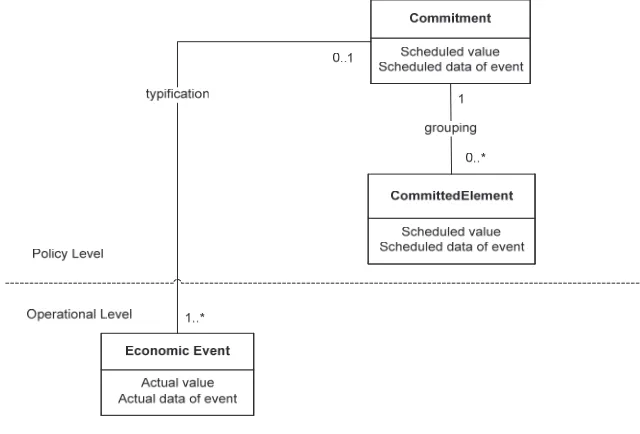
entity. The proposed solution is illustrated in the Fig. 3, where we use {or} restriction to indicate that only one relationship is in force. The original fulfillment relation is replaced by the grouping and typification relationships.
Proposed modification illustrated in Fig. 3 brings some drawbacks. The REA ontology does not know the {or} relationship and the Economic Event is related to the
Economic Commitment by two relationships, which is a bit awkward. The other possibility that would improve the proposed modification solution should conform the REA ontology and be simpler.
Scheduled value Scheduled data of event
Commitment
Actual value Actual data of event
Economic Event fulfillment
0..*
Fig. 3 Proposed modifications of the Commitment and Economic Event
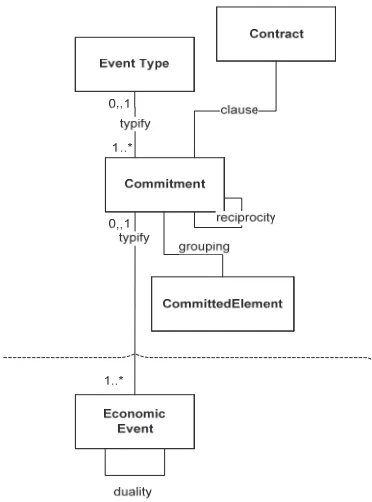
The typification relation is a very powerful tool that enables categorization of the typified entities. In the presented example it means that instances of the Economic Event can access data attributes of the instance of the Commitment entity that also comprises CommittedElement instances. The CommittedElement instances are stored in a collection that is represented by an attribute in the Commitment entity. The improved solution is in Fig. 4.
[image:6.595.123.443.461.678.2]4 Discussion with Further Improvement
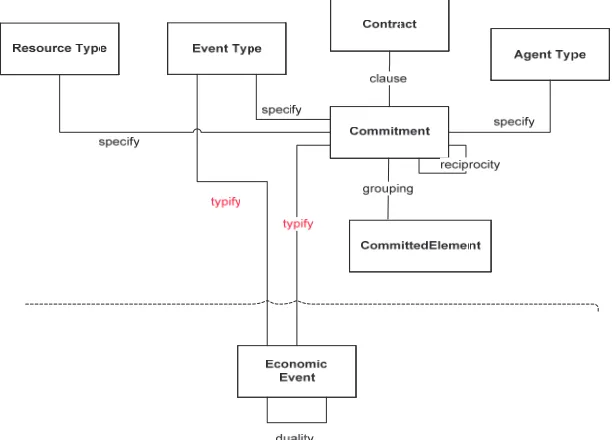
[image:7.595.126.433.211.431.2]However, the improved proposal diagram is rather isolated from the whole REA model. The proposal in the context of the REA model is illustrated in Fig. 5.
Fig. 5. Improved proposal in context of the REA model
It is obvious from the Fig. 5 that the Economic Event entity is related to the
Commitment entity and to the EventType entity through the typification relation. This solution however is not implementable by any software platform. One of the other improvements of this issue is to eliminate one of the typification relations. We will maintain the more important relationship, which is the relationship that relates the
Economic Event and the Economic Event Type entities as we suppose to put the
Commitment entity under the Event Type entity.
The other very important aspect that is necessary have in the mind during modification of the REA model is granularity of the entities. The other word for this activity can be gradual refinement of the requirements. What does it mean? The REA model should conform the gradual refinement of the requirements placed on the “planning – production” entities (Event Type, Commitment, Event). The Event Type
entity represents normative rules simply recipe of the advancement. The Commitment
entity gathers all planned requirements (information) – further adjustment of the original demands. Finally, the Event entity holds all actual information. This aspect should be fulfilled.
and Event entity is created. This link ensures essential granularity that is necessary for the whole solution.
In case that one Event entity is related to many Commitment entities the common properties of these entities are placed in the Commitment entity and the different properties are stored in a collection of CommittedElements entities. The Commitment
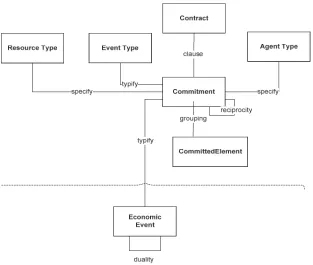
[image:8.595.137.323.237.488.2]entity is related to the CommittedElement entities through grouping relationship (see Fig. 6 and 7).
Fig. 7 Whole view of the proposed solution
5 Conclusion
The typification and grouping semantic abstractions specify policy-level extension of the REA framework. These abstractions enable to work with the types of declared entities and with a special form of aggregation with set-level characteristics. The
Economic Commitment entity with its fulfillment relationship stands a bit outside of the above mentioned abstractions. In the paper we tried to bring this entity closer to the typification and grouping semantic abstractions by introducing a new entity called
CommittedElement and by replacing the fulfillment relation with the typification relation. In this way, the Commitment entity can be composed of the
CommittedElement entities, which result in the replacement the many-to-many
relationship. The similar technique is utilized in the process of analysis and design of the information systems. While the relationship between analytical classes can have a many-to-many relationship, the relationship between designed classes is restricted only to one-to-many relationships, by [6].
In the proposed solution a stratified typification relation is utilized to reserve the granularity of the entities that lie in the direction from planning towards production. It is also assumed that in case there are many Commitment entities related to one Event
the Commitment entity. The specified properties are stored individually in the
CommittedEntities.
Acknowledgements. The paper was supported by the grant reference No. 402/08/0277 provided by The Grant Agency of the Czech Republic.
References
1. Geerts GL, McCarthy (2006) Policy-Level Specification in REA Enterprise Information Systems. Journal of Information Systems. Vol 20, No. 2 pp. 37-63.
2. Geerts GL, McCarthy WE (2000) The Ontological Foundation of the REA Enterprise Information Systems. Paper presented at the Annual Meeting of the American Accounting Association. Philadelphia, PA.
3. Geerts GL, McCarthy WE (2002) An Ontological Analysis of the Primitives of the Extended REA Enterprise Information Architecture at http://www.msu.edu/user/mccarth4/
4. Hruby P (2006) Model-Driven Design Using Business Patterns. Springer-Verlag Berlin Heidelberg
5. Martin J, Odell JJ (1998) Object-Oriented Methods: a Foundation. Prentice Hall PTR Upper Saddle River, New Jersey
6. Arlow J, Neustadt I (2002) UML and Unified Process: Practical Object-Oriented Analysis and Design. Addison-Wesley UK
![Fig. 2 Commitment and Economic Event Pattern Source [4]](https://thumb-us.123doks.com/thumbv2/123dok_us/7937532.750190/5.595.158.245.201.346/fig-commitment-economic-event-pattern-source.webp)