Munich Personal RePEc Archive
Bubbles and Leverage
Campbell, Gareth
30 June 2010
Online at
https://mpra.ub.uni-muenchen.de/29839/
Bubbles and Leverage
This paper analyses the relationship between leverage and asset price „bubbles‟. During an
important historical bubble there was a substantial expansion in the number of railways
promoted, most of which were financed by shares which could be purchased on an instalment
basis. An analysis of a new and comprehensive dataset suggests that these assets can be
modelled as futures or options, implying that investors were purchasing highly leveraged
derivatives. The leverage embedded in these assets amplified returns and made it possible to
obtain exposure to an asset for a small deposit. However, during the downturn negative
returns were also magnified and investors had difficulties paying further instalments.
Although leverage may have initially increased demand for these assets, they did not become
overpriced, possibly due to a substantial increase in their supply.
1
The prominent role of mortgages and derivatives in the recent „Housing Bubble‟ has led to
the suggestion that there may be some relationship between asset price „bubbles‟ and the use
of leverage. For example, Geithner (2010) has remarked that prior to the Credit Crunch „we
let leverage build up on a massive scale.‟ This paper analyses the effects of leverage by
examining an historical period known as the British Railway Mania.
During this period the prices of railway shares increased dramatically, but the market then
crashed and share prices fell considerably. The boom was associated with a substantial
increase in the promotion of new railway companies, with at least 1,000 new railway lines
being projected at this time. Most of these new companies issued shares with uncalled capital,
which meant that investors could acquire the asset by paying a small initial deposit, and by
agreeing to make a series of regular payments in the future.
To enable a comprehensive analysis of this episode, which the Economist (2008) has
described as „arguably the greatest bubble in history‟, a new dataset, consisting of daily share
prices for all railway securities listed on the London Stock Exchange between 1843 and 1850,
has been collected from original newspaper tables. The analysis in this paper begins with a
cointegration analysis relating fully-paid shares and partially-paid instalment plan shares,
which suggests that there was a spot-future relationship between these assets, implying that
the partially-paid shares could be modelled as futures. There is also some evidence of
partially-paid shares being treated as call options, with a significantly higher default rate on
payments when the price of a share was below the implied exercise price. If partially-paid
shares were analogous to derivatives, then it implies that the leverage which results from the
use of derivatives was available to investors during the Railway Mania.
An important consequence of leverage was to amplify the returns which investors
2
railway companies, on average, could have doubled their investment if they sold their shares
on the first-day that they were listed on the market. Throughout the boom the market price of
railway shares was, on average, more than double the amount that investors had paid up in
capital. However, this was largely due to the structure of the assets which gave investors
exposure to price changes for only a small deposit. If investors had been required to pay the
full cost of the asset immediately, their returns would have been fairly modest. The structure
of the assets meant that during the downturn the losses experienced were also magnified.
Another feature of leverage was to affect the timing with which investors had to make their
payments. During the boom shareholders had to initially deposit an average of less than 10
per cent of their total liability. At the market peak almost two hundred new railways were
listed on the stock market, but enough capital had been deposited to fully finance less than
twenty of these companies. During the construction phase there were a large number of calls
for capital, which meant that investors had to make further payments to the companies. This
resulted in deleveraging, and there is evidence of substantial price declines in the weeks when
these calls were made.
The potential for higher returns, and the ability to pay for assets on an instalment plan, may
have increased the demand for highly leveraged assets. This would tend to increase the price
of partially-paid shares relative to other assets. However, the increased risk, and the
considerable increase in the supply of assets, may have meant that the equilibrium price was
not particularly high. A comparison between the prices of the highly leveraged shares of the
new railways, and a sample of non-railways, suggests that the new railways were not
overpriced.
This analysis contributes to our understanding of the link between asset price reversals and
3
have an impact on the financial position of investors. Leverage may be employed during the
boom, as it amplifies positive returns and reduces the amount of capital which must be
deposited, but it could produce difficulties during a downturn, by magnifying negative returns
and enforcing deleveraging when payments are required.
This paper adds to other research into the relationship between leverage and asset price
reversals, such as that of Kindleberger (2000, p.14) who has suggested that a boom can be fed
by an expansion of bank credit. Allen and Gale (2001) have argued that using borrowed
money to invest in risky assets is relatively attractive because it is possible to avoid losses by
defaulting on the loan, which leads to investors bidding up asset prices. Bernanke and Gertler
(2001) have discussed how an initial increase in asset prices can improve the collateral of
investors, which increases borrowing, which can increase demand and prices further. Aoki et
al. (2002) have examined the links between house prices, collateral and borrowing in the
United Kingdom. Detken and Smets (2004) have found that real credit and money growth
have been relatively strong before and during booms in 18 countries since the 1970s.
This paper is organised as follows. The next two sections give a brief overview of the
Railway Mania, and of the data which has been used. The third section considers whether
partially-paid shares can be viewed as futures or options. The fourth section discusses the
relationship between leverage and returns, the fifth section considers the impact of leverage
on the timing of payments, the sixth section considers the effect on pricing, with the final
section being a brief conclusion.
1
Expansion during the British Railway Mania
The first modern railway, the Liverpool and Manchester, was promoted in 1824 and opened
in 1830. Within the next decade about sixty other railways obtained Parliamentary
4
1837. Whilst the economy was weak, and these railways were being constructed, share prices
remained low and the promotion of new lines was subdued. However, between 1843 and
August 1845, railway share prices rose rapidly in a period which has become known as the
Railway Mania. Figure 1 shows several market indices, constructed by Campbell and Turner
(2010), which illustrate a pronounced rise in prices amongst all railway companies, and in the
subset of railway companies which had already been established before the Mania began.
<< INSERT FIGURE 1 >>
Several suggestions have been offered for the cause of the price changes which were
experienced at this time. Bryer (1991) has argued that the Mania could have been an attempt
to „swindle‟ investors, but this view has been challenged by McCartney and Arnold (2003).
Odlyzko (2010) has suggested that „collective hallucinations‟ were responsible for the Mania,
whilst Campbell (2010) has argued that changes in the dividends paid by the established
railways were the main cause of the price changes which occurred during this period. Despite
this research, there has been little detail provided on the new companies promoted at this
time, or on the assets which they issued.
As with some other periods of rapid asset price growth, such as the South Sea Bubble of
1720, the boom of 1825, and the Dot-Com Bubble of the 1990s, there was a substantial
increase in the promotion of new companies during the Railway Mania. The number of
railway securities listed on the London Stock Exchange underestimates the extent of
promotion, as only a small proportion ever achieved a listing, but the number of listed
securities follows the pattern in prices with a lag, as shown in Figure 2.
5
Most of the new schemes issued partially-paid shares with uncalled capital, which meant that
investors paid a small deposit and would then make future payments when the process of
construction required it. Shares issued during the Railway Mania, and throughout much of the
eighteenth and nineteenth century, were quoted with a nominal value, a par value and the
market price. The nominal value of the share was the total amount that original shareholders
were initially liable to pay to the company. The par value of the share was the amount that
shareholders had already paid to the company.
The difference between the nominal and par value reflected uncalled capital, which was the
amount that shareholders were still liable to pay to the company. Uncalled capital could be
used in several ways, with banks and insurance companies generally retaining it as a reserve,
but the railways tended to call it up in regular instalments to finance the construction of their
lines. Figure 3 illustrates the rapid increase in nominal value during the boom in railway
shares, compared to a more gradual rise in par value. This reflects the issuance of the new
securities which had only a small proportion of capital initially paid up.
<< INSERT FIGURE 3 >>
Railway share prices peaked in August 1845, but fell by 18 per cent during the next three
months, just as the promotion of new railway schemes reached unprecedented levels. Many
of the railways promoted at the height of the boom never received Parliamentary
authorisation, and others faced difficulties when they began to lay their line, but the extent of
railway construction was still impressive. Estimates by Mitchell (1964) suggest that railway
investment represented 5.7 per cent of GDP in 1846, 6.7 per cent in 1847, and 4.7 per cent in
1848. However, the magnitude of railway expansion proved to be unsustainable, with the size
of investment being amongst a range of factors blamed by a Parliamentary Committee for the
6
overexpansion led several of the leading railways to announce they would not proceed with
much of the planned construction in October 1848 (Economist, November 4, 1848, p.1241). It
was not until near the end of the decade that most of the remaining construction had been
completed, and the new railways began to operate.
2
Data
Data on the number of shares in issue, the nominal value, the par value, and the market price
of every railway security listed on the London Stock Exchange between 1843 and 1850 was
obtained on a daily basis from the Railway Times, the leading railway newspaper during this
period. Data from each table, containing an average of 242.1 securities for each of the 417
weeks in the sample, was computerised and each table was then merged to produce a
comprehensive dataset. Due to the high number of listings and delistings the total number of
securities included in the dataset is 868, representing 442 railway companies.
Preference shares (88 securities) and assets issued by railways outside Great Britain and
Ireland (84 securities) were excluded. When some companies were first listed some of the
data on the number of shares, nominal value or par value were not reported. In these cases the
next reported data was assumed to be correct for the missing period. If this data was not
reported at any future period, the Railway Shareholders’ Manual (Tuck, 1845) was used to
obtain the missing details. There were 150 securities where data on either the number of
shares or par value could not be ascertained.
Several additional variables were also included. The value of uncalled capital for each asset
was calculated as the difference between the nominal value and the par value of that asset.
Data on dividends, for the subset of companies which were also reported in the Course of the
7
approximated as the yield on Consols, government debt perpetuities, which was also obtained
from the Course of the Exchange.
3
Embedded Leverage
The partially-paid shares issued during the Railway Mania were paid for in instalments. This
meant that investors subscribed to the shares for a small deposit, and then paid a fixed
amount at future dates. This feature makes them resemble future contracts, assuming that
investors could not default on their payments, or option contracts, assuming that default was
possible. One of the characteristics of these types of derivatives is the leverage which results
from their structure. Investors effectively borrow the funds from the counterparty, and obtain
exposure to the movements of the underlying asset by paying only a small initial amount. If
partially-paid shares can be modelled as derivative-like assets, then it suggests that the
leverage which results from these asset classes was available to investors during this period.
3.1 Partially-paid Shares as Futures
The relationship between fully-paid and partially-paid shares can be illustrated by a no
arbitrage argument. Investors should receive the same return from purchasing a fully-paid up
share, or from purchasing a partially-paid up share and paying the remaining liability.
Assuming that investors could not default on their liability, a partially-paid share can be
modelled as a future contract with a fixed payment in the future, and the fully-paid share can
be regarded as the underlying security, as suggested by Dale et al. (2005). Equation 1 adapts
the standard future pricing relationship, as stated by Hull (2003, p.50), to this situation and
accounts for dividends which can be expressed as a percentage of the future payment.
where: S = Price of fully-paid share, f = Price of partially-paid share,
K = Size of future payment, r = Risk-free interest rate, q = Dividend rate
8
To illustrate the implications of uncalled capital on the market price of an asset an example
will be used of the relationship between the fully-paid and partially-paid shares issued by the
Great Western Railway (GWR), before a more comprehensive analysis of other companies.
When only the market prices of the assets are compared, the difference in prices appears to
change over time, as suggested in Panel A of Figure 4. However, a fairer comparison would
be between the fully-paid „GWR Half Shares‟ and the implied price of an equivalent
fully-paid „GWR Original Share‟. This implied price can be estimated using Equation 1, by
adjusting the price of the partially-paid „GWR Original Share‟ to take account of uncalled
capital. Once these adjustments have been made, for each day of the sample between 1843
and 1850, there appears to be a close relationship between the implied prices of the fully-paid
shares, as shown in Panel B of Figure 4.
<< INSERT FIGURE 4 >>
It is possible to introduce a more systematic analysis, which can be used to examine a wider
sample of companies, by testing for cointegration. By using the Engle-Granger 2-step
approach (Engle and Granger, 1987) it is possible to test if the residual from a regression
between two time series is stationary. This test for cointegration has been carried out for the
pair of GWR assets discussed above, and then repeated for all other companies which had
partially and fully paid shares listed simultaneously. To be included in the analysis a pair of
assets had to be issued by the same company, have the same pro rata dividend rights, and
both be listed on the stock market for at least one year, and be traded on average at least once
per week. Any assets which delisted and were then relisted with a different nominal or par
value were excluded. The size of the Augmented Dickey Fuller (ADF) statistic, and its
significance, for each cointegration test is shown in Table 1.
9
The results suggest that when uncalled capital is accounted for, either as a separate variable
or to produce a notional fully-paid share, there is evidence of cointegration for almost every
pair of assets. This implies that investors were pricing partially-paid shares as if they were
future contracts, which means that investors who purchased these assets were effectively
purchasing assets with embedded leverage.
3.2 Partially-paid Shares as Options
The discussion has thus far assumed that the contract which subscribers entered into to pay
future instalments was a binding obligation. However, Shea (2007b) has suggested that it
may be better to treat these assets as options, as the holder may have had the right, but not the
obligation, to pay a future amount and obtain a fully-paid share.
During the Railway Mania the legal framework for this issue was set down in the Companies‟
Clauses Consolidation Act (Parliamentary Papers, 1845, II, p.226-227). If a shareholder had
failed to pay a call two months after it was due, the company could sue the shareholder and
attempt to recover the amount due with interest, or the directors could declare the share
forfeited. At least another two months had to pass before the declaration of forfeiture could
be confirmed at a general meeting, which would allow the company to sell the forfeited
shares.
By suing shareholders the company could hope to obtain the full amount due, but they would
have to pay legal expenses. By forfeiting the share these expenses could be avoided, and the
company could sell the share in the secondary market. During the construction of the early
railways (pre-1843), the practice of forfeiting shares seems to have been preferred by at least
some of the companies. For example, the Cheltenham and Great Western Railway had
originally issued 7,500 shares, but by 1843 only 5,693 remained in issue, with the rest having
10
It should have been in the best interests of an investor to forfeit a share if the amount which
the investor was required to pay was greater than the value of that share after that payment
had been made. The default condition should therefore have been given by Equation 2.
where: S = Price of asset after payment of instalment
K = Size of instalment
(2)
By analysing data on the arrears outstanding on the instalments due on the shares of various
railway companies, taken from Parliamentary Papers (1848, LXIII, p.275-442), it is possible
to estimate whether investors chose to forfeit a partially-paid share based on the criteria given
in Equation 2. The arrears data states the amount that investors had paid on that instalment
and the amount which was still outstanding in August 1848, when the data was collected.
Alternative scenarios are considered which consider whether companies enforced forfeiture if
payment was not made after either two months, four months, one year or two years. Table 2
shows how many times the default condition was met under the various scenarios.
<< INSERT TABLE 2 >>
The results for the timeframe of four months, one year and two years suggest that there was a
significantly higher default rate when it was in the best interests of investors to default.
Although it may be inappropriate to assume that partially-paid shares were pure call options,
the difference in default rates depending on the default criteria suggests that some investors
did treat them this way.
4
Amplifying Returns
The discussion in the previous section has suggested that there is evidence that the
partially-paid shares listed during the Railway Mania were considered by investors as either futures or
11
during this period. This section will consider the impact that this leverage had on returns,
initially examining first-day returns before considering returns throughout the period.
4.1 First-day Returns
Investors who subscribed to railway IPOs were asked to pay the par value of the share as a
deposit. They would then be liable to pay calls up to the amount of the nominal value of the
shares when the company requested it. An investor who subscribed to IPOs in the primary
market and then sold those shares on the first-day that they traded on the secondary market
would receive a return given by Equation 3. The abnormal return has been calculated by
subtracting the return on that day from an index of all railway shares which has been
constructed by Campbell and Turner (2010).
where: r = Return, P = Price, Z = Par Value
(3)
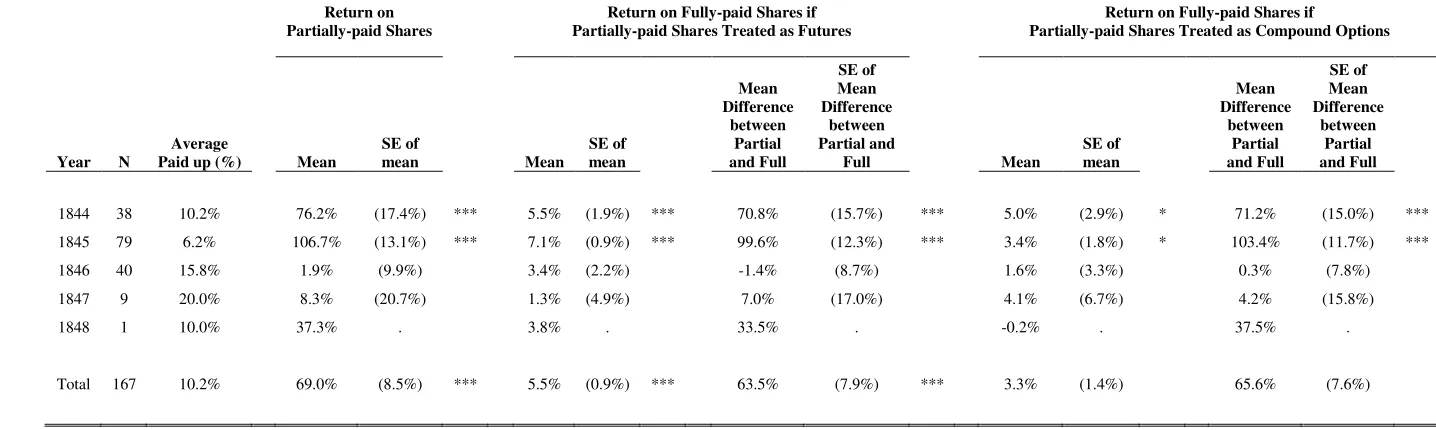
Table 3 shows that the size of the return which subscribers to new schemes could obtain
during the boom was substantial, with a mean abnormal first-day return of 76.2 per cent in
1844, and 106.7 per cent in 1845. This is consistent with commentary during the period, such
as the remark by the Railway Investment Guide (1845, p.10) that „it will be obvious that the
party who has had certain shares allotted to him, which rise to a premium (as they almost
invariably do, at least for a time) has the whole of that premium for his profit. By this means,
persons possessing only sufficient capital to pay the deposit, may more than double it in a
day‟.
<< INSERT TABLE 3 >>
If investors had been required to pay the total cost of the asset immediately, rather than in
12
be implied by adjusting the par value to include the discounted sum of future calls. The price
of the fully-paid share can be implied by adjusting the price of a partially-paid share
according to the futures pricing relationship, if it is assumed default is not possible. For this
analysis a discount rate of three per cent is used, which was close to the yield on Government
Consols, but unreported analysis suggests that similar results are obtained when other rates
are used.
where: r = Return, P = Price, Z = Par Value,
K = Size of future payment, r = Risk-free interest rate, q = Dividend rate (4)
When considering the scenario that default was possible, the price of a fully-paid share can be
implied by using an options pricing formula. Shea (2007a) has suggested modelling these
assets as n-fold compound call options. To facilitate computation for such an extensive
dataset, this paper considers them as 2-fold compound call options, and uses the closed form
formula proposed by Geske (1979). This implies that investors were initially purchasing
assets which gave them the right on the first exercise date to pay the first instalment K1, and
receive a call option which gave them the right on the second exercise date to pay the
remaining liability, K2, and receive the underlying asset. A volatility of 30 per cent has been
used for this analysis, which is close to the median volatility of 28 per cent for fully-paid
shares in the sample. Other volatilities have also been considered, although not reported, and
produce similar results.
Table 3 shows that the average returns which would have been experienced if only fully-paid
shares had been issued were just 5.5 per cent in 1844 and 7.1 per cent in 1845 if the
13
if the partially-paid share was regarded as an option contract. The difference between the
returns for partially-paid shares and fully-paid shares was substantial and significant during
these years.
These results suggest that the first-day returns for underlying ordinary shares were not
particularly high, but the return which was experienced was considerable because the full
premium was embedded in an asset on which only a small deposit was required. The impact
of uncalled capital was to magnify the first-day returns experienced by investors in new
companies. Thus the dramatic returns which investors experienced at this time from investing
in new companies were at least partially due to the effects of leverage.
4.2 Returns throughout Mania
To estimate the impact on shareholder returns throughout the Mania a similar analysis can be
repeated for each day of the sample period. If an investor subscribed to all new railway IPOs,
and then paid all subsequent calls when they were due, their cost at any particular time can be
calculated as the sum of the par values of all new companies. The market capitalisation at any
particular time reflected the price at which investors could sell their shares. Consequently, a
simple measure for estimating the return to investors was the price/par ratio. A price/par ratio
of 1 suggested that the current market price equalled the amount which had already been
invested. A price/par ratio of 2 suggested that the original investors had made a 100 per cent
return, whilst a price/par ratio of 0.5 suggested investors had lost 50 per cent of their original
investment.
The average price/par ratios for the established railways and new railways were calculated for
each day between 1844 and 1850, and are illustrated in Figure 5. The price/par ratio of the
new companies reached a peak of 2.74, which meant that an investor who had subscribed to
14
equivalent fully-paid share, when the partially-paid share is considered as a future contract,
has been calculated for each day of the sample. Alternative scenarios for the discount rate
have been employed, being -10 per cent, 0 per cent and +10 per cent. The implied price of
each equivalent fully-paid share, when the partially-paid share is treated as an option
contract, has been calculated using the approach of Geske (1979). To obtain a range of
scenarios volatilities of 20 per cent, 30 per cent and 40 per cent were analysed. The implied
total market capitalisation and the total par value for all of the new railways have been used
to calculate the implied price/par ratio for the industry, for each day, which is shown in
Figure 5.
<< INSERT FIGURE 5 >>
When partially-paid shares are treated as a future contract the average price/par ratio of the
equivalent fully-paid shares of new railways reached a peak of between 1.12 and 1.18
depending on what assumptions are made about the discount rate. When partially-paid shares
are treated as option contracts, a peak of between 0.98 and 1.11 was reached, depending on
the assumptions regarding volatility. In each instance the results suggest that the returns
which investors would have experienced from investing in fully-paid shares would have been
relatively low, but due to the leveraged nature of the partially-paid shares the returns which
they actually experienced were substantial.
5
Instalment Payments
The use of leveraged derivatives also affects when investors must provide payment. Rather
than paying the full amount initially, the use of leverage makes it possible to obtain an asset
for a small initial deposit. The ability to obtain exposure to the price movements of assets
without having to immediately find the total capital required may have contributed to the
15
subscribed to the new schemes. The Economist (April 5, 1845, p.310) noted that „it is one of
their peculiar characteristics but yet not less ultimately dangerous and deceptive on that
account, that from the delay of procuring the act and getting it into operation the period when
the main bulk of capital is required is remote from that when the greatest excitement and
speculation exists, and no immediate check is therefore experienced by calls of capital.‟
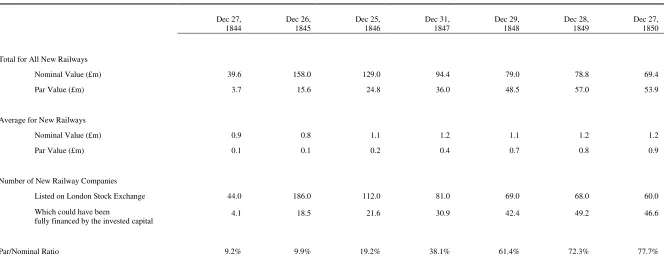
The substantial difference between the amount that investors were liable to pay (the nominal
value), and the amount which they had paid so far (the par value), is reported in Table 4 for
the end of each year. Only companies where the details of both the nominal and par values
are available are included in the analysis.
<< INSERT TABLE 4 >>
It can be seen from Table 4 that the total nominal value of new railways at the end of 1844
was £39.6m, and at the end of 1845 was £158.0m. In contrast, the total par value of these new
railways was just £3.7m in 1844, and £15.6m in 1845, which means that during the boom in
prices and promotions investors had been asked to pay up less than 10 per cent of their total
liability. This implies that although 44 new railway companies had been listed by the end of
1844, investors had only provided enough capital to fully finance 4.1 companies. By the end
of 1845, when 186 new railway companies were listed, investors had provided enough capital
to entirely finance just 18.5 companies.
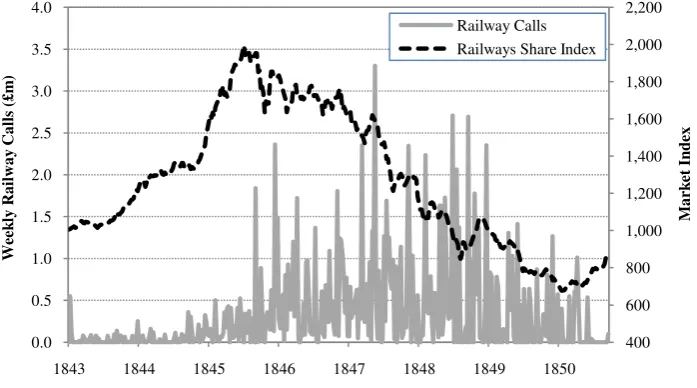
When payments were eventually demanded, the resulting deleveraging may have contributed
to a decline in prices. Investors were required to make regular and sizeable payments on their
partially-paid shares during the construction phase, especially between 1846 and 1848, as
shown in Figure 6.
16
The Times (July 30, 1845, p.4) had issued warnings at the height of the Mania about the
extent and impact of future calls for capital. They said „soon or late the day will come when
an untold proportion of this year‟s scripholders will be doubly pressed, no longer able to
suffer the sums they have already paid to remain buried in the earthworks of an unfinished
line, much less to pay up the quick recurring calls of the company‟. The Economist (October
21, 1848, p.1187)noted that „every fresh call that was made upon exhausted shareholders was
attended by one of two effects – either the shares themselves upon which the call had been
made were sold in order to avoid payment, or some other shares were sold in order to raise
the money for that purpose. There was constantly an increasing number of sellers, and a
constantly diminishing number of buyers.‟ This led to the result that „lines in course of
construction in place of increasing in price as more and more capital became invested in
them, have after each new call fallen about as much as they should have risen.‟
To estimate the impact which these calls for capital had on prices, 971 changes in capital
were analysed as shown in Table 5. When a company issued a call, its return during that
week was calculated, with the abnormal return being calculated as the company return minus
the return on an index of all railway shares which has been constructed by Campbell and
Turner (2010). If an asset was not traded in the week during which the call was made the
calculation was carried out for the week that it was next traded.
<< INSERT TABLE 5 >>
An analysis of all 971 calls for capital between 1843 and 1850 suggests that a share had an
average abnormal return of -9.7 per cent in the week that a call was made on it, as shown in
Table 5. The most likely reason for the falls in prices was investors selling some shares to pay
the instalments on others. If a three week period is analysed, there was an average abnormal
17
return of -4.7 per cent. The results from these longer windows suggest that part of the decline
was temporary, reflecting the short-term difficulties which investors had in meeting the
demand for further payments. Nevertheless, there is still evidence of substantial declines
which, combined with the number of calls which were made, would suggest that this
exercised a considerable downward pressure on prices during this period. This implies that
the process of deleveraging contributed to the decline in prices during the downturn.
6
Impact on Pricing
It is possible that leverage may initially increase the demand for an asset by raising expected
returns, and by providing easier payment terms. This would suggest that the price of the asset
could be higher than it would have been if leverage was not available. However, this increase
in demand may be at least partially offset by the increased risk of the asset. It is also possible
that an increase in the price of assets could be followed by an increase in the supply of assets,
reducing the equilibrium price. The net impact of leverage on the price of an asset is thus
ambiguous.
The impact of leverage on pricing during the Railway Mania can be assessed by comparing
the prices of highly leveraged assets, namely those issued by the new railways, with other
assets. A basic approach to assessing the relative price of an asset is to compare its dividend
yield with other assets. As the new railways promoted at this time could not pay a dividend
until they had finished construction and began operation, a current dividend yield cannot be
calculated for their early stages. However, it is possible to use an approximation to calculate
what dividend they would eventually have to achieve to produce a similar return to the
non-railways and established non-railways. The dividend yield can be expressed in terms of the
18
(5)
The highest price/par ratio of the new railways from the various scenarios discussed above
was 1.18, assuming a partially paid share can be treated as a future contract, and using a
discount rate of 10 per cent. During 1845 a sample of non-railway companies were trading at
an average dividend yield of 4.5 per cent (Campbell, 2010), so to achieve a similar yield the
new railways should have been producing a dividend/par ratio of 5.3 per cent. This is a lower
bound estimate, as it does not take account of the much greater uncertainty surrounding the
new railways, or the foregone dividends during the construction phase, but it provides an
approximation for required performance.
The dividend/par ratio of the established railways peaked at 7.2 per cent during the Mania
(Campbell, 2010). An analysis of the prospectuses of 85 new railways collected from
advertisements in the Railway Times (1843-45) suggests that the promoters of these new
railways encouraged investors to expect an average dividend/par ratio of 7.9 per cent. The
lower bound estimate of the required dividend/par ratio to justify the price of the new
railways was therefore much lower than either the established railways or the prospectuses of
the new railways suggested was possible.
These calculations have been performed using the highest price/par ratio of any scenario
which has been discussed above. If a more reasonable discount rate is used, or partially paid
shares were options, then the implied dividend rate would have been even lower, suggesting
that the prices of new railway shares were not particularly high during the Railway Mania,
even at the market peak.
7
Conclusion
Using an extensive dataset, this paper has analysed the pricing of assets with uncalled capital
19
on the market at this time may be modelled as either futures or options, which implies that
investors who purchased these assets were effectively purchasing highly leveraged
derivatives.
The evidence presented above suggests that the first impact of this leverage was to amplify
the returns to investors. First-day returns for partially-paid shares were significantly higher
than the returns which investors would have received if they had only been able to purchase
fully-paid shares. The returns, throughout the boom, which were accumulated by investors in
new railways were substantially increased by the effects of leverage, but during the downturn
negative returns were also magnified.
The second impact of leverage was to allow investors to purchase assets on an instalment
payment plan. Investors could subscribe to shares in new companies for a small deposit. This
meant that although almost two hundred new railways had been listed on the market at its
peak, enough capital had been provided to finance only about twenty of them. When
payments were subsequently required, the resulting deleveraging was associated with price
declines.
The combined effects of higher expected returns, and easier payment terms, may have
increased the demand for the assets issued by the new railways. However, possibly due to the
increased risk, and the substantial increase in the supply of assets, the new railways did not
have a much higher price than the non-railways at this time.
These results suggest that leverage may play an important role in „bubbles‟. Although its
influence on prices may be limited, it affects the returns experienced by investors, and the
timing of flows of capital. The use of leverage may initially appear to be attractive to
20
investment, but it can lead to problems in a downturn, when negative returns are magnified,
and deleveraging occurs.
References
Allen, F. and Gale, D. (2000), "Bubbles and Crises", The Economic Journal, vol. 110, no. 460, pp. 236-255.
Anonymous, (1845), The Railway Investment Guide. How to Make Money in Railway Shares: A Series of Hints and Advice to Parties Speculating, British Library.
Aoki, K., Proudman, J., and Vlieghe, G. (2002). „Houses as Collateral: Has the Link between
House Prices and Consumption in the U.K. Changed?‟, Economic Policy Review,
Federal Reserve Bank of New York, May, pp. 163-77
Bernanke, B.S., and Gertler, M. (2001). 'Should Central Banks Respond to Movements in Asset Prices?' American Economic Review, vol. 91 (May), pp. 253-57.
Bryer, R. A. (1991). “Accounting for the „Railway Mania‟ of 1845–a Great Railway Swindle?”, Accounting, Organisations and Society, vol. 16, no. 5/6, pp. 439-486. Campbell, G. (2010), “Cross-Section of a „Bubble‟: Stock Prices and Dividends during the
British Railway Mania”, SSRN Working Paper.
Campbell, G. and Turner, J. (2010), “„The Greatest Bubble in History‟: Stock Prices during the British Railway Mania”, SSRN Working Paper.
Dale, R., Johnson, J.E.V. and Tang, L. (2005), „Financial Markets can Go Mad: Evidence of
Irrational Behaviour during the South Sea Bubble‟, Economic History Review, vol.
58, no. 2, pp. 233-271.
Detken, C. and Smets, F. (2004), 'Asset Price Booms and Monetary Policy', ECB Working Paper no. 364.
Engle, R. F. and Granger, C.W.J. (1987), „Co-Integration and Error Correction:
Representation, Estimation, and Testing‟, Econometrica, vol. 55, pp.251-276.
Economist (2008). The Beauty of Bubbles, December 18.
Geithner, T. (2010), „Remarks before the American Enterprise Institute on Financial
Reform‟, Speech at the American Enterprise Institute, March 22.
Geske, R. (1979), „The Valuation of Compound Options‟, Journal of Financial Economics, vol. 7, pp. 63-81.
Guiso, L., Sapienza, P. & Zingales, L. (2009), „Moral and Social Constraints to Strategic
Default on Mortgages‟, CEPR Working Paper.
21
Kindleberger, C.P. (2000), Manias, Panics, and Crashes: A History of Financial Crises, John Wiley & Sons.
Lewin, H.G. (1968), The Railway Mania and its Aftermath, 1845-1852 (Being a Sequel to Early British Railways), Rev. Edn, A. M. Kelley.
MacDermot, E.T. (1964), History of the Great Western Railway, Ian Allan Ltd. McCartney, S. and Arnold A. J. (2003). “The Railway Mania of 1845-1847: Market
Irrationality or Collusive Swindle Based on Accounting Distortions?”Accounting, Auditing and Accountability Journal, vol. 16, no.5, pp.821-52.
Mitchell, B.R. (1964), „The Coming of the Railway and United Kingdom Economic Growth‟,
Journal of Economic History, vol. 24, no. 3, pp. 315-336.
Nairn, A. (2002), Engines that Move Markets: Technology Investing from Railroads to the Internet and Beyond, Wiley.
Odlyzko, A. (2010). Collective Hallucinations and Inefficient Markets: The British Railway Mania of the 1840s, University of Minnesota.
Parliamentary Papers (1847-48), LXIII, p.275-442 „Return of the names of railways for which acts have been obtained; calls made; amount received and remaining due; sums borrowed which remain owing; balance of capital uncalled for, and of money which the companies retain power to borrow; and, periods for which the companies have postponed making further calls.‟
Parliamentary Papers (1847-48), VIII, Pt. I, p.1, „Reports from the Secret Committee on Commercial Distress; with an Index‟.
Pollins, H. (1971), Britain's Railways: An Industrial History, David and Charles (Publishers) Limited.
Shea, G.S. (2007a), „Understanding Financial Derivatives During the South Sea Bubble: The
Case of the South Sea Subscription Shares‟, Oxford Economic Papers, vol. 59, no.
Supplement 1, pp. i73.
Shea, G.S. (2007b), „Financial Market Analysis Can Go Mad (in the Search for Irrational
Behaviour During the South Sea Bubble)‟, Economic History Review, vol. 60, no. 4,
pp. 742-765.
Simmons, J. (1978), The Railway in England and Wales, 1830-1914, vol.1, Leicester University Press.
22
Figure 1: Weekly Market Indices of All Railways, Established Railways and Non-Railways, 1843-50
Source: Campbell and Turner (2010).
Notes: Railway share indices calculated from weekly share price tables in Railway Times (1843-50). Non-Railway share index calculated from weekly share price tables in Course of the Exchange (1843-50). The All-Railway index includes all railway securities, whereas the Established-Railway index includes those railways which were operating before January 1843. The Non-Railway index includes the twenty largest non-railways by market capitalization. Capital gains for each company are weighted by market capitalization to produce weekly market indices.
400 600 800 1,000 1,200 1,400 1,600 1,800 2,000 2,200
1843 1844 1845 1846 1847 1848 1849 1850
In
d
ex
L
ev
el
23
Figure 2: Number of Railway Securities Listed on London Stock Exchange, and Railway Share Index 1843-50
Notes: Railway share index and number of securities listed on London Stock Exchange calculated from weekly share price tables in Railway Times (1843-50). Market index constructed from market returns, which have been calculated by weighting the returns of the component companies by their market capitalisation at the start of the day.
400 600 800 1,000 1,200 1,400 1,600 1,800 2,000 2,200 0 50 100 150 200 250 300 350
1843 1844 1845 1846 1847 1848 1849 1850
Ma rk et Inde x N u m b er o f S ec u ri ti es
Railway Securities listed on LSE
24
Figure 3: Total Par Value and Nominal Value of Railway Shares Listed on London Stock Exchange, 1843-50
Notes: Nominal Value and Par Value for each company listed on London Stock Exchange obtained from weekly share price tables in Railway Times (1843-50). Industry Nominal and Par Values calculated by summing individual companies.
0 50 100 150 200 250 300
1843 1844 1845 1846 1847 1848 1849 1850
N
o
m
in
a
l/
Pa
r
V
a
lu
e
(£
m
il
li
o
n
s)
Nominal Value
25
Figure 4: Daily Share Prices of a GWR Full Share and Two Half Shares, 1843-50
Panel A: Prices Observed in Market Panel B: Prices Adjusted for Uncalled Capital Discounted at Actual
Risk-Free and Dividend Rates
Notes: Share prices obtained on a daily basis from weekly share price tables in Railway
Times (1843-50).
Notes: Share prices and par values obtained from weekly share price tables in Railway
Times (1843-50). Implied price of a GWR original share calculated using Equation 1.
£0 £50 £100 £150 £200 £250 £300
1843 1844 1845 1846 1847 1848 1849 1850
Sha
re
P
ri
ce
(£
)
GWR Original Share
GWR Half Share (x2)
£0 £50 £100 £150 £200 £250 £300
1843 1844 1845 1846 1847 1848 1849 1850
Sha
re
P
ri
ce
(£
)
GWR Original Share [Price + Ue(-r+q)t]
26
Figure 5: Price/Par Ratio of New Railways, 1844-50
Panel A: Shares Treated as Futures, using Alternative
Scenarios of Discount Rate
Panel B: Shares Treated as Compound Call Options, using Alternative Scenarios of Volatility
Notes: Implied market capitalisation and par value calculated for individual new railways, promoted after 1843, using alternative scenarios of the interest and dividend rates. Implied price/par ratio of all new railways calculated as implied total market price/total cost.
Notes: When treated as a future the implied price/par ratio calculated as total price/total cost using an interest rate of 3 per cent and dividend rate of 0 per cent to discount uncalled capital. When treated as an option the price of a partially-paid share is assumed to be the price of a compound call option, using alternative assumptions about volatility. The pricing formula for a compound call option (Geske, 1979) was used to imply the price of an underlying fully-paid share for each company.
0.0 0.5 1.0 1.5 2.0 2.5 3.0
1844 1845 1846 1847 1848 1849 1850
Pr ic e/ Pa r R a ti o Market Price/Par
Implied from Future Pricing (-r+q = -0.1) Implied from Future Pricing (-r+q = 0) Implied from Future Pricing (-r+q = 0.1)
0 0.5 1 1.5 2 2.5 3
1844 1845 1846 1847 1848 1849 1850
Pr ic e/ Pa r R a ti o Market Price/Par
Implied from Future Pricing
27
Figure 6: Weekly Railways Calls and Railway Share Index 1843-50
Notes: Railway share index and volume of calls calculated from weekly share price tables in Railway Times
(1843-50). 400 600 800 1,000 1,200 1,400 1,600 1,800 2,000 2,200 0.0 0.5 1.0 1.5 2.0 2.5 3.0 3.5 4.0
1843 1844 1845 1846 1847 1848 1849 1850
28
Table 1: Augmented Dickey-Fuller (ADF) Tests of Residual from Estimated Cointegrating Relationships between Fully-paid and Partially-paid Shares of Established Railway Companies
Variables Included in Cointegrating Relationship
Y = PriceF
X1 = PriceP
Y = PriceF
X1 = PriceP
X2 = UncalledP
Y = PriceF
X1 = PriceP
X2 = UncalledP
X3 = Rf
X4 = Div
Y = PriceF
X1 = PriceP + Ue(-r+q)t, where (-r+q) is equal to:
Fully-paid Share
(Y = PriceF)
Partially-paid Share
(X = PriceP) Actual -10% 0% 10% Obs
Edinburgh and Glasgow Half Shares -1.60 -4.78 *** -5.33 *** -4.33 *** -3.59 ** -4.13 *** -4.72 *** 1,186 Great Western Half Share Full Shares -3.82 ** -16.36 *** -16.82 *** -14.50 *** -8.67 *** -13.21 *** -12.04 *** 2,284 Great Western Half Share Fifth Shares -3.79 ** -17.83 *** -18.26 *** -15.93 *** -10.09 *** -14.21 *** -17.20 *** 2,270 Great Western Half Share Sixth Shares -1.13 -9.83 *** -10.18 *** -8.90 *** -6.78 *** -8.29 *** -9.75 *** 1,119 Great Western Half Share Quarter Shares -2.38 -13.28 *** -13.18 *** -11.91 *** -9.31 *** -11.61 *** -11.23 *** 1,379 London and North Western New Shares -0.87 -7.52 *** -8.64 *** -8.17 *** -2.94 -6.18 *** -6.11 *** 1,050 London and North Western Fifth Shares -1.27 -9.07 *** -10.79 *** -6.11 *** -5.69 *** -7.07 *** -4.07 *** 1,359 London and North Western Quarter Shares -1.47 -6.25 *** -6.55 *** -5.03 *** -4.74 *** -4.91 *** -5.04 *** 537 Midland Half Shares -1.43 -5.03 *** -5.72 *** -4.34 *** -3.35 * -4.23 *** -4.02 *** 1,284
Midland New Shares -2.02 -8.84 *** -9.24 *** -8.45 *** -5.67 *** -8.27 *** -6.65 *** 989
York and Newcastle New Shares -2.70 -6.85 *** -6.79 *** -6.37 *** -6.65 *** -6.65 *** -6.07 *** 327 York, Newcastle and Berwick Extension No. 1 Shares -2.51 -12.00 *** -12.04 *** -9.92 *** -7.04 *** -9.04 *** -10.55 *** 1,008 York, Newcastle and Berwick Extension No. 2 Shares -1.93 -6.90 *** -7.58 *** -5.19 *** -3.47 ** -4.70 *** -5.23 *** 438 York and North Midland Half Shares -4.95 *** -14.35 *** -14.51 *** -12.30 *** -10.86 *** -11.67 *** -12.59 *** 1,279 York and North Midland E&W Riding Shares -0.89 -5.94 *** -7.86 *** -3.82 ** -2.95 -3.31 * -4.20 *** 1,035 York and North Midland Extension Shares -1.54 -4.97 *** -7.40 *** -2.61 -1.42 -2.00 -2.95 886 York and North Midland Scarborough Branch Shares -3.31 * -4.27 ** -4.31 * -2.90 -2.96 -2.92 -2.90 870
29
Table 2: Forfeiture Rates on Railway Share Instalments, using Alternative Scenarios for Deadline on Payment
Time between Instalment Due Date and Deadline for Payment
Criteria Met Forfeiture Rate
Difference in Forfeiture Rates
SE of Difference
N S-K>=0 S-K<0 S-K>=0 S-K<0
2 Months 225 214 11 10.5% 13.6% 3.2% (4.1%)
4 Months 221 197 24 8.5% 19.0% 10.5% *** (2.4%)
1 Year 163 132 31 5.5% 14.8% 9.3% *** (1.8%)
2 Years 74 52 22 2.7% 6.3% 3.5% ** (1.7%)
30
Table 3: New Railways’ First-day Abnormal Returns
Return on Partially-paid Shares
Return on Fully-paid Shares if Partially-paid Shares Treated as Futures
Return on Fully-paid Shares if
Partially-paid Shares Treated as Compound Options
Year N
Average
Paid up (%) Mean
SE of
mean Mean
SE of mean Mean Difference between Partial and Full SE of Mean Difference between Partial and
Full Mean
SE of mean Mean Difference between Partial and Full SE of Mean Difference between Partial and Full
1844 38 10.2% 76.2% (17.4%) *** 5.5% (1.9%) *** 70.8% (15.7%) *** 5.0% (2.9%) * 71.2% (15.0%) ***
1845 79 6.2% 106.7% (13.1%) *** 7.1% (0.9%) *** 99.6% (12.3%) *** 3.4% (1.8%) * 103.4% (11.7%) ***
1846 40 15.8% 1.9% (9.9%) 3.4% (2.2%) -1.4% (8.7%) 1.6% (3.3%) 0.3% (7.8%)
1847 9 20.0% 8.3% (20.7%) 1.3% (4.9%) 7.0% (17.0%) 4.1% (6.7%) 4.2% (15.8%)
1848 1 10.0% 37.3% . 3.8% . 33.5% . -0.2% . 37.5% .
Total 167 10.2% 69.0% (8.5%) *** 5.5% (0.9%) *** 63.5% (7.9%) *** 3.3% (1.4%) 65.6% (7.6%)
31
Table 4: Total Nominal and Par Values of New Railways, 1844-50
Dec 27, 1844
Dec 26, 1845
Dec 25, 1846
Dec 31, 1847
Dec 29, 1848
Dec 28, 1849
Dec 27, 1850
Total for All New Railways
Nominal Value (£m) 39.6 158.0 129.0 94.4 79.0 78.8 69.4
Par Value (£m) 3.7 15.6 24.8 36.0 48.5 57.0 53.9
Average for New Railways
Nominal Value (£m) 0.9 0.8 1.1 1.2 1.1 1.2 1.2
Par Value (£m) 0.1 0.1 0.2 0.4 0.7 0.8 0.9
Number of New Railway Companies
Listed on London Stock Exchange 44.0 186.0 112.0 81.0 69.0 68.0 60.0
Which could have been
fully financed by the invested capital
4.1 18.5 21.6 30.9 42.4 49.2 46.6
Par/Nominal Ratio 9.2% 9.9% 19.2% 38.1% 61.4% 72.3% 77.7%
32
Table 5: Event Study on Company Returns when Calls for Capital Were Issued
One Week Three Weeks Five Weeks
Year Number
of calls Mean
SE of
mean Mean
SE of
mean Mean
SE of mean
1843 22 -4.2% (2.5%) -0.7% (3.5%) 2.4% (3.0%)
1844 36 -4.6% (2.1%) ** -2.5% (3.5%) 4.8% (4.8%)
1845 110 -4.1% (1.6%) ** -2.4% (1.7%) -1.3% (2.2%)
1846 197 -7.4% (1.9%) *** -6.0% (2.1%) *** -3.9% (2.2%) *
1847 218 -9.1% (1.2%) *** -7.9% (1.5%) *** -6.2% (1.7%) ***
1848 182 -16.1% (1.8%) *** -14.3% (2.1%) *** -6.5% (3.4%) *
1849 149 -11.9% (2.3%) *** -11.4% (2.3%) *** -6.9% (2.6%) ***
1850 57 -10.9% (3.8%) *** -10.4% (3.6%) *** -6.1% (6.1%)
Overall 971 -9.7% (0.7%) *** -8.4% (0.8%) *** -4.7% (1.1%) ***