Collaborative research networks work
Anamaria A. Camargo, Andrew J.G. Simpson
J Clin Invest.
2003;
112(4)
:468-471.
https://doi.org/10.1172/JCI19520
.
Brazil was heralded for completion of the first genome sequence of a plant pathogen
following the development of a virtual research center — a collaborative network of
laboratories throughout the state of São Paulo, drawing on the expertise of a dispersed and
diverse scientific community and on investment from both the government and the private
sector. Strategies key to the success of this model are discussed here in the context of
continuing collaborative scientific endeavors in both developed and developing countries.
Science and Society
Find the latest version:
SCIENCE AND SOCIETY
Biomedical research can be approached in a piecemeal manner or attacked in large swaths. In molecular genetics, for example, genes can be identified, cloned, sequenced, and functionally characterized one at a time, or this task can be simultaneously undertaken for all the genes in a particular organism’s genome. The latter approach is known as genomics, which encompasses the generation, analysis, and utilization of global sets of genetic data. The individ-ual-gene approach fits perfectly within the traditional structural organization of scientific research, but genomics, especially when applied to complex organisms, does not. For example, sin-gle-gene cloning projects can be assigned to individual students or post-doctoral fellows within a research group, but genome projects are more complex and challenging and must be approached quite differently.
Networks: Brazil’s strategy for genome sequencing
The most commonly adopted strategy for genomics, and in particular ge-nome sequencing, has been to create large, stand-apart genome centers where the means to generate a vast amount of data are concentrated, rec-ognizing that this kind of science has no real place in the average tradition-al research laboratory (1). In Brazil, however, a developing country with a reasonably well developed scientific infrastructure and with aspirations to integrate science and technology into its further economic growth, a differ-ent strategy was used — that of the col-laborative research network (1, 2). In this approach, the necessary hardware, consumables, financing, and expertise are distributed within the existing sci-entific community, constituting a vir-tual research center that is, in reality, a large number of well-equipped labo-ratories linked by the Internet.
Such networks can be set up rapidly and can strengthen the general scien-tific community by disseminating financing, novel equipment, and ex-pertise. Moreover, they can undertake complex and socially relevant projects that would be impossible within the traditional model of modern science organized around an individual re-searcher and his or her immediate
col-leagues; thus they can attain a higher level of scientific achievement. This network structure may not only en-able developing countries like Brazil to move into more challenging areas of research but is also germane to the international community.
Brazil’s initial genome sequencing project: Xylella fastidiosa
It was in early 1997 that the Fundação de Amparo à Pesquisa do Estado de São Paulo (FAPESP), the governmental agency responsible for the support of scientific research in the state of São Paulo, first contemplated an organized genome project (2). This was done with the view, not that Brazil urgently need-ed the genome sequence of any partic-ular organism, but rather that expertise in this important field would greatly benefit the research community. It was also perceived that increasing expertise in genomics should simultaneously increase expertise in more basic molec-ular genetics, which was poorly repre-sented relative to other areas of biolo-gy. In May of that year a plan of action was proposed by FAPESP, in Septem-ber the deadlines for participant appli-cations were defined, and by the end of the year the practical work had begun. The decision made by FAPESP was that a project would be funded that was aimed at enabling the communi-ty to become acquainted with the complexities of genomics by generat-ing fundamental data in the form of a complete, computer-annotated se-quence of a bacterial genome. At that time, this was a significant challenge, since fewer than ten such projects had been completed anywhere in the world. Moreover, none of the partici-pants (including the coordinators) had any experience in genome se-quencing or hands-on bioinformat-ics. Most members of the network had never cloned a gene or sequenced DNA at all! FAPESP decided from the start that the project would be under-taken by a network of laboratories,
Collaborative research networks work
Anamaria A. Camargo and Andrew J.G. Simpson
Ludwig Institute for Cancer Research, New York, New York, USA
Brazil was heralded for completion of the first genome sequence of a plant pathogen following the development of a virtual research center — a collaborative network of laboratories throughout the state of São Paulo, drawing on the expertise of a dispersed and diverse scientific community and on investment from both the government and the pri-vate sector. Strategies key to the success of this model are discussed here in the context of continuing collaborative scientific endeavors in both developed and developing countries.
J. Clin. Invest.112:468–471 (2003). doi:10.1172/JCI200319520.
Address correspondence to: Andrew J.G. Simpson, Ludwig Institute for Cancer Research, 605 Third Avenue, New York, New York 10158, USA.
Phone: (212) 450-1556; Fax: (212) 450-1555; E-mail: [email protected].
Conflict of interest: The authors have declared that no conflict of interest exists.
rather than waiting for the construc-tion of a dedicated genomic center. In fact, it was the genome to be se-quenced that was determined last. As FAPESP, the agency that both con-ceived of and underwrote the initia-tive, receives its funds directly from taxpayers in a society with many eco-nomic challenges, it was crucial that the investment be perceived as a tool to raise not only the scientific but also the economic competitiveness of Brazil. Thus, the organismXylella fastidiosawas selected. This insect-borne phytopath-ogen causes citrus variegated chloro-sis, a disease that primarily affects oranges and results in significant eco-nomic loss to the state of São Paulo. Overnight, the X. fastidiosagenome project became the largest and most widely known scientific project in Brazil, receiving financial support of approximately US$12 million and involving laboratories spread through-out the state of São Paulo. The net-work, termed the Organization for Nucleotide Sequencing and Analysis (ONSA), was composed of one coordi-nation laboratory, one bioinformatics laboratory, and 30 sequencing centers functionally linked by the Internet with a central website (http://watson. fapesp.br/onsa/Genoma3.htm). Despite the group’s lack of experience and the complexity of its task, the
proj-ect was completed ahead of schedule (Figure 1), and the annotated sequence of the X. fastidiosagenome was pub-lished in a cover story in Naturein July 2000 (3). Brazil thus became the first country outside the US, Europe, and Japan to complete the sequencing of a bacterial genome. As a result, the proj-ect received wide attention from the national and international media (for a list of related news articles see http:// watson.fapesp.br/imprensa/press.htm).
The Economist began an article with “Samba, football and . . . genomics. The list of things for which Brazil is re-nowned has suddenly got longer” (4).
Consolidation of the original network
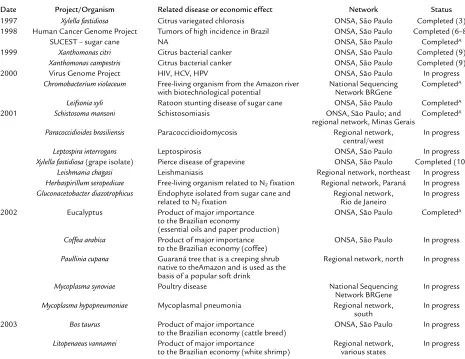
Inspired by the success of the X. fas-tidiosa genome project and by very positive responses from the scientific, financial, and commercial communi-ties, ONSA immediately embarked on several other sequencing projects, including (a) the FAPESP/LICR Human Cancer Genome Project (jointly run and funded with the Lud-wig Institute for Cancer Research), which has to date generated and deposited in GenBank almost 1 mil-lion DNA sequences of transcripts derived from human tumors and nor-mal tissues (5); (b) the Sugar Cane EST Project (SUCEST), which has
[image:3.576.86.507.51.281.2]produced over 300,000 expressed sequence tags (ESTs) from sugar cane; and (c) the Schistosoma mansoni ge-nome project, which has generated 160,000 ESTs from this important parasitic trematode. Thereafter, sev-eral other bacterial genome sequenc-ing projects were also launched, many of which have already been completed and published (Table 1). Most grati-fyingly, a number of private indus-tries and non-Brazilian agencies came forward to join with FAPESP in fund-ing the novel genome projects, with total investments approaching US$10 million. The disparate projects were upgraded into a fully fledged state research program, with a further US$15 million set aside by FAPESP for investment. As a result of this pro-gram, a total of 65 laboratories are now equipped for high-throughput DNA sequencing, and over 450 researchers have been trained to gen-erate and, more importantly, to explore whole-genome data. Six major papers have been published (with several more submitted at the time of writ-ing), over 1.5 million ESTs have been generated from various organisms, and over 20 Mb of high-quality, anno-tated bacterial genome sequence has been produced (1, 6–10). Further-more, two start-up biotechnology companies have now been founded by
Figure 1
former ONSA members and are cur-rently hiring many of the young researchers trained. Thus, we believe that, by any criteria, the initiative to develop genomics via collaborative research networks in the state of São Paulo must be considered a success.
The establishment of a nationwide genome network
In addition to the ONSA network, which operates in the relatively restrict-ed area of the state of São Paulo (about the size of France), a distinct National Sequencing Network (BRGene; http:// www.lncc.br/∼brgene/) was also estab-lished under the auspices of the Min-istério da Ciência e Tecnologia and the Conselho Nacional de Desenvolvimen-to Científico e Tecnológico. The na-tional network was inaugurated in 2000 and incorporated 25 sequencing
laboratories from as far apart as Manaus and Belém in the Amazon, and Porto Alegre near the borders of Uruguay. BRGene has now complet-ed the sequencing of the genome of
Chromobacterium violaceum, a free-liv-ing bacteria that is very abundant in the waters of the Rio Negro in the Amazon basin, and that is potential-ly important to the biotechnology industry. At present, the network is also in the final sequencing phase for the genome of Mycoplasma synoviae, a chicken pathogen. It is notable that the same spirit of enthusiastic col-laboration that was the hallmark of ONSA also emerged within BRGene, even though distance allowed only infrequent meetings of the group as a whole and almost all interactions occurred via e-mail and the Internet. In addition to this nationwide
initia-tive, further regional networks are currently undertaking both small-genome sequencing and EST proj-ects (Table 1).
[image:4.576.57.522.356.715.2]We have found that the greatest strength of sequencing networks comes from the interaction of the large number of scientists involved. For every sequencing machine there is at least one established scientist together with students and technicians (typically we funded the hiring of at least one tech-nician per machine to do the daily work of generating data). Thus, exten-sive expertise is available for the analy-sis and annotation of the genome data, and also for the solution of the inevitable technical problems that occur usually during the final stages of a project. The network also contributes strongly to the community in which it is established. This contribution is
Table 1
Summary of genome sequencing projects undertaken by Brazilian genome networks
Date Project/Organism Related disease or economic effect Network Status
1997 Xylella fastidiosa Citrus variegated chlorosis ONSA, São Paulo Completed (3)
1998 Human Cancer Genome Project Tumors of high incidence in Brazil ONSA, São Paulo Completed (6–8) SUCEST – sugar cane NA ONSA, São Paulo CompletedA
1999 Xanthomonas citri Citrus bacterial canker ONSA, São Paulo Completed (9)
Xanthomonas campestris Citrus bacterial canker ONSA, São Paulo Completed (9) 2000 Virus Genome Project HIV, HCV, HPV ONSA, São Paulo In progress
Chromobacterium violaceum Free-living organism from the Amazon river National Sequencing CompletedA with biotechnological potential Network BRGene
Leifsonia xyli Ratoon stunting disease of sugar cane ONSA, São Paulo CompletedA
2001 Schistosoma mansoni Schistosomiasis ONSA, São Paulo; and CompletedA
regional network, Minas Gerais
Paracoccidioides brasiliensis Paracoccidioidomycosis Regional network, In progress central/west
Leptospira interrogans Leptospirosis ONSA, São Paulo In progress
Xylella fastidiosa (grape isolate) Pierce disease of grapevine ONSA, São Paulo Completed (10) Leishmania chagasi Leishmaniasis Regional network, northeast In progress Herbaspirillum seropedicae Free-living organism related to N2fixation Regional network, Paraná In progress
Gluconacetobacter diazotrophicus Endophyte isolated from sugar cane and Regional network, In progress related to N2fixation Rio de Janeiro
2002 Eucalyptus Product of major importance ONSA, São Paulo CompletedA to the Brazilian economy
(essential oils and paper production)
Coffea arabica Product of major importance ONSA, São Paulo In progress to the Brazilian economy (coffee)
Paullinia cupana Guaraná tree that is a creeping shrub Regional network, north In progress native to theAmazon and is used as the
basis of a popular soft drink
Mycoplasma synoviae Poultry disease National Sequencing In progress
Network BRGene
Mycoplasma hypopneumoniae Mycoplasmal pneumonia Regional network, In progress south
2003 Bos taurus Product of major importance ONSA, São Paulo In progress
to the Brazilian economy (cattle breed)
Litopenaeus vannamei Product of major importance Regional network, In progress to the Brazilian economy (white shrimp) various states
achieved through the widespread avail-ability of the sequencing equipment, which can be employed in whatever other projects the participating groups are involved in, and through the prac-tical experience gained from dealing with large DNA data sets. Perhaps more important, however, is the expe-rience of working within a coordinated, collaborative network and the realiza-tion of the power that comes from col-lective endeavors.
Key factors in the success of genome networks in Brazil
In retrospect, several factors were cru-cial to the success of the sequencing networks. First, many of the partici-pants were young and not yet well established in a specific line of research; thus, the limits to their collaborative spirit were few. To attract young, moti-vated groups, the networks refrained from requiring either previous experi-ence in genomics or full-time dedica-tion. Also, to stimulate groups without a solid background in genetics to join the project, funding levels were set at a generous amount so that all partici-pating laboratories could purchase an automated sequencer and improve their laboratories. A second key factor was the commitment of governmental research-funding agencies. Most Brazil-ian funding agencies are autonomous and have regular budgets for invest-ment in training and research infra-structure. Through these agencies, hundreds of MD and PhD fellowships were made available for genomics research. Third, it was crucial for the projects to have outside steering com-mittees, which selected and evaluated the groups, monitored progress, and were prepared to recommend removal of groups, though no group has been removed to date.
The speed and quality of work achieved by all the networks that were set up in Brazil probably surprised even the participants. Fundamentally, this impressive showing demonstrates that, when appropriately nurtured and supported, group-based research is tremendously effective. Without the anxiety engendered by excessive com-petition for both funding and experi-enced staff, the various strengths, tal-ents, and areas of expertise within a
group can complement one another for the good of all. Subsequent to the projects we have described, several other collaborative research networks have been established in Brazil. These include a functional genomics net-work to study phytopathogens, an ini-tiative to complete the coding se-quences of expressed human genes, a viral-genetics network to monitor the genotype of endemic viral pathogens, and, in a completely different field, a huge effort to record and register the complete range of fauna and flora in the state of São Paulo (http://www. biota.org.br/). In Brazil, the research network is now a firmly established model, throughout the country and in many different fields. This represents a major change in the structure of Brazilian research.
The worldwide adoption of the network structure
In the Northern Hemisphere, we have come to feel that biomedical science should be an essentially individualistic activity, reaching its finest form when the greatest minds constantly vie for funds and prestige. However, the prob-lems we face, particularly in the genomics era, are too complex to be tackled effectively within the tradition-al research paradigm based on stand-alone laboratories. This is especially clear in the crucially important quest to move science from mere discovery to concrete contributions to society. Sci-ence must, in the long term, add to the richness of human life, reduce human suffering, and stimulate economic growth if it is to continue to receive the long-term support from governmental and private agencies that scientists have come to expect. For example, in our own field, an individual researcher may identify a gene that contributes to the molecular distortion of an epithe-lial cell, leading to its malignant trans-formation. However, it takes large coordinated teams to then discover effective strategies for inhibiting the gene product, to produce the required inhibiting substance under appropri-ate conditions, to undertake clinical tri-als, and ultimately to make the drug available to patients. Thus, the tenden-cy toward individualistic approaches may contribute to the paradox of
mod-ern cancer research — our tremendous progress in understanding the disease but modest progress in improving treatment. The Brazilian demonstra-tion of the efficacy of disseminated academic research networks that are focused on specific questions provides an alternative model for the organiza-tion of science that could be used to enhance its practical contributions.
We strongly advocate the adoption of network structures, similar to that which we developed in Brazil, in other developing countries that are embrac-ing the challenge of sustained invest-ment in science and technology. We also urge that collaborative networks be more vigorously pursued in devel-oped countries, so that academic research might become more multidi-mensional and capable of tackling complex problems. We realize that this would depend on some fundamental changes in the manner in which indi-vidual scientists are evaluated and research funds dispersed. Nevertheless, we feel that we have amply demon-strated that research networks work, and that their implementation within the wealthy research communities of the US, Europe, and Japan could begin a whole new chapter in modern bio-medical research, enhancing the trans-lation of improved knowledge into concrete contributions to society.
1. Simpson, A.J. 2001. Genome sequencing net-works. Nat. Rev. Genet.2:979–983.
2. Simpson, A.J., and Perez, J.F. 1998. ONSA, the Sao Paulo Virtual Genomics Institute. Organi-zation for Nucleotide Sequencing and Analysis.
Nat. Biotechnol.16:795–796.
3. Simpson, A.J., et al. 2000. The genome sequence of the plant pathogen Xylella fastidiosa. Nature. 13:151–157.
4. Collins, P. 2000. Fruits of co-operation. The Econ-omist, 22–29 July.
5. Bonalume Neto, R. 1999. Brazilian scientists team up for cancer genome project. Nature.398:450. 6. Dias Neto, E., et al. 2000. Shotgun sequencing of the human transcriptome with ORF expressed sequence tags. Proc. Natl. Acad. Sci. U. S. A. 97:3491–3496.
7. de Souza, S.J., et al. 2000. Identification of human chromosome 22 transcribed sequences with ORF expressed sequence tags. Proc. Natl. Acad. Sci. U. S. A.97:12690–12693.
8. Camargo, A.A., et al. 2001. The contribution of 700,000 ORF sequence tags to the definition of the human transcriptome. Proc. Natl. Acad. Sci. U. S. A.98:12103–12108.
9. da Silva, A.C., et al. 2002. Comparison of the genomes of two Xanthomonas pathogens with differing host specificities. Nature. 417:459–463. 10. Van Sluys, M.A., et al. 2003. Comparative analy-ses of the complete genome sequences of Pierce’s disease and citrus variegated chlorosis strains of