BIROn - Birkbeck Institutional Research Online
Cooper, Richard P. (2003) Mechanisms for the generation and regulation of
sequential behaviour. Philosophical Psychology 16 (3), pp. 389-416. ISSN
0951-5089.
Downloaded from:
Usage Guidelines:
Please refer to usage guidelines at or alternatively
Birkbeck ePrints: an open access repository of the
research output of Birkbeck College
http://eprints.bbk.ac.uk
Cooper, R. P. (2003). Mechanisms for the
generation and regulation of sequential behaviour.
Philosophical Psychology
16
(3) 389 – 416.
This is an author-produced version of a paper published in Philosophical
Psychology (ISSN 0951-5089). This version has been peer-reviewed but does
not include the final publisher proof corrections, published layout or
pagination.
All articles available through Birkbeck ePrints are protected by intellectual
property law, including copyright law. Any use made of the contents should
comply with the relevant law. Copyright © 2003 Taylor & Francis. This is an
electronic version of an article published in Philosophical Psychology.
Philosophical Psychology is available online at: http://www.informaworld.com/
The final version of this paper can be viewed online at:
http://www.informaworld.com/openurl?genre=article&issn=0951-5089&volume=16&issue=3&spage=389
Citation for this version:
Cooper, R. P. (2003). Mechanisms for the generation and regulation of
sequential behaviour. London: Birkbeck ePrints. Available at:
http://eprints.bbk.ac.uk/archive/00000534
Citation for the publisher’s version:
Cooper, R. P. (2003). Mechanisms for the generation and regulation of
sequential behaviour. Philosophical Psychology
16
(3) 389 – 416.
http://eprints.bbk.ac.uk
Published as:
Cooper, R.P. (2003). Mechanisms for the generation and regulation of sequential behaviour.
Philosophical Psychology, 16, 389–416
Mechanisms for the Generation and Regulation
of Sequential Behaviour
Richard P. Cooper
School of Psychology,
Birkbeck, University of London
A critical aspect of much human behaviour is the generation and regulation of sequential activities. Such behaviour is seen in both naturalistic settings such as routine action and language production and laboratory tasks such as serial recall and many reaction time experiments. There are a variety of computational mechanisms that may support the generation and regulation of sequential behaviours, ranging from those underlying Turing machines to those employed by recurrent connectionist networks. This paper surveys a range of such mechanisms, together with a range of empirical phenomena related to human sequential behaviour. It is argued that the empirical phenomena pose difficulties for most sequencing mechanisms, but that converging evidence from behavioural flexibility, error data arising from when the system is stressed or when it is damaged following brain injury, and between trial effects in reaction time tasks, point to a hybrid symbolic activation-based mechanism for the generation and regulation of sequential behaviour. Some implications of this view for the nature of mental computation are highlighted.
1 Introduction
A critical aspect of much human behaviour is the sequential generation of actions, responses or outputs. This can be seen in most everyday situations. For example, in language production the sequential ordering of words is critical to their meaning, and in routine action (such as dressing or preparing a meal) the order of one’s actions, though not fully rigid, is still vital to successfully achieving one’s goals. The sequential generation of actions is also seen in many behaviours elicited in the psychological laboratory, such as serial memory recall tasks and choice reaction time tasks.
Given that generation and regulation of sequential behaviour is implicated in most activities, it is perhaps surprising that the area has been largely ignored by philosophical discussions about the nature of mental representation and mental processing. Such discussions typically focus on whether mental representation is propositional, symbolic and/or compositional, whether mental computation is symbol manipulation or can be validly described as such at some level of analysis, or the relationship between mental states and brain states. In doing so, there is a tendency to ignore how mental representations serve to guide or control behaviour. Equally, there is a tendency to oversimplify some approaches to mental computation (notably symbolic approaches, which are frequently argued to be Turing equivalent, and hence all reducible to Turing machine computation).
2 2
Turing and/or Von Neumann machines are frequently cited by philosophers of cognitive science as representing the standard model of symbolic computation within cognitive science (e.g., Bechtel & Abrahamsen, 1991; Frawley, 1997; Dawson, 1998; Van Gelder, 1998; Frawley, 2002). They are equally frequently attacked as poor models of cognitive processing. Dawson (1998) summarises the principal arguments against the approaches: serial processing (as effected by both approaches) is too slow for most cognitive behaviour; the structure/process distinction arising from the separation of the machine from the transition functions or program leads to brittleness that cannot capture the subtle effects of, for example, physical damage analogous to that resulting from minor brain injury; discrete symbolic processing is insufficiently flexibility to deal with continuous, noisy or graded inputs; and symbolic systems are biological implausible and fail to account for learning.
Dawson’s arguments apply to Von Neumann machines and the standard interpretation of Turing machines, but they do not apply to all symbolic mechanisms for the generation of sequential behaviour. First, Wells (1998) has provided an interpretation of Turing machines that side-steps the arguments. Wells suggests that Turing machines provide a good model of human cognition when the infinite tape is viewed as a representation of the environment (as, he asserts, Turing intended it to be). In making this argument, Wells adopts a highly abstract view of mental processing, and while the argument is compelling, the highly abstract nature of the Turing sequencing mechanism entailed by the view provides little insight into the implementation of a sequencing mechanism at the representational and algorithmic level. Second, and more critically, production systems (as described below) provide a symbolic control mechanism that may support parallel, fine-grained cognitive processing, and hence that has the potential to avoid the difficulties enumerated by Dawson (1998).
Additional alternative sequencing mechanisms that avoid Dawson’s criticisms are embodied in interactive activation networks (Rumelhart & Norman, 1982; McClelland, 1992) and recurrent connectionist networks (Jordon, 1986; Elman, 1990; Plaut & McClelland, 1993). In fact, production systems, interactive activation networks, and recurrent networks all provide viable mechanisms for the cognitive control of sequential behaviour, and these mechanisms form the principal points of departure for the discussion below.
Historically, the computational mechanisms supporting sequential behaviour where first discussed by Lashley (1951), who contrasted approaches to behaviour based on “chaining” of actions (i.e., where each action acted as a cue for subsequent actions) with those based on activation or priming of actions (i.e., where action representations have an activation value and behaviour is triggered when a representation exceeds some threshold). Lashley suggested that data from, for example, errors in writing and speaking, supported an activation-based view, rather than a chaining view. The theory and practice of computation and cognitive modelling have advanced greatly since Lashley’s work, and the debate must now consider production systems, and be informed by the results of numerous simulation studies.
So-called chaining models have also developed greatly since Lashley’s (1951) critique. Recurrent network models (which we identify with chaining models) have demonstrated that complex behaviours and error patterns can be simulated, and even acquired, using a basic chaining mechanism. Many of Lashley’s criticisms still hold, however. In particular, error data (from both speech and action) strongly imply that behavioural units are primed in anticipation of their production. It is this priming that recurrent networks fail to capture, but that comes naturally to interactive activation models. Lashley’s position has also been strengthened by the arguments and models of Houghton & Hartley (1996), who presented a series of gradually more complex interactive activation models illustrating more complex aspects of sequential behaviour.
The sequence generation/regulation debate mirrors a number of other debates in the cognitive sciences, such as that concerning the nature of mental representation (local or distributed: see Hinton
3 3
the cognitive architecture is unitary (Newell, 1990) or composed of interacting functional modules (e.g., Shallice, 1988; Cooper & Shallice, 1995; Anderson et al., submitted). Such debates need not be resolved dogmatically in favour of either side (e.g., mental representation may involve both local and distributed representations), and the resolution proposed here of the sequence generation/regulation debate is a hybrid one.
This paper adopts the following strategy. We begin by elaborating the three computational mechanisms for sequencing behaviour identified above. This is followed by a review of some empirical phenomena relating to the generation and regulation of sequential behaviour, together with a discussion of existing computational models of these phenomena. The review suggests a hybrid activation-based production system mechanism for the generation and regulation of sequential behaviour. The general discussion raises issues relating to this conclusion, discusses existing architectures which are consistent with it, highlights implications fort he connectionist/symbolic debate, and points to some resulting challenges.
2 Computational Mechanisms for Sequential Behaviour
2.1 Production System Control
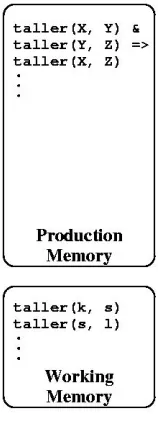
Work on human problem solving in the 1960s led to the introduction to cognitive psychology by Newell, Simon and colleagues of production systems (see, for example, Newell & Simon, 1972, Newell, 1973). A production system consists of two memories (working memory and production memory), and a cyclic control regime that operates on those memories (see Figure 1, left). Working memory elements represent discrete units of information concerning the system’s conception of the current state of processing. Production memory elements are rules that specify conditions under which existing working memory elements may be deleted or new working memory elements may be added. Working memory elements are typically structured (i.e., not atomic), and production rules typically contain variables that may match against parts of different working memory elements. As a simple illustration, working memory might contain elements such as:
taller(kim, sandy) taller(sandy, leslie)
with the intended interpretation that Kim is taller than Sandy and Sandy is taller than Leslie. Production memory might then contain a general rule expressing the fact that “taller” is a transitive relation:
IF: taller(X, Y) is in working memory &
taller(Y, Z) is in working memory THEN: add taller(X, Y) to working memory
where X, Y and Z are variables.
Production rules represent general ways in which the contents of working memory may be modified. A full-scale production system will generally have tens or even thousands of production rules. The purpose of the production system control regime is to find all ways of binding variables in production rules such that the conditions of those production rules are satisfied, to then select one instance, and finally to apply that production instance by modifying working memory accordingly. The control regime consists of two phases (see Figure 1, right). In the recognise phase the system determines all matching production instances and selects one instance from this set. The instance is applied or fired in the act phase. The process then repeats, with recognise and act phases alternating until the system is explicitly halted.
4 4
actions. Processing (and motor output) may thus be controlled by the effects of one production triggering another production or by new input triggering a different production, effectively interrupting ongoing processing.
Conflict resolution is the process by which one production instance is chosen. Production systems generally include a variety of principles to guide conflict resolution, such as favouring production instances that match many working memory elements over those that match few (on the assumption that such rules will correspond to special cases while rules that match few elements will correspond to general or default rules), and favouring rule instances that match recently created working memory elements over rule instances that match working memory elements that have been present for some time (on the assumption that new information is likely to be more relevant to current processing than old information). Conflict resolution plays a pivotal role within production system control because it dictates which production instance will be applied when multiple production instances are simultaneously applicable.
Production systems have been used extensively in modelling human problem solving (e.g., Newell & Simon, 1972), cognitive skill (e.g., Anderson, 1993) and even cognitive development (Klahr et al., 1987). They also form the basis of several cognitive architectures, including Soar (Laird et al., 1987; Newell, 1990), ACT-R (Anderson, 1993; Anderson & Lebiere, 1998; Anderson et al., submitted; see also Anderson, 1976), 4-CAPS (Just & Carpenter, 1992; Just et al., 1999), and EPIC (Meyer & Kieras, 1997; Kieras & Meyer, 1997; Kieras et al., 2000), and through these architectures have been applied to a wide range of cognitive tasks.
[image:6.595.142.221.72.283.2]Production system control has much to recommend it with respect to cognitive control, especially when compared to Von Neumann and Turing control: it is flexible (there is no explicit sequencing specified for productions, so they may fire in response to the changing contents of working memory, rather than according to some hard-wired schedule), production rules can be understood as discrete units of knowledge, and learning can be accommodated by mechanisms which add production rules to production memory. The prime disadvantage is arguably the conflict resolution sub-process, which in its basic form can be overly rigid. This is reflected by the fact that all four cognitive architectures cited in the previous paragraph adopt different approaches to conflict resolution.
5 5
2.2 Control via Interactive Activation
Sequential behaviour may also be controlled through the mechanism of interactive activation. An interactive activation network consists of a set of nodes or units at least some of which correspond to the individual outputs or responses that the network may generate. These nodes have activation values that may vary, typically between zero and one. Nodes are subject to excitatory and inhibitory interactions with other nodes within the network. Critically, inhibitory interactions within subsets of nodes ensure that only one node within such a subset may be highly active at a time. Interactive activation networks typically employ a threshold, with behaviour being controlled by any response node whose activation exceeds that threshold. (See McClelland (1992) for further details.)
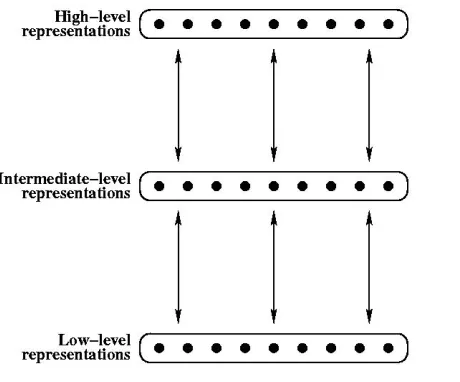
To illustrate, consider the McClelland & Rumelhart (1981) interactive activation model of word and letter recognition. This includes feature nodes, letter nodes and word nodes. Word nodes are excited by those letter nodes that correspond to the letters which make up the corresponding word. Word nodes are also inhibited by other word nodes, by an amount proportional to the activation of the other word nodes. Similarly, letter nodes are activated by feature nodes that correspond to the features of the letter, and letters at the same position within a word inhibit each other. Figure 2 shows a schematic fragment of the network.
Processing in the network is initiated by activating the feature nodes corresponding to a particular stimulus. Activation then propagates to letter nodes that contain those features. Inhibition between letter nodes at each position will normally ensure that exactly one letter node at each position within a word will become active. While this is happening, activation propagates from the letter nodes to the word nodes (and back). The propagation of activation is generally modelled through a cyclic process, and the number of cycles required for the network to yield a response (i.e., before a word node exceeds the network’s threshold) under various conditions may be related to the time taken for participants to identify words under equivalent conditions.
[image:7.595.134.364.74.265.2]In this basic form, interactive activation networks allow multiple sources of excitation and inhibition to be weighed up in the generation of a single response. Interactive activation networks may be augmented to produce sequences of responses by including a mechanism to inhibit the initial response after it has been generated. The dynamics of activation flow will then normally lead to the generation of a second response. This too may be inhibited, leading to a third response, and so on.
6 6
The interactive activation approach has been used to model sequential behaviour in a range of domains, including typing (Rumelhart & Norman, 1982), language production in normals and neurological patients (Dell, 1986; Dell et al., 1997), sequence learning and recall (Houghton, 1990), memory for serial order (Burgess & Hitch, 1992; Henson, 1998), spelling (Houghton et al., 1994; Glasspool, 1998), short-term memory for non-words (Hartley & Houghton, 1996) and the control of routine action (Cooper et al., 1995; Cooper & Shallice, 2000). Interactive activation has also been used to control separable cognitive processes or functions. Thus, Cohen et al. (1990: see also Cohen & Huston, 1994) present a model of the control of reading and colour naming sub-processes in the Stroop task. Further interactive activation models in this and related domains are described by Botvinick et al. (2001) and Gilbert & Shallice (2002).
The crux of the interactive activation approach is lateral inhibition between competing nodes: nodes that are mutually exclusive normally inhibit each other by an amount proportional to their own activation. This prevents multiple mutually exclusive nodes from becoming simultaneously active. There are two keys to generating sequential behaviour within an interactive activation network: the differential activation of response units during a task (also known as the application of an activation “gradient” over the response units) and the inhibition of each response node when its activation exceeds the network’s threshold.
2.3 Recurrent Network Control
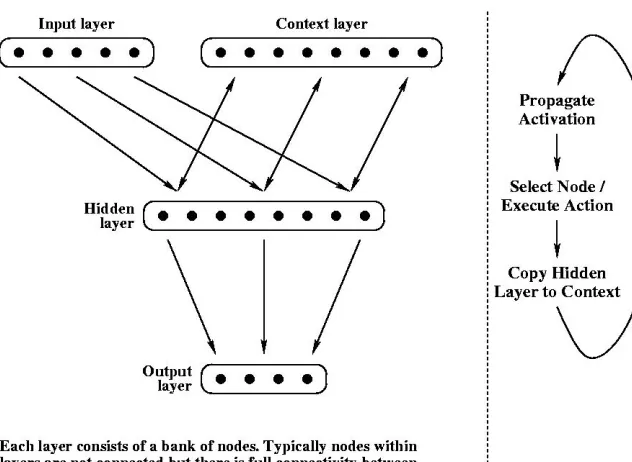
Recurrent connectionist networks provide a third alternative mechanism for the controlled generation of sequential behaviour. A simple recurrent network consists of a series of layers of nodes (typically three), with nodes in each layer connected to subsequent layers, and with nodes in one layer feeding back to nodes in a previous layer (cf. Jordon, 1986; Elman, 1990). Processing consists of activating the nodes in the first layer (which represents the input), and allowing this activation to propagate through connections to internal layers and then to the output layer (which represents the output) using standard feed-forward connectionist techniques (cf. Bechtel & Abrahamsen, 1991). Feedback allows the output generated at any point to be dependent upon previous inputs and outputs, and learning algorithms may be applied to adjust connection strengths between nodes such that specified inputs result in the generation of specified sequences of outputs. Figure 3 shows the basic arrangement for a three-layer “Elman-style” net.
Learning within an Elman net ensures that the internal layer grows to represent a kind of context. The network’s behaviour can then be analysed in terms of a state-dependent input/output mapping plus a state transition function: each input pattern generates an output which is dependent on the network’s state, while simultaneously altering the network’s state. Hence outputs depend on both the current input and previous processing. In this way, recurrent network control implements a continuous equivalent of Wells’ (1998) interpretation of a Turing machine.
The simple recurrent network described above may be extended to allow feedback loops within layers (i.e., doing away with an explicit context layer), but regardless of such extensions, recurrent networks differ from interactive activation networks in two critical ways. First, representation within an interactive activation network is localist, whereas within a recurrent network it is distributed. Second, recurrent networks do not employ inhibition between competing subsets of nodes.
7 7
2.4 Recurrent Networks and Interactive Activation: Equivalent Mechanisms?
There is a correspondence between critical aspects of functioning in recurrent networks and interactive activation networks. With fixed input a recurrent network will generally settle into a stable state. Such a state is known as an attractor state. Similarly, with fixed input an interactive activation network will generally settle into a state where one node within any set of competing nodes is active. Attractor states may therefore be viewed in some sense as the recurrent network analogue of nodes within an interactive activation network. If this correspondence could be formalised (e.g., though a mechanistic procedure for converting one network to the other), then recurrent networks and interactive activation networks could be viewed as alternative descriptions of a single mechanism. The recurrent network view would then seem to offer several advantages. First, within recurrent networks attractor states (and hence internal representations) are acquired in response to external input and learning. They are not pre-specified as with interactive activation networks. Second, recurrent networks do not require an explicit mechanism (lateral inhibition) to ensure that they represents just one state at a time: attractor states are naturally disjoint. (More precisely, attractor states may develop to reflect the structure of the task, possibly resulting in either disjoint or additive attractors depending on the nature of the task: Plaut & McClelland, 1993). Lateral inhibition is required within interactive activation networks specifically to prevent multiple nodes from becoming simultaneously active.
While the above correspondence suggests a potential equivalence between recurrent and interactive activation networks, critical to any such equivalence would be a demonstration of how representations could develop within recurrent networks such that a specific input would encourage the network to move towards a specific attractor state, in the same way that excitation of a specific node within an interactive activation network encourages that network to settle into a state in which that node is most active. However, exact equivalence (in the form of a mechanistic translation) remains to be demonstrated, and different properties of the two approaches (e.g., the form of error to which each is susceptible, as discussed below) argue against any direct mapping.
3 Relevant Empirical Phenomena
[image:9.595.135.451.66.297.2]The computational mechanisms described in the previous section are all able to generate sequences of outputs. If sequential behaviour consisted only of abstract output sequences then one would not be able to discriminate between the mechanisms on purely behavioural grounds. However, human
8 8
sequential behaviour exhibits a number of characteristics that provide insight into its underlying computational mechanisms. First, there are insights that stem from the capabilities and weaknesses of the behaviour control system or systems. Sequential behaviour is susceptible, for example, to several characteristic types of errors, and these types of error do not naturally arise from each of the computational mechanisms described in the previous section. Second, there are insights that stem from the timing of behaviour, and in particular the effects of recent prior experience on reaction times in a range of laboratory tasks. Again, these effects are more easily explained under some sequential mechanisms than others. This section elaborates on insights from these two sources by describing a range of robust empirical effects and reviewing existing computational accounts of those effects.
3.1 Routine and Non-Routine Action
3.1.1 Action Slips and Lapses
Routine functioning of the cognitive/behavioural control system requires that it be able to generate behavioural sequences such as those involved in grooming, feeding and moving around the environment. For example, the system must be able to control one’s behaviour whilst brushing one’s teeth, or control the routine for commuting between home and work. These sequences involve performing a series of relatively basic actions in an appropriate order and in a manner that is both dependent upon one’s specific goals and responsive to the immediate (changing) environment. Thus, the basic actions involved in brushing one’s teeth will depend upon the location of the toothbrush and toothpaste (which may vary from occasion to occasion), and possibly also the time available and the type of food recently consumed. The behavioural control system must therefore be sensitive to both internally generated goals and external constraints.
While the behavioural control system is capable of generating reasonably complex behaviours, it is also prone to certain kinds of error. Reason (1978, 1984) and Norman (1981) conducted diary studies in which participants recorded their slips and lapses of action. Common errors included omission of steps (e.g., failing to put a teabag in the tea-pot when preparing a pot of tea), anticipatory errors (e.g., inserting a key in a door with one hand and then attempting to open the door with the other before turning the key), perseverative errors (e.g., when adding lumps of sugar to tea/coffee failing to stop after the intended amount), object and place substitution errors (e.g., placing a mug of freshly prepared coffee, instead of the milk, in the fridge) and capture errors (e.g., counting “eight,” “nine,” “ten,” “jack,” “queen,” “king” when counting the pages copied by a photo-copier).
These kinds of slips and lapses provide some insight into the functioning of the behavioural control system. Capture errors, for instance, generally occur when there is some contextual overlap between the intended and capturing sequences (e.g., both include similar actions that are performed in similar contexts), and when both sequences are well-learnt. This suggests that the internal representation of well-learnt action sequences may be confused (e.g., because their representations are “close” within the space of cognitive representations or because performance of one effectively primes the other).
Two computational models of the control of routine action have recently been proposed. Cooper & Shallice (2000: see also Cooper et al, 1995) present a hierarchically structured interactive activation model whereas Botvinick & Plaut (2000, submitted) present a recurrent network model. Both models perform a similar routine task: making a cup of instant coffee, and both models are able to perform the task normally (i.e., generating appropriate actions in sequence) or with occasional slips and lapses. In the Cooper & Shallice model slips and lapses arise either from the effects of random noise on the spreading of activation or from inappropriate regulation of various activation sources (e.g., insufficient top-down or bottom-up activation). Noise in the propagation of activation is the only factor that may lead to errors in the Botvinick & Plaut model.
9 9
action lapses. However, error data cannot fully rule out production system control. It appears more viable when supplemented with graded condition matching and stochastic production firing, so that productions which don’t quite match the current state have an opportunity to fire, as, for example, in the ACT-R architecture (Anderson & Lebiere, 1998; Anderson et al., submitted).
3.1.2 Disorders of Routine Action
Errors in routine behaviour are also common in patients with certain forms of brain injury. The behaviour of patients with extensive frontal lesions, for example, can be grossly disorganised (Luria, 1966; Duncan, 1986; Schwartz et al., 1991; Schwartz et al., 1995; Humphreys & Forde, 1998), with behaviour being dominated by errors similar to the slips and lapses of normals. Thus, Luria (1966) reported one patient with extensive frontal lesions who, when asked to light a candle, continued to strike the match even after it was lit (a perseverative error). On another occasion after lighting the candle a patient started to “smoke” it as if it were a cigarette (a capture error). Luria suggests that such behaviours result from “the gross disintegration of the ‘preliminary synthesis’ of intended actions and by disturbances of the process of comparison of intention and effect” (Luria, 1966, p. 238).
Other interpretations of the difficulties of frontal patients are possible. A common view is that the frontal lobes are critical for the inhibition of prepotent responses (see, for example, Perret, 1974; Burgess & Shallice, 1996). On this view the behaviour of frontal patients is driven more by over-learned routines and environmentally triggered behaviours than by goals or desires. Alternatively, Goldman-Rakic (1987) argues that the frontal lobes are primarily responsible for the maintenance of information in working memory. Following this position, Kimberg & Farah (1993) suggest that the difficulties of frontal patients, including those relating to behavioural control, are due to the weakening of links between related elements within working memory. This position is consistent with frontal behaviour resulting from “the gross disintegration of the ‘preliminary synthesis’ of intended actions”, but de-emphasises the role (if any) of monitoring. A related view is offered by Duncan et al. (1995), who suggest that frontal patients have difficulty maintaining goal information, and that action disorganisation of frontal patients is a consequence of goal “decay.”
Disorganisation of routine action has been successfully modelled in both the interactive activation framework (Cooper et al., 1995; Cooper & Shallice, 2000) and the recurrent network framework (Botvinick & Plaut, 2000, submitted). Action disorganisation is simulated through the addition of substantial noise or through lesioning pathways between functionally distinct sets of nodes. Some errors of action disorganisation have also been simulated within the ACT-R production system architecture (Kimberg & Farah, 1993) by reducing the spread of activation between related working memory elements.
A second form of neurological damage—temporo-parietal lesions of the left cerebral hemisphere— may also lead to disorganisation of simple actions (e.g., Liepmann, 1920; Lehmkuhl & Poeck, 1981; DeRenzi & Lucchelli, 1988). While some aspects of behavioural breakdown in patients with such lesions are similar to those of frontal patients, DeRenzi & Lucchelli (1988) interpret the breakdown in terms of a deficit in access to an hypothesised semantic store of object/action knowledge. On this account, the deficit is therefore not a control deficit, but a deficit in access to the knowledge employed by control processes. The dissociation of control and knowledge is a problem for accounts of action in which control and knowledge are inter-twined, such as the recurrent network model of Botvinick & Plaut (2000, submitted). However, the degree of dissociation is open to debate, and recurrent network models cannot be ruled out until further case studies demonstrate an unequivocal dissociation between knowledge and control.
10 10
was already wearing spectacles. Alien (or anarchic) hand syndrome (e.g., Della Sala et al, 1991) is a disorder that is in some ways related. Patients with this syndrome show an extreme form of utilisation behaviour but only with one hand, often such that the actions of the anarchic hand conflict with the actions of the “normal” hand (and the reported intentions of the patient).
Utilisation behaviour suggests that the sequential generation and regulation of behaviour can be influenced by the visual environment. Empirical studies with neurologically healthy participants (e.g., Rumiati & Humphreys, 1998; Tucker & Ellis, 1998) have demonstrated that the visual environment can effectively prime certain actions, and utilisation behaviour would appear to reflect uninhibited or overactive priming of this sort. This evidence further supports an activation-based action control system, such as that employed in the above-mentioned models of action.
The control of action may also be affected by disorders of the dopamine system, including Parkinson’s disease, schizophrenia and amphetamine psychosis. Under-activity of the dopamine system (as in Parkinson’s disease) appears to be related to bradykinesia, a marked slowing of action initiation. In contrast, over-activity of the dopamine system (seen in some cases of schizophrenia and amphetamine psychosis: Frith, 1992) has been related to increased response rates and stereotyped behaviour (Lyons & Robbins, 1975; Frith, 1992). These disorders provide further support for an activation-based substrate underlying action control, and Cooper & Shallice (2000) explicitly demonstrate how action initiation and response rates vary with one parameter (the degree of self activation) within their interactive activation schema network. This parameter may be regarded as a loose analogue of dopamine concentration or receptivity. With regard to other sequence control mechanisms, one may speculate that a similar parameter may have a similar effect within an ACT-R production system model. However, this does not generalise to the only existing recurrent network model of action control (Botvinick & Plaut, 2000, submitted), which generates actions in sequence at a fixed rate (of one action per processing cycle). In order to generate response rates, this model would need to be augmented, perhaps through the addition of a settling process in the output layer. However, in the absence of an explicit demonstration it is unclear if such an augmented model would still produce the other target behaviours.
3.1.3 Monitoring and Error Correction
Slips and lapses in normal action do not go unnoticed or uncorrected. The action control system appears to monitor behaviour and modulate it on detection of an error. Empirical studies of action monitoring and error correction in routine action are rare, presumably because of the difficulties in eliciting errors in routine situations. One exception is that reported by Humphreys et al. (2000). In this study participants were required to complete a number of “everyday” tasks (such as preparing a letter for posting) while simultaneously completing a second, cognitively demanding, task (the Trails task, which requires participants to generate a verbal sequence of letters and digits according to specified rules). The dual task situation led to substantial error rates on the everyday tasks, with omission errors being most frequent. However, participants also produced a number of aborted reach actions, in which they began to reach to one object, but then discontinued the reach. In addition, 37 of the 74 action errors produced by participants occurred immediately after a self-corrected error on the Trails task. The occurrence of errors following self-correction on the Trails task suggests that the generation of responses in the Trails task is monitored, and that error correction interferes with production of actions in the everyday task. The suppression of actions prior to their completion (i.e., the discontinued reach actions) also suggests on-line monitoring of behaviour in the everyday tasks.
11 11
of activation being gated by discrete functions that test the model’s representation of the state of its environment. Monitoring and error correction are thus consistent with the basic approach of interactive activation.
Monitoring and error correction would also appear to be straightforward extensions of an action control system developed within a graded production system architecture such as ACT-R. The essential element in such systems is the existence of productions that detect abnormal or unanticipated states and invoke error correction routines. The equivalent extensions to recurrent network control, however, appear problematic. While a recurrent network model might be extended to include a separate network for the detection of abnormal or unanticipated states, error correction appears to require mechanisms for interrupting the intended action sequence, invoking an appropriate, goal directed, error correction sequence, and eventually resuming the intended action sequence. It is difficult to envisage how these mechanisms might be implemented without resorting to some form of temporary goal store, which is incompatible with the recurrent network model of Botvinick & Plaut (2000, submitted).
3.1.4 Dual Tasking, Interleaving and Responding to Interruptions
Non-routine situations impose significant additional computational requirements on an action control system. Our abilities to perform two tasks concurrently (sometimes with little or no interference between tasks: Byrne & Anderson, 2001), to interleave multiple tasks (Burgess, 2000; Burgess et al., 2000) and to respond to asynchronous interruptions all create difficulties for recurrent network control. Equally, all may be handled with little difficulty within a system based on production system control. Thus, Meyer & Kieras (1997), Kieras & Meyer (1997) and Kieras et al. (2000) provide models within the EPIC production system architecture of a range of dual task effects centred on Psychological Refractory Period (PRP) phenomena (see below), and Byrne & Anderson (2001) describe competing models within the ACT-R production system architecture.
PRP effects generally concern the effects of dual-tasking on reaction times in laboratory tasks. Salvucci & Macuga (2001) describe an ACT-R model of dual tasking in a more naturalistic setting: dialling a mobile telephone number while driving. The model produces a good fit to both the driving and dialling behaviour of participants operating a driving simulator under identical conditions. The model incorporates mechanisms for responding to interruptions, because dialling must be interrupted when unanticipated events relating to the driving task occur.
The computational demands of dual tasking, interleaving and responding to interruptions are less easily met by recurrent network and (pure) interactive activation models. As in the case of monitoring, these additional processes appear to require augmentations to the basic mechanisms of activation propagation.
3.1.5 Summary: Implications of Action Selection on Sequential Control
12 12
3.2 Reaction Time Effects
Properties of the computational mechanisms underlying the generation and regulation of sequential behaviour may also be adduced from reaction time studies involving relatively brief trials and performed under controlled laboratory settings. Findings from models of these studies provide a kind of micro-scale complement to the macro-scale findings derived from routine and non-routine behaviour.
3.2.1 Simulating Reaction Times with Different Control Regimes
The mechanisms of sequence generation and regulation must all be supplemented with additional assumptions in order to make contact with reaction time data. All approaches employ a processing cycle, so the natural assumption is that the number of processing cycles required by a task should correlate with reaction time on that task. Implicit in this is the assumption that cycle time is constant. With regard to production system control, several production system architectures (Soar, ACT-R, EPIC and 3-CAPS) have converged upon a timing of approximately 50ms per production cycle (cf. Anderson et al., submitted). This allows these architectures to make absolute timing predictions. These predictions must also take into account the speed of perception and motor processes and, at least in the case of ACT-R, the speed of memory retrieval, which is dependent upon a number of factors. With regard to interactive activation control, reaction times are generally related directly to the number of processing cycles between the input and generation of a response. However, the number of processing cycles for any particular stimulus is generally a function of numerical parameters such as lateral inhibition, self activation and decay. It is therefore not possible to specify a strict cycle time independent of a specific model. This reflects the fact that the equations governing interactive activation are difference equations that specify change in activation per unit time. These difference equations approximate differential equations, but different networks may use different degrees of approximation. In the case of recurrent networks, processing time is generally related to the number of cycles required before the network settles into a stable attractor state. Again, it is not possible to specify a precise cycle time, for reasons analogous to those given for interactive activation networks.
3.2.2 The Rabbit Effect
Rabbit (1966) analysed response times on error and non-error trials of a simple choice reaction time task and found that the mean reaction time on error trials was less than that on non-error trials. Furthermore, reaction time on non-error trials immediately following an error was greater than on other non-error trials. Laming (1968) reported similar results, but demonstrated that the increase in reaction time following an error was followed by a gradual decrease in reaction time, until a further error occurred, resulting in another increase in reaction time. These results may be accounted for by assuming that a response is made once a signal reaches a threshold. This threshold can change during the task. When the threshold is low responses are fast, but errors may occur. When an error occurs the threshold is increased, resulting in slowed reaction time on the next trial.
13 13
and demonstrates that interactive activation control can account for the kind of between-trial effects observed in choice reaction time tasks.
There are few if any competing models of the Rabbit Effect, so evaluation of other approaches to sequence generation and regulation is necessarily speculative. However, production system models with constant cycle times would appear to be unable to capture the effect. The ACT-R architecture is an exception, because production firing in ACT-R is dependent upon production utility (which alters with a production’s success or failure) and timings in ACT-R are dependent upon factors such as memory retrieval time (which is dependent upon how recently memory chunks have been accessed and how they are related to other memory chunks). Modelling the Rabbit Effect within a recurrent network would appear more difficult, however. Simply feeding the end state from one trial back into the network on the next trial, would ensure that the network’s start state varied from trial to trial, and could affect the settling time of the network. However it would not guarantee that settling time was reduced after correct trials and increased after error trials. This would require that following a correct trial the network starts from a state that is relatively close to an attractor state, and following an error trial the network starts from a state that is distant from both attractor states. Thus, while recurrent network control cannot be ruled out a priori, a solid case for its viability remains to be made.
3.2.3 Between Trial Effects in the Eriksen Task
Between trial effects also occur in Eriksen and Eriksen’s flankers task (Eriksen & Eriksen, 1974). The task is basically a choice reaction time task where the stimulus (e.g., the letter S) is surrounded by distractors that may be the same as the stimulus (in congruent trials) or different from the stimulus (in
incongruent trials). Reaction times are faster and error rates are lower in congruent trials than incongruent trials. Thus, the presence of congruent distractors improves performance compared with the presence of incongruent distractors. More interestingly, reaction times and error rates are also dependent on the nature of previous trials. Thus, Gratton et al. (1992) found that performance was better on trial N if it was the same kind of trial as trial N-1. Incongruent trials were responded to more quickly and with fewer errors if they were preceded by incongruent trials, and congruent trials were responded to more quickly if they were preceded by congruent trials (with accuracy near ceiling in congruent trials). These data suggest on-line modulation of spatial attention in response to task demands. When performing congruent trials, it is advantageous to adopt diffuse spatial attention (so flankers can speed identification of the stimulus). When performing incongruent trials, it is advantageous to adopt focussed spatial attention (so flankers do not slow identification of the stimulus). The pattern of the data can be explained by these assumptions if, in addition, the breadth of spatial attention adjusts in response to each trial and carries across trials.
Botvinick et al. (2001) have demonstrated that this on-line modulation of attention can be captured within an interactive activation model, in a way directly analogous to the modulation of response priming in their model of the Rabbit Effect. Other approaches to sequence generation and regulation have not been applied to the task. Conceivably the effects could be captured within the ACT-R and EPIC production system architectures, which employ separate modules (with separate processing times) for visual processing. Once again, however, the effects appear to be troublesome for recurrent network models.
3.2.4 Trial Type Frequency Effects in the Stroop Task
Stroop interference is a well known phenomenon whereby responding to a non-dominate feature of a stimulus (e.g., the colour of ink in which a word is written) is affected by some more dominant feature of the stimulus (e.g., the phonology of the word itself). In brief, participants are slower at naming the colour of ink in which a word is written if the word is a colour name than if the word is not a colour name.
14 14
written in ink of a different colour. Neutral trials consisted of non-colour words. When neutral trials were common, the difference in performance between congruent and incongruent trials was larger than when neutral trials were rare. It appears that the cognitive subsystems implicated in performing the Stroop task adjust their processing to take advantage of the relative frequencies of different trial types. The tendency to read the stimuli does not normally have to be suppressed when neutral trials are common. When congruent and incongruent trials are common, however, active suppression of word reading is advantageous.
Once again, Botvinick et al. (2001) have demonstrated that an existing interactive activation model (that of Cohen & Huston, 1994) can be extended with the inclusion of a conflict detection mechanism and feedback loop to modulate processing in such a way as to account for the Tzelgov et al. (1992) data. Again, there appear to be no other models of these data, which appear to present significant difficulties for most production system and recurrent network approaches to the control of behaviour. However, the data and the on-line modulation of performance is consistent with the ACT-R processing assumptions relating to adjustment of activation flow and production firing, and there is some possibility of ACT-R being successfully employed to account for the behaviour.
3.2.5 Task Switching in Stroop and Related Tasks
A second set of Stroop studies relevant to the current discussion was reported by Allport et al. (1994), who investigated the effects on reaction time of switching between word-reading and colour-naming. In one study (experiment 5) participants were required to alternate between word-reading and colour-naming (with trial N requiring word-reading and trial N+1 requiring colour-naming). The blocks of alternating tasks were contrasted with blocks of pure word-reading and blocks of pure colour-naming. Allport et al. (1994) found that word-reading was slowed when the previous trial required colour-naming, but that colour-naming was not slowed when the previous trial required word-reading. Thus, switching from the less dominant task appeared to incur a processing cost, whereas switching from the more dominant task did not incur such a cost. Allport et al. referred to this as an “asymmetric switch cost.” Allport et al. (1994) also reported “reverse Stroop interference,” whereby, when switching from colour-naming to word-reading, word-reading was slower for incongruent stimuli than for neutral stimuli. In contrast, there was no difference in reaction time between such stimuli on non-switch trials.
Gilbert & Shallice (2002) adapted the Cohen & Huston (1994) interactive activation model of the Stroop task to allow the study of task carry-over effects. Two augmentations were critical: connections were added from input units to task units (allowing stimuli to prime tasks which were compatible with them), and the task unit states were allowed to persist across trials. The adapted model was able to account for the standard Stroop effects, as well as asymmetric switch costs and reverse Stroop interference. Other models of task-switching costs in other domains have been developed. The production system models of Kieras et al. (2000) and Sohn & Anderson (2001) are particularly relevant to the current discussion. They demonstrate that accounts of at least some task-switching phenomena can be given within suitably augmented production system architectures (EPIC and ACT-R respectively). As in the case of the reaction time phenomena discussed above, recurrent network models of task switching effects remain to be developed.
15 15
3.2.6 The Psychological Refractory Period
A further paradigm relevant to the timing of sequential behaviour is that of the Psychological Refractory Period (PRP: see Meyer & Kieras (1997) for a comprehensive review). In PRP tasks participants are required to respond to two stimuli presented in quick succession. The common finding is that reaction times for the response to the second stimulus are prolonged, with smaller intervals between stimuli leading to longer reaction times.
Numerous theoretical accounts of PRP effects exist, but there are relatively few computational models of PRP phenomena. Models that do exist make critical demands upon production system control. Thus, Meyer & Kieras (1997: see also Kieras & Meyer, 1997) propose a “strategic response deferment” theory of PRP effects, and describe supportive results from simulations within the EPIC production system architecture. Byrne & Anderson (1998, 2001) provide an alternative account of the Meyer & Kieras data within ACT-R, and demonstrate that their model is also able to account for additional PRP effects. The debate between the EPIC and ACT-R models is of theoretical interest in its own right, but for present purposes it is sufficient to note that PRP effects pose a challenge for any mechanism of sequence generation/regulation, and that production system control is a common element of all current models.
3.2.7 Negative Priming, Attentional Blink and Inhibition of Return
There are several further reaction time effects that are generally taken to imply the existence of inhibitory mechanisms operating within an activation-based attentional framework. These include negative priming, the attentional blink, and inhibition of return. Negative priming (see, for example, Tipper, 1985) occurs between trials in reaction time experiments when some feature of a stimulus must be ignored on one trial but responded to on the next trial. The attentional blink (Raymond, et al., 1992) occurs during rapid serial visual presentation of stimuli, and refers to the inability of participants to detect one target immediately after another target if the time between targets is very small. It is as if processes required for further target detection are occupied or inhibited by the act of detecting a target for up to 500 ms. Inhibition of return (Posner & Cohen, 1984) refers to the slowing of responses to target stimuli that vary in location if the location of the target is cued less than 300ms before the target appears. Inhibition of return is usually taken to imply temporary inhibition of attention to the cued location.
Inhibitory processes operating within an activation-based framework are a key element of current models that demonstrate these effects (see, for example, Houghton & Tipper (1994) for a model of negative priming, and Balkenius (2000) for a model of attentional blink). Recurrent network models of the phenomena are scarce (if not non-existent), as are pure production system models. Hybrid production system models that employ an activation-based substrate may be able to account for the effects, but the most plausible candidate, ACT-R, does not include any explicit inhibitory processes (though it does include a normalisation procedure which can mimic some characteristics of inhibition).
3.2.8 Summary: Implications of Reaction Time Effects on Sequential Control
For the most part, reaction time effects appear to be most conducive to modelling within an interactive activation framework. That framework has been employed to account for many of the phenomena discussed above. Few recurrent network models of these phenomena have been proposed. Interactive activation does not appear to be the full story, however, as production system control is critical in current models of PRP effects and some models of task switching phenomena. The reaction time effects therefore suggest either a hybrid mechanism employing elements of both production system control and interactive activation control, or multiple mechanisms acting across different tasks.
4 General Discussion
16 16
ends of the spectrum suggest that the neural mechanism or mechanisms for the generation and regulation of sequential behaviour is/are activation-based, with inhibitory processes playing a key role. This is not the complete story, however. Some effects (e.g., PRP) are best accounted for by production system models, and others have only been given an incomplete account within the interactive activation framework. Most critically, elaboration of existing models of routine action appears to require concepts and control structures similar to those available within the production system approach. Thus, the above considerations point to a hybrid sequencing mechanism based on both interactive activation and production system control.
The strengths of the interactive activation mechanism are well illustrated by the models discussed above, but the mechanism is not without its weaknesses. Two weaknesses are of particular concern: limited learning capabilities and localist representation. Interactive activation in its most common form requires hand-specified nodes that use localist representations. Localist representations have been criticised as being neurophysiologically implausible and inappropriate for tasks requiring generalisation. (See Page (2000) for a summary of arguments against, and a defence of, localist representations.) Recurrent network models avoid both of these perceived difficulties. However, these difficulties are not necessarily critical. Interactive activation models that learn sequential information have been developed (e.g., Houghton, 1990; Burgess & Hitch, 1992; Houghton et al., 1994). While these models presuppose nodes that represent list elements (and then learn the order of those elements), Grossberg (1987; see also Grossberg, 1980) has shown how the basic interactive activation mechanisms can be extended with attentional and orienting subsystems so as to learn stable internal representations of elements.
It may be suggested that the above presentation under-represents the domains in which recurrent network models are most successful. Recurrent network models have been applied with considerable success in domains such as language (Elman, 1990, 1993; Plaut & McClelland, 1993; Plaut & Shallice, 1993) and sequence learning (e.g., Cleeremans, 1993). These models demonstrate the strengths of recurrent networks noted above: learning and distributed representation However, interactive activation models have also been developed in each of these domains (e.g., Dell, 1986, Dell
et al., 1997; Houghton, 1990; Burgess & Hitch, 1992; Houghton et al., 1994; Glasspool, 1998). Thus, the relative strength of interactive activation models over recurrent network models is not a product of ignoring domains in which recurrent network models are strongest.
The crucial argument made here is that there is a role for both production system and interactive activation mechanisms in the control of behaviour. Interactive activation alone, for example, does not appear to be sufficient to account for non-routine action or PRP effects. However, systems may be developed which can account for these behaviours and effects by supplementing interactive activation (or at least spreading activation and inhibition with localist representations) with production system control. This kind of merging between production system and activation-based sequence generation and regulation is present in two existing cognitive architectures: ACT-R (Anderson, 1993; Anderson & Lebiere, 1998; Anderson et al., submitted) and 4-CAPS (Just & Carpenter, 1992; Just et al., 1999). Both architectures employ an activation-based substrate in which the conditions of a production may be partially matched by the contents of a working memory, with activation spreading between working memory elements. In addition both have recently taken up the challenge of mapping function to structure posed by imaging studies (Anderson et al. (submitted) and Just et al. (1999)). The principal difference is that ACT-R is serial in its production firing—just one production may fire on any cycle— while 4-CAPS allows constrained parallel production firing—multiple productions may fire in parallel, but there is an upper-limit on the total activity in the system which acts to constrain parallel processing.
17 17
many of the frequently cited arguments against cognition as discrete symbol manipulation. They demonstrate that symbol manipulation does not entail serial processing, that symbol manipulation is compatible with learning, and that if symbol manipulation is suitably fine-grained, it need not be “brittle” or incapable of flexible behaviour. Distributed connectionist approaches to mental computation can therefore not necessarily be regarded as superior to symbolic approaches on any of these counts. Indeed, the evidence surveyed here raises more difficulties for distributed connectionist approaches than for activation-based symbolic approaches.
5 Concluding Remarks
The aim of this paper was to review computational models of sequential phenomena from two apparently unrelated areas of cognition—action selection and reaction time behaviour—and to attempt to draw general conclusions from these models about the cognitive mechanisms underlying the generation and regulation of sequential behaviour. The conclusion, that a range of effects support a production-system view of sequential control mediated by an activation-based substrate, is necessarily tentative. It could be undermined by the development of additional successful models of the various phenomena. Recurrent network models of between-trial effects in reaction time tasks would, for example, undermine the view that recurrent networks are incapable of accounting for these effects. As such, the phenomena reviewed here are perhaps better viewed as a challenge; as a set of phenomena to which those developing recurrent networks might direct their attention. Until successful models have been developed, however, the tentative conclusion must stand.
The paper also identifies a number of other challenges for modelling. One set of challenges revolves around ACT-R and 4-CAPS. Can either or both of these architectures account for the full range of behaviours surveyed above, and can test phenomena be identified that will help to discriminate between these architectures? A second set of challenges relate to the functional similarities identified between interactive activation networks and recurrent networks. Can a loose mapping between the two be developed? Such a mapping would clarify the strengths and weakness of the two approaches, and possibly identify ways in which key properties of each approach (e.g., learning within recurrent networks and focussed excitation of concepts within interactive activation networks) might be merged into more plausible symbolic activation-based mechanisms for the generation and regulation of sequential behaviour.
6 Acknowledgements
I am grateful to David Glasspool, John Fox, John Anderson, Tim Shallice and attendees at the 2002 ACT-R workshop for comments and discussions that have directly and indirectly informed the material presented here.
7 References
ALLPORT, D.A., STYLES, E.A. & HSIEH, S. (1994). Shifting intentional set: Exploring the dynamic
control of tasks. In C. UMILTA & M. MOSCOVITCH (Eds.) Attention and performance XV:
Conscious and nonconscious information processing (pp. 421–452). Cambridge, MA: MIT Press.
ALTMANN,E.M.&GRAY,W.D.(2002). Forgetting to remember: The functional relationship of decay
and interference. Psychological Science, 13, 27–33.
ALTMANN,E.M.&GRAY,W.D. (submitted). Attention, memory and mental set: An integrated model
of task switching and maintenance.
ANDERSON, J.R. (1976). Language, memory, and thought. Hillsdale, NJ: Lawrence Erlbaum
Associates.
ANDERSON,J.R.(1993). Rules of the mind. Hillsdale, NJ: Lawrence Erlbaum Associates.
ANDERSON,J.R.&LEBIERE,C. (1998). The atomic components of thought. Mahwah, NJ: Lawrence
Erlbaum Associates.
ANDERSON,J.R.,BOTHELL,D.,BYRNE,M.D.&LEBIERE,C.(submitted). An integrated theory of the
18 18
BALKENIUS, C. (2000). Attention, habituation and conditioning: Toward a computational model.
Cognitive Science Quarterly, 1, 171–204.
BECHTEL,W.&ABRAHAMSEN,A.(1991). Connectionism and the mind: An introduction to parallel
processing in networks. Oxford, UK: Blackwell publishers.
BOTVINICK, M.M. BRAVER, T.S., BARCH, D.M., CARTER, C.S. & COHEN, J.D. (2001). Conflict
monitoring and cognitive control. Psychological Review, 108, 624–652.
BOTVINICK,M., &PLAUT,D. (2000). Doing without schema hierarchies: A recurrent connectionist
approach to routine sequential action and its pathologies. Poster presented at Cognitive Neuroscience Conference.
BOTVINICK, M., & PLAUT, D. (submitted). Doing without schema hierarchies: A recurrent
connectionist approach to routine sequential action and its pathologies.
BURGESS, P.W. (2000). Real-world multitasking from a cognitive neuroscience perspective. In S.
MONSELL &J.DRIVER (Eds.) Attention and performance XVIII: Control of cognitive processes
(pp. 465–472). Cambridge, MA: MIT Press.
BURGESS,P.W. &SHALLICE,T.(1996). Response suppression, initiation and strategy use following
frontal lobe lesions. Neuropsychologia, 34, 263–273.
BURGESS, P.W., VEITCH, E., DE LACY COSTELLO, A., & SHALLICE, T. (2000). The cognitive and
neuroanatomical correlates of multitasking. Neuropsychologia, 34, 263–276.
BURGESS, N. & HITCH, G.J.(1992). Toward a network model of the articulatory loop. Journal of
Memory and Language, 31, 429–460.
BYRNE,M.D.&ANDERSON,J.R.(1998). Perception and action. In J.R.ANDERSON &C.LEBIERE, The
atomic components of thought (pp. 167–200). Mahwah, NJ: Lawrence Erlbaum Associates. BYRNE, M.D. & ANDERSON, J.R. (2001). Serial modules in parallel: The psychological refractory
period and perfect time-sharing. Psychological Review, 108, 847–869.
CLEEREMANS, A. (1993). Mechanisms of implicit learning: Connectionist models of sequence
processing. Cambridge, MA: MIT Press.
COHEN, J.D.,DUNBAR, K. & MCCLELLAND, J.L. (1990). On the control of automatic processes: A parallel distributed processing account of the Stroop effect. Psychological Review, 97, 332–361. COHEN, J.D. & HUSTON, T.A. (1994). Progress in the use of interactive models for understanding
attention and performance. In C.UMILTA &M.MOSCOVITCH (Eds.) Attention and performance
XV: Conscious and nonconscious information processing (pp. 453–476). Cambridge, MA: MIT Press.
COLTHEART,M.,CURTIS,B.,ATKINS,P.&HALLER,M. (1993). Models of reading aloud: Dual-route
and parallel distributed processing approaches. Psychological Review, 100, 589–608.
COOPER, R., SCHWARTZ, M.F., YULE, P., WARRICK, S., & SHALLICE, T. (in preparation). The
simulation of action disorganisation in complex activities of daily living.
COOPER,R.P.&SHALLICE,T.(1995). Soar and the case for Unified Theories of Cognition. Cognition,
55, 115–145.
COOPER, R., & SHALLICE, T. (2000). Contention Scheduling and the control of routine activities.
Cognitive Neuropsychology, 17, 297–338.
COOPER, R., SHALLICE, T., & FARRINGDON, J. (1995). Symbolic and continuous processes in the
automatic selection of actions. In J.HALLAM (Ed.) Hybrid Problems, Hybrid Solutions (pp. 27– 37). Amsterdam: IOS Press.
DAWSON,M.R.W.(1998). Understanding Cognitive Science. Oxford, UK: Blackwell publishers.
DELL, G.S.(1986). A spreading-activation theory of retrieval in sentence production. Psychological Review, 93, 283–321.
DELL, G.S., BURGER, L.K., AND SVEC, W.R. (1997). Language production and serial order: a functional analysis and a model. Psychological Review, 104, 123–147.
DELLA SALA, S., MARCHETTI, C. & SPINNLER, H. (1991). Right-sided anarchic (alien) hand: A
longitudinal study. Neuropsychologia, 29, 1113–1127.
DE RENZI,E.,&LUCCHELLI,F.(1988). Ideational Apraxia. Brain, 111, 1173–1185.
DETWEILER, M. & SCHNEIDER, W. (1991). Modelling the acquisition of dual-task skill in a
19 19
DUNCAN, J. (1986). Disorganisation of behaviour after frontal lobe damage. Cognitive
Neuropsychology, 3, 271–290.
DUNCAN, J., BURGESS, P.W. & EMSLIE, H. (1995). Fluid intelligence after frontal lobe lesions.
Neuropsychologia, 33, 261–268.
ELMAN,J.L.(1990). Finding structure in time. Cognitive Science, 14, 179–212.
ELMAN,J.L.(1993). Learning and development in neural networks: The importance of starting small.
Cognition, 48, 71–99.
ERIKSEN, B.A. &ERIKSEN, C.W.(1974). Effects of noise letters upon the identification of a target
letter in a nonsearch task. Perception and Psychophysics, 16, 143–149.
FRAWLEY,W.(1997). Vygotsky and cognitive science: Language and the unification of the social and
computational mind. Cambridge, MA: Harvard University Press.
FRAWLEY, W. (2002). Control in cross-domain mental computation: Evidence from language
breakdown. Computational Intelligence, 18, 1–28.
FRITH,C.D.(1992). The cognitive neuropsychology of schizophrenia. London, UK: Taylor & Francis.
GILBERT,S.&SHALLICE,T.(2002). Task switching: A PDP model. Cognitive Psychology, 44, 297–
337.
GLASSPOOL, D.W. (1998). Modelling serial order in behaviour: Studies of spelling. PhD thesis.
Department of Psychology, University College London.
GOLDMAN-RAKIC, P.S.(1987). Circuitry of primate prefrontal cortex and regulation of behavior by
representational knowledge. In F.PLUM &V.MOUNTCASTLE (Eds.) Handbook of Physiology,
Volume 5 (pp. 373–417). Bathesda, MD: American Psychological Society.
GRATTON,G., COLES,M.G.H.& DONCHIN,E. (1992). Optimizing the use of information: Strategic
control of activation and responses. Journal of Experimental Psychology: General, 4, 480–506.
GROSSBERG,S.(1980). How does a brain build a cognitive code? Psychological Review, 87, 1–51.
GROSSBERG, S. (1987). Competitive learning: From interactive activation to adaptive resonance.
Cognitive Science, 11, 23–63.
HARTLEY,T.&HOUGHTON,G.(1996). A linguistically constrained model of short-term memory for
nonwords. Journal of Memory and Language, 35, 1–31.
HENSON, R.N.A. (1998). Short-term memory for serial order: The Start-End Model. Cognitive
Psychology, 36, 73–137.
HINTON,G.E., MCCLELLAND,J.L.&RUMELHART,D.E.(1996). Distributed representations. In D.E.
RUMELHART &J.L.MCCLELLAND (Eds.) Parallel distributed processing: Explorations in the
microstructure of cognition. Volume 1: Foundations (pp. 76–109). Cambridge, MA: MIT Press.
HINTON, G.E. & SHALLICE, T. (1989). Lesioning an attractor network: Investigations of acquired
dyslexia. Psychological Review, 98, 74–95.
HOUGHTON,G.(1990). The problem of serial order: A neural network model of sequence learning and
recall. In DALE, R., MELLISH, C., & ZOCK, M. (Eds.) Current research in natural language
generation (pp. 287–319). London, UK: Academic Press.
HOUGHTON,G.,GLASSPOOL,D.W.,&SHALLICE,T.(1994). Spelling and serial recall: Insights from a
competitive queuing model. In G.D.A. BROWN & N.C. ELLIS (Eds.) Handbook of spelling: Theory, process and intervention (pp 365–404). Chichester, UK: John Wiley.
HOUGHTON, G. & HARTLEY, T. (1996). Parallel models of serial behaviour: Lashley revisited.
PSYCHE: An Interdisciplinary Journal of Research on Consciousness, 2(25). Available online at http://psyche.cs.monash.edu.au/v2/psyche-2-25-houghton.html
HOUGHTON,G. &TIPPER, S.P.(1994). A model of inhibitory processes in selective attention. In D.
DAGENBACH &T.H.CARR (Eds.) Inhibitory processes in attention, memory and language (pp.
53–112). San Diego, CA: Academic Press.
HUMPHREYS,G.W., &FORDE, E.M.E.(1998). Disordered action schema and action disorganisation
syndrome. Cognitive Neuropsychology, 15, 771–811.
HUMPHREYS,G.W.,FORDE,E.M.E.,&FRANCIS,D.(2000). The organisation of sequential actions. In
S. MONSELL & J. DRIVER (eds.) Attention and performance XVIII: Control of cognitive
processes (pp. 427–442). Cambridge, MA: MIT Press.
JORDON, M.I. (1986). Serial order: a parallel distributed approach. ICI report 8604. Institute for