DEVELOPMENT OF A WEB-BASED TENDERING
PROTOCOL FOR PROCUREMENT OF CONSTRUCTION
WORKS IN A TERTIARY INSTITUTION.
1
AFOLABI ADEDEJI, 1OWOLABI DELE, 1OJELABI RAPHEAL, 2OYEYIPO OPEYEMI,
1
AINA DAMILOLA
1
Covenant University, Department of Building Technology, NIGERIA 2
Bells University of Technology, Department of Quantity Surveying, NIGERIA
E-mail: [email protected], [email protected], [email protected], [email protected], [email protected]
ABSTRACT
There are myriads of ICT tools in the construction industry but many construction procurement organizations are yet to harness the benefits. Tertiary institutions that are at the forefront of accountability, transparency and openness, engage in a lot of construction works but majority of them do not have e-procurement sites. The aim of the study was to develop a web-based tendering protocol for e-procurement of construction works in a tertiary institution. The development of a web app and a survey research design was carried out for the study. For the latter, a questionnaire instrument distributed to the client representatives and contracting firms operating within a renowned tertiary institution through a convenience sampling method was utilized. A total of 58 questionnaires were returned between the two groups. The study tested hypotheses using Mann Whitney-U and T-test. The result revealed that there are no significant differences between client representatives and contractors on e-readiness and importance of implementing e-tendering in the procurement of construction works. The study developed a web-based tendering system for procurement of construction works in a tertiary institution using PHP, MYSQL, CSS and HTML. The study recommended the increase in awareness of e-tendering platforms through trainings and implementation and stakeholders should take hold of the benefits of ICT in the construction industry. There is need to create official e-tendering sites for both public and private institutions for the purpose of procurement of construction works to encourage competitiveness among different classes of contractors, enhancing transparency, accountability and proper documentation.
Keywords: Construction works, ICT, Procurement, Tertiary Institution, Web-Based Tendering Protocols
1. INTRODUCTION
The construction industry is one that is segmented and in phases from the inception to completion. These segmentation and phases require for adequate documentation with so much paper work, approvals, contract documents, etc., in order to carry out these processes. According to [1], the construction industry relies on information in order to function. This has been heavily aided with the introduction of the internet. The use of the internet helps to minimize the gap created by the different division of labour engaged on construction projects. The internet system has been able to improve the level of trust among client, contractor and consultants and decreased the level of enormous paper work which is prone to errors and high
bureaucracy [2]. However, [3] and [4] argued that the construction industry has been rigid in adapting to new (ICT) tools and processes owing to considerable lack of knowledge and awareness about its numerous benefits.
equally guarantee that the contractor would be awarded the contract [7].
The main idea about e-tendering is the elimination of the bulky paper work involved in the tendering process. E-tendering in the procurement process establishes a system where tendering can be done strictly electronically by integrating ICT and the existing traditional tendering protocols [8]. Apart from the tangible benefits of cost and time saving which e-tendering offers, the traditional process mostly adopted in Nigeria, has several loose ends which the web-based tendering systems attempts to eliminate [9].
Some of the related problems of the traditional tendering process include but not limited to; poor process review, high paper documentation which is a potential danger to the environment, delay in tendering process, poor record keeping, high processing cost, time consuming nature and slow processing [2,10].
Little research has been done on the implementation of a web-based tendering protocol in a tertiary institution. The uniqueness of this research is the consideration of a higher school for learning. The notion is that tertiary institutions should be benchmarks and at the forefront of disseminating knowledge on transparency, equality and accountability.
Majorly, [9] opined that it is always important to consider awareness new ICT systems in order to measure the success factors of acceptance and usage. With this view in mind, the study sets out to develop a web-based tendering system for procurement of construction works in a tertiary institution based on the existing and prospective procurement process. The objectives which the researcher aims to achieve concerning this study are:
• To assess the e-readiness of stakeholders
involved in the procurement process within and outside the tertiary institution, for the use of e-tendering method.
• To examine the importance of using web-based
tendering protocol for procurement of construction works to stakeholders.
• To develop a web-based tendering protocol for
procurement of construction works.
2. REVIEW OF LITERATURE
The high levels of corruption leading to lack of genuine competition and transparency led to reforms in the procurement systems in the Nigerian Public sector and renewed call for e-Government to enrich the public trust in the process [11, 12]. Yet, most construction projects in the public sector do
not conform to the true aim of tendering which
usually result in under funding, delayed
competition, price escalation and abandonment. This led to the term “Due Process” [10]. Due Process implies that governmental activities and businesses that engenders openness, economic sustainability and increase transparency, thereby reducing corruptible tendencies [13]. For example, in a study of 120 construction projects tertiary institutions in Nigeria, [11] reported that due process was hardly followed. This is evident in the time lag between the tendering and contract award which consequently had an adverse effect on the cost and time of completion.
According to [14], e-tendering is the automated communication and documentation via the internet of all tender related information. [9] stated that e-tendering is a proper ICT tool that empowers construction stakeholder to plan, control and increase productivity of the tendering phase. [15] described a step by step process for tendering as depicted in Figure 1. [2] added that
e-tendering engenders competitiveness and
sustainability for construction industry businesses which can be sort on a national and global level. [14] reported that the benefits of e-tendering are achieved by streamlining construction business
processes resulting in unbiased industry
[image:2.612.357.481.463.572.2]competitiveness, increased market share and environmental friendliness due to reduced paper works.
Figure 1: Web-based Tendering Cycle Adapted from [15]
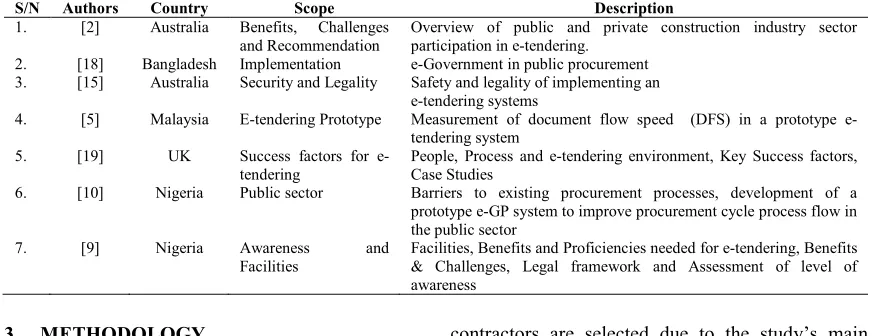
not have any prior ICT investment that may support e-tendering [9]. Another fear common with the use of ICT, which some construction professionals believe is that the process will make them redundant. However, [17] allayed this fear noting that throughout the process of e-tendering, the roles of construction stakeholders are greatly improved through an interactive web collaboration platform. Table 1 showed issues raised by some authors on e-tendering.
The full benefits of e-tendering have not been realized by developing countries such as
Nigeria with only 15.8% of construction
professionals having actually participated in tendering through the internet. [9] explained that this occurrence is predominantly dues to the fairly
low education among most indigenous contractors in the Nigerian construction industry.
Other reasons for poor adoption of e-tendering highlighted by [20, 21, 22] are issues relating to the legality and security of the process, who owns the system ones it is designed and subsequent management tendering information, as
well as trust issues among construction
[image:3.612.88.524.303.471.2]stakeholders. [2] hinged the barriers on three main themes employment barrier, security barrier and legal barrier. Specifically, in Nigeria, [9] linked the poor adoption of e-tendering systems to lack of basic groundwork ICT tools and expertise for running e-tendering, epileptic power supply, high cost of web based technologies and absence of laws aiding electronic relations.
Table 1: Some studies on e-tendering from different authors
S/N Authors Country Scope Description
1. [2] Australia Benefits, Challenges
and Recommendation
Overview of public and private construction industry sector participation in e-tendering.
2. [18] Bangladesh Implementation e-Government in public procurement
3. [15] Australia Security and Legality Safety and legality of implementing an
e-tendering systems
4. [5] Malaysia E-tendering Prototype Measurement of document flow speed (DFS) in a prototype e-tendering system
5. [19] UK Success factors for
e-tendering
People, Process and e-tendering environment, Key Success factors, Case Studies
6. [10] Nigeria Public sector Barriers to existing procurement processes, development of a
prototype e-GP system to improve procurement cycle process flow in the public sector
7. [9] Nigeria Awareness and
Facilities
Facilities, Benefits and Proficiencies needed for e-tendering, Benefits & Challenges, Legal framework and Assessment of level of awareness
3. METHODOLOGY
Due to the nature of the research, the
problem-solving approach (action research) data
collection was engaged. A survey research design was adopted in the study to achieve the outlined objectives specifically; a cross-sectional research design was used where samples were drawn from the population. The research strategy used for this study will be a combination of both quantitative and qualitative research along with attitudinal research strategy. The population comprised of the client representatives in the tertiary institution which consists of four groups of people which were management staff, academicians, CSIS (Centre for
systems and information services) staff and the
Physical planning development department (PPDD) which includes construction professionals in the institution such as Architects, Builders, Quantity surveyors and Civil Engineers.
The second class of population used for the study were all contractors registered with the institution in the three categories of contractors (A, B and C) based on their financial capacity. These
contractors are selected due to the study’s main themes of ‘ICT’ and ‘construction tendering’. For the two categories of respondents, the sample size
from the population was determined by
Convenience sampling design for the selection of the registered contractors and client base within the institution. The convenience sampling technique which is a non-probabilistic sampling method was used due to the willingness of the respondents to partake of the research and the ease of access to the researcher. For the purpose of this study, the data
collection instrument used was coded
A total of 100 questionnaires were distributed but only 58 questionnaires were
returned, fully completed with no errors,
representing a 58% return rate, which is adequate for this research. The questionnaire was analyzed using SPSS v21.0. Mann-Whitney U and T-test were used to analyze the hypotheses of the study. The study also engendered the development of a web app using an incremental model. The Unified Modelling Language (UML) approach was used to capture the system requirements and design. The web based tendering system developed is a web application that can be accessed from online browsers connected to the internet.
4. RESULTS AND FINDINGS
This section highlights the result and findings from the returned questionnaires of the contractor and client base. The stated objectives were justified as follows;
4.1 Background information
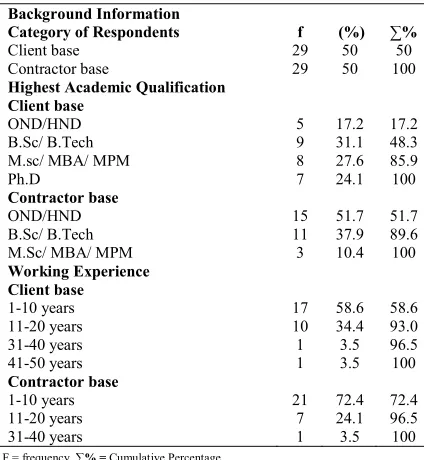
[image:4.612.312.524.109.339.2]The background information of the contractor and the client base is summarized in Table 2. From Table 2, majority of respondents from the client base have 9 (31.1%) B.Sc as their highest academic qualification followed by 8 (27.6%) that have M.sc/ MBA/ MPM, while 7 (24.1%) have Ph.D academic qualification and OND/HND at 5 (17.2%). For the contractors registered with the tertiary institution who participated in the survey, the result showed that the highest academic qualification attained by majority at 15 (51.7%) OND/HND followed by 11(37.9%) B.Sc/B.Tech and 3 (10.3%) of the contractor base had MSc/MBA/MPM. The working experience of the client base and the contractor base revealed that for both the client and contractor base, most respondents are within the range of 1-10 years of work experience. On the part of the client base 17(58.6%) of the respondents have had about 1-10 years of experience, 10 (34.4%) have had about 11-20 years of experience, with 1 (3.5%) respondent each has had 31-40 years and 41-50 years of experience. For the contractor base, 21 (72.4%) respondents have had 1-10 year of work experience, 7 (24.1%) have had 11-20 years of experience and 1 (3.5%) had 21-30 years of experience.
Table 2: Summary of Background Information
F = frequency, ∑% = Cumulative Percentage
4.2 Experience obtaining tendering documents using the internet
Figure 2 showed the experience of client base and contractor base obtaining tendering documents using the internet. For the Client base the result reveals that a total of 18 (62.1%) respondents have not obtained tendering documents using the internet while 11 (37.9%) respondents attested to the fact that they have used the internet for tendering purposes. One the other hand, data from the field survey of the contractor base revealed that 15 (51.7%) respondents have had experience obtaining tendering documents for construction projects using the internet while 14 (48.3%) respondents have not. This is supported by Oyediran and Akintola (2011), noting that more
that 50% construction professionals have
[image:4.612.314.522.573.677.2]knowledge of obtaining contract documents via the World Wide Web (WWW).
Figure 2: Experience Obtaining Tendering Documents Using The Internet
Background Information
Category of Respondents f (%) ∑%
Client base 29 50 50
Contractor base 29 50 100
Highest Academic Qualification Client base
OND/HND 5 17.2 17.2
B.Sc/ B.Tech 9 31.1 48.3
M.sc/ MBA/ MPM 8 27.6 85.9
Ph.D 7 24.1 100
Contractor base
OND/HND 15 51.7 51.7
B.Sc/ B.Tech 11 37.9 89.6
M.Sc/ MBA/ MPM 3 10.4 100
Working Experience Client base
1-10 years 17 58.6 58.6
11-20 years 10 34.4 93.0
31-40 years 1 3.5 96.5
41-50 years 1 3.5 100
Contractor base
1-10 years 21 72.4 72.4
11-20 years 7 24.1 96.5
4.3 E-readiness of stakeholders in the tendering process
This section shows the e-readiness of stakeholders for e-tendering in the procurement process using certain ICT parameters such as availability of personal or company email, Microsoft Word, Personal Computer, Microsoft Excel, Microsoft PowerPoint, Power Supply, Internet Facilities, Mobile Device, company Website, Microsoft Project, Autocad, Trained IT Specialist, ipad/Notebook. Previous studies have not tried to compare the e-readiness of client and contractor. This is important, in that, the client; who is giving out the job via an electronic platform should be concerned if the contractor is able to retrieve and interpret the documents been sent. This would engender the short and long-term success of the e-platform. Using the hypothesis testing of
where H0 is the null hypothesis and H1 is the
alternate hypothesis;
H0: There is no significant difference in the
e-readiness between client and contractor for
e-tendering in the procurement of
construction works.
H1: There is significant difference in the
e-readiness between client and contractor for
e-tendering in the procurement of
construction works.
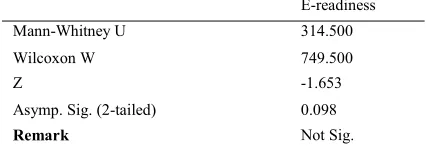
[image:5.612.89.302.508.585.2]The analysis deploys Mann-Whitney U test, a non-parametric alternative of Independent T-test to carry out inferential investigation on the e-readiness between client and contractor for e-tendering in the procurement of construction works. The result of the analysis is presented in Table 3.
Table 3: Mann-Whitney U Test for Significant Difference
E-readiness
Mann-Whitney U 314.500
Wilcoxon W 749.500
Z -1.653
Asymp. Sig. (2-tailed) 0.098
Remark Not Sig.
From Table 3, at 0.05 level of significance and since p > 0.05, a statistical significant difference was not found between the e-readiness between client and contractor for e-tendering in the procurement of construction works. Hence, the null hypothesis that there is no significant difference in the readiness between client and contractor for e-tendering in the procurement of construction works is accepted. This means that all stakeholders in the tertiary institution are at par in the necessary facilities to implement an e-tendering system. In the study by [23] observed that 98.5% construction
professionals had access to personal computers. [19] stated that construction businesses are gradually moving away from traditional processes to modern and efficient ways of working, mainly through electronic media. [23] noted that over 60%
of construction professionals are currently
connected to the internet either through desktops and smartphones. In the study by [9], construction industry professionals had high availability of computer systems, client operating systems and computer aided design software, while the availability of all other facilities were adjudged marginal and despite this below average level of availability, the available facilities are in good condition to facilitate participation in e-tendering.
4.4 Importance of Using Web-Based Tendering System for Procurement
This section shows the importance of using web-based tendering system for tendering purposes in the procurement of construction works. The study gathered several variables from different literature. This study was able to compare the means from the importance viewed from the client and contractor based perspective. Previous studies have largely considered the importance of web-based technologies from the perspective of contractors but this study adds the view of the client base and compares the result. Variables identified from literature such as Faster tendering process, Reduction in the use of paper, Ease of documenting transactions, Increased level of accountability, Ease of accessibility to tendering documents, Increased level of transparency in process, Reduction in cost of tendering, Increased competition among tenders, Increased innovation and creativity and Reduced corruption were used for the study. Using the
hypothesis testing of where H01 is the null
hypothesis and H2 is the alternate hypothesis;
H01: There is no significant difference on the
importance of web based tendering protocol for procurement process between client and contractor.
H2: There is significant difference on the
importance of web based tendering protocol for procurement process between client and contractor.
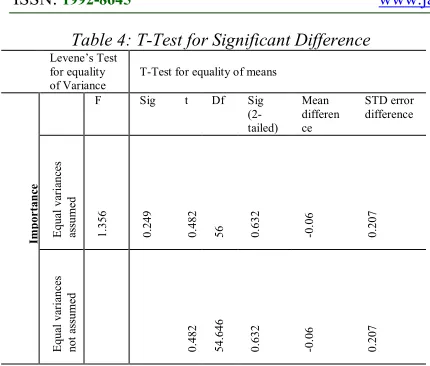
Table 4: T-Test for Significant Difference
Levene’s Test for equality of Variance
T-Test for equality of means
Im p or tan ce
F Sig t Df Sig
(2-tailed) Mean differen ce STD error difference E qua l va ri anc es as sum ed 1. 356 0. 249 0. 482
56 0.632 -0.
06 0. 207 E qua l va ri anc es not a ss um ed 0. 482 54. 646 0. 632 -0. 06 0. 207
Table 4 is broken down into two section the Levene’s test for equality of variance and the T-test for equality of means. A look at the section depicting the equality of means it can be observed that there is no alteration between the mean difference and standard error difference also the significant level column under Levene’s test segment is greater than 0.05 which confirms that there is no significant difference on the importance of web based tendering system for procurement process between client and contractor. Therefore, we accept the null hypothesis. This means that from the perspective of the client base which consists of the department in charge of works (PPD), CSIS, lecturers and Management staff and the contractor base agree that the implementation of e-tendering system in the procurement of construction works would impact the construction project delivery.
There is a general consensus in the Nigerian construction industry about the benefits of using ICT [23]. [9] argued that the importance of e-tendering systems are numerous and immediately
obvious to both client organizations and
contractors. With over 50% of construction stakeholders aware about e-tendering over a decade ago [24], In [23, 9] they opined that the use of e-tendering in the Nigerian construction industry has high prospects, because industry professionals are not ignorant of the benefits. Several researchers have reported on the benefits of implementing
e-tendering from reduced cost of tender
documentation [19], streamlined process [10], increased efficiency and transparency [5], paperless economy [25], reduce abuse of the tendering process and corruption [26], ease of monitoring [27], remote accessibility [9] to increased key project delivery parameters of the tender process [2]. The general belief is that e-tendering systems increase productivity from the traditional way of tendering. [9] opined that e-tendering does not
interfere with the traditional roles of project team members and therefore is not seen as a threat in the construction industry, noting that private and public institutions that have implemented e-tendering have recorded significant gains.
4.5 System Design and Implementation for the web-based tendering system
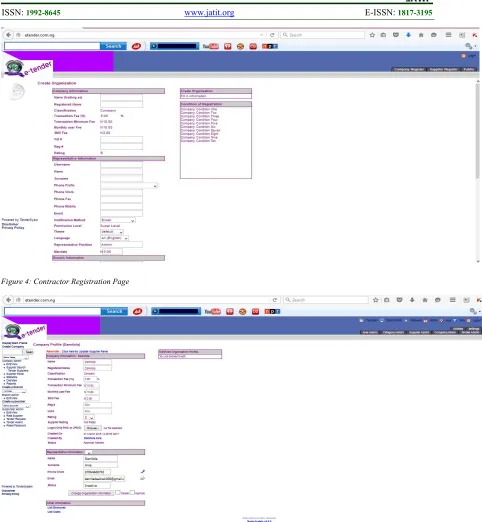
Previous studies have concentrated on the development and usage of web-based tendering systems in the public sector. This study engendered the development of web-based tendering systems in the private sector. The e-tender platform was designed to be user friendly by providing help tools without a complicated process of operation. The protocol will have a database to store information on tenders and the information of respective users of the platform. Following the typical steps identified by [15] in e-tendering process, this web based tendering system for procurement of construction works is designed. Figure 3 shows a conceptual framework on which the model is based. For this web app system, the registration process will include registering on the website, and once contractor registration is approved, an e-password/ login details would be sent to the contractor’s email address to access the contractors’ portal. In order to submit a quotation, the interested contractor will have to pay a required fee to the designated bank account and obtain the e-pin card which the institution will make available to the banks of their choice.
To familiarize oneself with the process of downloading documents which comes with an eligibility criteria, and help grasp the use of the e-Lodgement to submit an electronic response to tenders, visitors can access the provided link for ‘frequently asked questions’ which also provides further information regarding the use of the e-tendering web site including:
• Password issues
• Software installation instructions
• Trouble shooting
• Email notifications
• Collection or downloading of tender document
• Electronic Lodging to tender response
The selection approval criteria to be fulfilled include legal capacity, economic &
financial capacity and the technical and
professional capacity as shown in Figure 3.
language, MYSQL is an open-source relational database management system (RDBMS and the ‘SQL’ abbreviation stands for Structured Query Language, Cascading Style Sheets (CSS) is a style sheet language used for describing the presentation of a document written in a markup language. CSS is designed primarily to enable the separation of document content from document presentation, including aspects such as the layout, colors, and fonts while Hyper Text Markup Language, commonly referred to as HTML, is the standard markup language used to create web pages. Web browsers can read HTML files and render them into visible or audible web page and this is why it was used for this project. The contents of the web-based tendering protocol are:
• Details about its browsing and searching
functions
• General tendering related information.
• Registration of contractor/ supplier details
• Tender submission.
• Frequently asked questions portal (FAQ-portal)
• Other Features including: manuals, links, terms
of use, policy documents etc.
The name of the website designed for the purpose of this project is ‘etender.com.ng’. The site once opened takes you directly to the registration interface where the user can create an organization as a contractor or supplier on its top right corner, three links: Supplier register, Company register and Public. Links such as control panel, FAQ (frequently asked questions), help, password, profile and log out are located at the topmost right corner. At any point in time contractors can access the site and register. The registration is subject to approval by the administrators of the site and the login details of contractors can be sent to their emails. The site can be run by several others (administrators) with one supreme admin person or facilitator.
5 CONCLUSION
This study developed a web-based tendering system for procurement of construction works, with specific focus on a tertiary institution which served as the client base for this study. The result revealed that on average, both the client (37.9%) and contractor (51.7%) base, have in one time or the other participated in obtaining or sending tendering documents via the internet. This study showed that there was no significant difference in the e-readiness between client and contractor base on the adoption of e-tendering
systems. This means that ICT facilities available to both parties are significant enough to facilitate participation in an e-tendering process.
In addition, the study research revealed that there was no significant difference in the importance of implementing an e-tendering system in the procurement of construction works. This study is a pointer that construction stakeholders are aware of the benefits accrued to the use of
e-tendering systems in the procurement of
construction works even though there may be challenges to its effective implementation.
Using PHP programming language, a HTML interactive interfaces for creating the web pages, and a MYSQL for the relational database management for storing, retrieval and archiving of registration and contract documents, a web based tendering system for procurement of construction works in a tertiary institution was developed.
The researcher recommended the creation or organization of seminars, workshops and the likes to bring about better awareness of the possibility of using e-tendering platforms in order to increase competitiveness and openness in procurement of construction works. Construction firms and organizations should provide adequate internet facilities for staff to be able search for construction project adverts on e-tendering sites via the internet and get familiar with fast changing world of technology in the construction industry. Also, there is need to create official e-tendering sites for tertiary institutions for the purpose of procurement of construction works to encourage
transparency, accountability and proper
documentation. For further studies, there is need to increase the level of security of e-documents through encryption in order to encourage the use of web based technologies.
ACKNOWLEDGEMENT
Figure 3: Web based tendering requirements
REFRENCES:
[1] Industry Science Resources, “Building for
Growth: An analysis of the Australian Building and Construction Industries”, Canberra, Ausinfo, 1999.
[2] S. Kajewski and A. Weippert, “E-Tendering: Benefits, Challenges And Recommendations
For Practice”, Conference Proceedings:
Clients Driving Innovation, Surfers Paradise, Australia, 2004.
[3] NSW Government, “Information Technology
in Construction - Making IT Happen.
Sydney”, New South Wales (NSW)
Government: Department of Public Works and Services (DPWS), 1998.
[4] S. Kajewski and A. Weippert, “Online
Remote Construction Management: Literature Review”, Brisbane, Australia.,
Queensland University of Technology
(QUT), 2000.
[5] M. E. Ezanee, M. Norlila and S. Norshuhada, “E-Tendering System for Construction
Projects”, Proceedings of International
Conference on E-Commerce, presented at Selangor, Malaysia, 2005, pp. 10-11.
[6] C. Vee and C. M. Skitmore, “Professional
ethics in the construction industry”,
Engineering, Construction and Architectural Management, Vol.10, No. 2, 2003, pp. 117 – 127.
[7] C. Halaris and G. Papavassiliou, “A System
for Virtual Tendering and Bidding”,
Unpublished Thesis, Department of Electrical and Computer Engineering, National Technical University of Athens: Greece, 2000.
[8] P. Black, R. Du and J. G. Nieto, “Security and legal issues in e-tendering”. Retrieved
August 25, 2015 from
http://www.construction-innovation.com, 2005.
[9] O. S. Oyediran and A. A. Akintola, “A survey of the state of the art of e-tendering in
Nigeria”, Journal of Information
Tec-hnology in Construction, Vol. 16, 2011, pp. 557 – 576.
[10] A. A. Adebiyi, C. K. Ayo, O. Akinusi and M. O. Adebiyi, “Design and Implementation of Electronic Government Procurement (e-GP)
System for Nigeria Public Sector”
Proceedings of the International Conference on Software Engineering and Intelligent Systems, Ota, Nigeria, Vol. 1, 2010, pp. 71 – 84.
[11] W. A. Kareem, O. A. Asa and M. O. Lawal, “Due Process Compliance in Capital Projects
Execution in Tertiary Institutions in
Southwest Nigeria”, Developing Country
Studies, Vol. 4, No. 26, 2014, pp. 138 – 146. [12] S. J. Musa, B. E. Success and I. A. Nwaorgu,
“The Public Procurement Reforms in Nigeria: Implementation and Compliance
Challenges”, Journal of Asian Business
Contractor registration as shown in as shown in Figure 4
Web-Based Tendering
Approval by Admin
Download of contract
Payment in designated Bank to obtain e-pin
As shown in Figure 6 As shown in
Figure 5
Re-submission of contract
As shown in Figure 7 & 8 As shown in Figure 8
Retention of all documents
Selection criteria Legal capacity
Strategy, Vol. 4, No. 11, 2014, pp. 149 – 162.
[13] O. Ezekwesili, “E-Tendering: Benefits, Challenges And Recommendations For
Practice”, Welcome Speech at the Public
Procurement workshop, Abuja, Nigeria, 2004.
[14] NSW Government, “Welcome to the
e-Tendering System Help Page”,
https://tenders.nsw.gov.au/commerce/shared /help.cfm?p_page=rulesoftendering&p_page title=Rules%20of%20Tendering, New South Wales (NSW) Government Department of Commerce. 2003, accessed online on 25th August, 2015.
[15] D.Betts, P. Black, S. Christensen, E. Dawson,
R. Du, W. Duncan, E. Foo and J. G. Nieto, “Towards secure and legal e-tendering”,
Journal of Information and Technology in Construction, Vol. 11, 2006, pp. 89-102.
[16] P. Mayer and T. Wescott, “Electronic
tendering: Is it delivering? A U.K. and European perspective”, Bristol: University of West of England, 2002.
[17] A. Davila, M. Gupta and R. Palmer, “Moving Procurement Systems To The Internet: The Adoption And Use Of E-Procurement
Technology Models”, European
Management, Vol. 21, No. 1, 2004, pp. 11-23.
[18] S. A. I. Mahmood, “Public procurement system and e-Government implementation in
Bangladesh: The role of public
administration”, Journal of Public
Administration and Policy Research, Vol. 5, No. 5, 2013, pp. 117 – 123.
[19] E. W. Lou and M. Alshawi, “Critical success factors for e-tendering implementation in construction collaborative environments:
people and process issues”, Journal of
Information Technology in Construction, Vol. 14, No. 1, 2009, pp. 98-109.
[20] Y. Rezgui, I. E. Wilson, L. Damodaran, W. Olphert and M. Shilboum, “ICT adoption in the construction sector: Education and training issues”, Retrieved August 23, 2015.
http://e-pub.uni-weimar.de/volltexte/. 2004. [21] G. J. Brewer, T. Gajendran and S. E. Chen,
“The use of ICT in the construction industry: Critical success factors and strategic
relationships in temporary project organizations”. Retrieved on August 23, 2015 from http://itc.scix.net/data/, 2005. [22] V. Pasupathinathan and J. Pieprzyk, “A fair
e-tendering Protocol”, Retrieved August 23,
2015 from
http://www.vkrishnan.com/Research/publicat ions_assets/2008SECRYPT.pdf, 2008. [23] A. A. Oladapo, “An Investigation into the
Use of ICT in the Nigerian construction
industry”, Journal of Information
Technology in Construction, Vol. 12, 2007, pp. 261-277.
[24] O. S. Oyediran, “Awareness and adoption of information and communication technology (ICT) by Architectural, Engineering and Construction (AEC) industry educators in
Nigeria”, Construction Informatics Digital
Library. Retrieved August 23, 2015 from http://itc.scix.net/data/, 2005.
[25] C. Shapiro and H. R. Varian, “Information Rules”, MA: Hazard Business School Press: Boston, 1999
[26] M. Sohail and S. Cavill, “Accountability to prevent corruption in construction projects”,
Journal of Construction Engineering and Management, Vol. 134, No. 9, 2008, pp. 729-738.
[27] A. Aman and H. Kasimin, “E-procurement
implementation: a case of Malaysia
government”, Transforming Government:
People, Process and Policy, Vol. 5, No. 4, 2011, pp. 330-44.
Figure 4: Contractor Registration Page
[image:11.612.88.563.367.748.2]
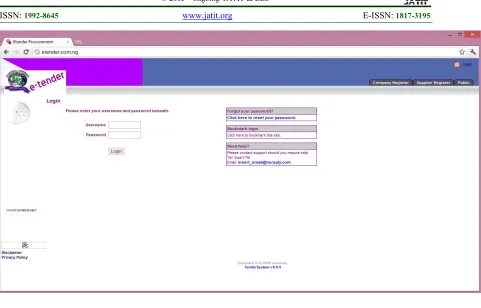
Figure 6: Login Page for downloading and re-submission of contract documents
![Figure 1: Web-based Tendering Cycle Adapted from [15]](https://thumb-us.123doks.com/thumbv2/123dok_us/8907098.957332/2.612.357.481.463.572/figure-web-based-tendering-cycle-adapted.webp)